Showing posts with label Cape Ann. Show all posts

Sunday, September 30, 2018

Steel-blue in the shade, but, seen against the sun, it is a rich purple.

September 30. 

September 30, 2018


A large flock of grackles amid the willows by the riverside, or chiefly concealed low in the button bushes beneath them, though quite near me. There they keep up their spluttering notes, though somewhat less loud, methinks, than in spring. These are the first I have seen, and now for some time, I think, the red wings have been gone. These are the first arrivers from the north where they breed. 

I observe the peculiar steel-bluish purple of the nightshade, i. e. the tips of the twigs, while all beneath is green, dotted with bright berries, over the water. Perhaps this is the most singular color of any autumnal tint. It is almost black in some lights, distinctly steel-blue in the shade and contrasting with the green beneath, but, seen against the sun, it is a rich purple, its veins full of fire. The form of the leaf, too, is peculiar. 

The pearly everlasting is an interesting white at present. Though the stem and leaves are still green, it is dry and unwithering like an artificial flower. Its white flexuous cotton. Its amaranthine quality is instead of high color. Neither is there any scent to betray it. Its very brown centre now afiects us as a fresh and original color. It monopolizes a small circle, in the midst of sweet-fem perchance, on a dry hillside. 

I see undoubtedly the little dipper by the edge of the pads this afternoon, and I think I have not seen it before this season. It is much smaller than I have seen this season, and is hard to detect even within four or five rods. It warily dives and comes up a rod or two further off amid the pads, scarcely disturbing the surface. 

The wind is northerly these afternoons, blowing pretty strong early in the afternoon, so that I can sail up the stream; but later it goes down, leaving the river glassy smooth, and only a leaping fish or an insect dimples it or makes a sparkle on it. 

Some young black cherry leaves are completely changed some time to their deep cherry-red. Also they are rather dull, but beneath quite lively, like the juice of a freshly crushed cherry. 

In our late walk on the Cape, we entered Gloucester each time in the dark at mid-evening, travelling partly across lots till we fell into a road, and as we were simply seeking a bed, inquiring the way of villagers whom we could not see, the town seemed far more homelike to us than when we made our way out of it in the morning. It was comparatively still, and the inhabitants were sensibly or poetically employed, too, and then we went straight to our chamber and saw the moonlight reflected from the smooth harbor and lighting up the fishing vessels, as if it had been the harbor of Venice. 

By day we went remarking on the peculiar angles of the bevelled roofs, of which there is a remarkable variety there. There are also many large, square, three-story houses with short windows in the upper story, as if the third story were as good as a gig for respectability. 

When entering the town in the moonlight we could not always tell whether the road skirted the back yards or the front yards of the houses, and the houses did not so impertinently stare after the traveller and watch his coming as by day. 

Walking early in the day and approaching the rocky shore from the north, the shadows of the cliffs were very distinct and grateful and our spirits were buoyant. Though we walked all day, it seemed the days were not long enough to get tired in. Some villages we went through or by without communicating with any inhabitant, but saw them as quietly and distantly as in a picture.

H. D. Thoreau,  Journal, September 30, 1858

A large flock of grackles amid the willows by the riverside keep up their spluttering notes, See October 14, 1857 ("I see a large flock of grackles, probably young birds, quite near me on William Wheeler's apple trees, pruning themselves and trying to sing. They never succeed; make a sort of musical spluttering.”)

I observe the peculiar steel-bluish purple of the nightshade . . . against the sun, it is a rich purple, its veins full of fire. See September 26, 1859 ("The peduncle and its branches are green, the pedicels and sepals only that rare steel-blue purple, and the berries a clear translucent cherry red."); October 4, 1857 (“Some nightshade leaves are a very dark purple.”)

The pearly everlasting is an interesting white at present. It monopolizes a small circle, in the midst of sweet-fem perchance, on a dry hillside
. See August 23, 1858 (“I see dense patches of the pearly everlasting, maintaining their ground in the midst of dense green sweet-fern, a striking contrast of snow-white and green.”)


From the smooth harbor
reflected  moonlight lights up
the fishing vessels.

Steel-bluish purple
nightshade seen against the sun –
its veins full of fire.

Though we walk all day
it seems the days are not long
enough to get tired.

Monday, September 24, 2018

At the East India Marine Hall

September 24. 

What that singular spiny plant, otherwise like chenopodium, which I found on a wharf in Salem?

Saw at the East India Marine Hall a bay lynx killed in Danvers July 21st (I think in 1827); another killed in Lynnfield in March, 1832. These skins were, now at any rate, quite light dirty-whitish or white wolfish color, with small pale-brown spots. The animals much larger than I expected. 

Saw a large fossil turtle, some twenty inches in diameter, with the plates distinct, in a slate colored stone from western New York; also a sword in its scabbard, found in the road near Concord April 19, 1775, and supposed to have belonged to a British officer. 

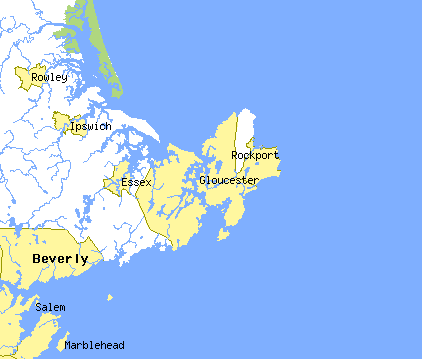
Cape Ann, from Beverly round to Squam, is bristling with little capes, projecting from the main one and similar to it.

H. D. Thoreau, Journal, September 24, 1858

Saw at the East India Marine Hall a bay lynx killed in Danvers. See September 13, 1860 ("Five [lynx] I have heard of (and seen three) killed within some fifteen or eighteen miles of Concord within thirty years past.");  September 29, 1856 ("Dr. Reynolds told me the other day of a Canada lynx (?) killed in Andover,. . . thought to be one of a pair, the other being killed or seen in Derry.")  and note to February 15, 1858 (' Saw, at a menagerie, a Canada lynx, said to have been taken at the White Mountains.")

Sunday, September 23, 2018

Cape Ann and the comet


September 23

September 23, 2018
Another fair day and wind northwest, but rather warmer. 

We kept along the road to Rockport, some two miles or more, to a “thundering big ledge” by the road, as a man called it; then turned off toward the south shore, at a house with two very large and old pear trees before it. Part of the house was built by a Witham, one of the first settlers, and the place or neighborhood used to be called “the Farms.” Saw the F. hyemalis flitting along the walls, and it was cool enough for them on this cape. 

In a marsh by the shore, where was a very broad curving sandy beach, the shore of a cove, found the Ranunculus Cymbalaria, still in bloom, but mostly in fruit. Glaux maritima (?), nearly prostrate, with oblong leaves. Triglochin palustris in fruit. An eleocharis, apparently marine, with lenticular fruit and a wrinkled mitre-shaped beak. Spergularia rubra, etc., samphire, etc. 

The narrow road — where we followed it — wound about big boulders, past small, often bevel-roofed cottages where sometimes was a small flag flying for a vane. The number and variety of bevelled roofs on the Cape is surprising. Some are so nearly flat that they reminded me of the low brows of monkeys. 

We had already seen a sort of bare rocky ridge, a bare boulder-covered back of the Cape, running northeasterly from Gloucester toward Rockport and for some three miles quite bare, the eastern extremity of the Cape being wooded. That would be a good place to walk. 

In this marsh, saw what I thought the solitary tattler, quite tame. 

Having reached the shore, we sat under the lee of the rocks on the beach, opposite Salt Island. A man was carting seaweed along the shore between us and the water, the leather-apron kind, which trailed from his cart like the tails of oxen, and, when it came between us and the sun, was of a warm purple-brown glow. 

Half a mile further, beyond a rocky head, we came to another curving sandy beach, with a marsh between it and the Cape on the north. Saw there, in the soft sand, with beach-grass, apparently Juncus Balticus (?), very like but not so stout (!) as Juncus effusus. 

Met a gunner from Lynn on the beach, who had several pigeons which he had killed in the woods by the shore. Said that they had been blown off the mainland. Second, also a kingfisher. Third, what he called the “ox eye,” about size of peetweet but with a short bill and a blackish-brown crescent on breast, and wing above like peetweet’s, but no broad white mark below. Could it be Charadrius semipalmatus? Fourth, what he called a sandpiper, very white with a long bill. Was this Tringa arenaria? Fifth, what I took to be a solitary tattler, but possibly it was the pectoral sandpiper, which I have seen since. 

On the edge of the beach you see small dunes, with white or fawn-colored sandy sides, crowned with now  yellowish smilax and with bayberry bushes. Just before reaching Loblolly Cove, near Thatcher’s Island, sat on a beach composed entirely of small paving-stones lying very loose and deep. 

We boiled our tea for dinner on the mainland opposite Straitsmouth Island, just this side the middle of Rockport, under the lee of a boulder, using, as usual, dead bay berry bushes for fuel. This was, indeed, all we could get. They make a very quick fire, and I noticed that their smoke covered our dippers with a kind of japan which did not crock or come off nearly so much as ordinary soot. 

We could see the Salvages very plainly, apparently ex tending north and south, the Main Rock some fifteen or twenty rods long and east-northeast of Straitsmouth Island, apparently one and a half or two miles distant, with half-sunken ledges north and south of it, over which the sea was breaking in white foam. The ledges all together half a mile long. 

We could see from our dining-place Agamenticus, some forty miles distant in the north. Its two sides loomed so that about a third of the whole was lifted up, while a small elevation close to it on the east, which afterward was seen to be a part of it, was wholly lifted up. 

Rockport well deserves its name, — several little rocky harbors protected by a breakwater, the houses at Rockport Village backing directly on the beach. 

At Folly Cove, a wild rocky point running north, covered with beach—grass. See now a mountain on the east of Agamenticus. Isles of Shoals too low to be seen. Probably land at Boar’s Head, seen on the west of Agamenticus, and then the coast all the way from New Hampshire to Cape Ann plainly, Newburyport included and Plum Island. Hog Island looks like a high hill on the mainland. 

It is evident that a discoverer, having got as far west as Agamenticus, off the coast of Maine, would in clear weather discern the coast trending southerly beyond him as far round as Cape Ann, and if he did not wish to be embayed would stand across to Cape Ann, where the Salvages would be the outmost point. 

At Annisquam we found ourselves in the midst of boulders scattered over bare hills and fields, such as we had seen on the ridge northerly in the morning, i. e., they abound chiefly in the central and northwesterly part of the Cape. This was the most peculiar scenery of the Cape. 

We struck inland southerly, just before sundown, and boiled our tea with bayberry bushes by a swamp on the hills, in the midst of these great boulders, about half way to Gloucester, having carried our water a quarter of a mile, from a swamp, spilling a part in threading swamps and getting over rough places. 

Two oxen feeding in the swamp came up to reconnoitre our fire. We could see no house, but hills strewn with boulders, as if they had rained down, on every side, we sitting under a shelving one. When the moon rose, what had appeared like immense boulders half a mile off in the horizon now looked by contrast no larger than nutshells or buri-nut against the moon’s disk, and she was the biggest boulder of all. 

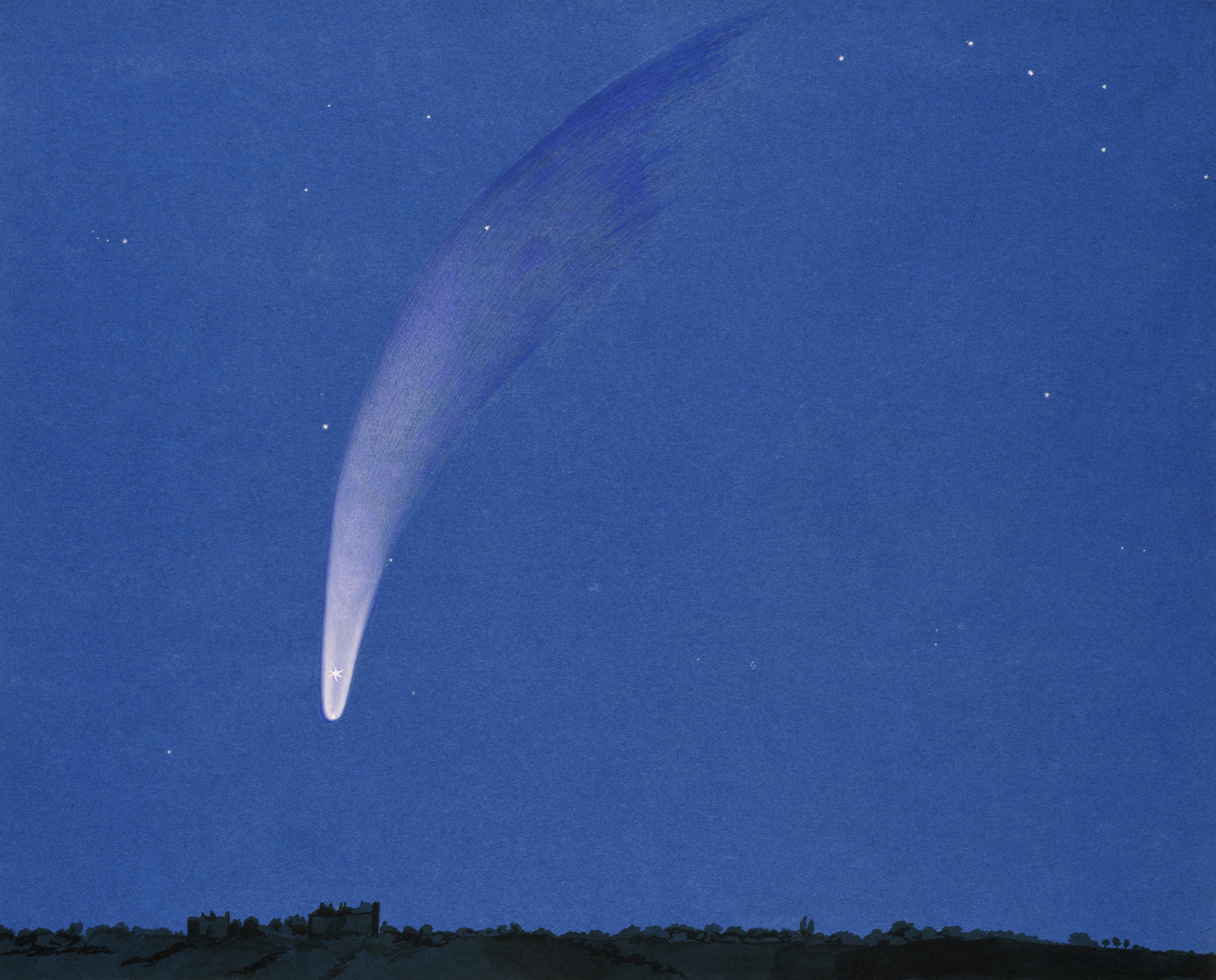
When we had put out our bayberry fire, we heard a squawk, and, looking up, saw five geese fly low in the twilight over our heads. We then set out to find our way to Gloucester over the hills, and saw the comet very bright in the northwest. 


Donati’s Comet 1858

After going astray a little in the moonlight, we fell into a road which at length conducted us to the town.

As we bought our lodging and breakfast, a pound of good ship-bread, which cost seven cents, and six herring, which cost three cents, with sugar and tea, supplied us amply the rest of the two days. The selection of suitable spots to get our dinner or supper led us into interesting scenery, and it was amusing to watch the boiling of our water for tea. There is a scarcity of fresh water on the Cape, so that you must carry your water a good way in a dipper.

H. D. Thoreau, Journal, September 23, 1858

Saturday, September 22, 2018

From Salem to Cape Ann on foot.


A clear cold day, wind northwest. 


Cape Ann
Leave Salem for the Cape on foot. Near Beverly Bridge, crossed over that low and flat part of Salem where the first settlement was made and Arabella Stewart is supposed to have been buried. 

Soon struck off to the shore in Beverly. See the discolor thistle on a sandy beach, and Phaseolus diversifolius (three-lobed bean vine), with pretty terete long pods, some ripe, but a few flowers still. Aster linifolius, perhaps still in prime, — though it has a flexuous stem, — in a marsh, and lyme-grass, apparently like ours, along edge of marsh. 

Dined on the edge of a high rocky clifl', quite perpendicular, on the west side of entrance of Manchester Harbor. 

One mile southeast of the village of Manchester, struck the beach of “musical sand,” just this side of a large, high, rocky point called Eagle Head. This is a curving sandy beach, maybe a third of a mile long by some twelVe rods wide. (We also found it on a similar but shorter beach on the east side of Eagle Head.) 

We first perceived the sound when we scratched with our umbrella or finger swiftly and forcibly through the sand; also still louder when we struck forcibly with our heels “scuffing” along. The wet or damp sand yielded no peculiar sound, nor did that which lay loose and deep next the bank, but only the more compact and dry. 

The sound was not at all musical, nor was it loud. Fishermen might walk over it all their lives, as indeed they have done, without noticing it. R., who had not heard it, was about right when he said it was like that made by rubbing on wet glass with your fingers. I thought it as much like the sound made in waxing a table as anything. It was a squeaking sound, as of one particle rubbing on another. I should say it was merely the result of the friction of peculiarly formed and constituted particles. 

The surf was high and made a great noise, yet I could hear the sound made by my companion’s heels two or three rods distant, and if it had been still, probably could have heard it five or six rods. 

We kept thence along the rocky shore to Kettle Cove, where, however, I did not find any rocks like Lewis’s.

Somewhere thereabouts Scirpus maritimus, with its great spikes now withered. In the marsh at Kettle Cove, Gerardia maritima, apparently in prime, four or five inches high; Euphorbia polygonifolia, six inches in diameter. Spartina glabra in the salt water of the cove.

The shore, thus far, from Beverly Bridge had been a succession of bold rocky points half a mile apart, with sometimes curving sandy beaches between, or else rocks. 

We now kept the road to Gloucester, leaving the shore a mile or more to the right, wishing to see the magnolia swamp. This was perhaps about a mile and a half beyond Kettle Cove. After passing over a sort of height of land in the woods, we took a path to the left, which within a few rods became a corduroy road in the swamp. Within three or four rods on the west side of this, and perhaps ten or fifteen from the highroad, was the magnolia. 

It was two to seven or eight feet high, but distinguished by its large and still fresh green leaves, which had not begun to fall. I saw last year's shoots which had died down several feet, and probably this will be the fate of most which has grown this year. 

The swamp was an ordinary one, not so wet but we got about very well. The bushes of this swamp were not generally more than six feet high. There was another locality the other side of the road. 

Cooked our supper in a salt marsh some two miles this side of Gloucester, in view of the town. We had cooked our tea for dinner with dead bayberry bushes; now we used the chips and bark which the tide had deposited in little parcels on the marsh, having carried water in our dippers from a brook, a quarter of a mile. 

There was a large patch of samphire turned a bright crimson, very conspicuous, near by on the flat marsh, the more conspicuous because large and in the midst of the liquid green of the marsh. 

We sat on some stones which we obtained flat in the marsh till starlight. 

I had seen in this day’s walk an abundance of Aster cordifolius (but no A. undulatus); also saw A. corymbosus, which is a handsome white wood aster; and, very common, what I called A. longifolius, with shorter thick, clasping leaves and growing in drier ground than ours, methinks; also, all along the road, the up-country hard, small, mulberry-shaped high blackberry, and many still holding on. This may be due to the cool air of the Cape. They were quite sweet and good. Vide a specimen. 

The foliage had but just fairly begun to change. Put up in Gloucester.

H. D. Thoreau, Journal, September 22, 1858

September 22, 2018

Friday, September 21, 2018

Botanizing Marblehead and Salem

September 21. 
September 21, 2019
Go to Cape Ann. 

A very warm day. A. M.—Go with Russell to the rooms of the Essex Institute, — if that is the name. 

See some Indian pottery from the Cayuga Reservation, fragments, very pale brick-color three eighths of an inch thick, with a rude ornament (apparently made with the end of a stick) of this form and size: - the lines re presenting slight hollows in a row around it. Saw a stone, apparently slate, shaped like small “sinkers,” but six inches by three and a half with a small handle, found near here. Was it a sinker or pestle? 

(On the 24th, at the East India Marine Hall, saw a circular stone mortar about six inches in diameter, and a stone exactly like the above in it, described as pestle and mortar found in making Salem Turnpike. Were they together? Also, at the last place, what was called the blade of an Indian knife found on Governor Endicott’s farm, broken, three or four inches long, of a light colored kind of slate, quite thin, with a back. It might have been for skinning.) 

At the Essex Institute (?),—if that ’s the name, — the eggs of the Rallus Virginianus, labelled by Brewer, but much smaller than those I have seen, and nearly white, with dull-brown spots! Can mine be the egg of the R. crepitons, though larger than mine? 

Their eggs of the Sterna hirundo look like mine which I have so called; also do those of the black-headed gull, which do not perceive in Peabody. 

Looked over the asters. goldenrods, and willows in their herbarium, collected and named by Oakes, Lapham, Russell, and Cassi —— something. Oakes’s Salix sericea, also Marshall’s, and what O. calls grisea of Willdenow, is the same I so call,, by the white maple at Assabet. What O. calls S. phyllicifolia from White Mountains, having only sterile catkins, ——his specimen, ——is apparently the one I have from there together with the repent. 

P. M. — Walked with Russell to Marblehead above railroad. 

Saw, in Salem, Solidago Canadensis, considerably past prime; our three-ribbed one done; Spartina cynosuroides; (was that the S. juncea, seven feet high, with a broad leaf, which I mistook for the above? Very common on edge of marshes); apparently Scirpus pungens, two to four feet high; Polygonum aviculare, appearently peculiar; swamp thistle, still abundant; Trifolium procumbens, still abundant; Aster Nova-Anglia, dark violet or lilac-purple, in prime or a little past, three quarters of a mile down railroad; also by shore in Manchester, the 22d; Ruppia maritima, in a ditch. 

In Marblehead, Aster cordifolius, abundant, railroad; Woodsia Ivensis. R. pointed out Juncus bufonius (? ?) (but did not know it); it was tenuis-like and probably that. Juncus Green (?) (tenuis-like), dense-flowered, on high sea-bank, sea side of Marblehead. Herb robert, near shore, done. Datura Stramonium var. Tatula, done there, but out at Rockport; got seeds. Also various lichens. Got Parmelia parietina, elegans, and rubina on the rocks. Saw, but did not get, P. murorum. Cetraria Islandica. 

R. said that that I saw at the White Mountains was bitter. Endocarpon miniatum (which we have) on rocks. Peltigera polydactyla. Umbilicaria Muhlenbergii, rocks by sea. That common crustaceous lichen on rdcks, —black fruit prettily scattered on a white ground, —— which reminds me of maps, is Lecidea atroalba. 

R. thought that my small umbilicaria on Monadnock and Lafayette was Uerosa or hyperborea. He knew a Carex lupulina because the beaks were recurved.

Called Marblehead coast greenstone generally with dykes in sienite. Saw artichokes out in several places, at some time. Have a sort of Spouting Horn by shore. Returned by some very deep hollows in Salem (like the Truro ones) called the Dungeons ! ! as our Dunge Hole. 

R. gave me from his garden corns of the true [?] squirrel-corn corydalis, which I plant, and what Tracy gave him for Utricularia intermedia from —-—, not in flower, though he says that T. has examined the flowers. It looks like mine. 

What I have called the clustered blackberry he has raised from the seed he got here, and this second year (or third) it has run as long as the common, but, perhaps because in rich soil and the shade, no flowers or fruit. 

Saw no Aster Tradescanti in this walk, but an abundance of A. multiflorus in its prime, in Salem and Marblehead.

H. D. Thoreau, Journal , September 21, 1858

Popular Posts Last 30 Days.

The week ahead in Henry’s journal

The week ahead in Henry’s journal
A journal, a book that shall contain a record of all your joy.
"A stone fruit. Each one yields me a thought." ~ H. D. Thoreau, March 28, 1859


I sit on this rock
wrestling with the melody
that possesses me.