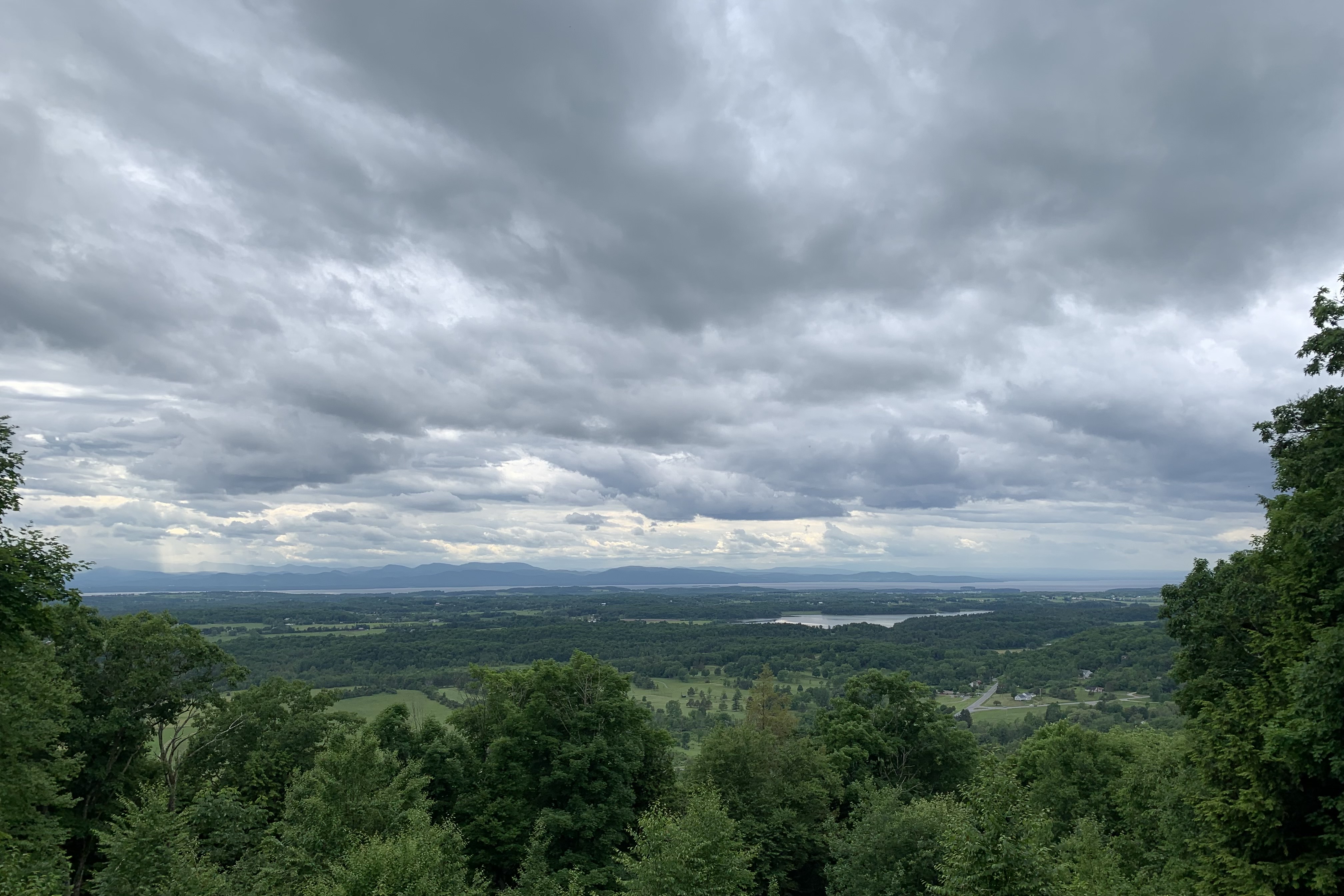
Showing posts with label Vermont. Show all posts

Thursday, October 2, 2025

Still More Poems that Strike me


July Mountain

We live in a constellation
Of patches and of pitches,
Not in a single world,

In things said well in music,
On the piano, and in speech,
As in a page of poetry –

Thinkers without final thoughts
In an always incipient cosmos,

The way, when we climb a mountain,
Vermont throws itself together.

~ Wallace Stevens


Aura


All day the mountain

flared in blue

September air.


The valley lay stunned 

by color.

autumn's maple-brightness.


Now twilight comes;

not dark but a moments 

clarity, so that brute


wonder drains

from my eyes, relieved 

by the evening star,


there, calm, over 

the horizon, a lucidity.

lucency. That light, far


lavender, restores

distance 

and measure,


and inside my skull I rise

tall and free again.

Then


the mountain, free too

in its subduing,

intercedes, a new presence now,


a sense given beyond 

color, around and surrounding-

Is it shadow, is it


a blue myth coming to be?

Ah, wonder gone, how 

lovely this welcoming! I see,


see the new dimension, form 

wavering into essence 

and shimmering-oh!


so slightly!-back to 

new form, while

the mountain looks at me.


~ Hayden Carruth


Zazen on Ching-t’ing Mountain

The birds have vanished down the sky.
Now the last cloud drains away.

We sit together, the mountain and me,
until only the mountain remains.

Li Po/ Li Bai (Hamill, translator) See also A Book of the Seasons, by Henry Thoreau,  Going out in stormy weather

Cold Mountain

I am sometimes asked the way to the Cold Mountain;
There is no path that goes all the way.

Even in summer the ice never melts;
Far into the morning the mists gather thick.

How, you may ask, did I manage to get here?
My heart is not like your heart.

If only your heart were like mine
You too would be living where I live now.

Han-shan
Translated by Arthur Waley

Dream in the Summer of my Seventy-third Year 

I am behind a funeral cortege on a mountain road 
And decide to pass it, but it seems to go on forever 
And I'm completely exposed in the oncoming lane 
And the only way out is to merge into the caravan 
Of mourners. It is getting dark and a thick snow 
Begins to fall in a sudden flurry and then stops 
Abruptly, which gives the world an expectant air, 
Though, really, nothing in particular happens 
After a snowfall, except for the intense stillness 
In the pine forest the road is winding through.

Robert Haas

[Traveler, your footprints]

Traveler, your footprints 
are the only road, nothing else.
Traveler, there is no road;
you make your own path as you walk.
As you walk, you make your own road,
and when you look back
you see the path 
you will never travel again.
Traveler, there is no road;
only a ship's wake on the sea.

-Antonio Machado

To See It

We need to separate
to see the life we’ve made,
to leave our house
where someone waits, patiently,
warm beneath the sheets;
to don layers of armor,
sweater, coat, mittens, scarf,
to stride down the frozen road,
putting distance between us,
this cold winter morning,

to look back and see,
on the hilltop, our life,
lit from inside.
~ Laura Foley

Let my snow-tracks lead 

on, on. Let them, where they stop, 

stop. There, in mid-field.


~ Hayden Carruth


Kono michi ya / yuku hito nashi ni / aki no kure


this road
with no traveler
autumn evening

~ Basho

“The truth is, of course, that there is no journey.
We are arriving and departing all at the same time.”
― David Bowie


Tuesday, June 8, 2021

The different colors of the various parts of this bark, at various times.


June 8.

Sunday. 

June 8, 2024

In F. A. Michaux's, i. e. the younger Michaux's “Voyage à l'ouest des Monts Alléghanys, 1802,” printed at Paris, 1808: 

. . . A Vermonter told him that the expense of clearing land in his State was always defrayed by the potash obtained from the ashes of the trees which were burnt, and sometimes people took land to clear on condition that they should have what potash they could make. 
June 8, 2017

***
Gathered the first strawberries to-day. 

Observed on Fair Haven a tall pitch pine, such as some call yellow pine, very smooth, yellowish, and destitute of branches to a great height. The outer and darker-colored bark appeared to have scaled off, leaving a fresh and smooth surface. At the ground, all round the tree, I saw what appeared to be the edges of the old surface scales, extending to two inches more in thickness. The bark was divided into large, smooth plates, one to two feet long and four to six inches wide.

I noticed that the cellular portion of the bark of the canoe birch log from which I stripped the epidermis a week or two ago was turned a complete brick-red color very striking to behold and reminding me of the red man and all strong, natural things, — the color of our blood somewhat. Under the epidermis it was still a sort of buff. The different colors of the various parts of this bark, at various times, fresh or stale, are extremely agreeable to my eye.

I found the white-pine-top full of staminate blossom buds not yet fully grown or expanded, with a rich red tint like a tree full of fruit, but I could find no pistillate blossom. 

The fugacious-petalled cistus, and the pink, and the lupines of various tints are seen together.

***

H. D. Thoreau, Journal, June 8, 1851


The different colors of the various parts of this bark, at various times, fresh or stale, are extremely agreeable to my eye.
See  May 18, 1851 ("The log of a canoe birch on Fair Haven, cut down the last winter . . . all parts of the epidermis exposed to the air and light were white, but the inner surfaces freshly exposed, were a buff or salmon-color."); January 24, 1858 ("The sprouts of the canoe birch are not reddish like the white, but a yellowish brown.); January 9, 1860 ("There is an interesting variety in the colors of their bark, passing from bronze at the earth, through ruddy and copper colors to white higher up, with shreds of different color from that beneath peeling off.")

I found the white-pine-top full of staminate blossom buds not yet fully grown or expanded, with a rich red tint like a tree full of fruit, but I could find no pistillate blossom. See June 21, 1860 ("In the white pine it is a dense cluster of twenty or thirty little flowers about the base of this year's shoot."); June 25, 1852 ("I am too late for the white pine flowers. The cones are half an inch long and greenish, and the male flowers effete."); July 1, 1852 ("The path by the wood-side is red with the effete staminiferous flowers of the white pine. ") See also A Book of Seasons,  by Henry Thoreau, The White Pines


June 8. See A Book of the Seasons, by Henry Thoreau, June 8

This white-pine-top full
of staminate blossom buds
with a rich red tint .

A Book of the Seasons,  by Henry Thoreau
"A book, each page written in its own season,
out-of-doors, in its own locality."
 ~edited, assembled and rewritten by zphx ©  2009-2021

Wednesday, November 13, 2019

What avails you now the fire you stole from heaven?

November 13

To Fair Haven Hill. 

A cold and dark afternoon, the sun being behind clouds in the west. The landscape is barren of objects, the trees being leafless, and so little light in the sky for variety. 

Such a day as will almost oblige a man to eat his own heart. A day in which you must hold on to life by your teeth. You can hardly ruck up any skin on Nature's bones. 

The sap is down; she won't peel. Now is the time to cut timber for yokes and ox-bows, leaving the tough bark on, — yokes for your own neck.  

Finding yourself yoked to Matter and to Time. Truly a hard day, hard times these! 

Not a mosquito left. Not an insect to hum. Crickets gone into winter quarters. 

Friends long since gone there, and you left to walk on frozen ground, with your hands in your pockets. 
Ah, but is not this a glorious time for your deep inward fires? 

And will not your green hickory and white oak burn clear in this frosty air? 


Now is not your manhood taxed by the great Assessor? Taxed for having a soul, a ratable soul.

A day when you cannot pluck a flower, cannot dig a parsnip, nor pull a turnip, for the frozen ground! 

What do the thoughts find to live on? What avails you now the fire you stole from heaven? Does not each thought become a vulture to gnaw your vitals? 

No Indian summer have we had this November. I see but few traces of the perennial spring. 

Now is there nothing, not even the cold beauty of ice crystals and snowy architecture, nothing but the echo of your steps over the frozen ground, no voice of birds nor frogs. You are dry as a farrow cow. The earth will not admit a spade.  All fields lie fallow. Shall not your mind? 
True, the freezing ground is being prepared for immeasurable snows, but there are brave thoughts within you that shall remain to rustle the winter through like white oak leaves upon your boughs, or like scrub oaks that remind the traveller of a fire upon the hillsides; or evergreen thoughts, cold even in midsummer, by their nature shall contrast the more fairly with the snow. 

Some warm springs shall still tinkle and fume, and send their column of vapor to the skies.
The walker now fares like cows in the pastures, where is no grass but hay; he gets nothing but an appetite. If we must return to hay, pray let us have that which has been stored in barns, which has not lost its sweetness.  
The poet needs to have more stomachs than the cow, for for him no fodder is stored in barns. He relies upon his instinct, which teaches him to paw away the snow to come at the withered grass.
Methinks man came very near being made a dormant creature, just as some of these animals. The ground squirrel, for instance, which lays up vast stores, is yet found to be half dormant, if you dig him out. 
Now for the oily nuts of thought which you have stored up. 


The mountains are of an uncommonly dark blue to-day. Perhaps this is owing, not only to the greater clearness of the atmosphere, which brings them nearer, but to the absence of the leaves! They are many miles nearer for it. A little mistiness occasioned by warmth would set them further off and make them fainter. 

I see snow on the Peterboro hills, reflecting the sun. It is pleasant thus to look from afar into winter. We look at a condition which we have not reached. Notwithstanding the poverty of the immediate landscape, in the horizon it is simplicity and grandeur. 

I look into valleys white with snow and now lit up by the sun, while all this country is in shade. This accounts for the cold northwest wind. 

There is a great gap in the mountain range just south of the two Peterboro hills. Methinks I have been through it, and that a road runs there. At any rate, humble as these mountains are compared with some, yet at this distance I am convinced that they answer the purpose of Andes; and, seen in the horizon, I know of nothing more grand and stupendous than this great mountain gate or pass, a great cleft or sinus in the blue banks, as in a dark evening cloud, fit portal to lead from one country, from one quarter of the earth, to another, where the children of the Israelites may file through. 

Little does the New Hampshire farmer who drives over that road realize through what a sublime gap he is passing. You would almost as soon think of a road to wind through and over a dark evening cloud. This prospect of the mountains from our low hills is what I would rather have than pastures on the mountain sides such as my neighbors own, aye, than townships at their base. 

Instead that I drive my cattle up in May, I turn my eyes that way. My eyes pasture there, and straightway the yearling thoughts come back. The grass they feed on never withers, for though they are not evergreen, they're ever blue to me. For though not evergreen to you, to me they're ever blue.
I do not fear my thoughts will die, 
For never yet it was so dry 
as to scorch the azure of the sky. 
It knows no withering and no drought, 
Though all eyes crop, it ne'er gives out. 
My eyes my flocks are; 
Mountains my crops are. 
I do not fear my flocks will stray, 
For they were made to roam the day, 
For they can wander with the latest light, 
Yet be at home at night. 

Just spent a couple of hours (eight to ten) with Miss Mary Emerson at Holbrook's. 
The wittiest and most vivacious woman that I know, certainly that woman among my acquaintance whom it is most profitable to meet, the least frivolous, who will most surely provoke to good conversation and the expression of what is in you. She is singular, among women at least, in being really and perseveringly interested to know what thinkers think. 
She relates herself surely to the intellectual where she goes. It is perhaps her greatest praise and peculiarity that she, more surely than any other woman, gives her companion occasion to utter his best thought. In spite of her own biases, she can entertain a large thought with hospitality, and is not prevented by any intellectuality in it, as women commonly are. 

In short, she is a genius, as woman seldom is, reminding you less often of her sex than any woman whom I know. In that sense she is capable of a masculine appreciation of poetry and philosophy. I never talked with any other woman who I thought accompanied me so far in describing a poetic experience. 

Miss Fuller is the only woman I think of in this connection, and of her rather from her fame than from any knowledge of her. 

Miss Emerson expressed to-night a singular want of respect for her own sex, saying that they were frivolous almost without exception, that woman was the weaker vessel, etc.; that into what ever family she might go, she depended more upon the "clown " for society than upon the lady of the house. Men are more likely to have opinions of their own. 
The cattle-train came down last night from Vermont with snow nearly a foot thick upon it. It is as if, in the fall of the year, a swift traveller should come out of the north with snow upon his coat. So it snows. Such, some years, may be our first snow. 

Just in proportion to the outward poverty is the inward wealth.  In cold weather fire burns with a clearer flame.

H. D. Thoreau, Journal, November 13, 1851

The landscape is barren of objects, the trees being leafless, and so little light in the sky for variety. Such a day as will almost oblige a man to eat his own heart . . . In cold weather fire burns with a clearer flame. See November 27, 1853 ("Now a man will eat his heart, if ever, now while the earth is bare, barren and cheerless, and we have the coldness of winter without the variety of ice and snow; but methinks the variety and compensation are in the stars now.")

Finding yourself yoked to Matter and to Time.
See September 7, 1851 ("I do not so much wish to know how to economize time as how to spend it"); February 5, 1852 ("Time never passes so rapidly and unaccountably as when I am engaged in recording my thoughts. The world may perchance reach its end for us in a profounder thought, and Time itself run down."); September 24, 1859 ("Great works of art have endless leisure for a background, as the universe has space. Time stands still while they are created."); There was an artist in the city of Kouroo ("As he made no compromise with Time, Time kept out of his way"): See also The Maine Woods ("
I stand in awe of my body, this matter to which I am bound has become so strange to me . . . I fear bodies, I tremble to meet them. What is this Titan that has possession of me?")

Not a mosquito left. Not an insect. Crickets gone into winter quarters. See November 13, 1858 ("Of course frozen ground, ice, and snow have now banished the few remaining skaters (if there were any ?), crickets, and water-bugs."); See also November 12, 1851 ("The ground is frozen and echoes to my tread. There are absolutely no crickets to be heard now. They are heard, then, till the ground freezes.")  and A Book of the Seasons, by Henry Thoreau, The Cricket in November

Just spent a couple of hours (eight to ten) with Miss Mary Emerson. Compare November 14. 1851 ("Was introduced to two young women . . .  I derive no pleasure from talking with a young woman half an hour simply because she has regular features. The society of young women is the most unprofitable I have ever tried.")

The mountains are of an uncommonly dark blue to-day. See November 9, 1851 ("To-day the mountains seen from the pasture above are dark blue, so dark that they look like new mountains and make a new impression, and the intervening town of Acton is seen against them in a new relation, a new neighborhood.");  March 31, 1853 ("It is affecting to see a distant mountain-top . . . still as blue and ethereal to your eyes as is your memory of it.") See also A Book of the Seasons, by Henry Thoreau,  Mountains in the Horizon

I see snow on the Peterboro hills, reflecting the sun.
See February 21,1855 ("I look at the Peterboro mountains with my glass from Fair Haven Hill. I think that there can be no more arctic scene than these mountains in the edge of the horizon completely crusted over with snow, with the sun shining on them.")

Instead that I drive my cattle up in May, I turn my eyes that way. My eyes pasture there . . . The grass they feed on never withers. See October 22, 1857 ("But what a perfect crescent of mountains we have in our northwest horizon! Do we ever give thanks for it? . . . My eyes it is alone that wander to those blue pastures, which no drought affects.")

The cattle-train came down last night from Vermont with snow nearly a foot thick upon it. See February 21, 1855 ("I see a train go by . . . from somewhere up country. . . thickly and evenly crusted with unspotted snow . . . It affected me as when a traveller comes into the house with snow on his coat, when I did not know it was snowing.")

Such, some years, may be our first snow.  See November 13, 1858 (“We looked out the window at 9 P. M. and saw the ground for the most part white with the first sugaring, which at first we could hardly tell from a mild moonlight, — only there was no moon.") See also note to November 29, 1856 ("This the first snow.")

November 11. See A Book of the Seasons, by Henry Thoreau,  November 13

Now is there nothing
but the echo of your steps
over frozen ground.

In this cold weather
 your deep inward fires burn
 with a clearer flame.


A Book of the Seasons,  by Henry Thoreau
"A book, each page written in its own season,
out-of-doors, in its own locality.”
~edited, assembled and rewritten by zphx © 2009-2025

https://tinyurl.com/hdt51113

Wednesday, October 16, 2019

A cold, clear, Novemberish day.; The different hues of Vermont gray.

October 16

Sunday. P. M. — Paddle to Puffer's and thence walk to Ledum Swamp and Conant's Wood. 

A cold, clear, Novemberish day. The wind goes down and we do not sail. The button-bushes are just bare, and the black willows partly so, and the mikania all fairly gray now. I see the button-bush balls reflected on each side, and each wool-grass head and recurved withered sedge or rush is also doubled by the reflection. The Scirpus lacustris is generally brown, the Juncus militaris greener. It is rather too cool to sit still in the boat unless in a sunny and sheltered place. 

I have not been on the river for some time, and it is the more novel to me this cool day. 

When I get to Willow Bay I see the new musquash-houses erected, conspicuous on the now nearly leafless shores. To me this is an important and suggestive sight, as, perchance, in some countries new haystacks in the yards; as to the Esquimaux the erection of winter houses. 

I remember this phenomenon annually for thirty years. A more constant phenomenon here than the new haystacks in the yard, for they were erected here probably before man dwelt here and may still be erected here when man has departed. For thirty years I have annually observed, about this time or earlier, the freshly erected winter lodges of the musquash along the riverside, reminding us that, if we have no gypsies, we have a more indigenous race of furry, quadrupedal men maintaining their ground in our midst still. 

This may not be an annual phenomenon to you. It may not be in the Greenwich almanac or ephemeris, but it has an important place in my Kalendar. So surely as the sun appears to be in Libra or Scorpio, I see the conical winter lodges of the musquash rising above the withered pontederia and flags. 

There will be some reference to it, by way of parable or otherwise, in my New Testament. 

Surely, it is a defect in our Bible that it is not truly ours, but a Hebrew Bible. The most pertinent illustrations for us are to be drawn, not from Egypt or Babylonia, but from New England. 

Talk about learning our letters and being literate! Why, the roots of letters are things. Natural objects and phenomena are the original symbols or types which express our thoughts and feelings, and yet American scholars, having little or no root in the soil, commonly strive with all their might to confine themselves to the imported symbols alone. 

All the true growth and experience, the living speech, they would fain reject as "Americanisms." It is the old error, which the church, the state, the school ever commit, choosing darkness rather than light, holding fast to the old and to tradition. A more intimate knowledge, a deeper experience, will surely originate a word. 

When I really know that our river pursues a serpentine course to the Merrimack, shall I continue to describe it by referring to some other river no older than itself which is like it, and call it a meander? It is no more meandering than the Meander is musketaquidding. As well sing of the nightingale here as the Meander. 

What if there were a tariff on words, on language, for the encouragement of home manufactures? Have we not the genius to coin our own? Let the schoolmaster distinguish the true from the counterfeit. 

They go on publishing the "chronological cycles" and "movable festivals of the Church" and the like from mere habit, but how insignificant are these compared with the annual phenomena of your life, which fall within your experience! The signs of the zodiac are not nearly of that significance to me that the sight of a dead sucker in the spring is. That is the occasion for an immovable festival in my church. Another kind of Lent then begins in my thoughts than you wot of. I am satisfied then to live on fish alone for a season.

Men attach a false importance to celestial phenomena as compared with terrestrial, as if it were more respect able and elevating to watch your neighbors than to mind your own affairs. The nodes of the stars are not the knots we have to untie. 

The phenomena of our year are one thing, those of the almanac another. For October, for instance, instead of making the sun enter the sign of the scorpion, I would much sooner make him enter a musquash-house. 

Astronomy is a fashionable study, patronized by princes, but not fungi. "Royal Astronomer." The snapping turtle, too, must find a place among the constellations, though it may have to supplant some doubtful characters already there. If there is no place for him overhead, he can serve us bravely underneath, supporting the earth. 

This clear, cold, Novemberish light is inspiriting. Some twigs which are bare and weeds begin to glitter with hoary light. The very edge or outline of a tawny or russet hill has this hoary light on it. 


Your thoughts sparkle like 
the water surface 
and the downy twigs. 

From the shore you look back at the silver-plated river. 

Every rain exposes new arrowheads. We stop at Clamshell and dabble for a moment in the relics of a departed race. 

Where we landed in front of Puffer's, found a jug which the haymakers had left in the bushes. Hid our boat there in a clump of willows, and though the ends stuck out, being a pale green and whitish, they were not visible or distinguishable at a little distance. 

Passed through the sandy potato-field at Witherell's cellar-hole. Potatoes not dug; looking late and neglected now; the very vines almost vanished on some sandier hills. 

When we emerged from the pleasant footpath through the birches into Witherell Glade, looking along it the westering sun, the glittering white tufts of the Andropogon scoparius, lit up by the sun, were affectingly fair and cheering to behold. It was already a cheerful Novemberish scene. 

A narrow glade stretching east and west between a dense birch wood, now half bare, and a ruddy oak wood on the upper side, a ground covered with tawny stubble and fine withered grass and cistuses. Looking westward along it, your eye on these lit tufts of andropogon, their glowing half raised a foot or more above the ground, a lighter and more brilliant white ness than the downiest cloud presents (though seen on one side they are grayish).

Even the lespedezas stand like frost-covered wands, and now hoary goldenrods and some bright-red blackberry vines amid the tawny grass are in harmony with the rest; and if you sharpen and rightly intend your eye you see the gleaming lines of gossamer (stretching from stubble to stubble over the whole surface) which you are breaking. How cheerful these cold but bright white waving tufts! 

They reflect all the sun's light without a particle of his heat, or yellow rays. A thousand such tufts now catch up the sun and send to us its light but not heat. His heat is being steadily withdrawn from us. Light without heat is getting to be the prevailing phenomenon of the day now. 

We economize all the warmth we get now. The frost of the 11th, which stiffened the ground, made new havoc with vegetation, as I perceive. Many plants have ceased to bloom, no doubt. 

Many Diplopappus linariifolius are gone to seed, and yellowish globes. 

Such are the stages in the year's decline. 

The flowers are at the mercy of the frosts. Places where erechthites grows, more or less bare, in sprout- lands, look quite black and white (black withered leaves and white down) and wintry.

At Ledum Swamp, feeling to find the Vaccinium Oxycoccus berries, I am struck with the coldness of the wet sphagnum, as if I put my hands into a moss in Labrador, — a sort of winter lingering the summer through there. 

To my surprise, now at 3.30 p. m., some of the sphagnum in the shade is still stiff with frost, and when I break it I see the glistening spiculae. This is the most startling evidence of winter as yet. 

For only on the morning of the 11th was there any stiffening of the ground elsewhere. Also in the high sedgy sprout-land south of this swamp, I see hoary or frost-like patches of sedge amid the rest, where all is dry; as if in such places (the lowest) the frost had completely bleached the grass so that it now looks like frost. I think that that is the case. 

It is remarkable how, when a wood has been cut (perhaps where the soil was light) and frosts for a long while prevent a new wood from springing up there, that fine sedge (Carex Pennsylvanica?) will densely cover the ground amid the stumps and dead sprouts. It is the most hardy and native of grasses there. This is the grass of the sprout-lands and woods. It wants only the sun and a reasonably dry soil. 

Then there are the grasses and sedges of the meadows, but the cultivated fields and the pastures are commonly clothed with introduced grasses. The nesaea is all withered, also the woodwardia. The ledum and Andromeda Polijolia leaves have fallen. The Kalmia glauca is still falling. The spruce, also, has fallen. 

The ledum smells like a bee, — that peculiar scent they have. C, too, perceives it. 

See a hairy woodpecker on a burnt pitch pine. He distinctly rests on his tail constantly. With what vigor he taps and bores the bark, making it fly far and wide, and then darts off with a sharp whistle! 

I remark how still it is to-day, really Sabbath-like. This day, at least, we do not hear the rattle of cars nor the whistle. I cannot realize that the country was often as still as this twenty years ago. 

Returning, the river is perfectly still and smooth. The broad, shallow water on each side, bathing the withered grass, looks as if it were ready to put on its veil of ice at any moment. It seems positively to invite the access of frost. I seem to hear already the creaking, shivering sound of ice there, broken by the undulations my boat makes. So near are we to winter. 

Then, nearer home, I hear two or three song sparrows on the button-bushes sing as in spring, — that memorable tinkle, — as if it would be last as it was first. 

The few blackish leaves of pontederia rising above the water now resemble ducks at a distance, and so help to conceal them now that they are returning. The weeds are dressed in their frost jackets, naked down to their close-fitting downy or flannel shirts. Like athletes they challenge the winter, these bare twigs. 

This cold refines and condenses us. Our spirits are strong, like that pint of cider in the middle of a frozen barrel. The cool, placid, silver-plated waters at even coolly await the frost. 

The musquash is steadily adding to his winter lodge. There is no need of supposing a peculiar instinct telling him how high to build his cabin. He has had a longer experience in this river-valley than we. 

Evergreens, I should say, fall early, both the coniferous and the broad-leaved. 

That election-cake fungus which is still growing (as for some months) appears to be a Boletus. 

I love to get out of cultivated fields where I walk on an imported sod, on English grass, and walk in the fine sedge of woodland hollows, on an American sward. In the former case my thoughts are heavy and lumpish, as if I fed on turnips. In the other I nibble ground nuts. 

Your hands begin to be cool, rowing, now. 

At many a place in sprout-lands, where the sedge is peculiarly flat and white or hoary, I put down my hand to feel if there is frost on it. It must be the trace of frost. Since the frost of the 11th, the grass and stubble has received another coat of tawny. 

That andropogon bright feathery top may be put with the clematis seed and tail. Only this cold, clear sky can light them up thus. 

The farmer begins to calculate how much longer he can safely leave his potatoes out. 

Each ball of the button-bush reflected in the silvery water by the riverside appears to me as distinct and important as a star in the heavens viewed through "optic glass." This, too, deserves its Kepler and Galileo. 

As nature generally, on the advent of frost, puts on a russet and tawny dress, so is not man clad more in harmony with nature in the fall in a tawny suit or the different hues of Vermont gray? I would fain see him glitter like a sweet-fern twig between me and the sun. 

A few green yellow lily pads lie on the surface waiting to be frozen in. 

All the Lycopodium complanatum I see to-day has shed its pollen.

H. D. Thoreau, Journal, October 16, 1859

I see the new musquash-houses erected, conspicuous on the now nearly leafless shores To me this is an important and suggestive sight, as, perchance, in some countries new haystacks in the yards. . . .So surely as the sun appears to be in Libra or Scorpio, I see the conical winter lodges of the musquash rising above the withered pontederia and flags.
See September 20, 1855 ("Open a new and pretty sizable muskrat-house with no hollow yet made in it. "); September 26, 1857 ("The pickerel-weed is brown, and I see musquash-houses"); October 15, 1851 ("The muskrat-houses appear now for the most part to be finished. Some, it is true, are still rising. They line the river all the way. Some are as big as small hay cocks");  October 18, 1852 ("A few muskrat houses are going up abrupt and precipitous on one side sloped on the other I distinguish the dark moist layer of weeds deposited last night on what had dried in the sun."):  November 2, 1851 ("The muskrat-houses are mostly covered by the rise of the river! — not a very unexpected one either"); November 4, 1855 ("Many new muskrat-houses have been erected this wet weather."); November 5, 1853 ("muskrat-cabins were lately covered by the flood, but now that it has gone down in a great measure, . . . I notice that they have not been washed away or much injured. . ..Moreover, for the most part they are protected, as well as concealed, by the button-bushes, willows, or weeds about them.What exactly are they for?"); November 7, 1855 ("Opened a muskrat-house nearly two feet high, but there was no hollow to it. Apparently they do not form that part yet."); November 11, 1855 ("The bricks of which the muskrat builds his house are little masses or wads of the dead weedy rubbish on the muddy bottom, which it probably takes up with its mouth. It consists of various kinds of weeds, now agglutinated together by the slime and dried confervae threads, utricularia, hornwort, etc., — a streaming, tuft-like wad. The building of these cabins appears to be coincident with the commencement of their clam diet, for now their vegetable food, excepting roots, is cut off.”); November 16, 1852 ("Muskrat-houses completed. Interesting objects looking down a river-reach at this season, and our river should not be represented without one or two of these cones. They are quite conspicuous half a mile distant, and are of too much importance to be omitted in the river landscape."); December 3, 1853 ("I see that muskrats have not only erected cabins, but, since the river rose, have in some places dug galleries a rod into the bank,")

This clear, cold, Novemberish light. Your thoughts sparkle like the water surface. See October 25, 1858 ("Call these November Lights. Hers is a cool, silvery light.”)

When we emerged from the pleasant footpath through the birches into Witherell Glade, looking along it the westering sun, the glittering white tufts of the Andropogon scoparius, lit up by the sun, were affectingly fair and cheering to behold. See November 8, 1859 (“The tufts of purplish withered andropogon in Witherell Glade are still as fair as ever, soft and trembling and bending from the wind; of a very light mouse-color seen from the side of the sun, and as delicate as the most fragile ornaments of a lady's bonnet; but looking toward the sun they are a brilliant white, each polished hair (of the pappus?) reflecting the November sun without its heats, not in the least yellowish or brown like the goldenrods and asters.”); November 10, 1858 (“This a November phenomenon, — the silvery light reflected from a myriad of downy surfaces. A true November seat is amid the pretty white-plumed Andropogon scoparius, the withered culms of the purple wood grass which covers so many dry knolls.. . .Looking toward the sun, as I sit in the midst of it rising as high as my head, its countless silvery plumes are a very cheerful sight. At a distance they look like frost on the plant.”);  November 15, 1858 ("[T]he silver-haired andropogon grass [belongs] to the first half of November.”); November 15, 1859 (“I turn down Witherell Glade, only that I may bring its tufts of andropogon between me and the sun for a moment. They are pretty as ever.”).

Two or three song sparrows on the button-bushes sing as in spring, See October 26, 1855 (“The song sparrow still sings on a button-bush.”)

The farmer begins to calculate how much longer he can safely leave his potatoes out. See October 16, 1856 ("The ground was so stiff on the 15th, in the morning, that some could not dig potatoes.")

The few blackish leaves of pontederia rising above the water now resemble ducks at a distance, and so help to conceal them now that they are returning. See September 18, 1858 ("I see one pontederia spike rising blue above the surface. Elsewhere the dark withered pontederia leaves show themselves, and at a distance look like ducks, and so help conceal them. For the ducks are now back again in numbers,")


In this clear cold light
your thoughts sparkle like
 the silver-plated river.

https://tinyurl.com/HDY591016

Popular Posts Last 30 Days.

The week ahead in Henry’s journal

The week ahead in Henry’s journal
A journal, a book that shall contain a record of all your joy.
"A stone fruit. Each one yields me a thought." ~ H. D. Thoreau, March 28, 1859


I sit on this rock
wrestling with the melody
that possesses me.