Showing posts with label august 5. Show all posts

Thursday, August 5, 2021

A Book of the Seasons: August 5 (meadow-haying season, midsummer dog-days, the river's brim, blueberries, choke-berries, a heron and bitterns, moonlight)


The year is but a succession of days,
and I see that I could assign some office to each day
which, summed up, would be the history of the year.
Henry Thoreau, August 24, 1852


The blue horizon
the blueness of the mountain –
blueberry blueness.

Now at 4 p. m.
this dog-day cloudy weather
dwarf johnswort open.
 
Mowers and rakers
bending to their manly work
with graceful motion.

Sobered by moonlight
sensing my own existence –
who I am and where.

August 5, 2013
August 5, 2016


It is one long acclivity from winter to midsummer and another long declivity from midsummer to winter. August 5, 1854

I go out before sunrise to gather blueberries; the-fresh, dewy almost crispy blueberries, much cooler and more grateful at this hour.  The whole mountain-top for two miles is covered, on countless little shelves and in hollows between the rocks, with low blueberries, just in their prime. Blueberries of every degree of blueness and of bloom.  August 5, 1860

When we behold this summit at this season of the year, far away and blue in the horizon, we may think of the blueberries as blending their color with the general blueness of the mountain. August 5, 1860

Though yesterday was rainy, the air to-day is filled with a blue haze. August 5, 1854

Perfect dog-days. To-day is sultry, i. e. hot and cloudy, the air full of mist and here and there misty clouds. . . Farmers complain that they cannot make hay this weather. August 5, 1853

This forenoon there were no hayers in the meadow, but before we returned we saw many at work. August 5, 1858

A platoon of haymakers has just attacked the meadow-grass in the Wheeler meadow. August 5, 1854

We are now in the midst of the meadow-haying season, and almost every meadow or section of a meadow has its band of half a dozen mowers and rakers, either bending to their manly work with regular and graceful motion or resting in the shade, while the boys are turning the grass to the sun. I passed as many as sixty or a hundred men thus at work to-day. August 5, 1854

On river. Mikania a day or two. August 5, 1856

See the mikania only in one or two places beginning, August 5, 1858

The river's brim is in perfection, after the mikania is in bloom and before the pontederia and pads and the willows are too much imbrowned, and the meadows all shorn. August 5, 1854

The foliage is apparently now in the height of its beauty, this wet year, now dense enough to hide the trunks and stems. The black willows are perhaps in their best condition, —airy, rounded masses of light green rising one above another . . . like long green clouds or wreaths of vapor resting on the riverside August 5, 1858

These willows appear to grow best on elevated sand-bars or deep sandy banks, which the stream has brought down, leaving a little meadow behind them, at some bend, often mixed with sawdust from a mill. They root themselves firmly here, and spread entirely over the sand. August 5, 1858 

[Willows] resound still with the sprightly twitter of the kingbird, that aerial and spirited bird hovering over them, swallow-like, which loves best, methinks, to fly where the sky is reflected beneath him. The kingbird, by his activity and lively note and his white breast, keeps the air sweet. He sits now on a dead willow twig, akin to the flecks of mackerel sky, or its reflection in the water, or the white clamshell, wrong side out, opened by a musquash, or the fine particles of white quartz that may be found in the muddy river’s sand.  He is here to give a voice to all these.  August 5, 1858  

Also now from time to time you hear the chattering of young blackbirds or the link of bobolinks there, or see the great bittem flap slowly away. August 5, 1858

Near Lee's (returning), see a large bittern, pursued by small birds, alight on the shorn meadow near the pickerel-weeds, but, though I row to the spot, he effectually conceals himselfAugust 5, 1854 

Paddling back at 6 A. M., saw, nearly half a mile off, a blue heron standing erect on the topmost twig of the great buttonwood on the street in front of Mr. Prichard’s house, while perhaps all within were abed and asleep. Little did they think of it, and how they were presided over.  August 5, 1855 

The late rose is still conspicuous, in clumps advanced into the meadow here and there . . . The rose, which grows along with the willows and button-bushes, has a late and rare look now. August 5, 1858

The sium has begun to lift its umbels of white flowers above most other plants. August 5, 1858

I cannot sufficiently admire the rhexia, one of the highest-colored purple flowers, bu
t difficult to bring home in its perfection. August 5, 1852

I see very few whorled or common utricularias, but the purple ones are exceedingly abundant on both sides the river, apparently from one end to the other. . . . Their color is peculiarly high for a water plant. August 5, 1854

The purple utricularia tinges the pools in many places, the most common of all its tribe. August 5, 1858

The purple utricularia is the flower of the river to-day, apparently in its prime. . . . I can distinguish their color thus far. The buds are the darkest or deepest purple. Methinks it is more abundant than usual this year. August 5, 1858

Now, at 4 p. m. this dog-day, cloudy weather, the Hypericum mutilum is abundantly open in the Solidago lanceolata path, sometimes fifteen inches high, while the Canadense and angulatum are shut. August 5, 1856 

At the Assabet stone bridge . . . apparently the Apocynum cannabinum var. hypericifolium (?). 
The tallest is four feet high. The flowers very small (hardly more than an eighth of an inch in diameter), the segments of the corolla not revolute but nearly erect. There are twenty to thirty flowers at end of a branch. August 5, 1856

That is a glorious swamp of Miles's. . . the wildest and richest gardens that we have. August 5, 1852

The men, women, and children who perchance come hither blueberrying in their season get more than the value of the berries in the influences of the scene. August 5, 1852

How wildly rich and beautiful hang on high there the blueberries which might so easily be poisonous, the cool blue clusters high in air. Choke-berries, fair to the eye but scarcely palatable, hang far above your head, weighing down the bushes. 
August 5, 1858

The wild holly berry, perhaps the most beautiful of berries, hanging by slender threads from its more light and open bushes and more delicate leaves. The bushes, eight feet high, are black with choke-berries. August 5, 1852

They are scarcely edible, but their beauty atones for it. See those handsome racemes of ten or twelve cherries each, dark glossy red, semi- transparent. You love them not the less because they are not quite palatable August 5, 1856

I now find an abundance of the clustered rubus ripe. It is not large and has a clammy, subacid taste, but some are very sweet. Clusters generally drooping. August 5, 1856  

Huckleberries are not quite yet in their prime. August 5, 1858

To my surprise found on the dinner-table at Thatcher's the Vaccinium Oxycoccus. August 5, 1857

When the moon is on the increase and half full, it is already in mid-heavens at sunset, so that there is no marked twilight intervening. August 5, 1851

The light from the western sky is stronger still than that of the moon, and when I hold up my hand, the west side is lighted while the side toward the moon is comparatively dark. August 5, 1851 

Now many swallows in the twilight, after circling eight feet high, come back two or three hundred feet high and then go down the river. August 5, 1855

The swallows go over with a watery twittering. I hear the whip-poor-will at a distance. It is almost dark. I distinguish the modest moonlight on my paper. August 5. 1851

As the twilight deepens and the moonlight is more and more bright, I begin to distinguish myself, who I am and where; as my walls contract, I become more collected and composed, and sensible of my own existence, as when a lamp is brought into a dark apartment and I see who the company are. August 5, 1851

I am sobered by the moonlight. I bethink myself. It is like a cup of cold water to a thirsty man.  August 5, 1851

The different kinds of moonlight are infinite. This is not a night for contrasts of light and shade, but a faint diffused light in which there is light enough to travel, and that is all. August 5, 1851.

What an entertainment for the traveller, this incessant motion apparently of the moon traversing the clouds! . . . You all alone, the moon all alone, overcoming with incessant victory whole squadrons of clouds . . . You cannot always calculate which one the moon will undertake next August 5, 1851

I see a solitary firefly over the woods. August 5, 1851.
Sun warm on my back
I turn round and shade my face -
a beautiful life.
July 21, 1853
July 23, 1860 ("The late rose is now in prime along the river, a pale rose-color but very delicate, keeping up the memory of roses")
July 28, 1854 ("Methinks the season culminated about the middle of this month, — . . . having as it were attained the ridge of the summer, commenced to descend the long slope toward winter, the afternoon and down-hill of the year")
July 30, 1860 ("Am glad to press my way through Miles's Swamp. Thickets of choke-berry bushes higher than my head, with many of their lower leaves already red, alternating with young birches and raspberry, high blueberry andromeda (high and low), and great dense flat beds of Rubus sempervirens. Amid these, perhaps in cool openings, stands an island or two of great dark-green high blueberry bushes, with big cool blueberries,")
August 1, 1854 ("Meadow-haying begun for a week.”)
August 1, 1856 (“Since July 30th, inclusive, we have had perfect dog-days without interruption. The earth has suddenly invested with a thick musty mist. The sky has become a mere fungus. A thick blue musty veil of mist is drawn before the sun. The sun has not been visible, except for a moment or two once or twice a day, all this time, nor the stars by night. Moisture reigns.”)
August 1, 1856 ("It is about the richest color to be seen now . . .these bright beds of rhexia turn their faces to the heavens, seen only by the bitterns and other meadow birds that fly over.")
August 2, 1854 ("I am compelled to stand to write where a soft, faint light from the western sky came in between two willows")
August 2, 1854 ("I am uncertain whether that so large and bright and high was a firefly or a shooting star. ")
Sitting on this rock
suddenly my life is a
fathomless ocean.
August 2, 1854
August 2, 1860 ("Mikania begun, and now, perhaps, the river's brink is at its height. ")
August 3, 1859 ("The haymakers are quite busy on the Great Meadows, it being drier than usual. It being remote from public view, some of them work in their shirts or half naked")
August 4, 1852 ("Most huckleberries and blueberries and low blackberries are in their prime now.")
August 4, 1854 ("See a late rose still in flower.")
August 4, 1855 ("After sunset, I saw a flock of thousands of barn swallows and some white-bellied, and perhaps others. . . I supposed that they were preparing to migrate")
August 4, 1856 ("Conantum hillside is now literally black with berries . . . They are literally five or six species deep.")


August 6, 1852 ("Has not the year grown old? . . . It is the signs of the fall that affect us most.")
August 6, 1853 ("More dog-days. The sun, now at 9 a. m., has not yet burst through the mists.")
August 6, 1854 ("The Great Meadows are for the most part shorn.")
August 6, 1855 ("Meadow-haying on all hands.")
August 6, 1856 ("Rubus hispidus ripe.")  
August 6, 1858 (" We pass haymakers in every meadow. ")
To lie on your back
with nothing but space between
your eye and the stars.
August 8, 1852 ("I. . . am sensible of a certain doubleness by which I can stand as remote from myself as from another.")
August 12, 1851 ("There are but us three, the moon, the earth which wears this jewel (the moon’s reflection) in her crown, and myself.")
There are but us three,
the moon, the earth, and myself–
(the moon’s reflection).
August 12, 1851
August 12, 1858 ("I eat the blueberry, but I am also interested in the rich-looking glossy black choke-berries which nobody eats, but which bend down the bushes on every side,—sweetish berries with a dry, and so choking, taste. Some of the bushes are more than a dozen feet high.")
August 14, 1852 ("Saw a rose still. There is such a haze that I cannot see the mountains.") 
August 18, 1853 ("What means this sense of lateness that so comes over one now, — as if the rest of the year were down-hill, and if we had not performed anything before, we should not now?")
August 19, 1851("Nature rests no longer at her culminating point than at any other. If you are not out at the right instant, the summer may go by and you not see it.”)
August 23, 1858 ("There is no plateau on which Nature rests at midsummer, but she instantly commences the descent to winter.") 
August 23, 1854 (“I find a new cranberry on the sphagnum . . .— V. Oxycoccus . . .It has small, now purplish-dotted fruit, flat on the sphagnum, some turned scarlet partly, on terminal peduncles, with slender, thread-like stems and small leaves strongly revolute on the edges.”)
August 26, 1860 ("I thread my way through the blueberry swamp in front of Martial Miles's. . . . And now a far greater show of choke-berries is here, rich to see.")
August 28, 1858 ("I have crossed the summit ridge of the year and have begun to descend the'other slope. The prospect is now toward winter.")
September 2, 1856 ("Some years ago I sought for Indian hemp (Apocynum cannabinum) hereabouts in vain, and concluded that it did not grow here. A month or two ago I read again, as many times before, that its blossoms were very small, scarcely a third as large as those of the common species, and for some unaccountable reason this distinction kept recurring to me, and I regarded the size of the flowers I saw, though I did not believe that it grew here; and in a day or two my eyes fell on it, aye, in three different places, and different varieties of it.")
September 7, 1852 (“Between the rocks on the summit, an abundance of large and fresh blueberries still”)
September 27, 1853 ("I cannot realize that on the tops of those cool blue ridges are in abundance berries still, bluer than themselves, as if they borrowed their blueness from their locality.")


August 5, 2023 
If you make the least correct 
observation of nature this year,
 you will have occasion to repeat it
 with illustrations the next, 
and the season and life itself is prolonged.

A Book of the Seasons, by Henry Thoreau,  August 5
A Book of the Seasons,  by Henry Thoreau
 "A book, each page written in its own season, 
out-of-doors, in its own locality." 
 ~edited, assembled and rewritten by zphx ©  2009-2022

Wednesday, August 5, 2020

The short-billed marsh wren.


August 5. 

Thursday. 9.30 A. M. — Up river to Pantry Brook. 

It clears up this morning after several cool, cloudy, and rainy dog-days. The wind is westerly and will probably blow us part way back.

The river is unusually full for the season, and now quite smooth. 

The pontederia is apparently in its prime; the button-bush perhaps a little past, the upper halves of its balls in the sun looking brown generally. 

The late rose is still conspicuous, in clumps advanced into the meadow here and there. 

See the mikania only in one or two places beginning. The white lilies are less abundant than usual, methinks, perhaps on account of the high water. 

The water milkweed flower is an interesting red, here and there, like roses along the shore. 

The gratiola begins to yellow the shore in some places, and I notice the unobtrusive red of dense fields of stachys on the flat shores. 

The sium has begun to lift its umbels of white flowers above most other plants. 

The purple utricularia tinges the pools in many places, the most common of all its tribe. 

The best show of lilies is on the west side of the bay, in Cyrus Hosmer’s meadow, above the willow— row. Many of them are not open at 10 o’clock A. M. 

I noticed one with the sepals perfectly spread flat on the water, but the petals still held together in a sharp cone, being held by the concave, slightly hooked points. Touching this with an oar, it opens quickly with a spring. 

The same with many others, whose sepals were less spread. Under the influence of the light and warmth, the petals elevate or expand themselves in the middle, becoming more and more convex, till at last, being released at their overlapping points, they spring open and quickly spread themselves equally, revealing their yellow stamens. 

How satisfactory is the fragrance of this flower! It is the emblem of purity. 

It reminds me of a young country maiden. It is just so simple and unproved. 

Wholesome as the odor of the cow. It is not a highly refined odor, but merely a fresh youthful morning sweetness.

 It is merely the unalloyed sweetness of the earth and the water; a fair opportunity and field for life; like its petals, uncolored by any experience; a simple maiden on her way to school, her face surrounded by a white ruff. 

But how quickly it becomes the prey of insects! As we paddle slowly along the edge of the pads, we can see the weeds and the bottom distinctly in the sun, in this still August air, even five or six feet deep, — the countless utricularias, potamogetons, etc., etc., and hornwort standing erect with its reddish stems.

Countless schools of little minnows of various species, chubby little breams not an inch long, and lighter-colored banded minnows are steadily passing, partly concealed by the pads, and ever and anon we see the dimple where some larger pickerel has darted away, for they lie just on the outer edge of the pads.

The foliage is apparently now in the height of its beauty, this wet year, now dense enough to hide the trunks and stems. 

The black willows are perhaps in their best condition, —airy, rounded masses of light green rising one above another, with a few slender black stems, like umbrella handles, seen here and there in their midst, low spreading cumuli of slender falcate leaves, buttressed by smaller sallows, button-bushes, cornels, and pontederias, ——like long green clouds or wreaths of vapor resting on the riverside. 

They scarcely leave the impression of leaves, but rather of a low, swelling, rounded bank, even as the heaviest particles of alluvium are deposited nearest the channel. 

It is a peculiarity of this, which I think is our most interesting willow, that you rarely see the trunk and yet the foliage is never dense. They generally line one side of the river only, and that is the meadow, a concave, passive, female side.

They resound still with the sprightly twitter of the kingbird, that aerial and spirited bird hovering over them, swallow-like, which loves best, methinks, to fly where the sky is reflected beneath him.

Also now from time to time you hear the chattering of young blackbirds or the link of bobolinks there, or see the great bittem flap slowly away. 

The kingbird, by his activity and lively note and his white breast, keeps the air sweet. He sits now on a dead willow twig, akin to the flecks of mackerel sky, or its reflection in the water, or the white clamshell, wrong side out, opened by a musquash, or the fine particles of white quartz that may be found in the muddy river’s sand. 

He is here to give a voice to all these. 

The willow’s dead twig is aerial perch enough for him. Even the swallows deign to perch on it. 

These willows appear to grow best on elevated sand-bars or deep sandy banks, which the stream has brought down, leaving a little meadow behind them, at some bend, often mixed with sawdust from a mill. They root themselves firmly here, and spread entirely over the sand. 

The rose, which grows along with the willows and button-bushes, has a late and rare look now. 

From off Rainbow Rush Shore I pluck a lily more than five inches in diameter. 

Its sepals and petals are long and slender or narrow (others are Often short, broad, and rounded); the thin white edges of the four sepals are, as usual, or often, tinged with red. 

There are some twenty-five petals in about four rows. Four alternate ones of the outmost row have a reddish or rosaceous line along the middle between the sepals, and both the sepals and the outmost row of petals have seven or eight parallel darkish lines from base to tip. 

As you look down on the lily, it is a pure white star centred with yellow, — with its short central anthers orange yellow. 

The Scirpus lacustris and rainbow rush are still in bloom and going to seed. 

The first is the tule of California. Landed at Fair Haven Pond to smell the Aster macro phyllus. It has a slight fragrance, somewhat like that of the Maine and northern New Hampshire one. Why has it no more in this latitude? When I first plucked it on Webster Stream I did not know but it was some fragrant garden herb. Here I can detect some faint relationship only by perseveringly smelling it.

The purple utricularia is the flower of the river to-day, apparently in its prime. It is very abundant, far more than any other utricularia, especially from Fair Haven Pond upward. 

That peculiar little bay in the pads, just below the inlet of the river, I will call Purple Utricularia Bay, from its prevalence there. I count a dozen within a square foot, one or two inches above the water, and they tinge the pads with purple for more than a dozen rods. 

I can distinguish their color thus far. The buds are the darkest or deepest purple. Methinks it is more abundant than usual this year. 

I notice a commotion in the pads there, as of a musquash making its way along, close beneath the surface, and at its usual rate, when suddenly a snap ping turtle puts its snout out, only up to the eyes. It looks exactly like a sharp stake with two small knots on it, thus:  

While passing there, I heard what I should call my night-warbler’s note, and, looking up, saw the bird drop ping to a bush on the hillside: Looking through the glass, I saw that it was the Maryland yellow-throat! ! and it afterward flew to the button-bushes in the meadow. 

I notice no polygonum out, or a little of the front-rank only. Some of the polygonums not only have leaves like a willow, especially like the S. lucida, but I see that their submerged leaves turn, or give place, to fibrous pink roots which might be mistaken for those of the willow. 

Lily Bay is on the left, just above the narrow place in the river, which is just above Bound Rock. There are but few lilies this year, however; but if you wish to see how many there are, you must be on the side toward the sun. 

Just opposite this bay, I heard a peculiar note which I thought at first might be that of a kingbird, but soon saw for the first time a wren within two or three rods perched on the tall sedge or the wool-grass and making it, —— probably the short-billed marsh wren. 

It was peculiarly brisk and rasping, not at all musical, the rhythm something like shar te dittle ittle ittle ittle ittle, but the last part was drier or less liquid than this implies. It was a small bird, quite dark above and apparently plain ashy white beneath, and held its head up when it sang, and also commonly its tail. It dropped into the deep sedge - on our approach, but did not go off, as we saw by the motion of the grass; then reappeared and uttered its brisk notes quite near us, and, flying off, was lost in the sedge again.

We ate our dinner on the hill by Rice’s. 

This forenoon there were no hayers in the meadow, but before we returned we saw many at work, for they had already cut some grass next to the upland, on the drier sides of the meadow, and we noticed where they had stuck up green bushes near the riverside to mow to. 

While bathing at Rice’s landing, I noticed under my arm, amid the potamogeton, a little pickerel between two and a half and three inches long, with a little silvery minnow about one inch long in his mouth. He held it by the tail, as it was jerking to and fro, and was slowly taking it in by jerks. 

I watched to see if he turned it, but to my surprise he at length ... lyallowed it tail fore most, the minnow struggling to the last and going alive into his maw. Perhaps the pickerel learn by experience to turn them head downward. 

Thus early do these minnows fall on fate, and the pickerel too fulfill his destiny. 

Several times on our return we scared up apparently two summer ducks, probably of this year, from the side of the river, first, in each case, seeing them swimming about in the pads; also, once, a great bittern, — I suspect also a this year’s bird, for they are probably weaned at the same time with the green one. 

Though the river was high, we pushed through many beds of potamogeton, long leafy masses, slanting down ward and waving steadily in the stream, ten feet or more in length by a foot wide. 

In some places it looked as if the new sparganium would fairly choke up the stream. 

Huckleberries are not quite yet in their prime.

H. D. Thoreau, Journal, August 5, 1858

August 5. See A Book of the Seasons, by Henry Thoreau, August 5


A Book of the Seasons, by Henry Thoreau
"A book, each page written in its own season,
out-of-doors, in its own locality."
~edited, assembled and rewritten by zphx © 2009-2021

Monday, August 5, 2019

Mosses at low water.

August 5. 

See many yellowed peach leaves and butternut leaves, which have fallen in the wind yesterday and the rain to-day.

The lowest dark-colored rocks near the water at the stone bridge (i. e. part of the bridge) are prettily marked with (apparently) mosses, which have adhered to them at higher water and now withered and bleached on, — in fact are transferred, — and by their whitish color are seen very distinctly on the dark stone and have a very pretty effect. They are quite like sea mosses in their delicacy, though not equally fine with many. These are very permanently and closely fastened to the rock. This is a phenomenon of low water. Also see them transferred to wood, as pieces of bridges.

H. D. Thoreau, Journal, August 5, 1859

August 5. See A Book of the Seasons, by Henry Thoreau, August 5


A Book of the Seasons, by Henry Thoreau
"A book, each page written in its own season,
out-of-doors, in its own locality."
~edited, assembled and rewritten by zphx © 2009-2021

Sunday, August 5, 2018

These are the wildest and richest gardens that we have

August 5

I can tell the extent to which a man has heard music by the faith he retains in the trivial and mean, even by the importance he attaches to what is called the actual world. Any memorable strains will have unsettled so low a faith and substituted a higher. Men profess to be lovers of music, but for the most part they give no evidence in their opinions and lives that they have heard it. It would not leave them narrow-minded and bigoted. 

Hearing that one with whom I was acquainted had committed suicide, I said I did not know when I had planted the seed of that fact that I should hear of it. 

P. M. —To C. Miles's blueberry swamp. 

There is a pond-hole there perfectly covered with the leaves of the floating-heart and whiter than ever with its small white flowers, as if a slight large-flaked snow had fallen on it. The ground rises gently on every side, and first by the edge grow a few gratiolas, then the Lysimachia stricta, with a few blossoms left, then, a rod or two distant, in the higher rows of this natural coliseum, the red-panicled racemes of the hardhack rise. 

That is a glorious swamp of Miles's, — the more open parts, where the dwarf andromeda prevails. Now, perhaps, an olivaceous green is the tint, not at all reddish, the lambkill and the bluish or glaucous rhodora and the pyrus intermixed making an extensive rich moss like bed, in which you sink three feet to a dry bottom of moss or dead twigs, or, if peaty ground, it is covered with cup lichens; surrounded all by wild-looking woods, with the wild white spruce advancing into it and the pitch pine here and there, and high blueberry and tall pyrus and holly and other bushes under their countenance and protection. 

These are the wildest and richest gardens that we have. Such a depth of verdure into which you sink. They were never cultivated by any. 

Descending wooded hills, you come suddenly to this beautifully level pasture, comparatively open, with a close border of high blueberry bushes. You cannot believe that this can possibly abut on any cultivated field. Some wood or pasture, at least, must intervene. Here is a place, at last, which no woodchopper nor farmer frequents and to which no cows stray, perfectly wild, where the bittern and the hawk are undisturbed. 

The men, women, and children who perchance come hither blueberrying in their season get more than the value of the berries in the influences of the scene. 

How wildly rich and beautiful hang on high there the blueberries which might so easily be poisonous, the cool blue clusters high in air. Choke-berries, fair to the eye but scarcely palatable, hang far above your head, weighing down the bushes. The wild holly berry, perhaps the most beautiful of berries, hanging by slender threads from its more light and open bushes and more delicate leaves. The bushes, eight feet high, are black with choke-berries, and there are no wild animals to eat them. 

I cannot sufficiently admire the rhexia, one of the highest-colored purple flowers, but difficult to bring home in its perfection, with its fugacious petals. 

The Hieracium scabrum is just opening. 

Large spotted polygonum by the river, with white flowers on a slender spike. 

Lechea racemulosa (?) of Bigelow, — not in Gray, — a fine, almost leafless, bushy, sometimes reddish, low plant in dry fields.

H. D. Thoreau, Journal, August 5, 1852

The men, women, and children who perchance come hither blueberrying in their season get more than the value of the berries in the influences of the scene. See June 26, 1853 ("Many of my fellow-citizens might go fishing a thousand times, perchance, before the sediment of fishing would sink to the bottom and leave their purpose pure, -- before they began to angle for the pond itself.”); August 30, 1856 (“It is in vain to dream of a wildness distant from ourselves. There is none such. It is the bog in our brain and bowels”);  December 28, 1856 (“getting what they went for, though they may not be aware of it, i. e. a wilder experience than the town affords.”); July 30, 1860 (“Am glad to press my way through Miles's Swamp.”)

Choke-berries, fair to the eye but scarcely palatable. See August 5, 1856 (“”Choke-cherries . . .begin to be ripe, though still red. They are scarcely edible, but their beauty atones for it. See those handsome racemes of ten or twelve cherries each, dark glossy red, semi- transparent. You love them not the less because they are not quite palatable”)

I cannot sufficiently admire the rhexia, one of the highest-colored purple flowers. See August 1, 1856 (“They make a splendid show, these brilliant rose-colored patches, especially in the neighborhood of Copan. It is about the richest color to be seen now. Yet few ever see them in this perfection”); August 27, 1856 (“The rhexia greets me in bright patches on meadow banks.”); August 28, 1859 ("The rhexia in Ebby Hubbard's field is considerably past prime, and it is its reddish chalices which show most at a distance now. I should have looked ten days ago. Still it is handsome with its large yellow anthers against clear purple petals. It grows there in large patches with hardhack."):  October 2, 1856 (“The scarlet leaves and stem of the rhexia, some time out of flower, makes almost as bright a patch in the meadow now as the flowers did,”)

August 5. See A Book of the Seasons, by Henry Thoreau, August 5


A Book of the Seasons, by Henry Thoreau

"A book, each page written in its own season,
out-of-doors, in its own locality."
~edited, assembled and rewritten by zphx © 2009-2021

Saturday, August 5, 2017

The bog cranberry on the dinner table

August 5

Wednesday. 

To my surprise found on the dinner-table at Thatcher's the Vaccinium Oxycoccus. T. did not know it was anything unusual, but bought it at such a rate per bushel of Mr. Such-a-one, who brought it to market. They call it the "bog cranberry." I did not perceive that it differed from the common, unless that it was rather more skinny. 

T. has four rude pictures which belonged to Reuben Brown, on which is printed, "A. Doolittle sculpt," and these titles : — 
"Plate I. The Battle of Lexington April 19, 1775.” 
"Plate II. A View of the Town of Concord.” 
"Plate III. The Engagement at the North Bridge in Concord.” 
"Plate IV. A View of the South Part of Lexington.” 

Plate II is like that at Mr. Brooks's. In Plate III (you look westward) what appears to be the old Buttrick house has the upper story projecting over the lower. The French (Hoar's) house appears on the left. Another house is seen on the right of Buttrick's (?), perhaps Jarvis's. There is a wall on the south or town side of the road, where the British stood, and a large upright tree on the south side there, at the Bridge. 

P. M. — Rode to Old Fort Hill at the bend of the Penobscot some three miles above Bangor, to look for the site of the Indian town, — perhaps the ancient Negas? [Willis puts it on the Kenduskeag.] Found several arrowheads and two little dark and crumbling fragments of Indian earthenware, like black earth.

H. D. Thoreau, Journal, August 5, 1857

To my surprise found on the dinner-table at Thatcher's the Vaccinium Oxycoccus. See August 30, 1856 ("I have come out this afternoon a-cranberrying, chiefly to gather some of the small cranberry, Vaccinium Oxycoccus . . .“); August 23, 1854 (“I find a new cranberry on the sphagnum amid the A. calyculata, — V. Oxycoccus . . .It has small, now purplish-dotted fruit, flat on the sphagnum, some turned scarlet partly, on terminal peduncles, with slender, thread-like stems and small leaves strongly revolute on the edges.”

August 5. See A Book of the Seasons, by Henry Thoreau, August 5


A Book of the Seasons, by Henry Thoreau
"A book, each page written in its own season,
out-of-doors, in its own locality."
~edited, assembled and rewritten by zphx © 2009-2021

Friday, August 5, 2016

Botanizing the Assabet near House-leek Rock

August 5

August 5, 2016

A. M. — On river. 

Mikania a day or two. Polygonum amphibium in water, slightly hairy, well out. Polygonum orientate, how long? 

P. M. — To house-leek via Assabet Bath. 

Trichostema, maybe several days in some places. Nightshade berries, how long? 

When I crossed the new stone bridge a great water adder lay on it, full five feet long and nearly as big round as my arm. It turned and ran along, with a coarse grating rustle, to the end of the railing, and then dropped deliberately head foremost from the last abutment, full nine feet, to the gravelly ground, amid the osiers, making a loud sound when he struck; at once took to the water, and showed his head amid the pads. I also saw another similar one at House-leek Rock. 

Centaurea well out, how long? 

Aster dumosus, apparently a day or two, with its large conspicuous flower-buds at the end of the branchlets and linear-spatulate involucral scales. 

At haunted house site, as at Bittern Cliff grain-field, I see much apparent Euphorbia maculata semi-erect in the grass. Eupatorium pubescens, by Pear Path. 

I now find an abundance of the clustered rubus ripe. It is not large and has a clammy, subacid taste, but some are very sweet. Clusters generally drooping.

Hypericum mutilum, dwart john’s-wort,
August 2, 2019
Now, at 4 p. m. this dog-day, cloudy weather, the Hypericum mutilum is abundantly open in the Solidago lanceolata path, sometimes fifteen inches high, while the Canadense and angulatum are shut.

S. lanceolata, some days. S. nemoralis, two or three days. 

Choke-cherries near House-leek Rock begin to be ripe, though still red. They are scarcely edible, but their beauty atones for it. See those handsome racemes of ten or twelve cherries each, dark glossy red, semi- transparent. You love them not the less because they are not quite palatable. Along fences or hedgerows. 


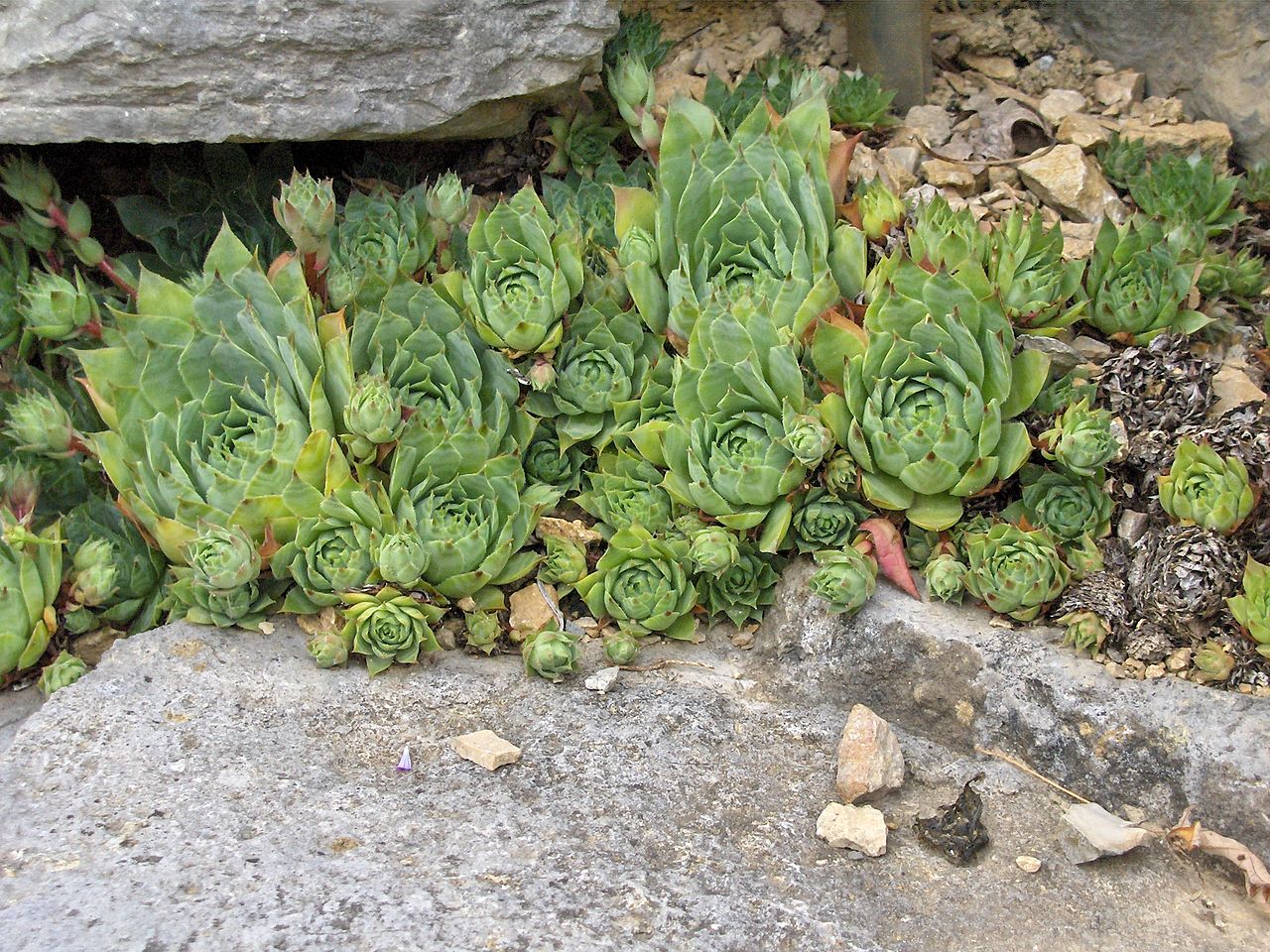
Sempervivium
(houseleek ~ hen & chickens)
To my surprise one house-leek (apparently Sempervivum tectorum of Dewey) has shot up twenty-two inches high and is apparently nearly out, though the petals are erect, not spread. The stem is clothed with the same thick leaves, only smaller and lessening up ward and forming a column about one and a half inches in diameter (with the leaves). The top is a broad raceme (?), about eight inches wide and two thirds as long, of eleven long, spreading, and recurved branches, lined with flowers on the upper side only. These consist of twelve to thirteen lanceolate calyx-segments and as many still longer dull-purple petals and about twenty pistils within and short stamens around them. It is a strange but rather stately cactus-like plant. 

The children call the pretty clusters of radical leaves hen and chickens. In this case the radical leaves are withered, and a fusiform root sustains the flower. This one is not on the bare rock, but lower amid the huckleberry bushes. 

At the Assabet stone bridge, apparently freshly in flower, — though it may have been out nearly as long as the androscemifolium, — apparently the Apocynum cannabinum var. hypericifolium (?). The tallest is four feet high. The flowers very small (hardly more than an eighth of an inch in diameter), the segments of the corolla not revolute but nearly erect. There are twenty to thirty flowers at end of a branch. The divisions of the calyx are longer than in the common, long ovate. Yet it differs from Gray's hypericifolium in having flowers rose-streaked within like the common, the cymes not shorter than the leaves, and the tube of the corolla rather longer than the divisions of the calyx. The leaves are hardly more downy or heart-shaped below than the common. Hypericifolium is a separate species in Pursh and some others. And the branches are less ascending than the common, making an angle of about 62° with the stem (the four lower), while three of the lower of a common one make an angle of 44°.

H. D. Thoreau, Journal, August 5, 1856

Trichostema, maybe several days in some places. See July 31, 1856  ("Trichostema has now for some time been springing up in the fields, giving out its aromatic scent when bruised, and I see one ready to open.");  August 17, 1851 ("The Trichostema dichotomum, — not only its bright blue flower above the sand, but its strong wormwood scent which belongs to the season, –– feed my spirit, endear the earth to me, make me value myself and rejoice.") See also  A Book of the Seasons, by Henry Thoreau, Blue-Curls

Now, at 4 p. m . .  .The Hypericum mutilum is abundantly open . . . sometimes fifteen inches high, while the Canadense and angulatum are shut
.  See August 12, 1856 ("11 a. m. . . .  The Hypericum mutilum is well out at this hour.");  August 17, 1856 ("Hypericum Canadense well out at 2 p. m"); .August 19, 1856 ("I see Hypericum Canadense and mutilum abundantly open at 3 p. m");  August 27, 1856  ("Hypericum Canadense and mutilum now pretty generally open at 4 P.M., thus late in the season, it being more moist and cooler."). See also  A Book of the Seasons by Henry Thoreau, St. Johns-wort (Hypericum)

A great water adder . . . full five feet long and nearly as big round as my arm. See July 23, 1856 ("water adder killed on the 15th and left hanging on a twig"); July 15, 1856 ("It was about three feet long, but large round in proportion, with about one hundred and forty abdominal plates and a long, slender tail.)

Aster dumosus, apparently a day or two, with its large conspicuous flower-buds. See August 10, 1856  ("Aster dumosus and pennyroyal out; how long? ");   August 24, 1853 ("The dumosus is the prevailing white one, very abundant.") See also   A Book of the Seasons by Henry Thoreau, Asters in August

Choke-cherries. . . scarcely edible, but their beauty atones for it. See August 5, 1858 ("Choke-berries, fair to the eye but scarcely palatable, hang far above your head, weighing down the bushes."); See 
also September 3, 1853 ("Now is the season for those comparatively rare but beautiful wild berries which are not food for man . . . it is strange that we do not devote an hour in the year to gathering those which are beautiful to the eye. It behooves me to go a-berrying in this sense once a year at least.”)

Apparently the Apocynum cannabinum var. hypericifolium (?). The tallest is four feet high. See August 7, 1856 ("Hemp, perhaps a week.");  August 13, 1856 ("I stripped off a shred of Indian hemp bark and could not break it. It is as strong as anything of the kind I know. ") August 16, 1856 (" I find the dog's-bane (Apocynum androsoemifolium) bark not the nearly so strong as that of the A. cannabinum.");  September 2, 1856 ("Some years ago I sought for Indian hemp (Apocynum cannabinum) hereabouts in vain, and concluded that it did not grow here. A month or two ago . . . my eyes fell on it, aye, in three different places, and different varieties of it.") See also A Book of the Seasons, by Henry Thoreau, Dogsbane and Indian hemp

August 5. See A Book of the Seasonsby Henry Thoreau, August 5

Now at 4 p. m.
this dog-day cloudy weather
dwarf johnswort open.

A Book of the Seasonsby Henry Thoreau. Near House-leek Rock

A Book of the Seasonsby Henry Thoreau. 

"A book, each page written in its own season,
out-of-doors, in its own locality."
~edited, assembled and rewritten by zphx © 2009-2026

https://tinyurl.com/hdt-560805

Popular Posts Last 30 Days.

The week ahead in Henry’s journal

The week ahead in Henry’s journal
A journal, a book that shall contain a record of all your joy.
"A stone fruit. Each one yields me a thought." ~ H. D. Thoreau, March 28, 1859


I sit on this rock
wrestling with the melody
that possesses me.