Showing posts with label June 15. Show all posts

Friday, June 12, 2026

A Book of the Seasons: Blue-eyed Grass


I would make a chart of our life,
know why just this circle of creatures completes the world.
Henry Thoreau, April 18, 1852

The blue-eyed grass is
one of the most beautiful of flowers . . .
It will bear to be praised by poets. 

Flowers were made to be seen,
not overlooked. Their bright colors
imply eyes, spectators. 
June 15, 1852

Blue patches began to appear,
answering to the blue sky.
June 17. 1853

May 27.  Blue-eyed grass out. May 27, 1859

May 29. Barberry in bloom, wild pinks, and blue-eyed grass May 29, 1852

May 29. That exceedingly neat and interesting little flower blue-eyed grass now claims our attention. May 29, 1853

May 29.  Blue-eyed grass, probably to-morrow. May 29, 1856

May 31.  Blue-eyed grass, apparently in pretty good season. May 31, 1854

June 6. Blue-eyed grass maybe several days in some places.  June 6, 1855

June 12.   The blue-eyed grass is one of the most beautiful of flowers. It might have been famous from Proserpine down. It will bear to be praised by poets.  June 12, 1852

June 15. The blue-eyed grass, well named, looks up to heaven. June 15, 1851

June 15. The fields are blued with blue-eyed grass, — a slaty blue. June 15, 1852

June 15. Blue-eyed grass at height. June 15, 1859 

June 17. The dense fields of blue-eyed grass now blue the meadows, as if, in this fair season of the year, the clouds that envelop the earth were dispersing, and blue patches began to appear, answering to the blue sky. The eyes pass from these blue patches into the surrounding green as from the patches of clear sky into the clouds. June 17. 1853

June 19.  I see large patches of blue-eyed grass in the meadow across the river from my window. June 19, 1853 

June 20.  The blue-eyed grass is shut up. When does it open? June 20, 1852

June 26. The blue-eyed grass, now in its prime, occupies the drier and harder parts of the meadow, where I can walk dry-shod, but where the coarser sedge grows and it is lower and wetter there is none of it. I keep dry by following this blue guide, and the grass is not very high about it. You cross the meadows dry-shod by following the winding lead of the blue-eyed grass, which grows only on the firmer, more elevated, and drier parts. June 26, 1860

July 3.   I noticed the other day, I think the 30th, a large patch of Agrostis scabrain E. Hosmer's meadow, — the firmer ridges, — a very interesting purple with its fine waving top, mixed with blue-eyed grass.  July 3, 1859

July 6. Blue-eyed grass is now rarely seen. July 6, 1851

August 13.  Some of the little cranberries at Gowing's Swamp appear to have been frost-bitten. Also the blue-eyed grass, which is now black-topped.  August 13, 1860

August 25. Blue-eyed grass still. August 25, 1851

August 30. Blue-eyed grass still.  August 30, 1854

September 11. Blue-eyed grass still. September 11, 1851

September 23.  So live that only the most beautiful wild-flowers will spring up where you have dwelt, – harebells, violets, and blue-eyed grass. September 23, 1859

See also Northern Woodlands, The Blue-eyed Grasses

A Book of the Seasons,  by Henry Thoreau,  Blue-eyed Grass
A Book of the Seasons,  by Henry Thoreau
 "A book, each page written in its own season,
out-of-doors, in its own locality."
 ~edited, assembled and rewritten by zphx ©  2009-2026

Thursday, June 5, 2025

A Book of the Seasons: Yellow Bethlehem-star (Hypoxis erecta).


 For the first time I perceive this spring
that the year is a circle.  
I would make a chart of our life,
know why just this circle of creatures completes the world.
Henry Thoreau, April 18, 1852

The Hypoxis erecta, yellow Bethlehem-star,
where there is a thick, wiry grass in open path;
should be called yellow-eyed grass, methinks.

May 22. A yellow Bethlehem-star. May 22, 1853

May 28. White thorn and yellow Bethlehem-star (Hypoxis erecta). May 28, 1852

May 28. Hypoxis erecta, maybe a day or two. May 28, 1856

June 5. Yellow Bethlehem-star in prime. June 5, 1855

June 6. Yellow Bethlehem-star. June 6, 1858

June 9. There are many star flowers. I remember the anemone, especially the rue anemone, which is not yet all gone, lasting longer than the true one above all the trientalis, and of late the yellow Bethlehem-star, and perhaps others. June 9, 1853

June 15. The Hypoxis erecta, yellow Bethlehem-star, where there is a thick, wiry grass in open path; should be called yellow-eyed grass, methinks. June 15, 1851

July 31. See yellow Bethlehem-star still. July 31, 1856

August 4.  The yellow Bethlehem-star still, and the yellow gerardia, and a bluish "savory-leaved aster." August 4, 1851

August 18. Yellow Bethlehem-star yet, and indigo.  August 18, 1856

August 24. Yellow Bethlehem-star still. August 24, 1853

Hypoxis erecta or Hypoxis hirsuta,  common star-grass,

A Book of the Seasons, by Henry Thoreau
"A book, each page written in its own season,
out-of-doors, in its own locality.”
~edited, assembled and rewritten by zphx © 2009-2025


Tuesday, June 16, 2020

I saw how He fed his fish.

June 15.

I observe to-night, June 15th, the air over the river by the Leaning Hemlocks filled with myriads of newly fledged insects drifting and falling as it were like snow flakes from the maples, only not so white. Now they drift up the stream, now down, while the river below is dimpled with the fishes rising to swallow the innumerable insects which have fallen [into] it and are struggling with it. 

I saw how He fed his fish. 

They, swimming in the dark nether atmosphere of the river, rose lazily to its surface to swallow such swimmers of the light upper atmosphere as sank to its bottom.

H. D. Thoreau, Journal, June 15, 1850

I saw how He fed his fish. See June 2, 1854 ("When we returned to our boat at 7 p. m., I noticed first, to my surprise, that the river was all alive with leaping fish, their heads seen continually darted above water, and they were large fish, too. Looking up I found that the whole atmosphere over the river was full of shad-flies. It was a great flight of ephemera"). June 9, 1854 ("The air is now full of shad-flies, and there is an incessant sound made by the fishes leaping for their evening meal, dimpling the river like large drops as far as I can see..”); June 8, 1856 (“My boat being by chance at the same place where it was in ’54, I noticed a great flight of ephemera”). June 9, 1856 ("Again, about seven, the ephemera came out, in numbers as many as last night, now many of them coupled, even tripled; and the fishes leap as before."); June 11, 1859 ("When I return, about 5 p. m., the shad-flies swarm over the river in considerable numbers, but there are very few at sundown.")

Monday, June 15, 2020

The year is in its manhood now.


June 15.

Tuesday. Silene Antirrhina, sleepy catch-fly, or snapdragon catch-fly, the ordinarily curled-up petals scarcely noticeable at the end of the large oval calyx. Gray says opening only by night or cloudy weather. Bigelow says probably nocturnal, for he never found it expanded by day. (I found it June 16th at 6 a. m. expanded, two of its flowers, — and they remained so for some hours, in my chamber.) 

By railroad near Badger's. 

Yesterday we smelt the sea strongly; the sea breeze alone made the day tolerable. 

This morning, a shower! The robin only sings the louder for it. He is inclined to sing in foul weather. 

To Clematis Brook, 1.30 p. m. Very warm. Now for a thin coat. This melting weather makes a stage in the year. 

The crickets creak louder and more steadily; the bullfrogs croak in earnest. 

The drouth begins. The dry z-ing of the locust is heard. 

The potatoes are of that height to stand up at night.

Bathing cannot be omitted. The conversation of all boys in the streets is whether they will or not or who will go in a-swimming, and how they will not tell their parents. You lie with open windows and hear the sounds in the streets.

The seringo sings now at noon on a post; has a light streak over eye.

The autumnal dandelion (Leontodon, or Apargia). Erigeron integrifolius of Bigelow (strigosus, i. e. narrow- leaved daisy fleabane, of Gray) very common, like a white aster. I will note such birds as I observe in this walk, beginning on the railroad causeway in middle of this hot day.

The chuckling warble of martins heard over the meadow, from a village box. The lark. 

The fields are blued with blue-eyed grass, — a slaty blue. The epilobium shows some color in its spikes. 

How rapidly new flowers unfold! as if Nature would get through her work too soon. One has as much as he can do to observe how flowers successively unfold.

It is a flowery revolution, to which but few attend. Hardly too much attention can be bestowed on flowers. We follow, we march after, the highest color; that is our flag, our standard, our "color." 

Flowers were made to be seen, not overlooked. Their bright colors imply eyes, spectators. 

There have been many flower men who have rambled the world over to see them. The flowers robbed from an Egyptian traveller were at length carefully boxed up and forwarded to Linnaeus, the man of flowers. 

The common, early cultivated red roses are certainly very handsome, so rich a color and so full of blossoms; you see why even blunderers have introduced them into their gardens. 

Ascending to pigeon-place plain, the reflection of the heat from the dead pine-needles and the boughs strewn about, combined with the dry, suffocating scent, is oppressive and reminds me of the first settlers of Concord.

The oven-bird, chewink, pine warbler (?), thrasher, swallows on the wire, cuckoo, phoebe, red eye, robin, veery. 

The maple-leaved viburnum is opening with a purplish tinge. 

Wood thrush. 

Is not that the Prunus obovata, which I find in fruit, a mere shrub, in Laurel Glen, with oval fruit and long pedicels in a raceme? And have I not mistaken the P. Virginiana, or northern red cherry, for this? 

Vide Virginiana and also vide the P. depressa

Golden and coppery reflections from a yellow dor-bug's coat of mail in the water. 

Is it a yellowbird or myrtle-bird? 

Huckleberry-bird. 

Walden is two inches above my last mark. It must be four or five feet, at least, higher than when I sounded it. 

Men are inclined to be amphibious, to sympathize with fishes, now. I desire to get wet and saturated with water. 

The North River, Assabet, by the old stone bridge, affords the best bathing-place I think of, — a pure sandy, uneven bottom, — with a swift current, a grassy bank, and overhanging maples, with transparent water, deep enough, where you can see every fish in it. Though you stand still, you feel the rippling current about you. 

First locust. 

The pea-wai. 

There is considerable pollen on the pond; more than last year, notwithstanding that all the white pines near the pond are gone and there are very few pitch. It must all come from the pitch pine, whose sterile blossoms are now dry and empty, for it is earlier than the white pine. Probably I have never observed it in the river because it is carried away by the current.

The umbellefl pyrola is just ready to bloom. 

Young robins, dark-speckled, and the pigeon woodpecker flies up from the ground and darts away. 

I forget that there are lichens at this season. 

The farmhouses under their shady trees (Baker's) look as if the inhabitants were taking their siesta at this hour. I pass it  in the rear, through the open pitch pine wood. 

Why does work go forward now? No scouring of tubs or cans now. The cat and all are gone to sleep, preparing for an early tea, excepting the indefatigable, never-resting hoers in the corn-field, who have carried a jug of molasses and water to the field and will wring their shirts to-night.

I shall ere long hear the horn blow for their early tea. The wife or the hired Irish woman steps to the door and blows the long tin horn, a cheering sound to the laborers in the field. 

The motive of the laborer should be not to get his living, to get a good job, but to perform well a certain work. 

A town must pay its engineers so well that they shall not feel that they are working for low ends, as for a livelihood merely, but for scientific ends. 

Do not hire a man who does your work for money, but him who does it for love, and pay him well. 

On Mt. Misery, panting with heat, looking down the river. The haze an hour ago reached to Wachusett; now it obscures it. 

Methinks there is a male and female shore to the river, one abrupt, the other flat and meadowy. Have not all streams this contrast more or less, on the one hand eating into the bank, on the other depositing their sediment? 

The year is in its manhood now. 

The very river looks warm, and there is none of that light celestial blue seen in far reaches in the spring. I see fields a mile distant reddened with sorrel. The very sight of distant water is refreshing, though a bluish steam appears to rest on it. 

Catbird. 

The waxwork is just in blossom and groves [of] hickories on the south of Mt. Misery. How refreshing the sound of the smallest waterfall in hot [weather]

I sit by that on Clematis Brook and listen to its music. The very sight of this half-stagnant pond-hole, drying up and leaving bare mud, with the pollywogs and turtles making off in it, is agreeable and encouraging to behold, as if it contained the seeds of life, the liquor rather, boiled down. The foulest water will bubble purely. 

They speak to our blood, even these stagnant, slimy pools. It, too, no doubt, has its falls nobler than Montmorenci, grander than Niagara, in the course of its circulations. 

Here is the primitive force of Egypt and the Nile, where the lotus grows. 

Some geraniums are quite rose-colored, others pale purplish-blue, others whitish. 

The blossom of the Zentago is rather sweet smelling.

Orobanche uniflora, sin gle-flowered broom-rape (Bigelow), [or] Aphyllon uniflorum, one-flowered cancer-root (Gray), grows by this brook-side, — a naked, low, bluish-white flower, even re minding you of the tobacco-pipe. 

Cattle walk along in a brook or ditch now for coolness, lashing their tails, and browse the edges; or they stand concealed for shade amid thick bushes. How perfectly acquainted they are with man, and never run from him! 

Thorn bushes appear to be just out of blossom. I have not observed them well. 

Woodchucks and squirrels are seen and heard in a walk. 

How much of a tortoise is shell! But little is gone with its spirit. It is well cleaned out, I trust. It is emptied of the reptile. It is not its exuviae. 

I hear the scream of a great hawk, sailing with a ragged wing against the high wood-side, apparently to scare his prey and so detect it, — r- shrill, harsh, fitted to excite terror in sparrows and to issue from his split and curved bill. I see his open bill the while against the sky. Spit with force from his mouth with an undulatory quaver imparted to it from his wings or motion as he flies. A hawk's ragged wing will grow whole again, but so will not a poet's. 

By half past five, robins more than before, crows, of course, and jays. 

Dogsbane is just ready to open. 

Swallows. 

It is pleasant walking through the June-grass (in Pleasant Meadow), so thin and offering but little obstruction. 

The nighthawk squeaks and booms. 

The Veratrum viride top is now a handsome green cluster, two feet by ten inches. 

Here also, at Well Meadow Head, I see the fringed purple orchis, unexpectedly beautiful, though a pale lilac purple, — a large spike of purple flowers. 

I find two, — the grandiflora of Bigelow and fimbriata of Gray. Bigelow thinks it the most beautiful of all the orchises. 

I am not prepared to say it is the most beautiful wild flower I have found this year. Why does it grow there only, far in a swamp, remote from public view? It is somewhat fragrant, reminding me of the lady's-slipper. 

Is it not significant that some rare and delicate and beautiful flowers should be found only in unfrequented wild swamps? There is the mould in which the orchis grows. Yet I am not sure but this is a fault in the flower. It is not quite perfect in all its parts. 

A beautiful flower must be simple, not spiked. It must have a fair stem and leaves. 

This stem is rather naked, and the leaves are for shade and moisture. It is fairest seen rising from amid brakes and hellebore, its lower part or rather naked stem concealed. 

Where the most beautiful wild-flowers grow, there man's spirit is fed, and poets grow. It cannot be high-colored, growing in the shade. Nature has taken no pains to exhibit [it], and few that bloom are ever seen by mortal eyes. 

The most striking and handsome large wild-flower of the year thus far that I have seen. 

Disturbed a company of tree-toads amid the bushes. They seemed to bewilder the passer by their croaking; when he went toward one, he was silent, and another sounded on the other side. 

The hickory leaves are fra grant as I brush past them. 

Quite a feast of strawberries on Fair Haven, — the upland strawberry. The largest and sweetest on sand. The first fruit. 

The night-warbler. 

There are few really cold springs. I go out of my way to go by the Boiling Spring. How few men can be believed when they say the spring is cold! There is one cold as the coldest well water. What a treasure is such a spring! Who divined it? 

The cistuses are all closed. Is it because of the heat, and will they be open in the morning? 

C. found common hound's-tongue (Cynoglossum officinale) by railroad. 

8 p. m. — On river. No moon. 

A deafening sound from the toads, and intermittingly from bullfrogs. What I have thought to be frogs prove to be toads, sitting by thousands along the shore and trilling short and loud, — not so long a quaver as in the spring, — and I have not heard them in those pools, now, indeed, mostly dried up, where I heard them in the spring. (I do not know what to think of my midsummer frog now.) 

The bullfrogs are very loud, of various degrees of baseness and sonorousness, answering each other across the river with two or three grunting croaks. They are not nearly so numerous as the toads. 

It is candle-light. The fishes leap. 

The meadows sparkle with the coppery light of fireflies. The evening star, multiplied by undulating water, is like bright sparks of fire continually ascending. 

The reflections of the trees are grandly indistinct.

There is a low mist slightly enlarging the river, through which the arches of the stone bridge are' just visible, as a vision. The mist is singularly bounded, collected here, while there is none there; close up to the bridge on one side and none on the other, depending apparently on currents of air. A dew in the air for it is, which in time will wet you through. 

See stars reflected in the bottom of our boat, it being a quarter full of water. There is a low crescent of northern light and shooting stars from time to time. 

(We go only from Channing's to the ash above the railroad.) I paddle with a bough, the Nile boatman's oar, which is rightly pliant, and you do not labor much. Some dogs bay. A sultry night.

H. D. Thoreau, Journal, June 15, 1852

The drouth begins. The dry z-ing of the locust is heard. See June 14, 1853 ("Heard the first locust from amid the shrubs by the roadside. He comes with heat.")

The fields are blued with blue-eyed grass, — a slaty blue. See June 15, 1851 ("The blue-eyed grass, well named, looks up to heaven."); June 15, 1859 ("Blue-eyed grass at height.")

Methinks there is a male and female shore to the river, one abrupt, the other flat and meadowy.See July 19, 1859 ("It is remarkable how the river, while it may be encroaching on the bank on one side, preserves its ordinary breadth by filling up the other side") See also August 7, 1858 ("The most luxuriant groves of black willow are on the inside curves, —but rarely ever against a firm bank or hillside, the positive male shore. “); August 15, 1858 (“I notice the black willows . . . to see where they grow, distinguishing ten places. In seven instances they are on the concave or female side distinctly.”); July 5, 1859 ("The deepest part of the river is generally rather toward one side, especially where the stream is energetic. On a curve it is generally deepest on the inside bank, and the bank most upright.")

The year is in its manhood now. See June 11, 1853 ("In the sorrel-fields, also, what lately was the ruddy, rosy cheek of health, now that the sorrel is ripening and dying, has become the tanned and imbrowned cheek of manhood."); June 15, 1853 ("The rude health of the sorrel cheek has given place to the blush of clover.")

I see fields a mile distant reddened with sorrel. See  note to June 12, 1859 ("I am struck with the beauty of the sorrel now.") See also A Book of the Seasons,  by Henry Thoreau, Wood Sorrel (Oxalis)


I see the fringed purple orchis, unexpectedly beautiful. See note to June 20, 1859 ("Great purple fringed orchis")  See also A Book of Seasons,  by Henry Thoreau, The Purple Fringed Orchids

Flowers were made to be seen, not overlooked. Their bright colors imply eyes, spectators. See August 22, 1852 ("Perhaps fruits are colored like the trillium berry and the scarlet thorn to attract birds to them.”); March 18, 1860 (“There is but one flower in bloom in the town, and this insect knows where to find it. . . .No doubt this flower, too, has learned to expect its winged visitor knocking at its door in the spring.”)

Do not hire a man who does your work for money, but him who does it for love, and pay him well. See December 12, 1859("Every man, and the woodchopper among the rest, should love his work as much as the poet does his."); March 31, 1842 ("The really efficient laborer will be found not to crowd his day with work , but will saunter to his task sur- rounded by a wide halo of ease and leisure . . .Those who work much do not work hard."). See also Do it Well

Saturday, June 15, 2019

Willow gone to seed, its down covers the water – white amid the weeds.

June 15. 


5.30 a. m. — To Island and Hill. 

A young painted tortoise on the surface of the water, as big as a quarter of a dollar, with a reddish or orange sternum. 

I suppose that my skater insect is the hydrometer. 

Found a nest of tortoise eggs, apparently buried last night, which I brought home, ten in all, — one lying wholly on the surface, — and buried in the garden. 

The soil above a dark virgin mould about a stump was unexpectedly hard.

1 P. M. — Up Assabet to Garlic Wall. 

That tall grass opposite the Merrick Swimming-Place is getting up pretty well, and blossoming with a broad and regular spike, for some time. 

June 15, 2024

This is the third afternoon that we have had a rumbling thunder-cloud arise in the east, — not to mention the west, — but all signs have failed hitherto, and I resolve to proceed on my voyage, knowing that I have a tight [roof] in my boat turned up. 

The froth on the alders, andromeda, etc., — not to speak of the aphides, — dirties and apparently spots my clothes, so that it is a serious objection to walking amid these bushes these days. I am covered with this spittle-like froth. 

At the Assabet Spring I must have been near a black and white creeper's nest. It kept up a constant chipping. 


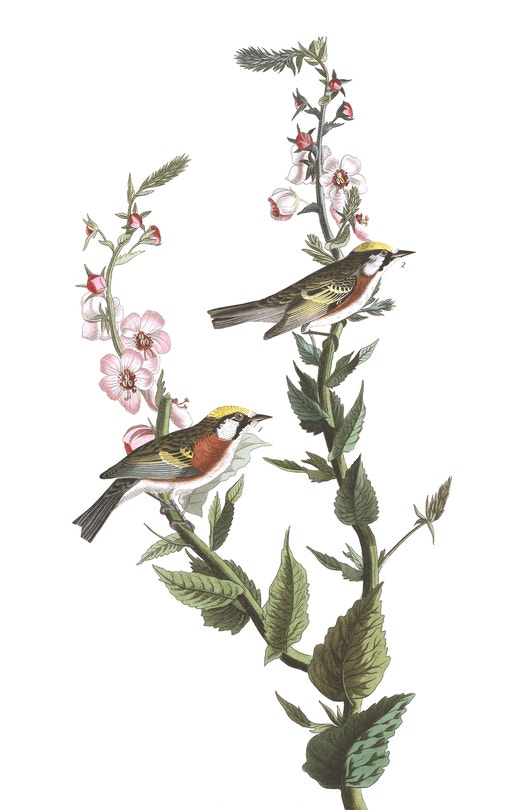
Saw there also, probably, a chestnut-sided warbler. A yellow crown, chestnut stripe on sides, white beneath, and two yellowish bars on wings. 

A red oak there has many large twigs drooping withered, apparently weakened by some insect. May it not be the locust of yesterday? 

Black willow is now gone to seed, and its down covers the water, white amid the weeds. 

The swamp-pink apparently two or even three days in one place. 

Saw a wood tortoise, about two inches and a half, with a black sternum and the skin, which becomes orange, now ochreous merely, or brown. The little painted tortoise of the morning was red beneath. Both these young tortoises have a distinct dorsal ridge. 

The garlic not in flower yet. 

I observed no Nuphar lutea var. Kalmiana on the Assabet. 

7 p. m. — To Cliff by railroad. 

Cranberry. Prinos Icevigatus, apparently two days.

Methinks the birds sing a little feebler nowadays. The note of the bobolink begins to sound somewhat rare. 

The sun has set, or is at least concealed in a low mist. 

As I go up Fair Haven Hill, I feel the leaves in the sprout-land oak, hickory, etc., cold and wet to my hand with the heavy dew that is falling. They look dry, but when I rub them with my hand, they show moist or wet at once. Probably I thus spread minute drops of dew or mist on their surface. It cannot be the warmth of my hand, for when I breathe on them it has no effect. 

I see one or two early blueberries prematurely turning. 

The Amelanchier Botryapium berries are already reddened two thirds over, and are somewhat palatable and soft, — some of them, — not fairly ripe.

H. D. Thoreau, Journal, June 15, 1854

A young painted tortoise . . . as big as a quarter of a dollar
. See April 21, 1855 ("Saw a painted turtle not two inches in diameter. This must be more than one year old."); April 24, 1856 ("A young Emys picta, one and five eighths inches long and one and a half wide. I think it must have been hatched year before last. "); August 28, 1856 ("I open the painted tortoise nest of June 10th, and find a young turtle partly out of his shell . . . The upper shell is fifteen sixteenths of an inch plus by thirteen sixteenths. He is already wonderfully strong and precocious."). See also A Book of the Seasons, by Henry Thoreau, the Painted Turtle (Emys picta)

Found a nest of tortoise eggs. . . which I brought home . . . and buried in the garden. See September 9, 1854 ("This morning I find a little hole, three quarters of an inch or an inch over, above my small tortoise eggs, and find a young tortoise coming out (apparently in the rainy night) just beneath. It is the Sternotherus odoratus"). See also A Book of the Seasons, by Henry Thoreau, the Musk Turtle (Sternothaerus odoratus)

This is the third afternoon that we have had a rumbling thunder-cloud arise in the east. . . I resolve to proceed on my voyage, knowing that I have a tight [roof] in my boat turned up. See June 13, 1854 (''I hear the muttering of thunder and see a dark cloud in the west-southwest horizon; am uncertain how far up-stream I shall get. An opposite cloud rises fast in the east-northeast, and now the lightning crinkles and I hear the heavy thunder. "); June 16, 1854 (" Three days in succession, — the 13th, 14th, and 15th, — thunder-clouds, with thunder and lightning, have risen high in the east, threatening instant rain, and yet each time it has failed to reach us. Thus it is almost invariably, methinks, with thunder-clouds which rise in the east; they do not reach us."). See also June 14, 1855 (" It suddenly begins to rain with great violence, and we in haste draw up our boat on the Clamshell shore, upset it, and get under, sitting on the paddles, and so are quite dry while our friends thought we were being wet to our skins. "); June 15, 1860 ("A thunder-shower in the north goes down the Merrimack. ");June 16, 1860  (" Thunder-showers show themselves about 2 P.M. in the west, but split at sight of Concord and go past on each side")

My skater insect. 
See March 25, 1858 ("Large skaters (Hydrometra) on a ditch"); March 29, 1853 (“Tried several times to catch a skater. Got my hand close to him; grasped at him as quick as possible; was sure I had got him this time; let the water run out between my fingers; hoped I had not crushed him; opened my hand; and lo! he was not there. I never succeeded in catching one.”); September 1, 1852 ("the surface of the pond is perfectly smooth except where the skaters dimple it, for at equal intervals they are scattered over its whole extent, and, looking west, they make a fine sparkle in the sun."); October 11, 1852 ("I could detect the progress of a water-bug over the smooth surface in almost any part of the pond, for they furrow the water slightly,. . . but the skaters slide over it without producing a perceptible ripple. ") See also A Book of the Seasons, by Henry Thoreau, the Water-bug (Gyrinus) and Skaters (Hydrometridae)

Saw probably, a chestnut-sided warbler. A yellow crown, chestnut stripe on sides, white beneath, and two yellowish bars on wings. See May 24, 1854 ("In woods the chestnut-sided warbler, with clear yellow crown and yellow on wings and chestnut sides. It is exploring low trees and bushes, often along stems about young leaves, and frequently or after short pauses utters its somewhat summer-yellowbird like note, say, tchip tchip, chip chip (quick), tche tche ter tchéa, —— sprayey and rasping and faint.”); May 20, 1856 ("I now see distinctly the chestnut-sided warbler (of the 18th and 17th), by Beck Stow’s. It is very lively on the maples, birches, etc., over the edge of the swamp. Sings eech eech eech | wichy wichy | tchea or itch itch itch | witty witty |tchea "); May 23, 1857 (“The chestnut-sided warbler . . .appears striped slate and black above, white beneath, yellow-crowned with black side-head, two yellow bars on wing, white side-head below the black, black bill, and long chestnut streak on side. Its song lively and rather long, about as the summer yellowbird, but not in two bars; tse tse tse \ te tsah tsah tsah \ te sak yer se is the rhythm.”)  See also A Book of the Seasons, by Henry Thoreau, the Chestnut-sided Warbler

Black willow is now gone to seed, and its down covers the water, white amid the weed.   See  June 10, 1853 ("The fuzzy seeds or down of the black (?) willows is filling the air over the river and, falling on the water, covers the surface.");   June 29, 1857  (""The river is now whitened with the down of the black willow, and I am surprised to see a minute plant abundantly springing from its midst and greening it,. . ., — like grass growing in cotton in a tumbler."); July 9, 1857 ("There is now but little black willow down left on the trees. . . . I think I see how this tree is propagated by its seeds." )See also A Book of the Seasons, by Henry Thoreau, the Propogation of the Willow.

The swamp-pink apparently two or even three days in one place. June 19, 1852 ("Is not this the carnival of the year when the swamp rose and wild pink are in bloom the last stage before blueberries come?") See also A Book of the Seasons, by Henry Thoreau, Swamp-pink

Methinks the birds sing a little feebler nowadays. See June 25, 1854 (“Through June the song of the birds is gradually growing fainter.”)

The note of the bobolink begins to sound somewhat rare.
See May 12, 1856 ("How much life the note of the bobolink imparts to the meadow! "); June 19, 1853 ("The strain of the bobolink now begins to sound a little rare. It never again fills the air as the first week after its arrival.") A Book of the Seasons,  by Henry Thoreau, the Bobolink

I see one or two early blueberries prematurely turning. The Amelanchier Botryapium berries are already red. See May 17, 1853 (“The petals have already fallen from the Amelanchier Botryapium, and young berries are plainly forming.”); May 30, 1854 (" I see now green high blueberries, and gooseberries in Hubbard's Close, as well as shad-bush berries and strawberries. "); June 7, 1854 ("I am surprised at the size of green berries. It is but a step from flowers to fruit.")

June 15. See A Book of the Seasons, by Henry Thoreau, June 15

Willow gone to seed
its down covers the water –
white amid the weeds.

A Book of the Seasons,  by Henry Thoreau 
 "A book, each page written in its own season, 
out-of-doors, in its own locality."
 ~edited, assembled and rewritten by zphx ©  2009-2024
https://tinyurl.com/hdt-540615

Friday, June 15, 2018

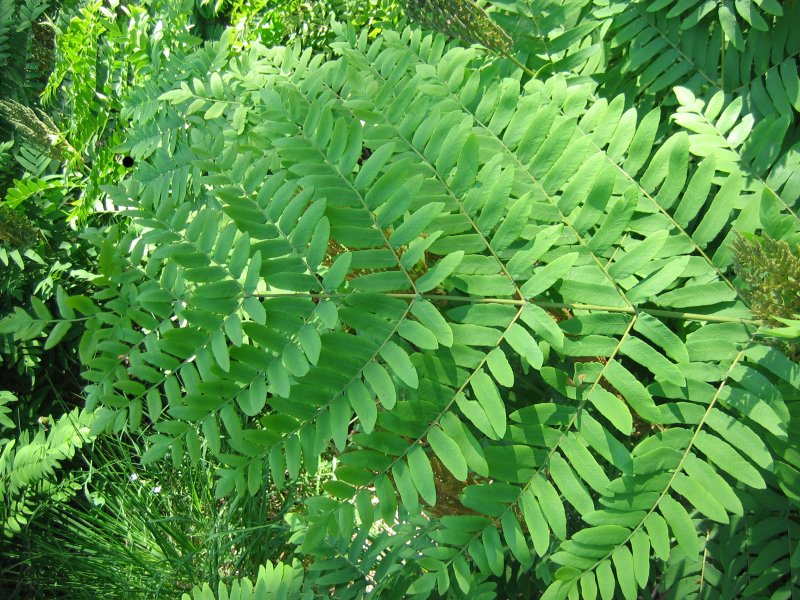
The Osmunda regalis, growing in very handsome hollow circles.

June 15. 
June 15, 2018

Rains steadily again, and we have had no clear weather since the 11th. 

The river is remarkably high, far higher than before, this year, and is rising. I can paddle into and all about the willowy meadow southwest of Island. I had, indeed, anticipated this on account of the remarkable lowness of the river in the spring. 

That coarse grass in the Island meadow which grows in full circles, as on the Great Meadows, is wool-grass, though but little blooms. Some is now fairly in bloom and it has the dark bracts of what I observed on the Great Meadows. The peculiarly circular form of the patches, sometimes their projecting edges being the arcs of circles, is very obvious now that the lower and different grass around is under water. Many plants have a similar habit of growth. 

The Osmunda regalis, growing in very handsome hollow circles, or sometimes only crescents or arcs of circles, is now generally a peculiarly tender green, — its delicate fronds, – but some has begun to go to seed and look brown. Hollow circles, one or two feet to a rod in diameter. 

These two are more obvious when, as now, all the rest of the meadow is covered with water. 

That large grass, five feet high, of the river brink is now just begun. Can it be blue-joint, or Calamagrostis Canadensis? [Probably phalaris.]

H. D. Thoreau, Journal, June 15, 1858

That coarse grass in the Island meadow which grows in full circles, as on the Great Meadows, is wool-grass, sometimes their projecting edges being the arcs of circles.  June 27, 1857 ("southwest of Egg Rock, the coarse sedge [wool-grass] — I think the same with that in the Great Meadows — evidently grows in patches with a rounded outline; i.e., its edge is a succession of blunt, rounded capes, with a very distinct outline amid the other kinds of grass and weeds.")

The Osmunda regalis, growing in very handsome hollow circles, or sometimes only crescents or arcs of circles, is now generally a peculiarly tender green. See July 5, 1860 ("I notice of late the Osmunda regalis fully grown, fresh and handsome.")

Popular Posts Last 30 Days.

The week ahead in Henry’s journal

The week ahead in Henry’s journal
A journal, a book that shall contain a record of all your joy.
"A stone fruit. Each one yields me a thought." ~ H. D. Thoreau, March 28, 1859


I sit on this rock
wrestling with the melody
that possesses me.