Showing posts with label water bugs. Show all posts

Tuesday, October 6, 2020

The reach of the river between Bedford and Carlisle, seen from a distance


October  6.

Monday. 12 m. — To Bedford line to set a stone by river on Bedford line. 


Carlisle Reach


The reach of the river between Bedford and Carlisle, seen from a distance in the road to-day, as formerly, has a singularly ethereal, celestial, or elysian look. It is of a light sky-blue, alternating with smoother white streaks, where the surface reflects the light differently, like a milk-pan full of the milk of Valhalla partially skimmed, more gloriously and heavenly fair and pure than the sky itself.

It is something more celestial than the sky above it. I never saw any water look so celestial. I have often noticed it. I believe I have seen this reach from the hill in the middle of Lincoln.

We have names for the rivers of hell, but none for the rivers of heaven, unless the Milky Way be one.

It is such a smooth and shining blue, like a panoply of sky-blue plates.

Our dark and muddy river has such a tint in this case as I might expect Walden or White Pond to exhibit, if they could be seen under similar circumstances, but Walden seen from Fair Haven is, if I remember, of a deep blue color tinged with green.

Cerulean?

Such water as that river reach appears to me of quite incalculable value, and the man who would blot that out of his prospect for a sum of money does not otherwise than to sell heaven.

George Thatcher, having searched an hour in vain this morning to find a frog, caught a pickerel with a mullein leaf.

The white ash near our house, which the other day was purple or mulberry-color, is now much more red. 


7.30 P. M. – To Fair Haven Pond by boat, the moon four-fifths full, not a cloud in the sky; paddling all the way.

The water perfectly still, and the air almost, the former gleaming like oil in the moonlight, with the moon's disk reflected in it.

When we started, saw some fishermen kindling their fire for spearing by the riverside.

It was a lurid, reddish blaze, contrasting with the white light of the moon, with dense volumes of black smoke from the burning pitch pine roots rolling upward in the form of an inverted pyramid.The blaze reflected in the water, almost as distinct as the substance. It looked like tarring a ship on the shore of the Styx or Cocytus. For it is still and dark, notwithstanding the moon, and no sound but the crackling of the fire.

The fishermen can be seen only near at hand, though their fire is visible far away; and then they appear as dusky, fuliginous figures, half enveloped in smoke, seen only by their enlightened sides. Like devils they look, clad in old coats to defend themselves from the fogs, one standing up forward holding the spear ready to dart, while the smoke and flames are blown in his face, the other paddling the boat slowly and silently along close to the shore with almost imperceptible motion.

The river appears indefinitely wide; there is a mist rising from the water, which increases the indefiniteness. A high bank or moonlit hill rises at a distance over the meadow on the bank, with its sandy gullies and clamshells exposed where the Indians feasted.

The shore line, though close, is removed by the eye to the side of the hill. It is at high-water mark. It is continued till it meets the hill.

Now the fisherman's fire, left behind, acquires some thick rays in the distance and becomes a star. As surely as sunlight falling through an irregular chink makes a round figure on the opposite wall, so the blaze at a distance appears a star.

Such is the effect of the atmosphere.

The bright sheen of the moon is constantly travelling with us, and is seen at the same angle in front on the surface of the pads; and the reflection of its disk in the rippled water by our boat-side appears like bright gold pieces falling on the river's counter. This coin is incessantly poured forth as from some unseen horn of plenty at our side.

(I hear a lark singing this morn (October 7th ), and yesterday saw them in the meadows. Both larks and blackbirds are heard again now occasionally, seemingly after a short absence, as if come to bid farewell.)

I do not know but the weirdness of the gleaming oily surface is enhanced by the thin fog.

A few water-bugs are seen glancing in our course.

I shout like a farmer to his oxen, — a short barking shout, — and instantly the woods on the eastern shore take it up, and the western hills a little up the stream; and so it appears to rebound from one side the river valley to the other, till at length I hear a farmer call to his team far up as Fair Haven Bay, whither we are bound.

We pass through reaches where there is no fog, perhaps where a little air is stirring.

Our clothes are almost wet through with the mist, as if we sat in water.

Some portions of the river are much warmer than others.

In one instance it was warmer in the midst of the fog than in a clear reach.

In the middle of the pond we tried the echo again. First the hill to the right took it up; then further up the stream on the left; and then after a long pause, when we had almost given it up, — and the longer expected, the more in one sense unexpected and surprising it was, — we heard a farmer shout to his team in a distant valley, far up on the opposite side of the stream, much louder than the previous echo; and even after this we heard one shout faintly in some neighboring town.
The third echo seemed more loud and distinct than the second.

But why, I asked, do the echoes always travel up the stream?

I turned about and shouted again, and then I found that they all appeared equally to travel down the stream, or perchance I heard only those that did so.

As we rowed to Fair Haven's eastern shore, a moonlit hill covered with shrub oaks, we could form no opinion of our progress toward it, — not seeing the water line where it met the hill, – until we saw the weeds and sandy shore and the tall bulrushes rising above the shallow water ( like ) the masts of large vessels in a haven. The moon was so high that the angle of excidence did not permit of our seeing her reflection in the pond.

As we paddled down the stream with our backs to the moon, we saw the reflection of every wood and hill on both sides distinctly. These answering reflections-shadow to substance-impress the voyager with a sense of harmony and symmetry, as when you fold a blotted paper and produce a regular figure, - a dualism which nature loves.

What you commonly see is but half.

Where the shore is very low the actual and reflected trees appear to stand foot to foot, and it is but a line that separates them, and the water and the sky almost flow into one another, and the shore seems to float.

As we paddle up or down, we see the cabins of muskrats faintly rising from amid the weeds, and the strong odor of musk is borne to us from particular parts of the shore.

Also the odor of a skunk is wafted from over the meadows or fields.

The fog appears in some places gathered into a little pyramid or squad by itself, on the surface of the water.

Home at ten.

H. D. Thoreau, Journal, October 6, 1851 


To Bedford line to set a stone by river on Bedford line.
See September 18, 1851 ("Perambulated Bedford line.") See also April 3, 1858 ("we paddle along all day, down to the Bedford line.")

The reach of the river between Bedford and Carlisle, seen from a distance in the road to-day, as formerly, has a singularly ethereal, celestial, or elysian look. See  April 1, 1852 ("Now I see the river - reach , far in the north . The more distant river is ever the most ethereal ,");April 10, 1852 ("This meadow is about two miles long at one view from Carlisle Bridge southward, appearing to wash the base of Pine hill, and it is about as much longer northward and from a third to a half a mile wide."):August 24, 1858 ("I look down a straight reach of water to the hill by Carlisle Bridge, —and this I can do at any season, — the longest reach we have. It is worth the while to come here for this prospect, — to see a part of earth so far away over the water")

The water and sky 
flow into one another –
 the shore seems to float.


The sheen of the moon 
constantly travels with us –
bright gold at out side.

tinyurl.com/HDT511006

Friday, February 28, 2020

A dozen robins to-day on the ground on Ebby Hubbard's hill by the Yellow Birch Swamp.


February 28. 

2 P. M. — Thermometer 52; wind easterly. To Conantum. 

I am surprised to see how my English brook cress has expanded or extended since I saw it last fall to a bed four feet in diameter, as if it had grown in the water, though it is quite dirty or muddied with sediment. Many of the sprigs turn upwards and just rest on the water at their ends, as if they might be growing. It has also been eaten considerably by some inhabitant of the water. I am inclined to think it must grow in the winter. 

What is that bluish bulb now apparently beginning to shoot in the water there, floating loose (not the water purslane )?

I suppose they are linarias which I still see flying about. 

Passed a very little boy in the street to-day, who had on a home-made cap of a woodchuck-skin, which his father or elder brother had killed and cured, and his mother or elder sister had fashioned into a nice warm cap. I was interested by the sight of it, it suggested so much of family history, adventure with the chuck, story told about [it], not without exaggeration, the human parents' care of their young these hard times. Johnny was promised many times, and now the work has been completed, — a perfect little idyl, as they say. The cap was large and round, big enough, you would say, for the boy's father, and had some kind of cloth visor stitched to it. The top of the cap was evidently the back of the woodchuck, as it were expanded in breadth, contracted in length, and it was as fresh and handsome as if the woodchuck wore it himself. The great gray-tipped wind hairs were all preserved, and stood out above the brown only a little more loosely than in life. 

As if he put his head into the belly of a woodchuck, having cut off his tail and legs and substituted a visor for the head. The little fellow wore it innocently enough, not knowing what he had on, forsooth, going about his small business pit-a-pat; and his black eyes sparkled beneath it when I remarked on its warmth , even as the woodchuck's might have done. Such should be the history of every piece of clothing that we wear. 

As I stood by Eagle Field wall, I heard a fine rattling sound, produced by the wind on some dry weeds at my elbow. It was occasioned by the wind rattling the fine seeds in those pods of the indigo-weed which were still closed, — a distinct rattling din which drew my attention to it, — like a small Indian's calabash. Not a mere rustling of dry weeds, but the shaking of a rattle, or a hundred rattles, beside. 

Looking from Hubbard's Bridge, I see a great water bug even on the river, so forward is the season. 

I take up a handsomely spread (or blossomed) pitch pine cone, but I find that a squirrel has begun to strip it first, having gnawed off a few of the scales at the base. The squirrel always begins to gnaw a cone thus at the base, as if it were a stringent law among the squirrel people, — as if the old squirrels taught the young ones a few simple rules like this. 

C. saw a dozen robins to-day on the ground on Ebby Hubbard's hill by the Yellow Birch Swamp. 

One tells me that George Hubbard told him he saw blackbirds go over this forenoon. 

One of the Corner Wheelers feels sure that he saw a bluebird on the 24th, and says he saw a sheldrake in the river at the factory "a month ago." I should say that the sheldrake was our hardiest duck. 

It suggests from what point of view Gesner (or his translator) describes an animal, — how far he takes into account man's relation to it, — that he commonly gives the “epithets” which have been applied to it. He deals in description, and epithets are a short description. And the translator says to the reader, “All these rows and ranks of living four-footed beasts are as letters and midwives to save the reverence which is due to the Highest (that made them ) from perishing within you.” 

I hear this account of Austin: An acquaintance who had bought him a place in Lincoln took him out one day to see it, and Austin was so smitten with the quiet and retirement and other rural charms that he at once sold his house in Concord, bought a small piece of rocky pasture in an out-of-the way part of this out-of-the-way town and with the funds raised by the sale of his old house built him a costly stone house upon it. Now he finds that this retirement (or country life) is the very thing which he does not want, but, his property being chiefly invested in the house, he is caught in a trap, as it were, for he cannot sell it, though he advertises it every year.

As for society, he has none; his neighbors are few and far between, and he never visits them nor they him. They can do without him, being old settlers, adscripti glebae. 

He found one man in the next town who got his living by sporting and fishing, and he has built him a little hut and got him to live on his place for society and help fulness. He cannot get help either for the outdoor or indoor work. There are none thereabouts who work by the day or job, and servant-girls decline to come so far into the country. Surrounded by grain-fields, he sends to Cambridge for his oats, and, as for milk, he can scarcely get any at all, for the farmers all send it to Boston, but he has persuaded one to leave some for him at the depot half a mile off.

As it is important to consider Nature from the point of view of science, remembering the nomenclature and system of men, and so, if possible, go a step further in that direction, so it is equally important often to ignore or forget all that men presume that they know, and take an original and unprejudiced view of Nature, letting her make what impression she will on you, as the first men, and all children and natural men still do. For our science, so called, is always more barren and mixed up with error than our sympathies are. 

As I go down the Boston road, I see an Irishman wheeling home from far a large damp and rotten pine log for fuel. He evidently sweats at it , and pauses to rest many times. He found, perhaps, that his wood-pile was gone before the winter was, and he trusts thus to contend with the remaining cold. I see him unload it in his yard before me and then rest himself. The piles of solid oak wood which I see in other yards do not interest me at all, but this looked like fuel. It warmed me to think of it. He will now proceed to split it finely, and then I fear it [will] require almost as much heat to dry it, as it will give out at last. 

How rarely we are encouraged by the sight of simple actions in the street! We deal with banks and other institutions, where the life and humanity are concealed, — what there is. I like at least to see the great beams half exposed in the ceiling or the corner.

H. D. Thoreau, Journal, February 28, 1860


I suppose they are linarias which I still see flying about See January 8, 1860 ("When I heard their note, I looked to find them on a birch, and lo, it was a black birch! [Were they not linarias? Vide Jan. 24, 27, 29.]")

The great gray-tipped wind hairs were all preserved, and stood out above the brown only a little more loosely than in life,  -- his black eyes sparkled beneath it when I remarked on its warmth , even as the woodchuck's might have done.See May 30, 1859 ("Its colors were gray, reddish brown, and blackish, the gray-tipped wind hairs giving it a grizzly look above, and when it stood up its distinct rust-color beneath was seen, while the top of its head was dark-brown, becoming black at snout, as also its paws and its little rounded ears."); April 29, 1855 ("See his shining black eyes and black snout and his little erect ears. He is of a light brown forward at this distance (hoary above, yellowish or sorrel beneath), gradually darkening backward to the end of the tail, which is dark-brown. The general aspect is grizzly.")

C. saw a dozen robins to-day. See February 25, 1857 ("Goodwin says he saw a robin this morning.”); February 25, 1859 ("I hear that robins were seen a week or more ago."); February 27, 1857 ("Before I opened the window this cold morning, I heard the peep of a robin, that sound so often heard in cheerless or else rainy weather, so often heard first borne on the cutting March wind or through sleet or rain, as if its coming were premature.")

Looking from Hubbard's Bridge, I see a great water bug even on the river, so forward is the season.C. saw a dozen robins to-day.One tells me that George Hubbard told him he saw blackbirds go over this forenoon. One of the Corner Wheelers feels sure that he saw a bluebird on the 24th See . March 10, 1855 ("You are always surprised by the sight of the first spring bird or insect; they seem premature, and there is no such evidence of spring as themselves, so that they literally fetch the year about. It is thus when I hear the first robin or bluebird or, looking along the brooks, see the first water-bugs out circling. But you think, They have come, and Nature cannot recede.")

Says he saw a sheldrake in the river at the factory "a month ago." I should say that the sheldrake was our hardiest duck .See March 1, 1856 ("It is remarkable that though I have not been able to find any open place in the river almost all winter,. . . Coombs should (as he says) have killed two sheldrakes at the falls by the factory, a place which I had forgotten, some four or six weeks ago. Singular that this hardy bird should have found this small opening,. . .If there is a crack amid the rocks of some waterfall, this bright diver is sure to know it. Ask the sheldrake whether the rivers are completely sealed up."); February 27, 1860 ("This is the first bird of the spring that I have seen or heard of.”) See also A Book of the Seasons, by Henry Thoreau, The Sheldrake (Merganser, Goosander)

It is equally important often to ignore or forget all that men presume that they know, and take an original and unprejudiced view of Nature, letting her make what impression she will on you, as the first men, and all children and natural men still do. See October 13, 1857 ("We ordinarily do not see what is before us, but what our prejudices presume to be there."); October 4, 1859 (“It is only when we forget all our learning that we begin to know. I do not get nearer by a hair's breadth to any natural object so long as I presume that I have an introduction to it from some learned man. To conceive of it with a total apprehension I must for the thousandth time approach it as something totally strange. If you would make acquaintance with the ferns you must forget your botany. You must get rid of what is commonly called knowledge of them. Not a single scientific term or distinction is the least to the purpose, for you would fain perceive something, and you must approach the object totally unprejudiced You must be aware that no thing is what you have taken it to be. In what book is this world and its beauty described? Who has plotted the steps toward the discovery of beauty? You have got to be in a different state from common. Your greatest success will be simply to perceive that such things are."); November 21, 1850(" I begin to see ... an object when I cease to understand it "); February 14, 1851 ("We shall see but little way if we require to understand what we see")

Thursday, February 27, 2020

The aspect of the meadow is sky-blue and dark-blue.


February 27

 2 P. M. — Thermometer 50.

February 27, 2015

February 27, 2020


To Abner Buttrick' s Hill. 

The river has been breaking up for several days and I now see great cakes lodged against each of the bridges, especially at Hunt's and the North Bridge, where the river flows with the wind. 

For a week or more you could not go to Ball's Hill by the south side of the river. The channel is now open, at least from our neighborhood all the way to Ball's Hill [ Yes , and upward as far as Cardinal Shore, the reach above Hubbard 's Bridge being open; thence it is mackerelled up to the pond], except the masses of ice moving in it; but the ice generally rests on the bottom of the meadows, — such as was there before the water rose, — and the freshet is for the most part covered with a thin ice except where the wind has broke it up. 

The high wind for several days has prevented this water from freezing hard. 

There are many cranberries washed far on to a large cake of ice which stretches across the river at Hunt's Bridge. The wind subsiding leaves them conspicuous on the middle of the cake. 

I noticed yesterday that the skunk-cabbage had not started yet at Well Meadow, and had been considerably frost-bitten. 

Heywood says that when the ground is regularly descending from the north to the railroad, a low fence a quarter of a mile off has been found to answer perfectly; if it slopes upward, it must be very near the road. 

I walk down the river below Flint's on the north side. 

The sudden apparition of this dark-blue water on the surface of the earth is exciting. I must now walk where I can see the most water, as to the most living part of nature. This is the blood of the earth, and we see its blue arteries pulsing with new life now. 

I see, from far over the meadows, white cakes of ice gliding swiftly down the stream, - a novel sight. They are whiter than ever in this spring sun. The abundance of light as reflected from clouds and the snow, etc., etc. is more springlike than anything of late. 

For several days the earth generally has been bare. I see the tawny and brown earth, the fescue- and lichen-clad hills behind Dakin's and A. Buttrick's. 

Among the radical leaves most common, and therefore early-noticed, are the veronica and the thistle, - green in the midst of brown and decayed; and at the bottom of little hollows in pastures, now perhaps nearly covered with ice and water, you see some greener leafets of clover. 

I find myself cut off by that arm of our meadow sea which makes up toward A. Buttrick's. The walker now by the river valley is often compelled to go far round by the water, driven far toward the farmers' door-yards.

I had noticed for some time, far in the middle of the Great Meadows, something dazzlingly white, which I took, of course, to be a small cake of ice on its end, but now that I have climbed the pitch pine hill and can overlook the whole meadow, I see it to be the white breast of a male sheldrake accompanied perhaps by his mate (a darker one). They have settled warily in the very midst of the meadow, where the wind has blown a space of clear water for an acre or two. The aspect of the meadow is sky-blue and dark-blue, the former a thin ice, the latter the spaces of open water which the wind has made, but it is chiefly ice still. Thus, as soon as the river breaks up or begins to break up fairly, and the strong wind widening the cracks makes at length open spaces in the ice of the meadow, this hardy bird appears, and is seen sailing in the first widened crack in the ice, where it can come at the water. 

Instead of a piece of ice I find it to be the breast of the sheldrake, which so reflects the light as to look larger than it is, steadily sailing this way and that with its companion, who is diving from time to time. They have chosen the opening farthest removed from all shores. As I look I see the ice drifting in upon them and contracting their water, till finally they have but a few square rods left, while there are forty or fifty acres near by. This is the first bird of the spring that I have seen or heard of.

C. saw a skater-insect on E. Hubbard's Close brook in woods to-day.

H. D. Thoreau, Journal, February 27, 1860


The river has been breaking up for several days . . .  The channel is now open, at least from our neighborhood all the way to Ball's Hill. Compare  February 27, 1856 ( the river has been frozen solidly for seven weeks.") and February 27, 1852 ("The main river is not yet open but in very few places, but the North Branch, which is so much more rapid, is open near Tarbell's and Harrington's, where I walked to-day, and, flowing with full tide bordered with ice on either side, sparkles in the clear, cool air, This restless and now swollen stream has burst its icy fetters, and as I stand looking up it westward for half a mile, where it winds slightly under a high bank, its surface is lit up here and there with a fine-grained silvery sparkle which makes the river appear something celestial"). See also A Book of the Seasons by Henry Thoreau,  Ice out

I noticed yesterday that the skunk-cabbage had not started yet at Well Meadow, and had been considerably frost-bitten. See February 13, 1851 ("Saw in a warm, muddy brook in Sudbury, quite open and exposed, the skunk-cabbage spathes above water. The tops of the spathes were frost- bitten, but the fruit sound. There was one partly expanded. The first flower of the season; for it is a flower. I doubt if there is [a] month without its flower. Examined by the botany all its parts, the first flower I have seen. The Ictodes fætidus.");  February 18, 1851 (" See the skunk-cabbage in flower.”); March 18, 1860   (“Skunk-cabbage, now generally and abundantly in bloom all along under Clamshell.”); March 21, 1858 (“The skunk-cabbage at Clamshell is well out, shedding pollen. The date of its flowering is very fluctuating.”); March 26, 1857 (“At Well Meadow Head, am surprised to find the skunk-cabbage in flower, . . .The first croaking frogs, the hyla, the white maple blossoms, the skunk-cabbage, and the alder’s catkins are observed about the same time.”); March 30, 1856 ("I am surprised to see the skunk cabbage, with its great spear-heads open and ready to blossom (i. e. shed pollen in a day or two)"); April 7, 1855 ("The skunk-cabbage open yesterday, — the earliest flower this season.") See also 
A Book of the Seasons,  by Henry Thoreau, Signs of Spring: the Skunk Cabbage

White cakes of ice gliding swiftly down the stream are whiter than ever in this spring sun. The abundance of light as reflected from clouds and the snow, etc., etc. is more springlike than anything of late. See March 1, 1855 ("Banks of snow by the railroad reflect a wonderfully dazzling white due to the higher sun.")  See also A Book of the Seasons,  by Henry Thoreau, Signs of the Spring; The Days have grown Sensibly Longer

The sudden apparition of this dark-blue water on the surface of the earth is exciting. I must now walk where I can see the most water, as to the most living part of nature. See February 12, 1860 ("Where the agitated surface of the river is exposed, [I see] the blue-black water. That dark-eyed water, especially when I see it at right angles with the direction of the sun, is it not the first sign of spring? How its darkness contrasts with the general lightness of the winter! It has more life in it than any part of the earth's surface. It is where one of the arteries of the earth is palpable, visible. . . .It excites me to see early in the spring that black artery leaping once more through the snow-clad town. All is tumult and life there, not to mention the rails and cranberries that are drifting in it. Where this artery is shallowest, i. e., comes nearest to the surface and runs swiftest, there it shows itself soonest and you may see its pulse beat. These are the wrists, temples, of the earth, where I feel its pulse with my eye. The living waters, not the dead earth. It is as if the dormant earth opened its dark and liquid eye upon us.") Compare March 12, 1854 ("A new feature is being added to the landscape, and that is expanses and reaches of blue water. This great expanse of deep-blue water, deeper than the sky, why does it not blue my soul as of yore? It is hard to soften me now. The time was when this great blue scene would have tinged my spirit more.") See also A Book of the Seasons,  by Henry Thoreau, Signs of the Spring: Bright Blue Water

This is the first bird of the spring that I have seen or heard of. See March 1, 1856 ("Singular that this hardy bird should have found this small opening, which I had forgotten, while the ice everywhere else was from one to two feet thick, and the snow sixteen inches on a level. , , , Ask the sheldrake whether the rivers are completely sealed up.”) See also A Book of the Seasons, by Henry Thoreau, The Sheldrake (Merganser, Goosander)

Thursday, January 30, 2020

What miracles, what beauty surrounds us!


January 30, 2022, 7:00AM


2 p. m. — To Nut Meadow and White Pond road. 

Thermometer 45°. Fair with a few cumuli of indefinite outline in the north and south, and dusky under sides. A gentle west wind and a blue haze. Thaws. 

The river has opened to an unusual extent, owing to the very long warm spell, — almost all this month. Even from Hubbard's Bridge up and down it is breaking up, is all mackerelled, with lunar-shaped openings  and some like a thick bow. * They [are] from one to twelve feet long. 

Yesterday's slight snow is all gone, leaving the ice, old snow, and bare ground; and as I walk up the river side, there is a brilliant sheen from the wet ice toward the sun, instead of the crystalline rainbow of yesterday. 

Think of that (of yesterday), — to have constantly before you, receding as fast as you advance, a bow formed of a myriad crystalline mirrors on the surface of the snow! ! What miracles, what beauty surrounds us! 

Then, another day, to do all your walking knee-deep in perfect six-rayed crystals of surpassing beauty but of ephemeral duration, which have fallen from the sky. 

The ice has so melted on the meadows that I see where the musquash has left his clamshells in a heap near the riverside, where there was a hollow in the bank. 

The small water-bugs are gyrating abundantly in Nut Meadow Brook. 

It is pleasant also to see the very distinct ripple-marks in the sand at its bottom, of late so rare a sight. 

I go through the piny field northwest of M. Miles's. There are no more beautiful natural parks than these pastures in which the white pines have sprung up spontaneously, standing at handsome intervals, where the wind chanced to let the seed lie at last, and the grass and blackberry vines have not yet been killed by them. 

There are certain sounds invariably heard in warm and thawing days in winter, such as the crowing of cocks, the cawing of crows, and sometimes the gobbling of turkeys. 

The crow, flying high, touches the tympanum of the sky for us, and reveals the tone of it. What does it avail to look at a thermometer or barometer compared with listening to his note? He informs me that Nature is in the tenderest mood possible, and I hear the very flutterings of her heart. Crows have singular wild and suspicious ways. You will [see] a couple flying high, as if about their business, but lo, they turn and circle and caw over your head again and again for a mile; and this is their business, — as if a mile and an afternoon were nothing for them to throw away. This even in winter, when they have no nests to be anxious about. 

But it is affecting to hear them cawing about their ancient seat (as at F. Wheeler's wood) which the choppers are laying low. 

I saw the other day (apparently) mouse(?)-tracks which had been made in slosh  on the Andromeda Ponds and then frozen, — little gutters about two inches wide and nearly one deep, looking very artificial with the nicks on the sides. 

I sit on the high hilltop south of Nut Meadow, near the pond. This hazy day even Nobscot is so blue that it looks like a mighty mountain. 

See how man has cleared commonly the most level ground, and left the woods to grow on the more uneven and rocky, or in the swamps.

I see, when I look over our landscape from any eminence as far as the horizon, certain rounded hills, amid the plains and ridges and cliffs, which have a marked family likeness, like eggs that belong to one nest though scattered. They suggest a relation geologically. Such are, for instance, Nashoba, Annursnack, Nawshawtuct, and Ponkawtasset, all which have Indian names, as if the Indian, too, had regarded them as peculiarly distinct. 

There is also Round Hill in Sudbury, and perhaps a hill in Acton. Perhaps one in Chelmsford. They are not apparently rocky. 

The snow-flea seems to be a creature whose summer and prime of life is a thaw in the winter. It seems not merely to enjoy this interval like other animals, but then chiefly to exist. It is the creature of the thaw. Moist snow is its element. That thaw which merely excites the cock to sound his clarion as it were calls to life the snow-flea.

H. D. Thoreau, Journal, January 30, 1860

The crystalline rainbow of yesterday. See January 29, 1860 ("that conical rainbow, or parabola of rainbow-colored reflections, from the myriad reflecting crystals of the snow, . . . as I walk toward the sun, — always a little in advance of me")

The small water-bugs are gyrating abundantly in Nut Meadow Brook.  See January 17, 1860 ("See In the spring-hole ditches of the Close I see many little water-bugs (Gyrinus) gyrating, and some under water. It must be a common phenomenon there in mild weather in the winter. "); January 24, 1858 (" At Nut Meadow Brook the small-sized water-bugs are as abundant and active as in summer.") See also A Book of the Seasons,  by Henry Thoreau, the Water-bug (Gyrinus) and  Skaters (Hydrometridae)

It is pleasant also to see the very distinct ripple-marks in the sand at its bottom, of late so rare a sight. See July 30, 1852 ("The ripple-marks on the east shore of Flint's are nearly parallel firm ridges in the white sand, one inch or more apart. They are very distinctly felt by the naked feet of the wader."); March 10, 1853 ("At Nut Meadow Brook . . . gazing into the eddying stream. The ripple-marks on the sandy bottom [and].the shadows of the invisible dimples reflecting prismatic colors on the bottom,"); April 3, 1859 ("The water being quite shallow on [White Pond], it is very handsomely and freshly ripple-marked for a rod or more in width, the ripples only two or three inches apart and very regular and parallel.") August 1, 1859 ("The [river] bottom is occasionally — though quite rarely in Concord — of soft shifting sand, ripple-marked, in which the paddle sinks, under four or five feet of water (as below the ash tree hole)")

There are certain sounds invariably heard in warm and thawing days in winter, such as the crowing of cocks, the cawing of crows, and sometimes the gobbling of turkeys. See January 12, 1855 ("Perhaps what most moves us in winter is some reminiscence of far-off summer. . . .It is in the cawing of the crow, the crowing of the cock, the warmth of the sun on our backs. "); March 16, 1858 (" The crowing of cocks and the cawing of crows tell the same story. The ice is soggy and dangerous to be walked on.")

But lo, they turn and circle and caw over your head again and again for a mile. See May 11, 1855 ("You can hardly walk in a thick pine wood now, especially a swamp, but presently you will have a crow or two over your head, either silently flitting over, to spy what you would be at and if its nest is in danger, or angrily cawing.") September 18, 1852 ("The crows congregate and pursue me through the half-covered woodland path, cawing loud and angrily above me, and when they cease, I hear the winnowing sound of their wings."); October 9, 1858 (" Crows fly over and caw at you now."); November 18, 1857 (" Crows will often come flying much out of their way to caw at me.")

Mouse-tracks which had been made in slosh on the Andromeda Ponds and then frozen, — little gutters about two inches wide and nearly one deep. See December 27, 1853 (“ I had not seen a meadow mouse all summer, but no sooner does the snow come and spread its mantle over the earth than it is printed with the tracks of countless mice"); January 15, 1857 ("And for a week, or fortnight even, of pretty still weather the tracks will remain, to tell of the nocturnal adventures of a tiny mouse")

This hazy day even Nobscot is so blue that it looks like a mighty mountain.
Compare June 26, 1853 ("Nobscot has lost all its blue, and the northwest mountains are too . . .firmly defined to be mistaken for clouds.")

The snow-flea is the creature of the thaw. Moist snow is its element.
See January 22, 1860 ("This must be as peculiarly a winter animal as any. It may truly be said to live in snow."). See also A Book of the Seasons: The Snow Flea


Beauty surrounds us!
Crystalline mirrors on the
surface of the snow.

The crow, flying high, 
touches the tympanum 
of the sky for us.


A Book of the Seasons,  by Henry Thoreau,

Thursday, August 29, 2019

It is so cool a morning that for the first time I move into the entry to sit in the sun.

August 29

August 29, 2019

I hear in the street this morning a goldfinch sing part of a sweet strain.

It is so cool a morning that for the first time I move into the entry to sit in the sun. But in this cooler weather I feel as if the fruit of my summer were hardening and maturing a little, acquiring color and flavor like the corn and other fruits in the field. 

When the very earliest ripe grapes begin to be scented in the cool nights, then, too, the first cooler airs of autumn begin to waft my sweetness on the desert airs of summer. Now, too, poets nib their pens afresh. I scent their first-fruits in the cool evening air of the year. 

By the coolness the experience of the summer is condensed and matured, whether our fruits be pumpkins or grapes. 

Man, too, ripens with the grapes and apples. 

I find that the water-bugs (Gyrinus) keep amid the pads in open spaces along the sides of the river all day, and, at dark only, spread thence all over the river and gyrate rapidly. For food I see them eating or sucking at the wings and bodies of dead devil's-needles which fall on the water, making them too gyrate in a singular manner. If one gets any such food, the others pursue him for it. 

There was a remarkable red aurora all over the sky last night. 

P. M. — To Easterbrooks Country. 

The vernonia is one of the most conspicuous flowers now where it grows, — a very rich color. It is some what past its prime; perhaps about with the red eupatorium. 

Botrychium lunarioides now shows its fertile frond above the shorn stubble in low grounds, but not shedding pollen. 

See the two-leaved Solomon's-seal berries, many of them ripe; also some ripe mitchella berries, contrasting with their very fresh green leaves. 

White cohush berries, apparently in prime, and the arum fruit. The now drier and browner (purplish- brown) looking rabbit's clover, whose heads collected would make a soft bed, is an important feature in the landscape; pussies some call them; more puffed up than before. 

The thorn bushes are most sere and yellowish-brown bushes now. 

I see more snakes of late, methinks, both striped and the small green. 

The slate-colored spots or eyes — fungi — on several kinds of goldenrods are common now. 

The knife-shaped fruit of the ash has strewn the paths of late.

H. D. Thoreau, Journal, August 29, 1859

It is so cool a morning that for the first time I move into the entry to sit in the sun. See August 29, 1854 ("It is so cool that we are inclined to stand round the kitchen fire . . .I enjoy the warmth of the sun now that the air is cool") See also September 4, 1860 ("It is cooler these days and nights, and I move into an eastern chamber in the morning, that I may sit in the sun"); September 17, 1858 (“Cooler weather now for two or three days, so that I am glad to sit in the sun on the east side of the house mornings.”); September 18, 1852 ("In the forenoons I move into a chamber on the east side of the house, and so follow the sun round.”)


The very earliest ripe grapes begin to be scented in the cool nights
. See August 29, 1853 ("Walking down the street in the evening, I detect my neighbor’s ripening grapes by the scent twenty rods off."); August 27, 1859 ("The first notice I have that grapes are ripening is by the rich scent at evening from my own native vine against the house");August 30, 1853 ("Grapes are already ripe; I smell them first.");

Man, too, ripens with the grapes and apples.See November 14, 1853. ("October answers to that period in the life of man when . . . all his experience ripens into wisdom, but every root, branch, leaf of him glows with maturity. What he has been and done in his spring and summer appears. He bears his fruit".)

I see more snakes of late, methinks, both striped and the small green. See September 3, 1858 ("See a small striped snake, some fifteen or eighteen inches long, swallowing a toad"); September 13, 1858 (""Saw a striped snake run into the wall, and just before it disappeared heard a loud sound like a hiss") October 18, 1857 (" Snakes lie out now on sunny banks, amid the dry leaves, now as in spring. They are chiefly striped ones.")

There was a remarkable red aurora all over the sky last night. .See also Wikipedia (Solar Cycle 10 beginning in December 1855 and the Solar storm ( Carrington Event.) of September 1–2, 1859) and A Book of the Seasons, by Henry Thoreau, Northern Lights

So cool a morning 
that for the first time I move 
to sit in the sun.

Saturday, August 3, 2019

The grassy sea.

August 3

6 A. M. — River fallen one inch since 2.30 P. M. yesterday; i.e., it is now a quarter of an inch above summer level. 

AUGUST 3, 2019

Juncus Greenei grows in river meadow opposite Dodd’s; long done. I saw (the 31st ult.) that the river was narrowed to a third its width by a large mass of button-bushes sunk in the middle of it_above the Sudbury causeway. 

The low water reveals a mass of meadow sunk under the railroad bridge. Both this and Lee’s Bridge are thus obstructed this year.  

I should say the origin of these holes was that the river, being shallow and therefore crowded, runs swiftly and digs into the bank and so makes a deep hole and a bend. The three large lakes may perhaps be considered as three deep holes made by a larger river or ocean current in former ages. The almost constant occurrence of a bay, or stagnant expansion, on the convex side at the bends is remarkable. It seems to be a place where the river has formerly flowed, but which, by wearing into the opposite bank, it has left. 

There are about twenty-one weedy places (i. e., where the weeds extend quite across), all together about two miles in length. These weedy places, you may say (not withstanding the frequent winding of the river), generally occur at bends (the Island shoal, perhaps, and Barrett’s Bar, and above Middlesex Turnpike Bridge are exceptions).  The most remarkable bend between Framingham and the Dam is the Ox-Bow in Framingham. 

Since our river is so easily affected by wind, the fact that its general course is northeast and that the prevailing winds in summer are southwest is very favorable to its rapid drainage at that season. If by fall you mean a swifter place occasioned by the bottom below for a considerable distance being lower than the bottom above for a considerable distance, I do not know of any such between Pelham Pond and the Falls. 

These swifter places are produced by a contraction of the stream,— chiefly by the elevation of the bottom at that point, — also by the narrowing of the stream. 

The depths are very slight compared with the lengths. The average depth of this twenty-five miles is about one seventeen thousandth the length; so that if this portion of the river were laid down on a map four feet long the  depth would be about equal to the thickness of ordinary letter paper, of which it takes three hundred and fifty to an inch. Double the thickness of the letter paper, and it will contain the deep holes which are so unfathomed and mysterious, not to say bottomless, to the swimmers and fishermen. 

Methinks the button-bushes about Fair Haven indicate a muddy but not deep pond.

The deepest reach of this twenty-five miles is from E. Davis Hill to Skelton Bend. 

Methinks I saw some of the fresh-water sponge in the river in Framingham. 

Undoubtedly, in the most stagnant parts of the river, when the wind blows hard up-stream, a chip will be drifted faster up-stream than ever it floats downward there in a calm. 

P. M. — I see two or three birds which I take to be rose-breasted grosbeaks of this year. They are speckled brown and white (with considerable white) birds, and no rose on breast that I see. I hear them singing a little in a grosbeak-like strain, but a more partial warble. Heard one July 28th on an oak high up Assabet, and to-day on an apple tree near Brister’s. 

Warren Miles tells me that in mowing lately he cut in two a checkered “adder,” — by his account it was the chicken snake, — and there was in its stomach a green snake, dead and partly digested, and he was surprised to find that they ate them. 

Water-bugs are collected in dense swarms about my boat, at its stagnant harbor. They gyrate in a very leisurely manner under my face, occasionally touching one another by their edges a moment. When I move or disturb the water, they at once begin to gyrate rapidly. After the evening has set in, I perceive that these water bugs, which all day were collected in dense swarms in the stagnant water amid the weeds at the sides, are dispersed over the river (quite across it here) and gyrating rapidly in the twilight.

The haymakers are quite busy on the Great Meadows, it being drier than usual. It being remote from public view, some of them work in their shirts or half naked. 

As I wade through the middle of the meadows in sedge up to my middle and look afar over the waving and rustling bent tops of the sedge (all are bent northeast by the southwest wind) toward the distant mainland, I feel a little as if caught by a rising tide on flats far from the shore. I am, as it were, cast away in the midst of the sea. It is a level sea of waving and rustling sedge about me. The grassy sea. 

You feel somewhat as you would if you were standing in water at an equal distance from the shore. To-day I can walk dry over the greater part of the meadows, but not over the lower parts, where pipes, etc., grow; yet many think it has not been so dry for ten years!

Goodwin is there after snipes. I scare up one in the wettest part. High blackberries begin to be ripe.

A novel phenomenon of dry weather and a low stage of water is the sight of dense green beds of Eleocharis acicularis, still in bloom, which grows at the bottom of muddy pools, but now, they being dry, looks like a dense fine bed of green moss, denser than grass. I recline on such a bed, perfectly dry and clean, amid the flags and pontederia, where lately was water and mud. It covers the mud with a short dense green mat of culms fine as a hair, quite agreeable to rest on and a rather novel sight.

H. D. Thoreau, Journal, August 3, 1859

It is a level sea of waving and rustling sedge about me. The grassy sea. See July 4, 1860 ("We are wading and navigating at present in a sort of sea of grass, which yields and undulates under the wind like water")

High blackberries begin to be ripe.
See August 3, 1856 ("High blackberries beginning; a few ripe."); August 4, 1856 ("Here and there the high blackberry, just beginning, towers over all."). See also A Book of the Seasons,  by Henry Thoreau, Blackberries

Saturday, June 15, 2019

Willow gone to seed, its down covers the water – white amid the weeds.

June 15. 


5.30 a. m. — To Island and Hill. 

A young painted tortoise on the surface of the water, as big as a quarter of a dollar, with a reddish or orange sternum. 

I suppose that my skater insect is the hydrometer. 

Found a nest of tortoise eggs, apparently buried last night, which I brought home, ten in all, — one lying wholly on the surface, — and buried in the garden. 

The soil above a dark virgin mould about a stump was unexpectedly hard.

1 P. M. — Up Assabet to Garlic Wall. 

That tall grass opposite the Merrick Swimming-Place is getting up pretty well, and blossoming with a broad and regular spike, for some time. 

June 15, 2024

This is the third afternoon that we have had a rumbling thunder-cloud arise in the east, — not to mention the west, — but all signs have failed hitherto, and I resolve to proceed on my voyage, knowing that I have a tight [roof] in my boat turned up. 

The froth on the alders, andromeda, etc., — not to speak of the aphides, — dirties and apparently spots my clothes, so that it is a serious objection to walking amid these bushes these days. I am covered with this spittle-like froth. 

At the Assabet Spring I must have been near a black and white creeper's nest. It kept up a constant chipping. 


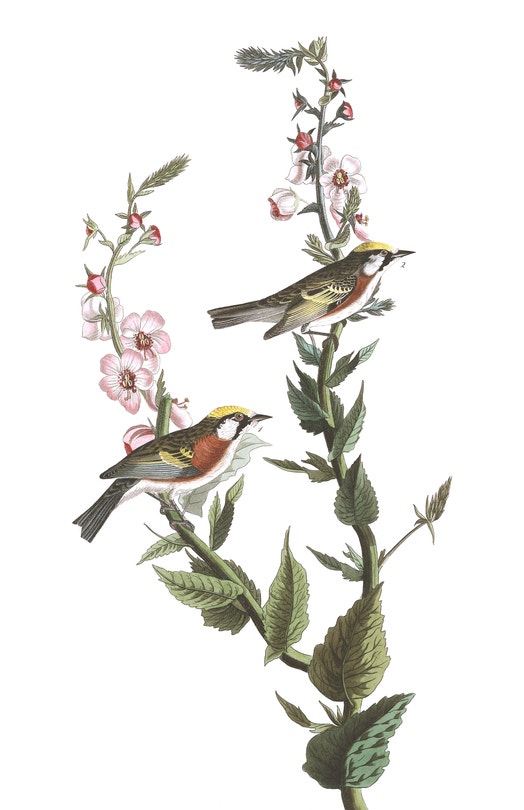
Saw there also, probably, a chestnut-sided warbler. A yellow crown, chestnut stripe on sides, white beneath, and two yellowish bars on wings. 

A red oak there has many large twigs drooping withered, apparently weakened by some insect. May it not be the locust of yesterday? 

Black willow is now gone to seed, and its down covers the water, white amid the weeds. 

The swamp-pink apparently two or even three days in one place. 

Saw a wood tortoise, about two inches and a half, with a black sternum and the skin, which becomes orange, now ochreous merely, or brown. The little painted tortoise of the morning was red beneath. Both these young tortoises have a distinct dorsal ridge. 

The garlic not in flower yet. 

I observed no Nuphar lutea var. Kalmiana on the Assabet. 

7 p. m. — To Cliff by railroad. 

Cranberry. Prinos Icevigatus, apparently two days.

Methinks the birds sing a little feebler nowadays. The note of the bobolink begins to sound somewhat rare. 

The sun has set, or is at least concealed in a low mist. 

As I go up Fair Haven Hill, I feel the leaves in the sprout-land oak, hickory, etc., cold and wet to my hand with the heavy dew that is falling. They look dry, but when I rub them with my hand, they show moist or wet at once. Probably I thus spread minute drops of dew or mist on their surface. It cannot be the warmth of my hand, for when I breathe on them it has no effect. 

I see one or two early blueberries prematurely turning. 

The Amelanchier Botryapium berries are already reddened two thirds over, and are somewhat palatable and soft, — some of them, — not fairly ripe.

H. D. Thoreau, Journal, June 15, 1854

A young painted tortoise . . . as big as a quarter of a dollar
. See April 21, 1855 ("Saw a painted turtle not two inches in diameter. This must be more than one year old."); April 24, 1856 ("A young Emys picta, one and five eighths inches long and one and a half wide. I think it must have been hatched year before last. "); August 28, 1856 ("I open the painted tortoise nest of June 10th, and find a young turtle partly out of his shell . . . The upper shell is fifteen sixteenths of an inch plus by thirteen sixteenths. He is already wonderfully strong and precocious."). See also A Book of the Seasons, by Henry Thoreau, the Painted Turtle (Emys picta)

Found a nest of tortoise eggs. . . which I brought home . . . and buried in the garden. See September 9, 1854 ("This morning I find a little hole, three quarters of an inch or an inch over, above my small tortoise eggs, and find a young tortoise coming out (apparently in the rainy night) just beneath. It is the Sternotherus odoratus"). See also A Book of the Seasons, by Henry Thoreau, the Musk Turtle (Sternothaerus odoratus)

This is the third afternoon that we have had a rumbling thunder-cloud arise in the east. . . I resolve to proceed on my voyage, knowing that I have a tight [roof] in my boat turned up. See June 13, 1854 (''I hear the muttering of thunder and see a dark cloud in the west-southwest horizon; am uncertain how far up-stream I shall get. An opposite cloud rises fast in the east-northeast, and now the lightning crinkles and I hear the heavy thunder. "); June 16, 1854 (" Three days in succession, — the 13th, 14th, and 15th, — thunder-clouds, with thunder and lightning, have risen high in the east, threatening instant rain, and yet each time it has failed to reach us. Thus it is almost invariably, methinks, with thunder-clouds which rise in the east; they do not reach us."). See also June 14, 1855 (" It suddenly begins to rain with great violence, and we in haste draw up our boat on the Clamshell shore, upset it, and get under, sitting on the paddles, and so are quite dry while our friends thought we were being wet to our skins. "); June 15, 1860 ("A thunder-shower in the north goes down the Merrimack. ");June 16, 1860  (" Thunder-showers show themselves about 2 P.M. in the west, but split at sight of Concord and go past on each side")

My skater insect. 
See March 25, 1858 ("Large skaters (Hydrometra) on a ditch"); March 29, 1853 (“Tried several times to catch a skater. Got my hand close to him; grasped at him as quick as possible; was sure I had got him this time; let the water run out between my fingers; hoped I had not crushed him; opened my hand; and lo! he was not there. I never succeeded in catching one.”); September 1, 1852 ("the surface of the pond is perfectly smooth except where the skaters dimple it, for at equal intervals they are scattered over its whole extent, and, looking west, they make a fine sparkle in the sun."); October 11, 1852 ("I could detect the progress of a water-bug over the smooth surface in almost any part of the pond, for they furrow the water slightly,. . . but the skaters slide over it without producing a perceptible ripple. ") See also A Book of the Seasons, by Henry Thoreau, the Water-bug (Gyrinus) and Skaters (Hydrometridae)

Saw probably, a chestnut-sided warbler. A yellow crown, chestnut stripe on sides, white beneath, and two yellowish bars on wings. See May 24, 1854 ("In woods the chestnut-sided warbler, with clear yellow crown and yellow on wings and chestnut sides. It is exploring low trees and bushes, often along stems about young leaves, and frequently or after short pauses utters its somewhat summer-yellowbird like note, say, tchip tchip, chip chip (quick), tche tche ter tchéa, —— sprayey and rasping and faint.”); May 20, 1856 ("I now see distinctly the chestnut-sided warbler (of the 18th and 17th), by Beck Stow’s. It is very lively on the maples, birches, etc., over the edge of the swamp. Sings eech eech eech | wichy wichy | tchea or itch itch itch | witty witty |tchea "); May 23, 1857 (“The chestnut-sided warbler . . .appears striped slate and black above, white beneath, yellow-crowned with black side-head, two yellow bars on wing, white side-head below the black, black bill, and long chestnut streak on side. Its song lively and rather long, about as the summer yellowbird, but not in two bars; tse tse tse \ te tsah tsah tsah \ te sak yer se is the rhythm.”)  See also A Book of the Seasons, by Henry Thoreau, the Chestnut-sided Warbler

Black willow is now gone to seed, and its down covers the water, white amid the weed.   See  June 10, 1853 ("The fuzzy seeds or down of the black (?) willows is filling the air over the river and, falling on the water, covers the surface.");   June 29, 1857  (""The river is now whitened with the down of the black willow, and I am surprised to see a minute plant abundantly springing from its midst and greening it,. . ., — like grass growing in cotton in a tumbler."); July 9, 1857 ("There is now but little black willow down left on the trees. . . . I think I see how this tree is propagated by its seeds." )See also A Book of the Seasons, by Henry Thoreau, the Propogation of the Willow.

The swamp-pink apparently two or even three days in one place. June 19, 1852 ("Is not this the carnival of the year when the swamp rose and wild pink are in bloom the last stage before blueberries come?") See also A Book of the Seasons, by Henry Thoreau, Swamp-pink

Methinks the birds sing a little feebler nowadays. See June 25, 1854 (“Through June the song of the birds is gradually growing fainter.”)

The note of the bobolink begins to sound somewhat rare.
See May 12, 1856 ("How much life the note of the bobolink imparts to the meadow! "); June 19, 1853 ("The strain of the bobolink now begins to sound a little rare. It never again fills the air as the first week after its arrival.") A Book of the Seasons,  by Henry Thoreau, the Bobolink

I see one or two early blueberries prematurely turning. The Amelanchier Botryapium berries are already red. See May 17, 1853 (“The petals have already fallen from the Amelanchier Botryapium, and young berries are plainly forming.”); May 30, 1854 (" I see now green high blueberries, and gooseberries in Hubbard's Close, as well as shad-bush berries and strawberries. "); June 7, 1854 ("I am surprised at the size of green berries. It is but a step from flowers to fruit.")

June 15. See A Book of the Seasons, by Henry Thoreau, June 15

Willow gone to seed
its down covers the water –
white amid the weeds.

A Book of the Seasons,  by Henry Thoreau 
 "A book, each page written in its own season, 
out-of-doors, in its own locality."
 ~edited, assembled and rewritten by zphx ©  2009-2024
https://tinyurl.com/hdt-540615

Popular Posts Last 30 Days.

The week ahead in Henry’s journal

The week ahead in Henry’s journal
A journal, a book that shall contain a record of all your joy.
"A stone fruit. Each one yields me a thought." ~ H. D. Thoreau, March 28, 1859


I sit on this rock
wrestling with the melody
that possesses me.