Showing posts with label vaccinium. Show all posts

Wednesday, July 15, 2020

Raspberries at their height


July 15. 

P. M. — To Ledum Swamp.

First notice Canada thistle, Aralia hispida, Stachys aspera, and Asclepias pulchra. 

The Eriophorum vaginatum done. 

The white orchis not yet, apparently, for a week or more. 

Hairy huckleberry still in bloom, but chiefly done. 

Gather a few Vaccinium Pennsylvanicum

Raspberries, in one swamp, are quite abundant and apparently at their height.

H. D. Thoreau, Journal, July 15, 1859

  The Eriophorum vaginatum done.See August 8, 1858 ("The peculiar plants of [Ledum] swamp are, then, as I remember, these nine: spruce, Andromeda Polifolia, Kalmia glauca, Ledum latifolium, Gaylussacia dumosa var. hirtella, Vaccinium Oxycoccus, Platanthera blephari glottis, Scheuchzeria palustris, Eriophorum 'vaginatum.")


The white orchis not yet, apparently, for a week or more. See .July 24, 1859 ("The white orchis will hardly open for a week.");  see also  July 23, 1854 ("The white orchis at same place, four or five days at least; spike one and three quarters by three inches."); August 8, 1858 (" I find at Ledum Swamp, near the pool, the white fringed orchis, quite abundant but past prime, only a few, yet quite fresh. It seems to belong to this sphagnous swamp and is some fifteen to twenty inches high, quite conspicuous, its white spike, amid the prevailing green. The leaves are narrow, half folded, and almost insignificant. It loves, then, these cold bogs"); August 11, 1852 ("Platanthera blephariglottis, white fringed orchis.")  See also A Book of the Seasons, by Henry Thoreau, The White Fringed Orchis


To Ledum Swamp.
Hairy huckleberry still in bloom, but chiefly doneGaylussacia bigeloviana  (Gaylussacia dumosa var. bigeloviana;  Gaylussacia dumosa, var. hirtella, Vaccinium dumosum) BOG HUCKLEBERRY  See July 24, 1859 ("The hairy huckleberry still lingers in bloom, — a few of them."); August 8, 1858 (“The Gaylussacia dumosa var. hiriella is the prevailing low shrub, perhaps. I See one ripe berry. This is the only inedible species of ' Vaccinieaz that I know in this town") See also August 30, 1856 ([Beck Stow's Swamp]"I have come out this afternoon a-cranberrying, chiefly to gather some of the small cranberry, Vaccinium Oxycoccus . . . I noticed also a few small peculiar-looking huckleberries hanging on bushes amid the sphagnum, and, tasting, perceived that they were hispid, a new kind to me. Gaylussacia dumosa var. hirtella. . . It grows from one to two feet high, the leaves minutely resinous- dotted — are not others ? — and mucronate, the racemes long, with leaf-like bracts now turned conspicuously red. Has a small black hairy or hispid berry, shining but insipid and inedible, with a tough, hairy skin left in the mouth ; has very prominent calyx-lobes.I seemed to have reached a new world, so wild a place that the very huckleberries grew hairy and were inedible. I feel as if I were in Rupert's Land, and a slight cool but agreeable shudder comes over me, as if equally far away from human society. . . . That wild hairy huckleberry, inedible as it was, was equal to a domain secured to me and reaching to the South Sea. That was an unexpected harvest. "); June 25, 1857 ("To Gowing's Swamp. . . . Gaylussacia dumosa apparently in a day or two.”): July 2, 1857 (" To Gowing's Swamp. . . .The Gaylussacia dumosa var. hirtella, not yet quite in prime. This is commonly an inconspicuous bush, eight to twelve inches high, half prostrate over the sphagnum in which it grows, together with the andromedas, European cranberry, etc., etc., but sometimes twenty inches high quite on the edge of the swamp. It has a very large and peculiar bell-shaped flower, with prominent ribs and a rosaceous tinge, and is not to be mistaken for the edible huckleberry or blueberry blossom. The flower deserves a more particular description than Gray gives it. But Bigelow says well of its corolla that it is "remarkable for its distinct, five angled form." Its segments are a little recurved. The calyx-segments are acute and pink at last; the racemes, elongated, about one inch long, one-sided; the corolla, narrowed at the mouth, but very wide above; the calyx, with its segments, pedicels, and the whole raceme (and indeed the leaves somewhat), glandular-hairy."); July 8, 1857 (to Gowing's Swamp. The Gaylussacia dumosa is now in prime at least"); August 30, 1860 ("Am surprised to find on Minott's hard land, where he once raised potatoes, the hairy huckleberry, which before I had seen in swamps only. The berries are in longer racemes or clusters than any of our huckleberries. They are improved, you would say, by the firmer ground. They are the prevailing berry all over this field. Are now in prime.");  August 30, 1856 ("Consider how remote and novel that [Gowings] swamp. Beneath it is a quaking bed of sphagnum, and in it grow Andromeda Polifolia, Kalmia glauca, menyanthes (or buck -bean), Gaylussacia dumosa, Vaccinium Oxycoccus, — plants which scarcely a citizen of Concord ever sees.”)

Gather a few Vaccinium Pennsylvanicum. See July 3, 1852 ("When the woods on some hillside are cut off, the Vaccinium Pennsylvanicum springs up, or grows more luxuriantly, being exposed to light and air, and by the second year its stems are weighed to the ground with clusters of blueberries covered with bloom, and much larger than they commonly grow, also with a livelier taste than usual, as if remembering some primitive mountain-side given up to them anciently.");July 11, 1857(“Vaccinium Pennsylvanicum ripe. Their dark blue with a bloom is a color that surprises me. ”); July 13, 1852 ("There are evidently several kinds of . . . blueberries not described by botanists: of the very early blueberries at least two varieties, one glossy black with dark-green leaves, the other a rich light blue with bloom and yellowish-green leaves"); July 13, 1854 (“The V. Pennsylvanicum is soft and rather thin and tasteless, mountain and spring like, with its fine light-blue bloom, very handsome, simple and ambrosial.”) July 16, 1857(“I hear of the first early blueberries brought to market.”)

Raspberries, in one swamp, are quite abundant and apparently at their height. July 2, 1851("Some of the raspberries are ripe, the most innocent and simple of fruits”); July 6, 1857 (“Rubus triflorus well ripe.”); July 11, 1857 ("I see more berries than usual of the Rubus triflorus in the open meadow near the southeast corner of the Hubbard meadow blueberry swamp.. . .They are dark shining red and, when ripe, of a very agreeable flavor and somewhat of the raspberry's spirit."); July 17, 1852 ("I pick raspberries dripping with rain beyond Sleepy Hollow. ");. . July 19, 1854 ("In Moore's Swamp I pluck cool, though not very sweet, large red raspberries in the shade") See also A Book of the Seasons,  by Henry Thoreau, the Raspberry

July 15. See A Book of the Seasons, by Henry Thoreau July 15

A Book of the Seasons, by Henry Thoreau
"A book, each page written in its own season,
out-of-doors, in its own locality."

~edited, assembled and rewritten by zphx © 2009-2021

Friday, July 3, 2020

The oven-bird's nest in Laurel Glen is near the edge of an open pine wood


July 3


July 3, 2013

Elder is now in its prime.

Buttercups are almost gone.

Clover is blackened.

The umbelled pyrola, apparently yesterday, as well as the P. rotundifolia and the P. elliptica, or shin-leaf.

The P. secunda, or one-sided pyrola, is already out of bloom.

The oven-bird's nest in Laurel Glen is near the edge of an open pine wood, under a fallen pine twig and a heap of dry oak leaves. Within these, on the ground, is the nest, with a dome-like top and an arched entrance of the whole height and width on one side. Lined within with dry pine-needles.

Mountain laurel lingers in the woods still.

The chestnut behind my old house site is fully out, and apparently has been partly so for several days.

There are no flowers on bass trees commonly this year.

Smooth sumach just opening and already resounding with bees.

The water-target appears to be in its prime, its flowers rising above the water. Remarkable for the thick jelly on its leaves and stem.

A smaller potamogeton is in flower there, — the small globose white flower. Why is it so often already torn up by the roots?


Poke a day or two in favorable places.

Dogsbane and Jersey tea are among the prevailing flowers now.

The Utricularia vulgaris now yellows low muddy water, as near the Lincoln bound by Walden.

The Vaccinium vacillans a day or two ripe.


Black huckleberries. 

Tansy on the causeway.

The Canada thistle.

The pinweeds have a reddish look, as if in flower. 

H. D. Thoreau, Journal, July 3, 1853

The oven-bird's nest in Laurel Glen is near the edge of an open pine wood. See June 7, 1853 ("The oven-bird runs from her covered nest, so close to the ground under the lowest twigs and leaves, even the loose leaves on the ground, like a mouse, that I can not get a fair view of her. "); June 10, 1855 ("Oven-bird’s nest with four eggs two thirds hatched, under dry leaves, composed of pine-needles and dry leaves and a hair or two for lining, about six feet south west of a white oak") See also A Book of the Seasons,  by Henry Thoreau, The Oven-bird

There are no flowers on bass trees commonly this year.  See June 3, 1857 (“The bass at the Island will not bloom this year. (?)”);  See also  June 21, 1853 (There are no flowers nor flower-buds on the bass this year, though it was so full last year."");June 30, 1852 ("The bass tree is budded"); July 4, 1853 ("The bass appears now — or a few trees — to have bloomed here and there prematurely.");  July 9, 1857 (“I see no flowers on the bass trees by this river this year, nor at Conantum.”)  and  A Book of Seasons, by Henry Thoreau, The Basswood

Dogsbane and Jersey tea are among the prevailing flowers now. See June 29, 1853 ("Jersey tea, just beginning.") and note to June 27, 1853 ("The dogsbane is one of the more interesting little flowers") see also 
A Book of the Seasons, by Henry Thoreau, Dogsbane and Indian hemp

Wednesday, January 22, 2020

Birds are commonly very rare in the winter

January 22

P. M. — Up river to Fair Haven Pond; return via Andromeda Ponds and railroad. 

Overcast, but some clear sky in southwest horizon; mild weather still. 

Where the sedge grows rankly and is uncut, as along the edge of the river and meadows, what fine coverts are made for mice, etc., at this season! It is arched over, and the snow rests chiefly on its ends, while the middle part is elevated from six inches to a foot and forms a thick thatch, as it were, even when all is covered with snow, under which the mice and so forth can run freely, out of the way of the wind and of foxes. 

After a pretty deep snow has just partially melted, you are surprised to find, as you walk through such a meadow, how high and lightly the sedge lies up, as if there had been no pressure upon it. It grows, perhaps, in dense tufts or tussocks, and when it falls over, it forms a thickly thatched roof. Nature provides shelter for her creatures in various ways. 

If the musquash, etc., has no longer extensive fields of weed and grass to crawl in, what an extensive range it has under the ice of the meadows and river sides! for, the water settling directly after freezing, an icy roof of indefinite extent is thus provided for it, and it passes almost its whole winter under shelter, out of the wind and invisible to men. 

The ice is so much rotted that I observe in many places those lunar-shaped holes, and dark places in the ice, convex up-stream, some times double-lunar. 

I perceive that the open places in the river do not preserve the same relative importance that they had December 29th. Then the largest four or five stood in this order: (1) below boat's place, (2) below junction, (3) Barrett's Bar, (4) Clamshell or else Hubbard's large as Hubbard's Bath. Which of the others is largest I am not quite sure. 

In other words, below junction and Hubbard's Bath (if not also Clamshell, not seen) retain about their former size, while below boat's place and Barrett's Bar have been diminished, especially below boat's place. 

Birds are commonly very rare in the winter. They are much more common at some times than at others. I see more tree sparrows in the beginning of the winter (especially when snow is falling) than in the course of it. I think that by observation I could tell in what kind of weather afterward these were most to be seen. 

Crows come about houses and streets in very cold weather and deep snows, and they are heard cawing in pleasant, thawing winter weather, and their note is then a pulse by which you feel the quality of the air, i. e., when cocks crow. 

For the most part, lesser redpolls and pine grosbeaks do not appear at all. 

Snow buntings are very wandering. They were quite numerous a month ago, and now seem to have quit the town. They seem to ramble about the country at will. 

C. says that he followed the track of a fox all yesterday afternoon, though with some difficulty, and then lost it at twilight. I suggested that he should begin next day where he had left off, and that following it up thus for many days he might catch him at last. 
"By the way," I asked, "did you go the same way the fox did, or did you take the back track?" 
"Oh," said he, "I took the back track. It would be of no use to go the other way, you know." 

Minott says that a hound which pursues a fox by scent cannot tell which way he is going; that the fox is very cunning and will often return on its track over which the dog had already run. It will ascend a high rock and then leap off very far to one side; so throw the dogs off the scent for a while and gain a breathing-spell. 

I see, in one of those pieces of drifted meadow (of last spring) in A. Wheeler's cranberry meadow, a black willow thus transplanted more than ten feet high and five inches in diameter. It is quite alive. 

The snow-fleas are thickest along the edge of the wood here, but I find that they extend quite across the river, though there are comparatively few over the middle. There are generally fewer and fewer the further you are from the shore. Nay, I find that they extend quite across Fair Haven Pond. There are two or three inches of snow on the ice, and thus they are revealed. There are a dozen or twenty to a square rod on the very middle of the pond. When I approach one, it commonly hops away, and if it gets a good spring it hops a foot or more, so that it is at first lost to me. Though they are scarcely the twentieth of an inch long they make these surprising bounds, or else conceal themselves by entering the snow. We have now had many days of this thawing weather, and I believe that these fleas have been gradually hopping further and further out from the shore. 

To-day, perchance, it is water, a day or two later ice, and no fleas are seen on it. Then snow comes and covers the ice, and if there is no thaw for a month, you see no fleas for so long. But, at least soon after a thaw, they are to be seen on the centre of ponds at least half a mile across. Though this is my opinion, it is by no means certain that they come here thus, for I am prepared to believe that the water in the middle may have had as many floating on it, and that these were afterward on the surface of the ice, though unseen, and hence under the snow when it fell, and ready to come up through it when the thaw came. 

But what do they find to eat in apparently pure snow so far from any land? Has their food come down from the sky with the snow? They must themselves be food for many creatures. This must be as peculiarly a winter animal as any. It may truly be said to live in snow. 

I see some insects, of about this form on the snow: 

I scare a partridge that was eating the buds and ends of twigs of the Vaccinium vacillans on a hillside. 

At the west or nesaea end of the largest Andromeda Pond, I see that there has been much red ice, more than I ever saw, but now spoiled by the thaw and snow. 

The leaves of the water andromeda are evidently more appressed to the twigs, and showing the gray under sides, than in summer.

H. D. Thoreau, Journal, January 22, 1860

See A Book of the Seasons,  by Henry Thoreau, Winter Birds


The water settling directly after freezing, an icy roof of indefinite extent is thus provided for it, and it passes almost its whole winter under shelter, out of the wind and invisible to men.   Compare January 22, 1859 (".Many are out in boats, steering outside the ice of the river over the newly flooded meadows, shooting musquash."); January 22, 1855 ("The muskrats driven out of their holes by the water are exceedingly numerous . . .We saw fifteen or twenty, at least, between Derby's Bridge and the Tarbell Spring, either swimming with surprising swiftness up or down or across the stream to avoid us, or sitting at the water's edge, or resting on the edge of the ice.") See also January 3, 1860 ("Melvin thinks that the musquash eat more clams now than ever, and that they leave the shells in heaps under the ice. As the river falls it leaves them space enough under the ice along the meadow's edge and bushes. I think he is right. He speaks of the mark of the tail, which is dragged behind them, in the snow."); January 24, 1856 ("I have not been able to find any tracks of muskrats this winter. I suspect that they very rarely venture out in winter with their wet coats "); January 27, 1860 (" I occasionally hear a musquash plunge under the ice next the shore.") See also A Book of the Seasons, by Henry Thoreau, the Musquash

Snow buntings are very wandering. They were quite numerous a month ago, and now seem to have quit the town.  See December 23, 1859 ("Then here they come, with a stiff rip of their wings as they suddenly wheel, and those peculiar rippling notes, flying low quite across the meadow, . . . Indeed, the flock, flying about as high as my head, divides, and half passes on each side of me. Thus they sport over these broad meadows of ice this pleasant winter day. ")

Crows are heard cawing in pleasant, thawing winter weather, and their note is then a pulse by which you feel the quality of the air, i. e., when cocks crow. See January 12, 1855 ("Perhaps what most moves us in winter is some reminiscence of far-off summer. . . .It is in the cawing of the crow, the crowing of the cock, the warmth of the sun on our backs. I hear faintly the cawing of a crow far, far away, echoing from some unseen wood-side. What a delicious sound! It is not merely crow calling to crow, for it speaks to me too. I am part of one great creature with him; if he has voice, I have ears. I can hear when he calls."); . March 16, 1858 ("The crowing of cocks and the cawing of crows tell the same story. The ice is soggy and dangerous to be walked on.")

"By the way," I asked, "did you go the same way the fox did, or did you take the back track?" See February 5, 1854 ("I followed on this trail so long that my thoughts grew foxy; though I was on the back track, I drew nearer and nearer to the fox each step.")

Minott says the fox is very cunning and will often return on its track over which the dog had already run. It will ascend a high rock and then leap off very far to one side; so throw the dogs off the scent. See January 30, 1855 (" Minott . . .told how Jake Lakin lost a dog, a very valuable one, by a fox leading him on to the ice on the Great Meadows and drowning him.")

At the west end of the largest Andromeda Pond, I see that there has been much red ice, more than I ever saw. See January 24, 1855 ("I was surprised to find the ice in the middle of the last [Andromeda] pond a beautiful delicate rose-color for two or three rods, deeper in spots. . . .This beautiful blushing ice! What are we coming to?"); January 25, 1855 ("I have come with basket and hatchet to get a specimen of the rose-colored ice.. . . The redness is all about an inch below the surface, the little bubbles in the ice there for half an inch vertically being coated interruptedly within or without with what looks like a minute red dust when seen through a microscope. . ."); March 4, 1855 ("Returning by the Andromeda Ponds, I am surprised to see the red ice visible still . . .It is melted down to the red bubbles, and I can tinge my finger with it there by rubbing it in the rotted ice.")

Saturday, September 7, 2019

Thermometer at 93°.

September 7. 

R. W. E. brought from Yarmouth this week Chrysopsis falcata in bloom and Vaccinium stamineum, deerberry, or squaw huckleberry, — the last with green berries, some as large as cranberries, globular (not pear-shaped), on slender peduncles, not edible, in low ground. 

Yesterday and to-day and day before yesterday, some hours of very warm weather, as oppressive as any in the year, one's thermometer at 93°.

H. D. Thoreau, Journal, September 7, 1853

Very warm weather, as oppressive as any in the year.  See September 7, 1858 (" It is an early September afternoon, melting warm and sunny. . .and ever and anon the hot z-ing of the locust is heard."); See also   June 25, 1858 ("the reflected heat is almost suffocating. 93° at 1 P. M"); July 11, 1857 ("Thermometer at 93° + this afternoon."); July 2, 1855 ("At 2 P. M. — Thermometer north side of house ... 93°")

Thursday, June 13, 2019

The Boston collection

June 13

To Boston. 

My rail's egg of June 1st looks like that of the Virginia rail in the Boston collection. 

A boy brought me a remarkably large cuckoo's egg on the 11th. Was it not that of the yellow-billed? The one in the collection looks like it. This one at B. is not only larger but lighter- colored. 

In the plates of Hooker's "Flora Boreali-Americana," the leaves of Vaccinium coespitosum are not so wide as the fruit; yet mine of Tuckerman's Ravine may be it.

H. D. Thoreau, Journal, June 13, 1859

My rail's egg of June 1st. See June 1, 1859 ("Some boys found yesterday, in tussock of sedge amid some flags in a wet place in Cyrus Hosmer's meadow, west of the willow-row, six inches above the water, the nest evidently of a rail, with seven eggs.I got one to-day. It is cream-colored, sprinkled with reddish-brown spots and more internal purplish ones, on most eggs (not on mine) chiefly about the larger end.")

A large cuckoo's egg. See June 5, 1856 ("A cuckoo’s nest with three light bluish-green eggs partly developed, short with rounded ends, nearly of a size;"); see also June 10, 1856 ("The cuckoo of June 5th has deserted her nest, and I find the fragments of egg-shells in it; probably because I found it.")

Mine of Tuckerman's Ravine. See July 19, 1858 (summing up the prevailing plants on Mt. Washington.)

Tuesday, May 28, 2019

A black snake at home in the trees.

May 28

Saturday. P. M. — To Cliffs. 

Some Salix rostrata seed begins to fly. 

Low blackberry in bloom on railroad bank. 

Also S. Torreyana seed, just begun to fly. S. pedicellaris long out of bloom there. 

At the extreme east side of Trillium Wood, come upon a black snake, which at first keeps still prudently, thinking I may not see him, — in the grass in open land, — then glides to the edge of the wood and darts swiftly up into the top of some slender shrubs there — Viburnum dentatum and alder — and lies stretched out, eying me, in horizontal loops eight feet high. The biggest shrub was not over one inch thick at the ground. At first I thought its neck was its chief member, — as if it drew itself up by it, — but again I thought that it rather (when I watched it ascending) extended its neck and a great part of its body upward, while the lower extremity was more or less coiled and rigid on the twigs from a point d'appui. Thus it lifted itself quickly to higher forks. When it moved along more horizontally, it extended its neck far, and placed it successively between the slender forks. 

This snake, some four feet long, rested there at length twelve feet high, on twigs, not one so big as a pipe-stem, in the top of a shad-bush; yet this one's tail was broken off where a third of an inch thick, and it could not cling with that. It was quick as thought in its motions there, and perfectly at home in the trees, so far was it from making the impression of a snake in an awkward position. 

Cinnamon fern pollen [sic]. 

Lady's-slipper pollen. These grow under pines even in swamps, as at Ledum Swamp. 

The lint from leaves sticks to your clothes now. 

Hear a rose-breasted grosbeak. 

Methinks every tree and shrub is started, or more, now, but the Vaccinium dumosum, which has not burst.

H. D.Thoreau, Journal, May 28, 1859

Some Salix rostrata seed begins to fly. See June 6, 1856 ("That willow, male and female, opposite to Trillium Woods on the railroad, I find to be the Salix rostrata, or long-beaked willow, one of the ochre-flowered.")

This snake, some four feet long, perfectly at home in the trees. See May 16, 2018 ("It surprised me very much to see it cross from tree to tree exactly like a squirrel, where there appeared little or no support for such a body."); May 30, 1855 ("See a small black snake run along securely through thin bushes (alders and willows) three or four feet from the ground, passing intervals of two feet easily,—very readily and gracefully, —ascending or descending")

The Vaccinium dumosum. See  August 30, 1856 (“I noticed also a few small peculiar-looking huckleberries hanging on bushes amid the sphagnum, and, tasting, perceived that they were hispid, a new kind to me. Gaylussacia dumosa var. hirtella . . .. Has a small black hairy or hispid berry, shining but insipid and inedible, with a tough, hairy skin left in the mouth.”); July 2, 1857 (“The Gaylussacia dumosa var. hirtella, not yet quite in prime. . . . not to be mistaken for the edible huckleberry or blueberry blossom.”); August 8, 1858 (“the Gaylussacia dumosa var. hiriella . . . the only inedible species of  Vaccinieoe that I know in this town”)


May 28. SeeA Book of the Seasons,, by Henry Thoreau, May 28

A Book of the Seasons,  by Henry Thoreau
"A book, each page written in its own season,
out-of-doors, in its own locality."
 ~edited, assembled and rewritten by zphx ©  2009-2021

Sunday, May 26, 2019

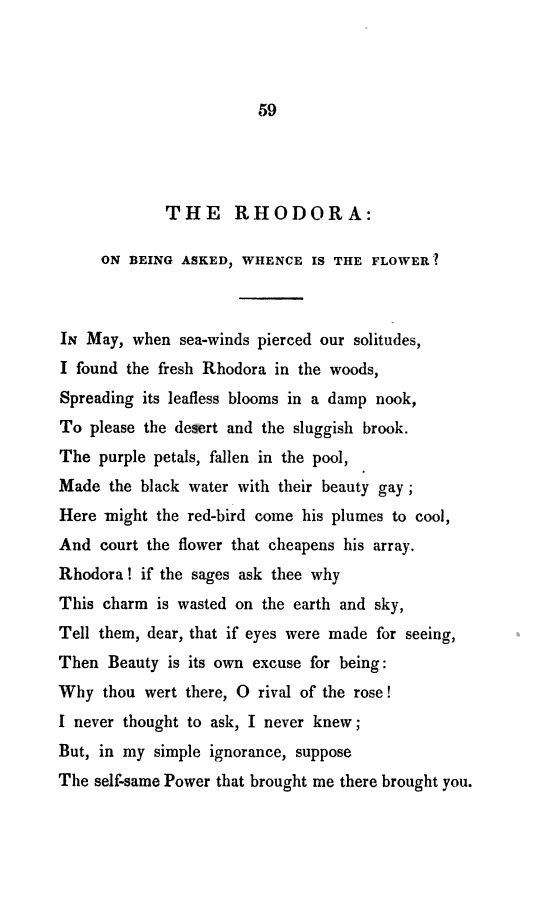
The rhodora at Ledum Swamp is now in its perfection, brilliant islands of color..

May 26. 
RWE 1847


Thursday. P. M. — To Ledum Swamp and Lee's Cliff.

Eleocharis tenuis in bloom, apparently the earliest eleocharis. 

The rhodora at Ledum Swamp is now in its perfection, brilliant islands of color. 

Eriophorum vaginatum, how long? 

Ledum out apparently two or three days. 

Andromeda Polifolia out, how long? 

Tall swamp huckleberry just budded to bloom. 

Do I not hear the nuthatch note in the swamp? 

Do not detect the scheuchzeria there yet.

The air is full of terebinthine odors to-day, — the scent of the sweet-fern, etc. 


May 26, 2019
Moss Ledge
The reddish leaves (and calyx) of the Vaccinium vacillans, just leafed, are interesting and peculiar now, perhaps more or less crimson. 

See a flock of cowbirds, the first I have seen. 

Cows in water, so warm has it got to be. 

Geranium (how long?), behind Bittern Cliff, and wild pink. 

Pitch pine pollen at Lee's. 

Cherry-birds. 

Ascendant potentilla abundant, how long? 

Juniperus repens pollen, how long ? 

Interrupted fern pollen [sic]. 

The dicksonia fern is one foot high, but not fairly unfolded. 

The tender white-downy stems of the meadow saxifrage, seen toward the westering sun, are very conspicuous and thick in the meadows now. 

A purple finch's nest in one of our firs.

H. D. Thoreau, Journal, May 26, 1859

The rhodora at Ledum Swamp is now in its perfection, brilliant islands of color.   See May 17, 1853 (“The rhodora is peculiar for being, like the peach, a profusion of pink blossoms on a leafless stem. This shrub is, then, a late one to leaf out.”);  May 17, 1858 ("Rhodora at Clamshell well out.”); May 18, 1853 ("The rhodora is one of the very latest leafing shrubs, for its leaf-buds are but just expanding, making scarcely any show yet, but quite leafless amid the blossoms."); May 18, 1855 ("Rhodora; probably some yesterday."); May 18, 1856 ("The rhodora there [Kalmia Swamp] maybe to-morrow. Elsewhere I find it (on Hubbard’s meadow) to-day. "); May 18, 1857 ("Pratt says he saw the first rhodora . . . out yesterday");  May 19, 1854 ("The rhodora is late, and is naked flowering."); May 27, 2016 (“Kalmia in prime, and rhodora.”); May 31, 1857 (“Rhodora now in its prime.”).

See a flock of cowbirds, the first I have seen. See September 6, 1858  (“To Ledum Swamp. Going over Clamshell Plain, I see a very large flock of a hundred or more cowbirds about some cows.”); August 25, 1855 (“They keep close to the cow’s head and feet, and she does not mind them; but when all go off . . .at my approach, the cow (about whom they were all gathered) looks off after them for some time, as if she felt deserted.”).

Cows in water, so warm has it got to be. See July 12, 1857 (“It is exceedingly sultry this afternoon, and few men are abroad. The cows stand up to their bellies in the river, lashing their sides with their tails from time to time.”).

May 26. See  A Book of the Seasons, by Henry Thoreau, May 26

Sunday, July 29, 2018

Looking for the Vaccinium Pennsylvanicum berries.

July 29

P. M. — To Pine Hill, looking for the Vaccinium Pennsylvanicum berries. 

I find plenty of bushes, but these bear very sparingly. They appear to bear but one or two years before they are overgrown. Also they probably love a cool atmosphere, for they bear annually on mountains, as Monadnock. Where the woods have been cut a year or two they have put forth fresh shoots of a livelier green. 

The V. vacillans berries are in dense clusters, raceme-like, as huckleberries are not. 

I see nowadays young martins perched on the dead tops of high trees; also young swallows on the telegraph wire. 

In the Chinese novel “ Ju-Kiao-Li, or The Two Fair Cousins,” I find in a motto to a chapter (quoted):


“He who aims at success should be continually on his guard against a thousand accidents. How many preparations are necessary before the sour plum begins to sweeten! . . . But if supreme happiness was to be attained in the space of an hour, of what use would be in life the noblest sentiments ?” (Page 227.)

Also these verses on page 230: —


“Nourished by the study of ten thousand dififerent works,
The pen in hand, one is equal to the gods.
 Let not humility take its rank amongst virtues:
Genius never yields the palm that belongs to it.”
 

Again, page 22, vol. ii: — 


“If the spring did not announce its reign by the return of the leaves,
The moss, with its greenish tints, would find favor in men’s eyes.”

H. D. Thoreau, Journal, July 29, 1858 

Looking for the Vaccinium Pennsylvanicum berries. See note to July 16, 1857(“I hear of the first early blueberries brought to market.”)

The V. vacillans berries are in dense clusters, raceme-like, as huckleberries are not. See July 29,, 1859 (“Vaccinium vacillans begin to be pretty thick and some huckleberries.”); July 31, 1856 (“How thick the berries — low blackberries, Vaccinium vacillans, and huckleberries — on the side of Fair Haven Hill! ”)

I see nowadays young martins perched on the dead tops of high trees.
See July 14, 1856 (“See and hear martins twittering on the elms by riverside.”); July 28, 1859 ("Saw young martins being fed on a bridge-rail yesterday.")

Young swallows on the telegraph wire. See July 5, 1854 ("One hundred and nine swallows on telegraph-wire at bridge within eight rods, and others flying about."); July 12, 1852 ("I observed this morning a row of several dozen swallows perched on the telegraph-wire by the bridge, and ever and anon a part of them would launch forth as with one consent, circle a few moments over the water or meadow, and return to the wire again."); July 12, 1859 (" They take their broods to the telegraph-wire for an aerial perch, where they teach them to fly.")

Note on blueberries: The difference between the often confused Huckleberry (Gaylussacia) and Lowbush Blueberry (Vaccinium angustifolium and vacillans) is inside the berry. Huckleberries have 10 hardened seeds inside each berry, compared the numerous softer seeds in the lowbush blueberry. The plants also differ in the texture of their stems. Huckleberry stems are smooth and lowbush blueberry are "warty". The two species of Lowbush Blueberry (angustifolium and vacillans) are distinguished by their leaves. Angustifolium has leaves which are a uniform green above and below; vacillans has leaves which are noticeably more pale beneath. ` Voyageur Country

July 29. See A Book of the Seasons, by Henry Thoreau, July 29

A Book of the Seasons,  by Henry Thoreau
 "A book, each page written in its own season, 
out-of-doors, in its own locality."
 ~edited, assembled and rewritten by zphx ©  2009-2024

Wednesday, May 9, 2018

This makes the fifth kind of frog or toad spawn that I have detected this year..

May 9. 

P. M. – To Holden and to Ledum Swamp. 

See two Rana halecina. They have the green halo, but are plain brown between the spots on the back and not vivid light-green like the one of May 4th

See in Ludwigia palustris ditch on Hubbard’s land evidently toad-spawn already hatched, or flatted out. I distinguish the long strings, now straighter than usual and floating thin on the surface. It is less obvious than frog-spawn, and might easily be overlooked on a slimy surface. I can distinguish the little pollywog while yet in the ova by their being quite small and very black. 

This makes the fifth kind of frog or toad spawn that I have detected this year.

See, in the Holden Swamp wood, the bird of May 3dIt has sly and inquisitive ways, holding down its head and looking at me at some distance off. It has a distinct white line along the bill and about the eyes, and no yellow there, as is said of the white-eyed vireo, and I am now inclined to think it the solitary vireo (?), whose song is not described, and which is considered rare. I should say it had a blue-slate head, and, I note, a distinct yellowish vent, which none of the vireos are allowed to have!! The sides of the body are distinctly yellow, but there is none at all on the throat or breast. 

Vaccinium Pennsylvanicum, – how long? — by owl nest tree. 


Sylvia Americana
The parti-colored warbler is very common and musical there, — my tweezer-bird, – making the screep screep screep note. It is an almost incessant singer and a very handsomely marked bird. It frequents the spruce trees, at regular intervals pausing as it flits, hops, and creeps about from limb to limb or up the main stem, and holding up its head, utters its humble notes, like ah twze twze twze, or ah twze twze twze twze.

I notice very large clams, apparently the Unio complanatus (vide two specimens in drawer), or common, in West Meadow Brook near the road, one more than four and a half inches long. I have before seen them very large in brooks. 


A dandelion perfectly gone to seed, a complete globe, a system in itself. 

My Rana palustris spawn, laid in house May 5th, in the sun this afternoon swells and rises to the surface in the jar, so that the uppermost ova project slightly above it.

H. D. Thoreau, Journal, May 9, 1858

The fifth kind of frog or toad spawn. See note to May 6, 1858 (Frogs of Massachusetts)

The parti-colored warbler — my tweezer-bird. See May 18, 1856 ("A Sylvia Americana, — parti-colored warbler, — in the Holden Wood, sings a, tshrea tshrea tshrea, tshre’ tshritty tshrit’." and note to May 13, 1856 ("The tweezer-bird or Sylvia Americana. . . . the parti-colored warbler, and was that switter switter switter switter swit also by it?.”) See also A Book of Seasons,  by Henry Thoreau, The Parti-Colored (Parula) Warbler (Sylvia Americana)

The bird of May 3d. . . . I am now inclined to think it the solitary vireo. See May 3, 1858.("See and hear a new bird to me. At first it was silent, and I took it for the common pewee, but, bringing my glass to bear on it, found it to be pure white throat and beneath, yellow on sides of body or wings, greenish-yellow back and shoulders, a white or whitish ring about eyes, and a light mark along side of head,
two white bars on wings, apparently black bill and dark or perhaps slate-colored (?) wings and above tail. It surprised me by singing in a novel and powerful and rich strain.")

Friday, July 28, 2017

We made this island the limit of our excursion in this direction.

July 28.

Tuesday. 


July 28, 2017


As I remember, Hodge mistakes when he says that "it [Chamberlain Lake] is erroneously represented on the charts, for it extends in a north-northeasterly, south-southwesterly direction about twelve miles." He appears to be thinking of the easterly part. 

On the north side there is quite a clearing, and we had been advised to ascend the bare hill there for the sake of the prospect. . . . 

Great trunks of trees stood dead and bare far out in the lake, making the impression of ruined piers of a city that had been, while behind, the timber lay criss-a-cross for half a dozen rods or more over the water. . . . 

We were glad to find on this carry some raspberries, and a few of the Vaccinium Canadense berries, which had begun to be ripe here.

H. D. Thoreau, Journal July 28, 1857

See The Maine Woods ("
When we awoke, we found a heavy dew on our blankets. I lay awake very early, and listened to the clear, shrill ah, te te, te te, te of the white-throated sparrow, repeated at short intervals, without the least variation, for half an hour, as if it could not enough express its happiness. Whether my companions heard it or not, I know not, but it was a kind of matins to me, and the event of that forenoon.
It was a pleasant sunrise, and we had a view of the mountains in the southeast. Ktaadn appeared about southeast by south.. . .we crossed the lake early, steering in a diagonal direction, northeasterly about four miles, to the outlet, which was not to be discovered till we were close to it. The Indian name, Apmoojenegamook, means lake that is crossed, because the usual course lies across, and not along it. This is the largest of the Allegash lakes, and was the first St. John water that we floated on. . . . We reached the outlet in about an hour, and carried over the dam there, which is quite a solid structure, and about one quarter of a mile farther there was a second dam. The reader will perceive that the result of this particular damming about Chamberlain Lake is, that the head-waters of the St. John are made to flow by Bangor. . . Below the last dam, the river being swift and shallow, though broad enough, we two walked about half a mile to lighten the canoe. . . .We were now fairly on the Allegash River, which name our Indian said meant hemlock bark. These waters flow northward about one hundred miles, at first very feebly, then southeasterly two hundred and fifty more to the Bay of Fundy . . . After perhaps two miles of river, we entered Heron Lake, called on the map Pongokwahem . . . This was the fourth great lake, lying northwest and southeast, like Chesuncook and most of the long lakes in that neighborhood, and, judging from the map, it is about ten miles long . . . 
Rounding a point, we stood across a bay for a mile and a half or two miles, toward a large island, three or four miles down the lake . . . We landed on the southeast side of the island, which was rather elevated and densely wooded, with a rocky shore, in season for an early dinner . . .
We made this island the limit of our excursion in this direction. We had now seen the largest of the Allegash lakes . . . 
This island, according to the map, was about a hundred and ten miles in a straight line north-northwest from Bangor, and about ninety-nine miles east-south east from Quebec. I rambled along the shore westward, which was quite stony, and obstructed with fallen, bleached, or drifted trees for four or five rods in width. I found growing on this broad, rocky, and gravelly shore the Salix rostrata, discolor, and lucida, Ranunculus recurvatus, Potentilla Norvegica, Scutellaria lateriflora, Eupatorium purpureum, Aster Tradescanti, Mentha Canadensis, Epilobium angustifolium (abundant), Lycopus sinuatus, Solidago lanceolata, Spiraa salicifolia, Antennaria margaraticea, Prunella, Rumex Acetosella, raspberries, wool-grass, Onoclea, etc. The nearest trees were Betula papyracea and excelsa, and Populus tremuloides. I give these names because it was my farthest northern point. . . .it clearing off, we resolved to start immediately, before the wind raised them again.. . .. At the outlet of Chamberlain Lake we were over taken by another gusty rain-storm, . . .At length, just before sunset, we set out again. It was a wild evening when we coasted up the north side of this Apmoojenegamook Lake. One. . .we were glad to reach, at length, in the dusk, the cleared shore of the Chamberlain Farm.. . .It is remarkable with what pure satisfaction the traveler in these woods will reach his camping-ground on the eve of a tempestuous night like this,. . .A shed-shaped tent will catch and reflect the heat like a Yankee baker, and you may be drying while you are sleeping. Some who have leaky roofs in the towns may have been kept awake, but we were soon lulled asleep by a steady, soaking rain, which lasted all night.")


July 28.
 
See A Book of the Seasons, by Henry Thoreau, July 28

We made this island 
the limit of our excursion 
in this direction.

A Book of the Seasons,  by Henry Thoreau, the limit of our excursion
A Book of the Seasons,  by Henry Thoreau
 "A book, each page written in its own season, 
out-of-doors, in its own locality."
 ~edited, assembled and rewritten by zphx ©  2009-2024

Saturday, July 15, 2017

Two woodcocks in the shady alder marsh at Well Meadow go off with a whistling flight.

July 15

July 15, 2017


Tephrosia is generally considerably past its prime. 

Vaccinium vacillans berries. 

Scare up a snipe (?) by riverside, which goes off with a dry crack, and afterward two woodcocks in the shady alder marsh at Well Meadow, which go off with a whistling flight. 

Rhus glabra under Cliffs, not yet. 

When I entered the woods there, I was at once pursued by a swarm of those wood flies which gyrate around your head and strike your hat like rain-drops. As usual, they kept up with me as I walked, and gyrated about me still, as if I were stationary, advancing at the same time and receiving reinforcements from time to time. Though I switched them smartly for half a mile with some indigo-weed, they did not mind it in the least, nor a better switch of Salix tristis; but though I knocked down many of them, they soon picked them selves up and came on again. 

They had a large black spot on their wings and some yellowish rings about their abdomens. They keep up a smart buzzing all the while. When I descended into the swamp at Well Meadow, they deserted me, but soon pursued me again when I came out. 

Apparently the same swarm followed me quite through the wood (with this exception), or for two miles, and they did not leave me till I had got some twenty rods from the woods toward Hayden's. They did not once sting, though they endeavored sometimes to alight on my face. What they got by their perseverance I do not know, — unless it were a switching.

H. D. Thoreau, Journal, July 15, 1857

Scare up a snipe (?) by riverside, which goes off with a dry crack, and afterward two woodcocks in the shady alder marsh at Well Meadow, which go off with a whistling flight. See July 3, 1856 ("I scare up one or two woodcocks in different places by the shore, where they are feeding, and in a meadow. They go off with a whistling flight. Can see where their bills have probed the mud. ") July 11, 1856 (“I scare up several apparent snipes (?), which go off with a crack. They are rather heavy-looking, like woodcocks. ”):  July 13, 1852 ("Each day now I scare up woodcocks by shady springs and swamps.");  July 18, 1856 (“Again scare up a woodcock, apparently seated or sheltered in shadow of ferns in the meadow on the cool mud in the hot afternoon. ”) See also A Book of the Seasons by Henry Thoreau: the SnipeA Book of the Seasons,  by Henry Thoreau, The American Woodcock

Rhus glabra under Cliffs, not yet. See  July 12, 1856 (“Smooth sumach, apparently yesterday.”): July 24, 1852 (“The smooth sumach berries are red. ”): July 31,1856 (“The smooth sumach is pretty generally crimson-berried on the Knoll . . .”)


July 15. See A Book of the Seasons, by Henry Thoreau July 15

A Book of the Seasons, by Henry Thoreau
"A book, each page written in its own season,
out-of-doors, in its own locality."

~edited, assembled and rewritten by zphx © 2009-2021

Popular Posts Last 30 Days.

The week ahead in Henry’s journal

The week ahead in Henry’s journal
A journal, a book that shall contain a record of all your joy.
"A stone fruit. Each one yields me a thought." ~ H. D. Thoreau, March 28, 1859


I sit on this rock
wrestling with the melody
that possesses me.