Showing posts with label shells. Show all posts

Monday, November 18, 2019

The thoughts of poets.


November18. 


Conchologists call those shells "which are fished up from the depths of the ocean" and are never seen on the shore, which are the rarest and most beautiful, Pelagii, but those which are cast on shore and are never so delicate and beautiful as the former, on account of exposure and abrasion, Littorales

So it is with the thoughts of poets: some are fresh from the deep sea, radiant with unimagined beauty, — Pelagii; but others are comparatively worn, having been tossed by many a tide, — Littorales, — scaled off, abraded, and eaten by worms.

H. D. Thoreau, Journal, November 18, 1853

Sunday, July 12, 2015

(Cape Cod) Fog wets your beard and papers


July 12

I measure a horseshoe on the back side twenty-two inches by eleven. 

The low sand-downs between East Harbor head and sea are thinly covered with beach-grass, seaside goldenrod, and beach pea. 

Fog wets your beard till twelve o’clock.

Long slender seaside plantain leaf at East Harbor head. Solanum (with white flowers) nigrum in marsh. Spergularia rubra var. marina

Great many little shells by edge of marsh - Auricula bidentata and Succinea avara

Great variety of beetles, dor-bugs, etc., on beach. I have one green shining one. Also butterflies over bank. 

I was surprised to see great spider-holes in pure sand and gravel, with a firm edge, where man could not make a hole without the sand sliding in, —in tunnel form.

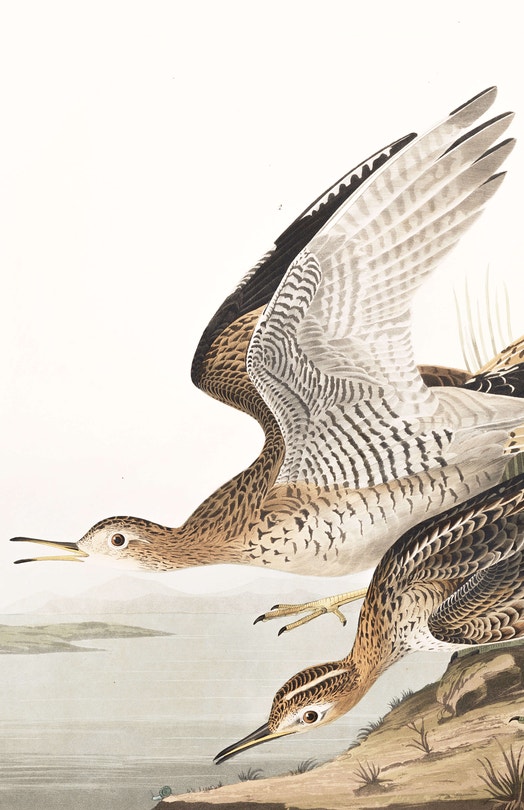
 "In Massachusetts, and to the eastward of that state, 
this species is best known by the name of 'Upland Plover,'” 
  ~ J. J. Audubon 

The upland plover begins with a quivering note somewhat like a tree-toad and ends with a long, clear, somewhat plaintive or melodious hawk-like scream. I never heard this very near to me, and when I asked the inhabitants about it they did not know what I meant.* It hovers on quivering wing, and alights by a steep dive.

My paper so damp in this house I can’t press flowers without mildew, nor dry my towel for a week.

H. D. Thoreau, Journal, July 12, 1855


*Frank Forester, in “Manual for Young Sportsmen,” 1856, page 308, says, 
“This bird has a soft plaintive call or whistle of two notes, which have something of a ventriloquial character and possess this peculiarity, that when uttered close to the ear, they appear to come from a distance, and when the bird is really two or three fields distant, sound as if near at hand.”
Upland ploever  See  Augusst (?), 1850 ("As I was stalking over the surface of this planet in the dark to-night, I started a plover resting on the ground and heard him go off with whistling wings."); June 15, 1860 ("I heard the familiar willet note of the upland plover and  looking up, saw one standing erect — like a large tell tale, or chicken with its head stretched up — on the rail fence. After a while it flew off southwest and l , then wheeled and went a little higher down the river . Of pigeon size, but quick quivering wings. Finally rose higher and flew more or less zigzag, as if uncertain where it would alight, and at last, when almost out of sight  it pitched down into a field near Cyrus Hubbard's. It was the same note I heard so well on Cape Cod in July, '55")

Thoreau's  Upland Plover is the Upland Sandpiper (Bartramia longicauda).His Peetweet  is the Spotted Sandpiper  (Actitis macularia). He also observed the Lesser Golden-Plover (Pluvialis dominica ) and Piping Plover (Charadrius melodus) See Thoreau's Birds

July 12. See A Book of the Seasons,  by Henry Thoreau, July 12

The upland plover
hovers on quivering wing –
 alights by steep dive.

A Book of the Seasons,  by Henry Thoreau
"A book, each page written in its own season,
out-of-doors, in its own locality.”
~edited, assembled and rewritten by zphx © 2009-2021 

Wednesday, March 11, 2015

Floating meadows explained,pine needles examined

March 11.

P. M. — To Annursnack. Clear and rather pleasant; the ground again bare; wind northerly. 

I am surprised to see how rapidly that ice that covered the meadows on the 1st of March has disappeared under the influence of the sun alone. The greater part of what then lay on the meadows a foot thick has melted—two thirds at least. 

On Abel Hosmer’s pasture, just southeast of the stone bridge, I see where the sod was lifted up over a great space in the flood of the 17th of February. I see one piece of crust, twelve feet by six, turned completely topsy turvy with its ice beneath it. This has prevented the ice from melting, and on examining it I find that the ice did not settle down on to the grass after the water went down and then freeze to it, for the blades of grass penetrate one inch into the ice, showing that, the water being shallow, the whole froze, and the grass was frozen in, and thus, when the water rose again, was lifted up. 

A bluebird day before yesterday in Stow.

Many of those dirty-white millers or ephemera in the air.

As I sit at the base of Annursnack the earth appears almost completely bare, but from the top I see considerable white ice here and there. What is left is only the whitened and rotting ice, which, being confined to the lowest hollows and meadows, is only observed from a height. 

At this season, — before grass springs to conceal them, — I notice those pretty little roundish shells on the tops of hills; one to-day on Annursnack. 

I see pitch pine needles looking as if whitewashed, thickly covered on each of the two slopes of the needle with narrow, white, oyster-shell-like latebra or chrysalids of an insect.

H. D. Thoreau, Journal, March 11, 1855

Many of those dirty-white millers or ephemera in the air. See March 3, 1855 (“I see a dirty-white miller fluttering about over the winter-rye patch next to Hubbard’s Grove. ”)

Popular Posts Last 30 Days.

The week ahead in Henry’s journal

The week ahead in Henry’s journal
A journal, a book that shall contain a record of all your joy.
"A stone fruit. Each one yields me a thought." ~ H. D. Thoreau, March 28, 1859


I sit on this rock
wrestling with the melody
that possesses me.