Showing posts with label Corydalis. Show all posts

Sunday, August 29, 2021

Tall gerardia, one flower only left


August 29.

Though it is early, my neighbor's hens have strayed far into the fog toward the river.

I find a wasp in my window, which already appears to be taking refuge from winter and unspeakable fate.

Might I not walk a little further, till I hear new crickets, till their creak has acquired some novelty, as if they were a new species whose habitat I had reached?

The air is filled with mist, yet a transparent mist, a principle in it you might call flavor, which ripens fruits This haziness seems to confine and concentrate the sunlight, as if you lived in a halo. It is August.

A flock of forty-four young turkeys with their old, half a mile from a house on Conantum by the river, the old faintly gobbling, the half-grown young peeping. Turkey-men

Gerardia glauca
(quercifolia, says one), tall gerardia, one flower only left; also Corydalis glauca

H. D. Thoreau, Journal, August 29, 1851

Tuesday, May 29, 2018

So the cows eat barberries, and help disperse or disseminate them exactly as they do the apple!

May 29


May 29, 2018


P. M. – To Bateman's Pond via Pratt's. 

Buttonwood, one tree, not for two or three days. 

Rubus triflorus, well out, at Calla Swamp, how long?

Calla apparently in two or three, or three or four days, the very earliest. 

Arethusa bulbosa, well out. 

Cornus Canadensis blooms apparently with C. florida; not quite yet. 

I mistook dense groves of little barberries in the droppings of cows in the Boulder Field for apple trees at first. So the cows eat barberries, and help disperse or disseminate them exactly as they do the apple! That helps account for the spread of the barberry, then. 

See the genista, winter-killed at top, some seven or eight rods north of the southernmost large boulder in the Boulder Field. 

Cannot find any large corydalis plants where it has been very plenty. 

A few of the Cornus florida buds by the pond have escaped after all. 

Farmer describes an animal which he saw lately near Bateman's Pond, which he thought would weigh fifty or sixty pounds, color of a she fox at this season, low but very long, and ran somewhat like a woodchuck. I think it must have been an otter, though they are described as dark glossy-brown.

H. D. Thoreau, Journal, May 29, 1858

Calla apparently in two or three, or three or four days, the very earliest. See June 7, 1857 (“Pratt has got the Calla palustris, in prime. . .from the bog near Bateman's Pond”) and note to July 2, 1857 ("Calla palustris . . . at the south end of Gowing's Swamp. Having found this in one place, I now find it in another.")

Arethusa bulbosa, well out. See note to May 29, 1856 ("Two Arethusa bulbosa at Hubbard’s Close apparently a day or two.")

See the genista, winter-killed at top, some seven or eight rods north of the southernmost large boulder in the Boulder Field. See May 21, 1858 ("Pratt shows me what I take to be Genista tinctoria (not budded) from the Boulder Field");  June 28, 1858  ("The Genista tinctoria has been open apparently a week. It has a pretty and lively effect, reminding me for some reason of the poverty-grass."). See also April 21, 1852 ("In the pasture beyond the brook, where grow the barberries, huckleberries, — creeping juniper, etc., are half a dozen huge boulders, which look grandly now in the storm, covered with greenish-gray lichens, alternating with the slatish-colored rock. Slumbering, silent, . . .I look down on some of them as on the backs of oxen. A certain personality, or at least brute life, they seem to have."); November 3, 1857 ("It is singular that several of those rocks should be thus split into twins. Even very low ones, just appearing above the surface, are divided and parallel, having a path between them. It would be something to own that pasture with the great rocks in it")

The Cornus florida by the pond. See May 18, 1857 (“There is a large tree [Cornus florida] on the further side the ravine near Bateman's Pond and another by some beeches on the rocky hillside a quarter of a mile northeast.”)

Tuesday, July 11, 2017

And now the lark must look out for the mowers.

July 11

July11,  2016


P. M. — To Corner Spring and Cliffs. 

Haying is fairly begun, and for some days I have heard the sound of the mowing-machine, and now the lark must look out for the mowers. 

The flowering fern, which is so much larger in the copses, though much is brown and effete, is still perhaps in prime. 

Vaccinium Pennsylvanicum ripe. Their dark blue with a bloom is a color that surprises me. 

The cymbidium is really a splendid flower, with its spike two or three inches long,  of commonly three or five large, irregular, concave, star-shaped purple flowers, amid the cool green meadow-grass. It has an agreeable fragrance withal. 

I see more berries than usual of the Rubus triflorus in the open meadow near the southeast corner of the Hubbard meadow blueberry swamp. Call it, perhaps, Cymbidium Meadow. They are dark shining red and, when ripe, of a very agreeable flavor and somewhat of the raspberry's spirit. 

Petty morel not yet, by the bars this side Corner Spring; nor is the helianthus there budded yet.

Apocynum cannabinum, with its small white flowers and narrow sepals half as long as whole corolla, apparently two or three days. 

The trumpet-weed is already as high as my head, with a rich glaucous bloom on its stem. 

Indeed, looking off into the vales from Fair Haven Hill, where a thin blue haze now rests almost universally, I see that the earth itself is invested with a glaucous bloom at this season like some fruits and rapidly growing stems. 

Thermometer at 93° + this afternoon. 

Am surprised to find the water of Corner Spring spoiled for the present, however much I clear it out, by the numbers of dead and dying frogs in it (Rana palustris). There is a mortality among which has made them hop to this spring to die. 

There is an abundance of corydalis on the top of the Cliffs, but most of it is generally out of bloom, i. e. excepting a twig or two, and it is partly withered, not so fresh as that in our garden; but some in the shade is quite green and fresh and abundantly blooming still.

H. D. Thoreau, Journal, July 11, 1857

And now the lark must look out for the mowers. See July 11, 1854 ("I hear Conant's cradle cronching the rye behind the fringe of bushes in the Indian field. Reaping begun."); July 29, 1853 ("About these times some hundreds of men with freshly sharpened scythes make an irruption into my garden when in its rankest condition, and clip my herbs all as close as they can,") See also A Book of the Seasons, by Henry Thoreau, Haymaking and June 30,1851 ("The lark sings a note which belongs to a New England summer evening. "); July 16, 1851 ("The lark sings in the meadow; the very essence of the afternoon is in his strain. This is a New England sound"); July 18, 1852 ("The larks and blackbirds and kingbirds are heard in the meadows."); July 26, 1853 ("Lark, too seen now, four or five together, sing as of yore"); July 26, 1856 ("I see young larks fly pretty well before me.")

Rubus triflorus in the open meadow near the southeast corner of the Hubbard meadow blueberry swamp. See note to July 6, 1857 ("Rubus triflorus well ripe.") See also A Book of the Seasons,  by Henry Thoreau, the Raspberry

Apocynum cannabinum, with its small white flowers and narrow sepals. See note to September 2, 1856 ("Some years ago I sought for Indian hemp (Apocynum cannabinum) hereabouts in vain, and concluded that it did not grow here. A month or two ago I read again, as many times before, that its blossoms were very small, scarcely a third as large as those of the common species, and for some unaccountable reason this distinction kept recurring to me, and I regarded the size of the flowers I saw, though I did not believe that it grew here; and in a day or two my eyes fell on it, aye, in three different places, and different varieties of it.")

Thermometer at 93° + this afternoon. See July 2, 1855 ("At 2 P. M. — Thermometer north side of house ... 93°") 

Dead and dying frogs in Corner Spring (Rana palustris). See A Book of the Seasons, by Henry Thoreau,  The   Pickerel frog  (Rana palustris or Lithobates palustris)

July 11. See A Book of the Seasons, by Henry Thoreau, July 11

A Book of the Seasons, by Henry Thoreau
"A book, each page written in its own season,
out-of-doors, in its own locality.”
~edited, assembled and rewritten by zphx © 2009-2021

Saturday, May 20, 2017

Postpone your journey till the May storm is over.

May 20. 

Began to rain the latter part of yesterday, and rains all day against all desire and expectation, raising the river and, in low land, rotting the seed. Gardeners wish that their land had not been planted nor plowed. Postpone your journey till the May storm is over.

Starflower
May 20, 2017


It has been confidently asserted and believed that if the cold in the winter exceeded a certain degree it surely killed the peach blossoms. Last winter we had greater cold than has ever been generally observed here, and yet it is a remarkable spring for peach blossoms; thus once for all disproving that assertion. 

Everything in the shape of a peach tree blossoms this season, even a mutilated shrub on the railroad causeway, sprung from a stone which some passenger cast out. Nevertheless the lowest limbs, which were covered by the drifts, have blossomed much the earliest and fullest, as usual, and this after-blow is quite unexpected. Peach trees are revealed along fences where they were quite unobserved before. 

The expression in Sophocles' (Edipus at Colonos, "White Colonos," said to refer to the silvery soil, reminded me at first of the tracts now whitened by the pyrus blossoms, which may be mistaken for hoary rocks. Vide this description of Colonos. 

Have all the Canada plums that striking pink color at the base of the blossoms at last? 

I find that the corydalis sprig which I brought home five days ago keeps fresh and blossoms remarkably well in water, — its delicate bright flesh-colored or pink flowers and glaucous leaves! 

How suddenly, after all, pines seem to shoot up and fill the pastures! 

I wonder that the farmers do not earlier encourage their growth. To-day, perchance, as I go through some run-out pasture, I observe many young white pines dotting the field, where last year I had noticed only blackberry vines; but I see that many are already destroyed or injured by the cows which have dived into them to scratch their heads or for sport (such is their habit; they break off the leading shoot and bend down the others of different evergreens), or perchance where the farmer has been mowing them down, and I think the owner would rather have a pasture here than a wood-lot. A year or two later, as I pass through the same field, I am surprised to find myself in a flourishing young wood-lot, from which the cows are now carefully fenced out, though there are many open spaces, and I perceive how much further advanced it would have been if the farmer had been more provident and had begun to abet nature a few years earlier. 

It is surprising by what leaps — two or three feet in a season — the pines stretch toward the sky, affording shelter also to various hardwoods which plant themselves in their midst. 

I do not know a white pine in the town which has been set out twenty-five years.

H. D. Thoreau, Journal, May 20, 1857

Postpone your journey till the May storm is over. See May 17, 1853 ("Does not summer begin after the May storm?”); compare May 13, 1852 (" They who do not walk in the woods in the rain never behold them in their freshest, most radiant and blooming beauty.”)

Have all the Canada plums that striking pink color at the base of the blossoms at last?
See note to May 10, 1856 (“Mr. Prichard’s Canada plum will open as soon as it is fair weather.”)

White pines. See April 29, 1857 (“I am surprised to see how some blackberry pastures and other fields are filling up with pines, trees which I thought the cows had almost killed two or three years ago; so that what was then a pasture is now a young wood-lot.”); May 18, 1857 ("Many are now setting out pines and other evergreens, transplanting some wildness into the neighborhood of their houses. I do not know of a white pine that has been set out twenty-five years in the town. It is a new fashion.”); May 19, 1854 ("The white pine shoots are now two or three inches long generally, — upright light marks on the body of dark green.”); July 4, 1860 ("The white pine shoot which on the 19th of June had grown sixteen and a quarter inches and on the 27th twenty and three quarters is now twenty-three and an eighth inches long.”)

Wednesday, May 3, 2017

Now is the time to paddle these smooth warm vernal waters.

May 3

Sunday. A remarkably warm and pleasant morning. A. M. — To Battle-Ground by river. 

I heard the ring of toads at 6 a. m. The flood on the meadows, still high, is quite smooth, and many are out this still and suddenly very warm morning, pushing about in boats. 

Now, thinks many a one, is the time to paddle or push gently far up or down the river, along the still, warm meadow's edge, and perhaps we may see some large turtles, or muskrats, or otter, or rare fish or fowl. It will be a grand forenoon for a cruise, to explore these meadow shores and inundated maple swamps which we have never explored. Now we shall be recompensed for the week's confinement to shop or garden. 

We will spend our Sabbath exploring these smooth warm vernal waters. Up or down shall we go? To Fair Haven Bay and the Sudbury meadows, or to Ball's Hill and Carlisle Bridge? Along the meadow's edge, lined with willow and alders and maples, under the catkins of the early willow, and brushing those of the sweet-gale with our prow, where the sloping pasture and the plowed ground, submerged, are fast drinking up the flood. What fair isles, what remote coast shall we explore? What San Salvador or Bay of All Saints arrive at? All are tempted forth, like flies, into the sun. 

All isles seem fortunate and blessed to-day; all capes are of Good Hope. 

The same sun and calm that tempts the turtles out tempts the voyagers. It is an opportunity to explore their own natures, to float along their own shores. The woodpecker cackles and the crow black bird utters his jarring chatter from the oaks and maples. All well men and women who are not restrained by superstitious custom come abroad this morning by land or water, and such as have boats launch them and put forth in search of adventure. 

Others, less free or, it may be, less fortunate, take their station on bridges, watching the rush of water through them and the motions of the departing voyagers, and listening to the notes of blackbirds from over the smooth water. They see a swimming snake, or a muskrat dive, — airing and sunning themselves there until the first bell rings. Up and down the town, men and boys that are under subjection are polishing their shoes and brushing their go-to-meeting clothes. 

I, a descendant of Northmen who worshipped Thor, spend my time worshipping neither Thor nor Christ; a descendant of Northmen who sacrificed men and horses, sacrifice neither men nor horses. I care not for Thor nor for the Jews. I sympathize not to-day with those who go to church in newest clothes and sit quietly in straight-backed pews. 

I sympathize rather with the boy who has none to look after him, who borrows a boat and paddle and in common clothes sets out to explore these temporary vernal lakes. I meet such a boy paddling along under a sunny bank, with bare feet and his pants rolled up above his knees, ready to leap into the water at a moment's warning. Better for him to read "Robinson Crusoe" than Baxter's "Saints' Rest."

I hear the soft, purring, stertorous croak of frogs on the meadow. 

The pine warbler is perhaps the commonest bird heard now from the wood-sides. It seems left [to] it almost alone to fill their empty aisles. 

The above boy had caught a snapping turtle, the third he had got this year. The first he said he got the fore part of April. He also had caught a bullfrog sitting on the shore just now. 

Thermometer from 1 to 2 p. m., at 78°. 

Neighbors come forth to view the expanding buds in their gardens. 

I see where some fish, probably a pickerel, darted away from high on the meadows, toward the river, and swims so high that it makes a long ripple for twenty rods. 

3 p. m. — To Cliffs. 

In the pool which dries up in Jonathan Wheeler's orchard, I see toads, or maybe frogs, spread out on the surface, uttering a short, loud, peculiar croak, not like that of the early croaking frog, nor the smooth, purring, stertorous one of this morning, but a coarse belching croak, at a little distance like quor and quar, being on various keys, but nearer like ow-oo-uk though one syllable or ar-r-r. Thus they lie, perhaps within a foot or two and facing each other, and alternately throwing their heads back, i. e. upward, swelling their white throats and uttering this abominable noise. 

Then one rushes upon the other, leaps upon him. They struggle and roll over and sink for a moment, and presently they show their heads again a foot or two apart. There are a dozen or more, with very prominent eyes, with bright golden irides. 

In another pool, in Warren's meadow, I hear the ring of toads and the peep of hylodes, and, taking off my stockings and shoes, at length stand in their midst. There are a hundred toads close around me, copulating or preparing to. These look at a little distance precisely like the last, but no one utters that peculiar rough, belching croak, only their common musical ring, and occasionally a short, fainter, interrupted, quivering note, as of alarm. They are continually swimming to and leaping upon each other. I see many large reddish-brown ones, probably females, with small grayish ones lying flat on their backs, the fore feet clasped around them. These commonly lie flat on the bottom, often as if dead, but from time [to time] the under one rises with its load to the surface, puts its nose out and then sinks again. 

The single ones leap upon these double ones and roll them over in vain like the rest. It is the single ones that ring and are so active. They make great gray, yellowish, greenish, or whitish bubbles (different specimens being thus various), as big as their heads. One that rings within a foot of me seems to make the earth vibrate, and I feel it and am thrilled to my very spine, it is so terrene a sound. It reminds me of many a summer night on the river. A bubbling ring, which is continuous about a minute, and then its bag must be inflated again. 

When I move suddenly, it is the single ones chiefly that conceal themselves. The others are not so easily disturbed. You would hardly believe that toads could be so excited and active. When that nearest ringer sounded, the very sod by my feet (whose spires rose above water) seemed to tremble, and the earth itself, and I was thrilled to my spine and vibrated to it. They like a rest for their toes when they ring. It is a sound as crowded with protuberant bubbles as the rind of an orange. A clear, ringing note with a bubbling trill. It takes complete possession of you, for you vibrate to it, and can hear nothing else. 

At length, too, a hylodes or two were heard close about me, but not one was seen. The nearest seemed to have his residence in my ear alone. It took such possession of my ear that I was unable to appreciate the source whence it came. 

It is so warm, mosquitoes alight on my hands and face. 

As I approach the entrance to the spring path, I hear some chickadees phe-be-ing. One sings phe-e — be' be — be' be, just as if another struck in immediately after the usual strain. 

Salix tristis is out to-day at least, perhaps yesterday, by what I may call S. tristis Path. 

Viola ovata is pretty common there. 

Above the Cliffs, scare up a pair of turtle doves from the stubble, which go off with their shrill rattling whistle. 

Corydalis glauca is five inches high. The pistillate Equisetum arvense shows itself. 

To-day we sit without fire. 

Emerson says that Brewer tells him my "night warbler" is probably the Nashville warbler.

H. D. Thoreau, Journal, May 3, 1857

I heard the ring of toads at 6 a. m. See A Book of the Seasons, by Henry Thoreau, The ring of toads

Emerson says that Brewer tells him my "night warbler" is probably the Nashville warbler.  Thoreau;s night-warbler  is likely the oven-bird making its flight call. According to Emerson the night warbler is "a bird he had never identified, had been in search of twelve years, which always, when he saw it, was in the act of diving down into a tree or bush.”  See note to May 19, 1858 (" Heard the night-warbler begin his strain just like an oven-bird! I have noticed that when it drops down into the woods it darts suddenly one side to a perch when low.")

Sunday, October 2, 2016

Late flowers, berries and changing leaves


October 2. 


P. M. — To Cliffs via Hubbard's meadow. 

Succory still, with its cool blue, here and there, and Hieracium Canadense still quite fresh, with its very pretty broad strap-shaped rays, broadest at the end, alternately long and short, with five very regular sharp teeth in the end of each. 

The scarlet leaves and stem of the rhexia, some time out of flower, makes almost as bright a patch in the meadow now as the flowers did, with its bristly leaves. Its seed-vessels are perfect little cream-pitchers of graceful form. 

The mountain sumach now a dark scarlet quite generally. 

The prinos berries are in their prime, seven sixteenths of an inch in diameter. They are scarlet, some what lighter than the arum berries. They are now very fresh and bright, and what adds to their effect is the perfect freshness and greenness of the leaves amid which they are seen. 

Gerardia purpurea still. 

Brakes in Hubbard's Swamp Wood are withered, quite dry. 

Solidago speciosa completely out, though not a flower was out September 27th, or five days ago; say three or four days. 

The river is still higher, owing to the rain of September 30th, partly covering the meadows; yet they are endeavoring to rake cranberries. After all, I perceive that in some places the greatest injury done by the water to these berries has probably been that it prevented their ripening, but generally it has been by softening them. They carry them home, spread, and dry them, and pick out the spoilt ones. One gets only fifty bushels where he would have had two hundred. 

Eupatorium purpureum is generally done. 

Now and then I see a Hypericum Canadense flower still. The leaves, etc., of this and the angulosum are turned crimson. 

I am amused to see four little Irish boys only five or six years old getting a horse in a pasture, for their father apparently, who is at work in a neighboring field. They have all in a row got hold of a very long halter and are leading him. All wish to have a hand in it. It is surprising that he obeys such small specimens of humanity, but he seems to be very docile, a real family horse. At length, by dint of pulling and shouting, they get him into a run down a hill, and though he moves very deliberately, scarcely faster than a walk, all but the one at the end of the line soon cut and run to right and left, without having looked be hind, expecting him to be upon them. They haul up at last at the bars, which are down, and then the family puppy, a brown pointer, about two-thirds grown, comes bounding to join them and assist. He is as youthful and about as knowing as any of them. The horse marches gravely behind, obeying the faint tug at the halter, or honestly stands still from time to time, as if not aware that they are pulling at all, though they are all together straining every nerve to start him. It is interesting to behold this faithful beast, the oldest and wisest of the company, thus implicitly obeying the lead of the youngest and weakest.

The second lechea radical shoots are one inch long. 

Solidago bicolor considerably past prime. Corydalis still fresh. 

Saw apparently two phoebes on the tops of the dry mulleins. Why so rarely seen for so many months?

H. D. Thoreau, Journal, October 2, 1856

The mountain sumach now a dark scarlet quite generally. See October 2, 1853 (“The smooth sumach is but a dull red.”)

The prinos berries are in their prime . . . See September 23, 1854 ("Very brilliant and remarkable now are the prinos berries, so brilliant and fresh when most things -- flowers and berries -- have withered.”);  September 28, 1851 ("The swamp is bordered with the red-berried alder, or prinos,")  

Prinos: Ilex verticillata (Prinos verticillatus) Black Alder. Winterberry. Feverbush.
Common winterberry is a shrub usually from 6 to 8 feet high (sometimes much higher) with grayish bark and smooth twigs. The leaves are from 2 to 3 inches long and about an inch wide. They are usually rather thick and sharply toothed. In autumn the leaves turn black. The flowers which appear from May to July, are small and white, the male clusters consisting of 2 to 10 flowers and the female clusters of only 1 to 3. The bright-red, shining fruits about the size of a pea and each containing about six seeds, are clustered around the stem. Branches and twigs of this plant with their bright-red berries are a familiar sight during the Christmas season when they are much used for decorative purposes.

Solidago bicolor considerably past prime. See August 12, 1852 ("Solidago bicolor, white goldenrod, apparently in good season")

Two phoebes on the tops of the dry mulleins. Why so rarely seen for so many months? See  August 26, 1854 ("I hear part of a phoebe's strain, as I go over the railroad bridge. It is the voice of dying summer."); September 10, 1854 ("Heard my last phoebe August 26th. ")

Wednesday, September 21, 2016

The advantage of going abroad

September 21 

September 21, 2015

P. M. — To Cliffs. 

Asclepias Cornuti discounting. The seeded parachutes which I release soon come to earth, but probably if they waited for a stronger wind to release them they would be carried far. 

Solidago nemoralis mostly done. 

Aster undulatus in prime, in the dry woods just beyond Hayden's, large slanting, pyramidal panicles of some lilac-tinged, others quite white, flowers, size of Diplopappus linariifolius

Solidago altissima past prime. 

Prinos berries. 

I hear of late faint chewink notes in the shrubbery, as if they were meditating their strains in a subdued tone against another year. 

A. dumosus past prime. 

Am surprised to see on top of Cliffs, where Wheeler burned in the spring and had cut rye, by a large rock, some very large perfectly fresh Corydalis glauca, still well in bloom as well as gone to seed, two and a half feet high and five eighths of an inch thick at base. There are also many large tufts of its glaucous leaves on the black burnt ground which have not come to flower, amid the rye stubble. The bumblebees are sucking its flowers. 

Beside the young oak and the sprouts, poke-weed, erechthites, and this corydalis even are common there. How far is this due to the fire, aside from the clearing? 

Was not the fireweed seed sown by the wind last fall, blown into the woods, where there was a lull which caused it to settle? Perhaps it is fitted to escape or resist fire. The wind which the fire creates may, perchance, lift it again out of harm's way.

The Asclepias obtusifolia is turned yellow. I see its often perfectly upright slender pod five inches long. It soon bursts in my chamber and shows its beautiful straw- colored lining. A fairy-like casket, shaped like a canoe, with its closely packed imbricated brown seeds, with their yet compressed silvery parachutes like finest unsoiled silk in the right position above them, ready to be wafted some dry and breezy day to their destined places. 

On top of Cliff, behind the big stump, a yellow white goldenrod, var. concolor, which Gray refers to Pennsylvania, apparently with the common. That is a great place for white goldenrod, now in its prime and swarming with honey-bees. 

Scare up turtle doves in the stubble. Uva-ursi berries quite ripe. 

Find, for first time in Concord, Solanum nigrum, berries apparently just ripe, by a rock northwest of corydalis. Thus I have within a week found in Concord two of the new plants I found up-country. Such is the advantage of going abroad, — to enable [you] to detect your own plants. I detected them first abroad, because there I was looking for the strange

It is a warm and very hazy day, with wreaths of mist in horizon.

See, in the cow-killer on railroad, a small mountain-ash naturalized!

H. D. Thoreau, Journal, September 21, 1856

Asclepias Cornuti discounting . . . if they waited for a stronger wind to release them they would be carried far. See September 10, 1860 ("If you sit at an open attic window almost anywhere, about the 20th of September, you will see many a milkweed down go sailing by on a level with you, though commonly it has lost its freight, — notwithstanding that you may not know of any of these plants growing in your neighborhood.");   October 8, 1851 ("The milkweed seeds must be carried far, for it is only when a strong wind is blowing that they are loosened from their pods.") 
Milkweed seeds loosen
only when a strong wind blows –
so they carry far.
 October 8, 1851 

October 19, 1856 ("The Asclepias Cornuti pods are now apparently in the midst of discounting.");   October 23, 1852 ("The milkweed (Syriaca) now rapidly discounting . . .the seeds spring out on the least jar, or when dried by the sun, and form a little fluctuating white silky mass or tuft, each held by the extremities of the fine threads, until a stronger puff of wind sets them free"); October 25, 1858 ("Near the end of the causeway, milkweed is copiously discounting."); November 20, 1858 ("The common milkweed (Asclepias Cornuti) and some thistles still discounting.") See also A Book of the Seasons,  by Henry Thoreau,  Milkweed.

Late faint chewink notes in the shrubbery . . . See September 21, 1854 (" Hear the chewink and the cluck of the thrasher."); September 19, 1858 ("Hear a chewink’s chewink. But how ineffectual is the note of a bird now! We hear it as if we heard it not, and forget it immediately.") See also A Book of the Seasons,  by Henry Thoreau, the Chewink  (Rufous-sided Towhee)

White goldenrod, now in its prime and swarming with honey-bees. See August 12, 1852 ("Solidago bicolor, white goldenrod, apparently in good season");  August 21, 1856 ("The bicolor, just begun in some places. "); October 2, 1856 ("Solidago bicolor considerably past prime"); Octpber 8, 1856 ("S. bicolor in some places, are common still");   October 11, 1856 ("The white goldenrod is still common here, and covered with bees.");  October 26, 1852 ("The blue-stemmed and white goldenrod apparently survive till winter. – push up and blossom anew.") 

Within a week found in Concord two of the new plants I found up-country. See September 10, 1856 ("Descending the steep south end of this hill [Fall Mountain near Bellow Falls], I saw an apparent Corydalis glauca . . .  By the railroad below, the Solanum nigrum, with white flowers but yet green fruit.") See also September 22, 1859 ("The Solanum nigrum, which is rare in Concord, with many flowers and green fruit.")

Such is the advantage of going abroad, — to enable to detect your own plants. I detected them first abroad, because there I was looking for the strange. See March 11, 1856 ("Only that travelling is good which reveals to me the value of home and enables me to enjoy it better"); August 6, 1851 ("It takes a man of genius to travel in his own country, in his native village; to make any progress between his door and his gate."); September 19, 1853 ("[the Maine woods] I looked very narrowly at the vegetation as we glided along close to the shore. . . that I might see what was primitive about our Concord River."); September 2, 1856 ("It commonly chances that I make my most interesting botanical discoveries when I am in a thrilled and expectant mood . . . prepared for strange things.");  September 19, 1856 ("Am surprised to find the Polygonum Pennsylvanicum abundant, by the roadside near the bank. First saw it the other day at Brattleboro."); November 4, 1858 ("We cannot see any thing until we are possessed with the idea of it, and then we can hardly see anything else.")

September 21. See A Book of the Seasons: September 21


It is a warm and 
very hazy day – wreaths of 
mist in horizon.

You first detect your
own plants when abroad – because 
looking for the strange.


A Book of the Seasons,  by Henry Thoreau
"A book, each page written in its own season,
out-of-doors, in its own locality."
 ~edited, assembled and rewritten by zphx ©  2009-2026


tinyurl.com/HDTabroad

Friday, September 9, 2016

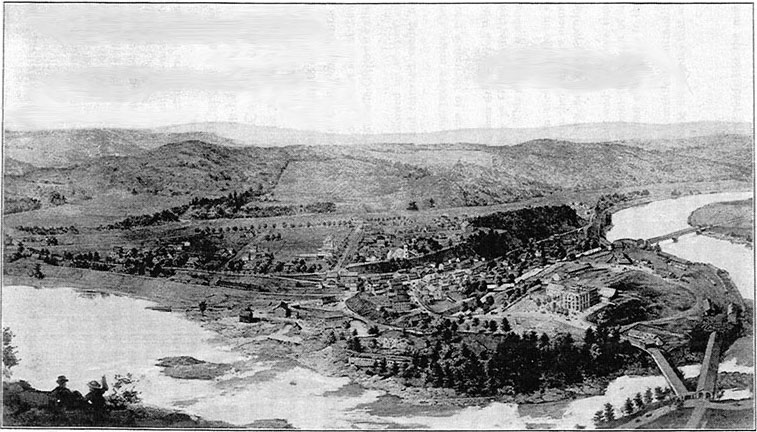
Ascended the Fall Mountain with a heavy valise on my back.

"Bellows Falls from Table Rock; From a Lithograph made in 1855”
(source: danaxtell)
September 10

10.30 A. M. — Took the cars to Bellows Falls, through Dummerston, Putney, and Westminster. 


Looked at the falls and rocks. River higher than usual at this season, yet could cross all but about twenty feet on the rocks. Some pot-holes, real pot-holes, but commonly several curves commingled, or the whole more rounded. 

Found, spreading prostrate on the rocks amid the pot-holes, apparently a small willow, with shining dark-red stems and smooth, spatulate, rather obtuse serrate leaves. (Vide press.) 

I read that salmon passed these falls but not shad. When the water is lowest, it is contracted to sixteen feet here, and Peters's, an old history of Connecticut, says it was so condensed that you could not thrust a crowbar into it. 

It did me good to read his wholesale hearty statements, — strong, living, human speech, so much better than the emasculated modern histories, like Bancroft's and the rest, cursed with a style. I would rather read such histories, though every sentence were a falsehood, than our dull emasculated reports which bear the name of histories. The former, having a human breath and interest behind them, are nearer to nature and to truth, after all. The historian is required to feel a human interest in his subject and to so express it.

President Dwight, speaking of the origin of those pot-holes, says, "The river now is often fuller than it probably ever was before the country above was cleared of its forests: the snows in open ground melting much more suddenly, and forming much greater freshets, than in forested ground." (Vol. ii, page 92.) 

Ascended the Fall Mountain with a heavy valise on my back, against the advice of the toll-man. But when I got up so soon and easily I was amused to remember his anxiety. It is seven hundred and fifty feet high, according to Gazetteer. 

Saw great red oaks on this hill, particularly tall, straight, and bare of limbs, for a great distance, amid the woods. Here, as at Brattleboro, a fine view of the country immediately beneath you; but these views lack breadth, a distant horizon. There is a complete view of the falls from this height. 

Saw a pair of middle-sized black hawks hovering about this cliff, with some white spots, with peculiar shrill snapping notes like a gull, a new kind to me. 

Descending the steep south end of this hill, I saw an apparent Corydalis glauca, mostly withered, three feet or more, and more than usually broad and stout in proportion. (Vide press.) My shoes were very smooth, and I got many falls descending, battering my valise. 

By the railroad below, the Solanum nigrum, with white flowers but yet green fruit. 

Just after crossing Cold River, bathed in the Connecticut, evidently not far from site of the old Kilbourn fort. Clay-muddy shore. 

Near the site of the old Bellows Fort, saw completely purple Polygala verticillata abundant in road. 

Rode the last mile into Walpole with a lumberer, who said that when he commenced operations at Bellows Falls he thought that there was not more than one hundred thousand there, but they had already got out four millions. 

He imported some of those masts I had seen go through Concord from Canada West. They were rafted along Lake Erie (a Mr. Dorr of Buffalo afterward told me that he did this part with steamers, merely running an inch chain through the butt of each log and fastening the ends to a boom, which surrounded the whole, leaving the small ends to play) and in small rafts by canal to Albany, and thence by railroad via Rutland to Portland, for the navy; and it cost only one third more to get them from Canada West than from Bellows Falls. Remembering the difficulty in old times of loading one of these sticks in New Hampshire for the King's Navy, this seemed the greatest triumph of the railroad. 

In Walpole, the Chenopodium Botrys.

H. D. Thoreau, Journal, September 10, 1856

Ascended the Fall Mountain.  See Dan Axtell, Sesquicentennial Hike Sunday, September 10, 2006

Saw a pair of middle-sized black hawks . . . a new kind to me.  [likely Peregrine Falcons.]

Descending the steep south end of this hill I saw an apparent Corydalis glauca . . .  By the railroad below, the Solanum nigrum. See September 21, 1856 (" I have within a week found in Concord two of the new plants I found up-country. Such is the advantage of going abroad, — to enable [you] to detect your own plants. I detected them first abroad, because there I was looking for the strange. ")  

Near the site of the old Bellows Fort, saw completely purple Polygala verticillata  [whoorled milkwort] abundant in road. See  August 13, 1856("The root of the Polygala verticillata also has the checkerberry odor. "); September 8, 1852 ("Polygala verticillata still, on left side of road beyond Lee place. I put it with the other polygalas in July.") See also A Book of the Seasons, by Henry Thoreau, The Polygala

Those masts I had seen go through Concord from Canada West. See November 18, 1852 ("Measured a stick of round timber, probably white pine, on the cars this afternoon . . . 
From Vermont.”)

September 10. See A Book of the Seasons,  by Henry Thoreau,  September 10

A pair of black hawks 
hovering about this cliff –
     a new kind to me.

A Book of the Seasons
,  by Henry Thoreau
 "A book, each page written in its own season,
out-of-doors, in its own locality."
 ~edited, assembled and rewritten by zphx ©  2009-2026

https://tinyurl.com/hdt-560910

Popular Posts Last 30 Days.

The week ahead in Henry’s journal

The week ahead in Henry’s journal
A journal, a book that shall contain a record of all your joy.
"A stone fruit. Each one yields me a thought." ~ H. D. Thoreau, March 28, 1859


I sit on this rock
wrestling with the melody
that possesses me.