Showing posts with label Wilson's thrush. Show all posts

Tuesday, May 4, 2021

5 Bird specimens.


 May 4. 


H. Mann brings me two small pewees, but not yellowish about eye and bill, and bill is all black. 

Also a white-throat sparrow, Wilson's thrush, and myrtle bird.

H. D. Thoreau, Journal, May 4, 1861

Friday, June 19, 2020

Heard my night-warbler on a solitary white pine in the Heywood Clearing by the Peak.


June 19, 2020


P. M. – To Flint ’ s Pond.

I see large patches of blue - eyed grass in the meadow across the river from my window.

The pine woods at Thrush Alley emit that hot dry scent, reminding me even of days when I used to go a-blackberrying.

The air is full of the hum of invisible insects, and I hear a locust. Perhaps this sound indicates the time to put on a thin coat.

But the wood thrush sings as usual far in the wood.

A blue jay and a tanager come dashing into the pine under which I stand. The first flies directly away, screaming with suspicion or disgust, but the latter, more innocent, remains.

The cuckoo is heard, too, in the depths of the wood.

Heard my night-warbler on a solitary white pine in the Heywood Clearing by the Peak. Discovered it at last, looking like a small piece of black bark curving partly over the limb. No fork to its tail. It appeared black beneath; was very shy, not bigger than a yellowbird, and very slender.

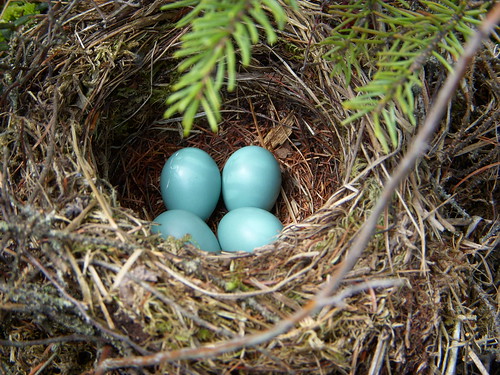
In the middle of the path to Wharf Rock at Flint's Pond, the nest of a Wilson's thrush, five or six inches high, between the green stems of three or four golden rods, made of dried grass or fibres of bark, with dry oak leaves attached loosely, making the whole nine or ten inches wide, to deceive the eye. Two blue eggs. Like an accidental heap. Who taught it to do thus?

Lobelia Dortmanna, a day or two at most.

No grass balls yet.

That fine-rooted green plant on bottom sends up stems with black heads three or four inches. Do they become white?

Every one who has waded about the shores of a pond must have been surprised to find how much warmer the water was close to the shore, where only three or four inches deep, than a little further out.

I think I saw a young crow now fully grown.

Returned by Smith’s Hill and the Saw Mill Brook.

Got quite a parcel of strawberries on the hill.

The hellebore leaves by the brook are already half turned yellow. Plucked one blue early blueberry.

The strain of the bobolink now begins to sound a little rare. It never again fills the air as the first week after its arrival.

At this season we apprehend no long storm, only showers with or without thunder.

H. D. Thoreau, Journal, June 19, 1853

Heard my night-warbler. Discovered it at last. See June 19, 1858 ("I do not hear the night-warbler so often as a few weeks ago. Birds generally do not sing so tumultuously.")  See also  May 17, 1858 ("Just after hearing my night-warbler I see two birds on a tree. ...[One perhaps golden-crowned thrush. ]”); May 19, 1858 (“Heard the night-warbler begin his strain just like an oven-bird! I have noticed that when it drops down into the woods it darts suddenly one side to a perch when low."); May 28, 1854 ("The night-warbler, after his strain, drops down almost perpendicularly into a tree-top and is lost.”). and  See also A Book of the Seasons,  by Henry Thoreau, The Oven-bird . Note Thoreau;s night-warbler  is likely the oven-bird making its flight call. According to Emerson the night warbler is "a bird he had never identified, had been in search of twelve years, which always, when he saw it, was in the act of diving down into a tree or bush.” 

In the middle of the path to Wharf Rock at Flint's Pond, the nest of a Wilson's thrush. See June 19, 1858 (“Boys have found this forenoon at Flint’s Pond one or more veery-nests on the ground. ”) and note to June 23, 1858 ("That rather low wood along the path which runs parallel with the shore of Flint's Pond, behind the rock, is evidently a favorite place for veery-nests. I have seen three there.")

I think I saw a young crow now fully grown. See.July 7, 1860 ("I see a flock of some twenty-five crows. Probably the young are just grown."); July 10, 1854 ("Crows are more noisy, probably anxious about young.")

The strain of the bobolink now begins to sound a little rare. See June 9, 1855 ("I think I have hardly heard a bobolink for a week or ten days.");June 15, 1852 ("The note of the bobolink begins to sound somewhat rare.") and note to July 7, 1859 ("The note of the bobolink has begun to sound rare?") See also A Book of the Seasons,  by Henry Thoreau, the Bobolink

Monday, June 18, 2018

I find a young Emys insculpta


June 18

How dogs will resort to carrion, a dead cow or horse, half buried, no matter how stale, — the best-bred and petted village dogs, and there gorge themselves with the most disgusting offal by the hour, as if it were a season of famine! Surely they are foul creatures that we make cossets of. 

P. M. – To Walden to see a bird's nest, a red-eye's, in a small white pine; nest not so high as my head; still laying. 

A boy climbs to the cat owl's nest and casts down what is left of it, — a few short sticks and some earthy almost turfy foundation, as if it were the accumulation of years. Beside much black and white skunk-hair, there are many fishes scales (!) intimately mixed with its substance, and some skunk’s bones. 

E. Bartlett has found three bobolinks’ nests. One or more of them he thinks has been covered by the recent flood. 

A little boy brings me an egg of Wilson's thrush, which he found in a nest in a low bush about a foot from the ground. 

Coming across the level pasture west of E. Hubbard's swamp, toward Emerson's, I find a young Emys insculpta, apparently going to lay, though she had not dug a hole. It was four and a quarter inches long by three and a half wide, and altogether the handsomest turtle of this species, if not of any, that I have ever seen. It was quite fresh and perfect, without wound or imperfection; its claws quite sharp and slender, and the annual striae so distinct on all the scales above and below that I could count them with ease. It was nine years old, though it would be like an infant among turtles, the successive striae being perfectly parallel at equal distances apart.

The sternum, with a large black spot on the rear angle of each scale and else where a rich brown color, even reminded me of the turtle-shell of commerce. While its upper shell was of ‘a uniform wholesome brown, very prettily marked in deed, not only by the outlines of the scales, but more distinctly by the lines of prominences raying out from the starting-point of each scale, perfectly preserved in each year’s growth, a most elaborate coat of mail, worthy the lifelong labor of some reptilian Vulcan. 

This must have been a belle among the E. insculpta. Nevertheless I did discover that all the claws but one of one hind foot were gone! Had not a bird peeked them off? So liable are they to injury in their long lives. Then they are so well-behaved; can be taken up and brought home in your pocket, and make no unseemly efforts to escape. The upper shell was remarkably spreading and curving upward on the rear edges.

H. D. Thoreau, Journal, June 18, 1858

A red-eye's, in a small white pine; nest not so high as my head; still laying. See June 12, 1855 ("In the thick swamp behind the hill I look at the vireo’s nest which C. found on the 10th, within reach on a red maple forked twig, eight feet from ground. He took one cowbird’s egg from it, and I now take the other, which he left. There is no vireo’s egg"); July 21, 1855 ("A red-eyed vireo nest on a red maple on Island Neck, on meadow-edge, ten feet from ground; one egg half hatched and one cowbird’s egg, nearly fresh, a trifle larger"); January 13, 1856 ("What a wonderful genius it is that leads the vireo to select the tough fibres of the inner bark, instead of the more brittle grasses, for its basket, the elastic pine-needles and the twigs, curved as they dried to give it form, and, as I suppose, the silk of cocoons, etc., etc., to bind it together with!")

A boy climbs to the cat owl's nest and casts down what is left of it, — a few short sticks and some earthy almost turfy foundation, as if it were the accumulation of years. Beside much black and white skunk-hair, there are many fishes scales (!) intimately mixed with its substance, and some skunk’s bones. See May 20, 1858 ("Saw in the street a young cat owl, one of two which Skinner killed in Walden Woods yesterday. . . .So I visited the nest. It was in a large white pine close . . . the nest is some thirty-five feet high on two limbs close to the main stem, and, according to Skinner, was not much more than a foot across, made of small sticks, nearly flat, “without fine stuff!” There were but two young. ")

E. Bartlett has found three bobolinks’ nests. See June 22, 1858 (“I have one of the nests. There is but little of it ...”);  see also  June 26, 1857 ("I must be near bobolinks' nests many times these days, — in E. Hosmer's meadow by the garlic and here in Charles Hubbard's, — but the birds are so overanxious, though you may be pretty far off, and so shy about visiting their nests while you are there, that you watch them in vain."); July 2, 1855 ("Young bobolinks are now fluttering over the meadow, but I have not been able to find a nest ..")

A little boy brings me an egg of Wilson's thrush. See June 2, 1852 ("Nest of Wilson's thrush with bluish-green eggs.")

This must have been a belle among the E. insculpta. Nevertheless I did discover that all the claws but one of one hind foot were gone! See May 14, 1857 ("I see one with a large dent three eighths of an inch deep and nearly two inches long in the middle of its back, where it was once partially crushed. Hardly one has a perfect shell.") See also A Book of the Seasons, by Henry Thoreau,the Wood Turtle (Emys insculpta)

June18. See A Book of the Seasons,  by Henry Thoreau, June 18

A Book of the Seasons,  by Henry Thoreau
"A book, each page written in its own season,
out-of-doors, in its own locality.”

~edited, assembled and rewritten by zphx © 2009-2020

Monday, May 8, 2017

The full moon rises.

May 8, 2017
May 8.

A third fine day. 

The sugar maple at Barrett's is now in full bloom. 

I finish the arbor to-night. This has been the third of these remarkably warm and beautiful. I have worked all the while in my shirt-sleeves. 

Summer has suddenly come upon us, and the birds all together. Some boys have bathed in the river. 

Walk to first stone bridge at sunset. Salix alba, possibly the 6th. 

It is a glorious evening. 

I scent the expanding willow leaves (for there are very few blossoms yet) fifteen rods off. Already hear the cheerful, sprightly note of the yellowbird amid them. It is perfectly warm and still, and the green grass reminds me of June. The air is full of the fragrance of willow leaves. The high water stretches smooth around. 

I hear the sound of Barrett's sawmill with singular distinctness. The ring of toads, the note of the yellowbird, the rich warble of the red-wing, the thrasher on the hillside, the robin's evening song, the woodpecker tapping some dead tree across the water; and I see countless little fuzzy gnats in the air, and dust over the road, between me and the departed sun. 

Perhaps the evenings of the 6th and 7th were as pleasant. But such an evening makes a crisis in the year. I must make haste home and go out on the water. 

I paddle to the Wheeler meadow east of hill after sundown. From amid the alders, etc., I hear the mew of the catbird and the yorrick of Wilson's thrush. One bullfrog's faint er-er-roonk from a distance. (Perhaps the Amphibia, better than any creatures, celebrate the changes of temperature.) One dump note. 

It grows dark around. The full moon rises, and I paddle by its light. 

It is an evening for the soft-snoring, purring frogs (which I suspect to be Rana palustris). I get within a few feet of them as they sit along the edge of the river and meadow, but cannot see them. Their croak is very fine or rapid, and has a soft, purring sound at a little distance. I see them paddling in the water like toads. 

Within a week I have had made a pair of corduroy pants, which cost when done $1.60. They are of that peculiar clay-color, reflecting the light from portions of their surface. They have this advantage, that, beside being very strong, they will look about as well three months hence as now, — or as ill, some would say. Most of my friends are disturbed by my wearing them. I can get four or five pairs for what one ordinary pair would cost in Boston, and each of the former will last two or three times as long under the same circumstances. The tailor said that the stuff was not made in this country; that it was worn by the Irish at home, and now they would not look at it, but others would not wear it, durable and cheap as it is, because it is worn by the Irish. 

Moreover, I like the color on other accounts. Anything but black clothes. I was pleased the other day to see a son of Concord return after an absence of eight years, not in a shining suit of black, with polished boots and a beaver or silk hat, as if on a furlough from human duties generally, — a mere clothes-horse, — but clad in an honest clay-colored suit and a snug every-day cap. It showed unusual manhood. Most returning sons come home dressed for the occasion. 

The birds and beasts are not afraid of me now. A mink came within twenty feet of me the other day as soon as my companion had left me, and if I had had my gray sack on as well as my corduroys, it would perhaps have come quite up to me. 

Even farmers' boys, returning to their native town, though not unfamiliar with homely and dirty clothes, make their appearance on this new stage in a go-to-meeting suit.

H. D. Thoreau, Journal, May 8, 1857

A third fine day. See May 6, 1857 ("A beautiful and warm day."); May 7, 1857 ("A second fine day."); May 9, 1857; ("Another fine day.") See also A Book of the Seasons, by Henry Thoreau, The world can never be more beautiful than now.

Summer has suddenly come upon us, and the birds all together. See May 6, 1852  ("Hear the first warbling vireo this morning on the elms. This almost makes a summer."); May 7, 1852 ("One or more little warblers in the woods this morning are new to the season, . . .The first wave of summer from the south") ; May 7, 1852 ("The birds I have lately mentioned come not singly, as the earliest, but all at once,"); May 10, 1858 ("It is remarkable how many new birds have come all at once to-day."); May 12, 1856 ("How suddenly the birds arrive after the storm, — even yesterday before it was fairly over, —as if they had foreseen its end!") See also A Book of the Seasons,  by Henry Thoreau. Summer and The Birds of May

It is a glorious evening . . . I must make haste home and go out on the water. See August 31, 1852 ("This is the most glorious part of this day,. . . and the most suggestive.. . . Evening is pensive. The serenity is far more remarkable to those who are on the water.”)

Already hear the cheerful, sprightly note of the yellowbird amid them. See May 8, 1854 (“Hear a yellowbird in the direction of the willows. Its note coarsely represented by che-che-che-char-char- char."); May 8 1859 ("Summer yellowbird.”) and note to May 11, 1856 ("At a distance I hear the first yellow-bird . . . All these willows blossom.”).

The full moon rises, and I paddle by its light. It is an evening for the soft-snoring, purring frogs (which I suspect to be Rana palustris). See April 11, 1854 ("Hear a slight snoring of frogs on the bared meadows. Is it not the R. palustris? This the first moon to walk by.”); May 3, 1852 ("The moon is full. The air is filled with a certain luminous, liquid, white light. You can see the moonlight, as it were, reflected from the atmosphere."); 
May 6, 1858 ("In the mornings now, I hear no R. palustris and no hylodes, but a few toads still, but now, at night, all ring together, the toads ringing through the day, the hylodes beginning in earnest toward night and the palustris at evening. I think that the different epochs in the revolution of the seasons may perhaps be best marked by the notes of [frogs]"); May 9, 1853 ("That slumbrous snoring croak far less ringing and musical than the toad' s (which is occasionally heard) now comes up from the meadows edge."); See also A Book of the Seasons,  by Henry Thoreau, May Moonlight and A Book of the Seasons, by Henry Thoreau, The  Pickerel frog  (Rana palustris)

Such an evening makes a crisis in the year.  Compare July 18, 1854 (“The atmosphere now imparts a bluish or glaucous tinge to the distant trees. A certain debauched look. This a crisis in the season.”); August 20, 1854 (“When the red-eye ceases generally, then I think is a crisis, — the woodland quire is dissolved.”)

May 8. See A Book of the Seasons, by Henry Thoreau,  May 8

Suddenly summer 
has come upon us, and the 
birds all together.

It grows dark around.
The full moon rises, and I
paddle by its light. 

                                     A Book of the Seasons, by Henry Thoreau
"A book, each page written in its own season,
out-of-doors, in its own locality.”
~edited, assembled and rewritten by zphx © 2009-2025

https://tinyurl.com/hdt-570508

Thursday, June 16, 2016

A wood thrush's nest on the steep moss and fern covered side of a rock


June 16 

Saw at the Natural History Rooms a shell labelled Haliotis splendens, apparently same with mine from Ricketson’s son, with holes and green reflections. 


To Purgatory in Sutton: by railroad to Wilkinsonville in the northeast corner of Sutton (thirty cents) and by buggy four or five miles to Purgatory in the south or southeast part of the town, some twelve miles from Worcester. 

The stream rising from the bottom of it must empty into the Blackstone, perhaps through the Mumford River. Sutton is much wooded. 

The woman at the last house told of an animal seen in the neighborhood last year. Well, she “had no doubt that there had been a bad animal about.” A Mr. Somebody, who could be relied on, between there and Sutton Centre, had been aroused by a noise early one morning, and, looking out, saw this animal near a wood-pile in his yard, as big as a good-sized dog. He soon made off, making nothing of the walls and fences, before he and his sons got their guns ready. They raised part of the town, a body of shoemakers, and surrounded a swamp into which it was supposed to have entered, but they did not dare to go into it. Also a strange large track was seen where it crossed the road. 

Found at the very bottom of this Purgatory, where it was dark and damp, on the steep moss and fern covered side of a rock which had fallen into it, a wood thrush’s nest. Scarcely a doubt of the bird, though I saw not its breast fairly. Heard the note around, and the eggs (one of which I have) correspond. Nest of fine moss from the rock (hypnum?), and lined with pine-needles; three eggs, fresh.

Found in the Purgatory the panicled elder (Sambucus pubens), partly gone to ribbed seed, but some in flower, new to me; Polygonum cilinode (?), not yet in flower; moose-wood or striped maple; and also, close by above, Actoea alba, out of bloom; and a chestnut oak common. Cow-wheat numerously out.

Heard around, from within the Purgatory, not only Wilson’s thrush, but evergreen forest note and tanager; and saw chip-squirrels within it.

H. D. Thoreau, Journal, June 16, 1856

[Purgatory is a 0.25-mile-long chasm between granite walls rising as high as 70 feet, once believed to have originated in the sudden release of dammed-up glacial meltwater near the end of the last Ice Age.  Today ice lingers in boulder caves into the early summer, however there is there is no evidence of water erosion in the chasm or on its walls.]

A wood thrush’s nest . . . of fine moss . . . lined with pine-needles; three eggs, fresh. See June 12, 1857 ("At Natural History Rooms . . . The wood thrush's is a slender egg , a little longer than a catbird's and uniform greenish-blue."); June 19, 1858  ("Storrow Higginson and other boys. . . showed me one of five eggs, far advanced, they found there [at Flint's Pond] in a nest some fourteen feet high in a slender maple sapling, placed between many upright shoots, many dry leaves outside. It is a slender clear-blue egg, more slender and pointed at the small end than the robin's . . . It is probably the wood thrush."); June 23, 1858 ("In the case of the hermit thrush, wood thrush, and tanager's [nests of June 19], each about fourteen feet high in slender saplings, you had to climb an adjacent tree in order to reach them."); July 31, 1858 ("Got the wood thrush’s nest of June 19th (now empty) . . . measures four and a half to five inches in diameter from outside to outside of the rim, and one and three quarters deep within . . .");  August 10, 1858 ("The wood thrush’s was a peculiarly woodland nest, made solely of such materials as that unfrequented grove afforded, the refuse of the wood or shore of the pond. There was no horsehair, no twine nor paper nor other relics of art in it.")

The panicled elder (Sambucus pubens), partly gone to ribbed seed, but some in flower, new to me. See  September 5, 1856 ("About one mile from West Fitchburg depot, westward, I saw the panicled elderberries on the railroad but just beginning to redden, though it is said to ripen long before this."); July 18, 1857 ("George Bradford says he finds in Salem striped maple and Sambucus pubens."); November 3, 1858 (" I see at the very northwest end of the White Cedar Swamp a little elder, still quite leafy and green, near the path on the edge of the swamp. Its leafets are commonly nine, and the lower two or more are commonly divided. This seemed peculiarly downy beneath, even “sub-pubescent,” as Bigelow describes the Sambucus pubens to be. Compare it with the common")

June 16. See A Book of the Seasons, by Henry Thoreau, June 16

The steep side of a rock -
a wood thrush’s nest lined with
pine-needles; three eggs. 

A Book of the Seasons, by Henry Thoreau, 
A Book of the Seasons, by Henry Thoreau
"A book, each page written in its own season,
out-of-doors, in its own locality."
~edited, assembled and rewritten by zphx © 2009-2026

https://tinyurl.com/hdt-560616

Friday, May 13, 2016

Birding at Kalmia glauca Swamp.

May 13. 


May 13, 2016

Hear a warbling vireo. 

Dandelions by road side; probably several days in some places.

P. M. — Up river to Kalmia glauca Swamp. 

In the swallows’ holes behind Dennis’s, I find two more dead bank swallows, and one on the sand beneath, and the feathers of two more which some creature has eaten. This makes at least seven dead bank swallows in consequence of the long, cold northeast rain. 

A male harrier, skimming low, had nearly reached this sand pit before he saw me and wheeled. Could it have been he that devoured the swallows? 

These swallows were 10 3/4+ alar extent, 4 3/4 inches long; a wing 4 3/4+ by 1 3/4+. Above they were a light brown on their backs, wings blackish, beneath white, with a dark-brown band over the breast and, again white throat and side of neck; bill small and black; reddish-brown legs, with long, sharp, slender claws. It chanced that each one of two I tried weighed between five and six sixteenths of an ounce, or between five and six drams avoirdupois. This seems to be the averge weight, or say six drams because they have pined a little. 

A man who weighs one hundred and fifty pounds weighs sixty-four hundred times as much as one. The wing of one contains about seven square inches, the body about five, or whole bird nineteen. If a man were to be provided with wings, etc., in proportion to his weight, they would measure about 844 square feet, and one wing would cover 311 feet, or be about 33 feet long by 14 wide. This is to say nothing of his muscles. 

The Kalmia glauca will not open for some days at least. At the swamp, hear the yorrick of Wilson’s thrush; the tweezer-bird or Sylvia Americana. Also the oven-bird sings.


Sylvia Americana (Northern Parula Warbler)
This species is found throughout the United States, 
and may be considered as one of the most beautiful of the birds of our country. 
It has no song, but merely a soft, greatly prolonged twitter, repeated at short intervals.~ J.J. Audubon


WILSON'S THRUSH or VEERY, Turdus Wilson,
The song of this species, although resembling that of the Wood Thrush in a great degree, is less powerful, and is composed of continued trills repeated with different variations, enunciated with great delicacy and mellowness, so as to be extremely pleasing to one listening to them in the dark solitudes where the sylvan songster resides. It now and then tunes its throat in the calm of evening, and is heard sometimes until after the day has closed. J.J. Audubon


Caterpillars’ nests on an apple two inches diameter. 

Downy amelanchier just out at Lupine Bank; elsewhere, maybe, a day or two. 

Where my sap has dried on the white birch bark it has now turned a bright light red. What a variety of colors it assumes! 

Potter has a remarkable field of mullein sown as thickly as if done with a machine (under Bear Garden Hill). I remarked them last year. William Wheeler thinks the seed lies in the ground an indefinite period ready to come up. I thought that it might have been introduced with his grain when it was sown lately. Wheeler says that many a pasture, if you plow it up after it has been lying still ten years, will produce an abundant crop of wormwood, and its seeds must have lain in the ground. Why do not the chemists in their analyses of soils oftener mention the seeds of plants? Would not  a careful analysis of old pasture sod settle the question? 

I suspect that I can throw a little light on the fact that when a dense pine wood is cut down oaks, etc., may take its place. There were only pines, no other tree. They are cut off, and, after two years have elapsed, you see oaks, or perhaps a few other hard woods, springing  up with scarcely a pine amid them, and you wonder how the acorns could have lain in the ground so long without decaying. There is a good example at Loring’s lot. 

But if you look through a thick pine wood, even the exclusively pitch pine ones, you will detect many little oaks, birches, etc., sprung probably from seeds carried into the thicket by squirrels, etc., and blown thither, but which are overshadowed and choked by the pines. This planting under the shelter of the pines may be carried on annually, and the plants annually die, but when the pines are cleared off, the oaks, etc., having got just the start they want, and now secured favorable conditions, immediately spring up to trees. 

Scarcely enough allowance has been made for the agency of squirrels and birds in dispersing seeds.

At the Kalmia Swamp, the parti-colored warbler, and was that switter switter switter switter swit also by it? [Probably by this or the redstart, which last I distinguish on the 17th.] 

H.D. Thoreau, Journal, May 13, 1856

Hear a warbling vireo. See  May 13, 1855 ("The air is filled with the song of birds, — warbling vireo, gold robin, yellowbirds, and occasionally the bobolink."); May 4, 1855 ("I think I hear a warbling vireo"); May 6, 1852 ("Hear the first warbling vireo this morning on the elms. This almost makes a summer. "):May 9, 1859 ("Hear the warbling vireo and oven-bird.") ;May 10, 1853 (“New days, then, have come, ushered in by the warbling vireo, yellowbird, Maryland yellow-throat, and small pewee"); May 10, 1858 ("The warbling vireo cheers the elms with a strain for which they must have pined."); May 29, 1855("the warbling vireo, with its smooth-flowing, continuous, one-barred, shorter strain, with methinks a dusky side-head )May 29, 1855("the warbling vireo, with its smooth-flowing, continuous, one-barred, shorter strain, with methinks a dusky side-head ) and A Book of the Seasons,  by Henry Thoreau, Birds of May

I find two more dead bank swallows, and one on the sand beneath, and the feathers of two more. See May 12, 1856 ("I see, in the road beyond Luther Hosmer’s, in different places, two bank swallows which were undoubtedly killed by the four days’ northeast rain we have just had.")

At the swamp, hear the yorrick of Wilson’s thrush. See May 13, 1860  ("Hear the yorrick"). See  also  May 8, 1857 (“From amid the alders, etc., I hear the mew of the catbird and the yorrick of Wilson's thrush”);  May 10, 1853 ("In the woods, the veery note."); May 10, 1858 (" Hear in various woods the yorrick note of the veery."); May 12, 1855("The cawing of crows, the peeping of hyla [and] the croaking of a tree-toad, the oven-bird, the yorrick of Wilson’s thrush, a distant stake-driver, the night-warbler and black and white creeper, the lowing of cows, the late supper horn, the voices of boys, the singing of girls”); May 12, 1857 (“I hear a yorrick, apparently anxious, near me, utter from time to time a sharp grating char-r-r, like a fine watchman’s rattle. As usual, I have not heard them sing yet.”);  May 14, 1859 ("Yorrick heard the 12th");  May 17, 1853 ("The sweetest singers among the birds are heard more distinctly now, as the reflections are seen more distinctly in the water, — the veery constantly now."); May 17, 1856 ("Hear the first veery note”); May 18, 1855 ("First veery strain."); May 23, 1857 ("Hear the first veery strain.")
.
The tweezer-bird or Sylvia Americana.  . . . the parti-colored warbler, and was that switter switter switter switter swit also by it [or the redstart]?  See May 13, 1860 ("At Holden Swamp, hear plenty of parti-colored warblers (tweezer-birds) and redstarts."); See also May 15, 1856 (" see also, for a moment, in dry woods, a warbler with blue-slate head and apparently all yellow beneath for a minute, nothing else conspicuous; note slightly like tseep, tseep, tseep, tseep, tsit sitter ra-re-ra, the last fast, on maples, etc. Maybe I heard the same yesterday. [No doubt the Sylvia Americana, blue yellow-back or parti-colored warbler; heard before.]”); May 17, 1856 ("The Sylvia Americana (parti-colored warbler, etc.) is very numerous there, darting about amid the hoary buds of the maples and oaks, etc. It seems the most restless of all birds, blue more or less deep above, with yellow dust on the back, yellow breast, and white beneath (the male with bright—orange throat, and some with a rufous crescent on breast); wings and tail, dark, black, with two white bars or marks, dark bill and legs."); May 18, 1856 ("A Sylvia Americana, — parti-colored warbler, — in the Holden Wood, sings a, tshrea tshrea tshrea, tshre’ tshritty tshrit’."); June 30, 1856 [in New Bedford]("my tweezer-bird, which is extremely restless, flitting from bough to bough and apple tree to apple tree. Its note like ah, zre zre zre, zritter zritter zrit’. Sylvia Americana, parti-colored warbler, with golden-green reflections on the back, two white bars on wings, all beneath white, large orange mark on breast, bordered broadly with lemon yellow, and yellow throat.");  May 27, 1855 ("The blue yellow-back or parti-colored warbler still, with the chestnut crescent on breast, near my Kalmia Swamp nest."); May 4, 1858 (“Heard the tweezer note, or screeper note, of the particolored warbler, bluish above, yellow or orange throat and breast, white vent, and white on wings, neck above yellowish, going restlessly over the trees”); May 9, 1858 ("The parti-colored warbler . . .— my tweezer-bird, – making the screep screep screep note. It is an almost incessant singer . . . utters its humble notes, like ah twze twze twze, or ah twze twze twze twze."); May 12, 1857 ("Hear the screep of the parti-colored warbler”):    June 11, 1858 ("Hear the parti-colored warbler. ") June 25, 1860 (" As near as I can make out with my glass, I see and hear the parti-colored warbler at Ledum Swamp on the larches and pines. A bluish back, yellow breast with a reddish crescent above, and white belly, and a continuous screeping note to the end.") and  A Book of Seasons,  by Henry Thoreau, The Parti-Colored (Parula) Warbler (Sylvia Americana

Downy amelanchier just out at Lupine Bank. See May 13, 1852 ( The amelanchiers are now the prevailing flowers in the woods and swamps and sprout-lands, a very beautiful flower, with its purplish stipules and delicate drooping white blossoms. The shad-blossom days in the woods.");  May 13, 1855 ("Saw an amelanchier with downy leaf (apparently oblongifolia) on the southeast edge of Yellow Birch Swamp, about eighteen feet high and five or six inches in diameter, —a clump of them about as big as an apple tree.")

I suspect that I can throw a little light on the fact that when a dense pine wood is cut down oaks, etc., may take its place. See May 10, 1856 ("Where the pitch pines were cut some years ago on Thrush Alley, I now see birches, oaks, and pitch and white pines. "); April 29, 1860 ("Henry Shattuck’s is a new pitch pine wood, say thirty years old . . It is a remarkable proof of my theory, for it contains thousands of little white pines but scarcely one little pitch pine. It is also well stocked with minute oak seedlings.");  The Succession of Forest Trees (“If a pine wood is surrounded by a white-oak one chiefly, white-oaks may be expected to succeed when the pines are cut.”)

Saturday, June 2, 2012

Early summer


June 2.

Buttercups now spot the churchyard. 

Golden alexanders - looks like a parsnip - near or beyond the East Quarter schoolhouse. 

The elms now hold a good deal of shade and look rich and heavy with foliage. You see darkness in them. 

Hazy days now. Milkweed, butter-and-eggs, etc., etc. are getting up. Low blackberry in bloom. The dried brown petals of apple blossoms spot the sod in pastures. Female sassafras in bloom.


Nest of Wilson's thrush with bluish-green eggs. 


H. D. Thoreau, Journal, June 2, 1852

Buttercups now spot the churchyard.  See May 30, 1857 ("Buttercups thickly spot the churchyard. “); May 27, 1853 ("The buttercups in the church-yard and on some hillsides are now looking more glossy and bright than ever after the rain.”)

Low blackberry in bloom. See note to June 1, 1860 (“Many low blackberry flowers at Lee's Cliff.”)


June 2. See A Book of the Seasons, by Henry Thoreau, June 2

A Book of the Seasons,  by Henry Thoreau
"A book, each page written in its own season,
out-of-doors, in its own locality.”

~edited, assembled and rewritten by zphx © 2009-2021

Popular Posts Last 30 Days.

The week ahead in Henry’s journal

The week ahead in Henry’s journal
A journal, a book that shall contain a record of all your joy.
"A stone fruit. Each one yields me a thought." ~ H. D. Thoreau, March 28, 1859


I sit on this rock
wrestling with the melody
that possesses me.