Showing posts with label asters. Show all posts

Monday, July 7, 2025

A Book of the Seasons: Savory-leaved aster (Aster Linariifolius/Diplopappus)


South of the lighthouse
the savory-leaved aster
on a steep hillside.
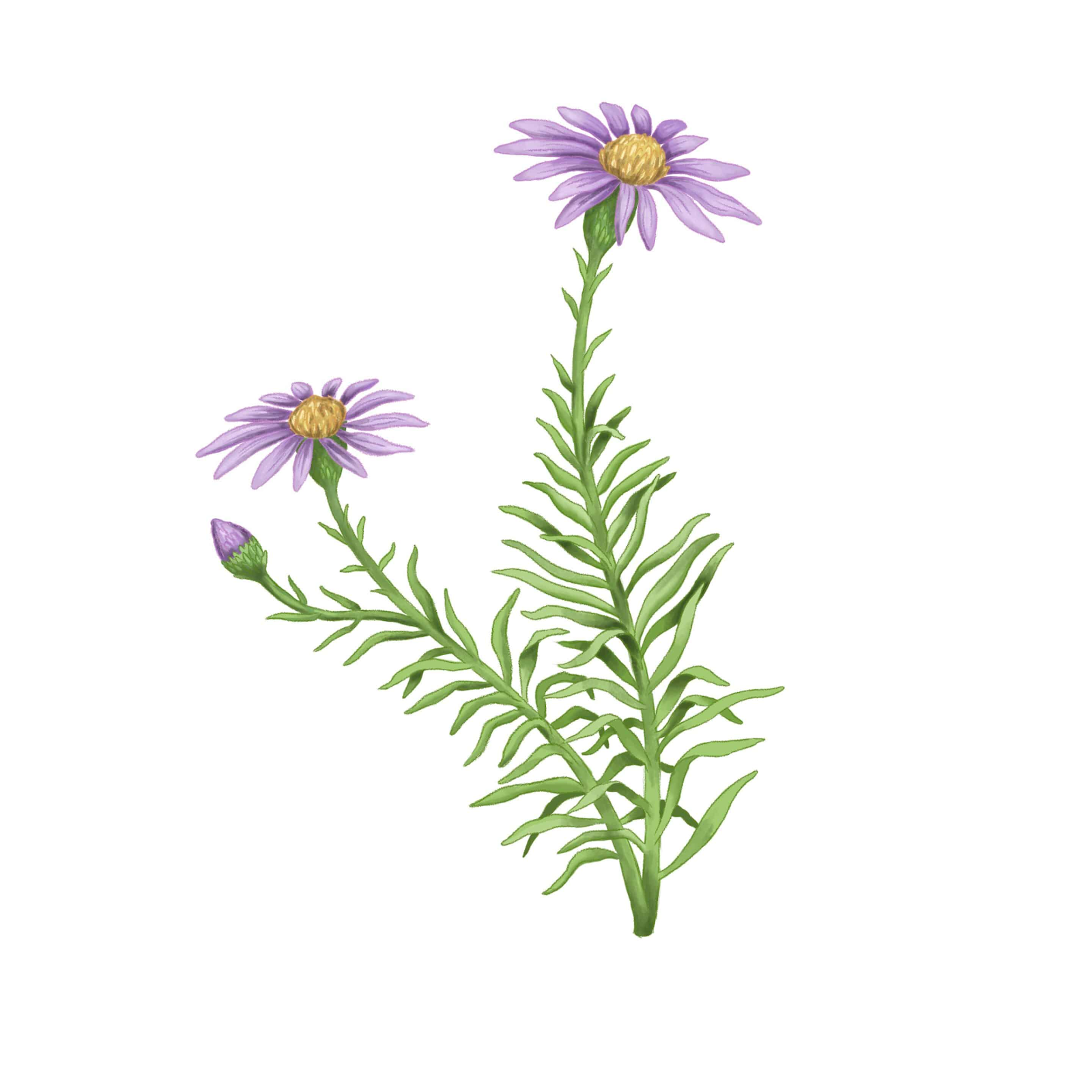
That common rigid
narrow-leaved faint-purplish
aster in dry woods.

July 7.  Just south of the lighthouse near the bank on a steep hillside, the savory-leaved aster (Diplopappus linariifolius) and mouse-ear (Gnaphalium plantaginifolium) form a dense sward, being short and thick; the aster not yet out. July 7, 1855

July 26. Diplopappus linariifolius. Aster dumosus. July 26, 1854

July 28Aster linariifolius.  July 28, 1853

July 29. That common rigid narrow-leaved faint-purplish aster in dry woods by shrub oak path, Aster linariifolius of Bigelow, but it is not savory leaved. I do not find it in Gray. July 29, 1852

August 3. Savory-leaved aster.  August 3, 1858 

August 4. The yellow Bethlehem-star still, and the yellow gerardia, and a bluish "savory-leaved aster."  August 4, 1851 

August 16. Diplopappus linariifolius, apparently several days. August 16, 1856 

August 22The savory-leaved aster (Diplopappus linariifolius) out; how long?  August 22, 1859

August 30. As I went along from the Minott house to the Bidens Brook, I was quite bewildered by the beauty and variety of the asters, now in their prime there – A. lævis (large and handsome with various leaves), patens, linariifolius, etc. Why so many asters and goldenrods now? The sun has shone on the earth, and the goldenrod is his fruit. The stars, too, have shone on it, and the asters are their fruit. August 30, 1853

September 1. D. linariifolius, hardly noticed. September 1, 1856

September 2. Diplopappus linariifolius, quite common . . . D. linariifolius, pale bluish-purple (Some, outdoors, have a lilac or violet tint.) . . . The D. linariifolius is interesting, with its commonly single flower, with very broad rays turned backward, or handsomer still when it has fifteen or twenty heads crowded together. September 2, 1853

September 7. At Brattleboro, Vt . . .The Solidago Canadensis, and the smooth three-ribbed one, and nemoralis, etc., the helianthus (apparently decapetalus), and Aster or Diplopappus linariifolius, Vitis cordifolius (?) (now beginning to be ripe) are quite common along the bank. September 7, 1856

September 10. Diplopappus linariifolius and Aster undulatus apparently now in prime. September 10, 1854

September 18.  – By boat to Conantum, barberrying. Diplopappus linariifolius in prime. September 18, 1856

September 24. D. linariifolius, in prime, abundant.  September 24, 1856

September 29. Diplopappus linariifolius, Aster undulatus, and a few small ones September 29,1853 

September 30. We then took the path to Clematis Brook on the north of Mt. Misery, where we found a few of the Diplopappus linariifolius (savory-leaved aster) and one or two small white (bushy ?) asters, also A. undulatus September 30, 1852

October 8. D. linariifolius, apparently nearly done  October 8, 1856

October 10.  Pulling up some Diplopappus linariifolius, now done, I find many bright-purple shoots, a half to three quarters of an inch long, freshly put forth underground and ready to turn upward and form new plants in the spring. October 10, 1858 

October 12. With man all is uncertainty. He does not confidently look forward to another spring. But examine the root of the  savory-leaved aster, and you will find the new shoots, fair purple shoots, which are to curve upward and bear the next year’s flowers, already grown half an inch or more in earth. Nature is confident. October 12, 1858

October 16.  Many Diplopappus linariifolius are gone to seed, and yellowish globes. Such are the stages in the year's decline. The flowers are at the mercy of the frosts.   October 16, 1859

October 20. Many plants which in the summer show a few red or scarlet leaves at length are all yellow only . . . Diplopappus linariifolius in shade yellow, in sun purple last of October  October 20, 1858

October 22.  I see the small narrow leaves of the Aster dumosus and also the yet finer ones of the Diplopappus linariifolius in wood-paths, turned a clear light-yellow.  October 22, 1858

October 23. One Diplopappus linariifolius in bloom, its leaves all yellow or red. This and A. undulatus the asters seen to-day.  October 23, 1853

October 25. Aster longifolius in low ground (a few). This and the Diplopappus linariifolius, and, above all,  A. undulatus, the only flowers of the kind seen this week. (Afterwards A. puniceus, Tradescanti, and one lævis!)  October 25, 1853

November 7The Diplopappus linariifolius, which was yellow in the shade, in open and sunny places is purple.  November 7, 1858

December 26.  After snow, rain, and hail yesterday and last night, we have this morning quite a glaze, there being at last an inch or two of crusted snow on the ground, the most we have had . . .Weeds in the fields and the wood-paths are the most interesting. Here are asters, savory-leaved, whose flat imbricated calyxes, three quarters of an inch over, are surmounted and inclosed in a perfectly transparent icebutton, like a glass knob, through which you see the reflections of the brown calyx. December 26, 1855 
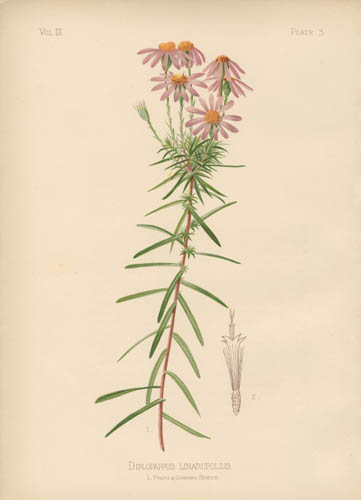
Aster linariifolius and  Diplopappus linariifolius — Savory-leaved aster, Flax-leaved stiff-aster , Stiff-leafed Aster, Sandpaper Aster or Sandpaper Starwort (now classified as  Lonactis linariifolia

See also

 A Book of the Seasons, by Henry Thoreau
"A book, each page written in its own season,
out-of-doors, in its own locality."
~edited, assembled and rewritten by zphx ©  2009-2025

https://tinyurl.com/hdt-savoryaster


Tuesday, August 13, 2024

A Book of the Seasons: Asters in August


I would make a chart of our life,
know why just this circle of creatures completes the world.
Henry Thoreau,
 April 18, 1852

Do not the flowers of August and September
generally resemble suns and stars?

So many asters
such bewildering beauty
and variety!


July 26. I mark again, about this time when the first asters open . . . This the afternoon of the year. July 26, 1853

July 28. Goldenrod and asters have fairly begun; there are several kinds of each out.  July 28, 1852

August 1.  Diplopappus cornifolius (how long?) at Conant Orchard Grove. August 1, 1855 

August 1 Diplopappus umbellatus at Peter's wall. August 1, 1856 

August 3Diplopappus cornifolius, some time. August 3, 1856

August 3Savory-leaved aster. August 3, 1858

August 4 The yellow Bethlehem-star still, and the yellow gerardia, and a bluish "savory-leaved aster."  August 4, 1851

August 5. Aster dumosus, apparently a day or two, with its large conspicuous flower-buds at the end of the branchlets and linear-spatulate involucral scales. August 5, 1856 

August 9. What I have called Aster corymbosus [white wood aster] out a day, above Hemlocks. It has eight to twelve white rays, smaller than those of the macrophyllus, and a dull-red stem commonly.  August 9, 1856 

August 10.  Aster dumosus and pennyroyal out; how long? August 10, 1856 

August 11.  Aster corymbosus, path beyond Corner Spring and in Miles Swamp. August 11, 1852

August 11.  Aster Tradescanti, two or three days in low ground; flowers smaller than A. dumosus, densely racemed, with short peduncles or branchlets, calyx-scales narrower and more pointed. August 11, 1854

August 11. Aster puniceus a day or more. August 11, 1856

August 12. The common asters now are the patens, dumosus, Radula, and Diplopappus umbellatus.  August 12, 1854

August 12. The Aster patens is very handsome by the side of Moore's Swamp on the bank, — large flowers, more or less purplish or violet, each commonly (four or five) at the end of a long peduncle, three to six inches long, at right angles with the stem, giving it an open look. August 12, 1856

August 14Aster tradescanti, apparently a day or two. August 14, 1856

August 16Diplopappus linariifolius, apparently several days. August 16, 1856

 
August 16, 2021

August 17Aster miser some time, turned purple. A. longifolius not long. August 17, 1856

August 20. An aster with a smooth leaf narrowed below, somewhat like A. amplexicaulis (or patens (Gray) ?). Is it var. phlogifolius August 20, 1852

August 21. Some of the Hubbard aster are still left, against the upper Hubbard Wood by the shore, which the mowers omitted. August 21, 1854

August 21The commonest asters now are, 
  • 1st, the Radula
  • 2d, dumosus
  • 3d, patens
  • 4th, say puniceus
  • 5th, cordtfolius
  • 6th, macrophyllus; (these two a good while); 
  • 7th, say Tradescanti
  • 8th, miser
  • 9th, longifolius ; (these three quite rare yet);
  • 10th, probably acuminatus, some time (not seen); 
  • 11th, undulatus
  • 12th, loevis; (these two scarcely to be seen yet). 
N. B. Water so high I have not seen early meadow aster lately. August 21, 1856

August 22.  The savory-leaved aster (Diplopappus linariifolius) out; how long? Saw the Aster corymbosus on the 19th  August 22, 1859

August 24. The autumnal flowers, — goldenrods, asters, and johnswort, — though they have made demonstrations, have not yet commenced to reign. August 24, 1851

August 24. The asters and diplopappi are about in this order:
  • (1) Radula,
  • (2) D. cornifolius (?),
  • (3) A. corymbosus,
  • (4) patens,
  • (5) lævis,
  • (6) dumosus (?),
  • (7) miser,
  • (8) macrophyllus,
  • (9) D. umbellatus,
  • (10) A. acuminatus,
  • (11) puniceus.
The patens (4), of various forms, some lilac, is the prevailing blue or bluish one now, middle sized and very abundant on dry hillsides and by wood paths; the lævis next. The 1st, or Radula, is not abundant. (These three are all the distinctly blue ones yet.) The dumosus is the prevailing white one, very abundant; miser mixed with it. D. umbellatus is conspicuous enough in some places (low grounds), and A. puniceus beginning to be so .But D. cornifolius, A. corymbosus, macrophyllus, and acuminatus are confined to particular localities.  Dumosus and patens (and perhaps lævis, not common enough) are the prevailing asters now. August 24, 1853

August 24. Aster puniceus and Diplopappus umbellatus, how long?  August 24, 1859

August 25. Passing over Tuttle’s farm . . . fire-weeds (senecio), thoroughwort, Eupatorium purpureum, and giant asters, etc., suggest a vigor in the soil. August 25, 1853

August 26 Sail across to Bee Tree Hill. This hillside, laid bare two years ago and partly last winter, is almost covered with the Aster macrophyllus, now in its prime. It grows large and rank, two feet high. On one I count seventeen central flowers withered, one hundred and thirty in bloom, and half as many buds. As I looked down from the hilltop over the sprout-land, its rounded grayish tops amid the bushes I mistook for gray, lichen-clad rocks, such was its profusion and harmony with the scenery, like hoary rocky hilltops amid bushes. There were acres of it, densely planted. . . . I thought I was looking down on gray, lichen-clad rocky summits on which a few bushes thinly grew. These rocks were asters, single ones a foot over, many prostrate, and making a gray impression.  August 26, 1856

August 26Aster loevis, how long?  August 26, 1858

August 27.  Aster undulatus. August 27, 1853

August 28.  The flowers I see at present are autumn flowers, such as have risen above the stubble in shorn fields since it was cut, whose tops have commonly been clipped by the scythe or the cow; or the late flowers, as asters and goldenrods, which grow in neglected fields and along ditches and hedgerows. August 28, 1859

August 28, 2014

August 30.  As I go along from the Minott house to the Bidens Brook, I am quite bewildered by the beauty and variety of the asters, now in their prime here. Why so many asters and goldenrods now? The sun has shone on the earth, and the goldenrod is his fruit. The stars, too, have shone on it, and the asters are their fruit. August 30, 1853

August 30. The Aster puniceusis hardly yet in prime; its great umbel-shaped tops not yet fully out. Its leaves are pretty generally whitened with mildew and unsightly. August 30, 1856

August 30. The prevailing flowers, considering both conspicuous- ness and numbers, at present time, as I think now:
  • Solidagos, especially large three-ribbed, nemoralis, tall rough, etc. 
  • Asters, especially Tradescanti, puniceus, corymbosus, dumosus, Diplopappus umbellatus 
  • Tansy 
  • Helianthuses, as Helianthus decapetalus, divaricatus, annum, etc.  . . .

August 31. The asters and goldenrods are now in their prime, I think . . . The Solidago altissima is now the prevailing one, i. e. goldenrod, in low grounds where the swamp has been cleared. It occupies acres, densely rising as high as your head, with the great white umbel-like tops of the Diplopappus umbellatus [Tall flat-top white aster]  rising above it. There are also intermixed Solidago stricta, erechthites (fire-weed), Aster puniceus and longifolius, . . .etc., etc. There has been no such rank flowering up to this. . . .Is that very dense-flowered small white aster with short branched racemes A. Tradescanti? — now begun to be conspicuous. A low aster by Brown's Ditch north of Sleepy Hollow like a Radula, but with narrower leaves and more numerous, and scales without herbaceous tips.  August 31, 1853


A Book of the Seasons,  by Henry Thoreau
 "A book, each page written in its own season,
out-of-doors, in its own locality."
 ~edited, assembled and rewritten by zphx ©  2009-2024


Sunday, September 24, 2023

Saw Ktaadn from a hill.

September 24

Saturday. 

Saw Ktaadn from a hill about two miles northwest of Bangor on the road to Pushaw. It is about eighty miles from Bangor. This was the nearest point from which we made out to see it. 

In the afternoon, walked up the Kenduskieg. 

White golden-rod, fall dandelion, hog peanut, Solidago arguta and altissima, Aster macrophyllus (?), and red maple (?). 

Witch-hazel well out. 

Epilobium coloratum, Solidago squarrosa, S. latifolia, Aster cordifolius (?). 

H. D. Thoreau, Journal, September 24, 1853

Saw Ktaadn from a hill about two miles northwest of Bangor See September 21, 1853 ("Rained all day, which prevented the view of Ktaadn, otherwise to be seen in very many places . . . Reached Bangor at dark.")

The Kenduskeag Stream flows from the northwest into the Penobscot at Bangor.

White golden-rod . . . Solidago arguta and altissima . . . Solidago squarrosa, S. latifolia. See September 24, 1854 ("Solidago nemorosa . . . generally withered or dim"); September 24, 1856 ("Early S. stricta, done some time. . . S. altissima, much past prime . . . S. bicolor . . . in prime . . S. lalifolia, in prime..") See also  July 31, 1857 ("The commonest solidago on the East Branch, Solidago squarrosa."): August 12, 1852 ("Solidago bicolor, white goldenrod, apparently in good season"); August 21, 1856 ("The prevailing solidagos now are, lst, stricta. . .; 2d, the three-ribbed, of apparently several varieties, which I have called arguta or gigantea (apparently truly the last); 3d, altissima, though commonly only a part of its panicles; 4th, nemoralis, just beginning generally to bloom. Then there is the odora, 5th, out some time, but not common; and, 6th, the bicolor, just begun in some places"); August 24, 1853 ("The altissima . . . is just beginning to be abundant. Its tops a foot or more broad, with numerous recurved racemes on every side, with yellow and yellowing triangular points. It is the most conspicuous of all . . . Solidago latifolia not yet."); August 31, 1853 (" The Solidago altissima is now the prevailing . . . goldenrod, in low grounds where the swamp has been cleared. It occupies acres, densely rising as high as your head"); September 1, 1856 ("Solidago stricta, still very abundant, though probably a little past prime. S. gigantea, say in prime. S. nemoralis, not quite in prime, but very abundant. S. altissima, perhaps in prime. S. odora, in prime, or maybe a little past. . . .S. bicolor, not quite in prime, but common . . .S. latifolia, not yet at all.");  September 6, 1856 ("Solidago arguta very common, apparently in prime"); September 15, 1856 ("Early Solidago stricta (that is, arguta) done "); September 12, 1859 ("The golden-rod on the top and the slope of the hill are the Solidago nemoralis, at the base the taller S. altissima. ); September 16, 1857 ("Solidago latifolia in prime at Botrychium Swamp.");  September 21, 1856 ("Solidago altissima past prime . . .[On top of Cliff, behind the big stump] is a great place for white goldenrod, now in its prime and swarming with honey-bees.");  October 2, 1856 ("Solidago bicolor considerably past prime"); October 6, 1858 ("Solidago latifolia in bloom still, but always sparingly."); October 8, 1856 ("S. latifolia, far gone."); October 11, 1856 ("The white goldenrod is still common here, and covered with bees."); October 20, 1852 ("Tansy, white goldenrod, blue-stemmed goldenrod. Aster undulatus, autumnal dandelion, tall buttercup, yarrow, mayweed. ");September 19, 1857("Solidago arguta variety done, say a week or more.") [Solidago arguta in old usage, or (misapplied) solidago stricta, is solidago juncea (early goldenrod) ~Vascular Flora of Concord, Massachusetts; see September 11, 1857 ("My old S. stricta (early form) must be S. Arguta var. juncea.")]

Saturday, September 23, 2023

Over the highest hill behind Bangor.

September 23

Friday. Walked down the riverside this forenoon to the hill where they were using a steamshovel at the new railroad cut, and thence to a hill three quarters of a mile further. 

Saw Aster undulatus, Solidago nemoralis, fragrant everlasting, silvery cinquefoil, small white birch, Lobelia inflata, both kinds of primrose, low cudweed, lactuca, Polygonum cilinode (apparently out of bloom), yellow oxalis.

I returned across the fields behind the town, and over the highest hill behind Bangor, and up the Kenduskieg, from which I saw the Ebeeme Mountains in the northwest and hills we had come by. 

The arbor-vitæ is the prevailing shrub.


H. D. Thoreau, Journal, September 23, 1853

Friday. Walked down the riverside. See September 21, 1853 ("Reached Bangor at dark."); September 22, 1853 ("Behind one house, an Indian had nearly finished one canoe and was just beginning another, outdoors")

Aster undulatus. See September 20, 1852 ("Aster undulatus, or variable aster, with a large head of middle-sized blue flowers."); October 6, 1858 ("the Aster undulatus is now very fair and interesting. Generally a tall and slender plant with a very long panicle of middle-sized lilac or paler purple flowers, bent over to one side the path. "); October 19, 1856 ("The A. undulatus is, perhaps, the only [aster] of which you can find a respectable specimen. I see one so fresh that there is a bumblebee on it."); October 25, 1858 ("The Aster undulatus is now a dark purple (its leaves), with brighter purple or crimson under sides.");November 7, 1858 ("Aster undulatus and several goldenrods, at least, may be found yet.")

Solidago nemoralis. See note to September 12, 1859 ("One dense mass of the bright golden recurved wands of the Solidago nemoralis, waving in the wind and turning upward to the light hundreds, if not a thousand, flowerets each.")

Fragrant everlasting, See August 11, 1858 (“I smell the fragrant everlasting concealed in the higher grass and weeds there, some distance off.”); September 19, 1852 ("The fall dandelion and the fragrant everlasting abound")

I saw the Ebeeme Mountains in the northwest and hills we had come by. See Book for the Children of Maine, 19 (1831)   ("The Ebeeme mountains nearly south of Ktaadn, are about four thousand feet high.")

Tuesday, August 8, 2023

Botonizing up the Railroad

August 8.

5 A.M.  -- Up railroad. The nabalus, which may have been out one week elsewhere.  

Also rough hawkweed, and that large asterlike flower Diplopappus umbellatus, a day or two. 

Smooth speedwell again. 

Erechthites. 

Columbine again. 

The first watermelon. 

Aster patens and Aster laevis, both a day or two.

H. D. Thoreau, Journal, August 8, 1853

The nabalus, which may have been out one week elsewhere. See note to September 13, 1857 ("The nabalus family generally, apparently now in prime")

Also rough hawkweed. See July 21, 1851 ("The rough hawkweed, too, resembling in its flower the autumnal dandelion.") See also A Book of the Seasons,  by Henry Thoreau, The Hawkweeds (hieracium)

That large asterlike flower Diplopappus. [Tall flat-top white aster] See August 1, 1856 ("Diplopappus umbellatus at Peter's wall."); August 24, 1853 ("D. umbellatus is conspicuous enough in some places (low grounds)"); August 24, 1859 ("Diplopappus umbellatus, how long?"); See August 31, 1853 ("The great white umbel-like tops of the Diplopappus umbellatus"); September 1, 1856 ("D. umbellatus, perhaps in prime or approaching it, but not much seen."); September 24, 1856 ("D. umbellatus, still abundant.")

Smooth speedwell again. See May 24, 1853 ("The smooth speedwell is in its prime now, whitening the sides of the back road . . . Its sweet little pansy like face looks up on all sides.")

Erechthites. See July 24, 1853 ("There is erechthites there [at Hubbard’s burnt meadow.], budded.") ; August 1, 1856 ("Erechthites, apparently two or three days, by Peter's Path, end of Cemetery, the middle flowers first.")

The first watermelon.
See August 11, 1852 ("We had a ripe watermelon on the 7th."); August 19, 1851 ("Gathered our first watermelon to-day."); August 28, 1856 ("First watermelon.")

Aster patens and Aster laevis, both a day or two. July 13, 1856 ("Am surprised to see an Aster laevis, out a day or two, in road on sandy bank.") See July 19, 1854 ("I am surprised to see at Walden a single Aster patens "); July 27, 1853 ("I notice to-day the first purplish aster... The afternoon of the year.”); August 10, 1853 (" I see again the Aster patens . . . though this has no branches nor minute leaves atop.") see also August 12, 1856 ("The Aster patens is very handsome by the side of Moore's Swamp on the bank, — large flowers, more or less purplish or violet, each commonly (four or five) at the end of a long peduncle, three to six inches long, at right angles with the stem, giving it an open look.”); August 21, 1856 ("The commonest asters now are, 1st, the Radula; 2d, dumosus; 3d, patens; 4th, say puniceus; 5th, cordtfolius; 6th, macrophyllus; (these two a good while); 7th, say Tradescanti ; 8th, miser; 9th, longifolius; (these three quite rare yet); 10th, probably acuminatus, some time (not seen); 11th, undulatus; 12th, loevis; (these two scarcely to be seen yet)."); September 18, 1857 ("Going along the low path under Bartlett's Cliff, the Aster laevis flowers, when seen toward the sun, are very handsome, having a purple or lilac tint.")

August 8.
See A Book of the Seasons, by Henry Thoreau, August 8
A Book of the Seasons by Henry Thoreau
 "A book, each page written in its own season, 
out-of-doors, in its own locality."  
 ~edited, assembled and rewritten by zphx ©  2009-2024

Tuesday, September 27, 2022

Light and shadows along the Concord River.


September 27

Here is a cloudy day, and now the fisherman is out. 

Some tall, many-flowered, bluish-white asters are still abundant by the brook-sides. 

I never found a pitcher-plant without an insect in it. The bristles about the nose of the pitcher all point inward, and insects which enter or fall in appear for this reason unable to get out again. It is some obstacle which our senses cannot appreciate. 

Pitcher-plants more obvious now.

***

2 P. M. Rowed down the river to Ball's Hill.

The maples by the riverside look very green yet, have not begun to blush, nor are the leaves touched by frost.  Not so on the uplands.

The river is so low that, off N. Barrett's shore, some low islands are exposed, covered with a green grass like mildew. 

There are all kinds of boats chained to stumps and trees by the riverside some from Boston and the salt — but I think that none after all is so suitable and convenient as the simple flat-bottomed and light boat that has long been made here by the farmers themselves. They are better adapted to the river than those made in Boston. 

From Ball's Hill the Great Meadows, now smoothly shorn  have a quite imposing appearance, so spacious and level. There is so little of this level land in our midst. 

There is a shadow on the sides of the hills surrounding (a cloudy day), and where the meadow meets them it is darkest. The shadow deepens down the woody hills and is most distinctly dark where they meet the meadow line. 

Now the sun in the west is coming out and lights up the river a mile off, so that it shines with a white light like a burnished silver mirror. 

The poplar tree seems quite important to the scene.

The pastures are so dry that the cows have been turned on to the meadow, but they gradually desert it, all feeding one way. 

The patches of sunlight on the meadow look luridly yellow, as if flames were traversing it. 

It is a day for fishermen. 

The farmers are gathering in their corn. 

The Mikania scandens and the button-bushes and the pickerel-weed are sere and flat with frost. 

We looked down the long reach toward Carlisle Bridge. The river, which is as low as ever, still makes a more than respectable appearance here and is of generous width. 

Rambled over the hills toward Tarbell's. The huckleberry bushes appear to be unusually red this fall, reddening these hills. 

We scared a calf out of the meadow which ran like a ship tossed on the waves, over the hills toward Tarbell's. They run awkwardly , red oblong squares tossing up and down like a vessel in a storm, with great commotion.  We fell into the path, printed by the feet of the calves, with no cows' tracks. 

The note of the yellow-hammer is heard from the edges of the fields. 

The soapwort gentian looks like a flower prematurely killed by the frost. 

The soil of these fields looks as yellowish white as the corn-stalks themselves. 

Tarbell's hip roofed house looked the picture of retirement, - of cottage size, under its noble elm with its heap of apples before the door and the wood coming up within a few rods, it being far off the road. The smoke from his chimney so white and vapor-like, like a winter scene. 

The lower limbs of the willows and maples and button bushes are covered with the black and dry roots of the water-marigold and the ranunculi, plants with filiform, capillary, root-like submerged leaves.


H. D. Thoreau, Journal, September 27, 1851


Pitcher-plants more obvious now. 
See September 11, 1851 ("We have had no rain for a week, and yet the pitcher-plants have water in them. Are they ever quite dry? Are they not replenished by the dews always, and, being shaded by the grass, saved from evaporation?"); September 28, 1851 ("This swamp contains beautiful specimens of the sidesaddle-flower (Sarracenia purpurea), better called pitcher-plant . . .These leaves are of various colors from plain green to a rich striped yellow or deep red. No plants are more richly painted and streaked than the inside of the broad lips of these."). See also 
A Book of the Seasonsby Henry Thoreau, The Purple Pitcher Plant

Here is a cloudy day, and now the fisherman is out. September 25, 1851 ("Both air and water are so transparent that the fisherman tries in vain to deceive the fish with his baits")

There are all kinds of boats chained to stumps and trees by the riverside. See October 15, 1851 ("We comment on the boats of different patterns, – dories (?), punts, bread-troughs, flatirons, etc., etc., — which we pass, the prevailing our genuine dead-river boats, not to be matched by Boston carpenters."); April 22, 1857 (“We pass a dozen boats sunk at their moorings, at least at one end, being moored too low.”).

Cows all feeding one way. See July 5, 1853 ("Such a habit have cows in a pasture of moving forward while feeding that, in surveying on the Great Fields to-day, I was interrupted by a herd of a dozen cows, which successively passed before my line of vision, feeding forward, and I had to watch my opportunity to look between them.")

The farmers are gathering in their corn. See August 27, 1853 ("Topping corn now reveals the yellowing pumpkins."); September 4, 1859 ("Topping the corn, which has been going on some days, now reveals the yellow and yellowing pumpkins."); September 5, 1851 ("A field of ripening corn, now at night, that has been topped, with the stalks stacked up to dry, – an inexpressibly dry, rich, sweet ripening scent."); September 14,1851 ("The corn-stalks standing in stacks, in long rows along the edges of the corn-fields, remind me of stacks of muskets."); September 16, 1852 ("The jay screams; the goldfinch twitters; the barberries are red. The corn is topped"); September 17, 1852 ("The corn-stalks are stacked like muskets along the fields."); October 6, 1858 ("The corn stands bleached and faded — quite white in the twilight");  October 10, 1857 ("See the heaps of apples in the fields and at the cider mill, of pumpkins in the fields, and the stacks of corn stalks and the standing corn. Such is the season.") See also September 27, 1858 ("The farmers digging potatoes on shore pause a moment to watch my sail and bending mast.")

We looked down the long reach toward Carlisle Bridge. See October 6, 1851 ("The reach of the river between Bedford and Carlisle, seen from a distance in the road to-day, as formerly, has a singularly ethereal, celestial, or elysian look.. . . I have often noticed it. I believe I have seen this reach from the hill in the middle of Lincoln."); April 10, 1852 ("This meadow is about two miles long at one view from Carlisle Bridge southward, appearing to wash the base of Pine hill, and it is about as much longer northward and from a third to a half a mile wide."); August 24, 1858 ("I look down a straight reach of water to the hill by Carlisle Bridge, —and this I can do at any season, — the longest reach we have. It is worth the while to come here for this prospect, — to see a part of earth so far away over the water"); July 14, 1859 ("There extends from Tarbell Hill to Skelton Bend what I will call the Straight Reach, a mile and a third long and quite straight. This is the finest water view, making the greatest impression of size, of any that I know on the river.")

The soapwort gentian looks like a flower prematurely killed by the frost.  See September 6, 1857 ("Soapwort gentian, out not long."); September 8, 1852 ("Gentiana saponaria out."); September 19, 1851 ("The soapwort gentian now.");  September 19, 1852 ("The soapwort gentian cheers and surprises, -- solid bulbs of blue from the shade, the stale grown purplish. It abounds along the river, after so much has been mown"); September 22, 1852 ("The soapwort gentian the flower of the river-banks now.") September 25, 1857 ("You notice now the dark-blue dome of the soapwort gentian in cool and shady places under the bank.") See also A Book of the Seasons, by Henry Thoreau, The Soapwort Gentian (Gentiana saponaria)

September 27.  See A Book of the Seasons,  by Henry Thoreau, September 27

Now the sun lights up 
the river so it shines like 
a silver mirror.  
A Book of the Seasons, by Henry Thoreau
"A book, each page written in its own season,
out-of-doors, in its own locality.”
~edited, assembled and rewritten by zphx © 2009-2025


Popular Posts Last 30 Days.

The week ahead in Henry’s journal

The week ahead in Henry’s journal
A journal, a book that shall contain a record of all your joy.
"A stone fruit. Each one yields me a thought." ~ H. D. Thoreau, March 28, 1859


I sit on this rock
wrestling with the melody
that possesses me.