November 27.
P. M. — To Colburn Farm wood-lot north of C. Hill.
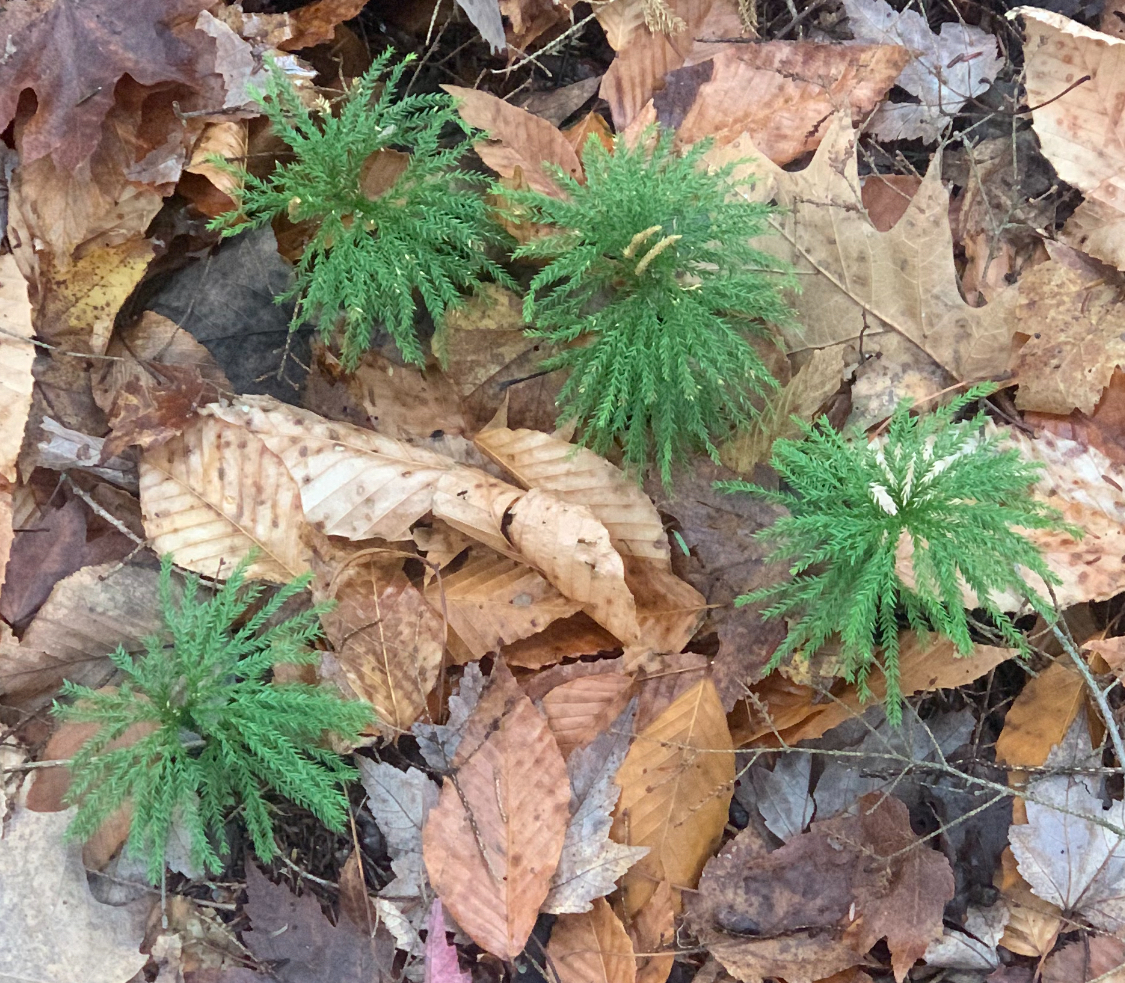
Lychopodium, November 27, 2024
I traverse this wood-lot back and forth by the lines cut by those who have lotted it off. Thus I scare up the partridges in it. A dozen long lines four rods apart are cut through it. Walking through these, I am pretty sure to scare up what partridges there are in it, and there are few wood-lots of this size which have not some in them at present.
Come upon a large ant-hill in the midst of the wood, but no ants on it. It has made an open and bare spot in the woods, ten or twelve feet in diameter. Its mound is partly grassed over, as usual, and trees have been prevented from springing up by the labors of the ants beneath. As this wood is about thirty years old, it may prove that the ant-hill is of the same age!
On the 22d the ground was white with snow for a few hours only. Yet, though you saw no more of it generally the latter part of that day, I still see some of it in cold, wet, shaded places, as amid andromeda and cranberry vines.

November 27, 2024
This wood-lot, especially at the northwest base of the hill, is extensively carpeted with the Lycopodium complanatum and also much dendroideum and Chimaphila umbellata.
The former, methinks, abounds especially in shady and rather moist, and I think old, or rather diseased, and cold(?), woods. It covers the earth densely, even under the thickest white pine groves, and equally grows under birches. It surprises you as if the trees stood in green grass where you commonly see only withered leaves.
The Greeks and Romans made much of honey be cause they had no sugar; olive oil also was very important. Our poets(?) still sing of honey, though we have sugar, and oil, though we do not produce and scarcely use it.
The principal flight of geese is said to have been a few days before the 24th. I have seen none.
H D. Thoreau, Journal, November 27, 1859
This wood-lot, especially at the northwest base of the hill, is extensively carpeted with the Lycopodium complanatum and also much dendroideum. See November 27, 1853 (" I observe the Lycopodium lucidulum still of .a fresh, shining green. ");October 16, 1859 ("All the Lycopodium complanatum I see to-day has shed its pollen.");November 11, 1859 ("The flat variety of Lycopodium dendroideum shed pollen on the 25th of October."); November 15, 1858 ("The Lycopodium dendroideum var. obscurum appears to be just in bloom in the swamp about the Hemlocks (the regular one (not variety) is apparently earlier)"); November 16, 1858 ("the lycopodium dendroideum, complanatum, and lucidulum, and the terminal shield fern are also very interesting."); November 17, 1858 ("Lycopodium dendroideum . . .was apparently in its prime yesterday); November 17, 1858 ("It would seem that these lycopodiums, at least, which have their habitat on the forest floor and but lately attracted my attention there (since the withered leaves fell around them and revealed them by the contrast of their color and they emerged from obscurity), —it would seem that they at the same time attained to their prime, their flowering season. "); December 7, 1853 ("I In the latter part of November and now, before the snow, I am attracted by the numerous small evergreens on the forest floor, now most conspicuous, especially the very beautiful Lycopodium dendroideum, somewhat cylindrical, and also, in this grove, the variety obscurum of various forms, . . .like looking down on evergreen trees. And the L. lucidulum of the swamps, forming broad, thick patches of a clear liquid green,. . . not to mention the spreading openwork umbrellas of the L. complanatum, or flat club-moss, all with spikes still. Also the liquid wet glossy leaves of the Chimaphila (winter or snow-loving) umbellata, with its dry fruit.") See also A Book of the Seasons, by Henry Thoreau, The Lycopodiums
Chimaphila umbellata. [what HDT calls pipsissewa, or “wintergreen.”] See November 16, 1858 (“Methinks the wintergreen, pipsissewa, is our handsomest evergreen, so liquid glossy green and dispersed almost all over the woods.”); November 19, 1850 ("Now that the grass is withered and the leaves are withered or fallen, it begins to appear what is evergreen the partridge-berry and checkerberry, and winter-green leaves even, are more conspicuous.”) See also November 27, 1853 (Checkerberries and partridge-berries are both numerous and obvious now")
The principal flight of geese is said to have been a few days before the 24th. See November 20, 1853 ("Methinks the geese are wont to go south just before a storm, and, in the spring, to go north just after one, say at the end of a long April storm.”); November 24, 1855 ("Geese went over on the 13th and 14th, on the 17th the first snow fell, and the 19th it began to be cold and blustering.”); November 25, 1852 ("At Walden. — I hear at sundown . . . a flock of wild geese going south."); November 30, 1857 ("The air is full of geese. I saw five flocks within an hour, about 10 A. M., containing from thirty to fifty each, and afterward two more flocks, making in all from two hundred and fifty to three hundred at least”)
November 27. See A Book of the Seasons, by Henry Thoreau, November 27
I am sure to scare
up partridges at present
a wood-lot this size
A Book of the Seasons, by Henry Thoreau,
A Book of the Seasons, by Henry Thoreau
"A book, each page written in its own season,
out-of-doors, in its own locality."
~edited, assembled and rewritten by zphx © 2009-2025


