Showing posts with label ants. Show all posts

Tuesday, January 21, 2020

Peacefully parting company with the best friend I ever had, by each pursuing his proper path.


January  21. 

One day, when I went out to my wood-pile, or rather my pile of stumps, I observed two large ants, the one red, the other much larger and black, fiercely contending with one another, and rolling over on the chips. It was evidently a struggle for life and death which had grown out of a serious feud. Having once got hold, they never let go of each other, but struggled and wrestled and rolled on the chips, each retaining his hold with mastiff-like pertinacity. 

Looking further, I found to my astonishment that the chips were covered with such combatants, that it was not a duellum but a bellum, a war between two races of ants, the red always pitted against the black, and frequently two red ones to one black. They covered all the hills and vales of my wood-yard, and, indeed, the ground was already strewn with the dead, both red and black. 

It was the only war I had ever witnessed, the only battle-field I ever trod while the battle was raging; internecine war; the red republicans and the black despots or imperialists. On every side they were engaged in deadly combat, yet without any noise that I could hear, and never human soldiers fought so resolutely. I watched a couple, in a little sunny valley amid the chips, that were fast locked in each other's embraces, now at noonday prepared to fight till the sun went down. The smaller red champion had fastened him self like a vise to his adversary's front, and through all the tumblings on that field never for an instant ceased to gnaw at one of his feelers near the root, having already caused the other to go by the board, while the stronger black one dashed him from side to side, and, as I saw on looking nearer, had divested him of several of his members. 

None manifested a disposition to retreat from the combat equal or unequal. It was evident that their battle-cry was conquer or die. They fought like mastiffs or bulldogs, who will not let go though all their legs are cut off. 

In the meanwhile there came along a single red ant on the side-hill of this valley, evidently full of excitement, who either had dispatched his foe or had not yet taken part in the battle; probably the latter, for he had lost none of his limbs. He saw this unequal combat from afar, — for the blacks were nearly twice the size of the red, — he drew near with rapid pace till he stood on his guard within half an inch of the combatants, then, watching his opportunity, he sprang upon the black warrior and commenced his operations near the root of his right fore leg, leaving the other to select among his own members, and so there were three united for life and death apparently, — united for life until death, — as if a new kind of attraction had been invented, which put all other locks and cements to shame. 

I should not wonder if they had their respective musical bands stationed on some chip and playing their national airs the while to cheer the dying combatants. (Whose mother had charged him to return with his shield or upon it.) I was myself excited some what, even as if they had been men. The more you think of it, the less the difference. And certainly there is no other fight recorded in Concord that will bear a moment's comparison with this. 

I have no doubt they had as just a cause, one or even both parties, as our forefathers, and that the results will be as important and memorable. And there was far more patriotism and heroism. For numbers and for carnage it was an Austerlitz or Dresden. I saw no disposition to retreat. 

I took up the chip on which the three I have particularly described were struggling, carried it into my house, and placed it under a tumbler on my window- sill, wishing [to] see the issue. 

Holding a microscope to the first-mentioned red ant, I saw that though he was assiduously gnawing at the near fore leg of his enemy, having severed his remaining feeler, his own breast was all torn away, exposing what vitals he had there to the jaws of the black warrior, whose own breastplate was apparently too thick for him; and the dark carbuncles of his eyes shone with ferocity such as wars only could excite. 

They struggled for half an hour longer under the tumbler, and when I looked again, the black soldier had severed the heads of his foes from their bodies, and the former were hanging on either side of him still apparently as firmly fastened as ever, and he was endeavoring, with feeble struggles, being without feelers and with only one or two legs, and I know not how many other wounds, to divest himself of them; which at length, after half an hour more, he had accomplished. I raised the tumbler, and he went off over the window-sill in that crippled state. Whether he finally survived that combat and had a pension settled on him, I do not know. But I thought that his industry would not be worth much thereafter. 

Which party was victorious I never learned, nor the cause of the war. But I felt for the rest of that day as if I had had my feelings harrowed and excited by witnessing the struggle, the ferocity and carnage, of a human battle before my door. 

To record truths which shall have the same relation and value to the next world, i.e. the world of thought and of the soul, that political news has to this. 

This winter they are cutting down our woods more seriously than ever, — Fair Haven Hill, Walden, Linnaea Borealis Wood, etc., etc. Thank God, they cannot cut down the clouds! 

History used to be the history of successive kings or their reigns, — the Williams, Henrys, Johns, Richards, etc., etc., all of them great in somebody's estimation. But we have altered that considerably. Hereafter it is to be to a greater extent the history of peoples. You do not hear some King Louis or Edward or Leopold referred to now by sensible men with much respect. 

Heard Higginson lecture to-night on Mohammed. Why did I not like it better? Can I deny that it was good? Perhaps I am bound to account to myself at least for any lurking dislike for what others admire and I am not prepared to find fault with. Well, I did not like it, then, because it did not make me like it, it did not carry me away captive. 

He is not simple enough. For the most part the manner overbore, choked off, and stifled, put out of sight and hearing, the matter. I was inclined to forget that he was speaking, conveying ideas; thought there had been an intermission. Never endeavor consciously to supply the tone which you think proper for certain sentences. It is as if a man whose mind was at ease should supply the tones and gestures for a man in distress who found only the words; as when one makes a speech and an other behind him makes gestures. 

Then he reminded me of Emerson, and I could not afford to be reminded of Christ himself. Yet who can deny that it was good? But it was that intelligence, that way of viewing things (combined with much peculiar talent), which is the common property of this generation. 

A man does best when he is most himself. 

I never realized so distinctly as this moment that I am peacefully parting company with the best friend I ever had, by each pursuing his proper path. I perceive that it is possible that we may have a better understanding now than when we were more at one. Not expecting such essential agreement as before. Simply our paths diverge.

H. D. Thoreau, Journal, January 21, 1852

I perceive that it is possible that we may have a better understanding now than when we were more at one. See  March 28, 1856 ("Farewell, my friends, my path inclines to this side the mountain, yours to that."); February 23, 1857 ("While I think I have broken one link, I have been forging another. ")

Wednesday, November 27, 2019

I am pretty sure to scare up partridges in a wood-lot of this size


November 27.

P. M. — To Colburn Farm wood-lot north of C. Hill.

 
Lychopodium, November 27, 2024

I traverse this wood-lot back and forth by the lines cut by those who have lotted it off. Thus I scare up the partridges in it. A dozen long lines four rods apart are cut through it. Walking through these, I am pretty sure to scare up what partridges there are in it, and there are few wood-lots of this size which have not some in them at present. 


Come upon a large ant-hill in the midst of the wood, but no ants on it. It has made an open and bare spot in the woods, ten or twelve feet in diameter. Its mound is partly grassed over, as usual, and trees have been prevented from springing up by the labors of the ants beneath. As this wood is about thirty years old, it may prove that the ant-hill is of the same age! 

On the 22d the ground was white with snow for a few hours only. Yet, though you saw no more of it generally the latter part of that day, I still see some of it in cold, wet, shaded places, as amid andromeda and cranberry vines. 

November 27, 2024

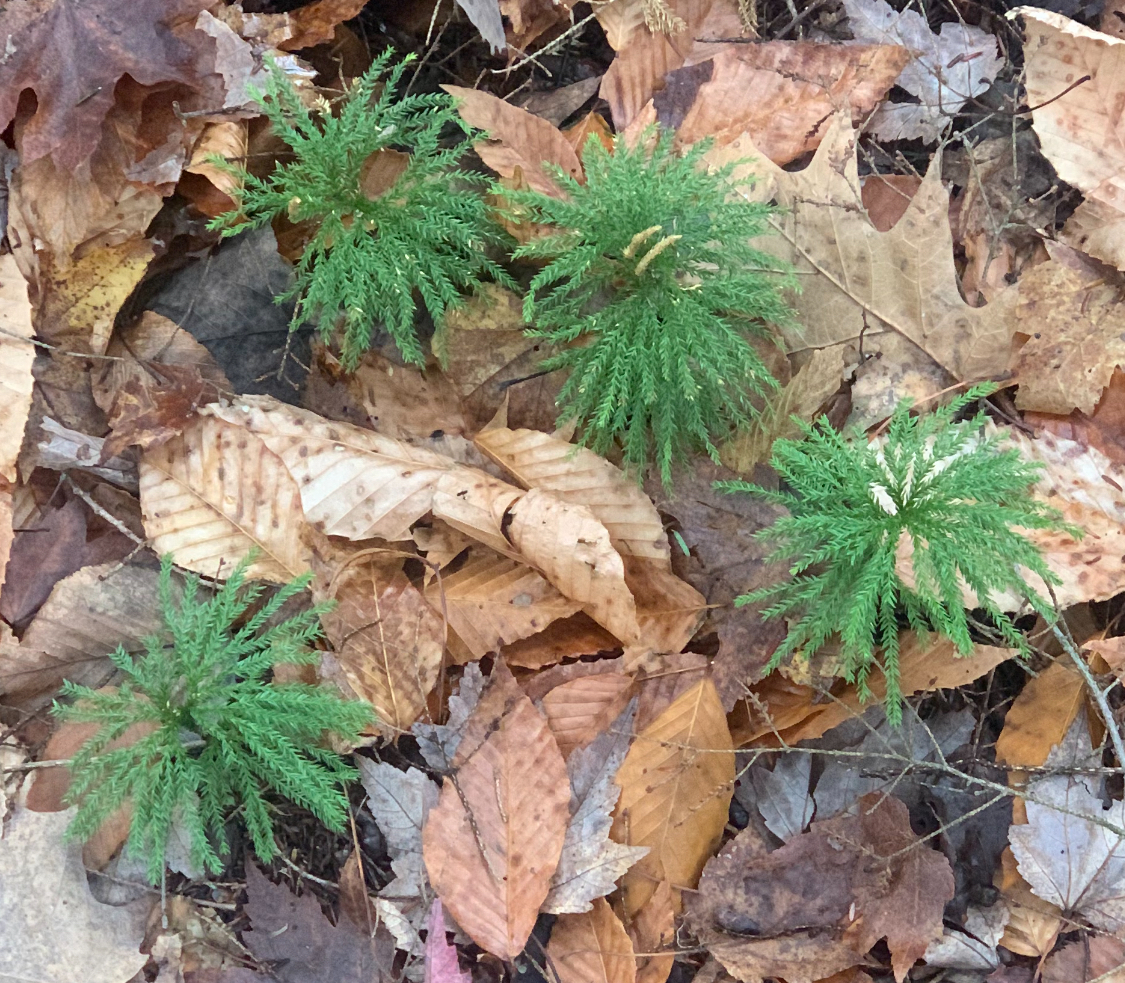
This wood-lot, especially at the northwest base of the hill, is extensively carpeted with the Lycopodium complanatum and also much dendroideum and Chimaphila umbellata

The former, methinks, abounds especially in shady and rather moist, and I think old, or rather diseased, and cold(?), woods. It covers the earth densely, even under the thickest white pine groves, and equally grows under birches. It surprises you as if the trees stood in green grass where you commonly see only withered leaves. 

The Greeks and Romans made much of honey be cause they had no sugar; olive oil also was very important. Our poets(?) still sing of honey, though we have sugar, and oil, though we do not produce and scarcely use it. 

The principal flight of geese is said to have been a few days before the 24th. I have seen none.

H D. Thoreau, Journal, November 27, 1859


This wood-lot, especially at the northwest base of the hill, is extensively carpeted with the Lycopodium complanatum and also much dendroideum. See November 27, 1853 (" I observe the Lycopodium lucidulum still of .a fresh, shining green. ");October 16, 1859 ("All the Lycopodium complanatum I see to-day has shed its pollen.");November 11, 1859 ("The flat variety of Lycopodium dendroideum shed pollen on the 25th of October."); November 15, 1858 ("The Lycopodium dendroideum var. obscurum appears to be just in bloom in the swamp about the Hemlocks (the regular one (not variety) is apparently earlier)");  November 16, 1858 ("the lycopodium dendroideum, complanatum, and lucidulum, and the terminal shield fern are also very interesting."); November 17, 1858 ("Lycopodium dendroideum . . .was apparently in its prime yesterday); November 17, 1858 ("It would seem that these lycopodiums, at least, which have their habitat on the forest floor and but lately attracted my attention there (since the withered leaves fell around them and revealed them by the contrast of their color and they emerged from obscurity), —it would seem that they at the same time attained to their prime, their flowering season. ");  December 7, 1853 ("I In the latter part of November and now, before the snow, I am attracted by the numerous small evergreens on the forest floor, now most conspicuous, especially the very beautiful Lycopodium dendroideum, somewhat cylindrical, and also, in this grove, the variety obscurum of various forms, . . .like looking down on evergreen trees. And the L. lucidulum of the swamps, forming broad, thick patches of a clear liquid green,. . . not to mention the spreading openwork umbrellas of the L. complanatum, or flat club-moss, all with spikes still. Also the liquid wet glossy leaves of the Chimaphila (winter or snow-loving) umbellata, with its dry fruit.") See also A Book of the Seasons, by Henry Thoreau, The Lycopodiums

Chimaphila umbellata. [what HDT calls pipsissewa, or “wintergreen.”]   See November 16, 1858 (“Methinks the wintergreen, pipsissewa, is our handsomest evergreen, so liquid glossy green and dispersed almost all over the woods.”); November 19, 1850 ("Now that the grass is withered and the leaves are withered or fallen, it begins to appear what is evergreen the partridge-berry and checkerberry, and winter-green leaves even, are more conspicuous.”)  See also  November 27, 1853 (Checkerberries and partridge-berries are both numerous and obvious now")

The principal flight of geese is said to have been a few days before the 24th.  See November 20, 1853 ("Methinks the geese are wont to go south just before a storm, and, in the spring, to go north just after one, say at the end of a long April storm.”); November 24, 1855 ("Geese went over on the 13th and 14th, on the 17th the first snow fell, and the 19th it began to be cold and blustering.”); November 25, 1852 ("At Walden. — I hear at sundown . . . a flock of wild geese going south."); November 30, 1857 ("The air is full of geese. I saw five flocks within an hour, about 10 A. M., containing from thirty to fifty each, and afterward two more flocks, making in all from two hundred and fifty to three hundred at least”)


November 27. See A Book of the Seasons,  by Henry Thoreau,  November 27


A Book of the Seasons,  by Henry Thoreau,  
A Book of the Seasons,  by Henry Thoreau
 "A book, each page written in its own season, 
out-of-doors, in its own locality."
 ~edited, assembled and rewritten by zphx ©  2009-2025

Monday, May 6, 2019

Young red maples suddenly bursting into leaf are very conspicuous now in the woods,

May 6. 

Surveying for Willis & Damon at the factory. 

Hear the tea-lee of the white-throat sparrow. 

It is suddenly very warm and oppressive, especially in the woods with thick clothing. 

Viola pedata begins to be common about white pine woods there.

While surveying this forenoon behind Willis's house on the shore of the mill-pond, I saw remarkable swarms of that little fuzzy gnat (Tipulidae). Hot as it was, — oppressively so, — they were collected in the hollows in the meadow, apparently to be out of the way of the little breeze that there was, and in many such places in the meadow, within a rod of the water, the ground was perfectly concealed by them. Nay, much more than that. I saw one shallow hollow some three feet across which was completely filled with them, all in motion but resting one upon another, to the depth, as I found by measurement with a stick, of more than an inch, — a living mass of insect life. There were a hundred of these basins full of them, and I then discovered that what I had mistaken for some black dye on the wet shore was the bodies of those that were drowned and washed up, blackening the shore in patches for many feet together like so much mud. We were also troubled by getting them into our mouths and throats and eyes. 

This insect resembles the plate of the Chironomus plumosus ("Library of Entertaining Knowledge, Insect Transformations," page 305), also the Corethra plumicornis (page 287), both of which live at first in the water, like the mosquito. 

Young red maples suddenly bursting into leaf are very conspicuous now in the woods, among the most prominent of all shrubs or trees. The sprouts are reddish. 

Hear yellow-throat vireo, and probably some new warblers. 

See the strong-scented wood ants in a stump. 

Black suckers, so called, are being speared at the factory bridge.

This is about the last of the very dry leaves in the woods, for soon the ground will be shaded by expanded green leaves. It is quite hazy, if not smoky, and I smell smoke in the air, this hot day. 

My assistants, being accustomed to work indoors in the factory, are quite overcome by this sudden heat. The old leaves and earth are driest now, just before the new leaves expand and when the heat is greatest. 

I see the black traces of many a recent fire in the woods, especially in young woods. At evening I hear the first sultry buzz of a fly in my chamber, telling of sultry nights to come.

H. D. Thoreau, Journal, May 6, 1859

Viola pedata begins to be common about white pine woods there
. See May 10, 1858 ("How much expression there is in the Viola pedata! I do not know on the whole but it is the handsomest of them all, it is so large and grows in such large masses.") See also  May 5, 1853 ("The Emerson children found blue and white violets May 1st at Hubbard's Close, probably Viola ovata and blanda; but I have not been able to find any yet."); May 5, 1859  ("V. pedata and lanceolata rarer yet, or not seen.")  May 6, 1852 (“The first Viola blanda (sweet-scented white), in the moist ground by this spring.”);  May 6, 1855 ("Viola lanceolata, yesterday at least. . . .Two or three rods this side of John Hosmer’s pitch pines, beyond Clamshell, some white Viola ovata, some with a faint bluish tinge. ")// Also  A Book of the Seasons, by Henry Thoreau, The Violets

I saw remarkable swarms of that little fuzzy gnat (Tipulidae). See A Book of the Seasons, by Henry Thoreau, the Fuzzy Gnat

Young red maples suddenly bursting into leaf are very conspicuous now in the woods. Compare May 6, 1855 ("The young sugar maples leafing are more conspicuous now than any maples.”) . See A Book of the Seasons, by Henry Thoreau, Spring Leaf-Out

Hear yellow-throat vireo, and probably some new warblers. See May 6, 1852 ("Hear the first warbling vireo this morning on the elms. This almost makes a summer.”); May 7, 1852 ("One or more little warblers in the woods this morning are new to the season, . . .The first wave of summer from the south.”)


An evening hike it’s been a perfectly blue sky  and puffy white clouds day we hear the first tree frog of the season somewhere past the junction. I stop and cut a hop hornbeam there, dispose of the top over the bank and leave the trunk along one of the trails. I see there the sedge flowering for the first time. The spring beauties are out in profusion and  I smell them now the sweet smell of spring. They’re everywhere in the woods but seemingly thriving more so in the paths The sun is still a couple of hours high, but quite a bit north right in front of the view. We sit long enough for the sky below the clouds to have an orangey peach tint. There seems to be an oven bird trying to sing. We go down past the middle pond and approaching the top of  middle ridge I hear the first wood thrush. We spend a long time listening. It sings in groups of four  phrases which it repeats. One -- after the throat clearing – starts with  a bursting  high note.  More trail cleaning on a spur trail on the way out and home at dusk to feed the dogs. 20190586: tree frog wood thrush oven bird black-throated green spring beauties

Sunday, May 5, 2019

Yellow birches in bloom.


May 5. 

Thursday. P.M. — To Melvin's Preserve.

             May 5, 2018                                                               May 5, 2019
 

Red-wings fly in flocks yet. 


Near the oak beyond Jarvis land, a yellow butterfly, — how hot! this meteor dancing through the air. 


Also see a scalloped-edge dark- colored butterfly resting on the trunk of a tree, where, both by its form and color, its wings being closed, it resembles a bit of bark, or rather a lichen. Evidently their forms and colors, especially of the under sides of their wings, are designed to conceal them when at rest with their wings closed. 


Am surprised to find the Viola Muhlenbergii quite abundant beyond the bayberry and near the wall. According to my observation this year, it now stands thus with the violets : the V. ovata is the commonest, but not abundant in one spot; the V. Muhlenbergii is most abundant in particular spots, coloring the hummocks with its small pale flowers; the V. blanda and cucullata are, equally, less abundant than the former, or rather rare; V. pedata and lanceolata rarer yet, or not seen. 

I noticed lately where middle-sized ants, half black and half sorrel, had completely removed the pine-needles from the crown of their large hills, leaving them bare like a mountain-top. 


Am struck by the beauty of the yellow birches, now fairly begun to be in bloom, at Yellow Birch, or Borychium, Swamp. It is perhaps the handsomest tree or shrub yet in bloom (apparently opened yesterday), of similar character to the alders and poplars, but larger and of higher color. You see a great tree all hung with long yellow or golden tassels at the end of its slender, drooping spray, in clusters at intervals of a few inches or a foot. These are all dangling and incessantly waving in the wind, — a great display of lively blossoms (lively both by their color and motion) without a particle of leaf. 


Yet they are dense enough to reveal the outline of the tree, seen against the bare twigs of itself and other trees. The tassels of this one in bloom are elongated to two or three times the length of those of another not in bloom by its side. These dancing tassels have the effect of the leaves of the tremble. Those not quite open have a rich, dark, speckled or braided look, almost equally handsome. Golden tassels all trembling in the gentlest breeze, the only signs of life on the trees. A careless observer might not notice them at all. 


The reawakened springy life of the swamp, the product of its golden veins. These graceful pendants, not in too heavy or dense masses, but thinly dispersed with a noble moderation. Great vegetable chandeliers they stand in the swamps. The unopened catkins, some more golden, others brown or coppery, are like living worms ready to assume a winged life. These trees, which cannot stir their stumps, thus annually assume this lively color and motion. 


I see and am bitten by little black flies, — I should say the same with those of Maine, — here on the Melvin Preserve. One eighth of an inch long. 


Brakes are five inches high. 


Poa annua (small and flat spreading in Pratt's garden), say a week. 

May 5, 2023

The sun sets red (first time), followed by a very hot and hazy day. 


The wilderness, in the eyes of our forefathers, was a vast and howling place or space, where a man might roam naked of house and most other defense, exposed to wild beasts and wilder men. They who went to war with the Indians and French were said to have been "out," and the wounded and missing who at length returned after a fight were said to have "got in," to Berwick or Saco, as the case might be. 


Veronica peregrina, Pratt's garden.


H. D. Thoreau, Journal, May 5, 1859


Near the oak beyond Jarvis land, 
a yellow butterfly, — 
how hot! this meteor 
dancing through the air. 

See May 5, 1860 ("Yellow butterflies."). and Buson:

     Butterfly
sleeping
                 on the temple bell.

See also  May 22, 1856 (“A yellow butterfly over the middle of the flooded meadow.”); May 25, 1852 (“Yellow butterflies one at a time. The large yellow woods violet (V. pubescens) by this brook now out.”); September 19, 1859 ("One flutters across between the horse and the wagon safely enough, though it looks as if it would be run down.") See also A Book of the Seasons,  by Henry Thoreau, Yellow Butterflies
Am surprised to find the Viola Muhlenbergii quite abundant beyond the bayberry and near the wall. See May 12, 1858 ("Find the Viola Muhlenbergii abundantly out (how long?), in the meadow southwest of Farmer's Spring.”); May 18, 1857 (“Viola Muhlenbergii abundantly out, how long?”); May 22, 1856 (“Viola Muhlenbergii, which is abundantly out; how long? A small pale-blue flower growing in dense bunches, but in spots a little drier than the V. cucullata and blanda”); May 29, 1856 ("What a flowery place, a vale of Enna, is that [Painted Cup] meadow! Painted Cup, Erigeron bellidifolius, Thalictrum dioicum, Viola Muhlenbergii, fringed polygala, buck-bean, pedicularis, orobanche, etc., etc. Where you find a rare flower, expect to find more rare ones”)
The yellow birches, now fairly begun to be in bloom, at Yellow Birch, or Borychium, Swamp. See May 17, 1857 ("The yellow birch catkins, now fully out or a little past prime, are very handsome now, numerous clusters of rich golden catkins hanging straight down at a height from the ground on the end of the pendulous branches, amid the just expanding leaf-buds. It is like some great chandelier hung high over the underwood.”)

The sun sets red (first time), followed by a very hot and hazy day. See May 5, 1860 ("Sun goes down red."); May 4, 1860 (“The sun sets red, shorn of its beams.”); August 25, 1854 ("The sun is shorn of his beams by the haze before 5 o'clock P.M., round and red, and is soon completely concealed, apparently by the haze alone.”)

Veronica peregrina, Pratt's garden. See May 5, 1860 ("Veronica serpyllifolia, say yesterday.."). See also See May 22, 1856 ("Veronica peregrina, apparently several days.”);May 25, 1855 ("Veronica peregrina in Mackay’s strawberries, how long? “)

Wednesday, April 24, 2019

The colors of the world.


April 24


April 24, 2017

6 a. m. — Water has fallen an inch and a half since last night, — which is at a regular rate. 

Now that the sun shines and the sky is blue, the water is a dark blue which in the storm was light or whitish. It follows the sky's, though the sky is a lighter blue.

The lilac buds have looked as forward as any for many weeks. 

2 p. m. — To Carlisle Bridge via Flint's Bridge, bank of river, rear of Joel Barrett's, returning by bridle-road. 

The elms are now fairly in blossom. 

It is one of those clear, washing days, — though the air is cold, — such as succeed a storm, when the air is clear and flowing, and the cultivated ground and the roads shine. 

Passed Flint's road on the wall. 

Sorrel is well under weigh, and cinquefoil. 

White oaks still hold their leaves. 

The pitch pine is a cheerful tree at this season, with its lively yellow-green in the sunshine, while the landscape is still russet and dead-grass colored.

Sitting by the road beyond N. Barrett's, the colors of the world are: 

  • overhead a very light blue sky, darkest in the zenith, lightest in the horizon, with scattered white clouds seeming thickest in the horizon;
  • all around the undulating earth a very light tawny color, from the dead grass, with the reddish and gray of forests mingled with evergreen;
  • and, in the lap of earth, very dark blue rippled water, answering to the light blue above; 
  • the shadows of clouds flitting over all below;
  • the spires of woods fringing the horizon on every side, and, nearer, single trees here and there seen with dark branches against the sky. T
  • this tawny ground divided by walls and houses, white, light slate, and red sprinkled here and there. 

Ball's Hill and the rest are deep sunk in the flood. 

The level water-line appears to best advantage when it appears thus to cut the trees and hills. It looks as if the water were just poured into its basin and simply stood so high. No permanent shore gives you this pleasure.

Saw the honey-bees on the staminate flowers of the willow catkins by the roadside (such as I described April 23d), with little bottles of the yellow pollen, apparently, as big as pin-heads on their thighs. With these flowers, then, come bees. Is there honey in staminate flowers? 

The innocent odor of spring flowers, flavorless, as a breakfast. They will be more spiced by and by.

Went over the cladonia hills toward Tarbell's.

A small tree, an oak for instance, looks large on a bare hilltop. 

The farmers, whom the storm has delayed, are busily plowing and overhauling their manure. 

Observed the ants at work on a large ant-heap. They plainly begin as soon as the snow is off and the ground thawed. 

Gold-thread, an evergreen, still bright in the swamps.

The rattlesnake-plantain has fresh leaves. 

A wall running over the top of a rocky hill, with the light seen through its chinks, has a pretty effect. 

The sparrows, frogs, rabbits, etc., are made to resemble the ground for their protection; but so is the hawk that preys on them; but he is of a lighter color beneath, that creeping things over which he hovers may confound him with the sky. The marsh hawk is not easily distinguished from the meadow or the stems of the maples. 

The water is still over the causeway on both sides of Carlisle Bridge for a long distance. It is a straight flood now for about four miles. Fortunately for the bridge the wind has not been very high since the flood was at its height. 

The leaves of the hardhack, curled up, show their white under sides. 

On the bridle-road observed the interesting light-crimson star-like flowers of the hazel, the catkins being now more yellowish. 

This is a singular and interesting part of Concord, extensive and rather flat rocky pastures without houses or cultivated fields on any but this unused bridle-road, from which I hear the frogs peep. These are Channing's "moors." He went in on this road to chop, and this is the scene of his "Woodman." 

Heard again (in the village) that vetter-vetter-vetter- vetter-vef, or tchi-tchi-tchi-tchi-tchi-tchi-tchi' very rapidly repeated, which I heard April 23d, and perhaps the same that I saw April 17th (described April 18th). I am pretty sure it is the pine warbler, yellow beneath, with faint olivaceous marks on the sides, olivaceous above, tail forked, about the size of a yellow-bird. 

I have not seen the fox-colored sparrow for some weeks.

Thought I saw a loon on Walden yesterday.

H. D. Thoreau, Journal, April 24, 1852

The pitch pine is a cheerful tree at this season, with its lively yellow-green in the sunshine, , while the landscape is still russet and dead-grass colored. See April 24, 1857 ("Now the sun comes out and shines on the pine hill west of Ball's Hill, lighting up the light-green pitch pines and the sand and russet-brown lichen-clad hill. That is a very New England landscape.")See also April 11, 1852 ("The light of the setting sun on the pitch pines on Fair Haven and Bear Hill lights them up warmly.") and A Book of the Seasons, by Henry Thoreau, the Pitch Pine.


The leaves of the hardhack, curled up, show their white under sides.
See April 24, 1860 ("The meadow-sweet and hardhack have begun to leaf.”)

Saw the honey-bees on the staminate flowers of the willow catkins . . . with little bottles of the yellow pollen, apparently, as big as pin-heads on their thighs. See April 9, 1853 (“Bees also in the female willows, of course without pellets. It must be nectar alone there.”); April 17, 1855 (“A bee curved close on each half-opened catkin, intoxicated with its early sweet, —one perhaps a honey-bee, — so intent on its sweets or pollen that they do not dream of flying. Various kinds of bees — some of the honey bees — have little yellow masses of pollen on their thighs; some seem to be taking it into their mouths”) 
Willows now in bloom 
resound with the hum of bees 
this warm afternoon. 
See also A Book of the Seasons, by Henry Thoreau, Bees

The interesting light-crimson star-like flowers of the hazel. See April 9, 1856 ("the stigmas already peep out, minute crimson stars"); April 11, 1856 ("the crimson stigmas of the hazel, like little stars peeping forth") April 13, 1855 ("many minute, but clear crystalline crimson stars at the end of a bare and seemingly dead twig.")

I am pretty sure it is the pine warbler, yellow beneath, with faint olivaceous marks on the sides, olivaceous above, tail forked, about the size of a yellow-bird
. See April 9, 1856 ("Its bright yellow or golden throat and breast, etc., are conspicuous at this season, — a greenish yellow above, with two white bars on its bluish-brown wings. It sits often with loose-hung wings and forked tail.");  August 18, 1856 ("Clear-yellow throat and breast, greenish-yellow head, conspicuous white bar on wings, white beneath, forked tail, bluish legs. Can it be pine warbler? The note, thus faint, is not like it.")

I have not seen the fox-colored sparrow for some weeks
. See April 24, 1855 ("Have not seen the F. hyemalis for a week.,"); April 17, 1855 ("A sudden warm day, like yesterday and this, takes off some birds and adds others. It is a crisis in their career. The fox-colored sparrows seem to be gone"). See also   A Book of the Seasons, by Henry Thoreau, the Fox-colored Sparrow.


Thought I saw a loon on Walden yesterday.
See October 8, 1852 ("At length, having come up fifty rods off, he uttered one of those prolonged unearthly howls, as if calling on the god of loons to aid him, and immediately there came a wind from the east and rippled the surface, and filled the whole air with misty rain.")

Sunday, March 31, 2019

When the surface of the earth generally begins to be dry.


March 31

The frost is out of our garden, and I see one or two plowing early land. You walk dry now over this sandy land where the frost is melted, even after heavy rain, and there is no slumping in it, for there is no hard-pan and ice to hold the water and make a batter of the surface soil. This is a new condition of things when the surface of the earth generally begins to be dry. 

But there is still much frost in cold ground, and I often feel the crust which was heaved by it sink under me, and for some time have noticed the chinks where the frozen ground has gaped and erected itself from and over stones and sleepers. 

P. M. — To Holbrook's improvements. 

Many painted turtles out along a ditch in Moore's Swamp. These the first I have seen, the water is so high in the meadows. One drops into the water from some dead brush which lies in it, and leaves on the brush two of its scales. Perhaps the sun causes the loosened scales to curl up, and so helps the turtle to get rid of them. 

Humphrey Buttrick says that he has shot two kinds of little dippers, — the one black, the other with some white. 

I see, on a large ant-hill, largish ants at work, front half reddish, back half black, but on another, very large ant-hill near by (a rod to left of Holbrook's road, perhaps fifty rods this side of his clearing on the north side), five feet through, there none out. 

It will show how our prejudices interfere with our perception of color, to state that yesterday morning, after making a fire in the kitchen cooking-stove, as I sat over it I thought I saw a little bit of red or scarlet flannel on a chink near a bolt-head on the stove, and I tried to pick it out, — while I was a little surprised that I did not smell it burning. It was merely the reflection of the flame of the fire through a chink, on the dark stove. This showed me what the true color of the flame was, but when I knew what this was, it was not very easy to perceive it again. It appeared now more yellowish. I think that my senses made the truest report the first time. 

The wood frogs lie spread out on the surface of the sheltered pools in the woods, cool and windy as it is, dimpling the water by their motions, and as you approach you hear their lively wurk wurrk wur-r-k, but, seeing you, they suddenly hist and perhaps dive to the bottom. 

It is a very windy afternoon, wind northwest, and at length a dark cloud rises on that side, evidently of a windy structure, a dusky mass with lighter intervals, like a parcel of brushes lying side by side, — a parcel of "mare's-tails " perhaps. It winds up with a flurry of rain.

H. D. Thoreau, Journal, March 31, 1859

Many painted turtles out along a ditch in Moore's Swamp. These the first I have seen,  See March 31, 1857 ("The tortoises now quite commonly lie out sunning on the sedge or the bank. As you float gently down the stream, you hear a slight rustling and, looking up, see the dark shining back of a picta sliding off some little bed of straw-colored coarse sedge...”); March 31, 1858 ("Ordinarily at this season, the meadows being flooded,. . . I first noticed them underwater on the meadow. But this year it is but a step for them to the sunny bank, and the shores of the Assabet and of ditches are lined with them “) See also A Book of the Seasons, by Henry Thoreau, the Painted Turtle (Emys picta)


Humphrey Buttrick says that he has shot two kinds of little dippers, — the one black, the other with some white. See March 27, 1858 ("At length I detect two little dippers . . . They are male and female close together . . . The female is apparently uniformly black, or rather dark brown, but the male has a conspicuous crest, with, apparently, white on the hindhead, a white breast, and white line on the lower side of the neck; i. e., the head and breast are black and white conspicuously.”);  December 26, 1857 ("Humphrey Buttrick tells me that he has shot little dippers. He also saw the bird which Melvin shot last summer (a coot), but he never saw one of them before. The little dipper must, therefore, be different from a coot.”) . “Little dipper” is  Thoreau's name for various small diving birds, perhaps the buffle-head (Fuligulaalbeola), sometimes the pied billed or horned grebe (Podiceps auritus). See A Book of the Seasons, by Henry Thoreau, The Little Dipper

The wood frogs lie spread out on the surface of the sheltered pools in the woods, cool and windy as it is, dimpling the water by their motions, and as you approach you hear their lively wurk wurrk wur-r-k. See March 31, 1857 (“As I rise the east side of the Hill, I hear the distant faint peep of hylodes and the tut tut of croaking frogs from the west of the Hill. . . .  The dry croaking and tut tut of the frogs (a sound which ducks seem to imitate, a kind of quacking . . .) is plainly enough down there in some pool in the woods, but the shrill peeping of the hylodes locates itself nowhere in particular.”); March 24, 1859 ("I am sitting in Laurel Glen, listening to hear the earliest wood frogs croaking . . . Now, when the leaves get to be dry and rustle under your feet, dried by the March winds, the peculiar dry note, wurrk wurrk wur-r-r-k wurk of the wood frog is heard faintly by ears on the alert, borne up from some unseen pool in a woodland hollow which is open to the influences of the sun."); March 26, 1860 (“The wood frog [first] may be heard March 15, as this year, or not till April 13, as in '56,”). Compare March 31, 1855 (“I go listening for the croak of the first frog, or peep of a hylodes.. . .I listen in vain to hear a frog”). And see note to May 6, 1858 (the frogs of Massachusetts) and A Book of the Seasons, by Henry Thoreau, the Wood Frog (Rana sylvatica)

Tuesday, March 26, 2019

What was that large rather grayish duck on Fair Haven Pond this afternoon?


March 26.

March 26, 2018

P. M. — To Conantum via Cardinal Shore and boat.

 The river has gone down considerably, but the rain of yesterday and to-day has checked its fall somewhat. 

Much earth has been washed away from the roots of grasses and weeds along the banks of the river, and many of those pretty little bodkin bulbs are exposed and so transported to new localities. This seems to be the way in which they are spread. 

I see many smallish ants on the red carcass of a musquash just skinned and lying on the bank, cold and wet as the weather is. They love this animal food. 

On the top of the hill at Lee's Cliff much wintergreen has been eaten; at least a great many leaves are lying loose, strewn about. 

I find washed up on the (Cardinal) shore a little bream about an inch and an eighth long, very much like those found at Walden last fall. It has about seven transverse bars, a similar dorsal fin, a reddish-copper iris, with the black vertical dash through the eye. I think it must be one of the common breams of the river, — though I see only the black spot on the operculum and not any red one, — and apparently all the young are thus striped (?) . 

What was that large rather grayish duck on Fair Haven Pond this afternoon? It was far off. Was it a last year's male sheldrake, or a female, or another?

H. D. Thoreau, Journal, March 26, 1859

Much earth has been washed away from the roots of grasses and weeds along the banks of the river, and many of those pretty little bodkin bulbs are exposed and so transported to new localities. See April 22, 1856 ("What is that little bodkin-shaped bulb which I found washed up on the edge of the meadow, white with a few small greenish rounded leafets? "); April 16, 1858 ("The bodkin-like bulb, . . . is probably the water-purslane. I see it floating free and sending out many rootlets, on pools and ditches. In this way it spreads itself.")

On the top of the hill at Lee's Cliff much wintergreen has been eaten. See November 16, 1858 (“Methinks the wintergreen, pipsissewa, is our handsomest evergreen, so liquid glossy green and dispersed almost all over the woods.”); November 19, 1850 ("Now that the grass is withered and the leaves are withered or fallen, it begins to appear what is evergreen the partridge-berry and checkerberry, and winter-green leaves even, are more conspicuous.”); December 23, 1855 (“At Lee’s Cliff I notice these radical(?) leaves quite fresh: saxifrage, sorrel, polypody, . . . checkerberry, wintergreen, . . .”); February 16, 1855 (“I see where probably rabbits have nibbled of the leaves of the Wintergreen.”); see also July 3, 1852 ("The Chimaphila umbellata, wintergreen, must have been in blossom some time.”)

A little bream about an inch and an eighth long, very much like those found at Walden last fall.  See November 26, 1858 (" a great many minnows about one inch long . . . shaped like bream, but had the transverse bars of perch. ... Yet, from their form and single dorsal fin, I think they are breams. Are they not a new species? "); November 27, 1858 ("They have about seven transverse dark bars, a vertical dark mark under eye, and a dark spot on edge of operculum. "); December 3, 1858 ("The largest of the four breams (vide November 26th) . . . Operculums tinged, streaked, and spotted with golden, coppery, greenish, and violet reflections. A vertical dark mark or line, corresponding to the stripes, through the eye. Iris copper-color or darker. ")

Tuesday, March 12, 2019

This kind of light, the air being full of rain and all vegetation dripping with it, brings out the browns wonderfully.

March 12

 Saturday. P. M. — Walk in rain to Ministerial Swamp. 

Going up the railroad in this rain, with a south wind, I see a pretty thick low fog extending across the rail road only against Dennis's Swamp. There being much more ice and snow within the swamp, the vapor is condensed and is blown northward over the railroad. I see these local fogs with always the same origin, i. e., large masses of snow or ice, in swamps or woods, perhaps the north sides of hills, in several places afterward. The air is warm. 

As often as we came to a particularly icy or snowy place, as Harrington's road in woods, we found ourselves in a fog. It is a regular spring rain, such as I remember walking in, — windy but warm. It alternately rains hard and then holds up a little. A similar alternation we see in the waves of water and all undulating surfaces, — in snow and sand and the clouds (the mackerel sky). Now you walk in a comparative lull, anticipating fair weather, with but a slight drizzling, and anon the wind blows and the rain drives down harder than ever. In one of these lulls, as I passed the Joe Hosmer (rough-cast) house, I thought I never saw any bank so handsome as the russet hillside behind it. 

Brown Season
March 12, 2021

It is a very barren, exhausted soil, where the cladonia lichens abound, and the lower side is a flowing sand, but this russet grass with its weeds, being saturated with moisture, was in this light the richest brown, methought, that I ever saw. 

There was the pale brown of the grass, red browns of some weeds (sarothra and pinweed probably), dark browns of huckleberry and sweet-fern stems, and the very visible green of the cladonias thirty rods off, and the rich brown fringes where the broken sod hung over the edge of the sand-bank. 

I did not see the browns of withered vegetation so rich last fall, and methinks these terrestrial lichens were never more fair and prominent. On some knolls these vivid and rampant lichens as it were dwarf the oaks. 

A peculiar and unaccountable light seemed to fall on that bank or hillside, though it was thick storm all around. A sort of Newfoundland sun seemed to be shining on it. It was such a light that you looked around for the sun that might be shining on it. 

Both the common largest and the very smallest hypericums (Sarothra) and the pinweeds were very rich browns at a little distance, coloring whole fields, and also withered and fallen ferns, reeking wet. 

It was a prospect to excite a reindeer.

These tints of brown were as softly and richly fair and sufficing as the most brilliant autumnal tints. In fair and dry weather these spots may be common place, but now they are worthy to tempt the painter's brush. The picture should be the side of a barren lichen-clad hill with a flowing sand-bank beneath, a few blackish huckleberry bushes here and there, and bright white patches of snow here and there in the ravines, the hill running east and west and seen through the storm from a point twenty or thirty rods south. 

March 12, 2016

This kind of light, the air being full of rain and all vegetation dripping with it, brings out the browns wonderfully. 

I notice now particularly the sallows by the railroad, full of dark cones, as a fruit. The broad radical leaves of (apparently) water dock are very fresh and conspicuous. 

See two ducks flying over Ministerial Swamp. 

In one place in the meadow southeast of Tarbell's, I find on the ice, about a couple of holes an inch across where a little stubble shows itself, a great many small ants dead, — say a thousand. They are strewn about the holes for six or eight inches, and are collected in a dense heap about the base of the stubble. I take up a mass of them on my knife, each one entire, but now, of course, all wet and adhering together. It looks as if they had been tempted out by the warmth of the sun and had been frozen or drowned; or is it possible that they were killed by the frost last fall and now washed up through the ice? I think, from their position around the base of the stubble in that little hole in the ice, that they came out of the earth and clustered there since the ice melted to that extent. 

There are many other insects and worms and caterpillars (and especially spiders, dead) on the ice, there as well as else where. 

I perceive that a freshet which washes the earth bare in the winter and causes a great flow of water over it in that state — when it is not soaked up — must destroy a great many insects and worms. I find a great many that appear to have been drowned rather than frozen. May not this have tempted the bluebirds on early this year ?

H. D. Thoreau, Journal, March 12, 1859

See two ducks flying over Ministerial Swamp. See  March 12, 1855 ("Two ducks in river, good size, white beneath with black heads, as they go over."); March 16, 1855 (“[S]care up two large ducks just above the bridge. . . . I think it the goosander or sheldrake.”). See also A Book of the Seasons, by Henry Thoreau, Signs of the Spring, Ducks Afar, Sailing on the Meadow

This kind of light, the air being full of rain and all vegetation dripping with it, brings out the browns wonderfully. See March 12, 1854 ("Memorable is the warm light of the spring sun on russet fields in the morning.") See also March 5, 1855 ("This blue haze, and the russet earth seen through it, remind me that a new season has come"); March 26, 1860 ("The brown season extends from about the 6th of March ordinarily into April. ") See also A Book of the Seasons, by Henry Thoreau, the Colors of March-- Brown Season

Thursday, September 13, 2018

Many yellow butterflies in road and fields all the country over.

September 13

P. M._—To Annursnack.


September 13, 2018
 Solidago puberula, apparently in prime and handsome, roadside, Colburn’s Hill. 

I noticed the black willows quite imbrowned on the 10th, and the button-bushes beginning to look yellowish. 

A. Hosmer is pleased because from the cupola of his new barn he can see a new round-topped mountain in the northwest. Is curious to know what one it is. Says that if he lived as near Annursnack as Heywood does, he should go up it once a week, but he supposes that Heywood does not go up it more than once a year. 

What is that grass still in bloom a foot or more in height in Heywood’s potato-field, some fifty rods west of house leek? It is somewhat like what I have wrongly called Danthonia spicata, but with a longer and a round spike, etc., etc. Vide press. 

There is a man there mowing the Panicum Crus-galli, which is exceedingly rank and dense, completely concealing the potatoes, which have never been hoed, it was so wet. He saves this grass and says the cattle like it well. 

I notice that the large ant-hills, though they prevent bushes and ferns from growing where they are built, keeping open a space four to seven feet wide in their midst, do not keep out grass, but they are commonly little grassy mounds with bare tops. 

Looking from the top of Annursnack, the aspect of the earth generally is still a fresh green, especially the woods, but many dry fields, where apparently the June-grass has withered uncut, are a very pale tawny or lighter still. It is fit that some animals should be nearly of this color. The cougar would hardly be observed stealing across these plains. In one place I still detect the ruddiness of sorrel. 

Euphorbia hypericifolia still, and gone to seed, on the top of Annursnack. 

From many a barn these days I hear the sound of the flail. For how many generations this sound will continue to be heard here! At least until they discover a new way of separating the chaff from the wheat.

Saw one raking cranberries on the 10th; rather early.

A small dense flock of wild pigeons dashes by over the side of the hill, from west to east, — perhaps from Wetherbee’s to Brooks’s, for I see the latter’s pigeon place. They make a dark slate-gray impression. 

Fringed gentian out well, on easternmost edge of the Painted-Cup Meadows, by wall.[Caroline Pratt tells me the 20th that her father found it out full a fortnight before that date!]

Saw a striped snake run into the wall, and just before it disappeared heard a loud sound like a hiss! I think it could hardly have been made by its tail among leaves. 

The squirrels know better than to open unsound hazelnuts. At most they only peep into them. I see some on the walls with a little hole gnawed in them, enough to show that they are empty. 

Muskmelons and squashes are turning yellow in the ‘  gardens, and ferns in the swamps. 

Hear many warbling vireos these mornings.

Many yellow butterflies in road and fields all the country over.

H. D. Thoreau, Journal, September 13, 1858

Fringed gentian out well, on easternmost edge of the Painted-Cup Meadows, by wall. See October 12, 1857 ("To Annursnack. . . .The fringed gentian by the brook opposite is in its prime, and also along the north edge of the Painted-Cup Meadows")

Many yellow butterflies in road and fields all the country over. See September 4, 1856 ("Butterflies in road a day or two. "); September 3, 1854 (“I see some fleets of yellow butterflies in the damp road after the rain, as earlier.”); September 11, 1852 ("I see some yellow butterflies and others occasionally and singly only."); September 17, 1852 ("Still the oxalis blows, and yellow butterflies are on the flowers"); September 19, 1859 (" See many yellow butterflies in the road this very pleasant day after the rain of yesterday. One flutters across between the horse and the wagon safely enough, though it looks as if it would be run down.")

Popular Posts Last 30 Days.

The week ahead in Henry’s journal

The week ahead in Henry’s journal
A journal, a book that shall contain a record of all your joy.
"A stone fruit. Each one yields me a thought." ~ H. D. Thoreau, March 28, 1859


I sit on this rock
wrestling with the melody
that possesses me.