Showing posts with label burdock. Show all posts

Saturday, October 10, 2020

Rain, more than wind, makes the leaves fall.


October 10. 

October 10, 2020

Burdock, Ranunculus acris, rough hawk-weed.

A drizzling rain to-day.

The air is full of falling leaves. The streets are strewn with elm leaves. The trees begin to look thin. The butternut is perhaps the first on the street to lose its leaves.

Rain, more than wind, makes the leaves fall.

Glow-worms in the evening.

H. D. Thoreau, Journal, October 10, 1852

Ranunculus acris. See June 15, 1851 ("I see the tall crowfoot now in the meadows ( Ranunculus acris ) , with a smooth stem ."); August 21, 1851 ("Ranunculus acris (tall crowfoot) still."); October 16, 1856 ("I notice these flowers on the way by the roadside, which survive the frost, . . . mayweed, tall crowfoot, autumnal dandelion, yarrow, ...”)

Rain, more than wind, makes the leaves fall. See October 24, 1855 ("The gentle touch of the rain brings down more leaves than the wind."); October 24, 1858 ("This rain and wind too bring down the leaves very fast. ")

Saturday, October 3, 2020

Bay-wings about. Sparrows in flocks.


October 3

See Vanessa Antiopa.

The hard frost of September 28th, 29th, and 30th, and especially of October 1st, has suddenly killed, crisped, and caused to fall a great many leaves of ash, hickory, etc., etc. These ( and the locusts generally ) look shrivelled and hoary, and of course they will not ripen or be bright. They are killed and withered green, — all the more tender leaves. Has killed all the burdock flowers and no doubt many others.

Sam Barrett says that last May he waded across the Assabet River on the old dam in front of his house with out going over his india - rubber boots, which are sixteen and a half inches high. I do not believe you could have done better than this a hundred years ago, or before the canal dam was built.

Bay-wings about.

I have seen and heard sparrows in flocks, more as if flitting by, within a week, or since the frosts began.

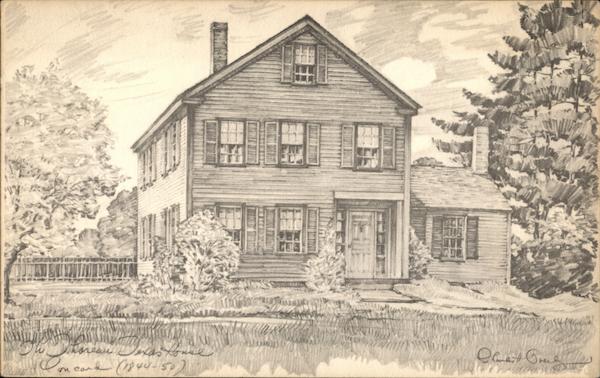
Gathered to-day my apples at the Texas house. I set out the trees, fourteen of them fourteen years ago and five of them several years later, and I now get between ten and eleven barrels of apples from them.

“Texas” House
(Thoreau Family Residence, 1844-1850)

H. D. Thoreau, Journal, October 3, 1860

See Vanessa Antiopa. See . April 17, 1860 (“It is unexpectedly very warm on lee side of hilltop just laid bare and covered with dry leaves and twigs. See my first Vanessa Antiopa”); October 1, 1860.(“C. saw the first Vanessa Antiopa since spring.”) See also A Book of the Seasons,  by Henry Thoreau, the Buff-edged Butterfly

The hard frost of September 28th, 29th, and 30th, and especially of October 1st. See October 1, 1860 ("Remarkable frost and ice this morning . . . I do not remember such cold at this season.").”); Compare October 3, 1856 (“The frost keeps off remarkably .” )

Sam Barrett says that last May he waded across the Assabet River on the old dam. See August 17, 1858 (“Being overtaken by a shower, we took refuge in the basement of Sam Barrett’s sawmill, where we spent an hour, and at length came home with a rainbow over arching the road before us”)

Bay-wings about. See April 15, 1859 (“The bay-wing now sings — the first I have been able to hear — . . . about the Texas house ”); October 9, 1858 (“Bay-wings flit along road.”); October 11, 1856 (“Bay-wing sparrows numerous.”); October 12, 1859 (“ I see scattered flocks of bay-wings amid the weeds and on the fences.”); October 16, 1855 ("I look at a grass-bird on a wall in the dry Great Fields. There is a dirty-white or cream-colored line above the eye and another from the angle of the mouth beneath it and a white ring close about the eye. The breast is streaked with this creamy white and dark brown in streams, as on the cover of a book.") See also A Book of the Seasons, by Henry Thoreau, the Bay-Wing Sparrow

I have seen and heard sparrows in flocks within a week. See September 17, 1858 (“Methinks, too, that there are more sparrows in flocks now about in garden”);  September 23, 1851 ("I scare up large flocks of sparrows in the garden.");September 26, 1858 (“Now is the time, too, when flocks of sparrows begin to scour over the weedy fields,”); September 27, 1858 ("What are those little birds in flocks in the garden and on the peach trees these mornings, about size of chip-birds, without distinct chestnut crowns?”); October 2, 1858 ("The garden is alive with migrating sparrows these mornings."); October 5, 1858 (“I still see large flocks, apparently of chip birds, on the weeds and ground in the yard.”); October 10, 1853 ("There are . . . large flocks of small sparrows,  which make a business of washing and pruning themselves in the puddles in the road, as if cleaning up after a long flight and the wind of yesterday.”)

October 3. See A Book of the Seasons, by Henry Thoreau,  October 3
See sparrows in flocks 
and have heard more flitting by 
since the frosts began.

A Book of the Seasons, by Henry Thoreau
"A book, each page written in its own season,
out-of-doors, in its own locality."
~edited, assembled and rewritten by zphx © 2009-2025
 

Saturday, July 25, 2020

I have for years had a great deal of trouble with my shoe-strings


July 25.

Dodder, probably the 21st.

Blue-curls.

Burdock, probably yesterday.

P. M. – To Le Grosse’s.

Cerasus Virginiana
— choke-cherry, — just ripe.

White and red huckleberries said to be in Le Grosse’s or Wetherbee’s pasture. Could not find them.

Cynoglossum Morisoni, beggar’s-lice, roadside between Sam Barrett’s mill and the next house east, in flower and fruiting probably ten days. Probably the same with plant found beyond the stone bridge, gone to seed, last year. 


I have for years had a great deal of trouble with my shoe-strings, because they get untied continually. They are leather, rolled and tied in a hard knot. But some days I could hardly go twenty rods before I was obliged to stop and stoop to tie my shoes.

My companion and I speculated on the distance to which one tying would carry you, — the length of a shoe-tie, 
— and we thought it nearly as appreciable and certainly a more simple and natural measure of distance than a stadium, or league, or mile.

Ever and anon we raised our feet on whatever fence or wall or rock or stump we chanced to be passing, and drew the strings once more, pulling as hard as we could. It was very vexatious, when passing through low scrubby bushes, to become conscious that the strings were already getting loose again before we had fairly started.

What should we have done if pursued by a tribe of Indians? My companion sometimes went without strings altogether, but that loose way of proceeding was not ſto] be thought of by me.

One shoemaker sold us shoe strings made of the hide of a South American jack ass, which he recommended; or rather he gave them to us and added their price to that of the shoes we bought of him. But I could not see that these were any better than the old.

I wondered if anybody had exhibited a better article at the World’s Fair, and whether England did not bear the palm from America in this respect. I thought of strings with recurved prickles and various other remedies myself.

At last the other day it occurred to me that I would try an experiment, and, instead of tying two simple knots one over the other the same way, putting the end which fell to the right over each time, that I would reverse the process, and put it under the other.

Greatly to my satisfaction, the experiment was perfectly successful, and from that time my shoe-strings have given me no trouble, except sometimes in untying them at night.

On telling this to others I learned that I had been all the while tying what is called a granny’s knot, for I had never been taught to tie any other, as sailors’ children are; but now I had blundered into a square knot, I think they called it, or two running slip-nooses. Should not all children be taught this accomplishment, and an hour, perchance, of their childhood be devoted to instruction in tying knots? 


Those New Hampshire-like pastures near Asa Melvin’s are covered or dotted with bunches of indigo, still in bloom, more numerously than anywhere that I remember.

H. D. Thoreau, Journal, July 25, 1853


Blue-curls
. See note to July 11, 1853 ("The aromatic trichostema now springing up."); July 31, 1856 ("Trichostema has now for some time been springing up in the fields, giving out its aromatic scent when bruised") See also A Book of the Seasons, by Henry Thoreau, Blue-Curls

Burdock, probably yesterday. See August 1, 1856 ("Burdock, several days at least")

Cerasus Virginiana, — choke-cherry, — just ripe. See July 18, 1852 ("The Cerasus Virginiana, or choke-cherry, is turning, nearly ripe."); July  19, 1854 ("Black choke-berry, several days."); July 30, 1860 ("Am glad to press my way through Miles's Swamp. Thickets of choke-berry bushes higher than my head, with many of their lower leaves already red");August 5, 1856 ("Choke-cherries near . . . begin to be ripe, though still red. They are scarcely edible, but their beauty atones for it. See those handsome racemes of ten or twelve cherries each, dark glossy red, semi- transparent. You love them not the less because they are not quite palatable."); August 5, 1858 (" Choke-berries, fair to the eye but scarcely palatable, hang far above your head, weighing down the bushes."); August 12, 1858 ("I eat the blueberry, but I am also interested in the rich-looking glossy black choke-berries which nobody eats, but which bend down the bushes on every side,—sweetish berries with a dry, and so choking, taste. Some of the bushes are more than a dozen feet high."); August 21, 1854 ("Red choke-berries are dried black; ripe some time ago. ");  August 15, 1852 ("The red choke-berry is small and green still. I plainly distinguish it, also, by its woolly under side."); August 25, 1854 ("Also the choke-berries are very abundant [at Shadbush Meadow], but mostly dried black."); August 26, 1860 ("I thread my way through the blueberry swamp in front of Martial Miles's. . . . And now a far greater show of choke-berries is here, rich to see."); August 28, 1856 ("The bushes are weighed down with choke-berries, which no creature appears to gather. This crop is as abundant as the huckleberries have been. They have a sweet and pleasant taste enough, but leave a mass of dry pulp in the mouth."); August 31, 1858 ("Red choke-berry, apparently not long. ");September 1,1856 ("Red choke-berries, which last further up in this swamp, with their peculiar glossy red and squarish form, are really very handsome.");  September 1, 1859 ("Red choke-berry ripe.")September 6, 1857 ("I see in the swamp black choke berries twelve feet high at least and in fruit.")

Cynoglossum Morisoni, beggar’s-lice, in flower and fruiting probably ten days.See August 6, 1856 ("Cynoglossum Morisoni mostly gone to seed, roadside, at grape-vine just beyond my bean-field. Some is five feet high")

I have for years had a great deal of trouble with my shoe-strings.See August 5, 1855 ("It seems that I used to tie a regular granny’s knot in my shoe-strings, and I learned of myself —rediscovered—to tie a true square knot, or what sailors sometimes call a reef-knot. It needed to be as secure as a reef-knot in any gale, to withstand the wringing and twisting I gave it in my walks")

Bunches of indigo, still in bloom, more numerously than anywhere that I remember. See June 3, 1851 ("I noticed the indigo-weed a week or two ago pushing up like asparagus."); July 10, 1855 ("Indigo out. "); July 17, 1852 ("Some fields are covered now with tufts or clumps of indigo- weed, yellow with blossoms, with a few dead leaves turned black here and there."); August 6, 1858 ("indigo, ' ' 'is still abundantly in bloom. "); August 17, 1851 ("Indigo-weed still in bloom by the dry wood-path-side,"); October 10, 1858 ("The indigo-weed, now partly turned black and broken off, blows about the pastures like the fiyaway grass."); October 22, 1859 ("In my blustering walk over the Mason and Hunt pastures yesterday, I saw much of the withered indigo-weed which was broken off and blowing about, and the seeds in its numerous black pods rattling like the rattlepod though not nearly so loud");February 28, 1860 ("As I stood by Eagle Field wall, I heard a fine rattling sound, produced by the wind on some dry weeds at my elbow. It was occasioned by the wind rattling the fine seeds in those pods of the indigo-weed which were still closed, — a distinct rattling din which drew my attention to it, — like a small Indian's calabash. Not a mere rustling of dry weeds, but the shaking of a rattle, or a hundred rattles, beside.")

July 25. See A Book of the Seasons, by Henry Thoreau,  July 25 

Wednesday, January 4, 2017

Even in the middle of winter, aye, in middle of the Great Snow, Nature does not forget these her vegetable economies.


January 4

To my surprise a high wind arose in the night and the cold so dried the snow that this morning it is a good deal drifted. 

It did not freeze together, or crust, as you might have expected. You would not suppose it had been moist when it fell. 

About eight inches have fallen, yet there is very little on the river. It blows off, unless where water has oozed out at the sides or elsewhere, and the rough, flowing, scaly mass is frozen into a kind of batter, like mortar, or bread that has spewed out in the oven. 

Deep and drifted as the snow is, I find, when I return from my walk, some dry burs of the burdock adhering to the lining of my coat. Even in the middle of winter, aye, in middle of the Great Snow, Nature does not forget these her vegetable economies. 

It does look sometimes as if the world were on its last legs. How many there are whose principal employment it is nowadays to eat their meals and go to the post-office! 

After spending four or five days surveying and drawing a plan incessantly, I especially feel the necessity of putting myself in communication with nature again, to recover my tone, to withdraw out of the wearying and unprofitable world of affairs. The things I have been doing have but a fleeting and accidental importance, however much men are immersed in them, and yield very little valuable fruit. I would fain have been wading through the woods and fields and conversing with the sane snow. Having waded in the very shallowest stream of time, I would now bathe my temples in eternity. I wish again to participate in the serenity of nature, to share the happiness of the river and the woods. 

I thus from time to time break off my connection with eternal truths and go with the shallow stream of human affairs, grinding at the mill of the Philistines; but when my task is done, with never-failing confidence I devote myself to the infinite again. It would be sweet to deal with men more, I can imagine, but where dwell they? Not in the fields which I traverse.

H. D. Thoreau, Journal, January 4, 1857

. . .the rough, flowing, scaly mass is frozen into a kind of batter, like mortar, or bread that has spewed out in the oven. See December 20, 1854 (The river is "uneven like frozen suds, in rounded pan cakes, as when bread spews out in baking.) ; December 26, 1858 ("I notice that water has oozed out over the edge of this ice or next the meadow’s edge . . . This thin water is turned to a slush of crystals as thick as mortar nearly, and will soon be solid ice. ")

Having waded in the very shallowest stream of time, I would now bathe my temples in eternity. See Where I lived and what I lived for (“I . . .detect how shallow it is. Its thin current slides away, but eternity remains.”); March 23, 1856 ("The eternity which I detect in Nature I predicate of myself also")

Popular Posts Last 30 Days.

The week ahead in Henry’s journal

The week ahead in Henry’s journal
A journal, a book that shall contain a record of all your joy.
"A stone fruit. Each one yields me a thought." ~ H. D. Thoreau, March 28, 1859


I sit on this rock
wrestling with the melody
that possesses me.