Showing posts with label walnuts. Show all posts

Tuesday, November 9, 2021

A footpath may be found encircling all our ponds.


November 9. 

Tuesday. 

November 9, 2020


Ranunculus repens, Bidens connata (flat in a brook), yarrow, dandelion, autumnal dandelion, tansy, Aster undulatus, etc. 

A late three ribbed goldenrod, with large serratures in middle of the narrow leaves, ten or twelve rays. Potentilla argentea.

Fore part of November time for walnutting.

All around Walden, both in the thickest wood and where the wood has been cut off, there can be traced a meandering narrow shelf on the steep hillside, the footpath worn by the feet of Indian hunters, and still occasionally trodden by the white man, probably as old as the race of man here. And the same trail may be found encircling all our ponds.

Near the sandy eastern shore, where the water is eight or ten feet deep, I have seen from a boat, in calm weather, broad circular heaps of small stones on the bottom, half a dozen feet in diameter by a foot or more in height, where all around was bare sand, - probably the work of some kind of fish.

The French call dragon-flies “demoiselles.”


H. D. Thoreau, Journal, November 9, 1852


Ranunculus repens, Bidens connata, yarrow, dandelion, autumnal dandelion, tansy, Aster undulatus
. See October 20, 1852 ("Tansy, white goldenrod, blue-stemmed goldenrod. Aster undulatus, autumnal dandelion, tall buttercup, yarrow, mayweed. ");  November 2, 1853 ("I might put by themselves the November flowers, — flowers which survive severe frosts and the fall of the leaf."); November 3, 1853 ("To-day I see yarrow, very bright "); November 3, 1853 ("I saw a very fresh A. undulatus this afternoon."); November 3, 1858 ("Aster undulatus is still freshly in bloom"); November 7, 1858 ("Aster undulatus and several goldenrods, at least, may be found yet."); November 12, 1853 ("Tansy is very fresh still in some places"); November 14, 1852 ("Still yarrow, tall buttercup, and tansy."); November 18, 1852 ("Yarrow and tansy still. These are cold, gray days."); November 18, 1855 ("Tansy still shows its yellow disks, but yarrow is particularly fresh and perfect, cold and chaste, with its pretty little dry-looking rounded white petals and green leaves."); November 22, 1853 ("Yarrow is particularly fresh and innocent"); November 23, 1852 ("Among the flowers which may be put down as lasting thus far, as I remember, in the order of their hardiness: yarrow, tansy (these very fresh and common), cerastium, autumnal dandelion, dandelion, and perhaps tall buttercup, etc., the last four scarce. The following seen within a fortnight: a late three-ribbed goldenrod of some kind, blue-stemmed goldenrod (these two perhaps within a week), Potentilla argentea, Aster undulatus, Ranunculus repens, Bidens connata, shepherd's-purse").  See also  December 6, 1852 ("Tansy still fresh."); December 12, 1852 ("Tansy still fresh yellow by the Corner Bridge."); December 19, 1859 ("Yarrow too is full of seed now")


Fore part of November time for walnutting. See October 27, 1857 ("Now it is time to look out for walnuts"); October 28, 1852 ("The boys are gathering walnuts."); November 20, 1858 ("When walnut husks have fairly opened, showing the white shells within, — the trees being either quite bare or with a few withered leaves at present, — a slight jar with the foot on the limbs causes them to rattle down in a perfect shower, and on bare, grass-grown pasture ground it is very easy picking them up."); December 5, 1856 ("There are a great many walnuts on the trees, seen black against the sky, and the wind has scattered many over the snow-crust. It would be easier gathering them now than ever. “); December 10, 1856 ("Gathered this afternoon quite a parcel of walnuts on the hill. It has not been better picking this season there. They lie on the snow, or rather sunk an inch or two into it. And some trees hang quite full.")

 The footpath worn by the feet of Indian hunters. See February 16, 1854 ("That Indian trail on the hillside about Walden is revealed with remarkable distinctness to me standing on the middle of the pond, by the slight snow which had lodged on it forming a clear white line unobscured by weeds and twigs.”) See  also  Walden, The Ponds ("I have been surprised to detect encircling the pond, even where a thick wood has just been cut down on the shore, a narrow shelf-like path in the steep hill side, alternately rising and falling, approaching and receding from the water's edge, as old probably as the race of man here, worn by the feet of aboriginal hunters, and still from time to time unwittingly trodden by the present occupants of the land. This is particularly distinct to one standing on the middle of the pond in winter, just after a light snow has fallen, appearing as a clear undulating white line, unobscured by weeds and twigs, and very obvious a quarter of a mile off in many places where in summer it is hardly distinguishable close at hand. The snow reprints it, as it were, in clear white type alto-relievo.")

Tuesday, July 20, 2021

The midsummer night's moon.


July 20.

 
July 20, 2012

To Nawshawtuct at moonrise with Sophia, by boat.

Moon apparently fulled yesterday.

A low mist in crusts the meadow, -- not so perceptible when we are on the water. Now we row through a thin low mist about as high as one's head, now we come to a place where there is no mist on the river or meadow, apparently where a slight wind stirs.

The gentle susurrus from the leaves of the trees on shore is very enlivening, as if Nature were freshening, awakening to some enterprise. There is but little wind, but its sound, incessantly stirring the leaves at a little distance along the shore, heard not seen, is very inspiriting. It is like an everlasting dawn or awakening of nature to some great purpose.

As we go up the hill we smell the sweet briar.

The trees are now heavy, dark masses without tracery, not as in spring or early in June; but I forgot to say that the moon was at first eclipsed by a vast black bank of cloud in the east horizon, which seemed to rise faster than it, and threatened to obscure it all the night.

But suddenly she rose above it, and when, a few moments after, we thought to look again for the threatening cloud-bank, it had vanished, or a mere filmy outline could be faintly traced beneath her.

It was the eclipse of her light behind it that made this evil look so huge and threatening, but now she had triumphed over it and eclipsed it with her light.

It had vanished, like an ugly dream.

So is it ever with evils triumphed over, which we have put behind us.

What was at first a huge dark cloud in the east which threatened to eclipse the moon the livelong night is now suddenly become a filmy vapor, not easy to be detected in the sky, lit by her rays.

She comes on thus, magnifying her dangers by her light, at first displaying, revealing them in all their hugeness and blackness, exaggerating, then casting them behind her into the light concealed.

She goes on her way triumphing through the clear sky like a moon which was threatened by dark clouds at her rising but rose above them. That black, impenetrable bank which threatened to be the ruin of all our hopes is now a filmy dash of vapor with a faint-purplish tinge, far in the orient sky.

From the hilltop we see a few distant lights in farmhouses down below, hard to tell where they are, yet better revealing where they are than the sun does.  But cottage lights are not conspicuous now as in the autumn.

As we looked, a bird flew across the disk of the moon.

Saw two skunks carrying their tails about some rocks. Singular that, of all the animated creation, chiefly these skunks should be abroad in this moonlight.

This is the midsummer night's moon.

We have come round the east side of the hill to see the moon from amid the trees. I like best to see its light falling far in amid the trees and along the ground before me, while itself is hidden behind them or one side.

It is cool, methinks with a peculiar coolness, as it were from the luxuriance of the foliage, as never in June. At any rate we have had no such sultry nights this month as in June.

There is a greater contrast between night and day now, reminding me that even in Hindostan they freeze ice in shallow vessels at night in summer (?).

There is a mist very generally dispersed, which gives a certain mellowness to the light, a wavingness apparently, a creaminess.

Yet the light of the moon is a cold, almost frosty light, white on the ground.

There are a few fireflies about. Green, their light looks sometimes, and crickets are heard.

You are pretty sure also to hear some human music, vocal or instrumental, far or near.

The masses of the trees and bushes would be called black, if our knowledge that they are leaves did not make us call them dark - green.

Here is the Pycnanthemum lanceolatum near the boat's place, which I scent in the dark. It has been out some days, for some flowers are quite withered.

I hear from the copses or bushes along the shore, returning, a faint everlasting fine song from some small cricket, or rather locust, which it required the stillness of night to reveal.

A bat hovers about us.

How oily smooth the water in this moonlight! And the apparent depth where stars are reflected frightens Sophia.

These Yankee houses and gardens seen rising beyond this oily moonlit water, on whose surface the circling insects are like sparks of fire, are like Italian dwellings on the shores of Italian lakes.

When we have left the boat and the river, we are surprised, looking back from the bank, to see that the water is wholly concealed under a white mist, though it was scarcely perceptible when we were in its midst.

The few bullfrogs are the chief music.

I do not know but walnuts are peculiarly handsome by moonlight, -- seeing the moon rising through them, and the form of their leaves.

I felt some nuts. They have already their size and that bracing, aromatic scent.


H. D. Thoreau, Journal, July 20, 1853

The moon was at first eclipsed by a vast black bank of cloud in the east horizon, which threatened to obscure it all the night  See June 1, 1852 ("The moving clouds are the drama of the moonlight nights")

Singular that, of all the animated creation, chiefly these skunks should be abroad in this moonlight. See June 20, 1853 (“ The moon full. . . . Saw a little skunk coming up the river-bank in the woods at the White Oak.”); July 12, 1851 ("I see a skunk on Bear Garden Hill stealing noiselessly away from me, while the moon shines over the pitch pines")

There are a few fireflies about.
See July 20, 1852 ("The stars are few and distant; the fireflies fewer still.") See also A Book of the Seasons, by Henry Thoreau, Fireflies

You are pretty sure also to hear some human music, vocal or instrumental, far or near. See June 14, 1851 ("How sweet and encouraging it is to hear the sound of some artificial music from the midst of woods or from the top of a hill at night, borne on the breeze from some distant farmhouse, — the human voice or a flute!"); July 12, 1851 ("I hear a human voice,"); August 5, 1851 ("I hear now from Bear Garden Hill — I rarely walk by moonlight without hearing — the sound of a flute, or a horn, or a human voice")

Sunday, January 5, 2020

A single tree-top showed finely.

January 5. 

To Kibbe Place Swamp. 

I see where probably a red squirrel had scratched along over the snow, and in one place a very perfect and delicate print of his feet. His five toes in separate sharp triangles distinctly raying off, or often only four visible. 

In one place I find a beaten track from a hole in the ground to a walnut a rod distant up which they have gone for nuts, which still hang on it. 

The whole print of the foot, etc., is about an inch and three quarters long, a part of the leg being impressed. Two of the tracks, when they are running, apparently, the two foremost, are wider apart; and perhaps with one pair they often make five marks, with the other four. 

Where there is a deep furrow in a chestnut tree between two swelling muscles, in two instances the squirrels, knowing it to be hollow, have gnawed a hole, enlarging the crack between two cheeks, and so made themselves a retreat. In one instance they have commenced to gnaw between the cheeks, though no cavity appears, but I have no doubt the tree is hollow. 

A large yellow birch — or black — has the main stem very short and branches very long, nearly from one centre. 

There was a fine rosy sky in the west after sunset; and later an amber-colored horizon, in which a single tree-top showed finely.

January 5, 1860

H. D. Thoreau, Journal, January 5, 1853

I see where probably a red squirrel had scratched along over the snow. In one place I find a beaten track from a hole in the ground to a walnut
See December 14, 1855 ("It imparts life to the landscape to see merely the squirrels’ track in the snow at the base of the walnut tree."); January 3, 1856 ("I see where a squirrel, gray or red, dug through the snow last night in search of acorns. I know it was last night, for it was while the last snow was falling, and the tracks are partly filled by it. "). See also A Book of the Seasons, by Henry Thoreau, The Red Squirrel


The squirrels, knowing it to be hollow, have gnawed a hole, enlarging the crack between two cheeks, and so made themselves a retreat. See  January 22, 1856 ("If you wish to know whether a tree is hollow, or has a hole in it, ask the squirrels.")

A fine rosy sky in the west after sunset; and later an amber-colored horizon, in which a single tree-top showed finely. See  December 12, 1859 ("The night comes on early these days, and I soon see the pine tree tops distinctly outlined against the dun (or amber) but cold western sky.").
Night comes on early.
Pine tree tops outlined against
the cold western sky,
December 20, 1851 ("The sun goes down apace behind glowing pines, and golden clouds like mountains skirt the horizon."); ; December 25, 1858 ("How full of soft, pure light the western sky now, after sunset! I love to see the outlines of the pines against it. . . . In a pensive mood I enjoy the complexion of the winter sky at this hour.");
Western sky full of
soft pure light after sunset,
the outlines of pines.
December 25, 1858
January 9, 1859 ("It is worth the while to stand here at this hour and look into the soft western sky, over the pines whose outlines are so rich and distinct against the clear sky"); January 17, 1852 (“In proportion as I have celestial thoughts, is the necessity for me to be out and behold the western sky sunset these winter day"); January 24, 1852 (" A single elm by Hayden's stands in relief against the amber and golden, deepening into dusky but soon to be red horizon.")


Monday, October 28, 2019

The rich nutmeg fragrance of black walnuts.


October 28

October 29, 2019

Goldenrods and asters have been altogether lingering some days. 

Walnuts commonly fall, and the black walnuts at Smith's are at least half fallen.  They are of the form and size of a small lemon and — what is singular — have a rich nutmeg fragrance. They are now turning dark-brown. 

Gray says it is rare in the Eastern but very common in the Western States. Is it indigenous in Massachusetts? [Emerson says it is, but rare.] If so, it is much the most remarkable nut that we have.

H. D. Thoreau, Journal, October 28, 1859

Walnuts commonly fall. See  October 14, 1859 ("At Baker's wall two of the walnut trees are bare but full of green nuts (in their green cases), which make a very pretty sight as they wave in the wind. So distinct you could count every one against the sky, for there is not a leaf on these trees, but other walnuts near by are yet full of leaves."); October 27, 1857 ("Now it is time to look out for walnuts"); October 28, 1852 ("The boys are gathering walnuts. Their leaves are a yellowish brown."); November 20, 1858 ("When walnut husks have fairly opened, showing the white shells within, — the trees being either quite bare or with a few withered leaves at present, — a slight jar with the foot on the limbs causes them to rattle down in a perfect shower, and on bare, grass-grown pasture ground it is very easy picking them up.")

Black walnuts rare.  See October 27, 1856 ("Black walnut . . . were pretty common [in New Jersey]"); June 8, 1857 ("There are two good-sized black walnuts at Cyrus Smith's"); June 23, 1857 ("Pratt says he knows of a black walnut at Hunt's on Ponkawtasset. "); May 12, 1858 ("They use [chestnut] wood for coffins, instead of black walnut.")

Monday, October 14, 2019

We sit on the rock on Pine Hill overlooking Walden.


October 14. 

9 a. m. — To and around Flint's Pond with Blake. 

A fine Indian-summer day. 

The 6th and 10th were quite cool, and any particularly warm days since may be called Indian summer (?), I think. 

We sit on the rock on Pine Hill overlooking Walden.
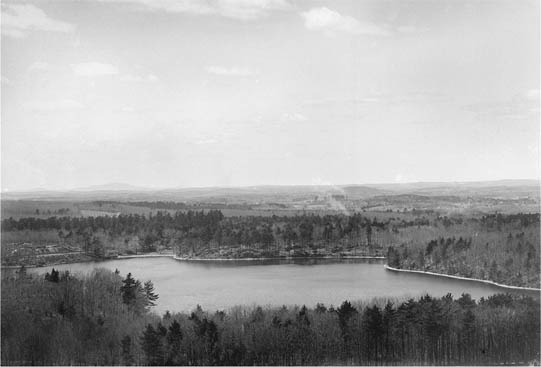

Overlooking Walden Pond from Pine Hill
April 28, 1906
There is a thick haze almost entirely concealing the mountains. There is wind enough to raise waves on the pond and make it bluer. What strikes me in the scenery here now is the contrast of the unusually blue water with the brilliant-tinted woods around it. 

The tints generally may be about at their height. The earth appears like a great inverted shield painted yellow and red, or with imbricated scales of that color, and a blue navel in the middle where the pond lies, and a distant circumference of whitish haze. 

The nearer woods, where chestnuts grow, are a mass of warm, glowing [yellow] (though the larger chestnuts have lost the greater part of their leaves and generally you wade through rustling chestnut leaves in the woods), but on other sides the red and yellow are intermixed. The red, probably of scarlet oaks on the south of Fair Haven Hill, is very fair. The beech tree at Baker's fence is past prime and many leaves fallen. 

The shrub oak acorns are now all fallen, — only one or two left on, — and their cups, which are still left on, are apparently somewhat incurved at the edge as they have dried, so that probably they would not hold the acorn now. 

The ground is strewn also with red oak acorns now, and, as far as I can discover, acorns of all kinds have fallen. 

At Baker's wall two of the walnut trees are bare but full of green nuts (in their green cases), which make a very pretty sight as they wave in the wind. So distinct you could count every one against the sky, for there is not a leaf on these trees, but other walnuts near by are yet full of leaves. You have the green nut contrasted with the clean gray trunks and limbs. These are pig nut-shaped. 

The chestnuts generally have not yet fallen, though many have. I find under one tree a great many burs, apparently not cast down by squirrels — for I see no marks of their teeth — and not yet so opened that any of the nuts fall out. They do not all wait till frosts open the burs before they fall, then. 

I see a black snake, and also a striped snake, out this warm day.

***
Some Rhus radicans was leafless on the 13th, and some tupelos bare maybe a week or more, and button-bushes nearly bare. 

My little white pines by Walden are now conspicuous in their rows, the grass, etc., having withered to tawny and the blackberry turned to scarlet. They have been almost inobvious through the summer. 

The dark evergreen leaves of the checkerberry also attract us now amid the shrub oaks, as on the southwest of Pine Hill.

I hear a man laughed at because he went to Europe twice in search of an imaginary wife who, he thought, was there, though he had never seen nor heard of her. But the majority have gone further while they stayed in America, have actually allied themselves to one whom they thought their wife and found out their mistake too late to mend it. It would be cruel to laugh at these. 

Wise, the balloonist, says that he lost a balloon "in a juniper bog in the State of Maine," which he mistook for a "prairie." Does he mean a larch swamp? 

Balloonists speak of hearing dogs bark at night and wagons rumbling over bridges.

Arbor-vitae falling (seeds), how long?

H. D. Thoreau, Journal, October 14, 1859

A fine Indian-summer day. See October 14, 1853 ("Fine, clear Indian-summer weather.")

We sit on the rock on Pine Hill overlooking Walden. See October 1, 1859 ("Looking down from Pine Hill, I see a fish hawk over Walden."); October 22, 1852 ("Looking over the forest on Pine Hill, I can hardly tell which trees are lit up by the sunshine and which are the yellow chestnut-tops."); October 20, 1852 (“Picking chestnuts on Pine Hill. . . . I see the mountains in sunshine, all the more attractive from the cold I feel here, with a tinge of purple on them”); October 25, 1858 ("Returning in an old wood-path from top of Pine Hill to Goose Pond, I see many goldenrods turned purple"); November 4, 1857 ("I climb Pine Hill just as the sun is setting, this cool evening. Sitting with my back to a thick oak sprout whose leaves still glow with life, Walden lies an oblong square endwise to, beneath me. Its surface is slightly rippled, and dusky prolonged reflections of trees extend wholly across its length, or half a mile, — I sit high."); November 5, 1857 ("I shiver about awhile on Pine Hill, waiting for the sun to set."); November 30, 1852 ("From Pine Hill, Wachusett is seen over Walden. The country seems to slope up from the west end of Walden to the mountain"); February 29, 1852 ("The ice on Walden is of a dull white as I look directly down on it, but not half a dozen rods distant on every side it is a light-blue color.From Pine Hill, looking westward, I see the snowcrust shine in the sun as far as the eye can reach. . ."); April 27, 1859 ("Through the cemetery, and over Pine Hill, where I heard a strange warbler, methought, a dark-colored, perhaps reddish-headed bird"); May 15, 1856 (“Checker-berries very abundant on south side of Pine Hill, by pitch pine wood. Now is probably best time to gather them.”); June 12, 1853 ("Going up Pine Hill, disturbed a partridge and her brood. She ran indeshabille directly to me, within four feet, while her young, not larger than a chicken just hatched, dispersed. "); July 29, 1858 ("To Pine Hill, looking for the Vaccinium Pennsylvanicum berries. I find plenty of bushes, but these bear very sparingly. They appear to bear but one or two years before they are overgrown."); August 27, 1854 ("I am surprised to see the top of Pine Hill wearing its October aspect, — yellow with changed maples and here and there faintly blushing with changed red maples. . . .. As I go up Pine Hill, gather the shrivelled Vaccinium vacillans berries, many as hard as if dried on a pan. They are very sweet and good."); September 12, 1851 ("Found a violet, apparently Viola cucullata, or hood-leaved violet, in bloom in Baker's Meadow beyond Pine Hill.")

The earth appears like a great inverted shield painted yellow and red. . .and a blue navel in the middle where the pond lies, and a distant circumference of whitish haze. See October 13, 1852 (" The water or lake from however distant a point seen is always the centre of the landscape. The pond is now most beautifully framed with the autumn-tinted woods and hills.");  November 4, 1857 ("I climb Pine Hill just as the sun is setting. . . Walden lies an oblong square endwise to, beneath me. Its surface is slightly rippled, and dusky prolonged reflections of trees extend wholly across its length");See also June 3, 1850 ("The landscape is a vast amphitheatre rising to its rim in the horizon."): June 25, 1852 ("The earth appears like a vast saucer sloping upward to its sharp mountain rim.")

The ground is strewn also with red oak acorns now, and, as far as I can discover, acorns of all kinds have fallen. See September 12, 1854 ("White oak acorns have many of them fallen. . . .. Some black scrub oak acorns have fallen, and a few black oak acorns also have fallen. The red oak began to fall first."); September 30, 1854 ("Acorns are generally now turned brown and fallen or falling; the ground is strewn with them and in paths they are crushed by feet and wheels."); October 1, 1859 ("The shrub oaks on this hill are now at their height, both with respect to their tints and their fruit. . . .Now is the time for shrub oak acorns if not for others."); October 11, 1860 ("There is a remarkably abundant crop of white oak acorns this fall, also a fair crop of red oak acorns; but not of scarlet and black, very few of them. The acorns are now in the very midst of their fall."); October 12, 1858 ("Acorns, red and white (especially the first), appear to be fallen or falling. They are so fair and plump and glossy that I love to handle them, and am loath to throw away what I have in my hand."); October 13, 1859 ("I see no acorns on the trees. They appear to have all fallen before this."); October 13, 1860 ("This is a white oak year, . . . I should think that there might be a bushel or two of acorns on and under some single trees.")

Some tupelos bare maybe a week or more. Compare October 14, 1857 ("Near by is a tupelo which is all a distinct yellow with a little green. ")

Tuesday, November 20, 2018

The glory of November is in its silvery, sparkling lights.

November 20

P. M. - To Ministerial Swamp. 

I have seen more gray squirrels of late (as well as musquash); I think not merely because the trees are bare but because they are stirring about more, — nutting, etc. 

Martial Miles tells me of a snapping turtle caught in the river at Waltham, about October 1st, he thinks, which weighed fifty-five pounds (?). He saw it. There were two fighting. 

He says that a marsh hawk had his nest in his meadow several years, and though he shot the female three times, the male with but little delay returned with a new mate. He often watched these birds, and saw that the female could tell when the male was coming a long way off. He thought that he fed her and the young all together (?). She would utter a scream when she perceived him, and, rising into the_air (before or after the scream ?), she turned over with her talons uppermost, while he passed some three rods above, and caught without fail the prey which he let drop, and then carried it to her young. He had seen her do this many times, and always without failing. 

The common milkweed (Asclepias Cornuti) and some thistles still discounting. 

I go across the great Tony Wheeler pasture. It is a cool but pleasant November afternoon. 

The glory of November is in its silvery, sparkling lights. I think it is peculiar among the months for the amount [of] sparkling white light reflected from a myriad of surfaces. The air is so clear, and there are so many bare, polished, bleached or hoary surfaces to reflect the light. Few things are more exhilarating, if it is only moderately cold, than to walk over bare pastures and see the abundant sheeny light like a universal halo, reflected from the russet and bleached earth. The earth shines perhaps more than in spring, for the reflecting surfaces are less dimmed now. It is not a red but a white light. 

In the woods and about swamps, as Ministerial, also, there are several kinds of twigs, this year’s shoots of shrubs, which have a slight down or hairiness, hardly perceptible in ordinary lights though held in the hand, but which, seen toward the sun, reflect a cheering silvery light. Such are not only the sweet-fern, but the hazel in a less degree, alder twigs, and even the short huckleberry twigs, also lespedeza stems. It is as if they were covered with a myriad fine spiculae which reflect a dazzling white light, exceedingly warming to the spirits and imagination. This gives a character of snug warmth and cheerfulness to the swamp, as if it were a place where the sun consorted with rabbits and partridges. Each individual hair on every such shoot above the swamp is bathed in glowing sunlight and is directly conversant with the day god. 

The cinnamon-brown of withered pinweeds (how long?) colors whole fields. It may be put with the now paler brown'of hardhack heads and the now darker brown of the dicksonia fern by walls.

I notice this afternoon that the pasture white oaks have commonly a few leaves left on the lower limbs and also next the trunk. 

Winter rye is another conspicuous green amid the withered grass fields. 

The rubuses are particularly hardy to retain their leaves. Not only low blackberry and high blackberry leaves linger still fresh, but the Rubus hispidus leaves last all winter like an evergreen. The great round-leaved pyrola, dwarf cornel, checkerberry, and lambkill have a lake or purplish tinge on the under side at present, and these last two are red or purplish above. It is singular that a blush should suffuse the under side of the thick leaved pyrola while it is still quite green above. 

When walnut husks have fairly opened, showing the white shells within, — the trees being either quite bare or with a few withered leaves at present, — a slight jar with the foot on the limbs causes them to rattle down in a perfect shower, and on bare, grass-grown pasture ground it is very easy picking them up. 

As I returned over Conantum summit yesterday, just before sunset, and was admiring the various rich browns of the shrub oak plain across the river, which seemed to me more wholesome and remarkable, as more permanent, than their late brilliant colors, I was surprised to see a broad halo travelling with me and always opposite the sun to me, at least a quarter of a mile off and some three rods wide, on the shrub oaks. 

 
Quaker colors

The rare wholesome and permanent beauty of withered oak leaves of various hues of brown mottling a hillside, especially seen when the sun is low, — Quaker colors, sober ornaments, beauty that quite satisfies the eye. The richness and variety are the same as before, the colors different, more incorruptible and lasting. 

Sprague Of Cohasset states to the Natural History Society, September 1st, ’58, that the light under the tail of the common glow-worm “remained for 15 minutes after death.” 

Who are bad neighbors? They who suffer their neighbors’ cattle to go at large because they don’t want their ill will, -- are afraid to anger them. They are abettors of the ill-doers. 

Who are the religious? They who do not differ much from mankind generally, except that they are more conservative and timid and useless, but who in their conversation and correspondence talk about kindness of Heavenly Father. Instead of going bravely about their business, trusting God ever, they do like him who says “Good sir” to the one he fears, or whistles to the dog that is rushing at him. And because they take His name in vain so often they presume that they are better than you. Oh, their religion is a rotten squash.

H. D. Thoreau, Journal, November 20, 1858

The glory of November is in its silvery, sparkling lights reflected from a myriad of surfaces. See October 25, 1858 ("The light reflected from the parallel twigs of birches recently bare, etc., like the gleam from gossamer lines. This is another Novemberish phenomenon. Call these November Lights. Hers is a cool, silvery light.");  November 2, 1853( "We come home in the autumn twilight . . . — clear white light, which penetrates the woods”);  November 10, 1858 (""This a November phenomenon, — the silvery light reflected from a myriad of downy surfaces . . . A cool and silvery light is the prevailing one;); November 17, 1858 (“We are interested at this season by the manifold ways in which the light is reflected to us . . . “November Lights" would be a theme for me.”)November 18, 1857 ("The sunlight is a peculiarly thin and clear yellow, falling on the pale-brown bleaching herbage of the fields at this season. There is no redness in it. This is November sunlight."); November 28, 1856 ("The sunlight reflected from the many ascending twigs . . . It is a true November phenomenon.")

The common milkweed (Asclepias Cornuti) and some thistles still discounting. See  October 23, 1852 ("The milkweed (Syriaca) now rapidly discounting. The lanceolate pods having opened, the seeds spring out on the least jar, or when dried by the sun, and form a little fluctuating white silky mass or tuft, each held by the extremities of the fine threads, until a stronger puff of wind sets them free"); see also September 21, 1856 ("Asclepias Cornuti discounting."); October 19, 1856 ("The Asclepias Cornuti pods are now apparently in the midst of discounting.");  October 25, 1858 ("Near the end of the causeway, milkweed is copiously discounting.");

The rare wholesome and permanent beauty of withered oak leaves of various hues of brown mottling a hillside. . . Quaker colors.  See October 25, 1858 ("Now, too, for the different shades of brown, especially in sprout-lands. I see [three] kinds of oaks now, — the whitish brown of the white oak, the yellowish brown of the black oak, and the red or purplish brown [of the scarlet oak] (if it can be called brown at all . . . but perhaps that may be called a lighter, yellowish brown, and so distinguished from the black in color. It has more life in it now than the white and black, not withered so much. These browns are very pure and wholesome colors");   November 29, 1857 ("I am struck by the singularly wholesome colors of the withered oak leaves, especially the shrub oak,. . . clear reddish-brown (sometimes paler or yellowish brown), its whitish under sides contrasting with it in a very cheerful manner . . .Then there is the now rich, dark brown of the black oak’s large and somewhat curled leaf on sprouts, with its lighter, almost yellowish, brown under side. Then the salmonish hue of white oak leaves, with the under sides less distinctly lighter."); December 21, 1856 ("The red oak leaves look thinner and flatter, and therefore perhaps show the lobes more, than those of the black. The white oak leaves are the palest and most shrivelled, the lightest, perhaps a shade of buff, but they are of various shades, some pretty dark with a salmon tinge. The swamp white oak leaves . . .are very much like the shrub oak . . . Both remarkable for their thick, leathery, sound leaves, uninjured by insects, and their very light downy under sides. The black oak leaves are the darkest brown, with clear or deep yellowish-brown undersides . . .The scarlet oak leaves, which are very numerous still, are of a ruddy color, having much blood in their cheeks. They are all winter the reddest on the hillsides . . .The red oak leaves are a little lighter brown than the black oak, less yellowish beneath.") See also  A Book of the Seasons, by Henry Thoreau, the Colors of March-- Brown Season

Who are bad neighbors? They who suffer their neighbors’ cattle to go at large are abettors of the ill-doers. See October 12, 1858 ("This town has made a law recently against cattle going at large, and assigned a penalty of five dollars. I am troubled by an Irish neighbor’s cow and horse, and have threatened to have them put in the pound. But a lawyer tells me that these town laws are hard to put through, there are so many quibbles. He never knew the complainant to get his case if the defendant were a-mind to contend. However, the cattle were kept out several days, till a Sunday came, and then they were all in my grounds again, as I heard, but all my neighbors tell me that I cannot have them impounded on that day. Indeed, I observe that very many of my neighbors do for this reason regularly turn their cattle loose on Sundays.")

November 20. See  A Book of the Seasons,  by Henry Thoreau, November 20

The withered oak leaves 
of various hues of brown
 mottling a hillside.

A Book of the Seasons,  by Henry Thoreau
 "A book, each page written in its own season, 
out-of-doors, in its own locality."
 ~edited, assembled and rewritten by zphx ©  2009-2024

https://tinyurl.com/hdt-581120

Saturday, October 27, 2018

The first object I saw on approaching this planet in the spring.

October 27. 

6.30 a. m. — To Island by boat. 

The river still rises, — more than ever last night, owing to the rain of the 24th (which ceased in the night of the 24th). It is two feet higher than then. 

I hear a blackbird in the air; and these, methinks, are song sparrows flitting about, with the three spots on breast. 

Now it is time to look out for walnuts, last and hardest crop of the year?

I love to be reminded of that universal and eternal spring when the minute crimson-starred female flowers of the hazel are peeping forth on the hillsides, — when Nature revives in all her pores.  

Some less obvious and commonly unobserved signs of the progress of the seasons interest me most, like the loose, dangling catkins of the hop-hornbeam or of the black or yellow birch. I can recall distinctly to my mind the image of these things, and that time in which they flourished is glorious as if it were before the fall of man. I see all nature for the time under this aspect. 

These features are particularly prominent; as if the first object I saw on approaching this planet in the spring was the catkins of the hop-hornbeam on the hillsides. As I sailed by, I saw the yellowish waving sprays.

See nowadays concave chocolate-colored fungi passing into dust on the edges, close on the ground in pastures.

H. D. Thoreau, Journal, October 27, 1853

Song sparrows flitting about, with the three spots on breast. See October 26, 1855 (“The song sparrow still sings on a button-bush.”); November 1, 1853 ("I now hear a robin, and see and hear some noisy and restless jays, and a song sparrow chips faintly. ")

Now it is time to look out for walnuts, last and hardest crop of the year? See October 27, 1855 ("It is high time we came a-nutting,")  See alao  October 24, 1852 ("I see, far over the river, boys gathering walnuts.”);  October 28, 1852 ("The boys are gathering walnuts.”); November 9, 1852 ("Fore part of November time for walnutting"); and note to December 10, 1856 ("Gathered this afternoon quite a parcel of walnuts on the hill.")  Also  October 11, 1860 ("The acorns are now in the very midst of their fall. . . .The best time to gather these nuts is now.”); October 22, 1857 ("Now is just the time for chestnuts.”); November 11, 1850 ("Now is the time for wild apples. “); November 18, 1858 (" Now is the time to gather the mocker-nuts.”)

I love to be reminded of that universal and eternal spring. See   October 26, 1853 ("You only need to make a faithful record of an average summer day's experience and summer mood, and read it in the winter, and it will carry you back to more than that summer day alone could show.”); October 26, 1857 ("The seasons and all their changes are in me. . . . The perfect correspondence of Nature to man, so that he is at home in her! ")

I can recall distinctly to my mind the image of . . . the catkins of the hop-hornbeam on the hillsides.
See May 7, 1853 ("The catkins of the hop-hornbeam, yellow tassels hanging from the trees, which grow on the steep bank of the Assabet, give them a light, graceful, and quite noticeable appearance.")

Chocolate-colored fungi passing into dust on the edges. See October 5, 1856 (“This before they are turned to dust. Large chocolate-colored ones have long since burst and are spread out wide like a shallow dish”)

 I see all nature
when fall flowers remind me –
hop-hornbeam catkins.

Friday, June 23, 2017

Looked for the black duck's nest.

June 23
June 23, 2017
Skinner, the harness-maker, tells me that he found a black duck's nest Sunday before the last, i. e. the 14th, with perhaps a dozen eggs in it, a mere hollow on the top of a tussock, four or five feet within a clump of bushes forming an islet (in the spring) in Hubbard's great meadow. He scared up the duck when within a few feet. 

Pratt says he knows of a black walnut at Hunt's on Ponkawtasset. 

P. M. — Looked for the black duck's nest, but could find no trace of it. Probably the duck led her young to the river as soon as hatched. What with gunners, dogs, pickerel, bullfrogs, hawks, etc., it is a wonder if any of them escape. 

Small rudbeckia, i. e. hirta, at Hubbard's Bath.

H. D. Thoreau, Journal, June 23, 1857

Small rudbeckia, i. e. hirta . . . See June 20, 1856 ("Rudbeckia hirta budded.”); July 31, 1856 (“Measured a Rudbeckia hirta flower; more than three inches and three eighths in diameter.”)

A black duck's nest a mere hollow on the top of a tussock, four or five feet within a clump of bushes forming an islet . See June 24, 1857 ("Melvin thinks there cannot be many black ducks' nests in the town, else his dog would find them"); June 4, 1856 (“found, on a hummock in the open swamp, in the midst of bushes, at the foot of a pitch pine, a nest about ten inches over, made of dry sedge and moss. I think it must have been a duck’s nest.”);

Thursday, June 8, 2017

So little it need cost to live..

June 8. 
June 8, 2017
Lake Champlain
P. M. — To Saw Mill Brook. 

White actaea done there. 

There are two good-sized black walnuts at Cyrus Smith's, by wall, out apparently a day. When I split the twigs they seemed hollowed by a worm or disease, the pith being (as is said of the butternut also) in plates. The fertile flower is probably not obvious yet. That of the butternut is now very distinct with its crimson stigmas. 

Mother was saying to-day that she bought no new clothes for John until he went away into a store, but made them of his father's old clothes, which made me say that country boys could get enough cloth for their clothes by robbing the scarecrows. So little it need cost to live.

H. D. Thoreau, Journal, June 8, 1857


June 8. See A Book of the Seasons, by Henry Thoreau, June 8

A Book of the Seasons,  by Henry Thoreau
"A book, each page written in its own season,
out-of-doors, in its own locality."
 ~edited, assembled and rewritten by zphx ©  2009-2021

Saturday, December 10, 2016

A fine, clear, cold winter morning -- a warm, clear, glorious winter day.


A fine, clear, cold winter morning --

The sun is rising 
and the smokes from the chimneys 
blush like sunset clouds
. . .
I hardly get out 
a couple of miles before 
the sun is setting
. . .
I see the sun set 
and make haste with the red sky
over my shoulder. 

It has been a warm, clear, glorious winter day.

December 10, 2022


A fine, clear, cold winter morning, with a small leaf frost on trees, etc. The thermometer at 7.15 and at 7.30 3°. 

Going to the post-office at the former hour, I notice those level bars, as it were, of frozen mist against the Walden wood. 

When I return, the sun is rising and the smokes from the chimneys, which slant from northwest to southeast, though it seems quite still, blush like sunset clouds. 

It is remarkable how suggestive the slightest drawing as a memento of things seen. For a few years past I have been accustomed to make a rude sketch in my journal of plants, ice, and various natural phenomena, and though the fullest accompanying description may fail to recall my experience, these rude outline drawings do not fail to carry me back to that time and scene. It is as if I saw the same thing again, and I may again attempt to describe it in words if I choose. 


Yesterday I walked under the murderous Lincoln Bridge, where at least ten men have been swept dead from the cars within as many years. I looked to see if their heads had indented the bridge, if there were sturdy blows given as well as received, and if their brains lay about. But I could see neither the one nor the other. The bridge is quite uninjured, even, and straight, not even the paint worn off or discolored. The ground is clean, the snow spotless, and the place looks as innocent as a bank whereon the wild thyme grows. It does its work in an artistic manner. 

We have another bridge of exactly the same character on the other side of the town, which has killed one, at least, to my knowledge. Surely the approaches to our town are well guarded. These are our modern Dragons of Wantley. Boucaniers of the Fitchburg Railroad, they lie in wait at the narrow passes and decimate the employees. 

The Company has signed a bond to give up one employee at this pass annually. The Vermont mother commits her son to their charge, and when she asks for him, again the Directors say: "I am not your son's keeper. Go look beneath the ribs of the Lincoln Bridge." It is a monster which would not have minded Perseus with his Medusa's head. If he could be held back only four feet from where he now crouches, all travellers might pass in safety and laugh him to scorn. This would require but a little resolution in our legislature, but it is preferred to pay tribute still. 

I felt a curiosity to see this famous bridge, naturally far greater than my curiosity to see the gallows on which Smith was hung, which was burned in the old court house, for the exploits of this bridge are ten times as memorable. Here they are killed without priest, and the bridge, unlike the gallows, is a fixture. Besides, the gallows bears an ill name, and I think deservedly. No doubt it has hung many an innocent man, but this Lincoln Bridge, long as it has been in our midst and busy as it has been, no legislature, nobody, indeed, has ever seriously complained of, unless it was some be reaved mother, who was naturally prejudiced against it. 

To my surprise, I found no difficulty in getting a sight of it. It stands right out in broad daylight in the midst of the fields. No sentinels, no spiked fence, no crowd about it, and you have to pay no fee for looking at it. It is perfectly simple and easy to construct, and does its work silently. The days of the gallows are numbered. The next time this county has a Smith to dispose of, they have only to hire him out to the Fitchburg Railroad Company. Let the priest accompany him to the freight-train, pray with him, and take leave of him there. 

Another advantage I have hinted at, an advantage to the morals of the community, that, strange as it may seem, no crowd ever assembles at this spot; there are no morbidly curious persons, no hardened reprobates, no masculine women, no anatomists there. 

Does it not make life more serious ? I feel as if these were stirring times, as good as the days of the Crusaders, the Northmen, or the Boucaniers.


Gathered this afternoon quite a parcel of walnuts on the hill. It has not been better picking this season there. They lie on the snow, or rather sunk an inch or two into it. And some trees hang quite full. See the squirrel-tracks leading straight from tree to tree. 

It has been a warm, clear, glorious winter day, the air full of that peculiar vapor. 

How short the afternoons! I hardly get out a couple of miles before the sun is setting. 

The nights are light on account of the snow, and, there being a moon, there is no distinct interval between the day and night. 

I see the sun set from the side of Nawshawtuct, and make haste to the post-office with the red sky over my shoulder. When the mail is distributed and I come forth into the street on my return, the apparently full moon has fairly commenced her reign, and I go home by her light. 

Bradford, in his "History of the Plymouth Plantation," written between 1630 and 1650, uses, on page 235, the word " kilter," speaking of guns being out of kilter, proving that this is an old word; yet it is not in my dictionaries.

H. D. Thoreau, Journal, December 10, 1856


A fine, clear, cold winter morning, . . . a warm, clear, glorious winter day. See  December 10, 1853 ("These are among the finest days in the year, on account of the wholesome bracing coolness and clearness.”) See also A Book of the Seasons, by Henry Thoreau, The world can never be more beautiful than now.

It is remarkable how suggestive the slightest drawing as a memento of things seen. Compare October 26, 1853 ("You only need to make a faithful record of an average summer day's experience and summer mood, and read it in the winter, and it will carry you back to more than that summer day alone could show."); April 7, 1853 ("If you make the least correct observation of nature this year, you will have occasion to repeat it with illustrations the next, and the season and life itself is prolonged.")

How short the afternoons! I hardly get out a couple of miles before the sun is setting. See November 27, 1853 ("The days are short enough now. The sun is already setting before I have reached the ordinary limit of my walk,  November 28, 1859 ("We make a good deal of the early twilights of these November days, they make so large a part of the afternoon.”); December 5, 1853 ("Now for the short days and early twilight”); December 9, 1856 ("The worker who would accomplish much these short days must shear a dusky slice off both ends of the night”); December 11, 1854 (“The day is short; it seems to be composed of two twilights merely”)

Gathered this afternoon quite a parcel of walnuts on the hill. See October 24, 1852 ("I see, far over the river, boys gathering walnuts.”);October 27, 1857 ("Now it is time to look out for walnuts"); October 28, 1852 ("The boys are gathering walnuts. Their leaves are a yellowish brown.”); November 16, 1850 ("The walnut trees spot the sky with black nuts"); November 9, 1852 ("Fore part of November time for walnutting."); November 20, 1858 ("When walnut husks have fairly opened, showing the white shells within, — the trees being either quite bare or with a few withered leaves at present, — a slight jar with the foot on the limbs causes them to rattle down in a perfect shower, and on bare, grass-grown pasture ground it is very easy picking them up."); December 5, 1856 ("There are a great many walnuts on the trees, seen black against the sky, and the wind has scattered many over the snow-crust. It would be easier gathering them now than ever. “); December 14, 1855 (" getting over the wall under the walnut trees on the south brow of the hill, I see the broad tracks of squirrels, probably red, where they have ascended and descended the trees, and the empty shells of walnuts which they have gnawed left on the snow.”)

The nights are light on account of the snow, and, there being a moon, there is no distinct interval between the day and night See August 5, 1851 (“When the moon is on the increase and half full it is already in mid-heaven at sunset so that there is no marked twilight intervening” )

December 10.  See A Book of the Seasons by Henry Thoreau, December 10

I hardly get out 
a couple of miles before 
the sun is setting.


A Book of the Seasons
,  by Henry Thoreau
 "A book, each page written in its own season, 
out-of-doors, in its own locality."
 ~edited, assembled and rewritten by zphx ©  2009-2023

https://tinyurl.com/HDT18561210


Popular Posts Last 30 Days.

The week ahead in Henry’s journal

The week ahead in Henry’s journal
A journal, a book that shall contain a record of all your joy.
"A stone fruit. Each one yields me a thought." ~ H. D. Thoreau, March 28, 1859


I sit on this rock
wrestling with the melody
that possesses me.