May 14.
5.30 A. M. — Up railroad.
Hear and see the red-eye on an oak. The tail is slightly forked and apparently three quarters of an inch beyond wings; all whitish beneath.
Hear and see a redstart. Methinks I did also on the 10th ? The rhythm a little way off is ah, tche tche tche'-ar.
10 A. M. — To Hill.
A kingbird.
Saw a young robin dead.
Saw the Viola palmata, early form, yesterday; how long?
Look at White Avens Shore. See what I call vernal grass in bloom in many places.
The Salix sericea, large and small, and the petiolaris or loose-catkinned (so far as I know their staminate flowers) are now out of bloom.The rostrata not quite done. Some of its catkins now three and a half inches long. The alba not quite done. S. pedicellaris by railroad about done, and the Torreyana done.
Picked up, floating, an Emys picta, hatched last year. It is an inch and one twentieth long in the upper shell and agrees with Agassiz's description at that age. Agassiz says he could never obtain a specimen of the insculpta only one year old, it is so rarely met with, and young Emydidae are so aquatic. I have seen them frequently.
To-day, for the first time, it appears to me summerlike and a new season. There is a tender green on the meadows and just leafing trees. The blossoms of the cherry, peach, pear, etc., are conspicuous, and the air is suddenly full of fragrance. Houses are seen to stand amid blossoming fruit trees, and the air about them is full of fragrance and the music of birds.
As I go down the railroad at evening, I hear the incessant evening song of the bay-wing from far over the fields. It suggests pleasant associations. Are they not heard chiefly at this season?
The fruit of the early aspen is almost as large — its catkins — as those of the early willow. It will soon be ripe. The very common puffed-up yellow ovaries make quite a show, like some normal fruit; even quite pretty.
I discovered this morning that a large rock three feet in diameter was partially hollow, and broke into it at length with a stone in order to reach some large black crystals which I could partly see. I found that it had been the retreat of a squirrel, and it had left many nuts there. It had entered a small hole bristling with crystals, and there found a chamber or grotto a foot long at least, surrounded on all sides by crystals. They thus explore and carry their nuts into every crevice, even in the rocks.
Celandine by cemetery.
One tells me he saw to-day the arum flower.
H. D. Thoreau, Journal, May 14, 1858
Kingbird. See May 14, 1852 (“First kingbird. Its voice and flight relate it to the swallow.”)
The evening song of the bay-wing from far over the fields. It suggests pleasant associations. See May 12, 1857 ("It reminded me of many a summer sunset, of many miles of gray rails, of many a rambling pasture, of the farmhouse far in the fields, its milk-pans and well-sweep, and the cows coming home from pasture.”)
Showing posts with label peaches. Show all posts
Showing posts with label peaches. Show all posts
Monday, May 14, 2018


Thursday, May 3, 2018
See and hear a new bird to me..
May 3
P. M. – Ride to Flint's Pond to look for Uvularia perfoliata.
Salix purpurea in Monroe's garden effete. Apparently blooms with our early willows; say 10th of April?
At Hosmer's medicinal (?) spring, Everett's farm, Ranunculus repens, abundantly out, apparently several days.
Hear of a peach out in Lincoln.
Probably I heard the black and white creeper April 25th. I hear it and see it well to-day.
Comptonia well out, how long?
Comptonia well out, how long? See May 3, 1855 ("Sweet-fern opened apparently yesterday. "); See also A Book of the Seasons, by Henry Thoreau, The Sweet-Fern
It may be the white-eyed vireo. See May 9, 1858 ("I am now inclined to think it the solitary vireo. . .it had a blue-slate head, and, I note, a distinct yellowish vent, which none of the vireos are allowed to have!! The sides of the body are distinctly yellow, but there is none at all on the throat or breast.")
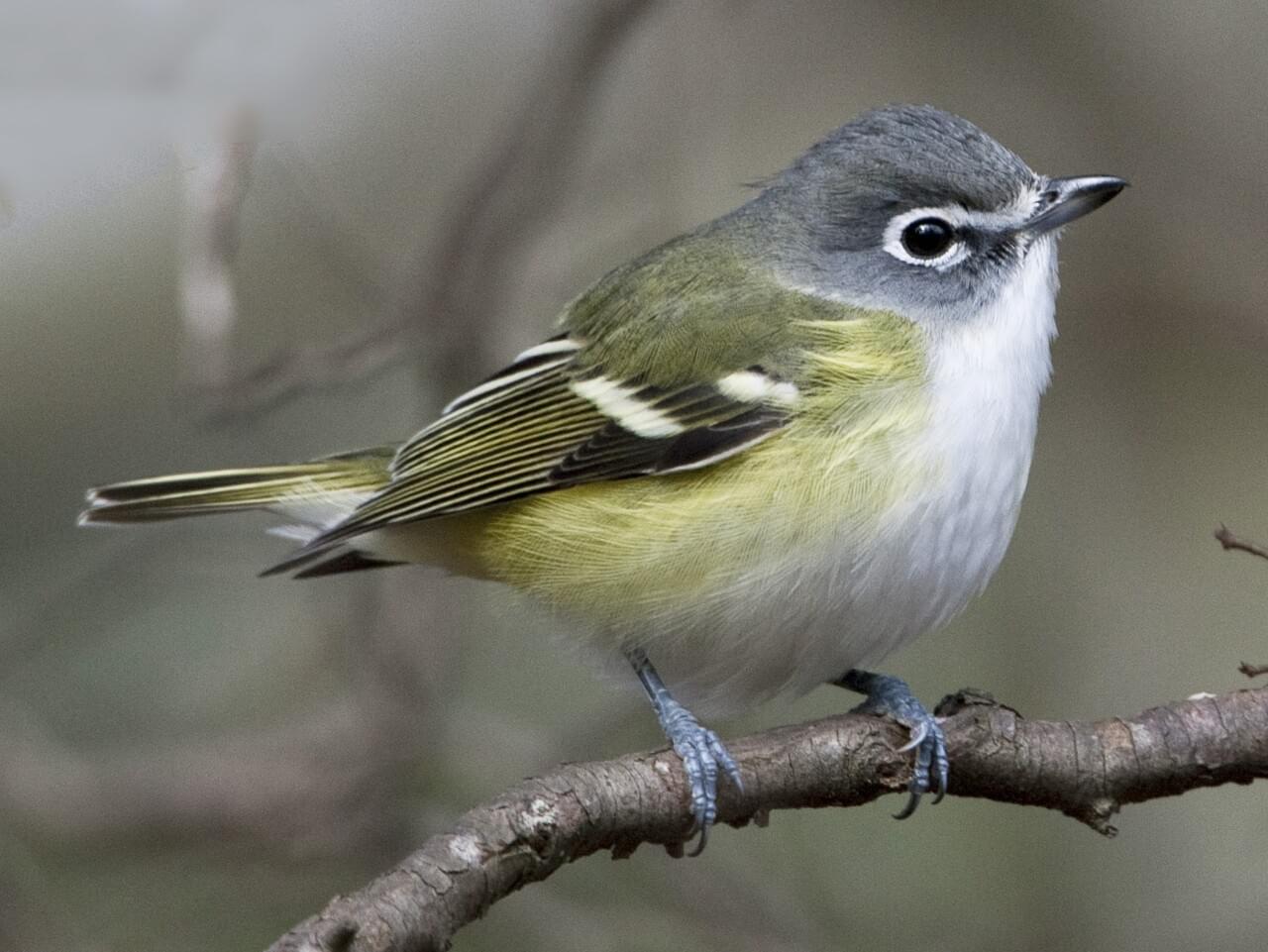 |
| Vireo solitarius (all about birds) |
Salix purpurea in Monroe's garden effete. Apparently blooms with our early willows; say 10th of April?
At Hosmer's medicinal (?) spring, Everett's farm, Ranunculus repens, abundantly out, apparently several days.
Hear of a peach out in Lincoln.
Probably I heard the black and white creeper April 25th. I hear it and see it well to-day.
Comptonia well out, how long?
Viola cucullata, how long?
Hear of robins' nests with four eggs.
See no signs of the Uvularia perfoliata yet; apparently will not bloom within ten days.
E. Hoar brings me a twig of a willow plucked in Newton, which was killed some weeks ago, when it had just begun to bloom. The catkins look peculiarly woolly, and the scales peculiarly rounded or blunt. Is it the eriocephala?
Our earliest gooseberry not yet, perhaps because there will be but few blossoms on it this year.
Partridges have been heard drumming.
In the woods near the Uvularia perfoliata, see and hear a new bird to me. At first it was silent, and I took it for the common pewee, but, bringing my glass to bear on it, found it to be
H. D. Thoreau, Journal, May 3, 1858
Ride to Flint's Pond to look for Uvularia perfoliata. ... It apparently will not bloom within ten days. See May 30, 1857 ("By the path near the northeast shore of Flint's Pond, just before reaching the wall by the brook, I . . .am surprised to find ... the Uvularia perfoliata, which I have not found hereabouts before. . . .. It is considerably past its prime “). See also note to August 22, 1857 ("He says he found the Uvularia perfoliata on the Stow road, he thinks within Concord bounds.”) and A Book of the Seasons, by Henry Thoreau, the Bellworts
Partridges have been heard drumming. See April 19, 1860 ("You will hear at first a single beat or two far apart and have time to say, "There is a partridge," so distinct and deliberate is it often, before it becomes a rapid roll."); April 25, 1854 ("The first partridge drums in one or two places, as if the earth's pulse now beat audibly with the increased flow of life. It slightly flutters all Nature and makes her heart palpitate."); April 29, 1857 ("C. says it makes his heart beat with it, or he feels it in his breast.") See also A Book of Seasons, by Henry Thoreau, the Partridge
Heard the black and white creeper April 25th. I hear it and see it well to-day. See April 28, 1856 ("I hear to-day frequently the seezer seezer seezer of the black and white creeper”); May 3, 1852 ("That oven-birdish note which I heard here on May 1st I now find to have been uttered by the black and white warbler or creeper. He has a habit of looking under the branches."); May 4, 1858 ("I hear the weese wese wese of the creeper continually from the swamp. It is the prevailing note there.") See also A Book of the Seasons, by Henry Thoreau, The Black and White Creeper
E. Hoar brings me a twig of a willow plucked in Newton, which was killed some weeks ago, when it had just begun to bloom. The catkins look peculiarly woolly, and the scales peculiarly rounded or blunt. Is it the eriocephala?
Our earliest gooseberry not yet, perhaps because there will be but few blossoms on it this year.
Partridges have been heard drumming.
In the woods near the Uvularia perfoliata, see and hear a new bird to me. At first it was silent, and I took it for the common pewee, but, bringing my glass to bear on it, found it to be
- pure white throat and beneath,
- yellow on sides of body or wings,
- greenish-yellow back and shoulders, a white or whitish ring about eyes,
- and a light mark along side of head,
- two white bars on wings,
- apparently black bill and
- dark or perhaps slate-colored (?) wings and above tail.
H. D. Thoreau, Journal, May 3, 1858
Ride to Flint's Pond to look for Uvularia perfoliata. ... It apparently will not bloom within ten days. See May 30, 1857 ("By the path near the northeast shore of Flint's Pond, just before reaching the wall by the brook, I . . .am surprised to find ... the Uvularia perfoliata, which I have not found hereabouts before. . . .. It is considerably past its prime “). See also note to August 22, 1857 ("He says he found the Uvularia perfoliata on the Stow road, he thinks within Concord bounds.”) and A Book of the Seasons, by Henry Thoreau, the Bellworts
Partridges have been heard drumming. See April 19, 1860 ("You will hear at first a single beat or two far apart and have time to say, "There is a partridge," so distinct and deliberate is it often, before it becomes a rapid roll."); April 25, 1854 ("The first partridge drums in one or two places, as if the earth's pulse now beat audibly with the increased flow of life. It slightly flutters all Nature and makes her heart palpitate."); April 29, 1857 ("C. says it makes his heart beat with it, or he feels it in his breast.") See also A Book of Seasons, by Henry Thoreau, the Partridge
Wednesday, September 27, 2017
I see the shadow of a hawk flying above and behind me.
I am surprised to find that, yesterday having been a sudden very warm day, the peaches have mellowed suddenly and wilted, and I find many more fallen than even after previous rains. Better if ripened more gradually.
How out of all proportion to the value of an idea, when you come to one, — in Hindoo literature, for instance, — is the historical fact about it, — the when, where, etc., it was actually expressed, and what precisely it might signify to a sect of worshippers! Any thing that is called history of India — or of the world — is impertinent beside any real poetry or inspired thought which is dateless.
P. M. — To Lee's Cliff by land.
Small red maples in low ground have fairly begun to burn for a week. It varies from scarlet to crimson. It looks like training-day in the meadows and swamps. They have run up their colors. A small red maple has grown, perchance, far away on some moist hill side, a mile from any road, unobserved. It has faith fully discharged the duties of a maple there, all winter and summer, neglected none of its economies, added to its stature in the virtue which belongs to a maple, by a steady growth all summer, and is nearer heaven than in the spring, never having gone gadding abroad; and now, in this month of September, when men are turned travellers, hastening to the seaside, or the mountains, or the lakes, – in this month of travelling, — this modest maple, having ripened its seeds, still with out budging an inch, travels on its reputation, runs up its scarlet flag on that hillside, to show that it has finished its summer work before all other trees, and withdraws from the contest. Thus that modest worth which no scrutiny could have detected when it was most industrious, is, by the very tint of its maturity, by its very blushes, revealed at last to the most careless and distant observer. It rejoices in its existence; its reflections are unalloyed. It is the day of thanksgiving with it. At last, its labors for the year being consummated and every leaf ripened to its full, it flashes out conspicuous to the eye of the most casual observer, with all the virtue and beauty of a maple, – Acer rubrum. In its hue is no regret nor pining. Its leaves have been asking their parent from time to time in a whisper, “When shall we redden?” It has faith fully husbanded its sap, and builded without babbling nearer and nearer to heaven. Long since it committed its seeds to the winds and has the satisfaction of knowing perhaps that a thousand little well-behaved and promising maples of its stock are already established in business somewhere. It deserves well of Mapledom. It has afforded a shelter to the wandering bird. Its autumnal tint shows how it has spent its summer; it is the hue of its virtue.
These burning bushes stand thus along the edge of the meadows, and I distinguish them afar upon all the hillsides, here and there. Her virtues are as scarlet.
The large common ferns (either cinnamon or interrupted) are yellowish, and also many as rich a deep brown now as ever.
White birches have fairly begun to yellow, and blackberry vines here and there in sunny places look like a streak of blood on the grass.
Bass, too, fairly begun to yellow.
Solidago nemoralis nearly done.
I sit on the hillside at Miles Swamp. A woodbine investing the leading stem of an elm in the swamp quite to its top is seen as an erect slender red column through the thin and yellowing foliage of the elm, – a very pretty effect. I see some small woodbine leaves in the shade of a delicate cherry-color, bordering on pink.
As I sit there I see the shadow of a hawk flying above and behind me. I think I see more hawks nowadays. Perhaps it is both because the young are grown and their food, the small birds, are flying in flocks and are abundant. I need only sit still a few minutes on any spot which overlooks the river meadows, before I see some black circling mote beating along, circling along the meadow's edge, now lost for a moment as it turns edgewise in a peculiar light, now reappearing further or nearer.
Witch-hazel two thirds yellowed.
Huckleberries are still abundant and quite plump on Conantum, though they have a somewhat dried taste.
It is most natural, i. e. most in accordance with the natural phenomena, to suppose that North America was discovered from the northern part of the Eastern Continent, for a study of the range of plants, birds, and quadrupeds points to a connection on that side. Many birds are common to the northern parts of both continents. Even the passenger pigeon has flown across there. And some European plants have been detected on the extreme northeastern coast and islands, which do not extend inland. Men in their migrations obey in the main the same law.
H. D. Thoreau, Journal, September 27, 1857
How out of all proportion to the value of an idea . . . is the historical fact about it. . . Any thing that is called history . . . is impertinent beside any real poetry or inspired thought which is dateless. See December 16, 1837 ("Mere accumulators of facts . . . are like those plants growing in dark forests, which 'put forth only leaves instead of blossoms.'"); November 9, 1851 ("I, too, would fain set down something beside facts."); February 18, 1852 ("I see that if my facts were sufficiently vital and significant . . . I should need but one book of poetry to contain them all."); June 19, 1852 (“Facts collected by a poet are set down at last as winged seeds of truth”)
I see the shadow of a hawk flying above and behind me. I think I see more hawks nowadays. See September 16, 1852 ("What makes this such a day for hawks? . . . I detect the transit of the first by his shadow on the rock, and look toward the sun for him.”); April 29, 1852 (“Discover a hawk over my head by his shadow on the ground.”)
Every leaf ripened to its full, it flashes out conspicuous to the eye of the most casual observer, with all the virtue and beauty of a maple, – Acer rubrum. See September 27, 1851 ("The maples by the riverside look very green yet, have not begun to blush, nor are the leaves touched by frost. Not so on the uplands"); September 27, 1855 ("Some single red maples now fairly make a show along the meadow. I see a blaze of red reflected from the troubled water."); September 27, 1858 ("Red maples now fairly glow along the shore.") See also September 1, 1852 ("Across the pond, beneath where the white stems of three birches diverge, at the point of a promontory next the water, I see two or three small maples already scarlet."); September 1, 1853 ("Some large maples along the river are beginning to redden."); September 12, 1858 ("Some small red maples by water begun to redden."); September 26, 1854 ("Some single red maples are very splendid now, the whole tree bright-scarlet against the cold green pines; now, when very few trees are changed, a most remarkable object in the landscape; seen a mile off."); September 20, 1857 ("A great many small red maples in Beck Stow's Swamp are turned quite crimson, when all the trees around are still perfectly green. It looks like a gala day there.")
The large common ferns (either cinnamon or interrupted) are yellowish, and also many as rich a deep brown now as ever. See September 6, 1854 ("The cinnamon ferns along the edge of woods next the meadow are many yellow or cinnamon, or quite brown and withered."); September 2, 1854 ("The interrupted fern begins to yellow.")
Thursday, September 21, 2017
The warmth of the sun is just beginning to be appreciated again on the advent of cooler days.
September 21.
Monday. P. M. – To Corallorhiza Rock. and Tobacco-pipe Wood, northeast of Spruce Swamp.
Peaches are now in their prime.
Came through that thick white pine wood on the east of the spruce swamp. This is a very dense white pine grove, consisting of tall and slender trees which have been thinned, yet they are on an average only from three to six feet asunder. Perhaps half have been cut. It is a characteristic white pine grove, and I have seen many such. The trees are some ten inches in diameter, larger or smaller, and about fifty feet high. They are bare for thirty-five or forty feet up, — which is equal to at least twenty-five years of their growth, or with only a few dead twigs high up. Their green crowded tops are mere oval spear-heads in shape and almost in proportionate size, four to eight feet wide, – not enough, you would think, to keep the tree alive, still less to draw it upward. In a dark day the wood is not only thick but dark with the boles of the trees.
Under this dense shade, the red-carpeted ground is almost bare of vegetation and is dark at noon. There grow Goodyera pubescens and repens, Corallorhiza multiflora (going to seed), white cohosh berries, Pyrola secunda, and, on the low west side and also the east side, an abundance of tobacco-pipe, which has begun to turn black at the tip of the petals and leaves.
The Solidago casia is very common and fresh in copses, perhaps the prevailing solidago now in woods.
Rudbeckia laciniata done, probably some time.
The warmth of the sun is just beginning to be appreciated again on the advent of cooler days.
Measured the large white willow north the road near Hildreth's. At a foot and a half from the ground it is fourteen feet in circumference; at five feet, the smallest place, it is twelve feet in circumference. It was once still larger, for it has lost large branches.[Cut down in '59.]
H. D. Thoereau, Journal, September 21, 1857
Corallorhiza Rock. See August 29, 1857 ("Nearby, north [of Indian Rock, west of the swamp], is a rocky ridge, on the east slope of which the Corallorhiza multiflora is very abundant.")
Corallorhiza multiflora [spotted coral root] (going to seed)... See note to August 13, 1857
Under this dense shade, the red-carpeted ground is almost bare of vegetation and is dark at noon. There grow Goodyera pubescens and repens See August 20, 1857 ("The Goodyera repens grows behind the spring where I used to sit, amid the dead pine leaves") and note to August 27, 1856 (“Goodyera pubescens, rattlesnake-plantain, is apparently a little past its prime. It is very abundant on Clintonia Swamp hillside. . .”)
An abundance of tobacco-pipe, which has begun to turn black . . . See July 24, 1856 ("Tobacco-pipe much blackened, out a long time.")
The Solidago casia is very common and fresh in copses, perhaps the prevailing solidago now in woods. See October 8, 1856 ("S. casia, much the worse for the wear, but freshest of any [goldenrod] seen.")
The warmth of the sun is just beginning to be appreciated again on the advent of cooler days. See September 18, 1860 ("This is a beautiful day, warm but not too warm, a harvest day . . ."If you are not happy to-day you will hardly be so to-morrow.”); August 29, 1854 ("I enjoy the warmth of the sun now that the air is cool, and Nature seems really more genial. ")
H. D. Thoereau, Journal, September 21, 1857
Corallorhiza Rock. See August 29, 1857 ("Nearby, north [of Indian Rock, west of the swamp], is a rocky ridge, on the east slope of which the Corallorhiza multiflora is very abundant.")
Corallorhiza multiflora [spotted coral root] (going to seed)... See note to August 13, 1857
Under this dense shade, the red-carpeted ground is almost bare of vegetation and is dark at noon. There grow Goodyera pubescens and repens See August 20, 1857 ("The Goodyera repens grows behind the spring where I used to sit, amid the dead pine leaves") and note to August 27, 1856 (“Goodyera pubescens, rattlesnake-plantain, is apparently a little past its prime. It is very abundant on Clintonia Swamp hillside. . .”)
An abundance of tobacco-pipe, which has begun to turn black . . . See July 24, 1856 ("Tobacco-pipe much blackened, out a long time.")
The Solidago casia is very common and fresh in copses, perhaps the prevailing solidago now in woods. See October 8, 1856 ("S. casia, much the worse for the wear, but freshest of any [goldenrod] seen.")
The warmth of the sun is just beginning to be appreciated again on the advent of cooler days. See September 18, 1860 ("This is a beautiful day, warm but not too warm, a harvest day . . ."If you are not happy to-day you will hardly be so to-morrow.”); August 29, 1854 ("I enjoy the warmth of the sun now that the air is cool, and Nature seems really more genial. ")
Saturday, May 20, 2017
Postpone your journey till the May storm is over.
Began to rain the latter part of yesterday, and rains all day against all desire and expectation, raising the river and, in low land, rotting the seed. Gardeners wish that their land had not been planted nor plowed. Postpone your journey till the May storm is over.

 |
| Starflower May 20, 2017 |
It has been confidently asserted and believed that if the cold in the winter exceeded a certain degree it surely killed the peach blossoms. Last winter we had greater cold than has ever been generally observed here, and yet it is a remarkable spring for peach blossoms; thus once for all disproving that assertion.
Everything in the shape of a peach tree blossoms this season, even a mutilated shrub on the railroad causeway, sprung from a stone which some passenger cast out. Nevertheless the lowest limbs, which were covered by the drifts, have blossomed much the earliest and fullest, as usual, and this after-blow is quite unexpected. Peach trees are revealed along fences where they were quite unobserved before.
The expression in Sophocles' (Edipus at Colonos, "White Colonos," said to refer to the silvery soil, reminded me at first of the tracts now whitened by the pyrus blossoms, which may be mistaken for hoary rocks. Vide this description of Colonos.
Have all the Canada plums that striking pink color at the base of the blossoms at last?
I find that the corydalis sprig which I brought home five days ago keeps fresh and blossoms remarkably well in water, — its delicate bright flesh-colored or pink flowers and glaucous leaves!
How suddenly, after all, pines seem to shoot up and fill the pastures!
I wonder that the farmers do not earlier encourage their growth. To-day, perchance, as I go through some run-out pasture, I observe many young white pines dotting the field, where last year I had noticed only blackberry vines; but I see that many are already destroyed or injured by the cows which have dived into them to scratch their heads or for sport (such is their habit; they break off the leading shoot and bend down the others of different evergreens), or perchance where the farmer has been mowing them down, and I think the owner would rather have a pasture here than a wood-lot. A year or two later, as I pass through the same field, I am surprised to find myself in a flourishing young wood-lot, from which the cows are now carefully fenced out, though there are many open spaces, and I perceive how much further advanced it would have been if the farmer had been more provident and had begun to abet nature a few years earlier.
It is surprising by what leaps — two or three feet in a season — the pines stretch toward the sky, affording shelter also to various hardwoods which plant themselves in their midst.
I do not know a white pine in the town which has been set out twenty-five years.
H. D. Thoreau, Journal, May 20, 1857
Postpone your journey till the May storm is over. See May 17, 1853 ("Does not summer begin after the May storm?”); compare May 13, 1852 (" They who do not walk in the woods in the rain never behold them in their freshest, most radiant and blooming beauty.”)
Have all the Canada plums that striking pink color at the base of the blossoms at last? See note to May 10, 1856 (“Mr. Prichard’s Canada plum will open as soon as it is fair weather.”)
Thursday, May 14, 2015
The red inner sides of the hickory bud-scales turned back.
May 14
Our peaches begin to bloom; others probably earlier. Domestic plums open; some maybe yesterday. Missouri currant open yesterday or day before. One apple on a roof open.
The beech blossom in house opens; say to-morrow in woods, and probably will leaf generally by the next day.
Second gooseberry in garden open.
White ash begins to leaf; and waxwork. Clethra leafs. High blueberry open by Hubbard’s Bath. Black scrub oak leafs, and chinquapin. Red choke-berry leafed, say two days later than black.

P. M. — To Cliffs via Hubbard’s Bath.
See a male hen-harrier skimming low along the side of the river, often within a foot of the muddy shore, looking for frogs, with a very compact flock of small birds, probably swallows, in pursuit. Occasionally he alights and walks or hops flutteringly a foot or two over the ground.
The Lombardy poplar and silvery white leafed at least two days ago.
Vaccinium vacillans leafed, and perhaps flower opened, if that is one near West Fair Haven Spring.
Some hickories, just opening their leaves, make quite a show with the red inner sides of the bud-scales turned back.
All the oak leaves off the shrub oak plain, except apparently a few white oaks.
Some gaylussacias leafed. Uva-ursi at Cliffs out some time, and some new shoots leafing.
Under the dead pine on which the fish hawk sat on the 12th inst, a half-mile from the river, I find a few fish bones — one, I am pretty sure from comparison, the jaw of a pout. So that in three instances, the only ones observed this year, they were feeding on pouts.
Probably the mice, etc., had picked up the rest of his droppings. Thus these inhabitants of the interior get a taste of fish from time to time, -- crumbs from the fish hawk’s table.
Prinos verticillatus leafs.
H. D. Thoreau, Journal, May 14, 1855
Our peaches begin to bloom; others probably earlier. Domestic plums open; some maybe yesterday. Missouri currant open yesterday or day before. One apple on a roof open.
The beech blossom in house opens; say to-morrow in woods, and probably will leaf generally by the next day.
Second gooseberry in garden open.
White ash begins to leaf; and waxwork. Clethra leafs. High blueberry open by Hubbard’s Bath. Black scrub oak leafs, and chinquapin. Red choke-berry leafed, say two days later than black.

May 14, 2015
P. M. — To Cliffs via Hubbard’s Bath.
See a male hen-harrier skimming low along the side of the river, often within a foot of the muddy shore, looking for frogs, with a very compact flock of small birds, probably swallows, in pursuit. Occasionally he alights and walks or hops flutteringly a foot or two over the ground.
The Lombardy poplar and silvery white leafed at least two days ago.
Vaccinium vacillans leafed, and perhaps flower opened, if that is one near West Fair Haven Spring.
Some hickories, just opening their leaves, make quite a show with the red inner sides of the bud-scales turned back.
All the oak leaves off the shrub oak plain, except apparently a few white oaks.
Some gaylussacias leafed. Uva-ursi at Cliffs out some time, and some new shoots leafing.
Under the dead pine on which the fish hawk sat on the 12th inst, a half-mile from the river, I find a few fish bones — one, I am pretty sure from comparison, the jaw of a pout. So that in three instances, the only ones observed this year, they were feeding on pouts.
Probably the mice, etc., had picked up the rest of his droppings. Thus these inhabitants of the interior get a taste of fish from time to time, -- crumbs from the fish hawk’s table.
Prinos verticillatus leafs.
H. D. Thoreau, Journal, May 14, 1855
Our peaches begin to bloom; others probably earlier. See May 13, 1854 ("Peach trees in bloom in our garden") See also May 14, 1858 ("To-day, for the first time, it appears to me summerlike and a new season. There is a tender green on the meadows and just leafing trees. The blossoms of the cherry, peach, pear, etc., are conspicuous, and the air is suddenly full of fragrance. Houses are seen to stand amid blossoming fruit trees, and the air about them is full of fragrance and the music of birds.")
.
.
See a male hen-harrier skimming low along the side of the river, often within a foot of the muddy shore, looking for frogs. See May 14, 1853 ("What is that small slate-colored hawk with black tips to wings?") and note to May 14, 1857 ("See a pair of marsh hawks, the smaller and lighter-colored male, with black tips to wings, and the large brown female, sailing low over J. Hosmer's sprout-land and screaming, apparently looking for frogs or the like.”); See also A Book of the Seasons, by Henry Thoreau, the Marsh Hawk (Northern Harrier)
Under the dead pine on which the fish hawk sat on the 12th inst, a half-mile from the river, I find a few fish bones. See May 12, 1855 ("See I direct my glass toward the dead tree on Cliffs, and am surprised to see the fish hawk still sitting there, about an hour after he first alighted; and now I find that he is eating a fish, which he had under his feet on the limb."). See also A Book of the Seasons, by Henry Thoreau, the Osprey (Fish Hawk)
Some hickories, just opening their leaves, make quite a show with the red inner sides of the bud-scales turned back. See May 17, 1853 ("How red are the scales of some hickory buds, now turned back!"); May 24, 1860 (“I notice the first shadows of hickories, - not dense and dark shade, but open-latticed, a network of sun and shadow on the north sides of the trees.”); May 26, 1857 ("The very sudden expansion of the great hickory buds, umbrella-wise."); May 29, 1857 (“Those great hickory buds, how much they contained! You see now the large reddish scales turned back at the base of the new twigs. Suddenly the buds burst, and those large pinnate leaves stretched forth in various directions.”) See also A Book of the Seasons, by Henry Thoreau. The Hickory. and Spring is the New Fall (May 15, 2020 )
May 14. See A Book of the Seasons, by Henry Thoreau, May 14.
Their leaves just open
hickories make quite a show –
red inner bud-scales.
A Book of the Seasons, by Henry Thoreau, The red inner sides of the hickory bud-scales turned back.
A Book of the Seasons, by Henry Thoreau
"A book, each page written in its own season,
out-of-doors, in its own locality.”
~edited, assembled and rewritten by zphx © 2009-2025
https://tinyurl.com/hdt-550514
Tuesday, August 12, 2014
The yellow afternoon of the year.
August 12
To Conantum by boat. To-day there is an uncommonly strong wind, against which I row, yet in shirt-sleeves, trusting to sail back. It is southwest.

August 12, 2913
The Bidens Beckii yellows the side of the river just below the Hubbard Path, but is hardly yet in fullest flower generally.
I see goldfinches nowadays on the lanceolate thistles, apparently after the seeds.
It takes all the heat of the year to produce these yellow flowers. It is the 3 o'clock p. m. of the year when they begin to prevail, — when the earth has absorbed most heat, when melons ripen and early apples and peaches. It is already the yellowing year.
Viburnum nudum berries generally green, but some, higher and more exposed, of a deep, fiery pink on one cheek and light green on the other, and a very few dark purple or without bloom, black already. I put a bunch with only two or three black ones in my hat, the rest pink or green. When I got home more than half were turned black, — and ripe !! A singularly sudden chemical change. They are a very pretty, irregularly elliptical berry, one side longer than the other, and particularly interesting on account of the mixture of light-green, deep-pink, and dark-purple, and also withered berries, in the same cyme.
The wind is autumnal and at length compels me to put on my coat.
I bathe at Hubbard's. The water is rather cool, comparatively.
As I look down-stream from southwest to northeast, I see the red under sides of the white lily pads about half exposed, turned up by the wind to [an] angle of 45 ° or more. These hemispherical red shields are so numerous as to produce a striking effect on the eye, as of an endless array of forces with shields advanced; sometimes four or five rods in width.
Off Holden Woods a baffling counter wind as usual (when I return), but looking up-stream I see the great undulations extending into the calm from above, where the wind blows steadily.
There are but few haymakers left in the meadows.
Off Holden Woods a baffling counter wind as usual (when I return), but looking up-stream I see the great undulations extending into the calm from above, where the wind blows steadily.
There are but few haymakers left in the meadows.
The woodbine on rocks in warm and dry places is now more frequently turned, a few leafets bright-scarlet.
The now quite common goldenrods fully out are what I have called stricta and also the more strict puberula (?). The arguta and odora are not abundant enough to make an impression. The Solidago nemoralis is not yet generally out.
The common asters now are the patens, dumosus, Radula, and Diplopappus umbellatus.
H. D. Thoreau, Journal, August 12, 1854
To Conantum by boat. See August 12, 1853 ("To Conantum by boat, berrying, with three ladies.”)\
H. D. Thoreau, Journal, August 12, 1854
To Conantum by boat. See August 12, 1853 ("To Conantum by boat, berrying, with three ladies.”)\
Strong wind, against which I row, . . . trusting to sail back. See May 28, 1855 ("Yesterday left my boat at the willow opposite this [Conantum] Cliff, the wind northwest. Now it is southeast, and I can sail back.")
The red under sides of the white lily pads. See June 29, 1852 ("This is one of the aspects of the river now."); June 30, 1859 (" this not a fall phenomenon yet."August 24,1854 (" It is not till August, methinks, that they are turned up conspicuously.”)
It is the 3 o'clock p. m. of the year . . . when the earth has absorbed most heat, when melons ripen . . .It is already the yellowing year. See July 26, 1853 ("This the afternoon of the year."); August 10, 1853 ("That month, surely, is distinguished when melons ripen. July could not do it."); August 19, 1853 ("The day is an epitome of the year."); August 23, 1853 "I am again struck by the perfect correspondence of a day – say an August day – and the year. I think that a perfect parallel may be drawn between the seasons of the day and of the year.”); Walden, "Spring" ("The night is the winter, the morning and evening are the spring and fall, and the noon is the summer.")
Viburnum nudum berries generally green. See August 10, 1853 ("What a moist, fertile heat now! I see naked viburnum berries beginning to turn. Their whiteness faintly blushing."); August 15, 1852 ("Some naked viburnum berries are quite dark purple amid the red, while other bunches are wholly green yet."); August 24, 1851 ("Is that the naked viburnum, so common, with its white, red, then purple berries, in Hubbard's meadow?"); August 24, 1852 ("The Viburnum nudum shows now rich, variegated clusters amid its handsome, firm leaves, bright rosy-cheeked ones mingled with dark-purple.") See also A Book of the Seasons, by Henry Thoreau, Viburnum
I bathe at Hubbard's. The water is rather cool, comparatively. See August 14, 1854 ("Though yesterday was quite a hot day, I find by bathing that the river grows steadily cooler, "): September 2, 1854 ("Bathe at Hubbard’s. The water is surprisingly cold on account of the cool weather and rain, but especially since the rain of yesterday morning. It is a very important and remarkable autumnal change. It will not be warm again probably"); September 12, 1854 ("I find it colder again than on the 2d, so that I stay in but a moment."); September 27, 1856 ("Bathed at Hubbard's Bath, but found the water very cold. Bathing about over”) See also A Book of the Seasons, by Henry Thoreau, The Luxury of Bathing
August 12. See A Book of the Seasons, by Henry Thoreau, August 12.
The Bidens Beckii
yellows the side of the river –
the yellowing year.
A Book of the Seasons, by Henry Thoreau, The yellow afternoon of the year.
A Book of the Seasons, by Henry Thoreau
"A book, each page written in its own season,
out-of-doors, in its own locality."
~edited, assembled and rewritten by zphx © 2009-2024
https://tinyurl.com/hdt-540812
Tuesday, May 13, 2014
Insects have just begun to be troublesome.
May 13.

The portion of the peach trees in bloom in our garden shows the height of the snow-drifts in the winter.
The bass suddenly expanding its little round leaves.
Uvularias, amid the dry tree-tops near the azaleas.
The great red maples begin to leaf.
As for the birds, I have not for some time noticed crows in flocks. The voices of the early spring birds are silenced or drowned in multitude of sounds. The black ducks are probably all gone. Are the rusty grackles still here? Birds generally are now building and sitting. Methinks I heard one snipe night before last? I have not noticed the pine warbler nor the myrtle-bird for a fortnight. The chip-sparrow is lively in the morning. I suspect the purple finches are all gone within a few days. The black and white creeper is musical nowadays, and thrushes and the catbird, etc., etc. Goldfinch heard pretty often.
Insects have just begun to be troublesome.
H. D. Thoreau, Journal, May 13, 1854
Peach trees in bloom in our garden. See May 14, 1855 (“Our peaches begin to bloom; others probably earlier.”)
The bass suddenly expanding its little round leaves. See May 13, 1855 (“The large bass trees now begin to leaf. ”)
Uvularias . . . near the azaleas See May 13, 1858 ("Uvularia sessilifolia is well out in Island woods, opposite Bath Rock; how long?"); May 13, 1860 (" At Holden Swamp . . .Uvularia sessilifolia abundant, how long?") See also A Book of the Seasons, by Henry Thoreau, the Bellworts

May 13, 2024
The portion of the peach trees in bloom in our garden shows the height of the snow-drifts in the winter.
The bass suddenly expanding its little round leaves.
Uvularias, amid the dry tree-tops near the azaleas.
The great red maples begin to leaf.
As for the birds, I have not for some time noticed crows in flocks. The voices of the early spring birds are silenced or drowned in multitude of sounds. The black ducks are probably all gone. Are the rusty grackles still here? Birds generally are now building and sitting. Methinks I heard one snipe night before last? I have not noticed the pine warbler nor the myrtle-bird for a fortnight. The chip-sparrow is lively in the morning. I suspect the purple finches are all gone within a few days. The black and white creeper is musical nowadays, and thrushes and the catbird, etc., etc. Goldfinch heard pretty often.
Insects have just begun to be troublesome.
H. D. Thoreau, Journal, May 13, 1854
Peach trees in bloom in our garden. See May 14, 1855 (“Our peaches begin to bloom; others probably earlier.”)
The bass suddenly expanding its little round leaves. See May 13, 1855 (“The large bass trees now begin to leaf. ”)
Uvularias . . . near the azaleas See May 13, 1858 ("Uvularia sessilifolia is well out in Island woods, opposite Bath Rock; how long?"); May 13, 1860 (" At Holden Swamp . . .Uvularia sessilifolia abundant, how long?") See also A Book of the Seasons, by Henry Thoreau, the Bellworts
As for birds. See May 28, 1854 ("The F. hyemalis fox-colored sparrow, rusty grackles, tree sparrows, have all gone by; also the purple finch. The snipe has ceased (?) to boom.")
Subscribe to:
Posts (Atom)
Popular Posts Last 30 Days.
-
 I would make a chart of our life, know why just this circle of creatures completes the world. Henry Thoreau, April 18, 1852 It is but a s...
 -
 July 14 P. M. — To Muhlenbergii Brook. Anthony Wright found a lark's nest with fresh eggs on the 12th in E. Hubbard's meadow by...
 -
 July 12 P. M. — Down Turnpike to Red Lily Meadow. Hear the plaintive note of young bluebirds, a reviving and gleaming of their blue...
 -
 July 18 P. M. — To Wheeler meadow to look at willows. Again scare up a woodcock, apparently seated or sheltered in shadow of ferns in the m...
The week ahead in Henry’s journal

A journal, a book that shall contain a record of all your joy.