Showing posts with label hat. Show all posts

Saturday, May 29, 2021

These are afternoons when you expect a thunder-shower before night.


May 29, 2015


These last two days, with their sultry, hazy air, are the first that suggest the expression “the furnace-like heat.”

Bathing has begun.

In the evening and during the night the ring of the toads fills the air, so that some have to shut the windows toward the river, but when you awake in the morning not one is to be heard. As it grows warmer in the forenoon I hear a few again; but still I do not hear them numerously and loudly as earlier in the season at that hour, though far more numerously and loudly at night.

P. M. - To Hosmer's Holden place.

Thimble-berry two or three days.

Cattle stand in the river by the bridge for coolness.

Place my hat lightly on my head that the air may circulate beneath.

Wild roses budded before you know it — will be out often before you know they are budded.

Fields are whitened with mouse-ear gone to seed 
—a mass of white fuzz blowing off one side — and also with dandelion globes of seeds.

Some plants have already reached their fall.

How still the hot noon; people have retired behind blinds.

Yet the kingbird — lively bird, with white belly and tail edged with white, and with its lively twittering
— stirs and keeps the air brisk.

I see men and women through open windows in white undress taking their Sunday-afternoon nap, overcome with heat.

At A. Hosmer's hill on the Union Turnpike I see the tanager hoarsely warbling in the shade; the surprising red bird, a small morsel of Brazil, advanced picket of that Brazilian army, — parrot-like. But no more shall we see; it is only an affair of outposts. It appears as if he loved to contrast himself with the green of the forest.

May 29, 2024

These are afternoons when you expect a thunder-shower before night; the outlines of cloudy cumuli are dimly seen through the hazy, furnace-like air, rising in the west.

Spergularia rubra, spurry sandwort, in the roadside ditch on left just beyond A. Hosmer's hill; also Veronica peregrina (?) a good while. The last also in Great Fields in the path.

Raspberry out.

That exceedingly neat and interesting little flower blue-eyed grass now claims our attention.

The barrenest pastures wear now a green and luxuriant aspect.

I see many of those round, white, pigeon-egg fungi in the grass since the rains. Do they become puffballs? 

The thyme-leaved veronica shows its modest face in little crescent-shaped regiments in every little hollow in the pastures where there is moisture, and around stumps and in the road ditches.

The Cratægus Crus-Galli this side the Holden place on left, probably yesterday, thorns three inches long, flowers with anthers not conspicuously red.

The Viola debilis near west end of Holden farm in meadow south side of road.

H. D. Thoreau, Journal, May 29, 1853


Bathing has begun. See May 8, 1857 (“Summer has suddenly come upon us, and . . . Some boys have bathed in the river.") May 12, 1860 ("First bathe in the river. Quite warm enough."); May 15,1853 ("The weather has grown rapidly warm. I even think of bathing in the river .")

Fields are whitened with mouse-ear gone to seed — a mass of white fuzz blowing off one side — and also with dandelion globes of seeds. See May 29, 1854 ("Dandelions and mouse-ear down have been blowing for some time and are seen on water. These are interesting as methinks the first of the class of downy seeds which are more common in the fall.") See also A Book of the Seasons, by Henry Thoreau, the Mouse-ear

That exceedingly neat and interesting little flower blue-eyed grass now claims our attention. See May 29, 1852 ("Blue-eyed grass [in bloom]."); May 29, 1856 (“Blue-eyed grass, probably to-morrow.”); See also May 31, 1854 (“Blue-eyed grass, apparently in pretty good season.”); June 6, 1855 (“Blue-eyed grass maybe several days in some places.”); June 15, 1851 (“The blue-eyed grass, well named, looks up to heaven.”); June 15, 1852 ("The fields are blued with blue-eyed grass, — a slaty blue. "); June 15, 1859 ("Blue-eyed grass at height."); June 17. 1853 ("The dense fields of blue-eyed grass now blue the meadows, as if, in this fair season of the year, the clouds that envelop the earth were dispersing, and blue patches began to appear, answering to the blue sky. The eyes pass from these blue patches into the surrounding green as from the patches of clear sky into the clouds. "); June 19, 1853 ("I see large patches of blue-eyed grass in the meadow across the river from my window"); July 6, 1851("Blue-eyed grass is now rarely seen. ") See also A Book of the Seasons,  by Henry Thoreau, blue-eyed grass
 
In the evening and during the night the ring of the toads fills the air.  See May 20, 1854 ("The steadily increasing sound of toads and frogs along the river with each successive warmer night is one of the most important peculiarities of the season. Their prevalence and loudness is in proportion to the increased temperature of the day.") See also A Book of the Seasons,  by Henry Thoreau: The Ring of Toads

I see the tanager hoarsely warbling in the shade; the surprising red bird, a small morsel of Brazil. . .as if he loved to contrast himself with the green of the forest. See May 23, 1853 ("That contrast of a red bird with the green pines and the blue sky!. . .this bird's colors and his note tell of Brazil. "); May 28, 1855 (" the most brilliant and tropical-looking bird we have, bright-scarlet with black wings, the scarlet appearing on the rump again between wing-tips. He brings heat, or heat him. A remarkable contrast with the green pines. ") See also A Book of the Seasons,  by Henry Thoreau, the  Scarlet Tanager

The Viola debilis near west end of Holden farm in meadow. See May 22, 1853 ("Found an abundance of the Viola Muhlenbergii (debilis of Bigelow), a stalked violet, pale blue and bearded"); May 22, 1856 ("To Viola Muhlenbergii, which is abundantly out; how long? A small pale-blue flower growing in dense bunches, but in spots a little drier than the V. cucullata and blanda.") See also A Book of the Seasons, by Henry Thoreau, the Violets

How still the hot noon; 
people retire behind blinds  –
 yet the kingbird stirs.

See men and women
through open windows undress,
overcome with heat. 

These are afternoons
when you expect a thunder-
shower before night.


Saturday, October 19, 2019

Lycopodium dendroideum is just shedding pollen.


October 19.

October 19,2 019

C. says that he saw a loon at Walden the 15th. 


P. M.— To Lee's Cliff. 

The tupelo berries have all fallen; how long? 

Alternate cornel about bare. 

Hardhack half bare. 

Many witch-hazel nuts are not yet open. The bushes just bare. 

The slippery elm is nearly bare, like the common near it. 

Cedar berries, how long? 14th at least; probably by the time they lost their leaves. There is one sizable tree west by north of Lee's Cliff, near the wall. 

Lycopodium dendroideum (not variety) is just shedding pollen near this cedar. 

I see asparagus in the woods there near the cedar, four or five feet high! 

Find the seedling archangelica grown about two feet high and still quite green and growing, though the full-grown plants are long since dead, root and stalk. This suggests that no doubt much of the radical spring greenness is of this character, — seedlings of biennials, and perhaps more of them a persistent or late growth from a perennial root, as crowfoot, whiteweed, five-finger, etc. 

The scent of the archangelica root is not agreeable to me. The scent of my fingers after having handled it reminds me strongly of the musquash and woodchuck, though the root itself does not; so its odor must be allied to theirs. 

I find at Lee's Cliff, on the shelves and sides of the rocks, a new fern, apparently Cystopteris fragilis, more than half decayed or withered, though some fresher and shorter fronds at the base of the others are still quite green. It curls up so in my hat that I have difficulty in examining it. It is abundant thereabouts. 

Paddling up the river the other day, those (probably canoe) birches on Mt. Misery on the edge of the hill a mile in front looked like little dark clouds, for I could not distinguish their white trunks against the sky. 

Though the dark-blue, or ripe, creeping juniper berries are chiefly on the lower part of the branches, I see fresh green ones on old wood as big as a pipe-stem and often directly opposite to purple ones (!). They are strangely mixed up. I am not sure but some of this year's berries are already ripe. 

See a black and rusty hedgehog (?) caterpillar in the path.

H. D. Thoreau, Journal, October 19, 1859

The tupelo berries have all fallen. See September 30, 1854 ("I find a fine tupelo near Sam Barrett’s now all turned scarlet. I find that it has borne much fruit — small oval bluish berries, . . .."); October 6, 1858 (“The tupelo at Wharf Rock is completely scarlet, with blue berries amid its leaves”)

Lycopodium dendroideum (not variety) is just shedding pollen near this cedar.  See September 24, 1857 ("I find the Lycopodium dendroideum, not quite out, just northwest of this pine grove, in the grass. It is not the variety obscurum, which grows at Trillium Wood, is more upright-branched and branches round."); October 12, 1859 ("Now for lycopodiums (the dendroideum not yet apparently in bloom), the dendroideum and lucidulum, etc., — how vivid a green ! — lifting their heads above the moist fallen leaves.") October 17, 1857 ("The Lycopodium lucidulum looks suddenly greener amid the withered leaves."); November 11, 1859 ("The flat variety of Lycopodium dendroideum shed pollen on the 25th of October."); November 17, 1858 ("It would seem that these lycopodiums, at least, which have their habitat on the forest floor and but lately attracted my attention there (since the withered leaves fell around them and revealed them by the contrast of their color and they emerged from obscurity), —it would seem that they at the same time attained to their prime, their flowering season. "); November 7, 1858 ("I see Lycopodium dendroideum which has not yet shed pollen."); November 11, 1859 ("The flat variety of Lycopodium dendroideum shed pollen on the 25th of October."); November 15, 1858 ("The Lycopodium dendroideum var. obscurum appears to be just in bloom in the swamp about the Hemlocks (the regular one (not variety) is apparently earlier)."); November 17, 1858 ("Lycopodium dendroideum . . .was apparently in its prime yesterday); December 7, 1853 ("In the latter part of November and now, before the snow, I am attracted by the numerous small evergreens on the forest floor, now most conspicuous, especially the very beautiful Lycopodium dendroideum, somewhat cylindrical") See also A Book of the Seasons,  by Henry Thoreau, The Lycopodiums

Lycopodium dendroideum,  (now 

C. says that he saw a loon at Walden the 15th. See October 8, 1852 ("As I was paddling along the north shore, after having looked in vain over the pond for a loon, suddenly a loon, sailing toward the middle, a few rods in front, set up his wild laugh")

Many witch-hazel nuts are not yet open. The bushes just bare. See October 19, 1856 ("Witch-hazel is in prime, or probably a little past, though some buds are not yet open. Their leaves are all gone.")

Find the seedling archangelica grown about two feet high and still quite green and growing, though the full-grown plants are long since dead. See September 4, 1856 ("Measured an archangelica stem (now of course dry) in Corner Spring Swamp, eight feet eight inches high, and seven and a quarter inches in circumference at ground. It is a somewhat zigzag stem with few joints and a broad umbelliferous top, so that it makes a great show. One of those plants that have their fall early")

Friday, September 27, 2019

From Smith's Hill I looked toward the mountain line.


September 27 

Monday. P. M.— To C. Smith's Hill. 

The flashing clearness of the atmosphere. More light appears to be reflected from the earth, less absorbed. 

September 27, 2015

Green lice are still on the birches. 

At Saw Mill Brook many finely cut and flat ferns are faded whitish and very handsome, as if pressed, — very delicate. 

White oak acorns edible. Everywhere the squirrels are trying the nuts in good season. 

The touch-me-not seed-vessels go off like pistols, — shoot their seeds off like bullets. They explode in my hat. 

The arum berries are now in perfection, cone-shaped spikes an inch and a half long, of scarlet or vermilion- colored, irregular, somewhat pear-shaped berries springing from a purplish core. They are exactly the color of bright sealing-wax, or, I believe, the painted tortoise's shell; on club-shaped peduncles. The changed leaves of this are delicately white, especially beneath. Here and there lies prostrate on the damp leaves or ground this conspicuous red spike. 

Medeola, September 27, 2023
Mt. Prithcard

The medeola berries are common now, and the large red berries of the panicled Solomon's-seal. 

It must have been a turtle dove that eyed me so near, turned its head sideways to me for a fair view, looking with a St. Vitus twitching of its neck, as if to recover its balance on an unstable perch, — that is their way. 

September 27, 2019

From Smith's Hill I looked toward the mountain line.

Who can believe that the mountain peak which he beholds fifty miles off in the horizon, rising far and faintly blue above an intermediate range, while he stands on his trivial native hills or in the dusty high way, can be the same with that which he looked up at once near at hand from a gorge in the midst of primitive woods? 

For a part of two days I travelled across lots once, loitering by the way, through primitive wood and swamps over the highest peak of the Peterboro Hills to Monadnock, by ways from which all landlords and stage-drivers endeavored to dissuade us. It was not a month ago. 

But now that I look across the globe in an instant to the dim Monadnock peak, and these familiar fields and copsewoods appear to occupy the greater part of the interval, I cannot realize that Joe Eavely's house still stands there at the base of the mountain, and all that long tramp through wild woods with invigorating scents before I got to it. 

I cannot realize that on the tops of those cool blue ridges are in abundance berries still, bluer than themselves, as if they borrowed their blueness from their locality. 

From the mountains we do not discern our native hills; but from our native hills we look out easily to the far blue mountains, which seem to preside over them. 

As I look northwestward to that summit from a Concord corn field, how little can I realize all the life that is passing between me and it, — the retired up-country farmhouses, the lonely mills, wooded vales, wild rocky pastures, and new clearings on stark mountain-sides, and rivers murmuring through primitive woods! 

All these, and how much more, I overlook. I see the very peak, — there can be no mistake, — but how much I do not see, that is between me and it! How much I overlook! In this way we see stars. 

What is it but a faint blue cloud, a mist that may vanish? 

But what is it, on the other hand, to one who has travelled to it day after day, has threaded the forest and climbed the hills that are between this and that, has tasted the raspberries or the blueberries that grow on it, and the springs that gush from it, has been wearied with climbing its rocky sides, felt the coolness of its summit, and been lost in the clouds there? 

When I could sit in a cold chamber muffled in a cloak each evening till Thanksgiving time, warmed by my own thoughts, the world was not so much with me.

H. D. Thoreau, Journal, September 27, 1852

The arum berries are now in perfection, cone-shaped spikes an inch and a half long, of scarlet or vermilion- colored, irregular, somewhat pear-shaped berries springing from a purplish core
. See September 28, 1856 (“The arum berries are still fresh and abundant, perhaps in their prime. . . .It is one of the most remarkable and dazzling, if not the handsomest, fruits we have.”)

The medeola berries are common now. See May 25, 1852 ("Medeola or cucumber-root in bud, with its two-storied whorl of leaves. "); July 24, 1853 ("The medeola is still in flower, though with large green berries"); August 26, 1859 ("Some medeola is quite withered. Perhaps they are somewhat frost-bitten. "); August 27, 1851 ("The Medeola Virginica, cucumber-root, the whorl-leaved plant, is now in green fruit"); September 1. 1856 ("A few medeola berries ripe"); September 2, 1853 ("The medeola berries are now dull glossy and almost blue-black; about three, on slender threads one inch long, arising in the midst of the cup formed by the purple bases of the whorl of three upper leaves."); September 3, 1853 ("To fill my basket with the neglected but beautiful fruit of the various species of cornels and viburnums, poke, arum, medeola, thorns, etc. Berries which are as beautiful as flowers, but far less known, the fruit of the flower"); September 11, 1859 ('September is the month when various small, and commonly inedible, berries in cymes and clusters hang over the roadsides and along the walls and fences, or spot the forest floor").; September 18, 1859 ("How little observed are the fruits which we do not use!"); October 6, 1858 ("The medeola leaves are a pale straw-color with a crimson centre; perhaps getting stale now.") See also 
A Book of the Seasons,  by Henry Thoreau, Cucumber Root (medeola)

The  large red berries of the panicled Solomon's-seal. See October 20, 1852 ("The small red Solomon's-seal berries spot the ground here and there amid the dry leaves. ")

From Smith's Hill I looked toward the mountain line. See June 3, 1850 ("The most imposing horizons are those which are seen from tops of hills rising out of a river valley. . . . The landscape is a vast amphitheatre rising to its rim in the horizon."); September 12, 1851 ("It is worth the while to see the mountains in the horizon once a day"); November 11, 1851 ("The horizon has one kind of beauty and attraction to him who has never explored the hills and mountains in it, and another ... to him who has."); August 2, 1852 ("In many moods it is cheering to look across hence to that blue rim of the earth, and be reminded of the invisible towns and communities, for the most part also unremembered, which lie in the further and deeper hollows between me and those hills. . . , and be reminded how many brave and contented lives are lived between me and the horizon. . . . These hills extend our plot of earth; they make our native valley or indentation in the earth so much the larger."); August 5, 1852 (" From Smith's Hill beyond, there is as good a view of the mountains as from any place in our neighbor hood, because you look across the broad valley in which Concord lies first of all. The foreground is on a larger scale and more proportionate. The Peterboro Hills are to us as good as mountains. Hence, too, I see that fair river-reach, in the north."): March 31, 1853 ("It is affecting to see a distant mountain-top,. . . still as blue and ethereal to your eyes as is your memory of it.'); February 6, 1854 ("I see great shadows on the northeast sides of the mountains, forty miles off, the sun being in the southwest.");  August 14, 1854 (“I have come forth to this hill at sunset to see the forms of the mountains in the horizon.— to behold and commune with something grander than man. “); December 8, 1854 ("Why do the mountains never look so fair as from my native fields?"); October 22, 1857 ("But what a perfect crescent of mountains we have in our northwest horizon! Do we ever give thanks for it? "); November 4, 1857 (" But those grand and glorious mountains, how impossible to remember daily that they are there, and to live accordingly! They are meant to be a perpetual reminder to us, pointing out the way."): March 28, 1858 ("turning my glass toward the mountains, I can see the sun reflected from the rocks on Monadnock, and I know that it would be pleasant to be there too to-day as well as here"); May 17, 1858 ("I doubt if in the landscape there can be anything finer than a distant mountain-range. They are a constant elevating influence.")  See also A Book of the Seasons, by Henry Thoreau, On Smith's Hill; A Book of the Seasons, by Henry Thoreau, Mountains in the Horizon

I cannot realize that on the tops of those cool blue ridges are in abundance berries still, bluer than themselves, as if they borrowed their blueness from their locality
. See August 5, 1860 ("When we behold this summit at this season of the year, far away and blue in the horizon, we may think of the blueberries as blending their color with the general blueness of the mountain.")

I see the very peak, — there can be no mistake, — but how much I do not see . . .What is it but a faint blue cloud, a mist that may vanish?  See Basho. "kiri shigure / fuji wo minu hi zo / omoriroki" :

How intriguing! —

Mount Fuji is veiled all day

in the misty rain.

(after Uedo)


See also A Book of the Seasons,  by Henry Thoreau, Basho's Commentary


September 27.  See A Book of the Seasons,  by Henry Thoreau, September 27


That far blue mountain
is but a faint blue cloud – a
mist that may vanish.

 A Book of the Seasons, by Henry Thoreau
"A book, each page written in its own season,
out-of-doors, in its own locality."
 ~edited, assembled and rewritten by zphx ©  2009-2026

tinyurl.com/hdt-520927

Sunday, June 26, 2016

I ought to have had my hat full of plants.

June 26

According to Audubon’s and Wilson’s plates, the Fringilla passerina has for the most part clear yellowish-white breast (vide May 28th), but the Savannah sparrow no conspicuous yellow on shoulder, a yellow brow, and white crown line. 

Rode to Sconticut Neck or Point in Fairhaven, five or six miles, and saw, apparently, the F. Savanna near their nests (my seringo note), restlessly flitting about me from rock to rock within a rod. Distinctly yellow-browed and spotted breast, not like plate of passerina. 

Audubon says that the eggs of the Savannah sparrow “are of a pale bluish color, softly mottled with purplish brown,” and those of the yellow-winged sparrow are “of a dingy white, sprinkled with brown spots.” The former is apparently my seringo’s egg of May 28th.

When R. decided to take another road home from the latter place, because it was less hilly, I said I had not observed a hill in all our ride. 

I found on the rocky and rather desolate extremity of this point the common Oxalis stricta on the seashore, abundant, going to seed; apparently carrots (?) naturalized; atriplex not yet out; beach pea, still out and going to seed. An abundance of the small iris in the field near by. 

It was thick weather, after a drizzling forenoon, and we could just see across Buzzard’s Bay from the point to Falmouth.

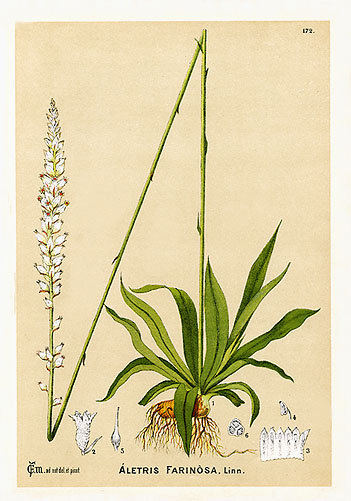
I had been expecting to find the aletris about New Bedford,
and when taking our luncheon on this neck what should I see rising above the luncheon-box, between me and R., but what I knew must be the Aletris farinosa; not yet out, but one near by would open apparently in two or three days.

Heard of, and sought out, the hut of Martha Simons, the only pure-blooded Indian left about New Bedford. She lives alone on the narrowest point of the Neck, near the shore, in sight of New Bedford. Her hut stands some twenty-five rods from the road on a small tract of Indian land, now wholly hers . . .

We knocked and walked in, and she asked us to sit down. She had half an acre of the real tawny Indian face, broad with high cheek-bones, black eyes, and straight hair, originally black but now a little gray, parted in the middle. Her hands were several shades darker han her face. She had a peculiarly vacant expression, perhaps characteristic of the Indian, and answered our questions listlessly, without being interested or implicated, mostly in monosyllables, as if hardly present there. To judge from her physiognomy, she might have been King Philip’s own daughter.


She was born on that spot. Her grandfather also lived on the same spot, though not in the same house. He was the last of her race who could speak Indian.

The question she answered with most interest was, “What do you call that plant?” and I reached her the aletris from my hat. She took it, looked at it a moment, and said, “That’s husk-root. It ’s good to put into bitters for a weak stomach.” 

The last year’s light-colored and withered leaves surround the present green star like a husk. This must be the origin of the name. Its root is described as intensely bitter. 

I ought to have had my hat full of plants.

H. D. Thoreau, Journal, June 26, 1856

Savannah sparrow no conspicuous yellow on shoulder, a yellow brow, and white crown line. . . Audubon says that the eggs “are of a pale bluish color, softly mottled with purplish brown,”  See ; April 22, 1856 ("The seringo also sits on a post, with a very distinct yellow line over the eye,_and the rhythm of its strain is ker chick | ker che | ker-char—r-r-r-r | chick, the last two bars being the part chiefly heard."); 
May 28, 1856 ("A seringo or yellow-browed (?) sparrow’s nest . . . Egg, bluish-white ground, thickly blotched with brown.”); July 16, 1854 ("Is it the yellow-winged or Savannah sparrow with yellow alternating with dark streaks on throat, as well as yellow over eye, reddish flesh-colored legs, and two light bars on wings?";) October 22, 1855 ("I sit on a bank at the brook crossing, beyond the grove, to watch a flock of seringos, perhaps Savannah sparrows, which, with some F. hyemalis and other sparrows, are actively flitting about amid the alders and dogwood. ") See also Guide to Thoreau’s Birds "(Thoreau frequently called the Savannah Sparrow Passerculus sandwichensis the seringo or seringo-bird, but he also applied the name to other small birds.)” and  A Book of the Seasons, by Henry Thoreau, The Savannah Sparrow (Fringilla savanna)

I had been expecting to find the aletris about New Bedford. . . See June 25 1856 ( “[i]n answer to my question what were the rare or peculiar plants thereabouts, [Green] named the Aletris farinosa, or star-grass”); See also November 4, 1858 ("We cannot see any thing until we are possessed with the idea of it, . . . In my botanical rambles I find that first the idea, or image, of a plant occupies my thoughts, . . . expecting it unconsciously, and at length I surely see it . . . This is the history of my finding a score or more of rare plants which I could name.”)

Aletris / husk root . . .withered leaves surround the present green star like a husk. See April 5, 1857 ("See in many places the withered leaves of the aletris in rather low ground, about the still standing withered stems. It was well called husk-root by the squaw.")

I ought to have had my hat full of plants. See June 23, 1852 ("I am inclined to think that my hat, whose lining is gathered in midway so as to make a shelf, is about as good a botany-box as I could have and far more convenient. . ."); September 7, 1852 ("We reach . . . Concord . . . four hours from the time we were picking blueberries on the mountain, with the plants of the mountain fresh in my hat.”); December 4, 1856 ("About half a dozen years ago I found myself again attending to plants with more method, looking out the name of each one and remembering it. I began to bring them home in my hat, a straw one with a scaffold lining to it, which I called my botany- box. I never used any other, and when some whom I visited were evidently surprised at its dilapidated look, as I deposited it on their front entry table, I assured them it was not so much my hat as my botany-box.”)
Heard of and sought out 
the hut of Martha Simons,
the last of her race
She named the plant in 
my hat,  I ought to have had 
my hat full of plants.

Friday, September 7, 2012

Quick Monadnock hike

September 7.

Across lots to Monadnock, some half-dozen miles in a straight line from Peterboro. Bunch-berries are everywhere now with the summit hardly more than a mile distant in a straight line, but about two miles as they go. Acer Pennsylvanicum, striped maple or moosewood or striped dogwood, but no keys to be seen.

Between the rocks on the summit, an abundance of large and fresh blueberries still, apparently Vaccnium Pennsylvanicum, very large fresh and cooling to eat, supplying the place of water. Though this vegetation was very humble, yet it was very productive of fruit. 

In one little hollow between the rocks grow blueberries, choke-berries, bunch-berries, red cherries, wild currants (Ribes prostratum, with the berry the odor of skunk-cabbage, but a not quite disagreeable wild flavor), a few raspberries still, holly berries, mountain cranberries (Vaccinium Vitis-Idaea), all close together. 
american spikenard september 7, 2022

The little soil on the summit between the rocks was covered with the Potentilla tridentata, now out of bloom, the prevailing plant at the extreme summit. Mountain-ash berries also.

We are on the top of the mountain at 1 P.M. The cars leave Troy, four or five miles off, at three. Descending toward Troy, we see that the mountain had spurs or buttresses on every side, by whose ridge you might ascend. It is an interesting feature in a mountain. I have noticed that they will send out these buttresses every way from their centre.

We reach the depot, by running at last, at the same instant the cars, and reach Concord at a quarter after five, i.e. four hours from the time we were picking blueberries on the mountain, with the plants of the mountain fresh in my hat. 

H. D. Thoreau, Journal, September 7, 1852

Tuesday, July 10, 2012

Walking up and down a river in torrid weather with only a hat.


July 10

Another day, if possible still hotter than the last. We have already had three or four such, and still no rain.

It is with a suffocating sensation and a slight pain in the head that I walk the Union Turnpike where the heat is reflected from the road.

July 10, 2019

 I have to lift my hat to let the air cool my head.There are but few travellers abroad, on account of the oppressive heat. 

I make quite an excursion up and down the river in the water, a fluvial, a water walk.  It seems the properest highway for this weather. Now in water a foot or two deep, now suddenly descending through valleys up to my neck, but all alike agreeable. 

There are many interesting objects of study walking up and down a clear river like this in the water, where you can see every inequality in the bottom and every object on it. Walking up and down a river in torrid weather with only a hat to shade the head.

Now we traverse a long water plain some two feet deep; now we descend into a darker river valley, where the bottom is lost sight of and the water rises to our armpits; now we go over a hard iron pan; now we stoop and go under a low bough of the Salix nigra; now we slump into soft mud amid the pads of the Nymphaea odorata, at this hour shut. 

On this road there is no other traveller to turn out for.

We finally return to the dry land, and recline in the shade of an apple tree on a bank overlooking the meadow. The stones lying in the sun on this hillside where the grass has been cut are as hot to the hand as an egg just boiled, and very uncomfortable to hold. 

Every hour we expect a thundershower to cool the air, but none comes.

H. D. Thoreau, Journal, July 10, 1852

I make quite an excursion up and down the river in the water, a fluvial, a water walk . . . Walking up and down a river in torrid weather with only a hat to shade the head. See July 22, 1851("I bathe, and in a few hours I bathe again, not remembering that I was wetted before. When I come to the river, I take off my clothes and carry them over, then bathe and wash off the mud and continue my walk. I would fain take rivers in my walks endwise.”); July 27, 1852 ("That the luxury of walking in the river may be perfect it must be very warm, such as are few days even in July, so that the breeze on those parts of the body that have just been immersed may not produce the least chilliness. It cannot be too warm, so that, with a shirt to fend the sun from your back, you may walk with perfect indifference, or rather with equal pleasure, alternately in deep and in shallow water. Both water and air must be unusually warm; otherwise we shall feel no impulse to cast ourselves into and remain in the stream")  See A Book of the Seasons, by Henry Thoreau, The Luxury of Bathing

July 10. See A Book of the Seasons, by Henry Thoreau, July 10

up and down river 
walking  in torrid weather 
with only a hat 

  A Book of the Seasons, by Henry Thoreau
"A book, each page written in its own season,
out-of-doors, in its own locality.”
~edited, assembled and rewritten by zphx © 2009-2021

Saturday, June 23, 2012

There is something in the darkness and the vapors that arise from the head . . .


June 23,2019

I am inclined to think that my hat, whose  lining is gathered in midway so as to make a shelf, is about as good a botany-box as I could have and far more convenient, and there is something in the darkness and the vapors that arise from the head - at least if you take a bath - which preserves flowers through a long walk. Flowers will frequently come fresh out of this botany- box at the end of the day, though they have had no sprinkling.

It is what I call a washing day, such as we sometimes have when buttercups first appear in the spring, an agreeably cool and clear and breezy day, when all things appear as if washed bright and shine, and, at this season especially, the sound of the wind rustling the leaves is like the rippling of a stream, and you see the light-colored under side of the still fresh foliage, and a sheeny light is reflected from the bent grass in the meadows. Haze and sultriness are far off. The air is cleared and cooled by yesterday's thunder-storms. The river too has a fine, cool, silvery sparkle or sheen on it. You can see far into the horizon, and you can hear the sound of crickets with such feelings as in the cool morning.

This grassy road now dives into the wood  as if it were entering a cellar or bulkhead, the shadow is so deep. June is the first month for shadows. How is it in July? 

And now I scent the pines. I plucked a blue geranium in a meadow near the Kibbe Place, which appeared to me remarkably fragrant, like lilies and strawberries combined. 

The path I cut through the swamp late last fall is much more grown up than I expected. The sweet fragrance of swamp-pinks fills all the swamps.

H. D. Thoreau, Journal, June 23, 1852


My hat, whose lining is gathered in midway so as to make a shelf, is about as good a botany-box as I could have. . . See December 4, 1856 ("About half a dozen years ago I found myself again attending to plants with more method, looking out the name of each one and remembering it. I began to bring them home in my hat, a straw one with a scaffold lining to it, which I called my botany- box. I never used any other, and when some whom I visited were evidently surprised at its dilapidated look, as I deposited it on their front entry table, I assured them it was not so much my hat as my botany-box.”)


It is an agreeably cool and clear and breezy day, when all things appear as if washed bright and shine. The river too has a fine, cool, silvery sparkle or sheen on it. You can see far into the horizon. See June 23, 1854 (“The air is beautifully clear, showing the glossy and light-reflecting greenness of the woods. It is a great relief to look into the horizon") See also  June 2, 1860 ("There is a lively and washing northwest wind after the rain. . . .The air is cleansed and clear, and the waves, as I look toward the sun, sparkle with so bright and white a light, - so peculiarly fresh and bright."); June 9, 1852 ("The weather is very clear, and the sky bright. The river shines like silver.”);; ; June 26, 1853 ("Summer returns without its haze. We see infinitely further into the horizon on every side, and the boundaries of the world are enlarged.") and also A Book of the Seasons, by Henry Thoreau, The Horizon

Popular Posts Last 30 Days.

The week ahead in Henry’s journal

The week ahead in Henry’s journal
A journal, a book that shall contain a record of all your joy.
"A stone fruit. Each one yields me a thought." ~ H. D. Thoreau, March 28, 1859


I sit on this rock
wrestling with the melody
that possesses me.