Showing posts with label eggs. Show all posts

Thursday, August 8, 2019

The river, now that it is so clear and sunny, is better than any aquarium

August 8. 

P. M. — Up Assabet. 

I perceive that rocks on the bottom stretch across from Mantatuket Point to the Island, and probably make the ancient core of the shoals and islands, and the river has cut through above and between them and made them islands, just as it at high water cuts off and makes an island of Mantatuket Rock itself; i.e., the shallows below the junction are to be considered as the point of the hill, at least the rocky portion of them. 

I find the same curious eggs (which I saw at the Fordway on the 22d) on the rocks and trees on the Assabet, always on the upright, or steep, sides of rocks in the water or on bare-barked (or perhaps denuded of bark) trees on the edge of the river and overhanging it. Are they to be found up the main stream? They are not yet hatched.

Peetweets take their flight over the water, several together, apparently the old with their young now grown, the former (?) uttering a peculiarly soft rippling call. That is, it is not now a sharp, ringing note. 

The river, now that it is so clear and sunny, is better than any aquarium. Standing up and pushing gently up the stream, or floating yet more quietly down it, I can, in some places, see the secrets of half the river and its inhabitants,

  • the common and familiar bream with the dusty light reflected from its fins,
  •  the vigorous looking perch, tiger-like among fishes (I notice that many of the perch are poised head downward, peeping under the rocks), 
  • the motionless pickerel with reticulated back and sides, as it were the seed-vessel of a water-plant, eyes set far back. 
It is an enchanter’s wand ready to surprise you with life. 

The weeds are as indispensable to the fishes as woods and shrubbery to us. I saw a perch conceal himself from my sight under a tuft of weeds at the bottom not much wider than its own length. That potamogeton (is it P. Robbinsii?) growing in dense beds under water, all immersed in shallow places, like a bed of brown and muddy ostrich-feathers, alternating with darker beds of Bidens Beckii, which show but a particle of green above the surface (I think of the latter in the South Branch), —what concealment these afford to turtles, frogs, fishes, etc.! The potamogetons are so thick in some places in the main stream that a frog might hop quite across the river on them without getting in over his head. 

Rice has had a little experience once in pushing a canal-boat up Concord River. Says this was the way they used to get the boat off a rock when by chance it had got on to one. If it had run quite on, so that the rock was partly under the main bottom of the boat, they let the boat swing round to one side and placed a stout stake underneath, a little aslant, with one end on the bottom of the river and the other ready to catch the bows of the boat, and while one held it, perhaps, the other pushed the boat round again with all his force, and so drove it on to the stake and lifted it up above the rock, and so it floated off.

H. D. Thoreau, Journal, August 8, 1859

Rocks on the bottom stretch across from Mantatuket Point to the Island. See March 17, 1859; ("Mantatuket Rock, commonly a rocky peninsula with a low or swampy neck and all covered with wood . . .is now a small rocky island")

The river, now that it is so clear and sunny, is better than any aquarium. See August 8, 1854 ("This is a day of sunny water.. . .I look down a rod and see distinctly the fishes and the bottom."); see also July 18, 1854 ("On all sides, as I float along, the recesses of the water and the bottom are unusually revealed, and I see the fishes and weeds and shells. I look down into the sunny water. "); July 30, 1856 ("The water is suddenly clear.”); July 28, 1859 ("The season has now arrived when I begin to see further into the water . . “);. July 27, 1860 ("The water has begun to be clear and sunny, revealing the fishes and countless minnows of all sizes and colors”).

Peetweets the old with their young now grown, the former uttering a peculiarly soft rippling call. That is, it is not now a sharp, ringing note. See June 21, 1855 ("Peetweets make quite a noise calling to their young with alarm."); July 2, 1860 ("the alarm note of the peetweets, concerned about their young."); July 6, 1856 ("hear the distressed or anxious peet of a peetweet, and see it hovering over its young, half grown"); August 22, 1853 ("A peetweet flew along the shore and uttered its peculiar note")

This was the way they used to get the boat off a rock. Compare July 18, 1859 ("If you get on to a rock in the river, rock the boat, while you keep steadily pushing, and thus there will be moments when the boat does not rest on the rock at all, and you will rapidly get it off.")

August 8. See A Book of the Seasons, by Henry Thoreau, August 8


A Book of the Seasons, by Henry Thoreau
"A book, each page written in its own season,
out-of-doors, in its own locality."
~edited, assembled and rewritten by zphx © 2009-2021

Thursday, July 25, 2019

I measure the rapidity of the river's current.

July 25
July 25, 2019


The Rice boy brings me what he thought a snipe's egg, recently taken from a nest in the Sudbury meadows. It is of the form of a rail's egg, but is not whitish like mine, but olive-colored with dark-brown spots. Is it the sora rail? 

He has also a little egg, as he says taken out of a thrasher's nest, apparently one third grown. 

Flagg says that the chimney swallow is sometimes abroad "the greater part of the night;" is informed by Fowler that the rose-breasted grosbeak often sings in the light of the moon. 

P. M. — Water three and a half inches above summer level. 

I measure the rapidity of the river's current. At my boat's place behind Channing's, a bottle sunk low in the water floats one hundred feet in five minutes; one hundred feet higher up, in four and a half minutes. (I think the last the most correct.) It came out a rod and a half ahead of two chips.

H. D. Thoreau, Journal, July 25, 1859

Olive-colored with dark-brown spots. Is it the sora rail? See note to December 7, 1858 ("The rail’s egg (of Concord, which I have seen) . . . Is it the sora rail’s (of which there is no egg in this collection)?")

Water three and a half inches above summer level. See July 9, 1859 ("July 9th, water is eleven and a half inches above summer level.")

Thursday, June 13, 2019

The Boston collection

June 13

To Boston. 

My rail's egg of June 1st looks like that of the Virginia rail in the Boston collection. 

A boy brought me a remarkably large cuckoo's egg on the 11th. Was it not that of the yellow-billed? The one in the collection looks like it. This one at B. is not only larger but lighter- colored. 

In the plates of Hooker's "Flora Boreali-Americana," the leaves of Vaccinium coespitosum are not so wide as the fruit; yet mine of Tuckerman's Ravine may be it.

H. D. Thoreau, Journal, June 13, 1859

My rail's egg of June 1st. See June 1, 1859 ("Some boys found yesterday, in tussock of sedge amid some flags in a wet place in Cyrus Hosmer's meadow, west of the willow-row, six inches above the water, the nest evidently of a rail, with seven eggs.I got one to-day. It is cream-colored, sprinkled with reddish-brown spots and more internal purplish ones, on most eggs (not on mine) chiefly about the larger end.")

A large cuckoo's egg. See June 5, 1856 ("A cuckoo’s nest with three light bluish-green eggs partly developed, short with rounded ends, nearly of a size;"); see also June 10, 1856 ("The cuckoo of June 5th has deserted her nest, and I find the fragments of egg-shells in it; probably because I found it.")

Mine of Tuckerman's Ravine. See July 19, 1858 (summing up the prevailing plants on Mt. Washington.)

Wednesday, June 12, 2019

I am struck with the beauty of the sorrel now.

June 12

Sunday. P. M. — To Gowing's Swamp. 

I am struck with the beauty of the sorrel now, e. g. Lepidium campestre field. What a wholesome red! It is densest in parallel lines according to the plowing or cultivation. There is hardly a more agreeable sight at this season. 

Maryland yellow-throat four eggs, fresh, in sphagnum in the interior omphalos.

H. D. Thoreau, Journal, June 12, 1859

I am struck with the beauty of the sorrel now. There is hardly a more agreeable sight at this season.
See June 12, 1852 ("It helps thus agreeably to paint the earth, contrasting even at a distance with the greener fields, blue sky, and dark or downy clouds. It is red, marbled, watered, mottled, or waved with greenish, like waving grain, — three or four acres of it.")  See also May 22, 1854 ("The sorrel beginning to redden the fields with ruddy health, — all these things make earth now a paradise. How many times I have been surprised thus, on turning about on this very spot, at the fairness of the earth!"); June 5, 1853 ("The distant fields are seen, reddened with sorrel, and the meadows wet green, full of fresh grass, and the trees in their first beautiful, bright, untarnished and unspotted green.");  June 6, 1857 (“A year is made up of a certain series and number of sensations and thoughts which have their language in nature. Now I am ice, now I am sorrel. Each experience reduces itself to a mood of the mind. ”); June 11, 1853 ("In the sorrel-fields, also, what lately was the ruddy, rosy cheek of health, now that the sorrel is ripening and dying, has become the tanned and imbrowned cheek of manhood.");  See also A Book of the Seasons,  by Henry Thoreau, Wood Sorrel (Oxalis) and also .June 12, 1854 ("Clover now reddens the fields.."); June 15, 1851 (“the clover gives whole fields a rich appearance, -- the rich red and the sweet-scented white. The fields are blushing with the red species as the western sky at evening.”); June 15, 1853 ("Clover now in its prime. What more luxuriant than a clover-field");  June 15, 1853 ("The rude health of the sorrel cheek has given place to the blush of clover") 

Maryland yellow-throat four eggs, fresh, in sphagnum.
See June 7, 1857 ("In a tuft a little from under the east edge of an apple tree, below violet wood-sorrel, a nest well made outside of leaves, then grass, lined with fine grass, very deep and narrow, with thick sides, with four small somewhat cream-colored eggs with small brown and some black spots chiefly toward larger end. . . It was a Maryland yellow-throat. Egg fresh. She is very shy and will not return to nest while you wait, but keeps up a very faint chip in the bushes or grass at some distance."); June 8, 1855 ("What was that little nest on the ridge near by, made of fine grass lined with a few hairs and containing five small eggs (two hatched the 11th), nearly as broad as long, yet pointed, white with fine dull-brown spots especially on the large end—nearly hatched? . . .(June 11.—It is a Maryland yellow-throat.)”); June 10, 1858 ("Perfectly concealed under the loose withered grass at the base of a clump of birches, with no apparent entrance. The usual small deep nest (but not raised up) of dry leaves, fine grass stubble, and lined with a little hair. Four eggs, white, with brown spots, chiefly at larger end, and some small black specks or scratches. The bird flits out very low and swiftly and does not show herself, so that it is hard to find the nest or to identify the bird.”)


The interior omphalos.
See May 31, 1857 ("That central meadow and pool in Gowing's Swamp is its very navel, omphalos, where the umbilical cord was cut that bound it to creation's womb.”)

Sunday, June 9, 2019

Hen-hawk's eggs

June 9, 1859

Thursday. A boy shows me one of three (apparent) hen-hawk's eggs, fresh, obtained on the 6th from a pine near Breed's house site.

H. D. Thoreau, Journal, June 9, 1859


Hen-hawk’s eggs. See March 2, 1856 ("I can hardly believe that hen-hawks may be beginning to build their nests now, yet their young were a fortnight old the last of April last year.”) ; May 1, 1855 ("The reason I did not see my hawks at Well Meadow last year was that he found and broke up their nest there, containing five eggs.”); and note to June 8, 1853 (“I hear a hawk scream, and, . . . its screaming is so incessant and it circles from time to time so near me, as I move southward, that I begin to think it has a nest near by and is angry at my intrusion into its domains. As I move, the bird still follows and screams, coming sometimes quite near. . . At length I detect the nest about eighty feet from the ground, in a very large white pine by the edge of the swamp. It is about three feet in diameter, of dry sticks, and a young hawk, apparently as big as its mother, stands on the edge.”). Compare June 8, 1858 (“The marsh hawk's eggs are not yet hatched. )

June 9. See A Book of the Seasons, by Henry Thoreau, June 9


A Book of the Seasons, by Henry Thoreau
"A book, each page written in its own season,
out-of-doors, in its own locality.”
~edited, assembled and rewritten by zphx © 2009-2021

Wednesday, June 5, 2019

A yellowbird's nest; four eggs, developed

June 5

Sunday. P. M. — To Ball's Hill. 

Cat-briar in flower, how long? 

Allium not out. 

See several ducks, I think both summer and black. 

A yellowbird's nest; four eggs, developed. 

Pigeon woodpecker's nest in a hollow black willow over river; six eggs, almost hatched. 

The new white maple leaves look reddish, and at a distance brown, as if they had not put out yet.

H. D. Thoreau, Journal, June 5, 1859

Allium not out. See June 7, 1857 ("Garlic . . . not yet out"); June 14, 1853 ("The Allium Canadense in Tarbell's meadow. Wild meadow garlic, with its head of bulbs and a few flower- buds, not yet").

Several ducks, both summer and black. See June 4, 1856 (“Found, on a hummock in the open swamp, in the midst of bushes, at the foot of a pitch pine, a nest about ten inches over, made of dry sedge and moss. I think it must have been a duck’s nest.”)

A yellowbird's nest; four eggs, developed. See  June 7, 1855 ("A yellowbird’s nest on a willow bough against a twig, ten feet high, four eggs."); June 9, 1855 ("A yellowbird’s nest eight feet from ground in crotch of a very slender maple"); June 9, 1856 ("A yellowbird’s nest in a poplar on Hubbard’s Bridge; four fresh eggs; ten feet high, three rods beyond fence.")

Pigeon woodpecker's nest in a hollow black willow over river; six eggs, almost hatched. See June 10, 1856 ("In a hollow apple tree, hole eighteen inches deep, young pigeon woodpeckers, large and well feathered.");  June 13, 1855 ("C. finds a pigeon woodpecker’s nest in an apple tree, five of those pearly eggs, about six feet from the ground."); June 13, 1858 ("In the great apple tree front of the Miles house I hear young pigeon woodpeckers")  See also A Book of the Seasons, by Henry Thoreau, The Pigeon Woodpecker (flicker).


Saturday, May 11, 2019

Youn fresh-expanding, oak leaves form a leafy mist throughout the forest.

May 11. 

Wednesday. 

Golden robin yesterday.

Fir-balsam well out in the rain; so say 9th. 

P. M. — To Flint's Pond. 

Arum triphyllum out. Almost every one has a little fly or two concealed within. One of the handsomest- formed plants when in flower. 

Sorrel out in rain, apparently a day or two, — say 9th. 

A blue heron flies away from the shore of the pond. 

Scirpus planifolius in bloom on Smith's wooded hill, side of Saw Mill Brook. 

A partridge-nest, with eleven fresh eggs, at foot of a chestnut, one upon another. It is quite a deep cavity amid the leaves, with some feathers of the bird in it.

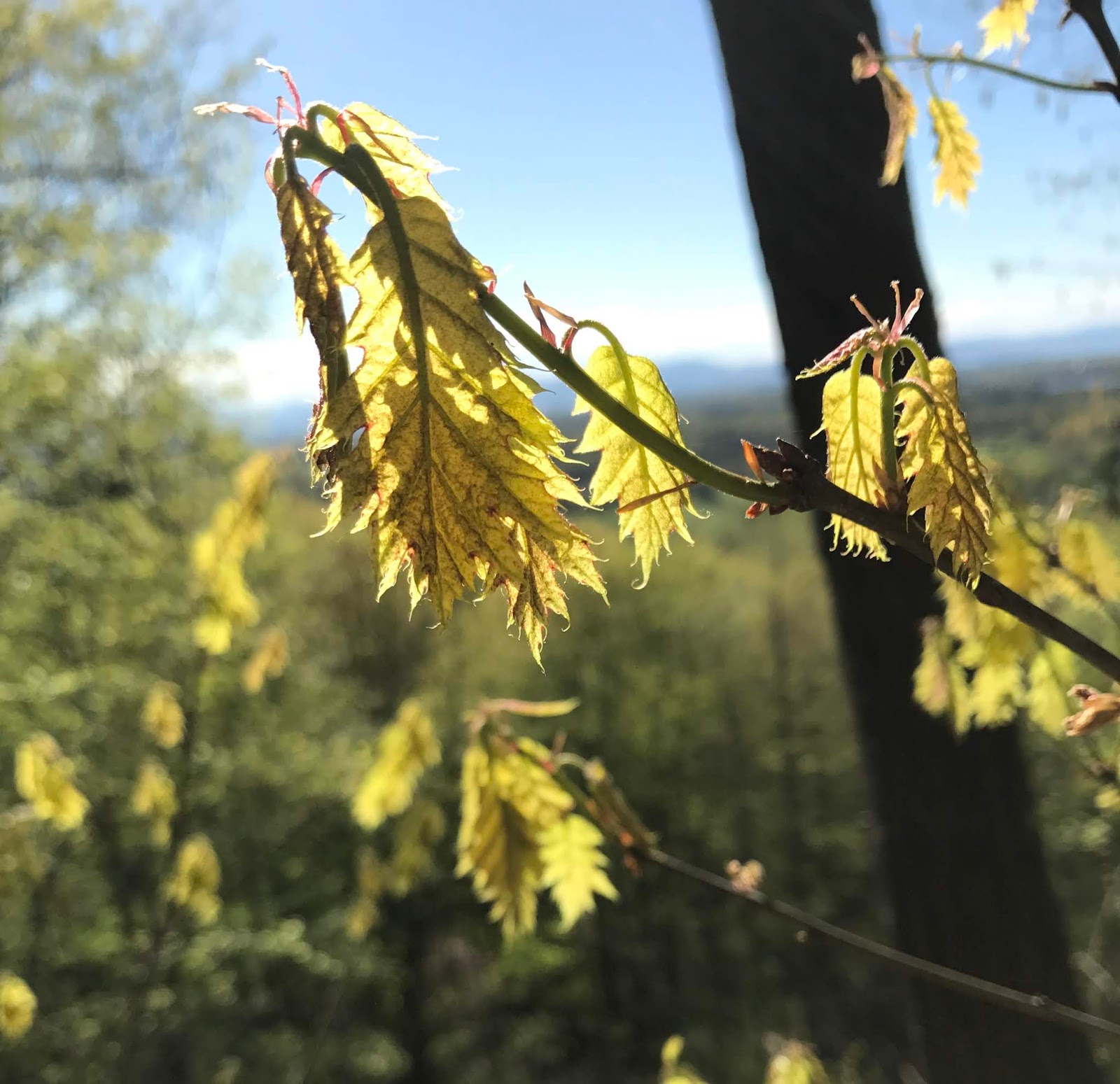
Young, or fresh-expanding, oak leaves are very handsome now, showing their colors. It is a leafy mist throughout the forest. 


May 12, 2017
Uvularia perfoliata out in rain; say, then, the 9th. Just after plucking it I perceived what I call the meadow fragrance, though in the woods; but I afterward found that this flower was peculiarly fragrant, and its fragrance like that, so it was probably this which I had perceived. S. was reminded of the lily-of-the-valley by it. 

The witch-hazel has one of the broadest leaves now.

In the path in Stow's wood-lot, I find apparently Thaspium aureum (Zizia aurea), which will open the first fair day. Shows quite yellow now. 

Found in the path in the woods by the Mill Brook ditch, Flint's Pond, dead, the Coluber punctatus13 1/4 inches long, but no row of spots in middle of abdomen. The head above blackish with a blackish ring behind the yellow. Tail 3 inches long; breadth of body 5/16 ; plates 162; scales 55. Above, uniform glossy slate-color, with a yellowish-white band across the occiput; the head above blackish, and a blackish band close behind the yellowish one. Beneath, yellow or buff (whitish under head), with a row of small slanting black spots, one on each side of each abdominal plate except the first 3/4 inch behind the head. In the midst of the path in the woods. I admired the iridescence from its glossy belly. It differs from Storer's C. punctatus, for it is not brown above, nor "reddish yellow" beneath, and has no row of spots in middle of the abdomen. 

In that first thunder-shower, the evening of the 9th, the grass evidently erected itself and grew darker, as  it were instantaneously. Was it the effect of electricity in the air? It looked very differently from what it had ten minutes before.

H. D. Thoreau, Journal, May 11, 1859

Golden robin yesterday. See. May 10, 1853 (“Hear higher the clear whistle of the oriole. New days, then, have come, ushered in by the warbling vireo, yellowbird, Maryland yellow-throat, and small pewee, and now made perfect by the twittering of the kingbird and the whistle of the oriole amid the elms, which are but just beginning to leaf out, thinking of his nest there, -. . .The warbling vireo promised warmer days, but the oriole ushers in summer heats.”); May 10, 1858 ("The oriole is seen darting like a bright flash with clear whistle from one tree-top to another over the street.”)

Arum triphyllum out. See May 1, 1857 ("Plucked the Arum triphyllum, three inches high, with its acrid corm.”);  May 19, 1851 ("Find the Arum triphyllum . .   in Conant's Swamp.")

Young, or fresh-expanding, oak leaves are very handsome now, showing their colors. It is a leafy mist throughout the forest.  See May 15, 1854 ("The aspect of oak and other woods at a distance is somewhat like that of a very thick and reddish or yellowish mist about the evergreens. . . . Oak leaves are as big as a mouse's ear.”); May 15, 1860 ("Looking from the Cliffs through the haze, the deciduous trees are a mist of leaflets.”);  May 18, 1851 ("The oak leaves of all colors are just expanding, and are more beautiful than most flowers"); May 23, 1860 ("The quarter-grown red oak leaves between you and the sun, how yellow-green! "); May 26, 1857 ("Very interesting now are the red tents of expanding- oak leaves, as you go through sprout-lands, — the crimson velvet of the black oak and the more pinkish white oak. The salmon and pinkish-red canopies or umbrellas of the white oak")

Uvularia perfoliata out in rain; say, then, the 9th. See September 22, 1852 ("Sophia has in her herbarium and has found in Concord these which I have not seen this summer ...Uvularia perfoliata);  May 30, 1857 ("By the path near the northeast shore of Flint's Pond, just before reaching the wall by the brook, I . . .am surprised to find ... the Uvularia perfoliata, which I have not found hereabouts before.  . . . It is considerably past its prime”); May 3, 1858 ("Ride to Flint's Pond to look for Uvularia perfoliata. ... It apparently will not bloom within ten days”); May 16, 1858 (“The Uvularia perfoliata, which did not show itself at all on the 3d, is now conspicuous, and one is open but will not shed pollen before to-morrow. It has shot up about ten inches in one case and bloomed within thirteen days!!”)

Just after plucking it I perceived what I call the meadow fragrance,  but I afterward found that this flower was peculiarly fragrant. See May 6, 1855 ("that unaccountable fugacious fragrance, as of all flowers,”);  May 15, 1856 ("Perceive some of that delicious meadow fragrance coming over the railroad causeway”); May 27, 1855 ("The meadow fragrance to-day”); May 27, 1856 ("perceived the meadow fragrance”); May 27, 1857 ("I perceived that rare meadow fragrance on the 25th.”); June 3, 1860 ("I perceive the meadow fragrance.”)

The Coluber punctatus [ringneck snake],  uniform glossy slate-color above, with a yellowish-white band across the occiput; the head above blackish, and a blackish band close behind the yellowish one. Beneath, yellow or buff (whitish under head), with a row of small slanting black spots. Nnot brown above, nor "reddish yellow" beneath,. Compare and see note to May 1, 1859 (“a little snake . . . uniformly brown (or reddish-brown) above except a yellowish ring on the occiput, the head also lighter than the body; beneath vermilion, with apparently a row of light dots along each side.”)

Friday, December 7, 2018

Eggs at Natural History Rooms.

December 7

Boston Society of Natural History 
(c. 1847-1863),
Mason Street, Boston
\
To Boston. At Natural History Rooms. 


December 7, 2018

The egg of Turdus solitarius is light-bluish with pale brown spots. This is apparently mine which I call hermit thrush, though mine is redder and distincter brown spots. 

The egg of Turdus brunneus (called hermit thrush) is a clear blue. 

The rail’s egg (of Concord, which I have seen) is not the Virginia rail’s, which is smaller and nearly pure white, nor the clapper rail’s, which is larger. Is it the sora rail’s (of which there is no egg in this collection)? 

My egg found in R. W. E’s garden is not the white throated sparrow’s egg. 

Dr. Bryant calls my seringo (i. e. the faint-noted bird) Savannah sparrow. 

He says Cooper’s hawk is just like the sharp-shinned, only a little larger commonly. He could not tell them apart. 

Neither he nor Brewer can identify eggs always. Could match some gulls’ eggs out of another basket full of a different species as well as out of the same basket.

H.D. Thoreau, Journal, December 7, 1858

The egg of Turdus solitarius is apparently mine which I call hermit thrush, though mine is redder and distincter brown spots. See June 12, 1857 (“The egg of the Turdus solitarius is lettered "Swamp Robin."”); June 21, 1858 ("Talked with Mr. Bryant at the Natural History Rooms... The egg of the Turdus solitarius in the collection is longer, but marked very much like the tanager’s, only paler-brown");  June 22, 1858 ("[Edward Bartlett]Says the bird was a thrush of some kind. The egg is one inch by five eighths, rather slender, faint-blue, and quite generally spotted with distinct rather reddish brown, inclining to small streaky blotches, though especially at the larger end; not pale-brown like that described [June 21]. Can it be the Turdus solitarias? I have the egg.");

The egg of Turdus brunneus (called hermit thrush) is a clear blue.
 See June 21, 1858 ("Talked with Mr. Bryant at the Natural History Rooms . . .They have also the egg of the T. brunneus, the other hermit thrush, not common here."); September 29, 1855 ("At Natural History Library saw Dr. Cabot, who says that he has heard either the hermit, or else the olivaceous, thrush sing,—very like a wood thrush, but softer. Is sure that the hermit thrush sometimes breeds hereabouts.”).; June 12, 1857 ("At Natural History Rooms.. . . The wood thrush's is a slender egg, a little longer than a catbird's and uniform greenish-blue. . . . The egg of the hermit thrush [which variety?] is about as big as that of Wilson's thrush, but darker green.”) Also see note to April 24, 1856 ("Behold my hermit thrush, with one companion, flitting silently through the birches.")

The rail’s egg (of Concord, which I have seen) is not the Virginia rail’s, which is smaller and nearly pure white, nor the clapper rail’s, which is larger. Is it the sora rail’s? See September 7, 1858 ("Storrow Higginson brings from Deerfield this evening some eggs to show me, — among others apparently that of the Virginian rail. It agrees in color, size, etc., according to Wilson, and is like (except, perhaps, in form) to one which E. Bartlett brought me a week or ten days ago, which dropped from a load of hay carried to Stow’s barn! So perhaps it breeds here. Also a smaller egg of same form, but dull white with very pale dusky spots, which may be that of the Carolina rail."); September 18, 1858 (" Rallus Carolinus . . .in Virginia is called the sora"); September 21, 1858 (" the eggs of the Rallus Virginianus,labelled by Brewer, but much smaller than those I have seen, and nearly white, with dull-brown spots! Can mine be the egg of the R. crepitons [Clapper rail], though larger than mine?")

My egg found in R. W. E’s garden is not the white throated sparrow’s egg. See June 12 1857 ("At Natural History Rooms. — The egg found on ground in R. W. E.'s garden some weeks since cannot be the bobolink's, for that is about as big as a bay-wing's but more slender, dusky-white, with numerous brown and black blotches")

Dr. Bryant calls my seringo (i. e. the faint-noted bird) Savannah sparrow. See June 26, 1856 ("[S]aw, apparently, the F. Savanna near their nests (my seringo note), restlessly flitting about me from rock to rock within a rod."); April 22, 1856 ("The seringo also sits on a post, with a very distinct yellow line over the eye,_and the rhythm of its strain is ker chick | ker che | ker-char—r-r-r-r | chick, the last two bars being the part chiefly heard."); and note to August 11, 1858 (" I heard there abouts the seringo note."); See also Guide to Thoreau’s Birds "(Thoreau frequently called the Savannah Sparrow Passerculus sandwichensis the seringo or seringo-bird, but he also applied the name to other small birds.”); April 27, 1859 (“Hear and see the seringo in fields next the shore. No noticeable yellow shoulder, pure whitish beneath, dashed throat and a dark-brown line of dashes along the sides of the body.”)

He says Cooper’s hawk is just like the sharp-shinned, only a little larger . See May 17, 1860 ("J. Farmer sends me to - day what is plainly Cooper's hawk. ") 

Friday, September 7, 2018

It is an early September afternoon.

September 7

P. M. — To Assabet Bath. 


September 7, 2018
I turn Anthony’s corner. It is an early September afternoon, melting warm and sunny; the thousands of grasshoppers leaping before you reflect gleams of light; a little distance off the field is yellowed with a Xerxean army of Solidago nemoralis between me and the sun; the earth-song of the cricket comes up through all; and ever and anon the hot z-ing of the locust is heard. (Poultry is now fattening on grasshoppers.) The dry deserted fields are one mass of yellow, like a color shoved to one side on Nature’s palette. You literally wade in yellow flowers knee-deep, and now the moist banks and low hollows are beginning to be abundantly sugared with Aster Tradescantia.

J. Farmer calls those Rubus sempervirens berries, now abundant, “snake blackberries.” 

Looking for my Maryland yellow-throat’s nest, I find that apparently a snake has made it the portico to his dwelling, there being a hole descending into the earth through it! 

In Shad-bush Meadow the prevailing grasses (not sedges) now are the slender Panicum clandestinum, whose seeds are generally dropped now, Panicum virgatum, in large tufts, and blue-joint, the last, of course, long since done. These are all the grasses that I notice there. 

What a contrast to sink your head so as to cover your ears with water, and hear only the confused noise of the rushing river, and then to raise your ears above water and hear the steady creaking of crickets in the aerial universe! 

While dressing, I see two small hawks, probably partridge hawks, soaring and circling about one hundred feet above the river. Suddenly one drops down from that height almost perfectly perpendicularly after some prey, till it is lost behind the bushes. 

Near the little bridge at the foot of Turtle Bank, Eragrostis capillaris in small but dense patches, apparently in prime (the Poa capillaris of Bigelow). What I have thus called in press is E. pectinacea (P. hirsuta of Bigelow). 

On the flat hill south of Abel Hosmer, Agrostis scabra, hair grass, flyaway grass, tickle grass, out of bloom; branches purplish. That of September 5th was the A. perennans, in lower ground. 

On the railroad between tracks above Red House, hardly yet out; forked aristida, or poverty grass. 

Storrow Higginson brings from Deerfield this evening some eggs to show me, — among others apparently that of the Virginian rail. It agrees in color, size, etc., according to Wilson, and is like (except, perhaps, in form) to one which E. Bartlett brought me a week or ten days ago, which dropped from a load of hay carried to Stow’s barn! So perhaps it breeds here. [Yes. Vide Sept. 9th. Vide Sept. 21st and Dec. 7th, and June 1st, 1859]

Also a smaller egg of same form, but dull white with very pale dusky spots, which may be that of the Carolina rail. 

He had also what I think the egg of the Falco fuscatus, it agreeing with MacGillivray’s sparrow hawk’s egg.

H. D. Thoreau, Journal, September 7, 1858

Looking for my Maryland yellow-throat’s nest. See June 10, 1858 (“To Assebet Bath. . .A Maryland yellow-throat's nest near apple tree by the low path beyond the pear tree. Perfectly concealed under the loose withered grass at the base of a clump of birches, with no apparent entrance. ”)

In Shad-bush Meadow the prevailing grasses now are the slender Panicum clandestine, Panicum virgatum,  and blue-joint, the last, of course, long since done. These are all the grasses that I notice there. See August 2, 1858 (“Landed at the Bath-Place and walked the length of Shad-bush Meadow. . . .What I have called the Panicum latifoliumhas now its broad leaves, striped with red, abundant under Turtle Bank, above Bath-Place.”)

Storrow Higginson brings from Deerfield this evening some eggs to show me, — among others apparently that of the Virginian rail. See September 9, 1858 (“My egg (named Sept. 7th) was undoubtedly a meadow-hen’s Rallus Virginiana.”)

Thursday, July 26, 2018

A broad egg, white with large reddish and purplish brown spots.

July 26.

Yellow-winged sparrow
Fringilla passerina
Ammodramus savannarum


Button-bush in prime. 

Edward Bartlett shows me a nest in the Agricultural ground which had four eggs, yet pretty fresh, but the bird has now deserted it. (Vide one.) It is like Farmer’s seringo.

It is a broad egg, white with large reddish and purplish brown spots chiefly about large end. 

The nest is small and deep and low in the grass of this pasture. (Vide nest out of order.)

Could not see the bird; only saw bay-wings and huckleberry-birds. I suspect it may be the Fringilla passerina? He says the bird had a clear yellowish-white breast!

H. D. Thoreau, Journal, July 26, 1858

Bay-wings and Huckleberry-birds. See A Book of the Seasons, the Bay-Wing [Vesper] Sparrow; also April 27, 1852 ("Heard the field or rush sparrow this morning (Fringilla juncorum), George Minott's "huckleberry-bird." "); April 9, 1856 ("Wandering over that high huckleberry pasture, I hear the sweet jingle of the Fringilla juncorum."); ; April 15, 1856 ("I hear the note of the Fringilla juncorum (huckleberry-bird) from the plains beyond. ")

A broad egg, white with large reddish and purplish brown spots chiefly about large end. I suspect it may be the Fringilla passerina? See June 26, 1856 ("According to Audubon’s and Wilson’s plates, the Fringilla passerina has for the most part clear yellowish-white breast .... Audubon says that the eggs . . .of the yellow-winged sparrow are “of a dingy white, sprinkled with brown spots.”); May 28, 1856 (“A seringo or yellow-browed (?) sparrow’s nest . . .Egg, bluish-white ground, thickly blotched with brown, yet most like a small ground bird’s egg, rather broad at one end, pretty fresh.”)

July 26. See A Book of the Seasons, by Henry Thoreau, July 26

A Book of the Seasons, by Henry Thoreau
"A book, each page written in its own season,
out-of-doors, in its own locality."
~edited, assembled and rewritten by zphx © 2009-2021

Sunday, June 24, 2018

A bobolink's egg.

June 24

Very hot weather. 

Aralia hispida at Cliffs. 

Epilobium, how long? 

Storrow Higginson gives me a bobolink's egg. It is a regular oval, seven eighths by five eighths inch. It is a dark cream-color with pretty large spots of brown, sometimes blackish, chiefly at the large end, and very faint, more internal pale-purplish spots equally dispersed.

H. D. Thoreau, Journal, June 24, 1858

A bobolink's egg. It is a dark cream-color with pretty large spots of brown, sometimes blackish. See June 12, 1857 (“ At Natural History Rooms. — The egg found on ground in R. W. E.'s garden some weeks since cannot be the bobolink's, for that is about as big as a bay-wing's but more slender, dusky-white, with numerous brown and black blotches.”)

Friday, June 22, 2018

Pine pollen adhering to the inside of the boat along the water-line

June 22
June 22, 2018
Edward Bartlett found what he calls two bobolinks’ nests some weeks ago, with each six eggs. I have one of the nests. There is but little of it, composed simply of some flexible grass without and finer within, kept in form by the thick tussock or tuft of meadow-grass at the bottom and in the midst of which it is placed. 

He shows me, also, one of three eggs found the 20th in Gourgas’s wood-lot, within a rod of the roadside, in a small slender oak (eighteen feet high), about fourteen feet from the ground, about fifteen rods north of Britton’s corner, in a grove, where two or three small branches left the main stem; eggs somewhat advanced. Says the bird was a thrush of some kind. The egg is one inch by five eighths, rather slender, faint-blue, and quite generally spotted with distinct rather reddish brown, inclining to small streaky blotches, though especially at the larger end; not pale-brown like that described [June 21]. Can it be the Turdus solitarias? I have the egg.

Mowing the June grass about our house a few days ago, I disturbed several toads squatted deep in the rankest grass near the house, and wounded one or two with the scythe. They appear to love such cool and shady retreats by day, hopping out at night and in the rain. 

I see in the river a little pickerel, not quite two inches long, which must have been hatched this year, and probably as early as the perch, since they have more to grow. 

I notice, after tipping the water out of my boat under the willows, much evidently pine pollen adhering to the inside of the boat along the water-line. Did it fall into it during my excursion to Holden’s Swamp the 20th, or has it floated through the air thus far? 

About the grassy island in front of the Rock, grows abundantly, apparently the Carex crinita, with about four long pendulous fertile spikes and one barren, two and a half feet high and long since done. 

I think that I first noticed willow down floating on the river about the 16th. 

Observe a painted turtle laying or digging at 5 P.M. She has not excavated any hole, but has already watered the ground, and, as usual when I take her up under these circumstances, passes more water.

H. D. Thoreau, Journal, June 22, 1858

Edward Bartlett found what he calls two bobolinks’ nests some weeks ago, with each six eggs. See note to June 18, 1858 (“E. Bartlett has found three bobolinks’ nests. One or more of them he thinks has been covered by the recent flood.”) See also  A Book of the Seasons,by Henry Thoreau, the Bobolink

Did it fall into it during my excursion to Holden’s Swamp the 20th, or has it floated through the air thus far? See June 20, 1858 ("Walking in the white pine wood there, I find that my shoes and, indeed, my hat are covered with the greenish-yellow pollen of the white pines, which is now being shed abundantly and covers like a fine meal all the plants and shrubs of the forest floor. I never noticed it in such abundance before. My shoes are green-yellow, or yellow-green, even the next day with it.”); June 21, 1860 ("The air must be full of this fine dust at this season, that it must be carried to great distances, and its presence might be detected remote from pines by examining the edges of bodies of water ... the lakes detect for us thus the presence of the pine pollen in the atmosphere. They are our pollinometers. “) See also A Book of the Seasons,by Henry Thoreau, The White Pines

I think that I first noticed willow down floating on the river about the 16th
. See June 10, 1853 ("The fuzzy seeds or down of the black (?) willows is filling the air over the river and, falling on the water, covers the surface. "); June 15, 1854 ("Black willow is now gone to seed, and its down covers the water, white amid the weeds. ") See also A Book of the Seasons,by Henry Thoreau, the Propogation of the Willow.

She has not excavated any hole, but has already watered the ground See June 11, 1858 (“I notice that turtles which have just commenced digging will void considerable water when you take them up. This they appear to have carried up to wet the ground with.” ) See also A Book of the Seasons, by Henry Thoreau, The Painted Turtle

Wednesday, June 20, 2018

My shoes and hat are covered with the greenish-yellow pollen of the white pines, which is now being shed abundantly.

June 20. 

P. M. – By boat to Holden Swamp. 

I heard that snapping sound against a pad on the surface, and at the same time saw a pad knocked up several inches, and a ripple in the water there as when a pickerel darts away. I should say without doubt some fish had darted there against the pad, perhaps at an insect on the under side. 

Got the marsh hawk's egg, which was addled. I noticed on the 17th that the hawk (my marsh hawk) was off her nest and soaring above the wood late in the afternoon, as I was returning. 

I notice that when turtles are floating dead their necks and legs are stretched out. I have seen them this year of every kind but the meleagris and cistudo, including a snapping turtle with shell some nine inches long, floating or lying dead. What kills them?

I wade about Holden Swamp, looking for birds’ nests. The spruce there are too thin-foliaged for nests, though I hear a pepe expressing anxiety, and also song sparrows. See the redstart and hear many; also hear the blue yellow-backs. 

Walking in the white pine wood there, I find that my shoes and, indeed, my hat are covered with the greenish-yellow pollen of the white pines, which is now being shed abundantly and covers like a fine meal all the plants and shrubs of the forest floor. I never noticed it in such abundance before. My shoes are green-yellow, or yellow-green, even the next day with it.

Dangle-berry well out, how long? 

Potentilla Norvegica, how long? 

What is that sedge with a long beak, some time out of bloom, now two feet high, common just north of new stone bridge? Vide pressed one.

I see that the French have a convenient word, aunaie, also spelt aulnaie and aulnage, etc., signifying a grove of alders. It reminds me of their other convenient word used by Rasle, cabanage.

H. D. Thoreau, Journal, June 20, 1858

I noticed on the 17th that the hawk (my marsh hawk) was off her nest and soaring. See May 30, 1858 ("Edward Emerson shows me the nest which he and another discovered. . . .There are two dirty, or rather dirtied, white eggs left (of four that were),"); June 8, 1858 (“The marsh hawk's eggs are not yet hatched. ”); June 17, 1858 ("P. M. – To hawk's nest. One egg is hatched since the 8th") See also A Book of the Seasons, by Henry Thoreau, The Marsh Hawk


I wade about Holden Swamp, looking for birds’ nests. The spruce there are too thin-foliaged for nests, though I hear a pepe expressing anxiety. See June 10, 1855 ("Nest of the Muscicapa Cooperi, or pe pe, on a white spruce in the Holden Swamp.") See also A Book of the Seasons, by Henry Thoreau, the Olive-sided flycatcher or pe-pe

The greenish-yellow pollen of the white pines is now being shed abundantly and covers like a fine meal all the plants and shrubs of the forest floor. See June 21, 1850 ("The flowers of the white pine are now in their prime, but I see none of their pollen on the pond."); June 21, 1856 ("Much pine pollen is washed up on the northwest side of the pond. Must it not have come from pines at a distance?"); June 22, 1858 (" I notice, after tipping the water out of my boat under the willows, much evidently pine pollen adhering to the inside of the boat along the water-line. Did it fall into it during my excursion to Holden’s Swamp the 20th, or has it floated through the air thus far? "); June 21, 1860 ("The air must be full of this fine dust at this season, that it must be carried to great distances, and its presence might be detected remote from pines by examining the edges of bodies of water ... the lakes detect for us thus the presence of the pine pollen in the atmosphere. They are our pollinometers. "); See also A Book of the Seasons, by Henry Thoreau, The White Pines

Potentilla Norvegica, how long? See June 20, 1856 ("Potentilla Norvegicea; apparently petals blown away.")

Other convenient word used by Rasle. See March 4, 1858 ("Father Rasle’s dictionary of the Abenaki language amounts to a very concentrated and trustworthy natural history of that people.")


June 20. See A Book of the Seasons, by Henry Thoreau, June 20
A Book of the Seasons, by Henry Thoreau
"A book, each page written in its own season,
out-of-doors, in its own locality.”
~edited, assembled and rewritten by zphx © 2009-2021

Tuesday, June 19, 2018

Storrow Higginson and other boys find nests and eggs of veery, wood thrush and tanager.


June 19. 

June 19, 2018
Saturday. 

I do not hear the night-warbler so often as a few weeks ago. Birds generally do not sing so tumultuously. 

Storrow Higginson and other boys have found this forenoon at Flint’s Pond one or more veery-nests on the ground. 

Also showed me one of five eggs, far advanced, they found there in a nest some fourteen feet high in a slender maple sapling, placed between many upright shoots, many dry leaves outside. It is a slender clear-blue egg, more slender and pointed at the small end than the robin's, and he says the bird was thrush like with a pencilled breast. It is probably the wood thrush. [Saw it the 23d, and it is apparently this bird. It is some ten rods south along path beyond the clearing, opposite a stone turned over.] He saw one or two other similar nests, he thought, not yet completed. 

Also showed me an egg, which answers to the description of the tanager's. Two fresh eggs in small white oak sapling, some four teen feet from ground. They saw a tanager near. [I have one egg. 
Vide 23d.] 

P. M. — To Bateman’s Pond. 

The swamp-pink, apparently not long, and the maple leaved viburnum, a little longer, but quite early. Some of the calla is going to seed. 

See an oven-bird's nest with two eggs and one young one just hatched. The bird flits out low, and is, I think, the same kind that I saw flit along the ground and trail her wings to lead me off day before yesterday.

H. D. Thoreau, Journal, June 19, 1858

To Bateman’s Pond. The swamp-pink, apparently not long. See June 20, 1853 ("Those great greenish-white puffs on the panicled andromeda are now decaying. On the swamp-pink they are solid."); June 20, 1856 ( ("Swamp-pink out apparently two or three days at Clamshell Ditch"); June 21, 1852 ("The swamp-pink bushes have many whitish spongy excrescences. "); June 30, 1852 ("Is not this period more than any distinguished for flowers, when roses, swamp-pinks, morning-glories, arethusas, pogonias, orchises, blue flags, epilobiums, mountain laurel, and white lilies are all in blossom at once?") See also November 5, 1855 ("Swamp-pink buds now begin to show.”); November 6, 1853 (“The remarkable roundish, plump red buds of the high blueberry.”); November 16, 1852 ("The swamp-pink and blueberry buds attract."); December 1, 1852 (“The large bright yellowish and reddish buds of the swamp-pink,"); December 11, 1855 ("The great yellow buds of the swamp-pink"); January 25, 1858 ("The large yellowish buds of the swamp pink."); January 10, 1855 ("The great buds of the swamp-pink, on the central twig, clustered together, are more or less imbrowned and reddened. "); January 31, 1854 ("In the winter, when there are no flowers and leaves are rare, even large buds are interesting and somewhat exciting. I go a-budding like a partridge. I am always attracted at this season by the buds of the swamp-pink, the poplars, and the sweet-gale."); February 13, 1858 )("How often vegetation is either yellow or red! as the buds of the swamp-pink, the leaves of the pitcher-plant, etc., etc."); February 13, 1858 ("The great buds of the swamp-pink, on the central twig, clustered together, are more or less imbrowned and reddened.")

Some of the calla is going to seed. See June 7, 1857 (“Pratt has got the Calla palustris, in prime. . .from the bog near Bateman's Pond”); June 9, 1857( “The calla is generally past prime and going to seed. I had said to Pratt, "It will be worth the while to look for other rare plants in Calla Swamp, for I have observed that where one rare plant grows there will commonly be others." ”); June 24, 1857 ("Found [in Owl-Nest Swamp] the Calla palustris, out of bloom, and the naumbergia, now in prime, which was hardly begun on the 9th at Bateman Pond Swamp.”); August 29, 1857 ("I find the calla [in Owl-Nest Swamp] going to seed, but still the seed is green.”); and note to July 2, 1857 ("Calla palustris . . . at the south end of Gowing's Swamp. Having found this in one place, I now find it in another.")

Also showed me one of five eggs found there in a nest some fourteen feet high in a slender maple sapling. See July 31, 1858 ("Got the wood thrush’s nest of June 19th (now empty) . . . measures four and a half to five inches in diameter from outside to outside of the rim, and one and three quarters deep within. "); August 10, 1858 ("The wood thrush’s was a peculiarly woodland nest, made solely of such materials as that unfrequented grove afforded, the refuse of the wood or shore of the pond. There was no horsehair, no twine nor paper nor other relics of art in it.") See also June 16, 1856 (Worcester) ("A wood thrush’s nest., , , of fine moss . . . lined with pine-needles; three eggs, fresh.");  June 23, 1858 ("In the case of the hermit thrush, wood thrush, and tanager's [nests], each about fourteen feet high in slender saplings, you had to climb an adjacent tree in order to reach them."); June 12, 1857 ("At Natural History Rooms . . . The wood thrush's is a slender egg , a little longer than a catbird's and uniform greenish-blue."); 

See an oven-bird's nest with two eggs and one young one just hatched. The bird flits out low, and is, I think, the same kind that I saw flit along the ground and trail her wings to lead me off day before yesterday. See June 1, 1853 (“ Eggs in oven- bird's nest. ”); June 7, 1853; (“The oven-bird runs from her covered nest, so close to the ground under the lowest twigs and leaves, even the loose leaves on the ground, like a mouse, that I can not get a fair view of her. She does not fly at all. Is it to attract me, or partly to protect herself ?”); June 10, 1855; ( Oven-bird’s nest with four eggs two thirds hatched, under dry leaves, composed of pine-needles and dry leaves and a hair or two for lining, about six feet south west of a white oak which is six rods southwest of the hawk pine.”); June 18, 1854 (“Observe in two places golden-crowned thrushes, near whose nests I must have been, hopping on the lower branches and in the underwood, — a somewhat sparrow-like bird, with its golden-brown crest and white circle about eye, carrying the tail somewhat like a wren, and inclined to run along the branches. Each had a worm in its bill, no doubt intended for its young.”); July 3, 1853 (“The oven-bird's nest in Laurel Glen is near the edge of an open pine wood, under a fallen pine twig and a heap of dry oak leaves. Within these, on the ground, is the nest, with a dome-like top and an arched entrance of the whole height and width on one side. Lined within with dry pine-needles.”).

Popular Posts Last 30 Days.

The week ahead in Henry’s journal

The week ahead in Henry’s journal
A journal, a book that shall contain a record of all your joy.
"A stone fruit. Each one yields me a thought." ~ H. D. Thoreau, March 28, 1859


I sit on this rock
wrestling with the melody
that possesses me.