Showing posts with label Haynes. Show all posts

Saturday, May 4, 2019

The female flower of the sweet-gale, red, like so many female flowers.

May 4. 

R. W. E. tells me he does not like Haynes as well as I do. I tell him that he makes better manure than most men. 
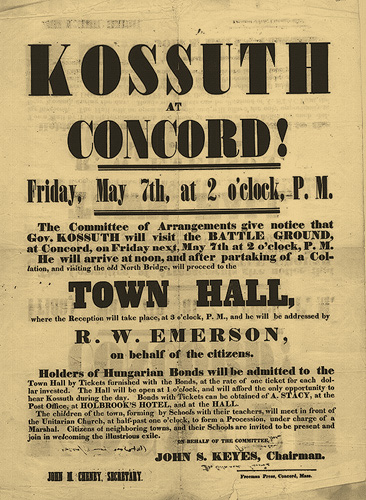


This excitement about Kossuth is not interesting to me, it is so superficial. It is only another kind of dancing or of politics. Men are making speeches to him all over the country, but each expresses only the thought, or the want of thought, of the multitude.

No man stands on truth. They are merely banded together as usual, one leaning on another and all together on nothing; as the Hindoos made the world rest on an elephant, and the elephant on a tortoise, and had nothing to put under the tortoise. 

You can pass your hand under the largest mob, a nation in revolution even, and, however solid a bulk they may make, like a hail-cloud in the atmosphere, you may not meet so much as a cobweb of support. They may not rest, even by a point, on eternal foundations. 

But an individual standing on truth you cannot pass your hand under, for his foundations reach to the centre of the universe. So superficial these men and their doings, it is life on a leaf or a chip which has nothing but air or water beneath. I love to see a man with a tap-root, though it make him difficult to transplant.

It is unimportant what these men do. Let them try forever, they can effect nothing. Of what significance the things you can forget? 

A little thought is sexton to all the world. 

I see the slate-colored snowbird still, — a few. 

What was that large olive-yellow bird on Heywood's apple trees? 

The female flower of the sweet-gale, red, like so many female flowers. 

The meadow-sweet begins to leave out. 

The male flowers of the maple look yellowish-scarlet, looking up to the sky. 

The elms are still in full blossom. 

The cowslip's is a vigorous growth and makes at present the most show of any flower. Leaf,  stem, bud, and flower are all very handsome in their place and season. It has no scent, but speaks wholly to the eye. The petals are covered at base with a transparent, dewy (dew-like), apparently golden nectar. Better for yellows than for greens. 

I hear trees creak here (at Saw Mill Brook) like inn signs in the street. 

The singularly rough winged (?) barked elms here, which run up so high, blossom only at top. They are very easy to climb, the bark is so rough and furrowed and soft, affording a support to the clothes. The bark on the twigs strips up long. A kind of corky bark, but flower like the common. 

The little frogs begin to peep in good earnest toward sundown.

H. D. Thoreau, Journal, May 4, 1852

The female flower of the sweet-gale. See May 10, 1857 (“I observe that the fertile flowers of many plants are more late than the barren ones, as the sweet-gale (whose fertile are now in prime),”)

The meadow-sweet begins to leave out. See April 24, 1860  ("The meadow-sweet and hardhack have begun to leaf."); May 5, 1855 ("The trees and shrubs which I observe to make a show now with their green, without regard to the time when they began, are (to put them in the order of their intensity and generalness) :— Gooseberry, both kinds; Raspberry; Meadow-sweet; Choke-cherry shoots [etc.]”

I hear trees creak here (at Saw Mill Brook) like inn signs in the street. See April 9, 1859 (“I hear a singular sound through the roaring of the wind amid the trees, which I think at first some creature forty rods off, but it proves to be the creaking of one bough on another.. . .The fiddles made by the trees whose limbs cross one another, — played on by the wind!”)


The little frogs begin to peep in good earnest toward sundown. See April 5, 1858 ("I hear the hylodes peeping now at evening, being at home, though I have not chanced to hear any during the day. They prefer the evening.");April 26, 1854 ("The hylodes commonly begins early in the afternoon, and its quire increases till evening."); May 2, 1852   (" The little frogs peep more or less during the day, but chiefly at evening twilight, rarely in the morning. .")
May 3, 1852 ("They begin to peep in earnest at or before sundown, and they keep it up now at 10 P. M. But I rarely hear any numbers in the morning, when they probably sleep "); May 5, 1860 ("The peepers and toads are in full blast at night. "); May 6, 1858("In the mornings now, I hear no R. palustris and no hylodes, but a few toads still, but now, at night, all ring together, the toads ringing through the day, the hylodes beginning in earnest toward night and the palustris at evening. I think that the different epochs in the revolution of the seasons may perhaps be best marked by the notes of reptiles."); . June 5, 1860 ("When I open my window at night I hear the peeping of hylodes distinctly through the rather cool rain (as also some the next morning ), but not of toads; . . . The hylodes evidently love the cooler nights of spring ; the toads, the warm days and nights of May. Now it requires a cool (and better if wet) nigh , which will silence the toad , to make the hylodes distinct")

Monday, April 29, 2019

Interrupted fern scrolls there, four to five inches high

April 29. 
Black and white creeper
7 a. m. — To Walden, and set one hundred larch trees from England, all two years from seed, about nine inches high, just begun to leaf. 

See and hear a black and white creeper. 

First observe the dandelion well out in R. W. E.'s yard; also anemone at Sassafras Shore. 

Interrupted fern scrolls there, four to five inches high. 

Those red maples are reddest in which the fertile flowers prevail. 

Haynes was fishing for pickerel with a pole yesterday, and said that he caught several the day before, i. e. 27th.

H. D. Thoreau, Journal, April 29, 1859


 See and hear a black and white creeper. See April 28, 1856 ("I hear to-day frequently the seezer seezer seezer of the black and white creeper, or what I have referred to that . . . It is not a note, nor a bird, to attract attention; only suggesting still warmer weather, —that the season has revolved so much further."); May 11, 1856("The black and white creeper also is descending the oaks, etc., and uttering from time to time his seeser seeser seeser. What a rich, strong striped blue-black (?) and white bird"); May 30, 1857 ("In the midst of the shower, though it was not raining very hard, a black and white creeper came and inspected the limbs of a tree before my rock, in his usual zigzag, prying way, head downward often, and when it thundered loudest, heeded it not.") See also A Book of the Seasons  by Henry Thoreau, The Black and White Creeper

Interrupted fern scrolls there, four to five inches high. See April 29, 1855 ("The scrolls of the interrupted fern are already four or five inches high"); April 30, 1858 ( I noticed one of the large scroll ferns, with its rusty wool, up eight inches on the 28th."); also May 12, 1858 ("The cinnamon and interrupted ferns are both about two feet high in some places.")


Those red maples are reddest in which the fertile flowers prevail
. See April 29, 1856 (" How pretty a red maple in bloom (they are now in prime), seen in the sun against a pine wood, like these little ones in the swamp against the neighboring wood, they are so light and ethereal, not a heavy mass of color impeding the passage of the light, and they are of so cheerful and lively a color. "); April 28, 1855 ("The red maples, now in bloom, are quite handsome at a distance over the flooded meadow . . .. The abundant wholesome gray of the trunks and stems beneath surmounted by the red or scarlet crescents"). See also April 1, 1860 ("The red maple buds are considerably expanded, and no doubt make a greater impression of redness."); April 10, 1853 (''The male red maple buds now show eight or ten (ten counting everything) scales, alternately crosswise, and the pairs successively brighter red or scarlet, which will account for the gradual reddening of their tops. They are about ready to open."); April 13, 1854 ('The red maple in a day or two. I begin to see the anthers in some buds. So much more of the scales of the buds is now uncovered that the tops of the swamps at a distance are reddened."); April 26, 1859 ('The blossoms of the red maple . . . are now most generally conspicuous and handsome scarlet crescents over the swamps.")  See also A Book of the Seasons,  by Henry Thoreau, The Red Maple

Sunday, October 21, 2018

The large sugar maples on the Common are in the midst of their fall to-day.

October 21. 

Cooler to-day, yet pleasant. 

October 21, 2018
6 A. M. — Up Assabet. 

Most leaves now on the water. They fell yesterday, — white and red maple, swamp white oak, white birch, black and red oak, hemlock (which has begun to fall), hop-hornbeam, etc., etc. They cover the water thickly, concealing all along the south side for half a rod to a rod in width, and at the rocks, where they are met and stopped by the easterly breeze, form a broad and dense crescent quite across the river. 

On the hilltop, the sun having just risen, I see on my note-book that same rosy or purple light, when contrasted with the shade of another leaf, which I saw on the evening of the 19th, though perhaps I can detect a little purple in the eastern horizon. 

The Populus grandidentata is quite yellow and leafy yet,— the most showy tree thereabouts. 

P. M. — Up Assabet, for a new mast, the old being broken in passing under a bridge. 

Talked with the lame Haynes, the fisherman. He feels sure that they were not “suckers” which I saw rise to the shad-flies, but chivin, and that suckers do not rise to a fly nor leap out. 

He has seen a great many little lamprey eels come down the rivers, about as long as his finger, attached to shad. But never knew the old to come down. Thinks they die attached to roots. Has seen them half dead thus. Says the spawn is quite at the bottom of the heap. Like Witherell, he wonders how the eels increase, since he could never find any spawn in them. 

The large sugar maples on the Common are in the midst of their fall to-day. 

H. D.. Thoreau, Journal, October 21, 1858

Up Assabet. Most leaves now on the water. They cover the water thickly See October 12, 1855 ("The leaves fallen last night now lie thick on the water next the shore, concealing it, “); October 15, 1856 ("Large fleets of maple and other leaves are floating on its surface as I go up the Assabet. . ."); October 17, 1856 ("Countless leafy skiffs are floating on pools and lakes and rivers and in the swamps and meadows, often concealing the water quite from foot and eye."); October 17, 1857("The swamp floor is covered with red maple leaves, many yellow with bright-scarlet spots or streaks. Small brooks are almost concealed by them”) ; October 17, 1858 (" Up Assabet. There are many crisped but colored leaves resting on the smooth surface of the Assabet,”); October 19, 1853 ("The leaves have fallen so plentifully that they quite conceal the water along the shore, and rustle pleasantly when the wave which the boat creates strikes them.”)


The Populus grandidentata is quite yellow and leafy yet. See October 16, 1857 (“The large poplar (P. grandidentata) is now at the height of its change, – clear yellow, but many leaves have fallen.”); Also October 18, 1853 (“clear, rich yellow.”); October 25, 1858 (“The leaves of the Populus grandidentata, though half fallen and turned a pure and handsome yellow, are still wagging as fast as ever. .. . I do not think of any tree whose leaves are so fresh and fair when they fall.”); October 28, 1858 (“Its leaves are large and conspicuous on the ground, and from their freshness make a great show there”); November 22, 1853 ("I was just thinking it would be fine to get a specimen leaf from each changing tree and shrub and plant in autumn, in September and October, when it had got its brightest characteristic color . . . I remember especially the beautiful yellow of the Populus grandidentata...”)


The large sugar maples on the Common are in the midst of their fall to-day. See. October 6, 1858 ("only one of the large maples on the Common is yet on fire. "); October 18, 1856 ("The sugar maples are now in their glory, all aglow with yellow, red, and green.”);  October 18, 1858 ("The large sugar maples on the Common are now at the height of their beauty. “);  October 24, 1855 (“The rich yellow and scarlet leaves of the sugar maple on the Common now thickly cover the grass in great circles about the trees, and, half having fallen, look like the reflection of the trees ")

Sunday, July 5, 2015

The great tupelo on the edge of Scituate.

July 5


In middle of the forenoon sailed in the Melrose

We hugged the Scituate shore as long as possible on account of wind. The great tupelo on the edge of Scituate is very conspicuous for many miles about Minot’s Rock. 

Scared up a flock of young ducks on the Bay, which have been bred hereabouts. Saw the petrel.

l Went to Gifford’s Union House (the old Tailor’s Inn) in Provincetown. They have built a town-house since I was here —the first object seen in making the port.

Talked with Nahum Haynes, who is making fisherman’s boots there. He came into the tavern in the evening. I did not know him —only that he was a Haynes. 

He remembered two mud turtles caught in a seine with shad on the Sudbury meadows forty years ago, which would weigh a hundred pounds each. Asked me, “Who was that man that used to live next to Bull’s, — acted as if he were crazy or out?” 

Talked with a man who has the largest patch of cranberries here, —ten acres, — and there are fifteen or twenty acres in all. 

The fishermen sell lobsters fresh for two cents apiece.

H. D. Thoreau, Journal, July 5, 1855


The great tupelo on the edge of Scituate... See July 27, 1851 ("Visit the large tupelo tree (Nyssa multiflora) in Scituate, whose rounded and open top I can see from Mr. Sewal's, the tree which George Emerson went twenty-five miles to see, called sometimes snag-tree and swamp hornbeam, also pepperidge and gum-tree.”)

Popular Posts Last 30 Days.

The week ahead in Henry’s journal

The week ahead in Henry’s journal
A journal, a book that shall contain a record of all your joy.
"A stone fruit. Each one yields me a thought." ~ H. D. Thoreau, March 28, 1859


I sit on this rock
wrestling with the melody
that possesses me.