Showing posts with label sedge. Show all posts

Monday, November 30, 2020

There was more light in the water than in the sky.


November 30


8 A. M. To river, to examine roots,

I rake up almost everywhere from the bottom of the river that very fresh and bright green ranunculus, the handsomely divided leaf.

I ascertain this morning that that white root with eyes and slaty-tinged fibres and sharp leaves rolled up, found gnawed off and floating about muskrat-houses, is the root of the great yellow lily. The leaf-stalk is yellow, while that of the white lily is a downy or mildewy blue black. The yellow lily root is, then, a principal item, it would seem, in their vegetable diet. 

I find that those large triangular or rhomboidal or shell-shaped eyes or shoulders on this root are the bases of leaf-stalks which have rotted off, but toward the upper end of the root are still seen decaying.  They are a sort of abutment on which the leaf-stalk rested, and the fine black dots on them are the bases of the fine threads or fibres of the leaf-stalk, which, in the still living leaf-stalk, are distinguished by their purple color.

These eyes, like the leaves, of course, are arranged spirally around the roots in parallel rows, in quincunx order, so that four make a diamond figure,

The slate-tinged fibres spring from the bare white intervals between the bases of the leaves, Closely packed between, and protected by the under leaf stalk, I find already the tender club-shaped yellow flower-bud a quarter of an inch in diameter, with a stem two inches long and wider than the bud. 

I am surprised to find these roots, even within to the bases of the leaves about the buds, infested with white grubs nearly half an inch long and minute, threadlike red dish and speckled worms.

Also on the fibres are transparent elliptical chrysalids, the color of a snail-shell, containing insects apparently just ready to fly,

The white lily roots are more enveloped in down and fibre, a dark-blue or blackish down.

I raked up one dark-brown root somewhat like a white lily, except that it was smooth and the leaf-stalks were very slender and the leaf-buds minute. Perhaps it was the kalmiana lily.

I raked up one live clam in deep water, and could feel them like stones on the bottom.

All these leaves are lightly rolled up in the form of arrowheads, as thus best prepared to pierce whatever obstacles the mud or water may present.

There is a vast amount of decaying vegetable matter at the bottom of the river, and what I draw up on my rake emits a very offensive odor. 


1 P. M. – Down river by boat and inland to the green house beyond Blood's.

A mild and summery afternoon with much russet light on the landscape.

I think it was a flock of low-warbling tree sparrows which I saw amid the weeds beyond the monument, though they looked larger,

I am attracted nowadays by the various withered grasses and sedges, of different shades of straw-color and of various more or less graceful forms.

That which I call fescue grass is quite interesting, gracefully bending to the zephyr, and many others are very perfect and pure.

Wool-grass is one of the largest and most conspicuous. I observe it rising thinly above the water in which it is reflected, two or three feet, and all its narrow rustling leaves stream southeasterly from the stems, though it is now quite calm, proving the prevalence of northwesterly winds.

An abundance of withered sedges and other coarse grasses, which in the summer you scarcely noticed, now cover the low grounds, -- the granary of the winter birds.

A very different end they serve from the flowers which decay so early.

Their rigid culms enable them to withstand the blasts of winter. Though divested of color, fairly bleached, they are not in the least decayed but seasoned and living like the heart-wood.

Now, first since spring, I take notice of the cladonia lichens, which the cool fall rains appear to have started.

The Callitriche verna is perfectly fresh and green, though frozen in, in the pools.

We are going across the Hunt and Mason pastures.

The twigs of young cedars with apparently staminate buds have even a strawberry-like fragrance, and what a heavenly blue have the berries! - a peculiar light blue, whose bloom rubs off, contrasting with the green or purplish-brown leaves.

I do not know so fine a pine grove as that of Mason's. The young second-growth white pines are peculiarly soft, thick, and bushy there. They branch directly at the ground and almost horizontally, for the most part four or five large stems springing from the ground together, as if they had been broken down by cattle originally. But the result is a very dark and dense, almost impenetrable, but peculiarly soft and beautiful grove, which any gentleman might covet on his estate.

We returned by the bridle-road across the pastures.

When I returned to town the other night by the Walden road through the meadows from Brister's Hill to the poorhouse, I fell to musing upon the origin of the meanders in the road; for when I looked straight before or behind me, my eye met the fences at a short distance, and it appeared that the road, instead of being built in a straight line across the meadows, as one might have expected, pursued a succession of curves like a cow-path.  In fact, it was just such a meandering path as an eye of taste requires, and the landscape-gardener consciously aims to make, and the wonder is that a body of laborers left to themselves, without instruments or geometry, and perchance intending to make a straight road, — in short, that circumstances ordinarily, — will so commonly make just such a meandering road as the eye requires.

A man advances in his walk somewhat as a river does, meanderingly, and such, too, is the progress of the race.

The law that plants the rushes in waving lines along the edge of a pond, and that curves the pond shore itself, incessantly beats against the straight fences and highways of men and makes them conform to the line of beauty which is most agreeable to the eye at last.
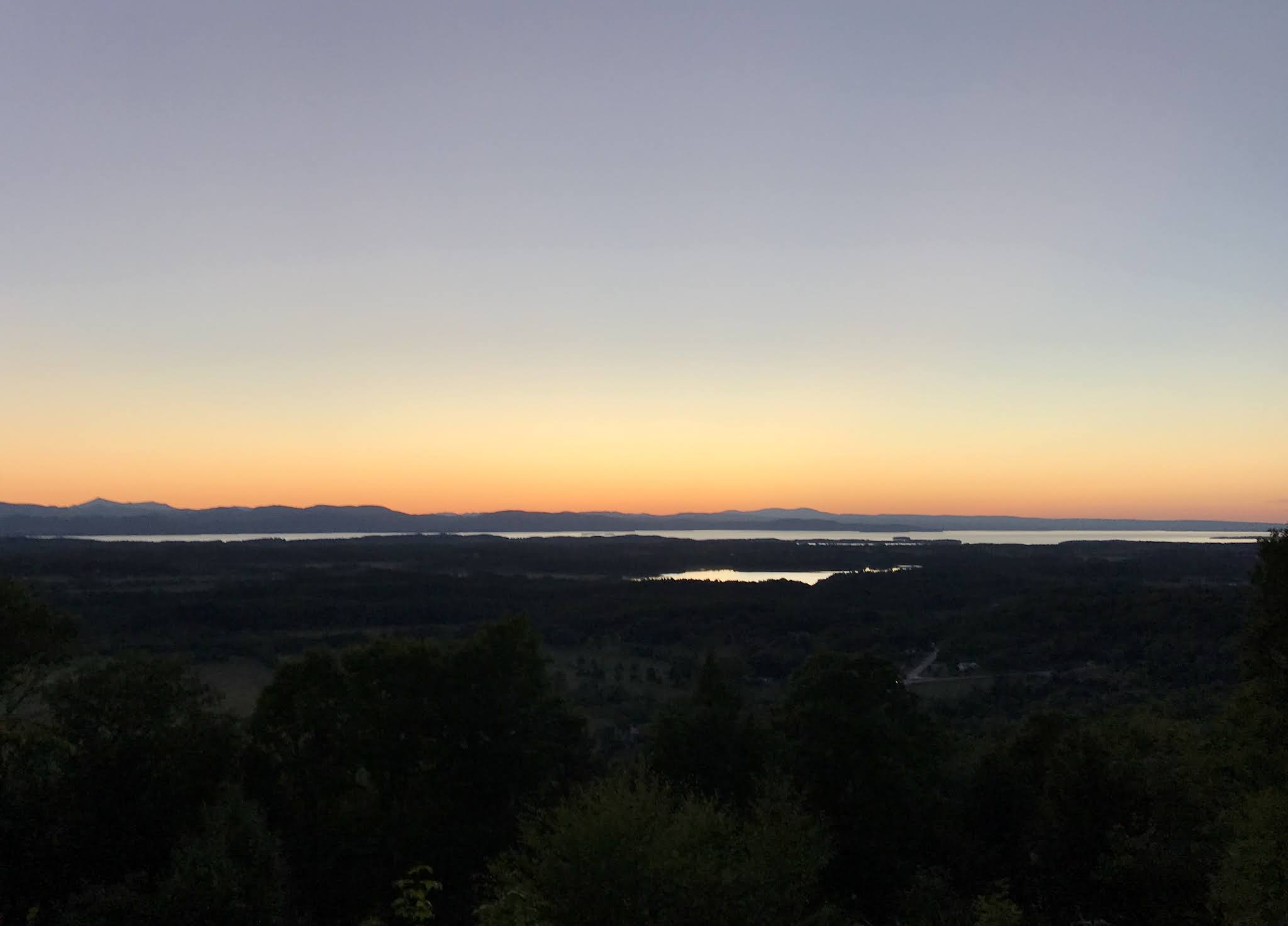

There was more light in
 the water than in the sky
as we paddled home.

But to return to the walk of the day.

Though there were some clouds in the west, there was a bright silver twilight before we reached our boat.

C. remarked it descending into the hollows immediately after sunset,

A red house could hardly be distinguished at a distance, but a white one appeared to reflect light on the landscape. 

At first we saw no redness in the sky, but only some peculiar dark wisp-like clouds in the west, but on rising a hill I saw a few red stains like veins of red quartz on a ground of feldspar.

The river was perfectly smooth except the upwelling of its tide, and as we paddled home westward, the dusky yellowing sky was all reflected in it, together with the dun-colored clouds and the trees, and there was more light in the water than in the sky.

The reflections of the trees and bushes on the banks were wonderfully dark and distinct, for though frequently we could not see the real bush in the twilight against the dark bank, in the water it appeared against the sky.  We were thus often enabled to steer clear of the overhanging bushes. 

It was an evening for the muskrats to be abroad, and we saw one, which dove as he was swimming rapidly, turning over like a wheel.

H. D. Thoreau, Journal, November 30, 1853


A flock of low-warbling tree sparrows.
See December 3, 1853 ("Saw two tree sparrows on Monroe's larch by the waterside. Larger than chip-birds, with more bay above and a distinct white bar on wings, not to mention bright-chestnut crown and obscure spot on breast; all beneath pale-ash. . . . uttering from time to time a faint, tinkling chip")

.I do not know so fine a pine grove as that of Mason's. See November 30, 1851 ("My eye wanders across the valley to the pine woods which fringe the opposite side, and in their aspect my eye finds something which addresses itself to my nature.. . .I experienced a transient gladness, at any rate, at something which I saw. I am sure that my eye rested with pleasure on the white pines, now reflecting a silvery light, the infinite stories of their boughs, tier above tier, a sort of basaltic structure, a crumbling precipice of pine horizontally stratified. Each pine is like a great green feather stuck in the ground. A myriad white pine boughs extend themselves horizontally, one above and behind another, each bearing its burden of silvery sunlight, ")

Though frequently we could not see the real bush in the twilight against the dark bank, in the water it appeared against the sky. See November 2, 1857 ("In the reflection the tree is black against the clear whitish sky, though as I see it against the opposite woods it is a warm greenish yellow. But the river sees it against the bright sky, and hence the reflection is like ink. The water tells me how it looks to it seen from below.");
 November 23, 1853 ("What lifts and lightens and makes heaven of the earth is the fact that you see the reflections of the humblest weeds against the sky, but you cannot put your head low enough to see the substance so. The reflection enchants us, just as an echo does.") See also A Book of the Seasons,  by Henry Thoreau, Reflections

It was an evening for the muskrats to be abroad, and we saw one, which dove as he was swimming rapidly, turning over like a wheel. See December 2, 1852 ("There goes a muskrat. He leaves so long a ripple behind that in this light you cannot tell where his body ends, and think him longer than he is.") See also A Book of the Seasons by Henry Thoreau, the Musquash

November 30. See A Book of the Seasons, by Henry Thoreau, November 30

There was more light in
 the water than in the sky
as we paddled home.


A Book of the Seasons
,  by Henry Thoreau
 "A book, each page written in its own season, 
out-of-doors, in its own locality."
 ~edited, assembled and rewritten by zphx ©  2009-2024

https://tinyurl.com/hdt-531130


Sunday, May 10, 2020

A kind of mining bee.


River six and one eighth inches below summer level.

Thermometer at 2 P. M., 71°. The winds died away with April. 

In the midst of a remarkable drought. Hear of great fires in the woods up country the past week, it is so dry. Some farmers plowed around their houses to save them. 

P. M. – To Bateman’s Pond.

Salix alba flower in prime and resounding with the hum of bees on it. The sweet fragrance fills the air for a long distance. How much the planting of this willow adds to the greenness and cheerfulness of our landscape at this season! 

As I stand on Hunt’s Bridge, I notice the now comparatively dark green of the canary grass (Phalaris), the coarse grass vigorously springing up on the muddy islands and edges, the glaucous green of Carex stricta tufts, and the light yellowish green of the very coarse sedges of the meadow. 

Going over the hill behind S. Brown’s, when we crossed the triangular space between the roads beyond the pump-maker’s, I saw countless little heaps of sand like the small ant-hills, but, looking more closely, the size of the holes (a little less than a quarter of an inch) and the comparative irregularity of the heaps — as if the sand had been brought forth and dropped in greater quantity at once — attracted my attention and I found they were the work of bees.

The bees were hovering low over the surface, and were continually entering and issuing from the holes. They were about the size of a honey-bee, black bodied, with, I thought, yellow thighs, -- if it was not pollen. Many of the holes appeared to have been freshly stopped up with granules of moist sand. These holes were made close together in the dry and sandy soil there, with very little grass on it, sloping toward the west, between the roads, and covered a triangular space some seven rods by three. I counted twenty-four in a square foot. There must have been some twenty-five thousand of these nests in all. The surface was yellowed with them. Evidently a kind of mining bee. 

I see in roadside hard sward, by the brook beyond, a sedge darker than the stricta and not in tufts, quite short. Is it the C. vulgaris? Its leading spikes are effete. 

Evergreen-forest note.

Some very young oaks — white oak, etc. — in woods begin to leaf. 

Hear the first cricket. 

The red maples, fruiting now, are in the brick-red state. 

I heard yesterday one or two warblers. One’s note was, in rhythm, like a very feeble field sparrow. Was it the redstart? Probably one or two strange warblers now. Was it not the parti-colored warbler, — with bluish head and yellow beneath, but not the screeper note, but note ending with a jingle slightly like the field sparrow? 

Meadow fox-tail grass out several days.

H. D. Thoreau, Journal, May 10, 1860

Salix alba flower in prime and resounding with the hum of bees. See May 10, 1853 ("At this season the traveller passes through a golden gate on causeways where these willows are planted, as if he were approaching the entrance to Fairyland."); May 10, 1854 ("I perceive the sweetness of the willows on the causeway."). See also May 3, 1853  ('The willows (Salix alba) where I keep my boat resound with the hum of bees and other insects"); May 9, 1852 ("I smell the blossoms of the willows, . . . a quarter of a mile to windward. "); May 11, 1854 ("The willows on the Turnpike now resound with the hum of bees,"); May 12, 1855 ("I perceive the fragrance of the Salix alba, now in bloom, more than an eighth of a mile distant. They now adorn the causeways with their yellow blossoms and resound with the hum of bumblebees,"); May 14, 1852 ("Going over the Corner causeway, the willow blossoms fill the air with a sweet fragrance, and I am ready to sing,")


The glaucous green of Carex stricta tufts, and the light yellowish green of the very coarse sedges of the meadow. By the brook beyond, a sedge darker than the stricta and not in tufts, quite short.
 See May 10, 1858 ("That early glaucous, sharp-pointed, erect sedge, grass like, by the riverside is now apparently in prime.") See also June 19, 1859 ("The prevailing sedge of Heywood Meadow by Bartlett Hill-side, that which showed yellow tops in the spring, is the Carex stricta.")

One or two strange warblers now. See April 19, 1854 ("Within a few days the warblers have begun to come."); April 30, 1859 ("This first off-coat warmth just preceding the advent of the swamp warblers (parti-colored, red start, etc.) brings them out."); May 7, 1852 ("For now, before the leaves, they begin to people the trees in this warm weather."); May 11, 1853 ("How many little birds of the warbler family are busy now about the opening buds, while I sit by the spring! They are almost as much a part of the tree as its blossoms and leaves. They come and give it voice. "); May 15, 1859 (“Now, when the warblers begin to come in numbers with the leafing of the trees, the woods are so open that you can easily see them. ”);May 15, 1860 ("Deciduous woods now swarm with migrating warblers, especially about swamps.”);May 18, 1856 ("The swamp is all alive with warblers about the hoary expanding buds of oaks, maples, etc., and amid the pine and spruce."); May 23, 1857("This is the time and place to hear the new-arriving warblers, the first fine days after the May storm. When the leaves generally are just fairly expanding,")

May 10. SeeA Book of the Seasonsby Henry Thoreau, May 10

A Book of the Seasons,  by Henry Thoreau
"A book, each page written in its own season,
out-of-doors, in its own locality."
 ~edited, assembled and rewritten by zphx ©  2009-2021


Saturday, May 2, 2020

A good deal of coolness in the wind, so that I can scarcely find a comfortable seat.


River three and five sixteenths below summer level. 

I observed on the 29th that the clams had not only been moving much, furrowing the sandy bottom near the shore, but generally, or almost invariably, had moved toward the middle of the river. Perhaps it had something to do with the low stage of the water. 

I saw one making his way — or perhaps it had rested since morning-over that sawdust bar just below Turtle Bar, toward the river, the surface of the bar being an inch or two higher than the water. Probably the water, falling, left it thus on dry (moist) land.

I notice this forenoon (11. 30 A. M. ) remarkably round-topped white clouds just like round-topped hills, on all sides of the sky, often a range of such, such as I do not remember to have seen before. There was considerable wind on the surface, from the northeast, and the above clouds were moving west and southwest, -- a generally distributed cumulus.    

What added to the remarkableness of the sight was a very fine, fleecy cirrhus, like smoke, narrow but of indefinite length, driving swiftly eastward beneath the former, proving that there were three currents of air, one above the other.  (The same form of cloud prevailed to some extent the next day.) 

Salix alba apparently yesterday.  

The early potentillas are now quite abundant.

P. M.    – To stone heaps and stone bridge. 

Since (perhaps) the middle of April we have had much easterly (northeast chiefly) wind, and yet no rain, though this wind rarely fails to bring rain in March.  (The same is true till 9th of May at least; i. e., in spite of east winds there is no rain.)

I find no stone heaps made yet, the water being very low. (But since — May 8th-I notice them, and perhaps I overlooked them before.) 

I notice on the east bank by the stone-heaps, amid the bushes, what I supposed to be two woodchucks' holes, with a well-worn path from one to the other, and the young trees close about them, aspen and black cherry, had been gnawed for a foot or more upward for a year or two.  There were some fresh wounds, and also old and extensive scars of last year partially healed. 

The naked viburnum is leafing.

The sedge apparently Carex Pennsylvanica has now been out on low ground a day or two.   

A crowd of men seem to generate vermin even of the human kind.  In great towns there is degradation undreamed of elsewhere, — gamblers, dog-killers, rag pickers.  Some live by robbery or by luck.  There was the Concord muster (of last September).  I see still a well dressed man carefully and methodically searching for money on the muster-fields, far off across the river.  I turn my glass upon him and notice how he proceeds.  (I saw them searching there in the fall till the snow came.) He walks regularly and slowly back and forth over the ground where the soldiers had their tents, — still marked by the straw, — with his head prone, and poking in the straw with a stick, now and then turning back or aside to examine something more closely. He is dressed, methinks, better than an average man whom you meet in the streets. How can he pay for his board thus? He dreams of finding a few coppers, or perchance a half-dime, which have fallen from the soldiers' pockets, and no doubt he will find something of the kind, having dreamed of it, --having knocked, this door will be opened to him.  

Walking over the russet interval, I see the first red-winged grasshoppers. They rise from the still brown sod before me, and I see the redness of their wings as they fly. They are quite shy and hardly let me come within ten feet before they rise again, — often before I have seen them fairly on the ground.   

It was 63° at 2 P. M., and yet a good deal of coolness in the wind, so that I can scarcely find a comfortable seat. (Yet a week later, with thermometer at 60° and but little wind, it seems much warmer.) We have had cool nights of late.

H. D. Thoreau, Journal, May 2, 1860

Salix alba apparently yesterday. See May 2, 1853 (" Summer yellowbird on the opening Salix alba.?"). See also  April 24, 1855 ("The Salix alba begins to leaf. "); April 29, 1855 ("For two or three days the Salix alba, with its catkins (not yet open) and its young leaves, or bracts (?), has made quite a show, before any other tree, —a pyramid of tender yellowish green in the russet landscape."); April 30, 1859 (Salix alba leafing, or stipules a quarter of an inch wide; probably began a day or two.");    May 10, 1858 (" For some days the Salix alba have shown their yellow wreaths here and there, suggesting the coming of the yellowbird, and now they are alive with them.")

The naked viburnum is leafing. See April 30, 1859 ("The viburnum buds are so large and long, like a spear-head, that they are conspicuous the moment their two leafets diverge and they are lit up by the sun.");  May 1, 1854 ("The viburnum (Lentago or nudum) leaves unexpectedly forward at the Cliff Brook and about Miles Swamp. ")

The early potentillas are now quite abundant.
See May 1, 1854 (“At Lee's Cliff find the early cinquefoil”); May 8, 1860 ("The cinquefoil is closed in a cloudy day, and when the sun shines it is turned toward it."); May 17, 1853 ("The early cinquefoil is now in its prime and spots the banks and hillsides and dry meadows with its dazzling yellow. How lively! It is one of the most interesting yellow flowers. ")

Sunday, February 2, 2020

Kindling a fire on the pond by the side of the island, we saw the fox.


February 2

6° below at about 8 a. m. Clock has stopped. Teams squeak. 

2 p. m. — To Fair Haven Pond. 

The river, which was breaking up, is frozen over again. The new ice over the channel is of a yellow tinge, and is covered with handsome rosettes two or three inches in diameter where the vapor which rose through froze and crystallized. This new ice for forty rods together is thickly covered with these rosettes, often as thick as snow, an inch deep, and sometimes in ridges like frozen froth three inches high. Sometimes they are in a straight line along a crack. The frozen breath of the river at a myriad breathing-holes. 

A thaw began the 7th of January, and it was mild and thawing most of the time for the rest of that month; but with February we have genuine winter again. Almost all the openings in the river are closed again, and the new ice is covered with rosettes. 

It blowed considerably yesterday, though it is very still to-day, and the light, dry snow, especially on the meadow ice and the river, was remarkably plowed and drifted by it, and now presents a very wild and arctic scene. Indeed, no part of our scenery is ever more arctic than the river and its meadows now, though the snow was only some three inches deep on a level. It is cold and perfectly still, and you walk over a level snowy tract. 

It is a sea of white waves of nearly uniform shape and size. Each drift is a low, sharp promontory directed toward the northwest, and showing which way the wind blowed with occasional small patches of bare ice amid them. It is exactly as if you walked over a solid sea where the waves rose about two feet high. These promontories have a general resemblance to one another. Many of them are perfect tongues of snow more or less curving and sharp.  

Commonly the wind has made a little hollow in the snow directly behind this tongue, it may be to the ice, spoon-shaped or like a tray, — if small, a cradle in the snow. Again it is a complete canoe, the tongue being its bows.

The many distinct firm ridges on a slope of the drift — as if the edges of so many distinct layers cropped out — form undulating parallel lines of great interest. Sometimes yet smaller hollows or cradles, not reaching to the ice and at right angles with the low ridges of the drift, remind you of panelling. Again these oval hollows produce a regular reticulation. 

One hour you have bare ice; the next, a level counter pane of snow; and the next, the wind has tossed and sculptured it into these endless and varied forms. It is such a scene as Boothia Felix may present, — if that is any wilder than Concord. 

I go sliding over the few bare spots, getting a foothold for my run on the very thin sloping and ridged snow. The snow is not thus drifted in fields and meadows generally, but chiefly where there was an icy foundation on which it slid readily. The whole of the snow has evidently shifted, perhaps several times, and you cannot tell whether some slight ridges an inch high are the foundation of a drift just laid or the relics of one removed. 

Behind a tuft of bushes it is collected deep. I forgot to say that all the ice between the rosettes was thinly sprinkled with very slender grain like spiculae, sometimes two together. 

The sky was all overcast, but the sun's place quite distinct. The cloud about the sun had a cold, dry, windy look, as if the cloud, elsewhere homogeneous cold slaty, were there electrified and arranged like iron-filings about the sun, its fibres, so to speak, more or less raying from the sun as a centre. 

About 3 p. m. I noticed a distinct fragment of rainbow, about as long as wide, on each side of the sun, one north and the other south and at the same height above the horizon with the sun, all in a line parallel with the horizon; and, as I thought, there was a slight appearance of a bow. 


The sun-dogs, if that is their name, were not so distinctly bright as an ordinary rainbow, but were plainly orange-yellow and a peculiar light violet-blue, the last color looking like a hole in the cloud, or a thinness through which you saw the sky. This lasted perhaps half an hour, and then a bow about the sun became quite distinct, but only those parts where the sun-dogs were were distinctly rainbow-tinted, the rest being merely reddish-brown and the clouds within finely raying from the sun more or less. But higher up, so that its centre would have been in the zenith or apparently about in the zenith, was an arc of a distinct rainbow. A rainbow right overhead. Is this what is called a parhelion? 

It is remarkable that the straw-colored sedge of the meadows, which in the fall is one of the least noticeable colors, should, now that the landscape is mostly covered with snow, be perhaps the most noticeable of all objects in it for its color, and an agreeable contrast to the snow. 

I frequently see where oak leaves, absorbing the heat of the sun, have sunk into the ice an inch in depth and afterward been blown out, leaving a perfect type of the leaf with its petiole and lobes sharply cut, with perfectly upright sides, so that I can easily tell the species of oak that made it. Sometimes these moulds have been evenly filled with snow while the ice is dark, and you have the figure of the leaf in white. 

I see where some meadow mouse — if not mole — just came to the surface of the snow enough to break it with his back for three or four inches, then put his head out and at once withdrew it. 

We walked, as usual, on the fresh track of a fox, peculiarly pointed, and sometimes the mark of two toe nails in front separate from the track of the foot in very thin snow. And as we were kindling a fire on the pond by the side of the island, we saw the fox himself at the inlet of the river. He was busily examining along the sides of the pond by the button-bushes and willows, smelling in the snow. 

Not appearing to regard us much, he slowly explored along the shore of the pond thus, half-way round it; at Pleasant Meadow, evidently looking for mice (or moles?) in the grass of the bank, smelling in the shallow snow there amid the stubble, often retracing his steps and pausing at particular spots. He was eagerly searching for food, intent on finding some mouse to help fill his empty stomach. 

He had a blackish tail and blackish feet. Looked lean and stood high. The tail peculiarly large for any creature to carry round. He stepped daintily about, softly, and is more to the manor born than a dog. It was a very arctic scene this cold day, and I suppose he would hardly have ventured out in a warm one.

The fox seems to get his living by industry and perseverance. He runs smelling for miles along the most favorable routes, especially the edge of rivers and ponds, until he smells the track of a mouse beneath the snow or the fresh track of a partridge, and then follows it till he comes upon his game. After exploring thus a great many quarters, after hours of fruitless search, he succeeds. 

There may be a dozen partridges resting in the snow within a square mile, and his work is simply to find them with the aid of his nose. Compared with the dog, he affects me as high-bred, unmixed. There is nothing of the mongrel in him. He belongs to a noble family which has seen its best days, — a younger son.

Now and then he starts, and turns and doubles on his track, as if he heard or scented danger. (I watch him through my glass.) He does not mind us at the distance of only sixty rods. I have myself seen one place where a mouse came to the surface to-day in the snow. Probably he has smelt out many such galleries. Perhaps he seizes them through the snow. 

I had a transient vision of one mouse this winter, and that the first for a number of years. 

I have seen a good many of those snails left on the ice during the late thaw, as the  caterpillars, etc., were.

H. D. Thoreau, Journal, February 2, 1860

6° below at about 8 a. m. Clock has stopped.
See February 7, 1855 ("Thermometer at about 7.30 A. M. gone into the bulb, -19° at least. The cold has stopped the clock.")

The new ice over the channel is of a yellow tinge, and is covered with handsome rosettes two or three inches in diameter where the vapor which rose through froze and crystallized. See December 28, 1852 ("The rosettes in the ice, as Channing calls them, now and for some time have attracted me."); December 21, 1854 ("What C. calls ice-rosettes, i.e. those small pinches of crystallized snow . . . I think it is a sort of hoar frost on the ice."); January 7, 1856 ("It is completely frozen at the Hubbard’s Bath bend now, — a small strip of dark ice, thickly sprinkled with those rosettes of crystals, two or three inches in diameter"); February 13, 1859 ("Ice which froze yesterday and last night is thickly and evenly strewn with fibrous frost crystals . . . sometimes arranged like a star or rosette, one for every inch or two . . . I think that this is the vapor from the water which found its way up through the ice and froze in the night"); December 29, 1859 ("On the thin black ice lately formed on these open places, the breath of the water has made its way up through and is frozen into a myriad of little rosettes.")

With February we have genuine winter again. Almost all the openings in the river are closed again, and the new ice is covered with rosettes.
See February 1, 1855 ("The river falling all day, no water has burst out through the ice next the shore, and it is now one uninterrupted level white blanket of snow quite to the shore on every side.");  The weather is still clear, cold, and unrelenting. I have walked much on the river this winter, but, ever since it froze over, it has been on a snow-clad river, or pond. They have been river walks because the snow was shallowest there. February 5, 1856 ("The weather is still clear, cold, and unrelenting. I have walked much on the river this winter, but, ever since it froze over, it has been on a snow-clad river, or pond. They have been river walks because the snow was shallowest there.") See if a man can think his summer thoughts now.); See also A Book of the Seasons, by Henry Thoreau, February is Mid-Winter

No part of our scenery is ever more arctic than the river and its meadows now.
See February 3, 1852 (The landscape covered with snow two feet thick, seen by moonlight from these Cliffs, gleaming in the moon and of spotless white. Who can believe that this is the habitable globe? The scenery is wholly arctic.")

It is remarkable that the straw-colored sedge of the meadows. . . should . . . be perhaps the most noticeable of all objects in it for its color, and an agreeable contrast to the snow.
  See  February 13, 1860 ("The principal charm of a winter walk over ice is perhaps the peculiar and pure colors exhibited . . .The yellow of the sun and the morning and evening sky, and of the sedge (or straw-color, bright when lit on edge of ice at evening), and all three in hoar frost crystals."); February 12, 1860 ("I thus find myself returning over a green sea, winding amid purple islets, and the low sedge of the meadow on one side is really a burning yellow."). See also A Book of the Seasons,  by Henry Thoreau, Winter Colors

The sun-dogs, if that is their name. See February 13, 1860 ("It is surprising what a variety of distinct colors the winter can show us . . .There is the red of the sunset sky, and of the snow at evening, and in rainbow flocks during the day, and in sun-dogs.")

We saw the fox himself at the inlet of the river busily examining along the sides of the pond by the button-bushes and willows, smelling in the snow. See January 21, 1857 (“It is remarkable how many tracks of foxes you will see quite near the village, where they have been in the night, and yet a regular walker will not glimpse one oftener than once in eight or ten years. ”); December 24, 1856 ("Do not see a track of any animal till returning near the Well Meadow Field, where many foxes, one of whom I have a glimpse of, had been coursing back and forth in the path and near it for three quarters of a mile. They had made quite a path"); February 10, 1856 ("Returning, I saw a fox on the railroad, at the crossing below the shanty site, eight or nine rods from me. He looked of a dirty yellow and lean. I did not notice the white tip to his tail. Seeing me, he pricked up his ears and at first ran up and along the east bank on the crust, then changed his mind and came down the steep bank, crossed the railroad before me, and, gliding up the west bank, disappeared in the woods. . . . “); November 25, 1857 ("Returning, I see a fox run across the road in the twilight from Potter’s into Richardson’s woods. He is on a canter, but I see the whitish tip of his tail. I feel a certain respect for him, because, though so large, he still maintains himself free and wild in our midst"); May 20, 1858 (“[J]ust before entering the part called Laurel Glen, I heard a noise, and saw a fox running off along the shrubby side-hill. . .It had a dirty or dark brown tail, with very little white to the tip. . . . I heard a bark behind me, and, looking round, saw an old fox on the brow of the hill on the west side of the valley, amid the bushes, about ten rods off, looking down at me. . . . I then saw a full-grown fox, perhaps the same as the last, cross the valley through the thin low wood fifteen or twenty rods behind me, but from east to west, pausing and looking at me anxiously from time to time. . . .It was a very wild sight to see the wolf-like parent circling about me in the thin wood, from time to time pausing to look and bark at me.”) See also A Book of the Seasons, by Henry Thoreau, The Fox and A Book of the Seasons, by Henry Thoreau, The Wild Mouse

The fresh track of a fox, peculiarly pointed, and sometimes the mark of two toe nails in front separate from the track of the foot in very thin snow. See February 5, 1854 ("The tracks were about two inches long, or a little less, by one and a half wide, shaped thus where the snow was only half an inch deep on ice")


February 2, 2014

Perhaps he seizes them through the snow. See January 7, 1860 ("It would be remarkable if a fox could smell and catch a mouse passing under the snow beneath him!")

I had a transient vision of one mouse this winter, and that the first for a number of years.
  See January 4, 1860 ("The woods are nightly thronged with little creatures which most have never seen."); February 20, 1855 ("Once in a year one glances by like a flash through the grass or ice at our feet, and that is for the most part all that we see of them.") See also A Book of the Seasons, by Henry Thoreau, The Wild Mouse

February 2.  See A Book of the Seasons,  by Henry Thoreau,  February 2

Walk as usual 
on the fresh track of a fox
in very thin snow . . .

kindling a fire on
the pond by the island –
see the fox himself.

Wednesday, January 22, 2020

Birds are commonly very rare in the winter

January 22

P. M. — Up river to Fair Haven Pond; return via Andromeda Ponds and railroad. 

Overcast, but some clear sky in southwest horizon; mild weather still. 

Where the sedge grows rankly and is uncut, as along the edge of the river and meadows, what fine coverts are made for mice, etc., at this season! It is arched over, and the snow rests chiefly on its ends, while the middle part is elevated from six inches to a foot and forms a thick thatch, as it were, even when all is covered with snow, under which the mice and so forth can run freely, out of the way of the wind and of foxes. 

After a pretty deep snow has just partially melted, you are surprised to find, as you walk through such a meadow, how high and lightly the sedge lies up, as if there had been no pressure upon it. It grows, perhaps, in dense tufts or tussocks, and when it falls over, it forms a thickly thatched roof. Nature provides shelter for her creatures in various ways. 

If the musquash, etc., has no longer extensive fields of weed and grass to crawl in, what an extensive range it has under the ice of the meadows and river sides! for, the water settling directly after freezing, an icy roof of indefinite extent is thus provided for it, and it passes almost its whole winter under shelter, out of the wind and invisible to men. 

The ice is so much rotted that I observe in many places those lunar-shaped holes, and dark places in the ice, convex up-stream, some times double-lunar. 

I perceive that the open places in the river do not preserve the same relative importance that they had December 29th. Then the largest four or five stood in this order: (1) below boat's place, (2) below junction, (3) Barrett's Bar, (4) Clamshell or else Hubbard's large as Hubbard's Bath. Which of the others is largest I am not quite sure. 

In other words, below junction and Hubbard's Bath (if not also Clamshell, not seen) retain about their former size, while below boat's place and Barrett's Bar have been diminished, especially below boat's place. 

Birds are commonly very rare in the winter. They are much more common at some times than at others. I see more tree sparrows in the beginning of the winter (especially when snow is falling) than in the course of it. I think that by observation I could tell in what kind of weather afterward these were most to be seen. 

Crows come about houses and streets in very cold weather and deep snows, and they are heard cawing in pleasant, thawing winter weather, and their note is then a pulse by which you feel the quality of the air, i. e., when cocks crow. 

For the most part, lesser redpolls and pine grosbeaks do not appear at all. 

Snow buntings are very wandering. They were quite numerous a month ago, and now seem to have quit the town. They seem to ramble about the country at will. 

C. says that he followed the track of a fox all yesterday afternoon, though with some difficulty, and then lost it at twilight. I suggested that he should begin next day where he had left off, and that following it up thus for many days he might catch him at last. 
"By the way," I asked, "did you go the same way the fox did, or did you take the back track?" 
"Oh," said he, "I took the back track. It would be of no use to go the other way, you know." 

Minott says that a hound which pursues a fox by scent cannot tell which way he is going; that the fox is very cunning and will often return on its track over which the dog had already run. It will ascend a high rock and then leap off very far to one side; so throw the dogs off the scent for a while and gain a breathing-spell. 

I see, in one of those pieces of drifted meadow (of last spring) in A. Wheeler's cranberry meadow, a black willow thus transplanted more than ten feet high and five inches in diameter. It is quite alive. 

The snow-fleas are thickest along the edge of the wood here, but I find that they extend quite across the river, though there are comparatively few over the middle. There are generally fewer and fewer the further you are from the shore. Nay, I find that they extend quite across Fair Haven Pond. There are two or three inches of snow on the ice, and thus they are revealed. There are a dozen or twenty to a square rod on the very middle of the pond. When I approach one, it commonly hops away, and if it gets a good spring it hops a foot or more, so that it is at first lost to me. Though they are scarcely the twentieth of an inch long they make these surprising bounds, or else conceal themselves by entering the snow. We have now had many days of this thawing weather, and I believe that these fleas have been gradually hopping further and further out from the shore. 

To-day, perchance, it is water, a day or two later ice, and no fleas are seen on it. Then snow comes and covers the ice, and if there is no thaw for a month, you see no fleas for so long. But, at least soon after a thaw, they are to be seen on the centre of ponds at least half a mile across. Though this is my opinion, it is by no means certain that they come here thus, for I am prepared to believe that the water in the middle may have had as many floating on it, and that these were afterward on the surface of the ice, though unseen, and hence under the snow when it fell, and ready to come up through it when the thaw came. 

But what do they find to eat in apparently pure snow so far from any land? Has their food come down from the sky with the snow? They must themselves be food for many creatures. This must be as peculiarly a winter animal as any. It may truly be said to live in snow. 

I see some insects, of about this form on the snow: 

I scare a partridge that was eating the buds and ends of twigs of the Vaccinium vacillans on a hillside. 

At the west or nesaea end of the largest Andromeda Pond, I see that there has been much red ice, more than I ever saw, but now spoiled by the thaw and snow. 

The leaves of the water andromeda are evidently more appressed to the twigs, and showing the gray under sides, than in summer.

H. D. Thoreau, Journal, January 22, 1860

See A Book of the Seasons,  by Henry Thoreau, Winter Birds


The water settling directly after freezing, an icy roof of indefinite extent is thus provided for it, and it passes almost its whole winter under shelter, out of the wind and invisible to men.   Compare January 22, 1859 (".Many are out in boats, steering outside the ice of the river over the newly flooded meadows, shooting musquash."); January 22, 1855 ("The muskrats driven out of their holes by the water are exceedingly numerous . . .We saw fifteen or twenty, at least, between Derby's Bridge and the Tarbell Spring, either swimming with surprising swiftness up or down or across the stream to avoid us, or sitting at the water's edge, or resting on the edge of the ice.") See also January 3, 1860 ("Melvin thinks that the musquash eat more clams now than ever, and that they leave the shells in heaps under the ice. As the river falls it leaves them space enough under the ice along the meadow's edge and bushes. I think he is right. He speaks of the mark of the tail, which is dragged behind them, in the snow."); January 24, 1856 ("I have not been able to find any tracks of muskrats this winter. I suspect that they very rarely venture out in winter with their wet coats "); January 27, 1860 (" I occasionally hear a musquash plunge under the ice next the shore.") See also A Book of the Seasons, by Henry Thoreau, the Musquash

Snow buntings are very wandering. They were quite numerous a month ago, and now seem to have quit the town.  See December 23, 1859 ("Then here they come, with a stiff rip of their wings as they suddenly wheel, and those peculiar rippling notes, flying low quite across the meadow, . . . Indeed, the flock, flying about as high as my head, divides, and half passes on each side of me. Thus they sport over these broad meadows of ice this pleasant winter day. ")

Crows are heard cawing in pleasant, thawing winter weather, and their note is then a pulse by which you feel the quality of the air, i. e., when cocks crow. See January 12, 1855 ("Perhaps what most moves us in winter is some reminiscence of far-off summer. . . .It is in the cawing of the crow, the crowing of the cock, the warmth of the sun on our backs. I hear faintly the cawing of a crow far, far away, echoing from some unseen wood-side. What a delicious sound! It is not merely crow calling to crow, for it speaks to me too. I am part of one great creature with him; if he has voice, I have ears. I can hear when he calls."); . March 16, 1858 ("The crowing of cocks and the cawing of crows tell the same story. The ice is soggy and dangerous to be walked on.")

"By the way," I asked, "did you go the same way the fox did, or did you take the back track?" See February 5, 1854 ("I followed on this trail so long that my thoughts grew foxy; though I was on the back track, I drew nearer and nearer to the fox each step.")

Minott says the fox is very cunning and will often return on its track over which the dog had already run. It will ascend a high rock and then leap off very far to one side; so throw the dogs off the scent. See January 30, 1855 (" Minott . . .told how Jake Lakin lost a dog, a very valuable one, by a fox leading him on to the ice on the Great Meadows and drowning him.")

At the west end of the largest Andromeda Pond, I see that there has been much red ice, more than I ever saw. See January 24, 1855 ("I was surprised to find the ice in the middle of the last [Andromeda] pond a beautiful delicate rose-color for two or three rods, deeper in spots. . . .This beautiful blushing ice! What are we coming to?"); January 25, 1855 ("I have come with basket and hatchet to get a specimen of the rose-colored ice.. . . The redness is all about an inch below the surface, the little bubbles in the ice there for half an inch vertically being coated interruptedly within or without with what looks like a minute red dust when seen through a microscope. . ."); March 4, 1855 ("Returning by the Andromeda Ponds, I am surprised to see the red ice visible still . . .It is melted down to the red bubbles, and I can tinge my finger with it there by rubbing it in the rotted ice.")

Friday, December 6, 2019

That is an era, when, in the beginning of the winter, you change from the shoes of summer to the boots of winter.

December 6

P. M. — To Walden and Baker Bridge, in the shallow snow and mizzling rain. 

It is somewhat of a lichen day. The bright-yellow sulphur lichens on the walls of the Walden road look novel, as if I had not seen them for a long time. Do they not require cold as much as moisture to enliven them? What surprising forms and colors! Designed on every natural surface of rock or tree. Even stones of smaller size which make the walls are so finished, and piled up for what use? How naturally they adorn our works of art! 

See where the farmer has set up his post-and-rail fences along the road. The sulphur lichen has, as it were, at once leaped to occupy the northern side of each post, as in towns handbills are pasted on all bare surfaces, and the rails are more or less gilded with them as if it had rained gilt. The handbill which nature affixes to the north side of posts and trees and other surfaces. 

And there are the various shades of green and gray beside. 

Though it is melting, there is more ice left on the twigs in the woods than I had supposed. 

The mist is so thick that we cannot quite see the length of Walden as we descend to its eastern shore. The reflections of the hillsides are so much the more unsubstantial, for we see even the reflected mist veiling them. You see, beneath these whitened wooded hills and shore sloping to it, the dark, half mist-veiled water. 

For two rods in width next the shore, where the water is shallowest and the sand bare, you see a strip of light greenish two or three rods in width, and then dark brown (with a few green streaks only) where the dark sediment of ages has accumulated. 

And, looking down the pond, you see on each side successive wooded promontories — with their dim reflections — growing dimmer and dimmer till they are lost in the mist. The more distant shores are a mere dusky line or film, a sort of concentration of the mistiness. 

In the pure greenish stripe next the shore I saw some dark-brown objects above the sand, which looked very much like sea turtles in various attitudes. One appeared holding its great head up toward the surface. 

They were very weird-like and of indefinite size. I supposed that they were stumps or logs on the bottom, but was surprised to find that they were a thin and flat collection of sediment on the sandy bottom, like that which covered the bottom generally further out. 

When the breeze rippled the surface some distance out, it looked like a wave coming in, but it never got in to the shore. 

No sooner has the snow fallen than, in the woods, it is seen to be dotted almost everywhere with the fine seeds and scales of birches and alders, — no doubt an ever-accessible food to numerous birds and perhaps mice. Thus it is alternate snow and seeds.

Returning up the railroad, I see the great tufts of sedge in Heywood's meadow curving over like locks of the meadow's hair, above the snow.  These browned the meadow considerably. 

Then came a black maze, of alders moistened by the rain, which made a broad black belt between the former brown and the red-brown oaks higher up the hillside. 

The white pines now, seen through the mist, the ends of their boughs drooping a little with the weight of the glaze, resemble very much hemlocks, for the extremities of their limbs always droop thus, while pines are commonly stiffly erect or ascendant.

***

I took out my boots, which I have not worn since last spring, with the mud and dust of spring still on them, and went forth in the snow. That is an era, when, in the beginning of the winter, you change from the shoes of summer to the boots of winter.

H. .D. Thoreau,  Journal, December 6, 1859

It is somewhat of a lichen day. See December 31, 1851 ("Nature has a day for each of her creatures, her creations. To-day it is an exhibition of lichens at Forest Hall.”); and note to February 7. 1959("I see the sulphur lichens on the rails brightening with the moisture I feel like studying them again as a relisher or tonic, to make life go down and digest well, as we use pepper and vinegar and salads. They are a sort of winter greens which we gather and assimilate with our eyes.")


No sooner has the snow fallen than, in the woods, it is seen to be dotted almost everywhere with the fine seeds and scales of birches and alders, — no doubt an ever-accessible food to numerous birds and perhaps mice. See November 4, 1860 ("The birch begins to shed its seed about the time our winter birds arrive from the north."; )December 4, 1854 ("Already the bird-like birch scales dot the snow.");See December 4 1856 ("I see where the pretty brown bird-like birch scales and winged seeds have been blown into the numerous hollows of the thin crusted snow. So bountiful a table is spread for the birds. For how many thousand miles this grain is scattered over the earth."); December 18, 1852 ("The crust of the slight snow covered in some woods with the scales (bird-shaped) of the birch, and their seeds. "); December 30, 1855 (“For a few days I have noticed the snow sprinkled with alder and birch scales.”); January 7, 1853 ("Still the snow is strewn with the seeds of the birch, the small winged seeds or samarae and the larger scales or bracts shaped like a bird in flight, . . .They cover the snow like coarse bran."); January 7, 1854 ("The bird-shaped scales of the white birch are blown more than twenty rods from the trees."); January 7, 1856 ("I see birch scales (bird-like) on the snow on the river more than twenty rods south of the nearest and only birch, and trace them north to it").


That is an era, when, in the beginning of the winter, you change from the shoes of summer to the boots of winter. See November 28, 1850 ("Within a day or two the walker finds gloves to be comfortable, and begins to think of an outside coat and of boots. Embarks in his boots for the winter voyage."); December 3, 1856 ("The man who has bought his boots feels like him who has got in his winter's wood.”); December 8, 1852 ("One cannot burn or bury even his old shoes without a feeling of sadness and compassion"); compare March 30, 1860 (“It is time to begin to leave your greatcoat at home, to put on shoes instead of boots and feel lightfooted.”)

That is an era
when you change from summer shoes 
to the boots of winter.

Popular Posts Last 30 Days.

The week ahead in Henry’s journal

The week ahead in Henry’s journal
A journal, a book that shall contain a record of all your joy.
"A stone fruit. Each one yields me a thought." ~ H. D. Thoreau, March 28, 1859


I sit on this rock
wrestling with the melody
that possesses me.