Showing posts with label bubbles. Show all posts

Monday, February 8, 2021

Warm rains.


February  8. 

The warm rains have melted off the surface snow or white ice on Walden, down to the dark ice, the color of the water, only three or four inches thick; but I observe that still, for a rod or more in width around the shores, the ice is white as snow and apparently thicker, probably owing to the reflection from the bottom from the first filling it with air-bubbles.

H. D Thoreau, JournalFebruary 8, 1853

Rains have melted off the surface snow or white ice on Walden, down to the dark ice. See; February 8, 1854 ("Rain, rain, rain, carrying off the snow and leaving a foundation of ice. "); See also note to February 8, 1852 ("Night before last, our first rain for a long time.")

Ice is white as snow and apparently thicker, probably owing to the reflection from the bottom. See Walden ("In spring the sun . . .is reflected from the bottom in shallow water, and so also warms the water and melts the under side of the ice, at the same time that it is melting it more directly above, making it uneven, and causing the air bubbles which it contains to extend themselves upward and downward until it is completely honeycombed, and at last disappears suddenly in a single spring rain. . . .When a warm rain in the middle of the winter melts off the snow-ice from Walden, and leaves a hard, dark, or transparent ice on the middle, there will be a strip of rotten though thicker white ice, a rod or more wide, about the shores, created by this reflected heat.")

A Book of the Seasons by Henry Thoreau, February 8

A Book of the Seasons,  by Henry Thoreau
 "A book, each page written in its own season, 
out-of-doors, in its own locality."
 ~edited, assembled and rewritten by zphx ©  2009-2023

Monday, January 6, 2020

Walden apparently froze over last night.

January 6

Walden apparently froze over last night. 

It is but little more than an inch thick, and two or three square rods by Hubbard's shore are still open. A dark, transparent ice. It would not have frozen entirely over, as it were in one night, or maybe a little more, and yet have been so thin next the shore as well as in the middle, if it had not been so late in the winter, and so ready to freeze. It is a dark, transparent ice, but will not bear me without much cracking. 

As I walked along the edge, I started out three little pickerel no longer than my finger from close to the shore, which went wiggling into deeper water like bloodsuckers or pollywogs. 

When I lie down on it and examine it closely, I find that the greater part of the bubbles which I had thought were within its own substance are against its under surface, and that they are continually rising up from the bottom, — perfect spheres, apparently, and very beautiful and clear, in which I see my face through this thin ice (perhaps an inch and an eighth), from one eightieth of an inch in diameter, or a mere point, up to one eighth of an inch. 

There are thirty or forty of these, at least, to every square inch. These, probably, when heated by the sun, make it crack and whoop. There are, also, within the substance of the ice, oblong perpendicular bubbles half an inch long, more or less, by about one thirtieth of an inch, and these are commonly widest at the bottom (?), or, oftener, separate minute spherical bubbles of equal or smaller diameter, one directly above another, like a string of beads, perhaps the first stage of the former. But these internal bubbles are not nearly so numerous as those in the water beneath. 

It may be twenty-four hours since the ice began to form decidedly. 

I see, on the sandy bottom a few inches beneath, the white cases of caddis-worms made of the white quartz sand or pebbles. And the bottom is very much creased or furrowed where some creature has travelled about and doubled on its tracks, — perhaps the caddis-worm, for I find one or two of the same in the furrows, though the latter are deep and broad for them to make. 

This morning the weeds and twigs and fences were covered with what I may call a leaf frost, the leaves a third of an inch long, shaped somewhat like this, with triangular points, but very thin. Another morning there will be no frost. 

I forgot to say yesterday that I picked up four pignuts by the squirrel's hole, from which he had picked the meat, having gnawed a hole about half the diameter of the nut in width on each side. After I got home I observed that in each case the holes were on the sides of the nut and not on the edges, and I cut into a couple with my knife in order to see certainly which was the best way to get at the meat. 

Cutting into the edge, I came upon the thick partition which runs the whole length of the nut, and then came upon the edges of the meats, and finally was obliged to cut away a good part of the nut on both edges before I could extract the meat, because it was held by the neck in the middle. 

But when I cut holes on the sides, not only the partitions I met with were thin and partial, but I struck the meats broadside and extracted them with less trouble. It may be that it is most convenient for the squirrel to hold the nut thus, but I think there is a deeper reason than that. 

I observe that, out of six whole pignuts which I picked from a tree, three are so cracked transversely to the division of the meat that I can easily pry them open with my knife. 

They hang on as food for animals.

H. D. Thoreau, Journal, January 6, 1853

Walden apparently froze over last night. See December 27, 1852 ("Not a particle of ice in Walden to-day. Paddled across it. I took my new boat out. A black and white duck on it."); . January 2, 1853 ("Walden begins to freeze in the coves or shallower water on the north side, where it was slightly skimmed over several weeks ago"); January 3, 1853 ("Walden not yet frozen.")

When I lie down on it and examine it closely, I find that the greater part of the bubbles are continually rising up from the bottom, — perfect spheres, very beautiful and clear, in which I see my face through this thin ice. June 3, 1854 ("On the pond we make bubbles with our paddles on the smooth surface, in which little hemispherical cases we see ourselves and boat, small, black and distinct, with a fainter reflection on the opposite side of the bubble (head to head).")

This morning the weeds and twigs and fences were covered with what I may call a leaf frost. See December 31, 1855 ("It is one of the mornings of creation, and the trees, shrubs, etc., etc., are covered with a fine leaf frost, as if they had their morning robes on, seen against the sun.")


A Book of the Seasons,  by Henry Thoreau
"A book, each page written in its own season,
out-of-doors, in its own locality.”
~edited, assembled and rewritten by zphx © 2009-2022

Thursday, February 14, 2019

As I walk over thin ice, settling it down, I see great bubbles under, three or four feet wide, go waddling or wobbling away.


February 14

P. M. — On ice up Assabet to railroad. 

The ice-belt which I still see along the steep bank of the Assabet is now some three weeks old, and though it was then six or eight inches thick, it is now only two or three, or much less, in many places nearly wasted away, and those once horizontal tables are often fallen aslant, like shields pierced with many holes. 

That belt, at first consisting of more or less blunt triangles projecting four or five feet from the bank, was at first, of course, perfectly horizontal and level (I see where dogs and foxes have run along on it for half a mile together), but now, such is the flexibility of the ice, it is bent downward by its own weight, or if you stand in front of it, it is a waving or undulating line instead of a level one, i. e. on its edge. 


I see one table, where the ice is a little more than one inch thick, which is curved downward on the sides eighteen inches within a horizontal distance of two and a half feet. There is nothing like a crack at this bend. Some of the belt itself, where three inches thick, has bent downward eighteen inches at four or five feet from the bank.

 I also see on Sunset Interval a large cake a rod square and a foot thick with more than a foot of soil attached beneath, which, by its own weight resting high and dry there, has bent very considerably. 

In one great cake there just like this, I see a fence-post with three holes in it standing upright, and perhaps the whole of it has been brought away in the soil beneath. 

It does not appear where it came from. Looking at the edge of one of these cakes, I notice some bubbles, seen edgewise, in the form of some buttons or of an inverted Moorish dome. 


These are they which when you look down on them appear thus: 

As I walk over thin ice, settling it down, I see great bubbles under, three or four feet wide, go waddling or wobbling away like a seared lady impeded by her train.

I have but little doubt that the musquash gets air from these bubbles, which are probably very conspicuous under the ice. They are its reservoirs.

H. D. Thoreau, Journal, February 14, 1859


The ice-belt which I still see along the steep bank of the Assabet is now some three weeks old. See  January 1, 1857 (" I observe a shelf of ice — what arctic voyagers call the ice-belt or ice-foot (which they see on a very great scale sledging upon it) — adhering to the walls and banks at various heights, the river having fallen nearly two feet since it first froze.""); January 16, 1857("As I pass the Island (Egg Rock), I notice the ice-foot adhering to the rock about two feet above the surface of the ice generally. . . . The same phenomena, no doubt, on a much larger scale occur at the north.”); February 1, 1859 ("Also an ice-belt adheres to the steep shores . . .and you see where this hard and thick ice has bent under its own weight.")

I have but little doubt that the musquash gets air from these bubbles. See January 22, 1859 ("J. Farmer tells me that he once saw a musquash rest three or four minutes under the ice with his nose against the ice in a bubble of air about an inch in diameter, and he thinks that they can draw air through the ice,"); January 24, 1859 ("He might... come to breathe in such a bubble as this already existing.")

Wednesday, February 13, 2019

As I walk toward the sun, the colors of the rainbow are reflected from a myriad fine facets..


February 13

P. M. —— On ice to Fair Haven Pond. 

Yesterday there was no skating, unless you swept the snow from the ice; but to-day, though there has been no rain nor thaw, there is pretty good skating. Yesterday the water which had flowed, and was flowing, back over the ice on each side of the river and the meadows, a rod or two in width, was merely skimmed over, but last night it froze so that there is good skating there. Also the wind will generally lay bare some portion of the ice, unless the snow is very deep. 

This yellowish ice which froze yesterday and last night is thickly and evenly strewn with fibrous frost crystals very much like bits of asbestos, an inch or more long, sometimes arranged like a star or rosette, one for every inch or two; but where I broke in yesterday, and apparently wherever the water overflowed the thin ice late in the day, there are none. I think that this is the vapor from the water which found its way up through the ice and froze in the night. It is sprinkled like some kind of grain, and is in certain places much more thickly strewn, as where a little snow shows itself above the ice. 

The old ice is covered with a dry, powdery snow about one inch deep, from which, as I walk toward the sun, this perfectly clear, bright afternoon, at 3.30 o’clock, the colors of the rainbow are reflected from a myriad fine facets. It is as if the dust of diamonds and other precious stones were spread all around. The blue and red predominate. Though I distinguish these colors everywhere toward the sun, they are so much more abundantly reflected to me from two particular directions that I see two distant rays, or arms, so to call them, of this rainbow-like dust, one on each side of the sun, stretching away from me and about half a dozen feet wide, the two arms including an angle of about sixty degrees. 

When I look from the sun, I see merely dazzling white points. I can easily see some of these dazzling grains fifteen or twenty rods distant on any side, though the facet which reflects this light cannot be more than a tenth or twelfth of an inch at most. 

Yet I might easily, and commonly do, overlook all this. 

Winter comes to make walking possible where there was no walking in summer. Not till winter do we take possession of the whole of our territory. I have three great highways raying out from one centre, which is near my door. I may walk down the main river or up either of its two branches. Could any avenues be contrived more convenient? With this river I am not compelled to walk in the tracks of horses. 

Never is there so much light in the air as in one of these bright winter afternoons, when all the earth is covered with new-fallen snow and there is not a cloud in the sky. The sky is much the darkest side, like the bluish lining of an egg-shell. There seems nothing left to make night out of. With this white earth beneath and that spot[less] skimmed-milk sky above him, man is but a black speck inclosed in a white egg-shell. 

Sometimes in our prosaic moods, life appears to us but a certain number more of days like those which we have lived, to be cheered not by more friends and friendship but probably fewer and less. As, perchance, we anticipate the end of this day before it is done, close the shutters, and with a cheerless resignation commence the barren evening whose fruitless end we clearly see, we despondingly think that all of life that is left is only this experience repeated a certain number of times. And so it would be, if it were not for the faculty of imagination.

I see, under this ice an inch thick, a large bubble with three cracks across it, yet they are so fine — though quite distinct —— that they let no air up, and I release it with my knife. An air-bubble very soon makes the ice look whitish above it. It is whitest of all when it is fairly inclosed, with ice beneath it. When, by treading above it, I dislodge a bubble under this ice which formed only last night, I see that it leaves the outline of its form behind, the ice being a little thinner above it.

Here is the track of one who walked here yesterday. The age of the track is betrayed by a certain smoothness or shininess produced by the sun shining on the raw and disturbed edges and melting them. The fresh track is evidently made in a dry, powdery substance; that of yesterday, as if it were made in a slightly glutinous matter, or which possessed considerable tenacity. 

Then there is the wonderful stillness of a winter day. The sources of sound, as of water, are frozen up; scarcely a tinkling rill of it is to be heard. When we listen, we hear only that sound of the surf of our internal sea, rising and swelling in our ears as in two seashells. It is the sabbath of the year, stillness audible, or at most we hear the ice belching and crackling as if struggling for utterance. 

A transient acquaintance with any phenomenon is not sufficient to make it completely the subject of your muse. You must be so conversant with it as to remember it and be reminded of it long afterward, while it lies remotely fair and elysian in the horizon, approachable only by the imagination.

H. D. Thoreau, Journal, February 13, 1859


As I walk toward the sun, this perfectly clear, bright afternoon, at 3.30 o’clock, the colors of the rainbow are reflected from a myriad fine facets. See December 11, 1855 ("Great winter itself looked like a precious gem, reflecting rainbow colors from one angle")

Winter comes to make walking possible where there was no walking in summer. See February 13, 1851 ("The meadows were frozen just enough to bear."); February 13, 1856 ("A very firm and thick, uneven crust, on which I go in any direction across the fields, stepping over the fences."); See also December 13, 1859 ("My first true winter walk is perhaps that which I take on the river, or where I cannot go in the summer.").  December 14, 1850 ("I walk on Loring's Pond to three or four islands there which I have never visited, not having a boat in the summer."); January 24, 1856 ("The snow is so deep along the sides of the river that I can now look into nests which I could hardly reach in the summer.");   February 8, 1852 ("I now walk over fields raised a foot or more above their summer level, and the prospect is altogether new."); February 10, 1860 ("No finer walking in any respect than on our broad meadow highway in the winter, when covered with bare ice"); February 19, 1854 ("I incline to walk now in swamps and on the river and ponds, where I cannot walk in summer. “)

Sometimes in our prosaic moods, life appears to us but a certain number more of days . . .as, perchance, we anticipate the end of this day before it is done, See. July 30, 1852 (" After midsummer we have a belated feeling and are forward to see in each sight and hear in each sound some presage of the fall, just as in middle age man anticipates the end of life")

I see, under this ice an inch thick, a large bubble with three cracks across it, yet they are so fine — though quite distinct —— that they let no air up, and I release it with my knife. An air-bubble very soon makes the ice look whitish above it. See January 24, 1859 ("("When I cut through with my knife an inch or two to one of the latter kind, making a very slight opening, the confined air, pressed by the water, burst up with a considerable hissing sound, sometimes spurting a little water with it, and thus the bubble was contracted, almost annihilated")

A transient acquaintance with any phenomenon is not sufficient to make it completely the subject of your muse. You must be so conversant with it as to remember it and be reminded of it long afterward, while it lies remotely fair and elysian in the horizon, approachable only by the imagination. See  May 12, 1857 ("Our past experience is a never-failing capital which can never be alienated, of which each kindred future event reminds us. If you would have the song of the sparrow inspire you a thousand years hence, let your life be in harmony with its strain to-day.")

Sometimes life appears 
as but a certain number 
more of shorter days.


Thursday, January 24, 2019

This ice is a good field for an entomologist.


January 24.

An abundance of excellent skating, the freshet that covered the meadows being frozen. Many boys and girls are skating on Mantatuket Meadow and on Merrick’s. Looking from this shore, they appear decidedly elevated,—not by their skates merely. What is the cause? Do we take the ice to be air? 

I see an abundance of caterpillars of various kinds on the ice of the meadows, many of those large, dark, hairy, with longitudinal light stripes, somewhat like the common apple one. Many of them are frozen in yet, some for two thirds their length, yet all are alive. 

Yet it has been so cold since the rise that you can now cross the channel almost anywhere. 

I also see a great many of those little brown grasshoppers and one perfectly green one, some of them frozen in, but generally on the surface, showing no signs of life; yet when I brought them home to experiment on, I found them all alive and kicking in my pocket. 

There were also a small kind of reddish wasp, quite lively, on the ice, and other insects; those naked, or smooth, worms or caterpillars. 

This shows what insects have their winter quarters in the meadow-grass. This ice is a good field for an entomologist. 

I experimented on the large bubbles under the ice. Some, the oldest and nearest the surface, were white; others, the newest and against the present under surface, were of a bluish or slate color, more transparent. I found that the whiteness of the first was owing to the great quantity of little bubbles above and below the great one produced by the heat of this “burning-glass,” while those of recent formation have not had time to accomplish this.

When I cut through with my knife an inch or two to one of the latter kind, making a very slight opening, the confined air, pressed by the water, burst up with a considerable hissing sound, sometimes spurting a little water with it, and thus the bubble was contracted, almost annihilated; but frequently, when I cut into one of the old or white ones, there was no sound, the air did not rush out because there was no pressure, there being ice below as well as above it; but when I also pierced the lower ice it did rush out with a sound like the others. 

My object at first was to ascertain if both kinds of bubbles contained air. But that was plain enough, for when the water rushed in the bluish, or new, ones wholly beneath the ice wholly or nearly disappeared, while the white ones, giving place to water, were no longer white. It would seem, then, that a considerable pressure, such as the water exerts on an air-bubble under the ice, does not force it through the ice, certainly not for a considerable time. 

How, then, can the musquash draw air through the ice as is asserted? He might, however, come to breathe in such a bubble as this already existing. 

The larger spiders generally rest on the ice with all their legs spread, but on being touched they gather them up.

H. D. Thoreau, Journal, January 24, 1859

This ice is a good field for an entomologist. See January 22, 1859 ("Perhaps the caterpillars, etc., crawl forth in sunny and warm days in midwinter when the earth is bare, and so supply the birds, and are ready to be washed away by a flow of water! I find thus a great variety of living insects now washed out. ")

I found that the whiteness of the first was owing to the great quantity of little bubbles above and below the great one produced by the heat of this “burning-glass,” See January 9, 1859 ("I inferred, therefore, that all those infinite minute bubbles I had seen first on the under side of the ice were now frozen in with it, and that each, in its proportion or degree, like the large ones, had operated like a burning-glass on the ice beneath it")

How, then, can the musquash draw air through the ice as is asserted? See January 22, 1859 ("J. Farmer tells me that he once saw a musquash rest three or four minutes under the ice with his nose against the ice in a bubble of air about an inch in diameter, and he thinks that they can draw air through the ice,")

The larger spiders generally rest on the ice with all their legs spread, but on being touched they gather them up. See January 6, 1854 ("Frequently see a spider apparently stiff and dead on snow."); December 18, 1855 ("A dark-colored spider of the very largest kind on ice.") ;December 23, 1859 ("A little black, or else a brown, spider (sometimes quite a large one) motionless on the snow or ice.")


A Book of the Seasons, by Henry Thoreau, This ice is a good field for an entomologist. 
A Book of the Seasons,  by Henry Thoreau 
"A book, each page written in its own season,
out-of-doors, in its own locality.”
~edited, assembled and rewritten by zphx © 2009-2025

Tuesday, January 8, 2019

Bubbles in Walden ice.


January  8

I see what are probably the anther cells distinctly in the large buds of the poplar, which for a long time have shown their wool one sixth of an inch long. Also similar cells in the alder catkins, but greener and less springlike. The birch ones are the yellowest. 

At Walden. — The bubbles which I made under the ice by casting on stones here night before last, or forty- eight hours ago, nearly half a foot in diameter, still remain. . . .

I inferred, therefore, that all those infinite minute bubbles I had seen first on the under side of the ice were now frozen in with it, and that each, in its proportion or degree, like the large ones, had operated like a burning-glass on the ice beneath it to rot it. And probably it is the expanding and shrinking of the air in them, as well as in the water, which cracks the ice and makes the whooping sound.

Perhaps those minute bubbles that are seen one above another in the freshest ice have been frozen in like the largest, as they successively rose from the bottom while the ice was freezing. 

It has been supposed that Walden ice does not keep so well because it has more air in it, there being no outlet or stream to carry it off. There may be some thing in this. Let me look at the fresh ice of a pond that has a stream, and see if there are fewer bubbles under it. Of course, large bubbles would be very obvious under transparent or black ice.

H.D. Thoreau, Journal, January 8, 1853

Probably it is the expanding and shrinking of the air in them, as well as in the water, which cracks the ice and makes the whooping sound. See Walden ("The cracking and booming of the ice indicate a change of temperature. . . .The pond does not thunder every evening, and I cannot tell surely when to expect its thundering")

A Book of the Seasons,  by Henry Thoreau, January 8
A Book of the Seasons,  by Henry Thoreau
 "A book, each page written in its own season, 
out-of-doors, in its own locality."
 ~edited, assembled and rewritten by zphx ©  2009-2023

Friday, March 16, 2018

The ice is soggy and dangerous to be walked on.

March 16.

P. M. — To Conantum. 

A thick mist, spiriting away the snow. Very bad walking. This fog is one of the first decidedly spring signs; also the withered grass bedewed by it and wetting my feet. A still, foggy, and rather warm day. 

I heard this morning, also, quite a steady warbling from tree sparrows on the dripping bushes, and that peculiar drawling note of a hen, who has this peevish way of expressing her content at the sight of bare ground and mild weather. The crowing of cocks and the cawing of crows tell the same story. The ice is soggy and dangerous to be walked on. 

How conversant the Indian who lived out of doors, who lay on the ground, must have been with mouse-ear leaves, pine-needles, mosses, and lichens, which form the crust of the earth. No doubt he had names accordingly for many things for which we have no popular names. 

I walk in muddy fields, hearing the tinkling of new born rills. Where the melted snow has made a swift rill in the rut of a cart-path, flowing over an icy bottom and between icy banks, I see, just below a little fall of one inch, a circular mass of foam or white bubbles nearly two inches in diameter, slowly revolving but never moving off. The swift stream at the fall appears to strike one side, as it might the side of a water-wheel, and so cause it to revolve, but in the angle between this and the fall, and half an inch distant, is another circle of bubbles, individually larger and more evanescent, only half an inch in diameter, revolving very rapidly in the opposite direction. The laws, perchance, by which the world was made, and according to which the systems revolve, are seen in full operation in a rill of melted snow.

H. D. Thoreau, Journal, March 16, 1858

The crowing of cocks and the cawing of crows tell the same story. See January 12, 1855 ("Perhaps what most moves us in winter is some reminiscence of far-off summer. . . .It is in the cawing of the crow, the crowing of the cock, the warmth of the sun on our backs.");  February 16, 1855 ("A thick fog without rain. Sounds sweet and musical through this air, as crows, cocks, and striking on the rails at a distance.”); December 17, 1855 ("the sound of cock-crowing is so sweet, and I hear the sound of the sawmill even at the door, also the cawing of crows."). See alsoA Book of the Seasons, by Henry Thoreau, Signs of the Spring: The crowing of cocks, the cawing of crows

The ice is soggy and dangerous to be walked on. See A Book of the Seasons, by Henry Thoreau, Ice-Out

No doubt he had names accordingly for many things for which we have no popular names. See March 5, 1858 ("It was a new light when my; guide gave me Indian names for things for which had only scientific ones before. In proportion as I understood the language, I saw them from a new point of view."); January 15, 1853 ("Science suggests the value of mutual intelligence. I have long known this dust, but, as I did not know the name of it, i. e . what others called it, I therefore could not conveniently speak of it. . ."); May 21, 1851 ("You have a wild savage in you, and a savage name is perchance somewhere recorded as yours.")

I walk in muddy fields, hearing the tinkling of new born rills See March 16, 1854 ("Willows and alders along watercourses all alive these mornings and ringing with the trills and jingles and warbles of birds, even as the waters have lately broken loose and tinkle below.") See also February 18, 1855 ("I listen ever for something springlike in the notes of birds, some peculiar tinkling notes."); March 7, 1859 ("I walk, these first mild spring days, with my coat thrown open, stepping over tinkling rills of melting snow, excited by the sight of the bare ground"); March 13, 1853.("Listening for early birds, I hear a faint tinkling sound in the leafless woods, as if a piece of glass rattled against a stone."); March 18, 1858 (“Almost every bush has its song sparrow this morning, and their tinkling strains are heard on all sides.”); March 18, 1858 ("The note of the first bluebird in the air answers to the purling rill of melted snow beneath."). See also A Book of the Seasons,  by Henry Thoreau, Braided ripples of melting snow

A circular mass of foam or white bubbles nearly two inches in diameter. See February 13, 1852 ("I now sit by the little brook in Conant's meadow, where it falls over an oak rail . . .. Bubbles on the surface make a coarse foam. . . .")

Sunday, July 9, 2017

I think I see how this tree is propagated.

July 9. 
July 9, 2017

Could see no yellow wasps about the nest over my window at 6 a. m., but did just before 6.30.  I hear of still a second nest at Mrs. Brown's and one at Julius Smith's. 

Another Attacus Promethea, a male from the same young black birch, was out and on the window this morning. Q. v. I dipped the body into alcohol before it had fairly spread its wings, but so discolored it, i. e. the white line with dots on the side of the abdomen. 

I see that the seeds of the Salix nigra gathered on the catkins on the 7th, or two days since, put in tumblers of water in my window, have already germinated ! and show those two little roundish green leaves. 

P. M. — Up Assabet with Sophia. 

There is now but little black willow down left on the trees. They will be handsomest somewhat later than this, when there is no down on them, and the new growth has more invested the stems. 

I think I see how this tree is propagated by its seeds. Its countless minute brown seeds, just perceptible to the naked eye in the midst of their cotton, are wafted with the cotton to the water, — most abundantly about a fortnight ago, — and there they drift and form a thick white scum together with other matter, especially against some alder or other fallen or drooping shrub where there is less current than usual. There, within two or three days, a great many germinate and show their two little roundish leaves, more or less tingeing with green the surface of the scum, — somewhat like grass seed in a tumbler of cotton. 

Many of these are drifted in amid the button-bushes, willows, and other shrubs, and the sedge, along the riverside, and the water falling just at this time, when they have put forth little fibres, they are deposited on the mud just left bare in the shade, and thus probably a great many of them have a chance to become perfect plants. But if they do not drift into sufficiently shallow water and are not left on the mud just at the right time, probably they perish. 

The mud in many such places is now green with them, though perhaps the seed has often blown directly through the air to such places. 

I am surprised to see dense groves of young maples an inch or more high from seed of this year. They have sprung in pure sand, where the seed has been drifted and moisture enough supplied at the water's edge. The seed (now effete) commonly lies on the surface, having sent down its rootlet into the sand. 

I see no flowers on the bass trees by this river this year, nor at Conantum. 

Am surprised to find how much carburetted hydrogen gas there is in the beds of sawdust by the side of this stream, as at the "Narrows." If I thrust in my paddle and give it a twist, great bubbles two inches or more in diameter rush up with great force and sound, lifting the water an inch or two, as if it were violently boiling, and filling the air with that strong gunpowder scent. 

The bubbles, being lighter than atmospheric air, burst at once, and give me no opportunity to see myself in them, as those which the boat makes in sluggish water.

H. D. Thoreau, Journal, July 9, 1857

See no yellow wasps about the nest over my window. . . See June 28, 1857 ("under the peak of our roof, just over my chamber windows.”)

Another Attacus Promethea, a male from the same young black birch, was out and on the window. See  July 5, 1857 ("There came out this morning, apparently from one of those hard stem-wound cocoons on a black birch in my window, a moth whose wings are spread four and a quarter inches")

I think I see how this tree is propagated by its seeds. See A Book of the Seasons, by Henry Thoreau, the Propogation of the Willow.

I see no flowers on the bass trees by this river this year . . . See. July 3, 1853 (" There are no flowers on bass trees commonly this year") and note to July 17, 1856 ("Hear at distance the hum of bees from the bass with its drooping flowers at the Island, a few minutes only before sunset. It sounds like the rumbling of a distant train of cars.”)  See also A Book of the Seasons, by Henry Thoreau, The Basswood

The beds of sawdust by the side of the stream. . . . See  April 12, 1852 ("The lines of sawdust left at different levels on the shore is just hint enough of a sawmill on the stream above. “); April 1, 1854 ("The lines of sawdust from Barrett's mill at different heights on the steep, wet bank under the hemlocks rather enhance the impression of freshness and wild-ness, as if it were a new country.”); April 19, 1854 ("Yesterday, as I was returning down the Assabet, . . . I was surprised to find the river so full of sawdust from the pail-factory and Barrett's mill that I could not easily distinguish if the stone-heaps had been repaired. There was not a square three inches clear. And I saw the sawdust deposited by an eddy in one place on the bottom like a sand-bank a foot or more deep half a mile below the mill.”);  October 20, 1856 (“ at Hemlocks, in the eddy there, where the white bits of sawdust keep boiling up and down and whirling round as in a pot.”):  April 1, 1858 ("It is remarkable that the river seems rarely to rise or fall gradually, but rather by fits and starts, and hence the water-lines, as indicated now by the sawdust, are very distinct parallel lines four or five or more inches apart.”);  April 1, 1859 ("The river being so low, we see lines of sawdust perfectly level and parallel to one another on the side of the steep dark bank at the Hemlocks. . .”);  July 7, 1859 ("Bathing at Barrett's Bay, I find it to be composed in good part of sawdust, mixed with sand.”)

The bubbles, being lighter than atmospheric air, burst at once . . .  See  July 14, 1857 ("Set fire to the carburetted hydrogen from the sawdust shoal with matches, and heard it flash. “);  Compare June 3, 1854 (“On the pond we make bubbles with our paddles on the smooth surface, in which little hemispherical cases we see ourselves and boat, small, black and distinct, with a fainter reflection on the opposite side of the bubble (head to head). These last sometimes a minute before they burst.”); September 14, 1854("Now our oars leave a broad wake of large bubbles, which are slow to burst.”); June 7, 1857 (“Now I notice many bubbles left on the water in my wake, as if it were more sluggish or had more viscidity than earlier. Far behind me they rest without bursting.”)


July 9. See A Book of the Seasons, by Henry Thoreau, July 9


I take a chainsaw into the woods and cut logs that have fallen across the trail. One is a leaner and my saw gets stuck. i leave it hanging, walk back for a hand saw take the chain saw apart then free the chain. The saw does not want to fit back together. Maybe because it is hot. I clear a dozen or so logs and also limb the large beech that fell across the stream in Little Valley. A productive afternoon. At sunset at the view we see ravens soaring in front of us then directly overhead. First one, then two, then four!

In the sunset sky
ravens float on wind and wing
playing in the air.

zphx 20170709


A Book of the Seasons, by Henry Thoreau
"A book, each page written in its own season,
out-of-doors, in its own locality.”
~edited, assembled and rewritten by zphx © 2009-2021

Wednesday, June 7, 2017

Now I notice many bubbles left on the water in my wake.

June 7. 

Sunday. P.M. — To river and Ponkawtasset with M. Pratt. 

June 7, 2017
Now I notice many bubbles left on the water in my wake, as if it were more sluggish or had more viscidity than earlier. Far behind me they rest without bursting. 

Pratt has got the Calla palustris, in prime, — some was withering, so it may have been out ten days,— from the bog near Bateman's Pond; also Oxalis violacea, which he says began about last Sunday, or May 31st, larger and handsomer than the yellow, though it blossoms but sparingly. Red huckleberry about same time. It is sticky like the black. His geranium from Fitzwilliam is well in bloom. It seems to be herb-robert, but without any offensive odor! (?)

A small elm in front of Pratt's which he says three years ago had flowers in flat cymes, like a cornel! ! [He must be mistaken.] I have pressed some leaves. 

At the cross-wall below N. Hunt's, some way from road, the red cohush, one plant only in flower, the rest going to seed. Probably, therefore, with the white. It has slender pedicels and petals shorter than the white. 

Garlic grows there, not yet out. 

Rubus triflorus still in bloom there. 

At the base of some hellebore, in a tuft a little from under the east edge of an apple tree, below violet wood-sorrel, a nest well made outside of leaves, then grass, lined with fine grass, very deep and narrow, with thick sides, with four small somewhat cream-colored eggs with small brown and some black spots chiefly toward larger end. 

The bird, which flew off quickly, made me think of a wren and of a Maryland yellow-throat, though I saw no yellow. 

It was a Maryland yellow-throat. 

Egg fresh. She is very shy and will not return to nest while you wait, but keeps up a very faint chip in the bushes or grass at some distance.

H. D. Thoreau, Journal, June 7, 1857

Now I notice many bubbles left on the water in my wake. See September 14, 1854 ("Now our oars leave a broad wake of large bubbles, which are slow to burst.”)

Oxalis violacea, which [Pratt] says began about last Sunday, or May 31st, larger and handsomer than the yellow, though it blossoms but sparingly . . . under the east edge of an apple tree, below violet wood-sorrel, a nest . . . See June 7, 1858 ("Oxalis violacea in garden.") See also A Book of the Seasons, by Henry Thoreau, Wood Sorrel (Oxalis)

A nest well made outside of leaves, then grass, lined with fine grass, very deep and narrow, with thick sides, with four small somewhat cream-colored eggs with small brown and some black spots chiefly toward larger end. See June 8, 1855 ("What was that little nest on the ridge near by, made of fine grass lined with a few hairs and containing five small eggs (two hatched the 11th), nearly as broad as long, yet pointed, white with fine dull-brown spots especially on the large end—nearly hatched? . . .(June 11.—It is a Maryland yellow-throat.)”); June 10, 1858 ("Perfectly concealed under the loose withered grass at the base of a clump of birches, with no apparent entrance. The usual small deep nest (but not raised up) of dry leaves, fine grass stubble, and lined with a little hair. Four eggs, white, with brown spots, chiefly at larger end, and some small black specks or scratches. The bird flits out very low and swiftly and does not show herself, so that it is hard to find the nest or to identify the bird.”); June 12, 1859 ("To Gowing's Swamp . . .Maryland yellow-throat four eggs, fresh, in sphagnum in the interior omphalos.")

June 7. See A Book of the Seasons,  by Henry Thoreau, June 7


Bubbles left behind
on the water in my wake 
rest without bursting.
A Book of the Seasons,  by Henry Thoreau
"A book, each page written in its own season,
out-of-doors, in its own locality.”
~edited, assembled and rewritten by zphx © 2009-2021

Sunday, September 14, 2014

A voyage up the Sudbury


September 14.

To opposite Pelham’s Pond by boat. Quite cool, with some wind from east and southeast. Took a watermelon for drink.

Now, instead of haying, they are raking cranberries all along the river. The raker moves slowly along with a basket before him, into which he rakes (hauling) the berries, and his wagon stands one side. It is now the middle of the cranberry season.

The river has risen about a foot within a week, and now the weeds in midstream have generally disappeared, washed away or drowned. Now our oars leave a broad wake of large bubbles, which are slow to burst.

This cooler morning methinks the jays are heard more. 

Now that the pontederias have mostly fallen, the polygonums are the most common and conspicuous flowers of the river.  I see a stream of small white insects in the air over the side of the river.

At a distance, entering the pond, we mistake some fine sparkles, probably of insects, for ducks in the water, they were so large, which when we are nearer, looking down at a greater angle with the surface, wholly disappear. 

Crossing Fair Haven, the reflections are very fine, prolonged by the ripples made by an east wind just risen. 

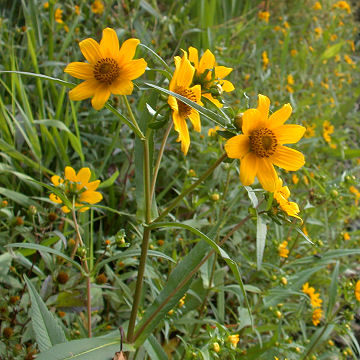
Bidens cernua

Large-flowered bidens,
or beggar-ticks,
or bur-marigold,
now abundant by riverside.

The Bidens Beckii is drowned or dried up, and has given place to the great bidens, the flower and ornament of the riversides at present, and now in its glory, especially at I. Rice’s shore, where there are dense beds. It is a splendid yellow — Channing says a lemon yellow — and looks larger than it is (two inches in diameter, more or less). 


Full of the sun. It needs a name.


We see half a dozen herons in this voyage. Their wings are so long in proportion to their bodies that there seems to be more than one undulation to a wing as they are disappearing in the distance, and so you can distinguish them. You see another begin before the first has ended. It is remarkable how common these birds are about our sluggish and marshy river.

A flock of thirteen tell tales, great yellow-legs, start up with their shrill whistle from the midst of the great Sudbury meadow, and away they sail in a flock,—a sailing (or skimming) flock, that is something rare methinks, — showing their white tails, to alight in a more distant place.

We went up thirteen or fourteen miles at least, and, as we stopped at Fair Haven Hill returning, rowed about twenty-five miles to-day.

H. D. Thoreau, Journal, September 14, 1854


To opposite Pelham’s Pond by boat. . . We went up thirteen or fourteen miles at least, and, . .rowed about twenty-five miles to-day.
See note to October 15, 1851 ("Up the river in a boat to Pelham's Pond . . . Rowed about twenty-four miles, going and coming. In a straight line it would be fifteen and one half." See also July 31, 1859 ("This sixteen miles up, added to eleven down, makes about twenty-seven that I have boated on this river, to which may be added five or six miles of the Assabet.")

Took a watermelon for drink. See August 12, 1853 ("Carry watermelons for drink. What more refreshing and convenient! This richest wine in a convenient cask, and so easily kept cool!")

It is now the middle of the cranberry season.
 See September 26, 1857 ("I see far off the various-colored gowns of cranberry pickers against the green of the meadow.")

Now the weeds in midstream have generally disappeared, washed away or drowned. See September 5, 1854 ("This is a fall phenomenon. The river weeds, becoming rotten, though many are still green, fall or are loosened, the water rises, the winds come, and they are drifted to the shore, and the water is cleared.")

Now our oars leave a broad wake of large bubbles See June 3, 1854 (“On the pond we make bubbles with our paddles on the smooth surface, in which little hemispherical cases we see ourselves and boat, small, black and distinct, with a fainter reflection on the opposite side of the bubble (head to head). These last sometimes a minute before they burst.”); June 7, 1857 (“Now I notice many bubbles left on the water in my wake, as if it were more sluggish or had more viscidity than earlier. Far behind me they rest without bursting.”)

This cooler morning methinks the jays are heard more.
 See September 21, 1854 ("I hear many jays since the frosts began."); September 21, 1859 ("Jays are more frequently heard of late, maybe because other birds are more silent") See also A Book of the Seasons, by Henry Thoreau, The Blue Jay

The polygonums are the most common and conspicuous flowers of the river. See September 18, 1858 ("The perfectly fresh spike of the Polygonum amphibium attracts every eye now. It is not past its prime. C. thinks it is exactly the color of some candy."); September 22, 1852 ("The Polygonum amphibium var. terrestre is a late flower, and now more common and the spikes larger, quite handsome and conspicuous, and more like a prince's-feather than any.");  September 27, 1858 ("The P. amphibium spikes still in prime. ")

We mistake some fine sparkles, probably of insects, for ducks in the water. See  September 20,1852 ("How sweet the phenomena of the lake! Everything that moves on its surface produces a sparkle.. . .The motion of an oar or an insect produces a flash of light;"); October 11, 1852 (" In this clear air and with this glassy surface the motion of every water-bug, ceaselessly progressing over the pond, was perceptible."); October 28, 1858 ("I can hardly distinguish the sparkle occasioned by an insect from the white breast of a duck")

The reflections are very fine, prolonged by the ripples.
See October 7, 1857 ("There being a slight ripple on the surface, these reflections . . .were extended downward . . .forming sharp pyramids of the several colors, gradually reduced to mere dusky points. The effect of this prolongation of the reflection was a very pleasing softening and blending of the colors . . .The color seems to be reflected and re-reflected from ripple to ripple, losing brightness each time by the softest possible gradation, and tapering toward the beholder, since he occupies a mere point of view. This is one of the prettiest effects of the autumnal change. . . .The ripples convey the reflection toward us."); November 1, 1858 ("The reflection of Flint’s white house in the river, prolonged by a slight ripple so as to reach the reflected cloud, was a very distinct and luminous light blue."); November 4, 1857 ("Its [Walden's] surface is slightly rippled, and dusky prolonged reflections of trees extend wholly across its length,")

Great bidens, the flower and ornament of the riversides at present ... ii needs a name.
See.September 12, 1859 ("The four kinds of bidens (frondosa, connata, cernua, and chrysanthemoides) abound now, but much of the Beckii was drowned by the rise of the river. Omitting this, the first two are inconspicuous flowers, cheap and ineffectual, commonly without petals, like the erechthites, but the third and fourth are conspicuous and interesting, expressing by their brilliant yellow the ripeness of the low grounds"); September 13, 1852 ("The great bidens in the sun in brooks affects me as the rose of the fall, the most flavid product of the water and the sun. They are low suns in the brook. The golden glow of autumn concentrated, more golden than the sun. How surely this yellow comes out along the brookss in autumn."); September 19, 1851 ("Large-flowered bidens,or beggar-ticks, or bur-marigold,now abundant by riverside")

Their wings are so long in proportion to their bodies that there seems to be more than one undulation to a wing as they are disappearing in the distance. See April 15, 1855 ("When the heron takes to flight, what a change in size and appearance! It is presto change! There go two great undulating wings pinned together, but the body and neck must have been left behind somewhere"); September 5, 1854 ("Now at sundown, a blue heron flaps away from his perch on an oak over the river before me, just above the rock."); November 1, 1855 ("I see the blue heron arise from the shore and disappear with heavily-flapping wings around a bend in front; the greatest of the bitterns, with heavily-undulating wings, low over the water, seen against the woods, just disappearing round a bend in front; with a great slate-colored expanse of wing, suited to the shadows of the stream, a tempered blue as of the sky and dark water commingled.") See also A Book of the Seasons, by Henry Thoreau, the Blue Heron

A flock of thirteen tell tales, great yellow-legs, start up with their shrill whistle. See May 31, 1854 ( It acts the part of a telltale."   "watchful, but not timid, ... while it stands on the lookout ... wades in the water to the middle of its yellow legs; goes off with a loud and sharp phe phe phe phe.";)  August 5, 1855 (" Hear a yellow-legs flying over,—phe' phe phe, phe' phe phe.” ); September 26, 1859 ("Hearing a sharp phe-phe and again phe-phe-phe, I look round and see two (probably larger) yellow-legs. . . their whole forms reflected in the water. They allow me to paddle past them, though on the alert."); October 20, 1859 ("Scare up a yellow-legs, apparently the larger, on the shore of Walden. It goes off with a sharp phe phe, phe phe.")

September 14.
See A Book of the Seasons, by Henry Thoreau, September 14

Along the river
they are raking cranberries
instead of haying.

Bidens in the sun –
the flower and ornament
of the riverside. 

With their shrill whistle
yellow-legs sail in a flock
showing their white tails.

A Book of the Seasons,  by Henry Thoreau
"A book, each page written in its own season,
out-of-doors, in its own locality.”
~edited, assembled and rewritten by zphx © 2009-2024

https://tinyurl.com/hdt-540914

Popular Posts Last 30 Days.

The week ahead in Henry’s journal

The week ahead in Henry’s journal
A journal, a book that shall contain a record of all your joy.
"A stone fruit. Each one yields me a thought." ~ H. D. Thoreau, March 28, 1859


I sit on this rock
wrestling with the melody
that possesses me.