Showing posts with label Irish. Show all posts

Wednesday, October 23, 2024

It is never too late to learn.


October 23

October 23, 2021

It is never too late to learn. 

I observed to-day the Irishman who helped me survey twisting the branch of a birch for a withe, and before he cut it off; and also, wishing to stick a tall, smooth pole in the ground, cut a notch in the side of it by which to drive it with a hatchet. 

H. D. Thoreau, Journal, October 23, 1851

Twisting the branch of a birch for a withe. See October 1, 1851 ("There is art to be used, not only in selecting wood for a withe, but in using it. Birch withes are twisted, I suppose in order that the fibres may be less abruptly bent; or is it only by accident that they are twisted?"); August 29, 1858 ("[Farmer] calls the Viburnum nudum 'withe-wood' and makes a withe by treading on one end and twisting by the other till he cracks it and makes it flexible so that it will bend without breaking.")

Saturday, February 12, 2022

The shanties which everywhere line our railroads.


February 12.

Living all winter with an open door for light and no visible wood-pile, the forms of old and young permanently contracted through long shrinking from cold, and their faces pinched by want.

I have seen an old crone sitting bareheaded on the hillside, then in the middle of January, while it was raining and the ground was slowly thawing under her, knitting there.

Their undeveloped limbs and faculties, buds that cannot expand on account of the severity of the season.

There is no greater squalidness in any part of the world! 

Contrast the physical condition of the Irish with that of the North American Indian, or the South Sea Islander, or any other savage race before they were degraded by contact with the civilized man.

H. D. Thoreau, Journal, February 12, 1852

The condition of the Irish. See August 23, 1851 ("I rarely pass the shanty in the woods, where human beings are lodged, literally, no better than pigs in a sty, — little children, a grown man and his wife, and an aged grandmother living this squalid life, squatting on the ground, — but I wonder if it can be indeed true that little Julia Riordan calls this place home, comes here to rest at night and for her daily food, — in whom ladies and gentlemen in the village take an interest. Of what significance are charity and almshouses? That there they live unmolested! in one sense so many degrees below the almshouse! beneath charity! It is admirable, — Nature against almshouses. A certain the wealth of nature, not poverty, it suggests. Not to identify health and contentment, aye, and independence, with the possession of this world’s goods! It is not wise to waste compassion on them."); September 24, 1851 ("The simple honesty of the Irish pleases me."); December 31, 1851 ("I observed this afternoon the old Irishwoman at the shanty in the woods, sitting out on the hillside, bare headed, in the rain and on the icy though thawing ground, knitting. She comes out, like the ground squirrel, at the least intimation of warmer weather. She will not have to go far to be buried, so close she lives to the earth, while I walk still in a greatcoat and under an umbrella. Such Irish as these are naturalizing themselves at a rapid rate, and threaten at last to displace the Yankees, as the latter have the Indians. The process of acclimation is rapid with them."); February 8, 1852 ("Carried a new cloak to Johnny Riordan. I found that the shanty was warmed by the simple social relations of the Irish. . . . One is not cold among his brothers and sisters. What if there is less fire on the hearth, if there is more in the heart! These Irish are not succeeding so ill after all."); February 17, 1852 ("I saw Patrick Riordan carrying home an armful of fagots from the woods to his shanty, on his shoulder. How much more interesting an event is that man's sup per who has just been forth in the snow to hunt, or perchance to steal, the fuel to cook it with ! His bread and meat must be sweet.") See also  Walden. (Economy pp 43 -45) "Granted that the majority are able outlast either to own or higher the modern house with all its improvements. . . . But how do the poor minority fair? . . . The luxury of one class is counterbalanced by the indigence of another. . . . I refer to the degraded poor, not now to the degraded rich. . . . Their condition only proves what squalidness may consist with civilization. I hardly need refer now to the laborers of our Southern States who produce the staple exports of this country, and are themselves a staple production of the South.")

A Book of the Seasons by Henry Thoreau, February 12

A Book of the Seasons,  by Henry Thoreau
 "A book, each page written in its own season, 
out-of-doors, in its own locality."
 ~edited, assembled and rewritten by zphx ©  2009-2023


Wednesday, November 24, 2021

The fauna and flora of Ministerial Swamp.


November 24. 

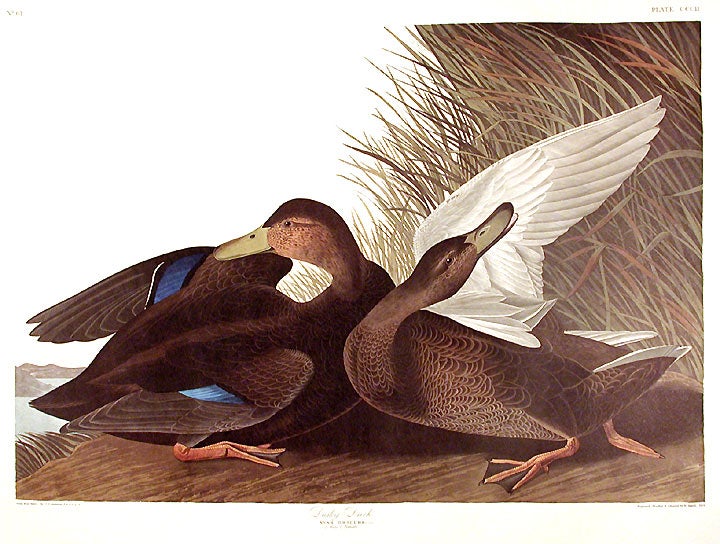
Setting stakes in the swamp (Ministerial). Saw seven black ducks fly out of the peat-hole.

J.J. Audubon (The flight of this Duck, which, in as far as I know, is peculiar to America, is powerful, rapid, and as sustained as that of the Mallard. While travelling by day they may be distinguished from that species by the whiteness of their lower wing-coverts, which form a strong contrast to the deep tints of the rest of their plumage )

Saw there also a tortoise still stirring, the painted tortoise, I believe.

Found on the south side of the swamp the Lygodium palmatum, which Bigelow calls the only climbing fern in our latitude, an evergreen, called (with others) snake tongue, as I find in Loudon.

The Irishman who helped me says, when I ask why his countrymen do not learn trades, — do something but the plainest and hardest work, — they are too old to learn trades when they come here.

H. D. Thoreau, Journal, November 24, 1851


Setting stakes in the swamp (Ministerial). See November 14, 1851 ("Surveying the Ministerial Lot in the southwestern part of the town."); November 18,1851 ("Surveying these days the Ministerial Lot . . .I hear the hooting of an owl . . . Here hawks also circle by day, and chickadees are heard, and rabbits and partridges abound.");  December 21, 1851 (“As I stand by the edge of the swamp (Ministerial), a heavy-winged hawk flies home to it at sundown, just over my head, in silence.”); December 13, 1857 ("I go this afternoon thinking I may find the stakes set for auction lots on the Ministerial Lot in December, '51") See also  July 7, 1854 ("See a pretty large hawk. . . circling over the Ministerial Swamp.") 

Saw seven black ducks fly out of the peat-hole. See September 24, 1855 ("See coming from the south in loose array some twenty apparently black ducks, . . .At first they were in form like a flock of blackbirds, then for a moment assumed the outline of a fluctuating harrow. ); September 29, 1851 ("Scared up three black ducks, which rose with a great noise of their wings, striking the water. "); September 30, 1853 ("Saw a large flock of black ducks flying northwest in the form of a harrow."); November 3, 1852 ("At Andromeda Pond, started nine black (?) ducks just at sunset, as usual they circling far round to look at me."); November 11, 1851 ("In the withered grass at Nut Meadow Brook, two black ducks, . . .rise black between me and the sun, but, when they have circled round to the east, show some silvery sheen on the under side of their wings. "); March 12, 1859 ("See two ducks flying over Ministerial Swamp.") See also  A Book of the Seasons, by Henry Thoreau, the American Black Duck)

Saw a tortoise still stirring, the painted tortoise, I believe. See November 14, 1855 ("A painted tortoise swimming under water and a wood tortoise out on the bank."); November 27, 1856 ("Take a turn down the river. A painted tortoise sinking to the bottom, and apparently tree sparrows along the shore"); December 2, 1857 ("Measuring Little Goose Pond, I observed two painted tortoises moving about under the thin transparent ice"); December 3, 1852 (" In a ditch near by, under ice half an inch thick, I saw a painted tortoise moving about.") See also A Book of the Seasons, by Henry Thoreau, the Painted Turtle (Emys picta)

Found on the south side of the swamp the Lygodium palmatum See November 30, 1851 ("The Lygodium palmatum is quite abundant on that side of the swamp, twining round the goldenrods, etc., etc"); October 2, 1859 (“The climbing fern is perfectly fresh, — and apparently therefore an evergreen, — the more easily found amid the withered cinnamon and flowering ferns.”); May 1, 1859 ("The climbing fern is persistent, i.e. retains its greenness still, though now partly brown and withered.") See also November 24, 1852 ("At this time last year the andromeda in the Ministerial Swamp was red . Now it has not turned from brown."): November 20, 1857 ("I enter the Ministerial Swamp at the road below Tarbell’s. The water andromeda leaves are brown now, except where protected by trees. In some places where many of the bright-crimson shoots of high blueberry are seen together, they have a very pretty effect");  April 29, 1857 ("Sweet-fern at entrance of Ministerial Swamp.");  May 19, 1860 (“At the Ministerial Swamp I see a white lady's-slipper almost out, fully grown, with red ones.”); August 28, 1860 ("The Lycopodium inundatum common by Harrington's mud-hole, Ministerial Swamp.")  

Friday, September 24, 2021

One milkweed with faith in its seeds.


September 24

Returning over the causeway from Flint's Pond the other evening (22d ), just at sunset, I observed that while the west was of a bright golden color under a bank of clouds, — the sun just setting, — and not a tinge of red was yet visible there, there was a distinct purple tinge in the nearer atmosphere, so that Annursnack Hill, seen through it, had an exceedingly rich empurpled look.

It is rare that we perceive this purple tint in the air, telling of the juice of the wild grape and poke-berries. The empurpled hills! Methinks I have only noticed this in cooler weather.

Last night was exceedingly dark. I could not see the sidewalk in the street, but only felt it with my feet. I was obliged to whistle to warn travellers of my nearness, and then I would suddenly find myself abreast of them without having seen anything or heard their footsteps.

It was cloudy and rainy weather combined with the absence of the moon. So dark a night that, if a farmer who had come in a-shopping had spent but an hour after sunset in some shop, he might find himself a prisoner in the village for the night.

Thick darkness.

8 A. M. — To Lee's Bridge via Conantum.

It is a cool and windy morning, and I have donned a thick coat for a walk.

The wind is from the north, so that the telegraph harp does not sound where I cross.

This windy autumnal weather is very exciting and bracing, clear and cold, after the rain of yesterday, it having cleared off in the night.

I see a small hawk, a pigeon (?) hawk, over the Depot Field, which can hardly fly against the wind.

At Hubbard's Grove the wind roars loudly in the woods.

Grapes are ripe and already shrivelled by frost; barberries also.

It is cattle show day at Lowell.

Yesterday's wind and rain has strewn the ground with leaves, especially under the apple trees. Rain coming after frost seems to loosen the hold of the leaves, making them rot off.

Saw a woodchuck disappearing in his hole.

The river washes up-stream before the wind, with white streaks of foam on its dark surface, diagonally to its course, showing the direction of the wind. Its surface, reflecting the sun, is dazzlingly bright.

The outlines of the hills are remarkably distinct and firm, and their surfaces bare and hard, not clothed with a thick air.

I notice one red tree, a red maple, against the green woodside in Conant's meadow. It is a far brighter red than the blossoms of any tree in summer and more conspicuous.

The huckleberry bushes on Conantum are all turned red.


September 24, 2021

What can be handsomer for a picture than our river scenery now? Take this view from the first Conantum Cliff:
  • First this smoothly shorn meadow on the west side of the stream, with all the swaths distinct, sprinkled with apple trees casting heavy shadows black as ink, such as can be seen only in this clear air, this strong light, one cow wandering restlessly about in it and lowing; 
  • then the blue river, scarcely darker than and not to be distinguished from the sky, its waves driven southward, or up-stream, by the wind, making it appear to flow that way, bordered by willows and button-bushes; 
  • then the narrow meadow beyond, with varied lights and shades from its waving grass, which for some reason has not been cut this year, though so dry, now at length each grass-blade bending south before the wintry blast, as if bending for aid in that direction; 
  • then the hill rising sixty feet to a terrace-like plain covered with shrub oaks, maples, etc., now variously tinted, clad all in a livery of gay colors, every bush a feather in its cap; and
  •  further in the rear the wood crowned Cliff some two hundred feet high, where gray rocks here and there project from amidst the bushes, with its orchard on the slope; 
  • and to the right of the Cliff the distant Lincoln hills in the horizon.
The landscape so handsomely colored, the air so clear and wholesome; and the surface of the earth is so pleasingly varied, that it seems rarely fitted for the abode of man.


In Cohush Swamp the sumach leaves have turned a very deep red, but have not lost their fragrance. I notice wild apples growing luxuriantly in the midst of the swamp, rising red over the colored, painted leaves of the sumach, and reminding me that they were ripened and colored by the same influences, some green, some yellow, some red, like the leaves.

Fell in with a man whose breath smelled of spirit which he had drunk. How could I but feel that it was his own spirit that I smelt? 

Behind Miles's, Darius Miles's, that was, I asked an Irishman how many potatoes he could dig in a day, wishing to know how well they yielded. “Well, I don't keep any account,” he answered; “I scratch away, and let the day's work praise itself.” Aye, there's the difference between the Irish man and the Yankee; the Yankee keeps an account. The simple honesty of the Irish pleases me.

A sparrow hawk, hardly so big as a nighthawk, flew over high above my head, –
 a pretty little graceful fellow, too small and delicate to be rapacious.

Found a grove of young sugar maples (Acer saccharinum ) behind what was Miles's. How silently and yet startlingly the existence of these sugar maples was revealed to me, which I had not thought grew in my immediate neighborhood, — when first I perceived the entire edges of its leaves and their obtuse sinuses.

Such near hills as Nobscot and Nashoba have lost all their azure in this clear air and plainly belong to earth. Give me clearness nevertheless, though my heavens be moved further off to pay for it.

I perceive from the hill behind Lee's that much of the river meadows is not cut, though they have been very dry. The sun-sparkle on the river is dazzlingly bright in this atmosphere, as it has not been, perchance, for many a month.

It is so cold I am glad to sit behind the wall.

Still the great bidens blooms by the causeway side beyond the bridge.


At Clematis Brook I perceive that the pods or follicles of the Asclepias Syriaca now point upward. Did they before all point down? Have they turned up? They are already bursting.

I release some seeds with the long, fine silk attached. The fine threads fly apart at once, open with a spring, and then ray themselves out into a hemispherical form, each thread freeing itself from its neighbor and all reflecting prismatic or rainbow tints. The seeds, besides, are furnished with wings, which plainly keep them steady and prevent their whirling round. I let one go, and it rises slowly and uncertainly at first, now driven this way, then that, by currents which I cannot perceive, and I fear it will make shipwreck against the neighboring wood; but no, as it approaches it, it surely rises above it, and then, feeling the strong north wind, it is borne off rapidly in the opposite direction, ever rising higher and higher and tossing and heaved about with every fluctuation of the air, till, at a hundred feet above the earth and fifty rods off, steering south, I lose sight of it.

How many myriads go sailing away at this season, high over hill and meadow and river, on various tacks until the wind lulls, to plant their race in new localities, who can tell how many miles distant! And for this end these silken streamers have been perfecting all summer, snugly packed in this light chest,
— a perfect adaptation to this end, a prophecy not only of the fall but of future springs.

Who could believe in prophecies of Daniel or of Miller that the world would end this summer, while one milkweed with faith matured its seeds?


On Mt. Misery some very rich yellow leaves — clear yellow — of the Populus grandidentata, which still love to wag, and tremble in my hands. Also canoe birches there.

The river and pond from the side of the sun look comparatively dark.

As I look over the country westward and northwestward, the prospect looks already bleak and wintry. The surface of the earth between the forests is no longer green, but russet and hoary. You see distinctly eight or ten miles the russet earth and even houses, and then its outline is distinctly traced against the further blue mountains, thirty or thirty-five miles distant. You see distinctly perhaps to the height of land between the Nashua and Concord, and then the convexity of the earth conceals the further hills, though high, and your vision leaps a broad valley at once to the mountains.

Get home at noon.

At sundown the wind has all gone down.

H. D. Thoreau, Journal, September 24, 1851


 I observed that while the west was of a bright golden color under a bank of clouds, — the sun just setting, — and not a tinge of red was yet visible there, there was a distinct purple tinge in the nearer atmosphere, so that Annursnack Hill, seen through it, had an exceedingly rich empurpled look. See October 19, 1858 ("The sun just ready to set, I notice that its light on my note-book is quite rosy or purple")

Last night was exceedingly dark. I could not see the sidewalk in the street, but only felt it with my feet. I was obliged to whistle to warn travellers of my nearness. See September 12, 1860 ("A dark and stormy night . . . Where the fence is not painted white I can see nothing, and go whistling for fear I run against some one. . . .You walk with your hands out to feel the fences and trees"); September 18, 1857 ("It was exceedingly dark. I met two persons within a mile, and they were obliged to call out from a rod distant lest we should run against each other. ")

I notice one red tree, a red maple, against the green woodside in Conant's meadow. See September 24, 1855 ("the maples are but just beginning to blush") See also September 25, 1857 ("The whole tree, thus ripening in advance of its fellows, attains a singular preéminence"); September 25, 1857 ("The red maple has fairly begun to blush in some places by the river. I see one, by the canal behind Barrett’s mill, all aglow against the sun."); September 25, 1857 ("A single tree becomes the crowning beauty of some meadowy vale and attracts the attention of the traveller from afar."); September 26, 1854 ("Some single red maples are very splendid now, the whole tree bright-scarlet against the cold green pines; now, when very few trees are changed, a most remarkable object in the landscape; seen a mile off."); September 27, 1855 ("Some single red maples now fairly make a show along the meadow. I see a blaze of red reflected from the troubled water."

At Clematis Brook I perceive that the pods or follicles of the Asclepias Syriaca now point upward. Did they before all point down? Have they turned up? See August 24, 1851 ("The pods of the Asclepias pulchra stand up pointedly like slender vases on a salver, an open salver truly! Those of the Asclepias Syriaca hang down.")

The fine threads fly apart at once, open with a spring, and then ray themselves out into a hemispherical form, each thread freeing itself from its neighbor. . . .a prophecy not only of the fall but of future springs. See September 10, 1860 ("If you sit at an open attic window almost anywhere, about the 20th of September, you will see many a milkweed down go sailing by on a level with you, though commonly it has lost its freight, — notwithstanding that you may not know of any of these plants growing in your neighborhood."); October 23, 1852 ("The milkweed (Syriaca) now rapidly discounting. The lanceolate pods having opened, the seeds spring out on the least jar, or when dried by the sun, and form a little fluctuating white silky mass or tuft, each held by the extremities of the fine threads, until a stronger puff of wind sets them free. It is a pleasant sight to see it dispersing its seeds")

The further blue mountains, thirty or thirty-five miles distant. See June 3, 1850 ("The landscape is a vast amphitheatre rising to its rim in the horizon."); September 12, 1851 ("It is worth the while to see the mountains in the horizon once a day"); August 2, 1852 ("In many moods it is cheering to look across hence to that blue rim of the earth,"); March 31, 1853 ("It is affecting to see a distant mountain-top,. . . still as blue and ethereal to your eyes as is your memory of it.'); September 27, 1853 ("From our native hills we look out easily to the far blue mountains, which seem to preside over them.");October 22, 1857 ("But what a perfect crescent of mountains we have in our northwest horizon! Do we ever give thanks for it? "); November 22, 1860 ("Simply to see to a distant horizon through a clear air, - the fine outline of a distant hill or a blue mountaintop through some new vista, - this is wealth enough for one afternoon.")

Sunday, August 23, 2020

A man in a boat in the sun, just disappearing in the distance round a bend.


August 23.

Saturday.

To Walden to bathe at 5.30 A. M.

Traces of the heavy rains in the night. The sand and gravel are beaten hard by them. Three or four showers in succession.

But the grass is not so wet as after an ordinary dew.

The Verbena hastata at the pond has reached the top of its spike, a little in advance of what I noticed yesterday; only one or two flowers are adhering.

At the commencement of my walk I saw no traces of fog, but after detected fogs over particular meadows and high up some brooks’valleys, and far in the Deep Cut the wood fog.

First muskmelon this morning.

I rarely pass the shanty in the woods, where human beings are lodged, literally, no better than pigs in a sty, — little children, a grown man and his wife, and an aged grandmother living this squalid life, squatting on the ground, — but I wonder if it can be indeed true that little Julia Riordan calls this place home, comes here to rest at night and for her daily food, — in whom ladies and gentlemen in the village take an interest.

Of what significance are charity and almshouses? That there they live unmolested! in one sense so many degrees below the almshouse! beneath charity!

It is admirable, — Nature against almshouses.

A certain the wealth of nature, not poverty, it suggests.

Not to identify health and contentment, aye, and independence, with the possession of this world’s goods!

It is not wise to waste compassion on them.

As I go through the Deep Cut, I hear one or two early humblebees, come out on the damp sandy bank, whose low hum sounds like distant horns from far in the horizon over the woods. It was long before I detected the bees that made it, so far away and musical it sounded, like the shepherds in some distant eastern vale greeting the king of day.

The farmers now carry — those who have got them — their early potatoes and onions to market, starting away early in the morning or at midnight. I see them returning in the afternoon with the empty barrels.

Perchance the copious rain of last night will trouble those who had not been so provident as to get their hay from the Great Meadows, where it is often lost.

P. M. – Walk to Annursnack and back over stone bridge.

I sometimes reproach myself because I do not find anything attractive in certain mere trivial employments of men, — that I skip men so commonly, and their affairs, — the professions and the trades, — do not elevate them at least in my thought and get some material for poetry out of them directly. I will not avoid, then, to go by where these men are repairing the stone bridge, — see if I cannot see poetry in that, if that will not yield me a reflection.

It is narrow to be confined to woods and fields and grand aspects of nature only. The greatest and wisest will still be related to men.

Why not see men standing in the sun and casting a shadow, even as trees? May not some light be reflected from them as from the stems of trees? I will try to enjoy them as animals, at least.

They are perhaps better animals than men.

Do not neglect to speak of men’s low life and affairs with sympathy, though you ever so speak as to suggest a contrast between them and the ideal and divine. You may be excused if you are always pathetic, but do not refuse to recognize.

Resolve to read no book, to take no walk, to undertake no enterprise, but such as you can endure to give an account of to yourself. Live thus deliberately for the most part.

When I stopped to gather some blueberries by the roadside this afternoon, I heard the shrilling of a cricket or a grasshopper close to me, quite clear, almost like a bell, a stridulous sound, a clear ring, incessant, not intermittent, like the song of the black fellow I caught the other day, and not suggesting the night, but belonging to day.

It was long before I could find him, though all the while within a foot or two. I did not know whether to search amid the grass and stones or amid the leaves. At last, by accident I saw him, he shrilling all the while under an alder leaf two feet from the ground, - a slender green fellow with long feelers and transparent wings.

When he shrilled, his wings, which opened on each other in the form of a heart perpendicularly to his body like the wings of fairies, vibrated swiftly on each other. The apparently wingless female, as I thought, was near.

We experience pleasure when an elevated field or even road in which we may be walking holds its level toward the horizon at a tangent to the earth, is not convex with the earth’s surface, but an absolute level.

On or under east side of Annursnack, Epilobium coloratum, colored willow-herb, near the spring.

Also Polygonum sagittatum, scratch-grass.

The Price Farm road, one of those everlasting roads which the sun delights to shine along in an August afternoon, playing truant; which seem to stretch themselves with terrene jest as the weary traveller journeys on; where there are three white sandy furrows (lira), two for the wheels and one between them for the horse, with endless green grass borders between and room on each side for huckleberries and birches; where the walls indulge in freaks, not always parallel to the ruts, and goldenrod yellows all the path; which some elms began to border and shade once, but left off in despair, it was so long; from no point on which can you be said to be at any definite distance from a town.

I associate the beauty of Quebec with the steel-like and flashing air.


Our little river reaches are not to be forgotten. I noticed that seen northward on the Assabet from the Causeway Bridge near the second stone bridge.

There was [a] man in a boat in the sun, just disappearing in the distance round a bend, lifting high his arms and dipping his paddle as if he were a vision bound to land of the blessed, — far off, as in picture.

When I see Concord to purpose, I see it as if it were not real but painted, and what wonder if I do not speak to thee? 

I saw a snake by the roadside and touched him with my foot to see if he were alive.

He had a toad in his jaws, which he was preparing to swallow with his jaws distended to three times his width, but he relinquished his prey in haste and fled; and I thought, as the toad jumped leisurely away with his slime-covered hind-quarters glistening in the sun, as if I, his deliverer, wished to interrupt his meditations, — without a shriek or fainting, — I thought what a healthy indifference he manifested. Is not this the broad earth still? he said.


H. D. Thoreau, Journal, August 23, 1851


The Verbena hastata at the pond has reached the top of its spike, a little in advance of what I noticed yesterday; only one or two flowers are adhering. See  August 6, 1852 ("Blue vervain is now very attractive to me, and then there is that interesting progressive history in its rising ring of blossoms. It has a story."); August 20, 1851 ("The flowers of the blue vervain have now nearly reached the summit of their spikes."); August 21, 1851 (" It is very pleasant to measure the progress of the season by this and similar clocks. So you get, not the absolute time, but the true time of the season."); August 22, 1859 The circles of the blue vervain flowers, now risen near to the top, show how far advanced the season is.") See also  A Book of the Seasons,  by Henry Thoreau,  the Blue Vervain

He had a toad in his jaws, which he was preparing to swallow with his jaws distended to three times his width, but he relinquished his prey in haste and fled. See May 19, 1856 ("saw a small striped snake in the act of swallowing a Rana palustris, within three feet of the water. The snake, being frightened, released his hold, and the frog hopped off to the water. "); April 16, 1861 ("Horace Mann says that he killed a bullfrog in Walden Pond which had swallowed and contained a common striped snake")

 Account to yourself –
always resolve to live 
deliberately.

HDT ~ August 23, 1851

Friday, February 28, 2020

A dozen robins to-day on the ground on Ebby Hubbard's hill by the Yellow Birch Swamp.


February 28. 

2 P. M. — Thermometer 52; wind easterly. To Conantum. 

I am surprised to see how my English brook cress has expanded or extended since I saw it last fall to a bed four feet in diameter, as if it had grown in the water, though it is quite dirty or muddied with sediment. Many of the sprigs turn upwards and just rest on the water at their ends, as if they might be growing. It has also been eaten considerably by some inhabitant of the water. I am inclined to think it must grow in the winter. 

What is that bluish bulb now apparently beginning to shoot in the water there, floating loose (not the water purslane )?

I suppose they are linarias which I still see flying about. 

Passed a very little boy in the street to-day, who had on a home-made cap of a woodchuck-skin, which his father or elder brother had killed and cured, and his mother or elder sister had fashioned into a nice warm cap. I was interested by the sight of it, it suggested so much of family history, adventure with the chuck, story told about [it], not without exaggeration, the human parents' care of their young these hard times. Johnny was promised many times, and now the work has been completed, — a perfect little idyl, as they say. The cap was large and round, big enough, you would say, for the boy's father, and had some kind of cloth visor stitched to it. The top of the cap was evidently the back of the woodchuck, as it were expanded in breadth, contracted in length, and it was as fresh and handsome as if the woodchuck wore it himself. The great gray-tipped wind hairs were all preserved, and stood out above the brown only a little more loosely than in life. 

As if he put his head into the belly of a woodchuck, having cut off his tail and legs and substituted a visor for the head. The little fellow wore it innocently enough, not knowing what he had on, forsooth, going about his small business pit-a-pat; and his black eyes sparkled beneath it when I remarked on its warmth , even as the woodchuck's might have done. Such should be the history of every piece of clothing that we wear. 

As I stood by Eagle Field wall, I heard a fine rattling sound, produced by the wind on some dry weeds at my elbow. It was occasioned by the wind rattling the fine seeds in those pods of the indigo-weed which were still closed, — a distinct rattling din which drew my attention to it, — like a small Indian's calabash. Not a mere rustling of dry weeds, but the shaking of a rattle, or a hundred rattles, beside. 

Looking from Hubbard's Bridge, I see a great water bug even on the river, so forward is the season. 

I take up a handsomely spread (or blossomed) pitch pine cone, but I find that a squirrel has begun to strip it first, having gnawed off a few of the scales at the base. The squirrel always begins to gnaw a cone thus at the base, as if it were a stringent law among the squirrel people, — as if the old squirrels taught the young ones a few simple rules like this. 

C. saw a dozen robins to-day on the ground on Ebby Hubbard's hill by the Yellow Birch Swamp. 

One tells me that George Hubbard told him he saw blackbirds go over this forenoon. 

One of the Corner Wheelers feels sure that he saw a bluebird on the 24th, and says he saw a sheldrake in the river at the factory "a month ago." I should say that the sheldrake was our hardiest duck. 

It suggests from what point of view Gesner (or his translator) describes an animal, — how far he takes into account man's relation to it, — that he commonly gives the “epithets” which have been applied to it. He deals in description, and epithets are a short description. And the translator says to the reader, “All these rows and ranks of living four-footed beasts are as letters and midwives to save the reverence which is due to the Highest (that made them ) from perishing within you.” 

I hear this account of Austin: An acquaintance who had bought him a place in Lincoln took him out one day to see it, and Austin was so smitten with the quiet and retirement and other rural charms that he at once sold his house in Concord, bought a small piece of rocky pasture in an out-of-the way part of this out-of-the-way town and with the funds raised by the sale of his old house built him a costly stone house upon it. Now he finds that this retirement (or country life) is the very thing which he does not want, but, his property being chiefly invested in the house, he is caught in a trap, as it were, for he cannot sell it, though he advertises it every year.

As for society, he has none; his neighbors are few and far between, and he never visits them nor they him. They can do without him, being old settlers, adscripti glebae

He found one man in the next town who got his living by sporting and fishing, and he has built him a little hut and got him to live on his place for society and help fulness. He cannot get help either for the outdoor or indoor work. There are none thereabouts who work by the day or job, and servant-girls decline to come so far into the country. Surrounded by grain-fields, he sends to Cambridge for his oats, and, as for milk, he can scarcely get any at all, for the farmers all send it to Boston, but he has persuaded one to leave some for him at the depot half a mile off.

As it is important to consider Nature from the point of view of science, remembering the nomenclature and system of men, and so, if possible, go a step further in that direction, so it is equally important often to ignore or forget all that men presume that they know, and take an original and unprejudiced view of Nature, letting her make what impression she will on you, as the first men, and all children and natural men still do. For our science, so called, is always more barren and mixed up with error than our sympathies are. 

As I go down the Boston road, I see an Irishman wheeling home from far a large damp and rotten pine log for fuel. He evidently sweats at it , and pauses to rest many times. He found, perhaps, that his wood-pile was gone before the winter was, and he trusts thus to contend with the remaining cold. I see him unload it in his yard before me and then rest himself. The piles of solid oak wood which I see in other yards do not interest me at all, but this looked like fuel. It warmed me to think of it. He will now proceed to split it finely, and then I fear it [will] require almost as much heat to dry it, as it will give out at last. 

How rarely we are encouraged by the sight of simple actions in the street! We deal with banks and other institutions, where the life and humanity are concealed, — what there is. I like at least to see the great beams half exposed in the ceiling or the corner.

H. D. Thoreau, Journal, February 28, 1860


I suppose they are linarias which I still see flying about See January 8, 1860 ("When I heard their note, I looked to find them on a birch, and lo, it was a black birch! [Were they not linarias? Vide Jan. 24, 27, 29.]")

The great gray-tipped wind hairs were all preserved, and stood out above the brown only a little more loosely than in life,  -- his black eyes sparkled beneath it when I remarked on its warmth , even as the woodchuck's might have done.See May 30, 1859 ("Its colors were gray, reddish brown, and blackish, the gray-tipped wind hairs giving it a grizzly look above, and when it stood up its distinct rust-color beneath was seen, while the top of its head was dark-brown, becoming black at snout, as also its paws and its little rounded ears."); April 29, 1855 ("See his shining black eyes and black snout and his little erect ears. He is of a light brown forward at this distance (hoary above, yellowish or sorrel beneath), gradually darkening backward to the end of the tail, which is dark-brown. The general aspect is grizzly.")

C. saw a dozen robins to-day. See February 25, 1857 ("Goodwin says he saw a robin this morning.”); February 25, 1859 ("I hear that robins were seen a week or more ago."); February 27, 1857 ("Before I opened the window this cold morning, I heard the peep of a robin, that sound so often heard in cheerless or else rainy weather, so often heard first borne on the cutting March wind or through sleet or rain, as if its coming were premature.")

Looking from Hubbard's Bridge, I see a great water bug even on the river, so forward is the season.C. saw a dozen robins to-day.One tells me that George Hubbard told him he saw blackbirds go over this forenoon. One of the Corner Wheelers feels sure that he saw a bluebird on the 24th See . March 10, 1855 ("You are always surprised by the sight of the first spring bird or insect; they seem premature, and there is no such evidence of spring as themselves, so that they literally fetch the year about. It is thus when I hear the first robin or bluebird or, looking along the brooks, see the first water-bugs out circling. But you think, They have come, and Nature cannot recede.")

Says he saw a sheldrake in the river at the factory "a month ago." I should say that the sheldrake was our hardiest duck .See March 1, 1856 ("It is remarkable that though I have not been able to find any open place in the river almost all winter,. . . Coombs should (as he says) have killed two sheldrakes at the falls by the factory, a place which I had forgotten, some four or six weeks ago. Singular that this hardy bird should have found this small opening,. . .If there is a crack amid the rocks of some waterfall, this bright diver is sure to know it. Ask the sheldrake whether the rivers are completely sealed up."); February 27, 1860 ("This is the first bird of the spring that I have seen or heard of.”) See also A Book of the Seasons, by Henry Thoreau, The Sheldrake (Merganser, Goosander)

It is equally important often to ignore or forget all that men presume that they know, and take an original and unprejudiced view of Nature, letting her make what impression she will on you, as the first men, and all children and natural men still do. See October 13, 1857 ("We ordinarily do not see what is before us, but what our prejudices presume to be there."); October 4, 1859 (“It is only when we forget all our learning that we begin to know. I do not get nearer by a hair's breadth to any natural object so long as I presume that I have an introduction to it from some learned man. To conceive of it with a total apprehension I must for the thousandth time approach it as something totally strange. If you would make acquaintance with the ferns you must forget your botany. You must get rid of what is commonly called knowledge of them. Not a single scientific term or distinction is the least to the purpose, for you would fain perceive something, and you must approach the object totally unprejudiced You must be aware that no thing is what you have taken it to be. In what book is this world and its beauty described? Who has plotted the steps toward the discovery of beauty? You have got to be in a different state from common. Your greatest success will be simply to perceive that such things are."); November 21, 1850(" I begin to see ... an object when I cease to understand it "); February 14, 1851 ("We shall see but little way if we require to understand what we see")

Thursday, September 28, 2017

No such gust since spring.


September 28

September 28, 2017

I planted six seeds sent from the Patent Office and labelled, I think, “Poitrine jaune grosse” (large yellow pumpkin (or squash?)). Two came up, and one bore a squash which weighs 123 1/2 lbs. the other bore four,    1 weighing  72 3/4
                 2d    “          54 
                 3d    “          37 3/4
                4th    “          21 3/4
                                  309 3/4

Who would have believed that there was 310 pounds of poitrine jaune grosse in that corner of our garden? Yet that little seed found it. Other seeds would find something else every year for successive ages, until the crop more than filled our whole garden; which suggests that the various fruits are the product of the same elements differently combined, and those elements are in continual revolution around the globe. This poitrine found here the air of France, and measurably its soil too.

Looking down from Nawshawtuct this afternoon, the white maples on the Assabet and below have a singular light glaucous look, almost hoary, as if curled and showing the under sides of the leaves, and they contrast with the fresh green pines and hemlocks.

The swamp white oaks present some of the same crisped whitish appearance. 

I see that E. Wood has sent a couple of Irishmen, with axe and bush-whack, to cut off the natural hedges of sumach, Roxbury waxwork, grapes, etc., which have sprung up by the walls on this hill farm, in order that his cows may get a little more green. And they have cut down two or three of the very rare celtis trees, not found anywhere else in town. The Lord deliver us from these vandalic proprietors! The botanist and lover of nature has, perchance, discovered some rare tree which has sprung up by a farmer's wall-side to adorn and bless it, sole representative of its kind in these parts. Strangers send for a seed or a sprig from a distance, but, walking there again, he finds that the farmer has sent a raw Irishman, a hireling just arrived on these shores, who was never there before, — and, we trust, will never be let loose there again, – who knows not whether he is hacking at the upas tree or the Tree of Knowledge, with axe and stub-scythe to exterminate it, and he will know it no more forever. What is trespassing? This Hessian, the day after he was landed, was whirled twenty miles into the interior to do this deed of vandalism on our favorite hedge. I would as soon admit a living mud turtle into my herbarium. 

If some are prosecuted for abusing children, others deserve to be prosecuted for maltreating the face of nature committed to their care. 

Had one of those sudden cool gusts, which filled the air with dust from the road, shook the houses, and caused the elms to labor and drop many leaves, early in afternoon. No such gust since spring.

H. D. Thoreau, Journal, September 28, 1857

They have cut down two or three of the very rare celtis trees, not found anywhere else in town. The Lord deliver us from these vandalic proprietors! . . . If some are prosecuted for abusing children, others deserve to be prosecuted for maltreating the face of nature committed to their care. See  October 16, 1860 (" I have come up here this afternoon to see the dense white pine lot beyond the pond, . . .To my surprise and chagrin, I find that the fellow who calls himself its owner has burned it all over and sowed winter-rye here.. . .He needs to have a guardian placed over him. A forest-warden should be appointed by the town. Overseers of poor husbandmen.");

No such gust since spring. See September 28 1852 ("What have these high and roaring winds to do with the fall?")

September 28.  See A Book of the Seasons, by Henry Thoreau, September 28


A Book of the Seasons, by Henry Thoreau, Scarlet berry season.
A Book of the Seasons, by Henry Thoreau
"A book, each page written in its own season,
out-of-doors, in its own locality.”
~edited, assembled and rewritten by zphx © 2009-2024

Friday, March 31, 2017

The voice of the peepers is not so much of the earth earthy as of the air airy.

March 31

A very pleasant day. 

Spent a part of it in the garden preparing to set out fruit trees. It is agreeable once more to put a spade into the warm mould. The victory is ours at last, for we remain and take possession of the field. In this climate, in which we do not commonly bury our dead in the winter on account of the frozen ground, and find ourselves exposed on a hard bleak crust, the coming out of the frost and the first turning up of the soil with a spade or plow is an event of importance. 

P. M. — To Hill. 

As I rise the east side of the Hill, I hear the distant faint peep of hylodes and the tut tut of croaking frogs from the west of the Hill. 

How gradually and imperceptibly the peep of the hylodes mingles with and swells the volume of sound which makes the voice of awakening nature! If you do not listen carefully for its first note, you probably will not hear it, and, not having heard that, your ears become used to the sound, so that you will hardly notice it at last, however loud and universal. 

I hear it now faintly from through and over the bare gray twigs and the sheeny needles of an oak and pine wood and from over the russet fields beyond, and it is so intimately mingled with the murmur or roar of the wind as to be well-nigh inseparable from it. 

It leaves such a lasting trace on the ear’s memory that often I think I hear their peeping when I do not. It is a singularly emphatic and ear-piercing proclamation of animal life, when with a very few and slight exceptions vegetation is yet dormant. 

The dry croaking and tut tut of the frogs (a sound which ducks seem to imitate, a kind of quacking, —and they are both of the water!) is plainly enough down there in some pool in the woods, but the shrill peeping of the hylodes locates itself nowhere in particular, but seems to take its rise at an indefinite distance over wood and hill and pasture, from clefts or hollows in the March wind. It is a wind-born sound. 

[This must be the Rana halecina. Vide Apr. 3d, 1858.]

To-day both croakers and peepers are pretty numerously heard, and I hear one faint stertorous (bullfrog-like ??) sound on the river meadow. 

What an important part to us the little peeping hylodes acts, filling all our ears with sound in the spring afternoons and evenings, while the existence of the otter, our largest wild animal, is not betrayed to any of our senses (or at least not to more than one in a thousand)! 

The voice of the peepers is not so much of the earth earthy as of the air airy. It rises at once on the wind and is at home there, and we are incapable of tracing it further back. 

The earliest gooseberry in the garden begins to show a little green near at hand. 

An Irishman is digging a ditch for a foundation wall to a new shop where James Adams’s shop stood. He tells me that he dug up three cannon-balls just in the rear of the shop lying within a foot of each other and about eighteen inches beneath the surface. I saw one of them, which was about three and a half inches in diameter and somewhat eaten with rust on one side. These were probably thrown into the pond by the British on the 19th of April, 1775. Shattuck says that five hundred pounds of balls were thrown into the pond and wells. These may have been dropped out the back window. 

The tortoises now quite commonly lie out sunning on the sedge or the bank. As you float gently down the stream, you hear a slight rustling and, looking up, see the dark shining back of a picta sliding off some little bed of straw-colored coarse sedge which is upheld by the button-bushes or willows above the surrounding water. They are very wary and, as I go up the Assabet, will come rolling and sliding down a rod or two, though they appear to have but just climbed up to that height.

H. D. Thoreau, Journal, March 31, 1857


The existence of the otter, our largest wild animal, is not betrayed to any of our senses (or at least not to more than one in a thousand)! See  April 6, 1855 ("it reminds me of an otter, which however I have never seen."); January 30, 1854 ("How retired an otter manages to live! He grows to be four feet long without any mortal getting a glimpse of him,"); February 20, 1855 (among the quadrupeds of Concord, the otter is "very rare."); the Natural History of Massachusetts (1842) ("The bear, wolf, lynx, wildcat, deer, beaver, and marten have disappeared ; the otter is rarely if ever seen here at present; and the mink is less common than formerly..")

As I rise the east side of the Hill, I hear the distant faint peep of hylodes and the tut tut of croaking frogs from the west of the Hill. Compare March 31, 1855 ("I listen in vain to hear a frog or a new bird as yet; only the frozen ground is melting a little deeper, and the water is trickling down the hills in some places.”)

There is just enough snow left from the big storm of the 15th to make good walking. We are out in a wet snow, almost rain, crossing the Kendall pond  coming out in the beautiful old woods and now head kitty corner straight down to the mountain. it is easy going downhill. The snow being just right. At the head of the stream that crosses our land  we go up a bank into a  hemlock woods on a steep knoll.  Looking down I see a deer. it  takes off and stops quite a distance away and takes off again before the dogs catch its scent and run off. Looking down I see our road and then  it is quite an experience to spot the house through the trees  from above just enough red color to make it visible And here we are high on a knoll never been here looking steeply down on the house The forest is full of large   hemlocks bigger than I can wrap my arms around the feeling of everything is new never been here before yet so close  I never knew the  deer runs  though these old trees standing on the mountain  high above the place where we live.


Everything is new
 never been here before yet
so close to the house.

20170331 zphx

Tuesday, December 13, 2016

A fine healthy and handsome scarlet oak.

December 13
December 13, 2016

P. M. — To Hill and round by J. Hosmer woodland and Lee house. 

I see some of those great andromeda puffs still hanging on the twigs behind Assabet Spring, black and shrivelled bags. 

The river is generally open again. The snow is mostly gone. In many places it is washed away down to the channels made by the mice, branching galleries. 

I go through the lot where Wheeler's Irishmen cut last winter. Though they changed hands, they did not cut twice in a place, and the stump, instead of having a smooth surface, is roughly hacked. 

There is a fine healthy and handsome scarlet oak between Muhlenbergii Brook and the Assabet River watering-place, in the open land. It is about thirty- five feet high and spreads twenty-five, perfectly regular. It is very full of leaves, excepting a crescent of bare twigs at the summit about three feet wide in the middle. The leaves have a little redness in them.

There is a dense growth of young birches from the seed in the sprout-land lot just beyond on the riverside, now apparently two or three years old,

H. D. Thoreau, Journal, December 13, 1856


The river is generally open again.   See December 13, 1850 ("The river froze over last night, — skimmed over."); December 13, 1852 ("River and ponds all open."); December 13, 1859 (" Now that the river is frozen we have a sky under our feet also.)

Though they changed hands, they did not cut twice in a place. . .  See December 11, 1856 ("[Minott] complains that the choppers make a very long carf nowadays, doing most of the cutting on one side, to avoid changing hands so much.")

A  fine healthy and handsome scarlet oak . . . very full of leaves, . . . a little redness in them. See October 30, 1855 ("I see that the scarlet oak leaves have still some brightness; perhaps the latest of the oaks."); October 21, 1855 ("Up Assabet. . . . [T]he scarlet oak is very bright and conspicuous. How finely its leaves are out against the sky with sharp points, especially near the top of the tree! . . .)

There is a dense growth of young birches from the seed in the sprout-land lot . . . See December 8, 1859 ("The birches, seen half a mile off toward the sun, are the purest dazzling white of any tree.")

Sunday, October 2, 2016

Late flowers, berries and changing leaves


October 2. 


P. M. — To Cliffs via Hubbard's meadow. 

Succory still, with its cool blue, here and there, and Hieracium Canadense still quite fresh, with its very pretty broad strap-shaped rays, broadest at the end, alternately long and short, with five very regular sharp teeth in the end of each. 

The scarlet leaves and stem of the rhexia, some time out of flower, makes almost as bright a patch in the meadow now as the flowers did, with its bristly leaves. Its seed-vessels are perfect little cream-pitchers of graceful form. 

The mountain sumach now a dark scarlet quite generally. 

The prinos berries are in their prime, seven sixteenths of an inch in diameter. They are scarlet, some what lighter than the arum berries. They are now very fresh and bright, and what adds to their effect is the perfect freshness and greenness of the leaves amid which they are seen. 

Gerardia purpurea still. 

Brakes in Hubbard's Swamp Wood are withered, quite dry. 

Solidago speciosa completely out, though not a flower was out September 27th, or five days ago; say three or four days. 

The river is still higher, owing to the rain of September 30th, partly covering the meadows; yet they are endeavoring to rake cranberries. After all, I perceive that in some places the greatest injury done by the water to these berries has probably been that it prevented their ripening, but generally it has been by softening them. They carry them home, spread, and dry them, and pick out the spoilt ones. One gets only fifty bushels where he would have had two hundred. 

Eupatorium purpureum is generally done. 

Now and then I see a Hypericum Canadense flower still. The leaves, etc., of this and the angulosum are turned crimson. 

I am amused to see four little Irish boys only five or six years old getting a horse in a pasture, for their father apparently, who is at work in a neighboring field. They have all in a row got hold of a very long halter and are leading him. All wish to have a hand in it. It is surprising that he obeys such small specimens of humanity, but he seems to be very docile, a real family horse. At length, by dint of pulling and shouting, they get him into a run down a hill, and though he moves very deliberately, scarcely faster than a walk, all but the one at the end of the line soon cut and run to right and left, without having looked be hind, expecting him to be upon them. They haul up at last at the bars, which are down, and then the family puppy, a brown pointer, about two-thirds grown, comes bounding to join them and assist. He is as youthful and about as knowing as any of them. The horse marches gravely behind, obeying the faint tug at the halter, or honestly stands still from time to time, as if not aware that they are pulling at all, though they are all together straining every nerve to start him. It is interesting to behold this faithful beast, the oldest and wisest of the company, thus implicitly obeying the lead of the youngest and weakest.

The second lechea radical shoots are one inch long. 

Solidago bicolor considerably past prime. Corydalis still fresh. 

Saw apparently two phoebes on the tops of the dry mulleins. Why so rarely seen for so many months?

H. D. Thoreau, Journal, October 2, 1856

The mountain sumach now a dark scarlet quite generally. See October 2, 1853 (“The smooth sumach is but a dull red.”)

The prinos berries are in their prime . . . See September 23, 1854 ("Very brilliant and remarkable now are the prinos berries, so brilliant and fresh when most things -- flowers and berries -- have withered.”);  September 28, 1851 ("The swamp is bordered with the red-berried alder, or prinos,")  

Prinos: Ilex verticillata (Prinos verticillatus) Black Alder. Winterberry. Feverbush.
Common winterberry is a shrub usually from 6 to 8 feet high (sometimes much higher) with grayish bark and smooth twigs. The leaves are from 2 to 3 inches long and about an inch wide. They are usually rather thick and sharply toothed. In autumn the leaves turn black. The flowers which appear from May to July, are small and white, the male clusters consisting of 2 to 10 flowers and the female clusters of only 1 to 3. The bright-red, shining fruits about the size of a pea and each containing about six seeds, are clustered around the stem. Branches and twigs of this plant with their bright-red berries are a familiar sight during the Christmas season when they are much used for decorative purposes.

Solidago bicolor considerably past prime. See August 12, 1852 ("Solidago bicolor, white goldenrod, apparently in good season")

Two phoebes on the tops of the dry mulleins. Why so rarely seen for so many months? See  August 26, 1854 ("I hear part of a phoebe's strain, as I go over the railroad bridge. It is the voice of dying summer."); September 10, 1854 ("Heard my last phoebe August 26th. ")

Popular Posts Last 30 Days.

The week ahead in Henry’s journal

The week ahead in Henry’s journal
A journal, a book that shall contain a record of all your joy.
"A stone fruit. Each one yields me a thought." ~ H. D. Thoreau, March 28, 1859


I sit on this rock
wrestling with the melody
that possesses me.