Showing posts with label sharp-shinned hawk. Show all posts

Sunday, April 4, 2021

All the farmers have pretty much the same stories of this kind .


April 4.

All day surveying a wood-lot in Acton for Abel Hosmer. He says that he has seen the small slate colored hawk pursue and catch doves, i.e. the sharp shinned.

Has found some trouble in driving off a large slate-colored hawk from a hen in his yard, at which he pounced again close by him, — undoubtedly a goshawk.

Has also noticed the butcher-bird catching other birds. Calls him the "mock-bird.”

I observe that all the farmers have pretty much the same stories of this kind to tell. They will describe a large, bold slate-colored hawk ( the goshawk ) about here some two years ago, which caught some of their hens, and the like.

The afternoon very pleasant.

H. D. Thoreau, Journal, April 4, 1854

Abel Hosmer says that he has seen the small slate colored hawk pursue and catch doves, i.e. the sharp shinned. See May 14, 1853("What is that small slate-colored hawk with black tips to wings?"); March 28, 1854 (“See a small slate-colored hawk, with wings transversely mottled beneath, — probably the sharp-shinned hawk.”)

A large slate-colored hawk — undoubtedly a goshawk.  See April 29, 1853 ("At Natural History Rooms in Boston . . . . The American goshawk is slate above, gray beneath; the young spotted dark and white beneath, and brown above."); April 24, 1854 ("Saw a very large hawk, slaty above and white beneath, low over river. Was it not a goshawk? ")

The butcher-bird catching other birds. See A Book of the Seasons,  by Henry Thoreau, The  Northern Shrike


All the farmers have pretty much the same stories of this kind. See June 13, 1853 ("I would rather save one of these hawks than have a hundred hens and chickens.")

Saturday, April 25, 2020

No wonder that they are never made dizzy by high climbing, that were born in the top of a tree.


April 25, 2020

A cold day, so that the people you meet remark upon it, yet the thermometer is 47° at 2 P. M. We should not have remarked upon it in March. It is cold for April, being windy withal. 

I fix a stake on the west side the willows at my boat‘s place, the top of which is at summer level and is about ten and a half inches below the stone wharf there. The river is one and one fourth inches above summer level to-day. That rock northwest of the boat‘s place is about fifteen inches (the top of it) below summer level. Heron Rock top (just above the junction of the rivers) is thirteen inches above summer level. I judge by my eye that the rock on the north side, where the first bridge crossed the river, is about four inches lower than the last.

Mr. Stewart tells me that he has found a gray squirrel‘s nest up the Assabet, in a maple tree. I resolve that I too will find it. 

I do not know within less than a quarter of a mile where to look, nor whether it is in a hollow tree, or in a nest of leaves. I examine the shore first and find where he landed. I then examine the maples in that neighborhood to see what one has been climbed. I soon find one the bark of which has been lately rubbed by the boots of a climber, and, looking up, see a nest. 

It was a large nest made of maple twigs, with a centre of leaves, lined with finer, about twenty feet from the ground, against the leading stem of a large red maple. I noticed no particular entrance. 

When I put in my hand from above and felt the young, they uttered a dull croak-like squeak, and one clung fast to my hand when I took it out through the leaves and twigs with which it was covered. It was yet blind, and could not have been many days old, yet it instinctively clung to my hand with its little claws, as if it knew that there was danger of its falling from a height to the ground which it never saw. The idea of clinging was strongly planted in it.

There was quite a depth of loose sticks, maple twigs, piled on the top of the nest. No wonder that they become skillful climbers who are born high above the ground and begin their lives in a tree, having first of all to descend to reach the earth. They are cradled in a tree-top, in but a loose basket, in helpless infancy, and there slumber when their mother is away. No wonder that they are never made dizzy by high climbing, that were born in the top of a tree, and learn to cling fast to the tree before their eyes are open.

On my way to the Great Meadows I see boys a-fishing, with perch and bream on their string, apparently having good luck, the river is so low. 

The river appears the lower, because now, before the weeds and grass have grown, we can see by the bare shore of mud or sand and the rocks how low it is. At midsummer we might imagine water at the base of the grass where there was none.

I hear the greatest concerts of blackbirds, – red wings and crow blackbirds nowadays, especially of the former (also the 22d and 29th). The maples and willows along the river, and the button-bushes, are all alive with them. They look like a black fruit on the trees, distributed over the top at pretty equal distances.

It is worthwhile to see how slyly they hide at the base of the thick and shaggy button-bushes at this stage of the water. They will suddenly cease their strains and flit away and secrete themselves low amid these bushes till you are past; or you scare up an unexpectedly large flock from such a place, where you had seen none. 

I pass a large quire in full blast on the oaks, etc., on the island in the meadow northwest of Peter‘s. Suddenly they are hushed, and I hear the loud rippling rush made by their wings as they dash away, and, looking up, I see what I take to be a sharp-shinned hawk just alighting on the trees where they were, having failed to catch one. They retreat some forty rods off, to another tree, and renew their concert there. 

The hawk plumes himself, and then flies off, rising gradually and beginning to circle, and soon it joins its mate, and soars with it high in the sky and out of sight, as if the thought of so terrestrial a thing as a blackbird had never entered its head. 

It appeared to have a plain reddish-fawn breast. The size more than anything made me think it a sharp-shin.

When looking into holes in trees to find the squirrel‘s nest, I found a pout partly dried, with its tail gone, in one maple, about a foot above the ground. This was probably left there by a mink. 

Minott says that, being at work in his garden once, he saw a mink coming up from the brook with a pout in her mouth, half-way across his land. The mink, observing him, dropped her pout and stretched up her head, looking warily around, then, taking up the pout again, went onward and went under a rock in the wall by the roadside. He looked there and found the young in their nest, — so young that they were all “red” yet.

H. D. Thoreau, Journal, April 25, 1860

Mr. Stewart tells me that he has found a gray squirrel‘s nest up the Assabet, in a maple tree. See note to June 1, 1860 ("Young Stewart tells me that when he visited again that gray squirrel's nest which I described about one month ago up the Assabet, the squirrels were gone, and he thought that the old ones had moved them, for he saw the old about another nest. . . .This makes three gray squirrels' nests that I have seen and heard of (seen two of them) this year, made thus of leaves and sticks open in the trees. ")

They look like a black fruit on the trees, distributed over the top at pretty equal distances. See March 16, 1860 ("They cover the apple trees like a black fruit."); April 30, 1855 ("Red-wing blackbirds now fly in large flocks, covering the tops of trees—willows, maples, apples, or oaks—like a black fruit , and keep up an incessant gurgling and whistling, — all for some purpose; what is it? ”)


Looking up, I see what I take to be a sharp-shinned hawk. See  April 27, 1860 ("I saw yesterday, and see to-day, a small hawk which I take to be a pigeon hawk. This one skims low along over Grindstone Meadow, close to the edge of the water, and I see the blackbirds rise hurriedly from the buttonbushes and willows before him.") and note to July 21, 1858 ("It was the Falco fuscus, the American brown or slate-colored hawk.") See also A Book of the Seasons, by Henry Thoreau The Sharp-shinned Hawk.

Minott says that, being at work in his garden once, he saw a mink coming up from the brook with a pout in her mouth. See note to April 15, 1858 ("I looked round and saw a mink under the bushes within a few feet.")

Tuesday, April 7, 2020

The river is but a long chain of flooded meadows.


April 7, 2020

6 A. M. — I did not notice any bees on the willows I looked at yesterday, though so many on the cabbage. 

The white-bellied swallows advertise themselves this morning, dashing up the street, and two have already come to disturb the bluebirds at our box. 

Saw and heard this morning, on a small elm and the wall by Badger’s, a sparrow (? ), seemingly somewhat slaty-brown and lighter beneath, whose note began loud and clear, twee-tooai, etc., etc., ending much like the field sparrow. Was it a female F. hyemalis? Or a field, or a swamp, sparrow? Saw no white in tail. 

Also saw a small, plain, warbler-like bird for a moment, which I did not recognize. 

10 A. M. — Down river in boat to Bedford, with C. 

A windy, but clear, sunny day; cold wind from north west. 

Notice a white maple with almost all the staminate flowers above or on the top, most of the stamens now withered, before the red maple has blossomed. Another maple, all or nearly all female. The staminiferous flowers look light yellowish, the female dark crimson. These white maples flower branches droop quite low, striking the head of the rower, and curve gracefully upward at the ends. 

Another sucker, the counterpart of the one I saw the other day, tail gone, but not purpled snout, being fresher. Is it the work of a gull or of the spearer? Do not the suckers chiefly attract the gulls at this season? 

River has risen from last rains, and we cross the Great Meadows, scaring up many ducks at a great distance, some partly white, some apparently black, some brownish (?). 

It is Fast-Day, and many gunners are about the shore, which makes them shy. I never cross the meadow at this season without seeing ducks. 

That is probably a marsh hawk, flying low over the water and then skirting the meadow’s copsy edge, when abreast, from its apparently triangular wings, reminding me of a smaller gull. Saw more afterward. 

A hawk above Ball’s Hill which, though with a distinct white rump, I think was not the harrier but sharp-shinned, from its broadish, mothlike form, light and slightly spotted beneath, with head bent downward, watching for prey. 

A great gull, though it is so fair and the wind northwest, fishing over the flooded meadow. He slowly circles round and hovers with flapping wings in the air over particular spots, repeatedly returning there and sailing quite low over the water, with long, narrow, pointed wings, trembling throughout their length. 

Hawks much about water at this season. 

If you make the least correct observation of nature this year, you will have occasion to repeat it with illustrations the next, and the season and life itself is prolonged. 

I am surprised to see how much in warm places the high blueberry buds are started, some reddish, some greenish, earlier now than any gooseberries I have noticed. 

Several painted tortoises; no doubt have been out a long time. 

Walk in and about Tarbell’s Swamp. Heard in two distinct places a slight, more prolonged croak, somewhat like the toad. This? Or a frog? It is a warmer sound than I have heard yet, as if dreaming outdoors were possible. 

Many spotted tortoises are basking amid the dry leaves in the sun, along the side of a still, warm ditch cut through the swamp. They make a great rustling a rod ahead, as they make haste through the leaves to tumble into the water. 

The flower-buds of the andromeda here are ready to open, almost. Yet three or four rods off from all this, on the edge of the swamp, under a north hillside, is a long strip of ice five inches thick for ten or twelve rods. 

The first striped snake crawling off through leaves in the sun. 

Crossed to Bedford side to see where [they] had been digging out ( probably ) a woodchuck. 

How handsome the river from those hills! The river southwest over the Great Meadows a sheet of sparkling molten silver, with broad lagoons parted from it by curving lines of low bushes; to the right or northward now, at 2 or 3 P. M., a dark blue, with small smooth, light edgings, firm plating, under the lee of the shore. 

Fly like bees buzzing about, close to the dry, barren hill side. 

The only large catkins I notice along the river side are on the recent yellow-green shoots from the stump of what looks like the ordinary early swamp willow, which is common, — nearby almost wholly grayish and stinted and scarcely opening yet. 

Small bee-like wasps (?) and flies are numerous on them, not flying when you stand never so close. 

A large leech in the water, serpentine this wise, as the snake is not. 

Approach near to Simon Brown’s ducks, on river. They are continually bobbing their heads under water in a shallow part of the meadow, more under water than above. I infer that the wild employ themselves likewise. You are most struck with the apparent ease with which they glide away, - not seeing the motion of their feet, - as by their wills. 

As we stand on Nawshawtuct at 5 P. M., looking over the meadows, I doubt if there is a town more adorned by its river than ours. Now the sun is low in the west, the northeasterly water is of a peculiarly ethereal light blue, more beautiful than the sky, and this broad water with innumerable bays and inlets running up into the land on either side and often divided by bridges and causeways, as if it were the very essence and richness of the heavens distilled and poured over the earth, contrasting with the clear russet land and the paler sky from which it has been subtracted, — nothing can be more elysian. Is not the blue more ethereal when the sun is at this angle? The river is but a long chain of flooded meadows.

I think our most distant extensive low horizon must be that northeast from this hill over Ball’s Hill, — to what town is it? It is down the river valley, partly at least toward the Merrimack, as it should be. 

What is that plant with a whorl of four, five, or six reddish cornel-like leaves, seven or eight inches from the ground, with the minute relics of small dried flowers left, and a large pink (?) bud now springing, just beneath the leaves? [Large cornel (Canadensis).] It is a true evergreen, for, it dries soon in the house, as if kept fresh by the root.

H. D. Thoreau, Journal, April 7, 1853


If you make the least correct observation of nature this year, you will have occasion to repeat it with illustrations the next, and the season and life itself is prolonged.
See August 24, 1852 (“The year is but a succession of days, and I see that I could assign some office to each da ywhich, summed up, would be the history of the year,”); October 26, 1853 ("You only need to make a faithful record of an average summer day's experience and summer mood, and read it in the winter, and it will carry you back to more than that summer day alone could show.")

The white-bellied swallows advertise themselves this morning, dashing up the street. See April 8, 1856 ("The white bellied swallows have paid us twittering visits the last three mornings. You must rush out quickly to see them,"); April 15, 1855 ("Many martins (with white—bellied swallows) are skimming and twittering above the water,"); April 15, 1856 ("The white-bellied swallows are circling about and twittering above the apple trees and walnuts on the hillside."); April 15, 1859 ("I see and hear white-bellied swallows as they are zigzagging through the air with their loud and lively notes")

Another sucker, the counterpart of the one I saw the other day, tail gone, but not purpled snout, being fresher. See April 4, 1853 (“Saw a sucker washed to the shore at Lee's Bridge, its tail gone, large fins standing out, purplish on top of head and snout”). See also May 23, 1854 ("How many springs shall I continue to see the common sucker (Catostomus Bostoniensis) floating dead on our river!”); and note to March 28, 1857 ("When I realize that the mortality of suckers in the spring is as old a phenomenon, perchance, as the race of suckers itself, I contemplate it with serenity and joy even, as one of the signs of spring.”)

The river is but a long chain of flooded meadows. See  April 16, 1852 ("A succession of bays it is, a chain of lakes.”); February 3, 1855 (“ It is all the way of one character, — a meadow river, or dead stream,—Musketicook,—the abode of muskrats, pickerel, etc., crossed within these dozen miles each way, —or thirty in all, —by some twenty low wooden bridges, connected with the mainland by willowy causeways. Thus the long, shallow lakes divided into reaches.”); July 30, 1859 (“It is a mere string of lakes which have not made up their minds to be rivers.”)

Many spotted tortoises are basking amid the dry leaves in the sun, along the side of a still, warm ditch. See April 7, 1856 ("See a yellow-spotted tortoise in a ditch."); See also February 23, 1857 ("See two yellow-spotted tortoises in the ditch south of Trillium Wood. . . .In your latest spring they still look incredibly strange when first seen, and not like cohabitants and contemporaries of yours. What mean these turtles, these coins of the muddy mint issued in early spring? The bright spots on their backs are vain unless I behold them. The spots seem brighter than ever when first beheld in the spring, as does the bark of the willow."); March 26, 1860 ("The yellow-spotted tortoise may be seen February 23, as in '57, or not till March 28, as in '55, — thirty-three days") See also A Book of the Seasons, by Henry Thoreau, The Yellow-Spotted Turtle (Emys guttata)

Wednesday, April 3, 2019

"What do you get for lecturing now?"

April 3. 

An easterly wind and rain. 

P. M. — To White Pond. 

C. says he saw a striped snake on the 30th. 

We go by Clamshell. The water on the meadows is now visibly lowered considerably, and the tops of bushes begin to appear. The high water has stood over and washed down the base of that avalanche of sand from my new ravine, leaving an upright edge a foot high, and as it subsided gradually, it has left various parallel shore lines, with stones arranged more or less in rows along them, thus forming a regular beach of four or five rods' length. 

The baeomyces is in its perfection this rainy day.

 I have for some weeks been insisting on the beauty and richness of the moist and saturated crust of the earth. It has seemed to me more attractive and living than ever, — a very sensitive cuticle, teeming with life, especially in the rainy days. I have looked on it as the skin of a pard. And on a more close examination I am borne out by discovering, in this now so bright baeomyces and in other earthy lichens and in cladonias, and also in the very interesting and pretty red and yellow stemmed mosses, a manifest sympathy with, and an expression of, the general life of the crust. This early and hardy cryptogamous vegetation is, as it were, a flowering of the crust of the earth. Lichens and these mosses, which depend on moisture, are now most rampant. If you examine it, this brown earth-crust is not dead. 

We need a popular name for the baeomyces. C. suggests " pink mould." Perhaps " pink shot " or "eggs " would do. 

A great many oak leaves have been blown off in the late windy weather. When I disturb a leaf in the woods I find it quite dry within this rainy day. I saw the other day a long winrow of oak leaves, a foot high, washed up on the meadow-edge a quarter of a mile off, opposite Ball's Hill, whence they partly came. 

It does not rain hard to-day, but mizzles, with considerable wind, and your clothes are finely bedewed with it even under an umbrella. The rain-drops hanging regularly under each twig of the birches, so full of light, are a very pretty sight as you look forth through the mizzle from under your umbrella. In a hard rain they do not lodge and collect thus. 

I hear that Peter Hutchinson hooked a monstrous pickerel at the Holt last winter. It was so large that he could not get his head through the hole, and so they cut another hole close by, and then a narrow channel from that to the first to pass the line through, but then, when they came to pull on the line, the pickerel gave a violent jerk and escaped. Peter thinks that he must have weighed ten pounds. 

Men's minds run so much on work and money that the mass instantly associate all literary labor with a pecuniary reward. 

They are mainly curious to know how much money the lecturer or author gets for his work. They think that the naturalist takes so much pains to collect plants or animals because he is paid for it. An Irishman who saw me in the fields making a minute in my note-book took it for granted that I was casting up my wages and actually inquired what they came to, as if he had never dreamed of any other use for writing. I might have quoted to him that the wages of sin is death, as the most pertinent answer. 

"What do you get for lecturing now?" I am occasionally asked. 

It is the more amusing since I only lecture about once a year out of my native town, often not at all; so that I might as well, if my objects were merely pecuniary, give up the business. 

Once, when I was walking on Staten Island, looking about me as usual, a man who saw me would not believe me when I told him that I was indeed from New England but was not looking at that region with a pecuniary view, — a view to speculation; and he offered me a handsome bonus if I would sell his farm for him. 

I see by the White Pond path many fox-colored sparrows apparently lurking close under the lee side of a wall out of the way of the storm. Their tails near the base are the brightest things of that color — a rich cinnamon -brown — that I know. Their note to-day is the chip much like a tree sparrow's. We get quite near them. 

Near to the pond I see a small hawk, larger than a pigeon hawk, fly past, — a deep brown with a light spot on the side. I think it probable it was a sharp- shinned hawk. 

The pond is quite high (like Walden, which, as I noticed the 30th ult., had risen about two feet since January, and perhaps within a shorter period), and the white sand beach is covered. 

The water being quite shallow on it, it is very handsomely and freshly ripple-marked for a rod or more in width, the ripples only two or three inches apart and very regular and parallel, but occasionally there is a sort of cell a foot long (a split closed at each end) in one. 

In some parts, indeed, it reminded me of a cellular tissue, but the last foot next the shore had no ripple-marks; apparently they were constantly levelled there. These were most conspicuous where a dark sediment, the dead wood or crumbled leaves, perchance, from the forest, lay in the furrows and contrasted with the white sand. The cells were much more numerous and smaller in proportion than I represent them. 

I find in drawing these ripple-marks that I have drawn precisely such lines as are used to represent a shore on maps, and perchance the sight of these parallel ripple-marks may have suggested that method of drawing a shore-line. I do not believe it, but if we were to draw such a lake-shore accurately it would be very similar.

H. D Thoreau, Journal, April 3, 1859


I see by the White Pond path many fox-colored sparrows apparently lurking close under the lee side of a wall out of the way of the storm.Their note to-day is the chip much like a tree sparrow's.
See March 23, 1858 ("A large flock of fox-colored sparrows flits by along an alder-row, uttering a faint chip like that of the tree sparrow."); March 23, 1853 ("The birds which are merely migrating or tarrying here for a season are especially gregarious now”); April 17, 1855 ("A sudden warm day, like yesterday and this, takes off some birds and adds others. It is a crisis in their career. The fox-colored sparrows seem to be gone, and I suspect that most of the tree sparrows and F. hyemalis, at least, went yesterday.") See also  A Book of the Seasons, by Henry Thoreau, the Fox-colored Sparrow.


I see a small hawk, larger than a pigeon hawk, fly past, — a deep brown with a light spot on the side. I think it probable it was a sharp- shinned hawk. See March 28, 1854 (“See a small slate-colored hawk, with wings transversely mottled beneath, — probably the sharp-shinned hawk.”);April 26, 1854 (“Saw probably a pigeon hawk skim straight and low over field and wood, and another the next day apparently dark slate-color.”); April 16, 1855 ( "What I call a pigeon hawk, probably sharp-shinned.”); May 8, 1854 (“Saw a small hawk flying low, about size of a robin — tail with black bars”); May 4, 1855 (“ See a small hawk go over high in the air, with a long tail and distinct from wings. . . .Was it not the sharp-shinned, or Falco fuscus? I think that what I have called the sparrow hawk falsely, and latterly pigeon hawk, is also the sharp-shinned (vide April 26th and May 8th, 1854, and April 16th, 1855), for the pigeon hawk’s tail is white-barred.”). See also  amd note to July 21, 1858 ("It was the Falco fuscus, the American brown or slate-colored hawk.")  See also A Book of the Seasons, by Henry Thoreau, The Sharp-shinned Hawk


April 3. See A Book of the Seasons, by Henry Thoreau, April 3

A Book of the Seasons, by Henry Thoreau
"A book, each page written in its own season,
out-of-doors, in its own locality.”
~edited, assembled and rewritten by zphx © 2009-2022


Friday, December 7, 2018

Eggs at Natural History Rooms.

December 7

Boston Society of Natural History 
(c. 1847-1863),
Mason Street, Boston
\
To Boston. At Natural History Rooms. 


December 7, 2018

The egg of Turdus solitarius is light-bluish with pale brown spots. This is apparently mine which I call hermit thrush, though mine is redder and distincter brown spots. 

The egg of Turdus brunneus (called hermit thrush) is a clear blue. 

The rail’s egg (of Concord, which I have seen) is not the Virginia rail’s, which is smaller and nearly pure white, nor the clapper rail’s, which is larger. Is it the sora rail’s (of which there is no egg in this collection)? 

My egg found in R. W. E’s garden is not the white throated sparrow’s egg. 

Dr. Bryant calls my seringo (i. e. the faint-noted bird) Savannah sparrow. 

He says Cooper’s hawk is just like the sharp-shinned, only a little larger commonly. He could not tell them apart. 

Neither he nor Brewer can identify eggs always. Could match some gulls’ eggs out of another basket full of a different species as well as out of the same basket.

H.D. Thoreau, Journal, December 7, 1858

The egg of Turdus solitarius is apparently mine which I call hermit thrush, though mine is redder and distincter brown spots. See June 12, 1857 (“The egg of the Turdus solitarius is lettered "Swamp Robin."”); June 21, 1858 ("Talked with Mr. Bryant at the Natural History Rooms... The egg of the Turdus solitarius in the collection is longer, but marked very much like the tanager’s, only paler-brown");  June 22, 1858 ("[Edward Bartlett]Says the bird was a thrush of some kind. The egg is one inch by five eighths, rather slender, faint-blue, and quite generally spotted with distinct rather reddish brown, inclining to small streaky blotches, though especially at the larger end; not pale-brown like that described [June 21]. Can it be the Turdus solitarias? I have the egg.");

The egg of Turdus brunneus (called hermit thrush) is a clear blue.
 See June 21, 1858 ("Talked with Mr. Bryant at the Natural History Rooms . . .They have also the egg of the T. brunneus, the other hermit thrush, not common here."); September 29, 1855 ("At Natural History Library saw Dr. Cabot, who says that he has heard either the hermit, or else the olivaceous, thrush sing,—very like a wood thrush, but softer. Is sure that the hermit thrush sometimes breeds hereabouts.”).; June 12, 1857 ("At Natural History Rooms.. . . The wood thrush's is a slender egg, a little longer than a catbird's and uniform greenish-blue. . . . The egg of the hermit thrush [which variety?] is about as big as that of Wilson's thrush, but darker green.”) Also see note to April 24, 1856 ("Behold my hermit thrush, with one companion, flitting silently through the birches.")

The rail’s egg (of Concord, which I have seen) is not the Virginia rail’s, which is smaller and nearly pure white, nor the clapper rail’s, which is larger. Is it the sora rail’s? See September 7, 1858 ("Storrow Higginson brings from Deerfield this evening some eggs to show me, — among others apparently that of the Virginian rail. It agrees in color, size, etc., according to Wilson, and is like (except, perhaps, in form) to one which E. Bartlett brought me a week or ten days ago, which dropped from a load of hay carried to Stow’s barn! So perhaps it breeds here. Also a smaller egg of same form, but dull white with very pale dusky spots, which may be that of the Carolina rail."); September 18, 1858 (" Rallus Carolinus . . .in Virginia is called the sora"); September 21, 1858 (" the eggs of the Rallus Virginianus,labelled by Brewer, but much smaller than those I have seen, and nearly white, with dull-brown spots! Can mine be the egg of the R. crepitons [Clapper rail], though larger than mine?")

My egg found in R. W. E’s garden is not the white throated sparrow’s egg. See June 12 1857 ("At Natural History Rooms. — The egg found on ground in R. W. E.'s garden some weeks since cannot be the bobolink's, for that is about as big as a bay-wing's but more slender, dusky-white, with numerous brown and black blotches")

Dr. Bryant calls my seringo (i. e. the faint-noted bird) Savannah sparrow. See June 26, 1856 ("[S]aw, apparently, the F. Savanna near their nests (my seringo note), restlessly flitting about me from rock to rock within a rod."); April 22, 1856 ("The seringo also sits on a post, with a very distinct yellow line over the eye,_and the rhythm of its strain is ker chick | ker che | ker-char—r-r-r-r | chick, the last two bars being the part chiefly heard."); and note to August 11, 1858 (" I heard there abouts the seringo note."); See also Guide to Thoreau’s Birds "(Thoreau frequently called the Savannah Sparrow Passerculus sandwichensis the seringo or seringo-bird, but he also applied the name to other small birds.”); April 27, 1859 (“Hear and see the seringo in fields next the shore. No noticeable yellow shoulder, pure whitish beneath, dashed throat and a dark-brown line of dashes along the sides of the body.”)

He says Cooper’s hawk is just like the sharp-shinned, only a little larger . See May 17, 1860 ("J. Farmer sends me to - day what is plainly Cooper's hawk. ") 

Wednesday, August 29, 2018

My knowledge now becomes communicable and grows by communication.

August  29

I hear this morning one eat it potter from a golden robin. They are now rarely seen. 

The ghost-horse (Spectrum) is seen nowadays, — several of them. 

All these high colors in the stems and leaves and other portions of plants answer to some maturity in us. I presume if I am the wiser for having lived this season through, such plants will emblazon the truth of my experience over the face of nature, and I shall be aware of a beauty and sweetness there. 

Has not the mind, too, its harvest? Do not some scarlet leaves of thought come scatteringly down, though it may be prematurely, some which, perchance, the summer’s drought has ripened,and the rain loosened? Are there my mind ?

 I remember when boiled green corn was sold piping hot on a muster-field in this town, and my father says that he remembers when it used to be carried about the streets of Boston in large baskets on the bare heads of negro women, and gentlemen would stop, buy an ear, and eat it in the street. 

Ah! what a voice was that hawk’s or eagle’s of the 22d! Think of hearing, as you walk the earth, as usual in leaden shoes, a fine, shrill scream from time to time, which you would vainly endeavor to refer to its truje source if you had not watched the bird in its upward flight. It comes from yonder black spot on the bosom of a cloud. I should not have suspected that sound to have issued from the bosom of a cloud if I had not seen the bird. What motive can an eagle have for screaming among the clouds, unobserved by terrestrial creatures? We walk invested by sound, -— the cricket in the grass and the eagle in the clouds. And so it circled over, and I strained my eyes to follow it, though my ears heard it without effort. ,

Almost the very sands confess the ripening influence of the August sun, and, methinks, with the slender grasses waving over them, reflect a purple tinge. The empurpled sands. Such is the consequence of all this sun shine absorbed into the pores of plants and of the earth. All sap or blood is wine-colored. The very bare sands, methinks, yield a purple reflection. At last we have not only the purple sea, but the purple land

P. M. — To J. Farmer’s via Assabet. 

As, standing up in my boat, I am watching some minnows at the Prichard bend steadily stemming the current in the sunny water between the waving potamogeton, right under my face, I see a musquash gliding along above the sand directly beneath them, a perfect denizen of the water as much as they. This rat was a pale brown, as light as pale-brown paper or perfectly withered white oak leaves. Its coat is never of this color out of water, and I suppose it was because it was completely coated with air. This makes it less visible on a sandy bottom. 

Is not that Eleocharis tenuis, long since out of bloom, growing in the water along the Merrick shore, near the oak; round culms, fifteen inches to two feet high? A spiked rush, without a leaf, and round. I can hardly find a head left on it. Yet Flint says this blooms in August! It grows in dense fields like pipes. Did I find it before this year? 

The mikania is apparently in prime or a little past. Perhaps the front-rank polygonum is in prime now, for there is apparently more than before.

I look along Mantatuket Field hedge to see if there are hazelnuts there, but am surprised to find that thereabouts the bushes have been completely stripped by squirrels already and the rich brown burs are strewn on the ground beneath. What a fine brown these dried burs have already acquired, — not chestnut nor hazel! I fear it is already too late for me, though I find some yet quite green in another place. They must have been very busy collecting these nuts and husking them for a fortnight past, climbing to the extremities of the slender twigs. Who witnesses the gathering of the hazelnuts, the hazel harvest? Yet what a busy and important season to the striped squirrel! Now, if ever, he needs to get up a bee. Every nut that I could find left in that field was a poor one. By more frequented paths the squirrels have not worked yet. Take warning from the squirrel, which is already laying up his winter store.

I see some Cornus sericea berries turning. 

The Assabet helianthus (apparently variety of decapetalus), well out some days at least. Are not the petals peculiarly reflexed? 

Small botrychium in the bobolink meadow, not yet. 

Gentiana Andrewsii, one not quite shedding pollen.

Before bathing at the Pokelogan, I see and hear a school of large suckers, which have come into this narrow bay and are swiftly dashing about and rising to the surface, with a bubbling sound, as if to snatch something from the surface. They agitate the whole bay. They [are] great ruddy-looking fellows, limber with life. How intelligent of all watery knowledge! They seem to measure the length, breadth, and depth of that cove — which perhaps they never entered before — with every wave of their fins. They feel it all at once. With what superfluous vigor they seem to move about restlessly in their element! Lift them but six inches, and they would quirk their tails in vain. They are poor, soft fish, however, large as they are, and taste when cooked at present much like boiled brown, paper. 

The wild Monarda fistulosa is apparently nearly done. 

Cicuta maculata, apparently generally done. 

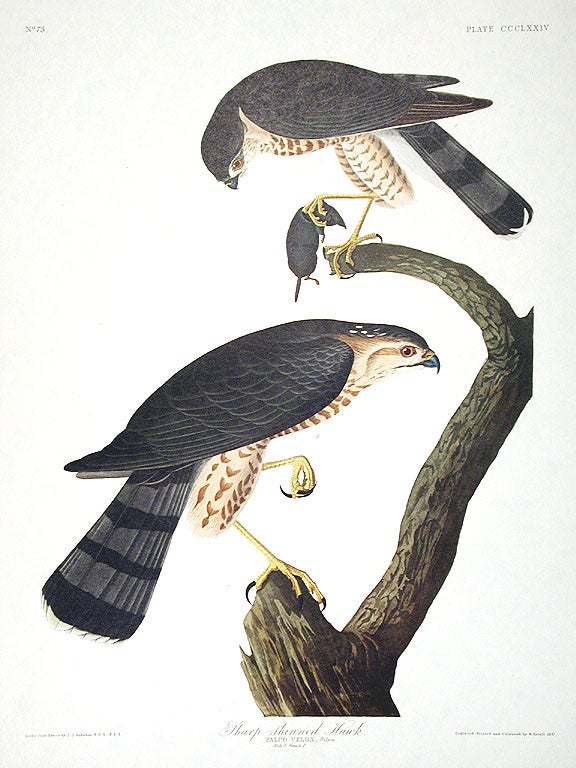
J. Farmer shot a sharp-shinned hawk this morning, which was endeavoring to catch one of his chickens. I bring it home and find that it measures seventeen inches in length and thirty in alar extent, and the tail extends four inches beyond the closed wings. It has a very large head, and the wing is six and a half inches wide at the secondaries. It is dark-brown above, skirted with ferruginous; scapulars, with white spots; legs, bright-yellow; iris, yellow. Has those peculiar pendulous lobes to the feet, which Farmer thinks are to enable it to hold a small bone of its prey between the nail and the lobe, as it feeds, while perching. The breast and belly feathers are shafted with dark-brown pointed spots. Vent white. There are three obvious slate-colored bars to tail, alternating with the black.

F. says that he has seen the nest of a smaller hawk, the pigeon hawk, heretofore, on an oak (in Owl-Nest Swamp), made of sticks, some fifteen feet from ground. R. Rice says that he has found the nest of the pigeon hawk hereabouts. 

We go to see a bittern nest by Spencer Brook. F. says they call the cardinal-flower “ slink-weed,” and say that the eating it will cause cows to miscarry. He calls the Viburnum nudum “withe-wood,” and makes a withe by treading on one end and twisting by the other till he cracks it and makes it flexible so that it will bend without breaking. 

The bittern’s nest was close to the edge of the brook, eighteen inches above the water, and was made of the withered sedge that had grown close by (i. e. wool-grass, etc.) and what I have called pages back Eleocharis tenuis. It was quite a deep nest, like and as big as a hen’s nest, deep in the grass. He or his son saw the young about it a month ago. 

He hears — heard a week ago — the sound of a bird flying over, like cra-a-ack, cr-r-r-a-k, only in the night, and thinks it may be a blue heron.

We saw where many cranberries had been frost-bitten, F. thinks the night of the 23d. They are much injured. 

Spiranthes cemua, how long? 

Near the bittern-nest, grows what F. calls blue-joint grass; out of bloom. 

Returning, rather late afternoon, we saw some forty martins sitting in a row and twittering on the ridge of his old house, apparently preparing to migrate. He had never seen it before. Soon they all took to flight and filled the air in the neighborhood. 

The sharp-shinned hawk of to-day is much larger than that of July 21st, though the colors, etc., etc., appear to be essentially the same. Yet its leg is not so stout as that which Farrar gave me, but is at least half an inch longer. The toes, especially, are longer and more slender, but I am not sure whether Farrar’s hawk has those pendulous lobes, the foot is so dry, nor if it had sharp-edged shin, it being eaten away by worms. The inner vanes of the primaries of Farrar’s bird are brighter white with much narrower bars of blackish. The longest primary of Farrar’s bird is about ten inches; that of to day, about eight inches. I find the outside tail-feathers of to-day’s bird much harder to pull than the inside ones!‘

Our black willow is of so peculiar and light a green, so ethereal, that, as I look back forty rods at those by the Heron Rock, their outlines are seen with perfect distinctness against the darker green of maples, etc., three or four rods behind them, as if they were a green cloud or smoke blown by. They are seen as distinctly against these other trees as they would be against the sky. 

Rice tells me a queer story. Some twenty-five years ago he and his brother William took a journey in their wagon into the northwest part of Maine, carrying their guns and fishing-tackle with them. At Fryeburg they visited the scene of Lovewell’s Fight, and, seeing some trout in the stream there, they tried to dig some fishworms for bait, but they could not find any. So they asked a boy where they got fishworms, but he did not know what they meant. “Long, slender worms, angle worms,” said they; but he only answered that he had seen worms in their manure-heap (which were grubs). On inquiring further, they found that the inhabitants had never seen nor heard of angleworms, and one old settler, who had come from Massachusetts and had lived there thirty years, declared that there was no such worm in that neighborhood. 

Mr. Farmer gave me a turtle-shaped bug found by Melvin on a board by the river, some time ago. 

I hear A. W. complained of for overworking his cattle and hired men, but there is this to be said in his favor, that he does not spare himself. They say that he made his horse “Tom” draw twenty-nine hundred of hay to Boston the other day, — or night, — but then he put his shoulder to the wheel at every hill. I hear that since then the horse has died, but W. is alive and working.

How hard one must work in order to acquire his language,—-words by which to express himself! I have known a particular rush, for instance, for at least twenty years, but have ever been prevented from describing some [of] its peculiarities, because I did not know its name nor any one in the neighborhood who could tell me it. With the knowledge of the name comes a distincter recognition and knowledge of'the thing. 

That shore is now more describable, and poetic even. My knowledge was cramped and confined before, and grew rusty be cause not used, — for it could not be used. My knowledge now becomes communicable and grows by communication. I can now learn what others know about the same thing.

H. D. Thoreau, Journal, August 29, 1858

The Assabet helianthus (apparently variety of decapetalus), well out some days at least. Are not the petals peculiarly reflexed? See August 29, 1856 ("To J. Farmer's by river. The Helianthus decapetalus, apparently a variety, with eight petals, about three feet high, leaves petioled, but not wing-petioled")

The sharp-shinned hawk of to-day is much larger than that of July 21st, yet its leg is not so stout as that which Farrar gave me. See July 21, 1858 ("A young man killed one of the young hawks, and I saw it. It was the Falco fuscus, the American brown or slate-colored hawk"); October 11, 1856 (“Farrar gave me a wing and foot of a hawk which he shot about three weeks ago . . . . This foot has a sharp shin and stout claws")  See also A Book of the Seasons, by Henry Thoreau, the sharp-shinned hawk.

With the knowledge of the name comes a distincter recognition and knowledge of'the thing. See August 20, 1851 ("Botany is worth studying if only for the precision of its terms, — to learn the value of words and of system."); March 1, 1852 (""There is a certain advantage in these hard and precise terms, such as the lichenist uses.); January 15, 1853 ("I have long known this dust, but, as I did not know the name of it, i. e . what others called it, I therefore could not conveniently speak of it, and it has suggested less to me and I have made less use of it. I now first feel as if I had got hold of it."); March 23, 1853 ("One studies books of science merely to learn the language of naturalists , — to be able to communicate with them.")

Saturday, July 21, 2018

It was the Falco fuscus, the American brown or slate-colored hawk.

July 21

Wednesday. Concord. P. M.—To Walden, with E. Bartlett and E. Emerson. 

The former wished to show me what he thought an owl’s nest he had found. Near it, in Abel Brooks’s wood lot, heard a note and saw a small hawk fly over. It was the nest of this bird. Saw several of the young flitting about and occasionally an old bird. 

The nest was in a middling-sized white pine, some twenty feet from the ground, resting on two limbs close to the main stem, on the south side of it. It was quite solid, composed entirely of twigs about as big round as a pipe-stem and less; was some fifteen inches in diameter and one inch deep, or nearly flat, and perhaps five inches thick. It was very much dirtied on the sides by the droppings of the young. 

As we were standing about the tree, we heard again the note of a young one approaching. We dropped upon the ground, and it alighted on the edge of the nest; another alighted near by, and a third a little further off. The young were apparently as big as the old, but still lingered about the nest and returned to it. 

I could hear them coming some distance off. Their note was a kind of peeping squeal, which you might at first suspect to be made by a jay; not very loud, but as if to attract the old and reveal their whereabouts. 

The note of the old bird, which occasionally dashed past, was somewhat like that of the marsh hawk or pigeon woodpecker, a cackling or clattering sound, chiding us. The old bird was anxious about her inexperienced young, and was trying to get them off. At length she dashed close past us, and appeared to fairly strike one of the young, knocking him off his perch, and he soon followed her off. 

I saw the remains of several birds lying about in that neighborhood, and saw and heard again the young and old there abouts for several days thereafter. 

A young man killed one of the young hawks, and I saw it. It was the Falco fuscus, the American brown or slate-colored hawk. 
J. J. Audubon
Sharp-shinned Hawk

Its length was thirteen inches; alar extent, twenty-three. The tail reached two or more inches beyond the closed wings. Nuttall says the upper parts are “a deep slate color” (these were very dark brown); also that the nest is yet unknown. But Wilson describes his F. velox (which is the same as Nuttall’s F. fuscus) as “whole upper parts very dark brown,” but legs, greenish-yellow (these were yellow). The toes had the peculiar pendulous lobes which W. refers to. 

As I saw it in the woods, I was struck by its dark color above, its tawny throat and breast, brown-spotted, its clean, slender, long yellow legs, feathered but little below the knee, its white vent, its wings distinctly and rather finely dark-barred beneath, short, black, much curved bill, and slender black sharp claws. Its tail with a dark bar near edge beneath. 

In hand I found it had the white spots on scapulars of the F. fuscus, and had not the white bars on tail of the F. Pennsylvanicus. It also had the fine sharp shin.

But what then is my hawk killed by Farrar, with so stout a leg? Had that any white bars on tail? 

H. D. Thoreau, Journal, July 21, 1858

In Abel Brooks’s wood lot, heard a note and saw a small hawk fly over. It was the Falco fuscus, the American brown or slate-colored hawk.
See May 4, 1855 (“Sitting in Abel Brooks’s Hollow, see a small hawk go over high in the air, with a long tail and distinct from wings. It advanced by a sort of limping flight yet rapidly, not circling nor tacking, but flapping briskly at intervals and then gliding straight ahead with rapidity, controlling itself with its tail. It seemed to be going a journey. Was it not the sharp-shinned, or Falco fuscus?  I think that what I have called the sparrow hawk falsely, and latterly pigeon hawk, is also the sharp-shinned (vide April 26th and May 8th, 1854, and April 16th, 1855), for the pigeon hawk’s tail is white-barred.”); September 22, 1852 ("Some of those I see are probably the sharp-shinned hawk.");  March 28, 1854 (“See a small slate-colored hawk, with wings transversely mottled beneath, — probably the sharp-shinned hawk.”); April 26, 1854 (“Saw probably a pigeon hawk skim straight and low over field and wood, and another the next day apparently dark slate-color.”); May 8, 1854 (“Saw a small hawk flying low, about size of a robin — tail with black bars”);  April 16, 1855 ( "What I call a pigeon hawk, probably sharp-shinned.”); ; April 25, 1860 ("Looking up, I see what I take to be a sharp-shinned hawk just alighting on the trees . . . The hawk plumes himself, and then flies off, rising gradually and beginning to circle, and soon it joins its mate, and soars with it high in the sky and out of sight. . . It appeared to have a plain reddish-fawn breast. The size more than anything made me think it a sharp-shin."). See also A Book of the Seasons, by Henry Thoreau, the sharp-shinned hawk. and   A Book of the Seasons by Henry Thoreau, The Pigeon Hawk (Merlin)

But what then is my hawk killed by Farrar, with so stout a leg? See October 11, 1856 (“Farrar gave me a wing and foot of a hawk which he shot about three weeks ago . . . . This foot has a sharp shin and stout claws, but the wing is much larger than that of the Falco fuscus (or sharp-shinned hawk), being, . . . the size of the F. Pennsylvanicus. ”)

Popular Posts Last 30 Days.

The week ahead in Henry’s journal

The week ahead in Henry’s journal
A journal, a book that shall contain a record of all your joy.
"A stone fruit. Each one yields me a thought." ~ H. D. Thoreau, March 28, 1859


I sit on this rock
wrestling with the melody
that possesses me.