Showing posts with label thistle. Show all posts

Monday, September 29, 2025

A Book of the Seasons: The Thistle and Thistle Down


I would make a chart of our life, 
know why just this circle of creatures 
completes the world.
Henry Thoreau, April 18, 1852

The thistle in bloom 
each child eager to clutch once - 
just a child's handful.
September 1850


March 10. Misty and mizzling. The radical leaves of the shepherd's-purse are common and fresh, also that early thistle by Nut Meadow Brook, with much down webbed, holding the mist in drops. March 10, 1854

March 29. I observe today the buttercup, very common, the pasture thistle, etc., etc., what perhaps are chickweeds? March 29, 1852

April 18. Observed a thistle just springing up in the meadow, a disk of green a few inches in diameter in the midst of the old decayed leaves, which, now being covered with rain-drops, beaded and edged - the close-packed leaves - with purple, made a very rich sight, not to be seen in dry weather. The green leaves of the thistle in a dense disk, edged with purple and covered with bead-like raindrops, just springing from the meadow. It reminded me of some delicious fruit, all ripe, quite flat. April 18, 1852

April 19. Observed the thistle again covered with the beads of rain-drops and tinged with purple on the edges of the leaves. It impressed me again as some rich fruit of the tropics ready to be eaten with a spoon. It suggests pineapples, custard-apples, or what is it? The pasture thistle April 19, 1852

June 18. Am surprised to find the Cirsium horridulum, or great yellow thistle, out, some already withering, turned a dark purple, possibly a week old.  June 18, 1854

June 24. Common yellow thistle [Cirsium horridulum] abundant about R’s; open a good while.  June 24, 1856

June 29. Canada thistle, yesterday. June 29, 1854

July 3.  The Canada thistle [Cirsium arvense]. July 3, 1853
July 6. Pasture thistle (Cirsium pumilum), out some time. A great many white ones.  July 6, 1855 [Cape Cod] 
July 9. Examine a lanceolate thistle which has been pressed and laid by a year. The papers being taken off, its head springs up more than an inch and the downy seeds begin to fly off. July 9, 1854
July 14.  Canada thistle some time on Huckleberry Pasture-side beyond. July 14, 1856
July 15.  To Ledum Swamp. First notice Canada thistle. July 15, 1859
July 17. Pasture thistle on Lee's Cliff, three or four days. July 17, 1854
July 19. Here is the Canada thistle in bloom, visited by butterflies and bees. July 19, 1851
July 22. The spear thistle [Cirsium lanceolatum] July 22, 1852
July 22. Spear-leaved thistle, apparently several days, some being withered. 
July 23. Cirsium pumilus, pasture thistle. July 23, 1852
July 23. Pasture thistle, not long. July 23, 1856 
July 25. On the farther hill in Hull, I saw a field full of Canada thistles close up to the fences on all sides, while beyond them there was none. So much for these fields having been subjected to different culture. July 25, 1851
July 29.  I found on the edge of this clearing the Cirsium muticum, or swamp thistle, abundantly in bloom. July 29, 1857  [the Maine Woods]
July 30. Is that goose-grass near yellow thistles? July 30, 1854

August 2. I see apparently a thistle-down over the river at Bittern Cliff; it is borne toward me, but when it reaches the rock some influence raises it high above the rock out of my reach. August 2, 1856
August 3.   Cirsium lanceolatum at Lee's Cliff, apparently some days. Its leaves are long-pointed and a much darker green than those of the pasture thistle.   On the under sides of its leaves I noticed very large ants attending peculiar large dark-colored aphides, for their milch cows.  August 3, 1856 
August 6. I find a bumblebee asleep in a thistle blossom (a pasture thistle)  the loiterer; having crowded himself in deep amid the dense florets, out of the reach of birds, while the sky was overcast. What a sweet couch!   August 6, 1852 
August 9. The notes of the wood pewee and warbling vireo are more prominent of late, and of the goldfinch twittering over. Does the last always utter his twitter when ascending? These are already feeding on the thistle seeds. August 9, 1856
August 9. The goldfinch nest of this forenoon is saddled on a horizontal twig of an apple,   . . . It is thickly and very warmly lined with (apparently) short thistle-down, mixed with which you see some grape-vine bark, and the rim is composed of the same shreds of bark, catkins, and some fine fibrous stems, and two or three hairs (of horse) mixed with wool (?); for only the hollow is lined with the looser or less tenacious thistle-down. This nest shows a good deal of art. August 9, 1858
August 12. I see goldfinches nowadays on the lanceolate thistles, apparently after the seeds.  It takes all the heat of the year to produce these yellow flowers. August 12, 1854
August 13. I see where the pasture thistles have apparently been picked to pieces (for their seeds? by the goldfinch?), and the seedless down strews the ground.  August 13, 1854
August 14. The Canada thistle down is now begun to fly, and I see the goldfinch upon it. August 14, 1858
August 15.  Cnicus pumilus, pasture thistle. How many insects a single one attracts ! While you sit by it, bee after bee will visit it, and busy himself probing for honey and loading himself with pollen, regardless of your over shadowing presence. He sees its purple flower from afar, and that use there is in its color.   August 15, 1851 
August 15.  On the top of the Hill I see the goldfinch eating the seeds of the Canada thistle. I rarely approach a bed of them or other thistles nowadays but I hear the cool twitter of the goldfinch about it.  August 15, 1854
August  19. The wind rises and the pasture thistle down is blown about. August 19, 1856
August  19.  I see thistle-down, grayish-white, floating low quite across Fair Haven Pond. There is wont to be just [wind] enough above the surface to drive it along. August 19, 1858
August 20.  Now the Canada thistle and the mullein crown their tops.  August 20, 1851
August 26. Radical leaves of the yellow thistle spot the meadow. August 25, 1854
August 26. As I stand there, a young male goldfinch darts away with a twitter from a spear thistle top close to my side, and, alighting near, makes frequent returns as near to me and the thistle as it dares pass, not yet knowing man well enough to fear him. August 26, 1856
August 28. A goldfinch twitters away from every thistle now, and soon returns to it when I am past. I see the ground strewn with the thistle-down they have scattered on every side. August 28, 1856 
August 30. The pasture thistle, though past its prime, is quite common, and almost every flower (i. e. thistle), wherever you meet with it, has one or more bumblebees on it, clambering over its mass of florets. . . . . . . Now that flowers are rarer, almost every one of whatever species has bees or butterflies upon it.  August 30, 1859
August 31Cirsium muticum, in Moore's Swamp behind Indian field, going out of flower; perhaps out three weeks.  August 31, 1853

September 1. This is a very warm and serene evening, and the surface of the pond is perfectly smooth except where the skaters dimple it, for at equal intervals they are scattered over its whole extent, and, looking west, they make a fine sparkle in the sun. Here and there is a thistle-down floating on its surface, which the fishes dart at, and dimple the water, --  a delicate hint of approaching autumn, when the first thistle-down descends on some smooth lake's surface, full of reflections, in the woods, sign to the fishes of the ripening year. These white faery vessels are annually wafted over the cope of their sky. Bethink thyself, O man, when the first thistle-down is in the air. Buoyantly it floated high in air over hills and fields all day, and now, weighed down with evening dews, perchance, it sinks gently to the surface of the lake. Nothing can stay the thistle-down, but with September winds it unfailingly sets sail. The irresistible revolution of time. It but comes down upon the sea in its ship, and is still perchance wafted to the shore with its delicate sails. The thistle-down is in the air. Tell me, is thy fruit also there? Dost thou approach maturity? September 1, 1852
September 1. The cherry-birds and robins seem to know the locality of every wild cherry in the town. You are as sure to find them on them now, as bees and butterflies on the thistles.  September 1, 1859 
September 4.The swamp thistle (Cirsium muticum) is apparently in its prime. One or two on each has faded, but many more are to come. Some are six feet high and have radical leaves nearly two feet long. Even these in the shade have humblebees on them . . . Three kinds of thistles are commonly out now, — the pasture, lanceolate, and swamp, — and on them all you are pretty sure to see one or two humblebees. They become more prominent and interesting in the scarcity of purple flowers. (On many you see also the splendid goldfinch, yellow and black like the humble-bee.) The thistles beloved of humblebees and goldfinches. September 4, 1859 
September 4. The goldfinch is very busy pulling the thistle to pieces. September 4, 1860 
September 5. I see much thistle-down without the seed floating on the river and a hummingbird about a cardinal-flower over the water’s edge. September 5, 1854. .  
September 6 At Brattlebotro . . . Cirsium discolor [field thistle], roadside below depot, apparently in prime, much like lanceolatum, but smaller leaves, whitish beneath and inner scales unarmed. September 6, 1856
September 9. I see very large plants of the lanceolate thistle, four feet high and very branching. September 9, 1860
September 13 I find the large thistle (Cirsium muticum) out of bloom, seven or eight rods, perhaps, north of the potato-field and seven feet west of ditch, amid a clump of raspberry vines. September 13, 1854 
September 21. Swamp thistle [Cirsium muticum], still abundant. September 21, 1858
September 24. Pasture thistle still. September 24, 1852
September 29On our way, near the Hosmer moraine, let off some pasture thistle-down. One steadily rose from my hand, freighted with its seed, till it was several hundred feet high, and then passed out of sight eastward. Its down was particularly spreading or open. Is not here a hint to balloonists?  Astronomers can calculate the orbit of that thistle-down called the comet, now in the northwest sky, conveying its nucleus, which may not be so solid as a thistle’s seed, some whither, but what astronomer can calculate the orbit of my thistle-down and tell where it will deposit its precious freight at last?
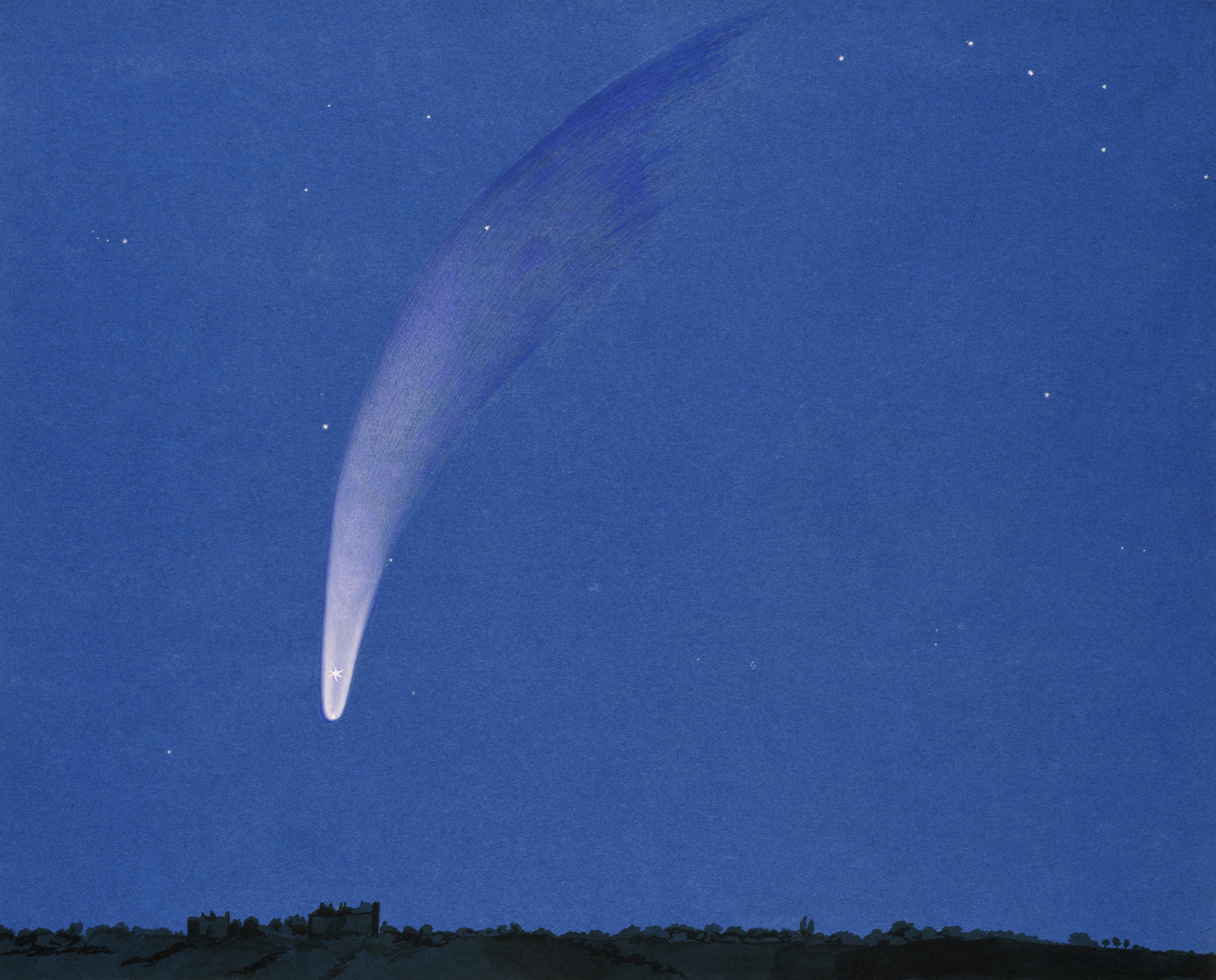
Donati’s Comet 1858
It may still be travelling when I am sleeping. September 29, 1858 

October 5.  I amuse myself on the hilltop with pulling to pieces and letting fly the now withered and dry pasture thistle tops. They have a much coarser pappus than the milkweeds. I am surprised, amid these perfectly withered and bleached thistles, to see one just freshly in flower.  October 5, 1856

Surprised amid these
withered thistles to see one
freshly in flower.

October 8.  The seeds of the pasture thistle are not so buoyed up by their down as the milkweed. October 8, 1851
October 11. A pasture thistle with many fresh flowers and bees on it. October 11, 1856 
October 12It is interesting to see how some of the few flowers which still linger are frequented by bees and other insects. Their resources begin to fail and they are improving their last chance. 
I have noticed them of late, especially on white goldenrod and pasture thistles, etc. October 12, 1856
October 18. A large pasture thistle bud close to the ground amid its leaves, as in spring. October 18, 1856
October 29.  Soapwort gentian and pasture thistle still.  October 29, 1855
October 23A pasture thistle on Conantum just budded, but flat with the ground. October 23, 1852

November 3.  The thistle radical leaves and fragrant everlasting not to be forgotten.  November 3, 1853
November 18. The fruitless enterprise of some persons who rush helter-skelter, carrying out their crazy scheme,—merely “putting it through,” as they phrase it, — reminds me of those thistle-downs which, not being detained nor steadied by any seed at the base, are blown away at the first impulse and go rolling over all obstacles. They may indeed go fastest and farthest, but where they rest at last not even a thistle springs. I meet these useless barren thistle-downs driving over the fields. They remind me of busy merchants and brokers on ’change doing business on credit, gambling with fancy stocks, that have failed over and over again, assisted to get a-going again to no purpose,—-a great ado about no thing, — all in my eye, — with nothing to deposit, not of the slightest use to the great thistle tribe, not even tempting a jackass. When you right or extricate one of these fellows and set him before the wind again, it is worth the while to look and see if he has any seed of success under him. Such a one you may know afar — he floats more slowly and steadily— and of his enterprise expect results. November18, 1858

December 23. At Lee’s Cliff I notice these radical(?) leaves quite fresh: saxifrage, sorrel, polypody, mullein, columbine, veronica, thyme-leaved sandwort, spleenwort, strawberry, buttercup, radical johnswort, mouse-ear, radical pinweeds, cinquefoils, checkerberry, Wintergreen, thistles, catnip, Turritis strictae specially fresh and bright. December 23, 1855 
January 25, I saw to-day, where a creeping juniper had been burnt, radical leaves of johnswort, thistle, clover, dandelion, etc., as well as sorrel and veronica. January 25, 1853
January 30.   There is also the early crowfoot in some places, strawberry, mullein, and thistle leaves, and hawkweeds, etc., etc. January 30, 1854
February 12. On those parts of the hill which are bare, I see the radical leaves of the butter-cup, mouse-ear, and the thistle.  February 12, 1854
February 18. The snow is nearly all gone, . . . I step excited over the moist mossy ground, dotted with the green stars of thistles, crowfoot, etc., the outsides of which are withered. February 18, 1857 
February 27.  Among the radical leaves most common, and therefore early-noticed, are the veronica and the thistle, - green in the midst of brown and decayed; and at the bottom of little hollows in pastures, now perhaps nearly covered with ice and water.  February 27, 1860 

We live as it were
like a bee asleep in a
thistle blossom.
August 6, 1852


A Book of the Seasons,  by Henry Thoreau
 "A book, each page written in its own season,
out-of-doors, in its own locality."
 ~edited, assembled and rewritten by zphx ©  2009-2025

Friday, July 23, 2021

To observe the sun set.


July 23

July 23, 2015 
As the light in the west fades, the sky there,
 seen between the clouds, has a singular clarity and serenity. 

P. M. – To Annursnack.

Herbage is drying up; even weeds are wilted, and the corn rolls.

Agriculture is a good school in which to drill a man. Successful farming admits of no idling.

Now is the haying season.

How active must these men be, all the country over, that they may get through their work in season! A few spoiled windrows, all black and musty, have taught them that they must make hay while the sun shines, and get it in before it rains.

Much that I had taken to be the lanceolate loosestrife is the heart-leaved, especially by the Corner road.

Pycnanthemum muticum
, mountain mint. Have I not mistaken this for the other species heretofore? 

The dwarf choke-cherry is ripe now, long before the rum cherry.
Also the Pyrus arbutifolia.

Cnicus pumilus, pasture thistle. [Cirsium pumilum.]

Chenopodium hybridum, maple-leaved goose-foot.

What is that white hairy plant with lanceolate leaves and racemes now, with flat burs, one to three, and a long spine in the midst, and five ovate calyx-leaves left (these turned to one side of the peduncle), burs very adhesive, close to road in meadow just beyond stone bridge on right; long out of bloom? 

Every man says his dog will not touch you. Look out, nevertheless.


Twenty minutes after seven, I sit at my window to observe the sun set.

The lower clouds in the north and southwest grow gradually darker as the sun goes down, since we now see the side opposite to the sun, but those high overhead, whose under sides we see reflecting the day, are light.

The small clouds low in the western sky were at first dark also, but, as the sun descends, they are lit up and aglow all but their cores.

Those in the east, though we see their sunward sides, are a dark blue, presaging night, only the highest faintly glowing.

A roseate redness, clear as amber, suffuses the low western sky about the sun, in which the small clouds are mostly melted, only their golden edges still revealed.

The atmosphere there is like some kinds of wine, perchance, or molten cinnabar, if that is red, in which also all kinds of pearls and precious stones are melted.

Clouds generally near the horizon, except near the sun, are now a dark blue.

(The sun sets.) It is half past seven.

The roseate glow deepens to purple.

The low western sky is now, and has been for some minutes, a splendid map, where the fancy can trace islands, continents, and cities beyond compare.

The glow forsakes the high eastern clouds; the uppermost clouds in the west now darken, the glow having forsaken them too; they become a dark blue, and anon their undersides reflect a deep red, like heavy damask curtains, after they had already been dark.

The general redness gradually fades into a pale reddish tinge in the horizon, with a clear white light above it, in which the clouds grow more conspicuous and darker and darker blue, appearing to follow in the wake of the sun, and it is now a quarter to eight, or fifteen minutes after sunset, twenty-five minutes from the first.

A quarter of an hour later, or half an hour after sunset, the white light grows cream colored above the increasing horizon redness, passing through white into blue above.

The western clouds, high and low, are now dark fuscous, not dark blue, but the eastern clouds are not so dark as the western.

Now, about twenty minutes after the first glow left the clouds above the sun's place, there is a second faint fuscous or warm brown glow on the edges of the dark clouds there, sudden and distinct, and it fades again, and it is early starlight, but the tops of the eastern clouds still are white, reflecting the day.

The cream color grows more yellowish or amber.

About three quarters of an hour after sunset the evening red is deepest, i. e. a general atmospheric redness close to the west horizon.

There is more of it, after all, than I expected, for the day has been clear and rather cool, and the evening red is what was the blue haze by day.

The moon, now in her first quarter, now begins to preside, 
 her light to prevail, — though for the most part eclipsed by clouds.

As the light in the west fades, the sky there, seen between the clouds, has a singular clarity and serenity.

H. D. Thoreau, Journal, July 23, 1852

Now is the haying season. See August 5, 1854 ("We are now in the midst of the meadow-haying season.") See also A Book of the Seasons,  by Henry Thoreau, Haymaking

Much that I had taken to be the lanceolate loosestrife is the heart-leaved, especially by the Corner road.
See July 22, 1852 ("Is not that the Lysimachia ciliata, or hairy-stalked loosestrife, by the Corner road, not the lanceolata?"); July 24, 1853 ("Lysimachia ciliata and, by the causeway near, the ovate-leaved, quite distinct from the lanceolate")

Cnicus pumilus, pasture thistle. See July 23, 1856 ("Pasture thistle, not long.") See also  August 6, 1852 ("I find a bumblebee asleep in a thistle blossom (a pasture thistle)") August 15, 1851 ("Cnicus pumilus, pasture thistle. How many insects a single one attracts ! While you sit by it, bee after bee will visit it, and busy himself probing for honey and loading himself with pollen, regardless of your over shadowing presence. He sees its purple flower from afar, and that use there is in its color."); October 11, 1856 ("A pasture thistle with many fresh flowers and bees on it.")

The dwarf choke-cherry is ripe now. See July 13, 1852 ("The northern wild red cherry of the woods is ripe, handsome, bright red, but scarcely edible; also, sooner than I expected, ") July 18, 1853 ("The Cerasus Virginiana, or choke-cherry, is turning, nearly ripe.") and note to July 25, 1853 ("Cerasus Virginiana, — choke-cherry, — just ripe."); also  August 15, 1852 ("The red choke-berry is small and green still. I plainly distinguish it, also, by its woolly under side.); August 21, 1854 ("Red choke-berries are dried black; ripe some time ago."); August 25, 1854 (Choke-berries are very abundant there, but mostly dried black."); See also July 19, 1852 ("The Cerasus pumila ripe.");July 28, 1856 ("Sand cherry ripe. The fruit droops in umble-like clusters, two to four peduncles together, on each side the axil of a branchlet or a leaf.") August 10, 1860 ("Sand cherry is well ripe — some of it — and tolerable, better than the red cherry or choke-cherry."); August 11, 1852 ("The rum cherry is ripe."); August 15, 1852 (' In E. Hubbard's swamp I gather some large and juicy and agreeable rum cherries. They are much finer than the small ones on large trees; quite a good fruit. The birds make much account of them.")

Also the Pyrus arbutifolia. [Black choke-berry]  See July 19, 1854 ("Black choke-berry, several days."); July 24, 1853 ("The black choke-berry, probably some days."); August 12, 1858 ("I am also interested in the rich-looking glossy black choke-berries which nobody eats, but which bend down the bushes on every side,—sweetish berries with a dry, and so choking, taste. Some of the bushes are more than a dozen feet high."); September 6, 1857 (" I see in the swamp black choke berries twelve feet high at least and in fruit.")

I sit at my window to observe the sun set. See December 23, 1851 ("I see that there is to be a fine, clear sunset, and make myself a seat in the snow on the Cliff to witness it."); December 25, 1851 (“I go forth to see the sun set. Who knows how it will set, even half an hour beforehand ?”); January 20, 1852 ("To see the sun rise or go down every day would preserve us sane forever,”); June 5, 1854 ("I have come to this hill to see the sun go down, to recover sanity and put myself again in relation with Nature."); August 14, 1854 ("I have come forth to this hill at sunset to see the forms of the mountains in the horizon, — to behold and commune with something grander than man.”); November 4, 1857 ("I climb Pine Hill just as the sun is setting,"); November 13, 1857 ("See the sun rise or set if possible each day."); December 23, 1859 ("I ascended Ball's Hill to see the sun set.")

About three quarters of an hour after sunset the evening red is deepest. See July 20, 1852 ("And now the evening redness deepens till all the west or northwest horizon is red; as if the sky were rubbed there with some rich Indian pigment, a permanent dye; as if the Artist of the world had mixed his red paints on the edge of the inverted saucer of the sky. An exhilarating, cheering redness, most wholesome."); July 21, 1852 ("Do we perceive such a deep Indian red after the first starlight at any other season as now in July?"); July 26, 1852 ("The grandest picture in the world is the sunset sky")

As the light in the west fades, the sky there, seen between the clouds, has a singular clarity and serenity. See December 14, 1852 ("Ah, who can tell the serenity and clarity of a New England winter sunset? "); January 17, 1852 ("Those western vistas through clouds to the sky show the clearest heavens, clearer and more elysian than if the whole sky is comparatively free from clouds. As the skies appear to a man, so is his mind. Some see only clouds there; some behold there serenity, purity, beauty ineffable.") See also A Book of the Seasons, by Henry Thoreau, the Western Sky

July 23. See A Book of the Seasons, by Henry Thoreau, July 23

A Book of the Seasons, by Henry Thoreau
"A book, each page written in its own season,
out-of-doors, in its own locality.” 
~edited, assembled and rewritten by zphx © 2009-2021

Saturday, January 30, 2021

The most common and conspicuous green leaf on the ground when the snow is off at this season.


January 30.  

Buda  January 30 2021


The most common and conspicuous green leaf on the ground when the snow is off at this season, as at present, is that of the buttercup. 

Sorrel is also very common, and johnswort, and the purplish gnaphaliums. There is also the early crowfoot in some places, strawberry, mullein, and thistle leaves, and hawkweeds, etc., etc.

On Cliffs.

The westering sun is yet high above the horizon, but, concealed by clouds, shoots down to earth on every side vast misty rays like the frame of a tent, to which clouds perchance are the canvas, under which a whole country rests. 

BTV February 1, 2023

The northern and southern rays appear very much slanted and long; those between us and the west, steeper and shorter.

What I have called the Shrub Oak Plain contains comparatively few shrub oaks, — rather, young red and white and, it may be, some scarlet (?).

The shrub oak leaf is the firmest and best preserved. The white oak is the most sere and curled and brittle, frequently with discolored, mould-like spots.

H. D Thoreau, Journal, January 30, 1853


The most common and conspicuous green leaf on the ground when the snow is off at this season, as at present, is that of the buttercup.
See November 8, 1858 ("The now more noticeable green radical leaves of the buttercup in the russet pastures remind me of the early spring to come, of which they will offer the first evidence."); January 9, 1853 ("On the face of the Cliff the crowfoot buds lie unexpanded just beneath the surface"); January 25, 1853 ("The buttercup leaves appear everywhere when the ground is bare.);  February 18, 1857 ("The snow is nearly all gone, and . . . I step excited over the moist mossy ground, dotted with the green stars of thistles, crowfoot, etc., the outsides of which are withered."); February 23, 1860 ("I walk over the moist Nawshawtuct hillside and see the green radical leaves of the buttercup"); February 28, 1857 ("At the Cliff, the tower-mustard, early crowfoot, and perhaps buttercup appear to have started of late.")

The westering sun, concealed by clouds, shoots down to earth on every side vast misty rays. See August 9, 1851 ("It was a splendid sunset that day, a celestial light on all the land, so that all people went to their doors and windows to look on the grass and leaves and buildings and the sky. . . We were in the westernmost edge of the shower at the moment the sun was setting, and its rays shone through the cloud and the falling rain. We were, in fact, in a rainbow.")

The shrub oak leaf is the firmest and best preserved. The white oak is the most sere and curled and brittle. See October 2, 1852 ("From Cliffs the shrub oak plain has now a bright-red ground, perhaps of maples.");  October 13, 1852 ("The shrub oak plain is now a deep red, with grayish, withered, apparently white oak leaves intermixed."); November 3, 1852 ("The shrub oak plain is all withered."); May 14, 1855 ("All the oak leaves off the shrub oak plain, except apparently a few white oaks.")

Thursday, September 24, 2020

Some hickories are yellow.


September 24.

According to Emerson, Lonicera hirsuta, hairy honeysuckle, grows in Sudbury.

Some hickories are yellow. 

Hazel bushes a brownish red. 

Most grapes are shrivelled.

Pasture thistle still.

The zizania ripe, shining black, cylindrical kernels, five eighths of an inch long.

The fruit of the thorn trees on Lee's Hill is large, globular, and gray-dotted, but I cannot identify it certainly.

H. D. Thoreau, Journal, September 24, 1852


Some hickories are yellow. See note to October 4, 1858 ("The hickories on the northwest side of this hill are in the prime of their color, of a rich orange; some intimately mixed with green, handsomer than those that are wholly changed") and  October 8, 1856 ("The hickory leaves are among the handsomest now, varying from green through yellow."); October 10, 1857 ("Generally speaking, chestnuts, hickories, aspens, and some other trees attain a fair clear yellow only in small specimens in the woods or sprout-lands, or in their lower leaves.");October 15, 1858 ("Small hickories are the clearest and most delicate yellow in the shade of the woods.")

The zizania ripe, shining black, cylindrical kernels, five eighths of an inch long. [Zizania aquatica var. aquatica ( Annual wild rice)] See July 22, 1854 ("Zizania, a day, with a handsome light-green panicle a foot or more long, a long slender stem, and corn-like leaves frequently more than an inch wide"); August 14, 1859 ("The zizania now makes quite a show along the river."); August 18, 1854  ("The zizania on the north side of the river near the Holt, or meadow watering-place, is very conspicuous and abundant."); August 24, 1858 ("The zizania is the greater part out of bloom; i. e., the yellowish-antlered (?) stamens are gone; the wind has blown them away"); September 3, 1858 ("Zizania still."); September 16, 1860 ("See no zizania seed ripe, or black, yet, but almost all is fallen."); September 25, 1858 ("The zizania fruit is green yet, but mostly dropped or plucked. Does it fall, or do birds pluck it?")

The fruit of the thorn trees on Lee's Hill is large, globular, and gray-dotted, but I cannot identify it certainly. See September 23, 1852 ("I gathered some haws very good to eat to-day."); September 24, 1859 ("Those thorns by Shattuck's barn, now nearly leafless, have hard green fruit as usual.");  September 25, 1856  ("The haws of the common thorn are now very good eating and handsome."); September 25, 1856 ("the Crataegus Crus-Galli on the old fence line between Tarbell and T. Wheeler beyond brook are smaller, stale, and not good at all. “); See also   May 21, 1853 ("There are, apparently, two kinds of thorns close together on Nawshawtuct,"); June 6, 1857 ("There is a thorn now in its prime. . .with leaves more wedge-shaped at base than the Cratcegus coccinea; apparently a variety of it, between that and Crus-Galli."); September 4, 1853 ("The scarlet thorn is in many places quite edible and now a deep scarlet."); September 13, 1859("Some haws of the scarlet thorn are really a splendid fruit to look at now and far from inedible. "); October 5, 1857 ("I see many haws still green and hard, though their leaves are mostly fallen. Do they ever turn red and edible?")

Wednesday, September 9, 2020

The Concord River at Lowell


In Lowell.-- My host says that the thermometer was at 80° yesterday morning, and this morning is at 52º. 

Sudden coolness.

Clears up in afternoon, and I walk down the Merrimack on the north bank.

I see very large plants of the lanceolate thistle, four feet high and very branching.


Also Aster cordata with the corymbosus.

Concord River has a high and hard bank at its mouth, maybe thirty feet high on the east side; and my host thinks it was originally about as high on the west side, where now it is much lower and flat, having been dug down.

There is a small isle in the middle of the mouth.

There are rips in the Merrimack just below the mouth of the Concord.

There is a fall and dam in the Concord at what was Hurd's factory, — the principal fall on the Concord, in Lowell, — one at a bleachery above, and at Whipple's, — three in all below Billerica dam.


H.D. Thoreau, Journal, September 9, 1860

Wednesday, September 4, 2019

The earth itself appears to me as a ripe purple fruit.

September 4

P. M. — To Well Meadow and Walden.

The purple culms and spikes of the crab-grass or finger-grass, spreading and often almost prostrate under our feet in sandy paths and causeways, are where the purple cuticle of the earth again shows itself, and we seem to be treading in our vintage whether we will or not. Earth has donned the purple. 

When, walking over some dry field (some time since), I looked down and saw the yellowish tuft of the Fimbristylis capillaris, with its spreading inverted cone of capillary culms, like the upper half of an hour-glass, but still more, when, pacing over the sandy railroad causeway, I look down and find myself treading on the purple culms of the crab-grass, I am reminded of the maturity of the year. 

We have now experienced the full effects of heat such as we have in this latitude. The earth itself appears to me as a ripe purple fruit, — though somewhat dusty here, — and I may have rubbed the bloom off with my feet. But if Bacchus can ever stand our climate, this must be his season. 

Topping the corn, which has been going on some days, now reveals the yellow and yellowing pumpkins. This is a genuine New England scene. The earth blazes not only with sun-flowers but with sun-fruits. 

The four-leaved loosestrife, which is pretty generally withering and withered, seems to have dried up, — to suffer peculiarly from the annual drought, — perhaps both on account of its tenuity and the sandiness or dryness of its locality. 

The Lycopodium complanatum sheds pollen [sic]. 

Where are the robins and red-wing blackbirds of late? I see no flocks of them; not one of the latter, and only a few solitary robins about wild cherry trees, etc.

 A few yew berries, but they appear (?) to be drying up. The most wax-like and artificial and surprising of our wild berries, — as surprising as to find currants on hemlocks. 

In the Well Meadow Swamp, many apparent Aster miser, yet never inclining to red there (in the leaf) and sometimes with larger flowers (five eighths of an inch [in] diameter) and slenderer cauline leaves than common, out apparently almost as long as miser elsewhere. 

The swamp thistle (Cirsium muticum) is apparently in its prime. One or two on each has faded, but many more are to come. Some are six feet high and have radical leaves nearly two feet long. Even these in the shade have humblebees on them. 

You see small flocks of ducks, probably wood ducks, in the smaller woodland ponds now and for a week, as I at Andromeda Ponds, and can get nearer to them than in the spring. 

The Cornus sericea and C. paniculata are rather peculiar for turning to a dull purple on the advent of cooler weather and frosts, in the latter part of August and first part of September. The latter, which grows at the bottom of our frostiest hollows, turns a particularly clear dark purple, an effect plainly attributable to frost. 

I see it this afternoon in the dry, deep hollow just west of the middle Andromeda Pond. 

I think I see two kinds of three-ribbed goldenrod (beside Canadensis), both being commonly smooth-stemmed below and downy above, but one has very fine or small rays as compared with the other. They appear to be both equally common now. The fine-rayed at Sedge Path. 

See a very large mass of spikenard berries fairly ripening, eighteen inches long. 

Three kinds of thistles are commonly out now, — the pasture, lanceolate, and swamp, — and on them all you are pretty sure to see one or two humblebees. They be come more prominent and interesting in the scarcity of purple flowers. (On many you see also the splendid goldfinch, yellow and black (?) like the humble-bee.) The thistles beloved of humblebees and goldfinches. 

Three or four plants are peculiar now for bearing plentifully their fruit in drooping cymes, viz. the elder berry and the silky cornel and the Viburnum Lentago and Solanum Dulcamara

The other cornels do not generally come to droop before they lose their fruit. Nor do the viburnums droop much. The fruit of the Cornus sericea is particularly interesting to me, and not too profuse, — small cymes of various tints half concealed amid the leaves.


H. D. Thoreau, Journal, September 4, 1859

The purple culms and spikes of the crab-grass or finger-grass. See September 4, 1858 ("P[anicum]. sanguinale, crab grass, finger grass, or purple panic grass")

The earth blazes not only with sun-flowers but with sun-fruits. See October 6, 1857 ("The very pumpkins yellowing in the fields become a feature in the landscape, and thus they have shone, maybe, for a thousand years here.")

Where are the robins and red-wing blackbirds of late? I see no flocks of them; not one of the latter. See September 20, 1859 ("Where are the red-wings now? I have not seen nor heard one for a long time")

The swamp thistle (Cirsium muticum) is apparently in its prime. See July 29, 1857 (" [the Maine Woods--} Cirsium muticum, or swamp thistle, abundantly in bloom."); September 13, 1854 ("I find the large thistle (Cirsium muticum) out of bloom,")

 The Cornus sericea and C. paniculata are rather peculiar for turning to a dull purple on the advent of cooler weather and frosts, in the latter part of August and first part of September. The fruit of the Cornus sericea is particularly interesting to me, and not too profuse, — small cymes of various tints half concealed amid the leaves. See September 4, 1857 ("Cornus sericea berries begin to ripen").; September 1, 1854 ("The Cornus sericea berries are now in prime, of different shades of blue, lighter or darker, and bluish white."); August 31, 1856 (“The Cornus sericea, with its berries just turning, is generally a dull purple now "); August 28, 1856 ("The bright china-colored blue berries of the Cornus sericea begin to show themselves along the river.”)

Three kinds of thistles are commonly out now, — the pasture, lanceolate, and swamp, — . . . The thistles beloved of humblebees and goldfinches. See September 4, 1860  ("The goldfinch is very busy pulling the thistle to pieces") and  A Book of the Seasons, by Henry Thoreau, the Thistles.See also A Book of the Seasons, by Henry Thoreau the Goldfinch

Friday, August 30, 2019

The prevailing flowers at present time,


August 30.

P. M. — Up Assabet. 

August 30, 2019

The river began to fall perhaps yesterday, after rising perhaps fourteen or fifteen inches. It is now about one foot higher than before the rain of the 25th. A rise of one foot only from low water gives an appearance of fullness to the stream, and though the meadows were dry before, it would now be difficult to work on them. 

The potamogetons, etc., are drowned, and you see a full rippling tide where was a sluggish and weedy stream but four or five days ago. Now, perhaps, will be the end of quite a number of plants which culminate in dry weather when the river is low, as some potamogetons, limnanthemum (in the river), etc. 

Sparganium and heart-leaf are washed up, and the first driftwood comes down; especially portions of bridges that have been re paired take their way slowly to the sea, if they are not saved by some thrifty boatman. 

The river is fuller, with more current; a cooler wind blows; the reddish Panicum agrostoides stands cool along the banks; the great yellow flowers of the Bidens chrysanthemoides are drowned, and now I do not see to the bottom as I paddle along. 

The pasture thistle, though past its prime, is quite common, and almost every flower (i. e. thistle), wherever you meet with it, has one or more bumblebees on it, clambering over its mass of florets. One such bee which I disturb has much ado before he can rise from the grass and get under weigh, as if he were too heavily laden, and at last he flies but low. 

Now that flowers are rarer, almost every one of whatever species has bees or butterflies upon it. 

Now is the season of rank weeds, as Polygonum Careyi, tall rough goldenrod, Ambrosia elatior, primrose, erechthites (some of this seven feet high), Bidens frondosa (also five feet high). 

The erechthites down has begun to fly. 

We start when we think we are handling a worm, and open our hands quickly, and this I think is designed rather for the protection of the worm than of ourselves. 

Acorns are not fallen yet. Some haws are ripe. 


How is it with the trilllium?
  

The plants now decayed and decaying and withering are those early ones which grow in wet or shady places, as hellebore, skunk-cabbage, the two (and perhaps three) smilacinas, uvularias, polygonatum, medeola, Senecio aureus (except radical leaves), and many brakes and sarsaparillas, and how is it with trilliums and arums? 

The prevailing flowers, considering both conspicuous- ness and numbers, at present time, as I think now:

  • Solidagos, especially large three-ribbed, nemoralis, tall rough, etc. 
  • Asters, especially Tradescanti, puniceus, corymbosus, dumosus, Diplopappus umbellatus 
  • Tansy 
  • Helianthuses, as Helianthus decapetalus, divaricatus, annum, etc. 
  • Eupatoriums, as perfoliatum, purpureum 
  • Mikania 
  • Polygonums, as P. Careyi, dumetorum, front-rank, Persicaria, sagittaium, etc. 
  • Gnaphalium, as polycephalum and pearly 
  • Bidens, as frondosa and chrysanthemoides
  • Gerardias, as purpurea and pediculata 
  • Hieraciums, as Canadense, scabra, and paniculatum 
  • Vernonia 
  • Polygala sanguinea, etc. 
  • Liatris 
  • Nabalus albus 
  • Mints, as lycopuses, white mint, pycnanthemums 
  • Hypericums, the small ones of all kinds 
  • Leontodon autumnalis (prevailing, open in forenoon) 
  • Pontederia 
  • Sagittaria variabilis 
  • Desmodiums 
  • Spiranthes cernua 
  • Lespedeza vidacea 
  • Cuscuta 
  • Rhexia 
  • Lobelia cardinalis 
  • Cirsium pumilum 
  • Chenopodiums 
  • Scutellaria lateriflora 
  • Impatiens 
  • Apios 
  • Linaria vulgaris 
  • Gratiola aurea


H. D. Thoreau, Journal, August 30, 1859

How is it with trilliums and arums? See August 19, 1852 ("The trillium berries, six-sided, one inch in diameter, like varnished and stained cherry wood, glossy red, crystalline and ingrained, concealed under its green leaves in shady swamps."); August 21, 1854 ("Trillium berries bright red.");  August 28, 1856 ("See the great oval masses of scarlet berries of the arum now in the meadows. Trillium fruit, long time."); September 1, 1851("The fruit of the trilliums is very handsome.. . .a dense crowded cluster of many ovoid berries turning from green to scarlet or bright brick color.") ; September 1, 1859 ("The scarlet fruit of the arum spots the swamp floor."); September 2, 1853 (" The dense oval bunches of arum berries now startle the walker in swamps. They are a brilliant vermilion on a rich ground.”); September 4, 1856 ("Splendid scarlet arum berries there now in prime.”); September 4, 1857 ("Arum berries ripe.”); September 24, 1856 ("Aarum berries still fresh"); September 28, 1856 ("The arum berries are still fresh and abundant, perhaps in their prime. A large cluster is two and a half inches long by two wide and rather flattish. . . . These singular vermilion-colored berries, about a hundred of them, surmount a purple bag on a peduncle six or eight inches long. ")

Popular Posts Last 30 Days.

The week ahead in Henry’s journal

The week ahead in Henry’s journal
A journal, a book that shall contain a record of all your joy.
"A stone fruit. Each one yields me a thought." ~ H. D. Thoreau, March 28, 1859


I sit on this rock
wrestling with the melody
that possesses me.