Showing posts with label thought. Show all posts

Sunday, March 1, 2020

Thoughts as I walk running in my head

March 1

Rain all day. This will apparently take the frost out very much and still further settle the ways. 

March 1, 2019

It was already yesterday pretty good bare-ground walking on the north side the street. Yesterday was a dark, louring, moist day and still. The afternoon before, the wind was east, and I think that a storm (snow or rain) always succeeds. 

To-day is a still, dripping spring rain, but more fell in the night. It makes the walking worse for the time, but if it does not freeze again, will greatly help to settle the ways. 

I have thoughts, as I walk, on some subject that is running in my head, but all their pertinence seems gone before I can get home to set them down. The most valuable thoughts which I entertain are anything but what I thought. Nature abhors a vacuum, and if I can only walk with sufficient carelessness I am sure to be filled.

H. D. Thoreau, Journal, March 1, 1860

Rain all day. This will apparently take the frost out very much and still further settle the ways. See March 5, 1860("Ways fairly settled generally. "); March 15, 1860 ("Though it is pretty dry and settled travelling on open roads, it is very muddy still in some roads through woods, as the Marlborough road or Second Division road. ");  March 19, 1860 ("The road and paths are perfectly dry and settled in the village, except a very little frost still coming out on the south side the street");; See also February 18, 1857 (" The frost out of the ground and the ways settled in many places."); March 17, 1853 ("The ways are mostly settled, frozen dry."); March 21, 1858 ("This first spring rain . . .helps take the remaining frost out and settles the ways. “)

The afternoon before, the wind was east, and I think that a storm (snow or rain) always succeeds. See March 30, 1852 (“To-day, as frequently for some time past, we have a raw east wind, which is rare in winter.”); September 15, 1858 (“There is a southeast wind, with clouds, and I suspect a storm brewing. It is very rare that the wind blows from this quarter.”); September, 16, 1858 ("A southeast storm. . . . The trees are unprepared to resist a wind from this quarter. ") see also March 24, 1860 ("During the year the wind [at Cambridge] was southwest 130 days, northwest 87, northeast 59, south 33, west 29, east 14, southeast 10, north 3 days.”); May 2, 1860 (“Since (perhaps) the middle of April we have had much easterly (northeast chiefly) wind, and yet no rain, though this wind rarely fails to bring rain in March.”)

I have thoughts, as I walk, on some subject that is running in my head, but all their pertinence seems gone before I can get home to set them down. Compare August 21, 1851 ("A man may walk abroad and no more see the sky than if he walked under a shed.");  February 12, 1860 ("Surrounded by our thoughts or imaginary objects, living in our ideas, not one in a million ever sees the objects which are actually around him."); Walking (“I am alarmed when it happens that I have walked a mile into the woods bodily, without getting there in spirit . . . But sometimes it happens that I cannot easily shake off the village. The thought of some work will run in my head and I am not where my body is. I am out of my senses. In my walks I would fain return to my senses. What business have I in the woods, if I am thinking of something out of the woods?” ) with June 14, 1853 (“This seems the true hour to be abroad sauntering far from home. Your thoughts being already turned toward home, your walk in one sense ended, you are in that favorable frame of mind described by De Quincey, open to great impressions, and you see those rare sights with the unconscious side of the eye, which you could not see by a direct gaze before. Then the dews begin to descend in your mind, and its atmosphere is strained of all impurities; and home is farther away than ever. Here is home; the beauty of the world impresses you. There is a coolness in your mind as in a well. Life is too grand for supper.")

March 1.  See A Book of the Seasons,  by Henry Thoreau,   March 1

I have thoughts as I
walk on some subject that is 
running in my head.

A Book of the Seasons,  by Henry Thoreau, Thoughts as I walk running in my head.

A Book of the Seasons
,  by Henry Thoreau
 "A book, each page written in its own season,
out-of-doors, in its own locality."
 ~edited, assembled and rewritten by zphx ©  2009-2025


Thursday, February 13, 2020

What a variety of distinct colors the winter can show us


February  13

2 p. m. — Down river. Thermometer 38°. Warm; a cloud just appearing in the west. 

That hard meadow just below the boys' bathing- place below the North Bridge is another elfin burial- ground. It would be a bad place to walk in a dark night. The mounds are often in ridges, even as if turned up by the plow. 

Water overflowing the ice at an opening in the river, and mixing with thin snow, saturating it, seen now on one side at right angles with the sun's direction, is as black as black cloth. 

It is surprising what a variety of distinct colors the winter can show us, using but few pigments, so to call them. The principal charm of a winter walk over ice is perhaps the peculiar and pure colors exhibited.

There is the red of the sunset sky, and of the snow at evening, and in rainbow flocks during the day, and in sun-dogs. 

The blue of the sky, and of the ice and water reflected, and of shadows on snow. 

The yellow of the sun and the morning and evening sky, and of the sedge (or straw-color, bright when lit on edge of ice at evening), and all three in hoar frost crystals. 

Then, for the secondary, there is the purple of the snow in drifts or on hills, of the mountains, and clouds at evening. 

The green of evergreen woods, of the sky, and of the ice and water toward evening. 

The orange of the sky at evening. 

The white of snow and clouds, and the black of clouds, of water agitated, and water saturating thin snow on ice. 

The russet and brown and gray, etc., of deciduous woods. 

The tawny of the bare earth. 

I suspect that the green and rose (or purple) are not noticed on ice and snow unless it is pretty cold, and perhaps there is less greenness of the ice now than in December, when the days were shorter. 

The ice may now be too old and white. 

Those horn, knob, and rake icicles on the southeast sides of all open places — or that were open on the 10th near enough to the bushes — are suddenly softening and turning white on one side today, so that they remind me of the alabaster (?) or plaster images on an Italian's board. 

All along the ice belt or shelf — for the river has fallen more than a foot — countless white figures stand crowded, their minute cores of sedge or twigs being concealed. Some are like beaks of birds, — cranes or herons. Having seen this phenomenon in one place, I know with certainty in just how many places and where, throughout the town, — four or five, — I shall find these icicles, on the southeast sides of the larger open places which approached near enough to a bushy or reedy shore. 

The grass comes very nearly being completely en crusted in some places, but commonly rounded knobs stand up. 

The ground being bare, I pick up two or three arrow heads in Tarbell's field near Ball's Hill. There is nothing more affecting and beautiful to man, a child of the earth, than the sight of the naked soil in the spring. I feel a kindredship with it. 

The sun being in a cloud, partly obscured, I see a very dark purple tinge on the flat drifts on the ice earlier than usual, and when afterward the sun comes out below the cloud, I see no purple nor rose. Hence it seems that the twilight has as much or more to do with this phenomenon, supposing the sun to be low, than the slight angle of its rays with the horizon.  

Always you have to contend with the stupidity of men. It is like a stiff soil, a hard-pan. If you go deeper than usual, you are sure to meet with a pan made harder even by the superficial cultivation. The stupid you have always with you. Men are more obedient at first to words than ideas. They mind names more than things. Read to them a lecture on "Education," naming that subject, and they will think that they have heard some thing important, but call it "Transcendentalism," and they will think it moonshine. 

Or halve your lecture, and put a psalm at the beginning and a prayer at the end of it and read it from a pulpit, and they will pronounce it good without thinking. 

The Scripture rule, "Unto him that hath shall be given," is true of composition. The more you have thought and written on a given theme, the more you can still write. Thought breeds thought. It grows under your hands.

H. D. Thoreau, Journal, February 13, 1860

Thought breeds thought. See January 22, 1852 ("Thought begat thought.")

It is surprising what a variety of distinct colors the winter can show us. See February 13, 1859 ('As I walk toward the sun, this perfectly clear, bright afternoon, at 3.30 o’clock, the colors of the rainbow are reflected from a myriad fine facets."); December 20, 1851 ("Red, white, green, and, in the distance, dark brown are the colors of the winter landscape."); December 21, 1855 ("A few simple colors now prevail.") See also Winter Colors (The solstice) (posted December 21, 2020)

Sun-dogs. See February 2, 1860 ("I noticed a distinct fragment of rainbow, about as long as wide, on each side of the sun.")

Sunday, November 11, 2018

Waters waiting for ice.

November 11

Goodwin brings me this forenoon a this year’s loon, which he just killed on the river, — great northern diver, but a smaller specimen than Wilson describes and somewhat differently marked. It is twenty-seven inches long to end of feet by forty-four, and bill three and three-quarters to angle of mouth; above blackish-gray with small white spots (two at end of each feather). Beneath, pure white, throat and all, except a dusky bar across the vent. Bill chiefly pale bluish and dusky. You are struck by its broad, flat, sharp-edged legs, made to cut through the water rather than to walk with, set far back and naturally stretched out backward, its long and powerful bill, conspicuous white throat and breast. 

Dislodged by winter in the north, it is slowly travelling toward a warmer clime, diving in the cool river this morning, which is now full of light, the trees and bushes on the brink having long since lost their leaves, and the neighboring fields are white with frost. Yet this hardy bird is comfortable and contented there if the sportsman would let it alone.

 P. M. — To Island and J. P. Brown’s cold pond. 

A cold day. Now seek sunny and sheltered places as in early spring, the south side the island, for example. Certain localities are thus distinguished. And they retain this peculiarity permanently, unless it depends on a wood which may be cut. Thousands of years hence this may still be the warmest and sunniest spot in the spring and fall. 

I hear here a faint creaking of two or three crickets or locustae, but it is a steady sound, — not the common cricket’s,— long-continued, and when one pauses, generally another continues the strain, so that it seems absolutely continuous. They are either in the grass or on the bushes by the edge of the water, under this sunny wood-side. I afterward hear a few of the common cricket on the side of Clamshell. Thus they are confined now to the sun on the south sides of hills and woods. They are quite silent long before sunset. 

Snow-fleas are skipping on the surface of the water at the edge, and spiders running about. These become prominent now. 

The waters look cold and empty of fish and most other inhabitants now. Here, in the sun in the shelter of the wood, the smooth shallow water, with the stubble standing in it, is waiting for ice. Indeed, ice that formed last night must have recently melted in it. The sight of such water now reminds me of ice as much as of winter quarters. 

The flowering dogwood, though still leafy, is uninteresting and partly withered. 

Gossamer reflecting the light is another November phenomenon (as well as October). I see here, looking toward the sun, a very distinct silvery sheen from the cranberry vines, as from a thousand other November surfaces, though, looking down on them, they are dark purple. 

Speaking of twiggy mazes, the very stubble and fine pasture grasses unshorn are others reflecting the light, too, like twigs; but these are of a peculiar bleached brownish color, a principal ingredient in the russet of the earth’s surface. 

Going by the willow-row above railroad, scare up a small duck, —perhaps teal, —and, in the withered grass at Nut Meadow Brook, two black ducks, which rise black between me and the sun, but, when they have circled round to the east, show some silvery sheen on the under side of their wings. 

Am surprised to see a little ice in this brook in the shade, as I push far up it through a dense field of withered blue-joint,—a spot white with frost, a few inches over. Saw a small pool in the woods also skimmed over, and many ice-crystals heaved up in low ground. 

Scare up a bird which at first ran in the grass, then flew, —a snipe. 

See only a very few small water-bugs in the brook, but no large ones nor skaters.

As a general rule, the leaves hold on longest on our indigenous trees and shrubs which were the first to leaf out, e. g. aspen, white birch, meadow-sweet, gooseberry, roses, sallows. 

In the shade of the wood, on the hillside just west of the cold pond, am surprised to see the frost about the cistus not in the least melted. This, at least, is an evidence that cold weather is come. Looking closely at it, it reminds me by its form and position of the decodon bark half cracked open. It consists of four or five thin curled shavings of frost, so to speak horizontally grained, placed vertically; and based on the stem, one within another, and curling toward the same side, forming a sort of fool’s cap of different thicknesses, or cockles, or sugar-plums. It seems it is so cool that the frost about the cistus does not melt all day, in the shade. 

Coming home I have cold fingers, and must row to get warm. 

In the meadows the pitcher-plants are bright-red. 

This is the month of nuts and nutty thoughts, — that November whose name sounds so bleak and cheerless. Perhaps its harvest of thought is worth more than all the other crops of the year. Men are more serious now. 

I find, in the wood-path this side that pond, thirteen kernels of corn close together, and five of them have the germ uncovered, the thin husk that was over them torn off. This might have been done accidentally by the squirrel (?) in separating it from the ear or in transporting it. And this may be the origin of some accounts of their eating out the germ to prevent its sprouting. If they do eat it, perhaps it is because it is the softest (as it is) and perhaps the most savory part. These were at least a third of a mile from a corn-field.

The tail-coverts of the young hen-hawk, i. e. this year’s bird, at present are white, very handsomely barred or watered with dark brown in an irregular manner, somewhat as above, the bars on opposite sides of the midrib alternating in an agreeable manner. Such natural objects have suggested the “watered” figures or colors in the arts. Few mortals ever look down on the tail-coverts of a young hen-hawk, yet these are not only beautiful, but of a peculiar beauty, being differently marked and colored (to judge from Wilson’s account of the old) from those of the old bird. Thus she finishes her works above men’s sight.


The scarlet oak leaf! What a graceful and pleasing outline! a combination of graceful curves and angles.     These deep bays in the leaf are agreeable to us as the thought of deep and smooth and secure havens to the mariner. But both your love of repose and your spirit of adventure are addressed, for both bays and head lands are represented, — sharp-pointed rocky capes and rounded bays with smooth strands. To the sailor’s eye it is a much indented shore, and in his casual glance he thinks that if he doubles its sharp capes he will find a haven in its deep rounded bays. 

If I were a drawing master, I would set my pupils to copying these leaves, that they might learn to draw firmly and gracefully. It is a shore to the aerial ocean, on which the windy surf beats. 

How different from the white oak leaf with its rounded headlands, on which no lighthouse need be placed! Some white oak leaves retain a smothered inward crimson fire long after they have fallen very pure and complete, more interesting to me than their fresher glow, because more indestructible, — an evening glow. 

H. D. Thoreau, Journal, November 11, 1858

Now seek sunny and sheltered places as in early spring. See note to November 18, 1857 (“Now, as in the spring, we rejoice in sheltered and sunny places. ”)

Thousands of years hence this may still be the warmest and sunniest spot in the spring and fall. Compare August 19, 1852 (“Here is a recess apparently never frequented. Thus this rill flowed here a thousand years ago, and with exactly these environments. ”)

The month of nuts and nutty thoughts, — that November whose name sounds so bleak and cheerless. Perhaps its harvest of thought is worth more than all the other crops of the year. See January 30, 1854 ("The winter was made to concentrate and harden and mature the kernel of man's brain, to give tone and firmness and consistency to his thought. This harvest of thought the great harvest of the year. The human brain is the kernel which the winter itself matures. Now we burn with a purer flame like the stars.")

See only a very few small water-bugs in the brook, but no large ones nor skaters. See November 11, 1852 ("Did Harris call the water-bug Gyrinus to-day? ")

In the meadows the pitcher-plants are bright-red.
 See September 28, 1851 ("This swamp [the spruce swamp in Conant's Grove] contains beautiful specimens of the sidesaddle-flower (Sarracenia purpurea), better called pitcher-plant. . . . These leaves are of various colors from plain green to a rich striped yellow or deep red.") See also A Book of the Seasons, by Henry Thoreau, The Purple Pitcher Plant

 A pleasing outline
of graceful curves and angles –
the scarlet oak leaf!

Monday, August 20, 2018

Preface to Autumn

August 20

Edward Hoar has found in his garden two or three specimens of what appears to be the Veronica Bumbaumii, which blossomed at least a month ago. Yet I should say the pods were turgid, and, though obcordate enough, I do not know in what sense they are “obcordate-triangular.” 

He found a Viburnum dentatum with leaves somewhat narrower than common and wedge shaped at base. He has also the Rudbeckia speciosa, cultivated in a Concord garden. 

Flannery tells me that at about four o’clock this morning he saw white frost on the grass in the low ground near Holbrook’s meadow. Up early enough to see a frost in August! 

P. M. — To Poplar Hill and the Great Fields. 

It is still cool weather with a northwest wind. This weather is a preface to autumn. There is more shadow in the landscape than a week ago, methinks, and the creak of the cricket sounds cool and steady. 

August 20, 2018

The grass and foliage and landscape generally are of a more thought-inspiring color, suggest what some perchance would call a pleasing melancholy. In some meadows, as I look southwesterly, the aftermath looks a bright yellowish-green in patches. 

Both willows and poplars have leaves of a light color, at least beneath, contrasting with most other trees.

Generally there has been no drought this year. Nothing in the landscape suggests it. Yet no doubt these leaves are, compared with themselves six or eight weeks ago, as usual, “horny and dry,” as one remarks by my side. 

You see them digging potatoes, with cart and barrels, in the fields on all hands, before they are fairly ripe, for fear of rot or a fall in the price, and I see the empty barrels coming back from market already. 

Polygonum dumetorum, how long?

H. D. Thoreau, Journal, August 20, 1858

There is more shadow in the landscape than a week ago, methinks, and the creak of the cricket sounds cool and steady. See August 20, 1853 ("I am struck by . . .  the darkness and heaviness of the shade."); August 20, 1851 ("The song of the crickets . . . fails not in its season"); See also A Book of the Seasons, by Henry Thoreau, the Cricket in August

The grass and foliage and landscape generally are of a more thought-inspiring color suggest what some perchance would call a pleasing melancholy. See August 18, 1856 ("I hear the steady shrilling of . . . the alder cricket, clear, loud, and autumnal, a season sound . . . It reminds me of past autumns and the lapse of time, suggests a pleasing, thoughtful melancholy,"); August 18, 1851 ("It plainly makes men sad to think. Hence pensiveness is akin to sadness"); see also August 17, 1851 ("I feel as if this coolness would do me good. If it only makes my life more pensive! Why should pensiveness be akin to sadness? There is a certain fertile sadness which I would not avoid, but rather earnestly seek. It is positively joyful to me.") and A Book of the Seasons,  by Henry Thoreau,  Moods and Seasons of the Mind.

In some meadows, as I look southwesterly, the aftermath looks a bright yellowish-green in patches
.See July 24, 1852 ("There is a short, fresh green on the shorn fields, the aftermath. When the first crop of grass is off, and the aftermath springs, the year has passed its culmination."); July 24, 1860 ("Many a field where the grass has been cut shows now a fresh and very lit-up light green as you look toward the sun."); July 28, 1852 ("There is a yellowish light now from a low, tufted, yellowish, broad-leaved grass, in fields that have been mown."); August 7, 1852 ("At this season we have gentle rain-storms, making the aftermath green . . . as if it were a second spring."); August 10, 1854 ("As I go along the railroad, I observe the darker green of early-mown fields."); August 17, 1858 ("The aftermath on early mown fields is a very beautiful green. "); August 21, 1851 ("Mowing to some extent improves the landscape to the eye of the walker. The aftermath, so fresh and green, begins now to recall the spring to my mind")

This weather is a preface to autumn.
See August 20, 1853 ("This day, too, has that autumnal character")

August 20. See A Book of the Seasons, by Henry Thoreau, August 20
 
More shadow in the 
landscape than a week ago –
preface to autumn.

A Book of the Seasons,  by Henry Thoreau. Preface to Autumn
A Book of the Seasons,  by Henry Thoreau. 
 "A book, each page written in its own season,
out-of-doors, in its own locality."
 ~edited, assembled and rewritten by zphx ©  2009-2024

Thursday, August 9, 2018

A goldfinch nest

August 9.

Edward Bartlett shows me this morning a nest which he found yesterday. It is saddled on the lowest horizontal branch of an apple tree in Abel Heywood’s orchard, against a small twig, and answers to Nuttall’s description of the goldfinch’s nest, which it probably is. The eggs were five, pure white or with a faint bluish-green tinge, just begun to be developed. 

I did not see the bird. 

It is but little you learn of a bird in this irregular way, — having its nest and eggs shown you. How much more suggestive the sight of the goldfinch going of on a jaunt over the hills, twittering to its plainer consort by its side!

It is surprising to what extent the world is ruled by cliques. They who constitute, or at least lead, New England or New York society, in the eyes of the world, are but a clique, a few “men of the age” and of the town, who work best in the harness provided for them. The institutions of almost all kinds are thus of a sectarian or party character. Newspapers, magazines, colleges, and all forms of government and religion express the superficial activity of a few, the mass either conforming or not attending. The newspapers have just got over that eating-fullness or dropsy which takes place with the annual commencements and addresses before the Philomathean or Alpha Beta Gamma societies. Neither they who make these addresses nor they who attend to them are representative of the latest age. The boys think that these annual recurrences are part and parcel of the annual revolution of the system. There are also regattas and fireworks and “surprise parties” and horse-shows. So that I am glad when I see or hear of a man anywhere who does not know of these things nor recognizes these particular fuglers. 

I was pleased to hear the other day that there were two men in Tamworth, N. H., who had been fishing for trout there ever since May; but it was a serious drawback to be told that they sent their fish to Boston and so catered for the few. The editors of newspapers, the popular clergy, politicians and orators of the day and office-holders, though they may be thought to be of very different politics and religion, are essentially one and homogeneous, inasmuch as they are only the various ingredients of the froth which ever floats on the surface of society. 

I see a pout this afternoon in the Assabet, lying on the bottom near the shore, evidently diseased. He permits the boat [to] come within two feet of him. Nearly half the head, from the snout backward diagonally, is covered with an inky-black kind of leprosy, like a crustaceous lichen. The long feeler on that side appears to be wasting, and there stands up straight in it, about an inch high, a little black tree-like thorn or feeler, branched at top. It moves with difficulty. 

Edith Emerson gives me an Asclepias tuberosa from Naushon, which she thinks is now in its prime there. 

It is surprising what a tissue of trifles and crudities make the daily news. For one event of interest there are nine hundred and ninety-nine insignificant, but about the same stress is laid on the last as on the first. The newspapers have just told me that the transatlantic telegraph-cable is laid. That is important, but they instantly proceed to inform me how the news was received in every larger town in the United States, — how many guns they fired, or how high they jumped, —in New York, and Milwaukee, and Sheboygan; and the boys and girls, old and young, at the corners of the streets are reading it all with glistening eyes, down to the very last scrap, not omitting what they did at New Rochelle and Evansville. And all the speeches are reported, and some think of collecting them into a volume ! ! ! You say that you have travelled far and wide. How many men have you seen that did not belong to any sect, or party, or clique? Did you go further than letters of introduction would avail?

The goldfinch nest of this forenoon is saddled on a horizontal twig of an apple, some seven feet from ground and one third of an inch in diameter, supported on one side by a yet smaller branch, also slightly attached to another small branch. It measures three and one half inches from outside to outside, one and three quarters inside, two and one half from top to bottom, or to a little below the twig, and one and one half inside. It is a very compact, thick, and warmly lined nest, slightly incurving on the edge within. It is composed of fine shreds of bark — grape-vine and other— and one piece of twine, with, more externally, an abundance of pale-brown slender catkins of oak (?) or hickory (?), mixed with effete apple blossoms and their peduncles, showing little apples, and the petioles of apple leaves, some times with half-decayed leaves of this year attached, last year’s heads of lespedeza, and some other heads of weeds, with a little grass stem or weed stem, all more or less disguised by a web of white spider or caterpillar silk, spread over the outside. It is thickly and very warmly lined with (apparently) short thistle-down, mixed with which you see some grape-vine bark, and the rim is composed of the same shreds of bark, catkins, and some fine fibrous stems, and two or three hairs (of horse) mixed with wool (?); for only the hollow is lined with the looser or less tenacious thistle-down. This nest shows a good deal of art. 

The mind tastes but few flavors in the course of a year. We are visited by but few thoughts which are worth entertaining, and we chew the end of these unceasingly. What ruminant spirits we are! I remember well the flavor of that rusk which I bought in New York two or three months ago and ate in the cars for my supper. A fellow-passenger, too, pretended to praise it, and yet, O man of little faith! he took a regular supper at Springfield. They cannot make such in Boston. The mere fragrance, rumor, and reminiscence of life is all that we get, for the most part. If I am visited by a thought, I chew that cud each successive morning, as long as there is any flavor in it. Until my keepers shake down some fresh fodder. Our genius is like a brush which only once in many months is freshly dipped into the paint-pot. It becomes so dry that though we apply it incessantly, it fails to tinge our earth and sky. Applied to the same spot incessantly, it at length imparts no color to it.

H. D. Thoreau, Journal, August 9, 1858

The sight of the goldfinch going of on a jaunt over the hills, twittering to its plainer consort by its side. See note to August 9, 1856 (". . .the goldfinch twittering over. Does the last always utter his twitter when ascending? These are already feeding on the thistle seeds. ")

Edith Emerson gives me an Asclepias tuberosa from Naushon. See August 29, 1857 ("R. W. E. says that he saw Asclepias tuberosa abundant and in bloom on Naushon last week.")

August 9. SeeA Book of the Seasons, by Henry Thoreau,  August 9 

Our genius is like 
a brush never freshly dipped 
into the paint-pot.

It becomes so dry
it fails to tinge earth and sky.
A Book of the Seasons,  by Henry Thoreau
"A book, each page written in its own season,
out-of-doors, in its own locality.”
~edited, assembled and rewritten by zphx © 2009-2021

Sunday, May 6, 2018

Thermometers, hygrometers, and barometers. Frogs of Massachusetts

May 6 

I heard from time to time a new note from my Rana palustris in the firkin in my chamber. It was that strong vibratory purr or prr-r-r-a-a-a, as if it began with a p, lasting two or three seconds and sometimes longer. In the firkin near my bed, it sounded just like a vibrating sliver which struck hard and rapidly against the rail [it] belonged to, – dry, like a fine and steady watchman's rattle sounding but little while. I recognized it as a sound I hear along the riverside. It was like the tut tut tut more sharply and very rapidly or closely sounded perchance; perhaps even like the tapping of a woodpecker. Yes, quite like it thus close by. 

This morning that spawn laid night before last has expanded to three and a half inches in diameter. 

P. M. — To Trillium Wood. 

It is a muggy and louring afternoon, and I go looking for toad spawn and for frogs. 

In all cases in which I have noticed frogs coupled this year, — the sylvatica, halecina, and palustris, - the female has been considerably the largest. 

The most common frog that I get sight of along the brooks and ditches this afternoon, and indeed for some weeks in similar localities and even in some parts of the river shore, is what I have called the young R. pipiens, with commonly a dull-green head and sides of head, sometimes bright green, and back dusky-spotted. Can this be the bull frog? Is it not the fontinalis with less bright green and a white throat? Sometimes it is yellow-throated. 

I saw lately in the river a full-grown bullfrog, with, I think, a white throat. I see a Rana sylvatica by a ditch in Stow’s meadow, fifteen rods from the (Trillium) Wood. 

The Salix rostrata staminate flowers are of very peculiar yellow, — a bright, what you might call yellow yellow. 

A boy brings me to-day an Attacus Cecropia moth which has come out of a cocoon in his trunk. It is, I think, the male, a dark brown above, and considerably larger than mine. It must be about seven inches in alar extent. 

Minott remembers the Rana palustris, or yellow legged one, as “ the one that stinks so,” as if that scent were peculiar to it. I suppose it is. He says that the white-legged one (the halecina) was preferred for invalids, i. e. their legs, as being sweeter. He says that there used to be a great many more bullfrogs than there are now, and what has got them he does not know. 

About 9 P. M. I went to the edge of the river to hear the frogs. It was a warm and moist, rather foggy evening, and the air full of the ring of the toad, the peep of the hylodes, and the low growling croak or stertoration of the Rana palustris. Just there, however, I did not hear much of the toad, but rather from the road, but I heard the steady peeping of innumerable hylodes for a background to the palustris snoring, further over the meadow. 

There was a universal snoring of the R. palustris all up and down the river on each side, the very sounds that mine made in my chamber last night, and probably it began in earnest last evening on the river. It is a hard, dry, unmusical, fine watchman’s-rattle-like stertoration, swelling to a speedy conclusion, lasting say some four or five seconds usually. The rhythm of it is like that of the toads’ ring, but not the sound. This is considerably like that of the tree-toad, when you think of it critically, after all, but is not so musical or sonorous as that even. There is an occasional more articulate, querulous, or rather quivering, alarm note such as I have described (May 2d). 

Each shore of the river now for its whole length is all alive with this stertorous purring. It is such a sound as I make in my throat when I imitate the growling of wild animals. I have heard a little of it at intervals for a week, in the warmest days, but now at night it [is] universal all along the river. If the note of the R. halecina, April 3d, was the first awakening of the river meadows, this is the second, —considering the hylodes and toads less (?) peculiarly of the river meadows. Yet how few distinguished this sound at all, and I know not one who can tell what frog makes it, though it is almost as universal as the breeze itself. 

The sounds of those three reptiles now fill the air, especially at night. The toads are most regardless of the light, and regard less a cold day than the R. palustris does. In the mornings now, I hear no R. palustris and no hylodes, but a few toads still, but now, at night, all ring together, the toads ringing through the day, the hylodes beginning in earnest toward night and the palustris at evening. I think that the different epochs in the revolution of the seasons may perhaps be best marked by the notes of reptiles. They express, as it were, the very feelings of the earth or nature. They are perfect thermometers, hygrometers, and barometers. 

One of our cherries opens. 

I heard a myrtle-bird's tull-lull yesterday, and that somebody else heard it four or five days ago. 

Many are catching pouts this louring afternoon, in the little meadow by Walden. 

May 6, 2017


The thinker, he who is serene and self-possessed, is the brave, not the desperate soldier. He who can deal with his thoughts as a material, building them into poems in which future generations will delight, he is the man of the greatest and rarest vigor, not sturdy diggers and lusty polygamists. He is the man of energy, in whom subtle and poetic thoughts are bred. Common men can enjoy partially; they can go a-fishing rainy days; they can read poems perchance, but they have not the vigor to beget poems. They can enjoy feebly, but they cannot create. Men talk of freedom! How many are free to think? free from fear, from perturbation, from prejudice? Nine hundred and ninety-nine in a thousand are perfect slaves. How many can exercise the highest human faculties? He is the man truly — courageous, wise, ingenious - who can use his thoughts and ecstasies as the material of fair and durable creations. One man shall derive from the fisherman’s story more than the fisher has got who tells it. The mass of men do not know how to cultivate the fields they traverse. The mass glean only a scanty pittance where the thinker reaps an abundant harvest. What is all your building, if you do not build with thoughts? No exercise implies more real manhood and vigor than joining thought to thought. How few men can tell what they have thought! I hardly know half a dozen who are not too lazy for this. They cannot get over some difficulty, and therefore they are on the long way round. You conquer fate by thought. If you think the fatal thought of men and institutions, you need never pull the trigger. The consequences of thinking inevitably follow. There is no more Herculean task than to think a thought about this life and then get it expressed. - Horticulturalists think that they make flower-gardens, though in their thoughts they are barren and flowerless, but to the poet the earth is a flower-garden wherever he goes, or thinks. Most men can keep a horse or keep up a certain fashionable style of living, but few indeed can keep up great expectations. They justly think very meanly of themselves.

H. D. Thoreau, Journal, May 6, 1858

The Salix rostrata staminate flowers are of very peculiar yellow, — a bright, what you might call yellow yellow. See May 5, 1857 ("Staminate Salix rostrata, possibly yesterday.”); June 6, 1856 ("That willow, male and female, opposite to Trillium Woods on the railroad, I find to be the Salix rostrata, or long-beaked willow, one of the ochre-flowered . . . willows”); May 2, 1859 (“I see on the Salix rostrata by railroad many honey bees laden with large and peculiarly orange-colored pellets of its pollen.”)

A boy brings me to-day an Attacus Cecropia moth . . . considerably larger than mine. See June 2, 1855 (“I gave it ether and so saved it in a perfect state. As it lies, not spread to the utmost, it is five and nine tenths inches by two and a quarter.”)

I heard a myrtle-bird's tull-lull yesterday, and that somebody else heard it four or five days ago. See May 5, 1857 (“Hear the tull-lull of a myrtle-bird (very commonly heard for three or four days after).”); May 6, 1855 (“Myrtle-birds very numerous just beyond Second Division. They sing like an instrument, teee teee te, t t t, t t t, on very various keys . . . Many white-throated sparrows there.”

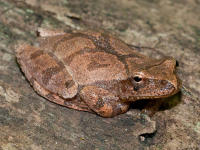
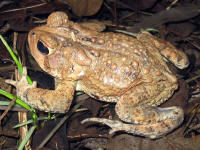
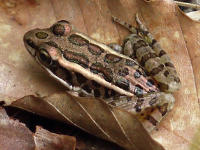
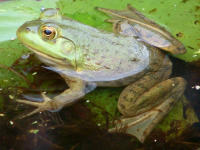
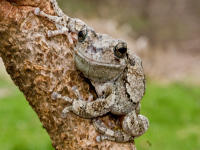
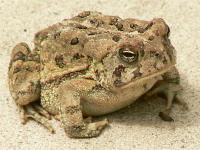
In all cases in which I have noticed frogs coupled this year, — the sylvatica, halecina, and palustris, - the female has been considerably the largest. . .The young R. pipiens, with commonly a dull-green head and sides of head, sometimes bright green, and back dusky-spotted. Can this be the bull frog? Is it not the fontinalis with less bright green and a white throat? Sometimes it is yellow-throated. I saw lately in the river a full-grown bullfrog, with, I think, a white throat. . . .the air full of the ring of the toad, the peep of the hylodes, and the low growling croak or stertoration of the Rana palustris. . . .The rhythm of it is like that of the toads’ ring, but not the sound. This is considerably like that of the tree-toad.  See The 10 frog species in Massachusetts. (Mass Audubon) (HDT’s halecina is the northern leopard frog, his fontinalis is the green frog, his hylodes the peeper):

Spring peeper (Pseudacris crucifer)[hylodes]


Wood frog (Lithobates sylvaticus)[Rana 
sylvatica]


American toad (Anaxyrus americanus)


Green frog (Lithobates clamitans)[
Rana pipiens]


Northern leopard frog (Lithobates pipiens)[Rana halecina]


Pickerel frog (Lithobates palustris)[Rana palustris]


American bullfrog (Lithobates catesbeianus)


Gray treefrog (Hyla versicolor)[tree-toad ]


Eastern spadefoot (Scaphiopus holbrookii)


Fowler's toad (Anaxyrus fowleri)

Saturday, November 7, 2015

The world and my life are simplified .

November 7. 

Another drizzling day, — as fine a mist as can fall. 

November 7, 2021

I find it good to be out this still, dark, mizzling afternoon; my walk or voyage is more suggestive and profitable than in bright weather. 
The view is contracted by the misty rain, the water is perfectly smooth, and the stillness is favorable to reflection. 

I am more open to impressions, more sensitive (not calloused or indurated by sun and wind), as if in a chamber still. 
My thoughts are concentrated; I am all compact. 

The solitude is real, too, for the weather keeps other men at home. 

This mist is like a roof and walls over and around, and I walk with a domestic feeling. 

The sound of a wagon going over an unseen bridge is louder than ever, and so of other sounds. 

I am compelled to look at near objects. 
All things have a soothing effect; the very clouds and mists brood over me. 

My power of observation and contemplation is much increased.
My attention does not wander. 
The world and my life are simplified. 

I see a painted tortoise swimming under water, and to my surprise another afterward out on a willow trunk this dark day. It is long since I have seen one of any species except the insculpta. They must have begun to keep below and go into winter quarters about three weeks ago. 

Looking west over Wheeler’s meadow, I see that there has been much gossamer on the grass, and it is now revealed by the dewy mist which has collected on it. 

Some green-briar leaves still left, a dull red or scarlet, others yellowish; also the silky cornel is conspicuously dull-red, and others yellowish-red. 

And the sallow on river’s brink (not cordata), with a narrow leaf pointed at both ends, shows some clear chrome yellow leaves atop. 

The white birches lose their lower leaves first, and now their tops show crescents or cones of bright-yellow (spring flames) leaves, some of the topmost even green still. 

The black willows almost everywhere entirely bare, yet the color of their twigs gives them the aspect of the crisp brown weeds of the river’s brink. 

How completely crisp and shrivelled the leaves and stems of the Polygonum amphibium var. terrestre, still standing above the water and grass! 

The river has risen a little more, the North Branch especially, and the pail-stuff which has drifted down it has been carried a few rods up the main stream above the junction. It rises and falls very suddenly, and I was surprised to see the other day a line of sawdust more than a foot above the water’s edge, showing that it had risen to that height and suddenly fallen without my knowledge. 

Opened a muskrat-house nearly two feet high, but there was no hollow to it. Apparently they do not form that part yet. 

Birds are pretty rare now. I hear a few tree sparrows in one place on the trees and bushes near the river, — a clear, chinking chirp and a half-strain,— a jay at a distance; and see a nuthatch flit with a ricochet flight across the river, and hear his gnah half uttered when he alights. 

A gray squirrel —as day before yesterday—runs down a limb of an oak and hides behind the trunk and I lose him. A red one runs along the trees to scold at me, boldly or carelessly, with a chuckling, bird like note and that other peculiar sound at intervals, between a purr and a grunt. He is more familiar than the gray and more noisy. What sound does the gray make? 

H. D. Thoreau, Journal, November 7, 1855

More open to impressions. See June 14, 1853 ("open to great impressions . . .you see those rare sights with the unconscious side of the eye.")

The view is contracted by the misty rain . . . I am compelled to look at near objects. See August 4, 1854 ("Rain and mist contract our horizon and we notice near and small objects”).  Also  December 16, 1855 ("The mist makes the near trees dark and noticeable"); February 6, 1852 (A mistiness makes the woods look denser, darker and more primitive.); November 29, 1850("The trees and shrubs look larger than usual when seen through the mist")

The world and my life are simplified. See January 7, 1857 ("I come out to these solitudes, where the problem of existence is simplified.

I see a painted tortoise swimming. See November 1, 1855 ("I see no painted tortoises out, and I think it is about a fortnight since I saw any."):  November 14, 1855 ("A clear, bright, warm afternoon. A painted tortoise swimming under water and a wood tortoise out on the bank."); See also A Book of the Seasons, by Henry Thoreau, the Painted Turtle (Emys picta)

Opened a muskrat-house nearly two feet high, but there was no hollow to it. 
See    November 7, 1853 ("A muskrat-house on the top of a rock, too thin round the sides for a passage beneath, yet a small cavity at top, which makes me think that they use them merely as a sheltered perch above water."); November 7, 1858 ("I pass a musquash-house, apparently begun last night. ") See also September 20, 1855 ("Open a new and pretty sizable muskrat-house with no hollow yet made in it.") and A Book of the Seasons, by Henry Thoreau, the Musquash

Birds are pretty rare now. 
See November 4, 1855 ("The winter is approaching. The birds are almost all gone. The note of the dee de de sounds now more distinct, prophetic of winter,"):November 5, 1858 ("It is quite still; no wind, no insect hum, and no note of birds, but one hairy woodpecker."); November 24, 1857 ("Nowadays birds are so rare I am wont to mistake them at first for a leaf or mote blown off from the trees or bushes")

See a nuthatch flit with a ricochet flight across the river, and hear his gnah half uttered when he alights. 
See November 7, 1858 ("The nuthatch is another bird of the fall which I hear these days and for a long time, — apparently ever since the young birds grew up. ") See also  October 20, 1856 ("Think I hear the very faint gnah of a nuthatch. Thus, of late, when the season is declining, many birds have departed, and our thoughts are turned towards winter (began to have a fire, more or less, say ten days or a fortnight ago), we hear the jay again more frequently, and the chickadees are more numerous and lively and familiar and utter their phebe note, and the nuthatch is heard again, and the small woodpecker seen amid the bare twigs");  November 26, 1860 ("I hear the faint note of a nuthatch . . .a phenomenon of the late fall or early winter; for we do not hear them in summer that I remember.”); December 1, 1857 ("I thus always begin to hear this bird on the approach of winter, as if it did not breed here, but wintered here.”) and A Book of the Seasons, by Henry Thoreau, The Nuthatch

A gray squirrel. . . runs down a limb of an oak and hides behind the trunk See November 13, 1857 (“ I see, on a white oak on Egg Rock, where the squirrels have lately made a nest for the winter of the dry oak leaves . . . I suspect it is a gray squirrel's nest.”); November 20, 1858 ("I have seen more gray squirrels of late . . . not merely because the trees are bare but because they are stirring about more, — nutting, etc.");  November 30, 1851 ("While the squirrels hid themselves in the tree-tops, I sat on an oak stump by an old cellar-hole and mused. This squirrel is always an unexpectedly large animal to see frisking about. ") 

A red one runs along the trees to scold at me,
See December 1, 1857 ("I hear a red squirrel barking at me amid the pine and oak tops, and now I see him coursing from tree to tree.") See also A Book of the Seasons, by Henry Thoreau, The Red Squirrel

The world and my life
are simplified this still, dark
mizzling afternoon.


A Book of the Seasons, by Henry Thoreau
"A book, each page written in its own season,
out-of-doors, in its own locality."
~edited, assembled and rewritten by zphx © 2009-2024

https://tinyurl.com/hdt-551107

Popular Posts Last 30 Days.

The week ahead in Henry’s journal

The week ahead in Henry’s journal
A journal, a book that shall contain a record of all your joy.
"A stone fruit. Each one yields me a thought." ~ H. D. Thoreau, March 28, 1859


I sit on this rock
wrestling with the melody
that possesses me.