Showing posts with label sunshine. Show all posts

Monday, April 24, 2017

A New England landscape.

April 24

Sail to Ball's Hill. 

The water is at its height, higher than before this year. I see a few shad-flies on its surface. 

Scudding over the Great Meadows, I see the now red crescents of the red maples in their prime round about, above the gray stems. 

The willow osiers require to be seen endwise the rows, to get an intense color. 

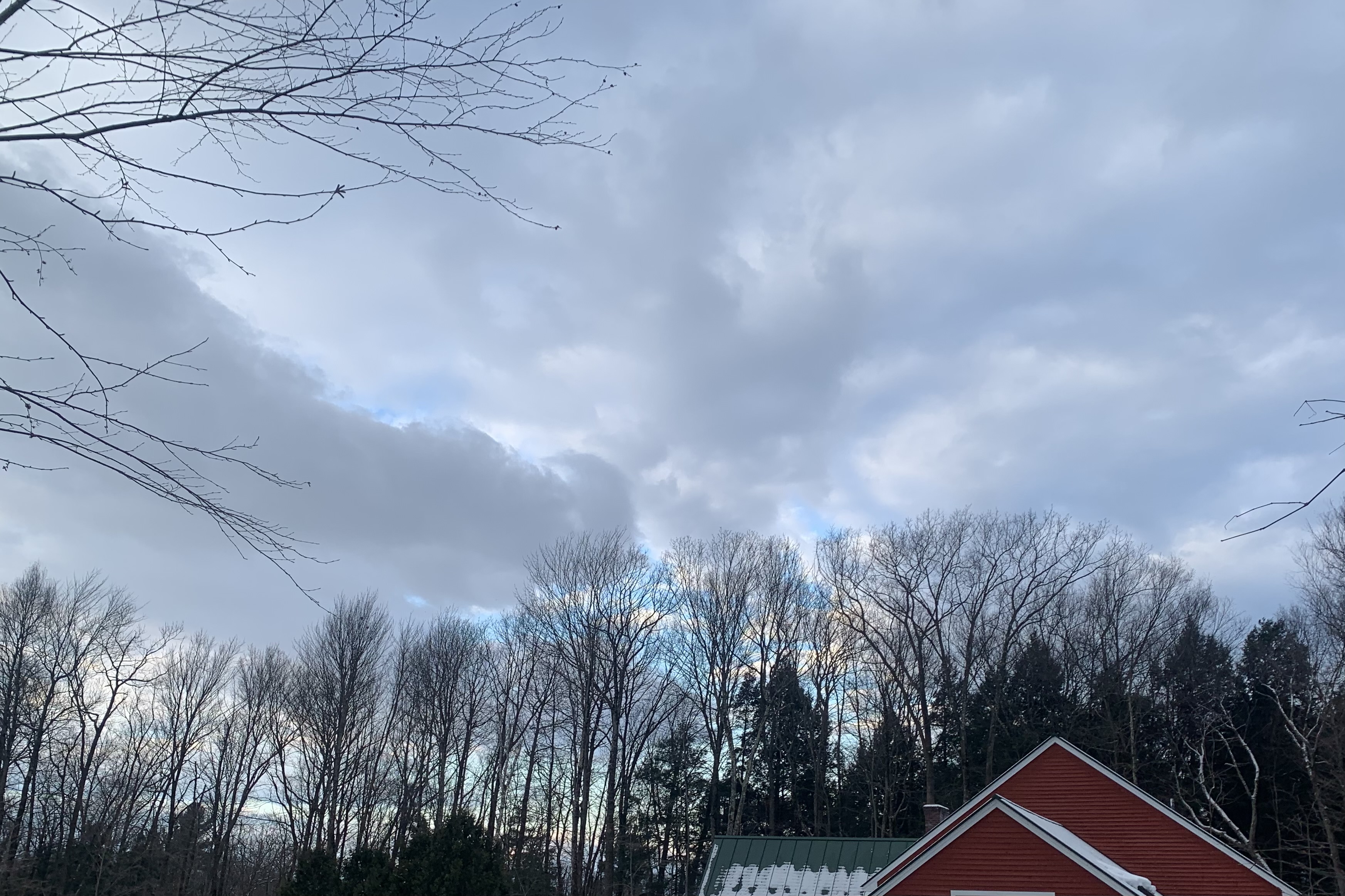
The clouds are handsome this afternoon : on the north, some dark, windy clouds, with rain falling beneath


— but it is chiefly wind; 

southward, those summer clouds in numerous isles, light above and dark-barred beneath. 

Now the sun comes out and shines on the pine hill west of Ball's Hill, lighting up the light-green pitch pines and the sand and russet-brown lichen-clad hill. That is a very New England landscape. Buttrick's yellow farmhouse near by is in harmony with it. 

The little fuzzy gnats are about. I see a vertical circular cobweb, more than a foot in diameter, nearly filled with them, and this revealed the existence of the swarms that had filled the air on all sides. If it had been as many yards wide as it was inches, it would probably have been just as full. 

Saw on a small oak slanting over water in a swamp, in the midst of a mass of cat-briar, about ten feet from the ground, a very large nest, of that hypnum (?) moss, in the form of an inverted cone, one foot across above and about eight inches deep, with a hole in the side very thick and warm; probably a mouse-nest, for there were mouse droppings within.

H. D. Thoreau, Journal, April 24, 1857

I see the now red crescents of the red maples in their prime . . . above the gray stems. See April 24, 1854 ("The first red maple blossoms — so very red over the water — are very interesting. ") See also April 26, 1855 ("The blossoms of the red maple (some a yellowish green) are now most generally conspicuous and handsome scarlet crescents over the swamps. "); April 26, 1860 ("I have noticed their handsome crescents over distant swamps commonly for some ten days. At height, then, say the 21st. "); April 28, 1855 (" The abundant wholesome gray of the trunks and stems beneath surmounted by the red or scarlet crescents.”) note to May 1, 1856 ("Looking over the swamps a quarter of a mile distant, you see dimly defined crescents of bright brick red above and amid a maze of ash-colored branches.”) and A Book of the Seasons, by Henry Thoreau, The Red Maple

That is a very New England landscape. Buttrick's yellow farmhouse near by is in harmony with it. See  February 9, 1858 (“A distant farmhouse on a hill, French’s or Buttrick's, perhaps.”); May 12, 1857 ("It reminded me of many a summer sunset, of many miles of gray rails, of many a rambling pasture, of the farmhouse far in the fields, its milk-pans and well-sweep, and the cows coming home from pasture.”). Compare August 26, 1856 ("What is a New England landscape this sunny August day? A weather-painted house and barn, with an orchard by its side, in midst of a sandy field surrounded by green woods, with a small blue lake on one side.”); June 15, 1859 (“A regular old-fashioned country house, long and low, one story unpainted, with a broad green field, half orchard, for all yard between it and the road, — a part of the hill side, — and much June-grass before it. This is where the men who save the country are born and bred.”)

The little fuzzy gnats are about.
See April 21, 1855 ("All the button-bushes, etc., etc., in and about the water are now swarming with those minute fuzzy gnats about an eighth of an inch long. The insect youth are on the wing. The whole shore resounds with their hum wherever we approach it, and they cover our boat and persons. They are in countless myriads the whole length of the river. ") See also A Book of the Seasons, by Henry Thoreau, Fuzzy Gnats (tipulidæ)

About ten feet from the ground . . . a mouse-nest.
See November 15, 1857 ("A little Mus leucopus, panting with fear and with its large black eyes upon me . . . It will thus make its nest at least sixteen feet up a tree, improving some cleft or hollow, or probably bird's nest, for this purpose. These nests, I suppose, are made when the trees are losing their leaves") See also A Book of the Seasons, by Henry Thoreau, The Wild Mouse

The yellow farmhouse
nearby the light-green pitch pines
lit up by the sun.

A Book of the Seasons,  by Henry Thoreau
 "A book, each page written in its own season,
out-of-doors, in its own locality."
 ~edited, assembled and rewritten by zphx ©  2009-2024
https://tinyurl.com/hdt570424

Thursday, December 17, 2015

A fine, springlike morning.

December 17.

9.30 A. M. — To Hill. 

A remarkably fine, springlike morning. 

The earth all bare; the sun so bright and warm; the steam curling up from every fence and roof, and carried off at an angle by the slight northwesterly air.

After those rainy days the air is apparently uncommonly clear, and hence (?) the sound of cock-crowing is so sweet, and I hear the sound of the sawmill even at the door, also the cawing of crows.

There is a little ice, which makes it as yet good walking, in the roads. 

The peculiar brightness and sunniness may be partly owing to the sun being reflected through the cleansed air from the more than russet, the bleached, surface of the earth. 

Methinks every squirrel will be out now. 

This is the morning. Ere long the wind will rise and this season will be over. There will probably be some wrack in the afternoon sky. 

H. D. Thoreau, Journal, December 17, 1855

After those rainy days the air is apparently uncommonly clear, and I hear the sound of the sawmill even at the door, also the cawing of crows. See March 15, 1854 ("The sound of Barrett's sawmill in the still morning comes over the water very loud.");April 15, 1856 ("I hear very distinctly Barrett’s sawmill at my landing."); May 8, 1857 ("I hear the sound of Barrett's sawmill with singular distinctness."); February 16, 1855 (" Sounds sweet and musical through this air, as crows, cocks, and striking on the rails at a distance.”) January 12, 1855 ("Perhaps what most moves us in winter is some reminiscence of far-off summer. . . .It is in the cawing of the crow, the crowing of the cock, the warmth of the sun on our backs. I hear faintly the cawing of a crow far, far away, echoing from some unseen wood-side. What a delicious sound! It is not merely crow calling to crow, for it speaks to me too. I am part of one great creature with him; if he has voice, I have ears. I can hear when he calls.”); See also December 31, 1853 (“I hear very distinctly from the railroad causeway the whistle of the locomotive on the Lowell road. . . . He that hath ears, let him hear. Sugar is not so sweet to the palate, as sound to the healthy ear.”)

Methinks every squirrel will be out now. See  December 17, 1859  ("I see many tracks of squirrels . . . It is pleasant to see the tracks of these squirrels (I am not sure whether they are red or gray or both, for I see none) leading straight from the base of one tree to that of another, thus leaving untrodden triangles, squares, and polygons of every form, bounded by much trodden highways.One, two, three, and the track is lost on the upright bole of a pine . . . The tracks of two or three suggest a multitude. You come thus on the tracks of these frisky and volatile (semivolitant) creatures in the midst of perfect stillness and solitude, as you might stand in a hall half an hour after the dancers had departed.")

Sunday, March 1, 2015

A fresh and inspiring dazzling bright day.

March 1


The last day for skating. It is a very pleasant and warm day, the finest yet, with considerable coolness in the air however, — winter still. 


March 1, 2025


The air is beautifully clear, and I trace at a distance the roofs and outlines of farmhouses amid the woods. 

We go listening for bluebirds, but only hear crows and chickadees. 

A fine seething air over the fair russet fields. 

The dusty banks of snow by the railroad reflect a wonderfully dazzling white due to the higher sun.

I am surprised to find the North River more frozen than the South, and we can cross it in many places. The spring sun shining on the sloping icy shores makes numerous dazzling ice-blinks, still brighter and prolonged with rectilinear sides in the reflection. 

I did well to walk in the forenoon, the fresh and inspiring half of this bright day.

H. D. Thoreau, Journal, March 1, 1855


The last day for skating. See February 3, 1855 ("This will deserve to be called the winter of skating."); See also A Book of the Seasons, by Henry Thoreau, The Winter of Skating

It is a very pleasant and warm day, the finest yet.  See March 2, 1855 ("Another still, warm, beautiful day like yesterday. "); March 15, 1860 ("On the whole the finest day yet . . . Here is the first fair, and at the same time calm and warm, day") See also A Book of the Seasons, by Henry Thoreau, The world can never be more beautiful than now.

I am surprised to find the North River more frozen than the South. See March 1, 1856 ("Ask the sheldrake whether the rivers are completely sealed up.") and A Book of the Seasons,  by Henry Thoreau, Ice-out

The spring sun shining on the sloping icy shores. See March 1, 1854 ("For some days past the surface of the earth, covered with water, or with ice where the snow is washed off, has shone in the sun as it does only at the approach of spring.")

We go listening for bluebirds, but only hear crows and chickadees.  
A fine seething air over the fair russet fields. See February 22, 1855 ("Remarkably warm and pleasant weather, perfect spring. I even listen for the first bluebird. I see a seething in the air over clean russet fields. "); March 1, 1854 ("I hear the phoebe or spring note of the chickadee, and the scream of the jay is perfectly repeated by the echo from a neighboring wood "); March 1, 1856 ("I hear several times the fine-drawn phe-be note of the chickadee. . .Singular that I should hear this on the first spring day."). See also A Book of the Seasons,  by Henry Thoreau, Signs of the Spring:   

March 1.  See A Book of the Seasons,  by Henry Thoreau,   March 1

I did well to waik
the fresh and inspiring half
of this bright day.


We go listening 
for bluebirds, but only hear 
crows and chickadees. 


A Book of the Seasons
,  by Henry Thoreau
 "A book, each page written in its own season,
out-of-doors, in its own locality."
 ~edited, assembled and rewritten by zphx ©  2009-2025

https://tinyurl.com/hdt-550301

***


March 1. 10 A. M. — To Derby's Bridge and return by Sam Barrett's, to see ice cakes and meadow crust.

The last day for skating.

It is a very pleasant and warm day, the finest yet, with considerable coolness in the air, however, — winter still.

The air is beautifully clear, and through [ it ] I love to trace at a distance the roofs and outlines of sober - colored farmhouses amid the woods.

We go listening for bluebirds, but only hear crows and chickadees.

A fine seething air over the fair russet fields.

The dusty banks of snow by the railroad reflect a wonderfully dazzling white from their pure crannies, being melted into an uneven, sharp, wavy surface.

This more dazzling white must be due to the higher sun.

I see some thick cakes of ice where an ice - car has broken up : I detect a large bubble four inches in diameter about a foot be neath the upper surface and six inches from the lower.

In confirmation of my theory, the grain of the ice, as indicated by the linear bubbles within it, was converging beneath this bubble, as the rays of light under a burning glass, and what was the under surface at that time was melted in a concave manner to within one and a half inches of the bubble, as appeared by the curvature in the horizontal grain of the more recently formed ice beneath.

I omit to draw the other horizontal grain.

The situation of this bubble also suggests that ice perhaps increases more above than below the plane of its first freezing in the course of a winter, by the addition of surface water and snow ice.

Examined again the ice and meadow - crust deposited just south of Derby's Bridge.

The river is almost down to summer level there now, being only three to four feet deep at that bridge.

It has fallen about eight feet since February 17. The ice is piled up there three or four feet deep, and no water beneath, and most of the cakes, which are about one foot thick, have a crust of meadow of equal thickness (i. e. from six inches to a foot) attached beneath.

I saw in one place three cakes of ice each with a crust of meadow frozen to it beneath, lying one directly upon another and all upon the original ice there, alternately ice and meadow, and the middle crust of meadow measured twenty eight by twenty - two feet.

In this case the earth was about six inches thick only for the most part, three to four feet high in all above original ice.

This lay on a gentle ridge or swell between the main Derby Bridge and the little one beyond, and it suggested that that swell might have been thus formed or increased.

As we went down the bank through A. Hosmer's land we saw great cakes, and even fields of ice, lying up high and dry where you would not suspect otherwise that water had been.

Some have much of the withered pickerel - weed, stem and leaves, in it, causing it to melt and break up soon in the sun.

I saw one cake of ice, six inches thick and more than six feet in diameter, with a cake of meadow of exactly equal dimensions attached to its underside, exactly and evenly balanced on the top of a wall in a pasture forty rods from the river, and where you would not have thought the water ever came.

We saw three white maples about nine inches in diameter which had been torn up, roots and sod together, and in some cases carried a long distance.

One quite sound, of equal size, had been bent flat and broken by the ice striking it some six or seven feet from the ground.

Saw some very large pieces of meadow lifted up or carried off at mouth of G. M. Barrett's Bay.

One measured seventy - four by twenty - seven feet.

Topped with ice almost always, and the old ice still beneath.

In some cases the black, peaty soil thus floated was more than one and a half feet thick, and some of this last was carried a quarter of a mile without trace of ice to buoy it, but probably it was first lifted by ice.

Saw one piece more than a rod long and two feet thick of black, peaty soil brought from I know not where.

The edge of these meadow - crusts is singularly abrupt, as if cut with a turf - knife.

Of course a great surface is now covered with ice on each side of the river, under which there is no water, and we go constantly getting in with impunity.

The spring sun shining on the sloping icy shores makes numerous dazzling ice - blinks, still brighter, and prolonged with rectilinear sides, in the reflection.

I am surprised to find the North River more frozen than the South, and we can cross it in many places.

I think the meadow is lifted in this wise: First, you have a considerable freshet in midwinter, succeeded by severe cold before the water ' has run off much.

Then, as the water goes down, the ice for a certain width on each side the river meadows rests on the ground, which freezes to it.

Then comes another freshet, which rises a little higher than the former.

This gently lifts up the river ice, and that meadow ice on each side of it which still has water under it, without breaking them, but overflows the ice which is frozen to the bot tom.

Then, after some days of thaw and wind, the latter ice is broken up and rises in cakes, larger or smaller with or without the meadow - crust beneath it, and is floated off before the wind and current till it grounds somewhere, or melts and so sinks, frequently three cakes one upon another, on some swell in the meadow or the edge of the upland.

The ice is thus with us a wonderful agent in changing the aspect of the surface of the river - valley.

I think that there has been more meadow than usual moved this year, because we had so great a freshet in midwinter succeeded by severe cold, and that by another still greater freshet before the cold weather was past.

Saw a butcher-bird, as usual on top of a tree, and distinguished from a jay by black wings and tail and streak side of head.

I did well to walk in the forenoon, the fresh and inspiring half of this bright day, for now, at mid afternoon, its brightness is dulled, and a fine stratus is spread over the sky.

Is not “the starry puff (Lycoperdon stellatum)” of the “Journal of a Naturalist,” which “remains driving about the pastures, little altered until spring," my five fingered fungus ?

The same tells of goldfinches (Fringilla carduelis) (Bewick calls it the " thistle - finch ”) "scattering all over the turf the down of the thistle, as they pick out the seed for their food.” It is singular that in this particular it should resemble our goldfinch, a different bird.


Monday, June 25, 2012

A morning rainbow. A moonlit walk. A flower for every mood of the mind.


Just as the sun rises this morning, under clouds, I see a rainbow in the west horizon, the lower parts quite bright. 


A few moments after, it rains heavily for a half-hour; and it continues cloudy as well as cool most of the day.

I observe that young birds are usually of a duller color and more speckled than old ones, as if for their protection in their tender state. They have not yet the markings (and the beauty) which distinguish their species, and which betray it often, but by their colors are merged in the variety of colors of the season.

To Cliffs, 4 P.M. 


It is cool and cloudy weather in which the crickets, still heard, remind you of the fall, -a clearer ring to their creak. . . .

Sometimes the lambkill flowers form a very even rounded, close cylinder, six inches long and two and a half in diameter, of rich red saucer-like flowers, the counterpart of the latifolia in flowers and flower- buds, but higher colored. I regard it as a beautiful flower neglected. It has a slight but not remarkable scent. 

The Convolvulus sepium, bindweed; morning-glory is the best name. It always refreshes me to see it. Some saw it the 19th. In the morning and cloudy weather, says Gray. I associate it with holiest morning hours. It may preside over my morning walks and thoughts. 

There is a flower for every mood of the mind.

Methinks roses oftenest display their high colors, colors which invariably attract all eyes and betray them, against a dark ground, as the dark green or the shady recesses of the bushes and copses, where they show to best advantage. Their enemies do not spare the open flower for an hour. Hence, if for no other reason, their buds are most beautiful. Their promise of perfect and dazzling beauty, when their buds are just beginning to expand, — beauty which they can hardly contain, — as in most youths, commonly surpasses the fulfillment of their expanded flowers. The color shows fairest and brightest in the bud. The expanded flower has no higher or deeper tint than the swelling bud exposed. This raised a dangerous expectation. 

The season when wild roses are in bloom should have some preeminence, methinks.


Agreeable is this cool cloudy weather, favorable to thought, after the sultry days. 


The air is clear, as if a cool, dewy brush had swept the vales and meadows of all haze. A liquid coolness invests them, as if their midnight aspect were suddenly revealed to midday. 

The mountain outline is remarkably distinct, and the intermediate earth appears more than usually scooped out, like a vast saucer sloping up ward to its sharp mountain rim. The mountains are washed in air. 

The sunshine, now seen far away on fields and hills in the northwest, looks cool and whole some, like the yellow grass in the meadows.

I am too late for the white pine flowers. The cones are half an inch long and greenish, and the male flowers effete.

The sun now comes out bright, though westering, and shines on Fair Haven, rippled by the wind.


8.30 p. m. — To Conantum. 

Moon half full. Fields dusky; the evening star and one other bright one near the moon. It is a cool but pretty still night. 

Methinks I am less thoughtful than I was last year at this time. The flute I now hear from the Depot Field does not find such caverns to echo and resound in in my mind, — no such answering depths. Our minds should echo at least as many times as a Mammoth Cave to every musical sound. It should awaken reflections in us. 

I hear not many crickets. 

Some children calling their kitten home by some endearing name. 

Now his day's work is done, the laborer plays his flute, — only possible at this hour. 

Contrasted with his work, what an accomplishment! Some drink and gamble. He plays some well-known march. But the music is not in the tune; it is in the sound. It does not proceed from the trading nor political world. He practices this ancient art. 

There are light, vaporous clouds overhead; dark, fuscous ones in the north. The trees are turned black. As candles are lit on earth, stars are lit in the heavens. I hear the bullfrog's trump from afar. 

Now I turn down the Corner road. At this quiet hour the evening wind is heard to moan in the hollows of your face, mysterious, spirit-like, conversing with you. It can be heard now only. The whip-poor-will sings. 

I hear a laborer going home, coarsely singing to himself. Though he has scarcely had a thought all day, killing weeds, at this hour he sings or talks to himself. His humble, earthy contentment gets expression. It is kindred in its origin with the notes or music of many creatures. A more fit and natural expression of his mood, this humming, than conversation is wont to be. 

The fireflies appear to be flying, though they may be stationary on the grass stems, for their perch and the nearness of the ground are obscured by the darkness, and now you see one here and then another there, as if it were one in motion. Their light is singularly bright and glowing to proceed from a living creature. Nature loves variety in all things, and so she adds glow-worms to fireflies, though I have not noticed any this year. 

The great story of the night is the moon's adventures with the clouds. What innumerable encounters she has had with them! 

When I enter on the moonlit causeway, where the light is reflected from the glistening alder leaves, and their deep, dark, liquid shade beneath strictly bounds the firm damp road and narrows it, it seems like autumn. The rows of willows completely fence the way and appear to converge in perspective, as I had not noticed by day. 

The bullfrogs are of various tones. Some horse in a distant pasture whinnies; dogs bark; there is that dull, dumping sound of frogs, as if a bubble containing the lifeless sultry air of day burst on the surface, a belching sound. When two or more bullfrogs trump together, it is a ten-pound-ten note. 

In Conant's meadow I hear the gurgling of unwearied water, the trill of a toad, and go through the cool, primordial liquid air that has settled there. As I sit on the great door-step, the loose clapboards on the old house rattle in the wind weirdly, and I seem to hear some wild mice running about on the floor, and sometimes a loud crack from some weary timber trying to change its position. 

On Conantum-top, all white objects like stones are observed, and dark masses of foliage, at a distance even. How distant is day and its associations! 

The light, dry cladonia lichens on the brows of hills reflect the moon light well, looking like rocks. The night wind comes cold and whispering, murmuring weirdly from distant mountain-tops. No need to climb the Andes or Himalayas, for brows of lowest hills are highest mountain-tops in cool moonlight nights. 

Is it a cuckoo's chuckling note I heard? Occasionally there is something enormous and monstrous in the size and distance of objects. A rock, is it? or an elephant asleep? Are these trees on an upland or a lowland? Or do they skirt the brink of a sea-beach? When I get there, shall I look off over the sea? 

The whiteweed is the only obvious flower. I see the tops of the rye wave, and grain-fields are more interesting than by day. The water is dull-colored, hardly more bright than a rye-field. There is dew only in the low grounds. 

What were the firefly's light, if it were not for darkness? The one implies the other. 

You may not suspect that the milk of the cocoanut which is imported from the other side of the world is mixed. So pure do some truths come to us, I trust. 

What a mean and wretched creature is man! By and by some Dr. Morton may be filling your cranium with white mustard seed to learn its internal capacity. Of  all ways invented to come at a knowledge of a living man, this seems to me the worst, as it is the most belated. You would learn more by once paring the toe nails of the living subject. There is nothing out of which the spirit has more completely departed, and in which it has left fewer significant traces.

H. D. Thoreau, Journal, June 25, 1852

The mountain outline is remarkably distinct, the earth appears like a vast saucer sloping upward to its sharp mountain rim. See November 30, 1852 (“The country seems to slope up from the west end of Walden to the mountain.”)

The fireflies appear to be flying . . . now you see one here and then another there, as if it were one in motion. See August 2, 1854 (“A few fireflies in the meadows. I am uncertain whether that so large and bright and high was a firefly or a shooting star.”)

The Convolvulus sepium, bindweed; morning-glory is the best name.
It always refreshes me to see it.") See  June 21, 1853 ("The morning-glory still fresh at 3 P.M.  A fine, large, delicate bell with waved border, some pure white ,some reddened. The buds open perfectly in a vase I find them open when I wake at 4 A .M. Is not this one of the eras or culminating places in the flower season? Not this till the sultry mornings come."); July 19, 1851("The wild morning-glory or bindweed, with its delicate red and white blossoms.")

There is a flower for every mood of the mind. See May 23, 1853 (" Every new flower that opens, no doubt, expresses a new mood of the human mind.”); August 7, 1853 ("The objects I behold correspond to my mood.”); May 6, 1854 ("I can be said to note the flower's fall only when I see in it the symbol of my own change. When I experience this, then the flower appears to me.”); June 6, 1857 (“Each experience reduces itself to a mood of the mind.”) See also A Book of the Seasons, by Henry Thoreau, Moods and Seasons of the Mind.

Roses oftenest display their high colors. . . fairest and brightest in the bud. See A Book of the Seasons, by Henry Thoreau, The Wild Rose

Sometimes the lambkill flowers form a very even rounded, close cylinder . . . of rich red saucer-like flowers. . . I regard it as a beautiful flower neglected. See June 13, 1852 ('Lambkill is out. I remember with what delight I used to discover this flower in dewy mornings."); June 13, 1854 ("How beautiful the solid cylinders of the lamb-kill now just before sunset, — small ten-sided, rosy-crimson basins, about two inches above the recurved, drooping dry capsules of last year"); See also A Book of the Seasons, by Henry Thoreau, Lambkill (Kalmia augustifolia)

Methinks I am less thoughtful than I was last year at this time. See July 7, 1852 "(I am older than last year; the mornings are further between; the days are fewer.")

Dr. Morton filling your cranium with white mustard seed. Samuel George Morton believed that cranial capacity determined intellectual ability, and he used his craniometric evidence in conjunction with his analysis of anthropological literature then available to argue in favor of a racial hierarchy which put Caucasians on the top rung and Africans on the bottom. Morton's "systematic justification" for the separation of races was used by those who favored slavery in the United States.~ wikipedia

July 25. See A Book of the Seasons,, by Henry Thoreau, June 25

The earth is a vast
saucer sloping upward to
its sharp mountain rim.

Sunshine now seen far
away looks like the yellow
grass in the meadows.

I am too late for
the white pine flowers. -- The cones
are half an inch long.

The sun comes out bright
and shines on Fair Haven Pond,
rippled by the wind.

There is a flower 
for every mood of the mind –
wild roses in bloom. 
June 25, 1852

Why the firefly's light,
if it were not for darkness?
One implies the other.
June 25, 1852

You see one here and
another there as if it
were one in motion.
June 25, 1852


A Book of the Seasons,by Henry Thoreau
"A book, each page written in its own season,
out-of-doors, in its own locality.”
~edited, assembled and rewritten by zphx © 2009-2021

Popular Posts Last 30 Days.

The week ahead in Henry’s journal

The week ahead in Henry’s journal
A journal, a book that shall contain a record of all your joy.
"A stone fruit. Each one yields me a thought." ~ H. D. Thoreau, March 28, 1859


I sit on this rock
wrestling with the melody
that possesses me.