The year is but a succession of days,
and I see that I could assign some office to each day
which, summed up, would be the history of the year.
Henry Thoreau, August 24, 1852
Live in each season –
in August live on berries,
grow ripe with autumn.
August 23, 1853
Now begins the year's
dark green early afternoon
when shadows increase.
The blackness of the
foliage between me and
the light reminds me
foliage between me and
the light reminds me
it begins in spring
the dewy dawn of the year
silver downiness
the saffron-robed morn
a yellowish or light green
then pure glossy green
undersides reflect
the light – the forenoon
and now early afternoon
the dark green shadows
begin to increase and next
it will turn yellow
or red the sunset
finally black when the night
of the year sets in . . .
 |
| August 23, 2013 |
I sometimes remember something which I have told another as worth telling to myself, i.e. writing in my Journal. August 23, 1858
Resolve to read no book, to take no walk, to undertake no enterprise, but such as you can endure to give an account of to yourself. August 23, 1851
Live thus deliberately for the most part. August 23, 1851Open all your pores and bathe in all the tides of Nature, in all her streams and oceans, at all seasons. Grow green with spring, yellow and ripe with autumn. Drink of each season's influence. August 23, 1853
Live in each season as it passes; breathe the air, drink the drink, taste the fruit, and resign yourself to the influences of each. Let them be your only diet drink and botanical medicines. In August live on berries. Be blown on by all the winds. August 23, 1853
For all Nature is doing her best each moment to make us well. She exists for no other end. Do not resist her. "Nature" is but another name for health, and the seasons are but different states of health. August 23, 1853
To Walden to bathe at 5.30 A. M. August 23, 1851
Traces of the heavy rains in the night. The sand and gravel are beaten hard by them. August 23, 1851
A very clear but cool morning, all white light. August 23, 1853
Cooler than ever. Some must have fires, and I close my window. August 23, 1858
August has been thus far dog-days, rain, oppressive sultry heat, and now beginning fall weather. August 23, 1853
At the commencement of my walk I saw no traces of fog, but after detected fogs over particular meadows and high up some brooks’ valleys, and far in the Deep Cut the wood fog. August 23, 1851
As I go through the Deep Cut, I hear one or two early humblebees, come out on the damp sandy bank, whose low hum sounds like distant horns from far in the horizon over the woods. It was long before I detected the bees that made it, so far away and musical it sounded. August 23, 1851
On the west side of Emerson's Cliff, I notice many Gerardia pedicularia out. A bee is hovering about one bush. The flowers are not yet open, and if they were, perhaps he could not enter. He proceeds at once, head downwards, to the base of the tube, extracts the sweet there, and departs. Examining, I find that every flower has a small hole pierced through the tube, commonly through calyx and all, opposite the nectary. This does not hinder its opening. August 23, 1856
It was long before I could find him, though all the while within a foot or two. I did not know whether to search amid the grass and stones or amid the leaves. At last, by accident I saw him, he shrilling all the while under an alder leaf two feet from the ground, - a slender green fellow with long feelers and transparent wings. August 23, 1851
When he shrilled, his wings, which opened on each other in the form of a heart perpendicularly to his body like the wings of fairies, vibrated swiftly on each other. The apparently wingless female, as I thought, was near. August 23, 1851
On this Lespedeza Stuvei, a green locust an inch and three quarters long. August 23, 1856
I saw a snake by the roadside . . had a toad in his jaws, which he was preparing to swallow with his jaws distended to three times his width, but he relinquished his prey in haste and fled; and . .the toad jumped leisurely away with his slime-covered hind-quarters glistening in the sun,. August 23, 1851
To Laurel Glen to see the effect of the frost. August 23, 1859
Everywhere in woods and swamps I am already reminded of the fall. August 23, 1858
As for autumnal tints, the Smilacina racemosa is yellowed, spotted brown in streaks, and half withered. August 23, 1859
Also two-leaved Solomon's-seal is partly yellowed and withered. August 23, 1859
First muskmelon this morning. August 23, 1851
The rhexia in the field west of Clintonia Swamp makes a great show now, though a little past prime. August 23, 1858
Now for high blackberries, though the low are gone. August 23, 1856
High blackberries now in their prime, their great racemes of shining black fruit, mixed with red and green, bent over amid the sweet-fern and sumach on sunny hill sides, or growing more rankly with larger fruit by rich roadsides and in lower ground. August 23, 1858
At the Lincoln bound hollow, Walden, there is a dense bed of the Rubus hispidus, matting the ground seven or eight inches deep, and full of the small black fruit, now in its prime. It is especially abundant where the vines lie over a stump. Has a peculiar, hardly agreeable acid. August 23, 1856
I go through the swamp, wading through the luxuriant cinnamon fern, which has complete possession of the swamp floor. Its great fronds, curving this way and that, remind me of a tropical vegetation. August 23, 1858
The scent of decaying fungi in woods is quite offensive now in many places, like carrion even. I see many red ones eaten more or less in the paths, nibbled out on the edges. August 23, 1856
On the west side of Emerson's Cliff, I notice many Gerardia pedicularia out. A bee is hovering about one bush. The flowers are not yet open, and if they were, perhaps he could not enter. He proceeds at once, head downwards, to the base of the tube, extracts the sweet there, and departs. Examining, I find that every flower has a small hole pierced through the tube, commonly through calyx and all, opposite the nectary. This does not hinder its opening. August 23, 1856
The Rape of the Flower! The bee knew where the sweet lay, and was unscrupulous in his mode of obtaining it. A certain violence tolerated by nature. August 23, 1856
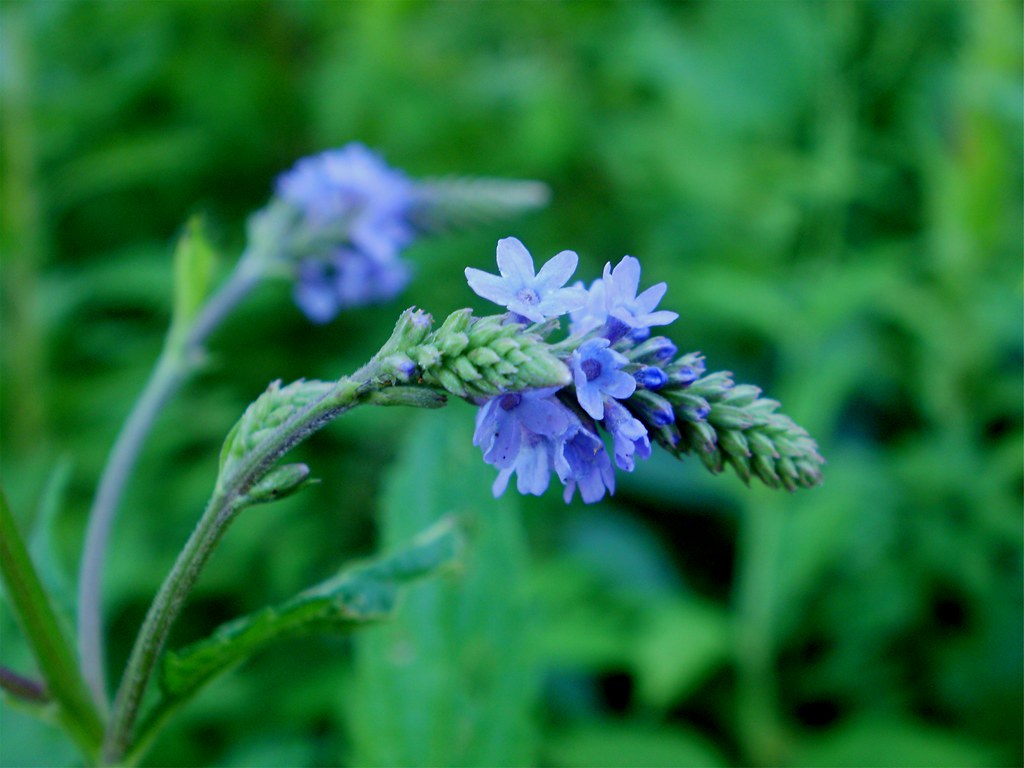
The Verbena hastata at the pond has reached the top of its spike, a little in advance of what I noticed yesterday; only one or two flowers are adhering. August 23, 1851
How handsome now the cymes of Viburnum Lentago berries, flattish with red cheeks! August 23, 1853
Viburnum nudum berries, apparently but a day or two. August 23, 1858
Elder-berries, now looking purple, are weighing down the bushes along fences by their abundance. August 23, 1856
White goldenrod, not long commonly. August 23, 1856
I see a bed of Antennaria margaritacea, now in its prime, by the railroad, and very handsome. It has fallen outward on all sides ray-wise, and rests on the ground, forming perfectly regular circle, four feet in diameter and fifteen inches high, with a dark ash- colored centre, twenty inches in diameter, composed of the stems, then a wide circumference, one foot or more broad, of dense pearly masses of flowers covered with bees and butterflies. This is as regular as a wheel. So fair and pure and abundant. August 23, 1856
I see dense patches of the pearly everlasting, maintaining their ground in the midst of dense green sweet-fern, a striking contrast of snow-white and green. August 23, 1858
P. M. – Walk to Annursnack and back . . . to go by where these men are repairing the stone bridge, — see if I cannot see poetry in that, if that will not yield me a reflection. August 23, 1851
Our little river reaches are not to be forgotten. I noticed that seen northward on the Assabet from the Causeway Bridge near the second stone bridge. August 23, 1851
There was a man in a boat in the sun, just disappearing in the distance round a bend, lifting high his arms and dipping his paddle as if he were a vision — far off, as in picture. August 23, 1851
Why not see men standing in the sun and casting a shadow, even as trees? May not some light be reflected from them as from the stems of trees? August 23, 1851
On or under east side of Annursnack, Epilobium coloratum, colored willow-herb, near the spring. August 23, 1851
Epilobium angustifolium is abundantly shedding its downy seed, — wands of white and pink. August 23, 1858
Also Polygonum sagittatum, scratch-grass. August 23, 1851
The Verbena hastata at the pond has reached the top of its spike, a little in advance of what I noticed yesterday; only one or two flowers are adhering. August 23, 1851
How handsome now the cymes of Viburnum Lentago berries, flattish with red cheeks! August 23, 1853
Viburnum nudum berries, apparently but a day or two. August 23, 1858
Elder-berries, now looking purple, are weighing down the bushes along fences by their abundance. August 23, 1856
White goldenrod, not long commonly. August 23, 1856
I see a bed of Antennaria margaritacea, now in its prime, by the railroad, and very handsome. It has fallen outward on all sides ray-wise, and rests on the ground, forming perfectly regular circle, four feet in diameter and fifteen inches high, with a dark ash- colored centre, twenty inches in diameter, composed of the stems, then a wide circumference, one foot or more broad, of dense pearly masses of flowers covered with bees and butterflies. This is as regular as a wheel. So fair and pure and abundant. August 23, 1856
I see dense patches of the pearly everlasting, maintaining their ground in the midst of dense green sweet-fern, a striking contrast of snow-white and green. August 23, 1858
P. M. – Walk to Annursnack and back . . . to go by where these men are repairing the stone bridge, — see if I cannot see poetry in that, if that will not yield me a reflection. August 23, 1851
There was a man in a boat in the sun, just disappearing in the distance round a bend, lifting high his arms and dipping his paddle as if he were a vision — far off, as in picture. August 23, 1851
Why not see men standing in the sun and casting a shadow, even as trees? May not some light be reflected from them as from the stems of trees? August 23, 1851
On or under east side of Annursnack, Epilobium coloratum, colored willow-herb, near the spring. August 23, 1851
Epilobium angustifolium is abundantly shedding its downy seed, — wands of white and pink. August 23, 1858
Also Polygonum sagittatum, scratch-grass. August 23, 1851
When I stopped to gather some blueberries by the roadside this afternoon, I heard the shrilling of a cricket or a grasshopper close to me, quite clear, almost like a bell, a stridulous sound, a clear ring, incessant, not intermittent, like the song of the black fellow I caught the other day, and not suggesting the night, but belonging to day. August 23, 1851
It was long before I could find him, though all the while within a foot or two. I did not know whether to search amid the grass and stones or amid the leaves. At last, by accident I saw him, he shrilling all the while under an alder leaf two feet from the ground, - a slender green fellow with long feelers and transparent wings. August 23, 1851
When he shrilled, his wings, which opened on each other in the form of a heart perpendicularly to his body like the wings of fairies, vibrated swiftly on each other. The apparently wingless female, as I thought, was near. August 23, 1851
About 8 p.m.- To Cliffs, moon half full. As I go up the back road, I hear the loud ringing creak of crickets, louder singers on each apple tree by the roadside, with an intermittent pulsing creak . . .I hear a faint metallic titter from a bird, so faint that if uttered at noonday it would not be heard, — not so loud as a cricket. I cannot remember the last moon. August 23, 1852
Hear the mole cricket nowadays. August 23, 1857
On this Lespedeza Stuvei, a green locust an inch and three quarters long. August 23, 1856
I saw a snake by the roadside . . had a toad in his jaws, which he was preparing to swallow with his jaws distended to three times his width, but he relinquished his prey in haste and fled; and . .the toad jumped leisurely away with his slime-covered hind-quarters glistening in the sun,. August 23, 1851
To Laurel Glen to see the effect of the frost. August 23, 1859
Everywhere in woods and swamps I am already reminded of the fall. August 23, 1858
As for autumnal tints, the Smilacina racemosa is yellowed, spotted brown in streaks, and half withered. August 23, 1859
Also two-leaved Solomon's-seal is partly yellowed and withered. August 23, 1859
I see the spotted sarsaparilla leaves and brakes, and, in swamps, the withering and blackened skunk-cabbage and hellebore, and, by the river, the already blackening pontederias and pipes. August 23, 1858
Birches have been much yellowed for some time. August 23, 1859
Also young wild cherry and hazel, and some horse-chestnuts and larches on the street. August 23, 1859
The scarlet lower leaves of the choke-berry and some brakes are the handsomest autumnal tints which I see to-day. August 23, 1859
In the river meadows the blue-eyed grass was very generally cut off and is now conspicuously black, — I find but one in bloom, — also small flowering ferns. August 23, 1859
The cranberries (not vines) are extensively frost-bitten and spoiled. August 23, 1859
In Moore's Swamp the potatoes were extensively killed, the greenest or tenderest vines. August 23, 1859
The farmers now carry — those who have got them — their early potatoes and onions to market, starting away early in the morning or at midnight. I see them returning in the afternoon with the empty barrels. August 23, 1851
One man had his squash vines killed. August 23, 1859
One man had his squash vines killed. August 23, 1859
First muskmelon this morning. August 23, 1851
The rhexia in the field west of Clintonia Swamp makes a great show now, though a little past prime. August 23, 1858
Now for high blackberries, though the low are gone. August 23, 1856
High blackberries now in their prime, their great racemes of shining black fruit, mixed with red and green, bent over amid the sweet-fern and sumach on sunny hill sides, or growing more rankly with larger fruit by rich roadsides and in lower ground. August 23, 1858
At the Lincoln bound hollow, Walden, there is a dense bed of the Rubus hispidus, matting the ground seven or eight inches deep, and full of the small black fruit, now in its prime. It is especially abundant where the vines lie over a stump. Has a peculiar, hardly agreeable acid. August 23, 1856
I go through the swamp, wading through the luxuriant cinnamon fern, which has complete possession of the swamp floor. Its great fronds, curving this way and that, remind me of a tropical vegetation. August 23, 1858
The scent of decaying fungi in woods is quite offensive now in many places, like carrion even. I see many red ones eaten more or less in the paths, nibbled out on the edges. August 23, 1856
See an abundance of pine-sap on the right of Pine-sap Path. . . . It lifts the leaves with it like the Indian-pipe, but is not so delicate as that. August 23, 1858
The Indian-pipe is still pushing up. August 23, 1858
The great bidens flowers are all turned toward the westering sun like sun flowers, hieroglyphics of the seasons. August 23, 1853
The milkweed leaves are already yellowing. August 23, 1853
I improve the dry weather to examine the middle of Gowing's Swamp. There is in the middle an open pool, twenty or thirty feet in diameter, nearly full of sphagnum and green froth on the surface (frog-spittle). August 23, 1854
I find a new cranberry on the sphagnum amid the A. calyculata, — V. Oxycoccus . . . It has small, now purplish-dotted fruit, flat on the sphagnum, some turned scarlet partly, on terminal peduncles, with slender, thread-like stems and small leaves strongly revolute on the edges August 23, 1854
Platanthera blephariglottis, white fringed orchis. August 23, 1854
I see a golden-crowned thrush, but it is silent except a chip; sitting low on a twig near the main stem of a tree, in these deep woods. August 23, 1858
The chewink note of a chewink (not common), also a cuckoo’s note. August 23, 1858
There is no plateau on which Nature rests at midsummer, but she instantly commences the descent to winter. August 23, 1858
Perhaps after middle age man ceases to be interested in the morning and in the spring. August 23. 1853
Poke stems are now ripe. I walked through a beautiful grove of them, six or seven feet high, on the side of Lee's Cliff, where they have ripened early. Their stems are a deep, rich purple with a bloom, contrasting with the clear green leaves. Its stalks, thus full of purple wine, are one of the fruits of autumn. It excites me to behold it. What a success is its ! What maturity it arrives at, ripening from leaf to root! August 23, 1853
May I mature as perfectly, root and branch, as the poke! It is a royal plant. I could spend the evening of the year musing amid the poke stems. August 23, 1853
There is something invigorating in this air, which I am peculiarly sensible is a real wind blowing from over the surface of a planet. August 23, 1852
The Indian-pipe is still pushing up. August 23, 1858
The great bidens flowers are all turned toward the westering sun like sun flowers, hieroglyphics of the seasons. August 23, 1853
The milkweed leaves are already yellowing. August 23, 1853
I improve the dry weather to examine the middle of Gowing's Swamp. There is in the middle an open pool, twenty or thirty feet in diameter, nearly full of sphagnum and green froth on the surface (frog-spittle). August 23, 1854
I find a new cranberry on the sphagnum amid the A. calyculata, — V. Oxycoccus . . . It has small, now purplish-dotted fruit, flat on the sphagnum, some turned scarlet partly, on terminal peduncles, with slender, thread-like stems and small leaves strongly revolute on the edges August 23, 1854
Platanthera blephariglottis, white fringed orchis. August 23, 1854
Smooth sumach berries all turned crimson. This fruit is now erect spear-heads, rising from the ample dark-green, unspotted leaves, pointing in various directions. August 23, 1858
Decodon getting stale at Second Andromeda Pond. August 23, 1856
On R. W. E.'s hillside by railroad, burnt over by the engine in the spring, the erechthites has shot up abundantly, very tall and straight, some six or seven feet high. August 23, 1856
Those singular crowded and wrinkled dry galls, red and cream-color mingled, on white oak shrubs, with their grubs in them. August 23, 1856
J. Farmer says that he found that the gummed twig of a chimney swallow's nest, though it burned when held in a flame, went out immediately when taken out of it, and he thinks it owing to a peculiarity in the gum, rendering the twig partly fire-proof, so that they cannot be ignited by the sparks in a chimney. August 23, 1856
I see a golden-crowned thrush, but it is silent except a chip; sitting low on a twig near the main stem of a tree, in these deep woods. August 23, 1858
The chewink note of a chewink (not common), also a cuckoo’s note. August 23, 1858
We experience pleasure when an elevated field or even road in which we may be walking holds its level toward the horizon at a tangent to the earth, is not convex with the earth’s surface, but an absolute level. August 23, 1851
Channing, thinking of walks and life in the country, says, “You don’t want to discover anything new, but to discover something old,” i.e. be reminded that such things still are. August 23, 1858
The Price Farm road, one of those everlasting roads which the sun delights to shine along in an August afternoon, August 23, 185_
An hour before sundown, I am struck with nothing so much as the autumnal coolness of the landscape and the predominance of shade. August 23, 1853
There is no plateau on which Nature rests at midsummer, but she instantly commences the descent to winter. August 23, 1858
Perhaps after middle age man ceases to be interested in the morning and in the spring. August 23. 1853
May I mature as perfectly, root and branch, as the poke! It is a royal plant. I could spend the evening of the year musing amid the poke stems. August 23, 1853
Observing the blackness of the foliage, especially between me and the light, I am reminded that it begins in the spring, the dewy dawn of the year, with a silvery hoary downiness, changing to a yellowish or light green, — the saffron-robed morn, — then to a pure, spotless, glossy green with light under sides reflecting the light, — the forenoon, — and now the dark green, or early afternoon, when shadows begin to increase, and next it will turn yellow or red, — the sunset sky, — and finally sere brown and black, when the night of the year sets in. August 23. 1853
I am again struck by the perfect correspondence of a day — say an August day — and the year. I think that a perfect parallel may be drawn between the seasons of the day and of the year. August 23. 1853
I am again struck by the perfect correspondence of a day — say an August day — and the year. I think that a perfect parallel may be drawn between the seasons of the day and of the year. August 23. 1853
There is something invigorating in this air, which I am peculiarly sensible is a real wind blowing from over the surface of a planet. August 23, 1852
I look out at my eyes, I come to my window, and I feel and breathe the fresh air. It is a fact equally glorious with the most inward experience. August 23, 1852
I forget there is any outside to the globe and am surprised when I behold it as now, -- yonder hills and river in the moonlight, the monsters. August 23, 1852
What are these rivers and hills, these hieroglyphics which my eyes behold? August 23, 1852
What are these rivers and hills, these hieroglyphics which my eyes behold? August 23, 1852
To-night there are no fireflies, no nighthawks nor whip-poor-wills. August 23, 1852

*****

July 17, 1852 ("The Antennaria margaritacea, pearly everlasting, is out")

August 24, 1858 ("Climbing the hill at the bend, I find Gerardia Pedicularia, apparently several days, or how long?")
August 24,1858 ("I look down a straight reach of water to see a part of earth so far away over the water that it appears islanded between two skies. If that place is real, then the places of my imagination are real.")
August 25, 1852 ("The fruit of the Viburnum Lentago is now very handsome, with its sessile cymes of large elliptical berries, green on one side and red with a purple bloom on the other or exposed side, not yet purple, blushing on one cheek")
August 25, 1852 (“One of the most noticeable wild fruits at present is the Viburnum nudum berries, their variegated cymes amid the green leaves in the swamps or low grounds, some whitish, some greenish, some red, some pink, some rose-purple and very beautiful”)
August 26, 1859 ("The creak of the mole cricket has a very afternoon sound")
August 26, 1856 ("We begin to apprehend frosts before the melons are ripe!")
August 30, 1859 ("The plants now decayed and decaying and withering are those early ones which grow in wet or shady places, as hellebore, skunk-cabbage, the two (and perhaps three) smilacinas, uvularias, polygonatum, medeola, Senecio aureus (except radical leaves), and many brakes and sarsaparillas, and how is it with trilliums and arums?")
August 31, 1852 ("The evening of the year is colored like the sunset.")


August 23, 2018
*****
A Book of the Seasons, by Henry Thoreau:
*****

August 23, 2019
Walden (" Nature is as well adapted to our weakness as to our strength.").
The Maine Woods ("Daily to be shown matter, to come in contact with it-rocks, trees, wind on our cheeks! the solid earth! the actual world! the common sense! Contact! Contact! Who are we? where are we?”)March 30, 1852 ("Perhaps we grow older and older till we no longer sympathize with the revolution of the seasons, and our winters never break up.")
April 16, 1861 ("Horace Mann says that he killed a bullfrog in Walden Pond which had swallowed and contained a common striped snake")
April 16, 1861 ("Horace Mann says that he killed a bullfrog in Walden Pond which had swallowed and contained a common striped snake")
May 19, 1856 ("Saw a small striped snake in the act of swallowing a Rana palustris, within three feet of the water. The snake, being frightened, released his hold, and the frog hopped off to the water. ")
May 31, 1857 ("That central meadow and pool in Gowing's Swamp is its very navel, omphalos, where the umbilical cord was cut that bound it to creation's womb. Methinks every swamp tends to have or suggests such an interior tender spot. The sphagnous crust that surrounds the pool is pliant and quaking, like the skin or muscles of the abdomen; you seem to be slumping into the very bowels of the swamp.")
May 31, 1857 ("That central meadow and pool in Gowing's Swamp is its very navel, omphalos, where the umbilical cord was cut that bound it to creation's womb. Methinks every swamp tends to have or suggests such an interior tender spot. The sphagnous crust that surrounds the pool is pliant and quaking, like the skin or muscles of the abdomen; you seem to be slumping into the very bowels of the swamp.")
July 3, 1840 (We will have a dawn, and noon, and serene sunset in ourselves.)
July 14, 1854 (Health is a sound relation to nature)July 17, 1852 ("The Antennaria margaritacea, pearly everlasting, is out")
August 4, 1854 ("It is already fall in low swampy woods where the cinnamon fern prevails.")
August 4, 1854 (“The swamp blackberry on high land, ripe a day or two.”)
August 5, 1854 ("It is one long acclivity from winter to midsummer and another long declivity from midsummer to winter.")
August 6, 1852 ("Blue vervain is now very attractive to me, and then there is that interesting progressive history in its rising ring of blossoms. It has a story.")
August 6, 1855 ("The mole cricket creaks along the shore.")
August 6, 1856 (“Rubus hispidus ripe.”);
August 12, 1856 ("Gerardia pedicularia, how long?")
August 12, 1854 ("It is the 3 o'clock p. m. of the year . . .It is already the yellowing year")
August 15, 1853 ("an inky darkness as of night under the edge of the woods, now at noonday heralding the evening of the year.”)
August 15, 1852 ("The swamp blackberry begins.”)
. August 17, 1853 ("The high blackberries are now in their prime; the richest berry we have")
August 18, 1853 ("The night of the year is approaching.")
August 19, 1851("Nature rests no longer at her culminating point than at any other. If you are not out at the right instant, the summer may go by and you not see it.”)
August 19, 1853 (“The day is an epitome of the year.”)
August 20, 1851 ("The flowers of the blue vervain have now nearly reached the summit of their spikes.")
August 21, 1851 ("It is very pleasant to measure the progress of the season by this and similar clocks. So you get, not the absolute time, but the true time of the season.")
August 21, 1853 ("The Viburnum Lentago berries are but just beginning to redden on one cheek.”)August 21, 1853 ("Saw one of those light-green locusts about three quarters of an inch long on a currant leaf in the garden.. . . The wings are transparent, with marks somewhat like a letter.")
August 22, 1852 ("The elder bushes are weighed down with fruit partially turned, and are still in bloom at the extremities of their twigs.")
August 22, 1852 ("Is not the high blackberry our finest berry? ")
August 22, 1852 ("Is not the high blackberry our finest berry? ")
August 22, 1856 ("The creak of the mole cricket is heard along the shore.")
August 22, 1859 The circles of the blue vervain flowers, now risen near to the top, show how far advanced the season is.")

August 23, 2021
August 24,1858 ("I look down a straight reach of water to see a part of earth so far away over the water that it appears islanded between two skies. If that place is real, then the places of my imagination are real.")
August 25, 1852 ("The fruit of the Viburnum Lentago is now very handsome, with its sessile cymes of large elliptical berries, green on one side and red with a purple bloom on the other or exposed side, not yet purple, blushing on one cheek")
August 25, 1852 (“One of the most noticeable wild fruits at present is the Viburnum nudum berries, their variegated cymes amid the green leaves in the swamps or low grounds, some whitish, some greenish, some red, some pink, some rose-purple and very beautiful”)
August 26, 1859 ("The creak of the mole cricket has a very afternoon sound")
August 26, 1856 ("We begin to apprehend frosts before the melons are ripe!")
August 27, 1860 ("See one of the shrilling green alder locusts on the under side of a grape leaf. Its body is about three quarters of an inch or less in length; antennae and all, two inches. Its wings a. . . transparent, with lines crossing them.")
August 27, 1854 ("Some Viburnum Lentago berries, turned blue before fairly reddening.”)
August 27, 1854 ("Some Viburnum Lentago berries, turned blue before fairly reddening.”)
August 27, 1859 ("Elder-berry clusters swell and become heavy and therefore droop, bending the bushes down, just in proportion as they ripen.")
August 29, 1854 ("The cymes of elder-berries, black with fruit, are now conspicuous.")
August 30, 1856 ("I have come out this afternoon a-cranberrying, chiefly to gather some of the small cranberry, Vaccinium Oxycoccus . . . “I noticed also a few small peculiar-looking huckleberries hanging on bushes amid the sphagnum, and, tasting, perceived that they were hispid, a new kind to me. Gaylussacia dumosa var. hirtella . . .. Has a small black hairy or hispid berry, shining but insipid and inedible, with a tough, hairy skin left in the mouth.”)August 29, 1854 ("The cymes of elder-berries, black with fruit, are now conspicuous.")
August 30, 1859 ("The plants now decayed and decaying and withering are those early ones which grow in wet or shady places, as hellebore, skunk-cabbage, the two (and perhaps three) smilacinas, uvularias, polygonatum, medeola, Senecio aureus (except radical leaves), and many brakes and sarsaparillas, and how is it with trilliums and arums?")
August 31, 1852 ("The evening of the year is colored like the sunset.")
August 31, 1857 ("An abundance of fine high blackberries behind Britton's old camp on the Lincoln road, now in their prime there, which have been overlooked. Is it not our richest fruit?")
August 31, 1856 ("The Viburnum nudum berries are now in prime, a handsome rose-purple. I brought home a bunch of fifty-three berries, all of this color, and the next morning thirty were turned dark purple. In this state they are soft and just edible, having somewhat of a cherry flavor, not a large stone.")September 1, 1857 ("High blackberries are still in their prime on Lee's Cliff.")
September 3, 1856 ("Gather four or five quarts of Viburnum nudum berries, now in their prime, attracted more by the beauty of the cymes than the flavor of the fruit. The berries, which are of various sizes and forms, — elliptical, oblong, or globular, — are in different stages of maturity on the same cyme, and so of different colors, — green or white, rose-colored, and dark purple or black, — i. e. three or four very distinct and marked colors, side by side.. . . Remarkable for passing through so many stages of color before they arrive at maturity.")
September 6, 1857 ("I see one of those peculiarly green locusts . . .which are often concealed by their color. ")
September 11, 1855 ("Loudly the mole cricket creaks by mid-afternoon.")
October 28, 1857 ("At the eleventh hour, late in the year, we have visions of the life we might have lived")
Walden, "Spring" ("The day is an epitome of the year. The night is the winter, the morning and evening are the spring and fall, and the noon is the summer.")
September 20, 1855 ("Tried to trace by the sound a mole cricket, —- thinking it a frog, — advancing from two sides and looking where our courses intersected, but in vain.")
September 27, 1855 ("I traced the note of what I have falsely thought the Rana palustris, or cricket frog, to its true source [and] I found a mole cricket (Gryllotalpa brevipennis).")
September 27, 1856 ("The creak of the mole cricket sounds late along the shore.")
October 6, 1857 (“I see a great quantity of hypopitys, now all sere, along the path in the woods beyond. Call it Pine-Sap Path. It seems to have been a favorable season for it”) September 27, 1855 ("I traced the note of what I have falsely thought the Rana palustris, or cricket frog, to its true source [and] I found a mole cricket (Gryllotalpa brevipennis).")
September 27, 1856 ("The creak of the mole cricket sounds late along the shore.")
October 28, 1857 ("At the eleventh hour, late in the year, we have visions of the life we might have lived")
Walden, "Spring" ("The day is an epitome of the year. The night is the winter, the morning and evening are the spring and fall, and the noon is the summer.")

August 23, 2021
If you make the least correct
observation of nature this year,
you will have occasion to repeat it
with illustrations the next,
and the season and life itself is prolonged.
A Book of the Seasons, by Henry Thoreau, August 23
A Book of the Seasons, by Henry Thoreau
"A book, each page written in its own season,
out-of-doors, in its own locality.”
~edited, assembled and rewritten by zphx © 2009-2022
https://tinyurl.com/HDT23August