Showing posts with label moonlight. Show all posts

Sunday, March 1, 2026

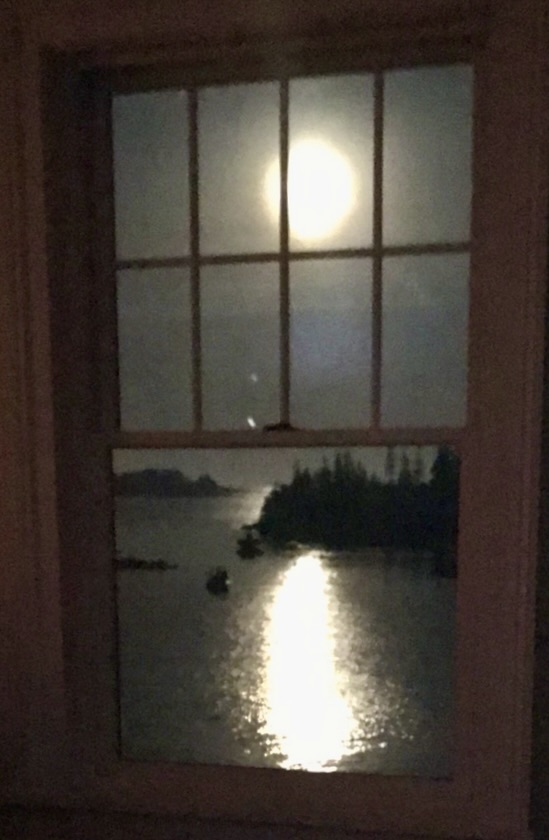
A Book of the Seasons: March Moonlight


Beyond the lone graveyard, 
his footsteps shining like silver 
between me and the moon. 

I see a promise 
or sign of spring 
in the way the moon 
is reflected from the snow.

Henry Thoreau, March 7, 1852


March 6.   A still and mild moonlight night and people walking about the streets.  March 6, 1860

March 7.  At 9 o'clock P.M to the woods by the full moon. It is rather mild to-night. I can walk without gloves. There is no snow on the trees. The ground is thinly covered with a crusted snow, through which the dead grass and weeds appear, telling the nearness of spring.

Though the snow-crust between me and the moon reflects the moon at a distance, westward it is but a dusky white; only where it is heaped up into a drift, or a steep bank occurs, is the moonlight reflected to me as from a phosphorescent place.
 
I distinguish thus large tracts an eighth of a mile distant in the west, where a steep bank sloping toward the moon occurs, that glow with a white, phosphorescent light, while all the surrounding snow is comparatively dark, as if shaded by the woods. I look to see if these white tracts in the distant fields correspond to openings in the woods, and find that they are places where the crystal mirrors are so disposed as to reflect the moon's light to me. 


Going through the high field beyond the lone graveyard, I see the track of a boy's sled before me, and his footsteps shining like silver between me and the moon. I forget that the sun shone on them as if I had reached the region of perpetual twilight, and their sport appears more significant. For what a man does abroad by night is more spiritual, less animal or vegetable.

As I look down the railroad, standing on the west brink of the Deep Cut, I see a promise or sign of spring in the way the moon is reflected from the snow covered west slope – a sort of misty light as if a fine vapor were rising from it. 

The stillness is more impressive than any sound – the moon, the stars, the trees, the snow – a monumental stillness, whose void must be supplied by thought. 

The moon appears to have waned a little, yet, with this snow on the ground, I can plainly see the words I write. What a contrast there may be between this moon and the next ! March 7, 1852

March 26It was like the light reflected from the mountain ridges within the shaded portion of the moon, forerunner and herald of the spring. March 26, 1857


See also:
A Book of the Seasons,  by Henry Thoreau, April Moonlight

A Book of the Seasonsby Henry Thoreau
 "A book, each page written in its own season,
out-of-doors, in its own locality."
 ~edited, assembled and rewritten by zphx ©  2009-2026

https://tinyurl.com/hdt-marchmoon

Saturday, February 1, 2025

A Book of the Seasons: February Moonlight


The landscape covered with snow two feet thick
seen by moonlight from these Cliffs –
my owl sounds hoo hoo hoo, ho-O.

Henry Thoreau, February 3, 1852


February 2. Snows again half an inch more in the evening, after which, at ten o’clock, the moon still obscured, I skate on the river and meadows . . . Our skates make but little sound in this coating of snow about an inch thick, as if we had on woollen skates  and we can easily see our tracks in the night . . . In the meanwhile we hear the distant note of a hooting owl, and the distant rumbling of approaching or retreating cars sounds like a constant waterfall. February 2, 1855

February 3. The moon is nearly full tonight, and the moment is passed when the light in the east (i. e. of the moon) balances the light in the west. Venus is now like a little moon in the west, and the lights in the village twinkle like stars. It is perfectly still and not very cold. The shadows of the trees on the snow are more minutely distinct than at any other season, finely reticulated, each limb and twig represented, as cannot be in summer. The heavens appear less thickly starred than in summer, —  rather a few bright stars, brought nearer by this splendid twinkling in the cold sky. I hear my old acquaintance, the owl, from the Causeway. As I stand over Deep Cut the cars do not make much noise, or else I am used to it. And now whizzes the boiling, sizzling kettle by me, in which the passengers make me think of potatoes, which a fork would show to be done by this time. The steam is denser for the cold, and more white; like the purest downy clouds in the summer sky, its volumes roll up between me and the moon, and far behind, when the cars are a mile off, it still goes shading the fields with its wreaths, - the breath of the panting traveller. I now cross from the railroad to the road. This snow, the last of which fell day before yesterday, is two feet deep, pure and powdery. From a myriad little crystal mirrors the moon is reflected, which is the untarnished sparkle of its surface. Here, in the midst of a clearing, where the choppers have been leaving the woods in pieces to-day, I hear the hooting of an owl, whose haunts the chopper is laying waste. The ground is all pure white powdery snow, which his sled, etc., has stirred up. I can see every track distinctly where the teamster drove his oxen to the choppers' piles and loaded his sled, and even the tracks of his dog in the moonlight, and plainly to write this. The moonlight now is very splendid in the untouched pine woods above the Cliffs, alternate patches of shade and light. The light has almost the brightness of sunlight. The stems of the trees are more obvious than by day, being simple black against the moonlight and the snow. I can tell where there is wood and where open land for many miles in the horizon by the darkness of the former and whiteness of the latter. The landscape covered with snow two feet thick, seen by moonlight from these Cliffs, gleaming in the moon and of spotless white. Who can believe that this is the habitable globe? The scenery is wholly arctic. It looks as if the snow and ice of the arctic world, travelling like a glacier, had crept down southward and overwhelmed and buried New England. See if a man can think his summer thoughts now. But the evening star is preparing to set, and I will return. Floundering through snow, sometimes up to my middle, my owl sounds hoo hoo hoo, ho-OFebruary 3, 1852


February 411 P. M. — Coming home through the village by this full moonlight, it seems one of the most glorious nights I ever beheld. Though the pure snow is so deep around, the air, by contrast perhaps with the recent days, is mild and even balmy to my senses, and the snow is still sticky to my feet and hands . And the sky is the most glorious blue I ever beheld, even a light blue on some sides, as if I actually saw into day, while small white, fleecy clouds, at long intervals, are drifting from west-north west to south-southeast. If you would know the direction of the wind, look not at the clouds, which are such large bodies and confuse you , but consider in what direction the moon appears to be wading through them. The outlines of the elms were never more distinctly seen than now. It seems a slighting of the gifts of God to go to sleep now; as if we could better afford to close our eyes to daylight, of which we see so much. Has not this blueness of the sky the same cause with the blue ness in the holes in the snow, and in some distant shadows on the snow? — if, indeed, it is true that the sky is bluer in winter when the ground is covered with snow.  February 4, 1852

February 14.  Higginson told me yesterday . . . of a person in West Newbury, who told him that he once saw the moon rising out of the sea from his house in that place, and on the moonlight in his room the distinct shadow of a vessel which was somewhere on the sea between him and the moon!!  February 14, 1857

February 27.  To-night a circle round the moon. February 27, 1852

See also:


A Book of the Seasons,  by Henry Thoreau
 "A book, each page written in its own season,
out-of-doors, in its own locality."
 ~edited, assembled and rewritten by zphx ©  2009-2025

Wednesday, January 1, 2025

A Book of the Seasons: January Moonlight


What are heat and cold,
day and night, sun, moon,
and stars to us?
Henry Thoreau, January 26, 1852

The invisible moon
gives light through the thickest of
a driving snow-storm.


January 1Moon little more than half full. Not a cloud in the sky. The stars dazzlingly bright. It is a remarkably warm night for the season, the ground almost entirely bare . . . The white pines, now seen against the moon, with their single foliage, look thin . . . Perhaps the only thing that spoke to me on this walk was the bare, lichen-covered gray rock at the Cliff, in the moonlight, naked and almost warm as in summer. January 1, 1852

January 7Later this evening, walking to Lincoln to lecture in a driving snow-storm, the invisible moon gives light through the thickest of it. January 7, 1852

January 8We have a fine moonlight evening after, and as by day I have noticed that the sunlight reflected from this moist snow had more glitter and dazzle to it than when the snow was dry, so now I am struck by the brighter sheen from the snow in the moonlight. All the impurities in the road are lost sight of, and the melting snow shines like frostwork. When returning from Walden at sunset, the only cloud we saw was a small purplish one, exactly conforming to the outline of Wachusett, — which it concealed, — as if on that mountain only the universal moisture was at that moment condensed.  January 8, 1860

January 19As I come home through the village at 8.15 P. M., by a bright moonlight, the moon nearly full and not more than 18° from the zenith, the wind northwest, but not strong, and the air pretty cold, I see the melon-rind arrangement of the clouds on a larger scale and more distinct than ever before. January 19, 1856

January 21. A fine, still, warm moonlight evening. We have had one or two already. Moon not yet full. . . . I wish to hear the silence of the night, for the silence is something positive and to be heard. I cannot walk with my ears covered. I must stand still and listen with open ears, far from the noises of the village, that the night may make its impression on me. A fertile and eloquent silence . . . Silence alone is worthy to be heard. Silence is of various depth and fertility, like soil. . . . As I leave the village, drawing nearer to the woods, I listen from time to time to hear the hounds of Silence baying the Moon, — to know if they are on the track of any game. If there 's no Diana in the night, what is it worth? I hark the goddess Diana. The silence rings; it is musical and thrills me. A night in which the silence was audible. I hear the unspeakable. I easily read the moral of my dreams. January 21, 1853

January 23And the new moon and the evening star, close together, preside over the twilight scene. January 23, 1852


January 24.  And now the crescent of the moon is seen, and her attendant star is farther off than last night. January 24, 1852

See also 


A Book of the Seasons,  by Henry Thoreau
"A book, each page written in its own season,
out-of-doors, in its own locality.”
~edited, assembled and rewritten by zphx © 2009-2025

Saturday, September 9, 2023

Walking by moonliight til dawn.


September 9.

2 A.M. -The moon not quite full.

To Conantum via, road.

There is a low vapor in the meadows beyond the depot, dense and white, though scarcely higher than a man's head, concealing the stems of the trees. I see that the oaks, which are so dark and distinctly outlined, are illumined by the moon on the opposite side. This as I go up the back road.

A few thin, ineffectual clouds in the sky. 

I come out thus into the moonlit night, where men are not, as if into a scenery anciently deserted by men. The life of men is like a dream. It is three thousand years since night has had possession.

Go forth and hear the crickets chirp at midnight. Hear if their dynasty is not an ancient one and well founded. I feel the antiquity of the night.

She surely repossesses herself of her realms, as if her dynasty were uninterrupted, or she had underlain the day. No sounds but the steady creaking of crickets and the occasional crowing of cocks.

I go by the farmer's houses and barns, standing there in the dim light under the trees, as if they lay at an immense distance or under a veil. The farmer and his oxen now all asleep. Not even a watch-dog awake.

The human slumbers. There is less of man in the world.

The fog in the lowlands on the Corner road is never still. It now advances and envelops me as I stand to write these words, then clears away, with ever noiseless step. It covers the meadows like a web.

I hear the clock strike three.

Now at the clayey bank. The light of Orion's belt seems to show traces of the blue day through which it came to us. The sky at least is lighter on that side than in the west, even about the moon.

Even by night the sky is blue and not black, for we see through the veil of night into the distant atmosphere of day. I see to the plains of the sun, where the sunbeams are revelling.

The cricket's (?) song, on the alders of the causeway, not quite so loud at this hour as at evening. 

The moon is getting low. I hear a wagon cross one of the bridges leading into the town. I see the moonlight at this hour on a different side of objects. 

I smell the ripe apples many rods off beyond the bridge. A sultry night; a thin coat is enough.

On the first top of Conantum. I hear the farmer harnessing his horse and starting for the distant market, but no man harnesses himself, and starts for worthier enterprises. One cock-crow tells the whole story of the farmer's life.

The moon is now sinking into clouds in the horizon. I see the glow-worms deep in the grass by the little brookside in midst of Conantum. The moon shines dun and red. A solitary whip-poor-will sings.

The clock strikes four.

A few dogs bark. A few more wagons start for market, their faint rattling heard in the distance. 

I hear my owl without a name; the murmur of the slow-approaching freight-train, as far off, perchance, as Waltham; and one early bird.

The round, red moon disappearing in the west. I detect a whiteness in the east.

Some dark, massive clouds have come over from the west within the hour, as if attracted by the approaching sun, and have arranged themselves raywise about the eastern portal, as if to bar his coming. They have moved suddenly and almost unobservedly quite across the sky (which before was clear) from west to east.

No trumpet was heard which marshalled and advanced these dark masses of the west's forces thus rapidly against the coming day. Column after column the mighty west sent forth across the sky while men slept, but all in vain.

The eastern horizon is now grown dun-colored, showing where the advanced guard of the night are already skirmishing with the vanguard of the sun, a lurid light tingeing the atmosphere there, while a dark-columned cloud hangs imminent over the broad portal, untouched by the glare.

Some bird flies over, making a noise like the barking of a puppy.

It is yet so dark that I have dropped my pencil and cannot find it. It was a cuckoo.

The sound of the cars is like that of a rushing wind. They come on slowly. I thought at first a morning wind was rising.

And now (perchance at half-past four) I hear the sound of some far-off factory bell arousing the operatives to their early labors. It sounds very sweet here. It is very likely some factory which I have never seen, in some valley which I have never visited; yet now I hear this, which is its only matin bell, sweet and inspiring as if it summoned holy men and maids to worship and not factory girls and men to resume their trivial toil, as if it were the summons of some religious or even poetic community. 

My first impression is that it is the matin bell of some holy community who in a distant valley dwell, a band of spiritual knights, - thus sounding far and wide, sweet and sonorous, in harmony with their own morning thoughts. What else could I suppose fitting this earth and hour? Some man of high resolve, devoted soul, has touched the rope; and by its peals how many men and maids are waked from peaceful slumbers to fragrant morning thoughts! Why should I fear to tell that it is Knight's factory bell at Assabet? 

A few melodious peals and all is still again.

The whip-poor-wills now begin to sing in earnest about half an hour before sunrise, as if making haste to improve the short time that is left them. As far as my observation goes, they sing for several hours in the early part of the night, are silent commonly at midnight, - though you may meet [them] then sitting on a rock or flitting silently about, - then sing again just before sunrise.

It grows more and more red in the east – a fine-grained red under the overhanging cloud – and lighter too, and the threatening clouds are falling off to southward of the sun's passage, shrunken and defeated, leaving his path comparatively clear. The increased light shows more distinctly the river and the fog.

5 o'clock. - The light now reveals a thin film of vapor like a gossamer veil cast over the lower hills beneath the Cliffs and stretching to the river, thicker in the ravines, thinnest on the even slopes. The distant meadows towards the north beyond Conant's Grove, full of fog, appear like a vast lake out of which rise Annursnack and Ponkawtasset like rounded islands. Nawshawtuct is a low and wooded isle, scarcely seen above the waves. The heavens are now clear again. 

The vapor, which was confined to the river and meadows, now rises and creeps up the sides of the hills. I see it in transparent columns advancing clown the valley of the river, ghost-like, from hair Haven, and investing some wooded or rocky promontory, before free. are said to advance.

Annursnack is exactly like some round, steep, distant hill on the opposite shore of a large lake (and Tabor on the other side), with here and there some low Brush Island in middle of the waves (the tops of some oaks or elms).

Oh, what a sail I could take, if I had the right kind of bark, over to Annursnack! for there she lies four miles from land as sailors say. And all the farms and houses of Concord are at bottom of that sea. So I forget them, and my thought sails triumphantly over them.

As I looked down where the village of Concord lay buried in fog, I thought of nothing but the surface of a lake, a summer sea over which to sail; no more than a voyager on the Dead Sea who had not read the Testament would think of Sodom and Gomorrah, once cities of the plain.

I only wished to get off to one of the low isles I saw in midst of the [sea] (it may have been the top of Holbrook's elm), and spend the whole summer day there.

Meanwhile the redness in the east had diminished and was less deep. (The fog over some meadows looked green.) 

I went down to Tupelo Cliff to bathe. A great bittern, which I had scared, flew heavily across the stream. 

The redness had risen at length above the dark cloud, the sun approaching. And next the redness became a sort of yellowish or fawn-colored light, and the sun now set fire to the edges of the broken cloud which had hung over the horizon, and they glowed like burning turf.

H. D. Thoreau, Journal, September 9, 1851

 Even by night the sky is blue and not black, for we see through the veil of night into the distant atmosphere of day. See January 21, 1853 ("The blueness of the sky at night — the color it wears by day — is an everlasting surprise to me, suggesting the constant presence and prevalence of light in the firmament, that we see through the veil of night to the constant blue, as by day."); February 12, 1860 ("There is an annual light in the darkness of the winter night. The shadows are blue, as the sky is forever blue."); May 11, 1853 ("Blue is the color of the day, and the sky is blue by night as well as by day, because it knows no night.") See also  Night and Moonlight (first published in the Atlantic Monthly, November 1863) ("Nevertheless, even by night the sky is blue and not black, for we see through the shadow of the earth into the distant atmosphere of day, where the sunbeams are reveling.")


We see through the veil
of night into the distant
atmosphere of day.

Wednesday, May 3, 2023

A Book of the Seasons: May Moonlight


[The lupines] are transparent. 
Last night in the dark they were all a pale, whitish color like the moon by day — 
a mere dull luminousness, as if they reflected light absorbed by day. 
Henry Thoreau, May 28, 1853

The moon is now full.
The air is liquid white light 
luminous moonlight.

It grows dark around. 
The full moon rises, and I 
paddle by its light.

In the moonlight night
there are three objects  – the moon
 a pine tree and me. 
May 16, 1851


May 3.  5 a. m. — To Cliffs. A great brassy moon going down in the west . . .  Evening. -- The moon is full. The air is filled with a certain luminous, liquid, white light. You can see the moonlight, as it were, reflected from the atmosphere.  May 3, 1852

May 4. A robin sings when I, in the house, cannot distinguish the earliest dawning from the full moon light. His song first advertises me of the daybreak, when I think it night, as I lie looking out into the full moonlight. I hear a robin begin his strain, and yield the point to him, believing he is better acquainted with the springs of the day than I, — with the signs of day. May 4, 1855

May 5. Evening. — To the Lee place rock. Moon not up.There goes a shooting star down towards the horizon, like a rocket, appearing to describe a curve. The water sleeps with stars in its bosom. May 5, 1852

May 8. It grows dark around. The full moon rises, and I paddle by its light. May 8, 1857

May 16. A splendid full moon to-night. Walked from 6. 30 to 10 P M. Lay on a rock near a meadow, which had absorbed and retained much heat, so that I could warm my back on it, it being a cold night. I found that the side of the sand-hill was cold on the surface, but warm two or three inches beneath. If there is a more splendid moonlight than usual, only the belated traveller observes it. When I am outside, on the outskirts of the town, enjoying the still majesty of the moon, I am wont to think that all men are aware of this miracle, that they too are silently worshipping this manifestation of divinity elsewhere. But when I go into the house I am undeceived; they are absorbed in checkers or chess or novel, though they may have been advertised of the brightness through the shutters. In the moonlight night what intervals are created! The rising moon is related to the near pine tree which rises above the forest, and we get a juster notion of distance. The moon is only somewhat further off and on one side. There may be only three objects, — myself, a pine tree, and the moon, nearly equidistant. Talk of demonstrating the rotation of the earth on its axis, — see the moon rise, or the sun! The moonlight reveals the beauty of trees. By day it is so light and in this climate so cold commonly, that we do not perceive their shade. We do not know when we are beneath them. May 16, 1851


A Book of the Seasons,  by Henry Thoreau
 "A book, each page written in its own season,
out-of-doors, in its own locality."
 ~edited, assembled and rewritten by zphx ©  2009-2023

Monday, April 3, 2023

A Book of the Seasons: April Moonlight


There always appears to be something phosphorescent
in moonlight reflected from water.
Henry Thoreau April 3, 1852

Evening on river. 
Fine full moon —
river smooth.

The pale cloud-like moon
spirit-like seen in daylight –
just over the woods.
April 30, 1852


April 1. There will be no moon till toward morning. There are but three elements in the landscape now, -- the star-studded sky, the water, reflecting the stars and the lingering daylight, and the dark narrow land between. A slight mist is rising from the surface of the water. April 1, 1853

April 3. The moon appears to be full to-night. About 8.30 P. M. I walked to the Clamshell Hill. It is very cold and windy, and I miss my gloves, left at home. Colder than the last moon. The sky is two-thirds covered with great four or more sided downy clouds, drifting from the north or northwest, with dark-blue partitions between them. The moon, with a small brassy halo, seems travelling ever through them toward the north. The water is dull and dark, except close to the windward shore, where there is a smooth strip a rod or more in width protected from the wind, which reflects a faint light. When the moon reaches a clear space, the water is suddenly lit up quite across the meadows, for half a mile in length and several rods in width, while the woods beyond are thrown more into the shade, or seen more in a mass and indistinctly, than before. The ripples on the river, seen in the moonlight, those between the sunken willow lines, have the arc of a circle, as if their extremities were retarded by the friction of the banks. I noticed this afternoon that bank below Cæsar's, now partially flooded, higher than the neighboring meadow, so that sometimes you can walk down on it a mile dry shod with water on both sides of you. Like the banks of the Mississippi. There always appears to be something phosphorescent in moonlight reflected from water. Venus is very bright now in the west, and Orion is there, too, now. I came out mainly to see the light of the moon reflected from the meadowy flood. It is a pathway of light, of sheeny ripples, extending across the meadow toward the moon, consisting of a myriad little bent and broken moons. I hear one faint peep bird on its roost. The clouds are travelling very fast into the south. I would not have believed the heavens could be cleared so soon. They consist of irregularly margined, wide whitish bars, apparently converging, rendezvousing, toward one point far in the south horizon. Like the columns of a host in the sky, each being conducted by its own leader to one rendezvous in the southern heavens. Such is the illusion, for we are deceived when we look up at this concave sphere, as when we look on a plane map representing the convex globe, --not by Mercator's projection. But what a grand incident of the night — though hardly a night passes without many such — that, between the hours of nine and ten, a battalion of downy clouds many miles in length and several in width were observed sailing noiselessly like a fleet from north to south over land and water, town and cottage, at the height of half a dozen miles above the earth! Over woods and over villages they swept along, intercepting the light of the moon, and yet perchance no man observed them. Now they are all gone. The sky is left clear and cold and but thinly peopled at this season. It is of a very light blue in all the horizon, but darker in the zenith, darkest of all in the crevice between two downy clouds. It is particularly light in the western horizon. Who knows but light is reflected from snow lying on the ground further inland? The water, as I look at it in the north or northeast, is a very dark blue, the moon being on my right; afterwards, crossing the railroad bridge, is a deep sea-green. The evenings are now much shortened, suggesting that ours is to be henceforth a daylight life. April 3, 1852

April 11. Evening on river. Fine full moon; river smooth. Hear a slight snoring of frogs on the bared meadows. Is it not the R. palustris? This the first moon to walk by. April 11, 1854

April 12. A white frost this morning, after the clear moonlight. April 12, 1854

April 15. It is a rather warm, moist night, the moon partially obscured by misty clouds, all the village asleep, only a few lights to be seen in some windows, when, as I pass along under the warm hillside, I hear a clear, shrill, prolonged ringing note from a toad, the first toad of the year, sufficiently countenanced by its Maker in the night and the solitude, and then again I hear it (before I am out of hearing, i.e. it is deadened by intervening buildings), on a little higher key. At the same time, I hear a part of the hovering note of my first snipe, circling over some distant meadow, a mere waif, and all is still again. A-lulling the watery meadows, fanning the air like a spirit over some far meadow’s bay. April 15, 1856

April 24. I saw the moon rise last night over great bare hills eastward and it reminded me of Ossian.  April 24, 1853

April 30. Dodging behind a swell of land to avoid the men who were plowing, I saw unexpectedly (when I looked to see if we were concealed by the field) the blue mountains' line in the west (the whole intermediate earth and towns being concealed), this greenish field for a foreground sloping upward a few rods, and then those grand mountains seen over it in the background, so blue, — seashore, earth-shore, — and, warm as it is, covered with snow which reflected the sun. Then when I turned, I saw in the east, just over the woods, the modest, pale, cloud-like moon, two thirds full, looking spirit-like on these daylight scenes. Such a sight excites me. The earth is worthy to inhabit. April 30, 1852

See also:

A Book of the Seasons,  by Henry Thoreau, April Moonlight
 "A book, each page written in its own season,
out-of-doors, in its own locality."
 ~edited, assembled and rewritten by zphx ©  2009-2023

https://tinyurl.com/HDTaprilmoon

Popular Posts Last 30 Days.

The week ahead in Henry’s journal

The week ahead in Henry’s journal
A journal, a book that shall contain a record of all your joy.
"A stone fruit. Each one yields me a thought." ~ H. D. Thoreau, March 28, 1859


I sit on this rock
wrestling with the melody
that possesses me.