Showing posts with label thistle-down. Show all posts

Monday, September 29, 2025

A Book of the Seasons: The Thistle and Thistle Down


I would make a chart of our life, 
know why just this circle of creatures 
completes the world.
Henry Thoreau, April 18, 1852

The thistle in bloom 
each child eager to clutch once - 
just a child's handful.
September 1850


March 10. Misty and mizzling. The radical leaves of the shepherd's-purse are common and fresh, also that early thistle by Nut Meadow Brook, with much down webbed, holding the mist in drops. March 10, 1854

March 29. I observe today the buttercup, very common, the pasture thistle, etc., etc., what perhaps are chickweeds? March 29, 1852

April 18. Observed a thistle just springing up in the meadow, a disk of green a few inches in diameter in the midst of the old decayed leaves, which, now being covered with rain-drops, beaded and edged - the close-packed leaves - with purple, made a very rich sight, not to be seen in dry weather. The green leaves of the thistle in a dense disk, edged with purple and covered with bead-like raindrops, just springing from the meadow. It reminded me of some delicious fruit, all ripe, quite flat. April 18, 1852

April 19. Observed the thistle again covered with the beads of rain-drops and tinged with purple on the edges of the leaves. It impressed me again as some rich fruit of the tropics ready to be eaten with a spoon. It suggests pineapples, custard-apples, or what is it? The pasture thistle April 19, 1852

June 18. Am surprised to find the Cirsium horridulum, or great yellow thistle, out, some already withering, turned a dark purple, possibly a week old.  June 18, 1854

June 24. Common yellow thistle [Cirsium horridulum] abundant about R’s; open a good while.  June 24, 1856

June 29. Canada thistle, yesterday. June 29, 1854

July 3.  The Canada thistle [Cirsium arvense]. July 3, 1853
July 6. Pasture thistle (Cirsium pumilum), out some time. A great many white ones.  July 6, 1855 [Cape Cod] 
July 9. Examine a lanceolate thistle which has been pressed and laid by a year. The papers being taken off, its head springs up more than an inch and the downy seeds begin to fly off. July 9, 1854
July 14.  Canada thistle some time on Huckleberry Pasture-side beyond. July 14, 1856
July 15.  To Ledum Swamp. First notice Canada thistle. July 15, 1859
July 17. Pasture thistle on Lee's Cliff, three or four days. July 17, 1854
July 19. Here is the Canada thistle in bloom, visited by butterflies and bees. July 19, 1851
July 22. The spear thistle [Cirsium lanceolatum] July 22, 1852
July 22. Spear-leaved thistle, apparently several days, some being withered. 
July 23. Cirsium pumilus, pasture thistle. July 23, 1852
July 23. Pasture thistle, not long. July 23, 1856 
July 25. On the farther hill in Hull, I saw a field full of Canada thistles close up to the fences on all sides, while beyond them there was none. So much for these fields having been subjected to different culture. July 25, 1851
July 29.  I found on the edge of this clearing the Cirsium muticum, or swamp thistle, abundantly in bloom. July 29, 1857  [the Maine Woods]
July 30. Is that goose-grass near yellow thistles? July 30, 1854

August 2. I see apparently a thistle-down over the river at Bittern Cliff; it is borne toward me, but when it reaches the rock some influence raises it high above the rock out of my reach. August 2, 1856
August 3.   Cirsium lanceolatum at Lee's Cliff, apparently some days. Its leaves are long-pointed and a much darker green than those of the pasture thistle.   On the under sides of its leaves I noticed very large ants attending peculiar large dark-colored aphides, for their milch cows.  August 3, 1856 
August 6. I find a bumblebee asleep in a thistle blossom (a pasture thistle)  the loiterer; having crowded himself in deep amid the dense florets, out of the reach of birds, while the sky was overcast. What a sweet couch!   August 6, 1852 
August 9. The notes of the wood pewee and warbling vireo are more prominent of late, and of the goldfinch twittering over. Does the last always utter his twitter when ascending? These are already feeding on the thistle seeds. August 9, 1856
August 9. The goldfinch nest of this forenoon is saddled on a horizontal twig of an apple,   . . . It is thickly and very warmly lined with (apparently) short thistle-down, mixed with which you see some grape-vine bark, and the rim is composed of the same shreds of bark, catkins, and some fine fibrous stems, and two or three hairs (of horse) mixed with wool (?); for only the hollow is lined with the looser or less tenacious thistle-down. This nest shows a good deal of art. August 9, 1858
August 12. I see goldfinches nowadays on the lanceolate thistles, apparently after the seeds.  It takes all the heat of the year to produce these yellow flowers. August 12, 1854
August 13. I see where the pasture thistles have apparently been picked to pieces (for their seeds? by the goldfinch?), and the seedless down strews the ground.  August 13, 1854
August 14. The Canada thistle down is now begun to fly, and I see the goldfinch upon it. August 14, 1858
August 15.  Cnicus pumilus, pasture thistle. How many insects a single one attracts ! While you sit by it, bee after bee will visit it, and busy himself probing for honey and loading himself with pollen, regardless of your over shadowing presence. He sees its purple flower from afar, and that use there is in its color.   August 15, 1851 
August 15.  On the top of the Hill I see the goldfinch eating the seeds of the Canada thistle. I rarely approach a bed of them or other thistles nowadays but I hear the cool twitter of the goldfinch about it.  August 15, 1854
August  19. The wind rises and the pasture thistle down is blown about. August 19, 1856
August  19.  I see thistle-down, grayish-white, floating low quite across Fair Haven Pond. There is wont to be just [wind] enough above the surface to drive it along. August 19, 1858
August 20.  Now the Canada thistle and the mullein crown their tops.  August 20, 1851
August 26. Radical leaves of the yellow thistle spot the meadow. August 25, 1854
August 26. As I stand there, a young male goldfinch darts away with a twitter from a spear thistle top close to my side, and, alighting near, makes frequent returns as near to me and the thistle as it dares pass, not yet knowing man well enough to fear him. August 26, 1856
August 28. A goldfinch twitters away from every thistle now, and soon returns to it when I am past. I see the ground strewn with the thistle-down they have scattered on every side. August 28, 1856 
August 30. The pasture thistle, though past its prime, is quite common, and almost every flower (i. e. thistle), wherever you meet with it, has one or more bumblebees on it, clambering over its mass of florets. . . . . . . Now that flowers are rarer, almost every one of whatever species has bees or butterflies upon it.  August 30, 1859
August 31Cirsium muticum, in Moore's Swamp behind Indian field, going out of flower; perhaps out three weeks.  August 31, 1853

September 1. This is a very warm and serene evening, and the surface of the pond is perfectly smooth except where the skaters dimple it, for at equal intervals they are scattered over its whole extent, and, looking west, they make a fine sparkle in the sun. Here and there is a thistle-down floating on its surface, which the fishes dart at, and dimple the water, --  a delicate hint of approaching autumn, when the first thistle-down descends on some smooth lake's surface, full of reflections, in the woods, sign to the fishes of the ripening year. These white faery vessels are annually wafted over the cope of their sky. Bethink thyself, O man, when the first thistle-down is in the air. Buoyantly it floated high in air over hills and fields all day, and now, weighed down with evening dews, perchance, it sinks gently to the surface of the lake. Nothing can stay the thistle-down, but with September winds it unfailingly sets sail. The irresistible revolution of time. It but comes down upon the sea in its ship, and is still perchance wafted to the shore with its delicate sails. The thistle-down is in the air. Tell me, is thy fruit also there? Dost thou approach maturity? September 1, 1852
September 1. The cherry-birds and robins seem to know the locality of every wild cherry in the town. You are as sure to find them on them now, as bees and butterflies on the thistles.  September 1, 1859 
September 4.The swamp thistle (Cirsium muticum) is apparently in its prime. One or two on each has faded, but many more are to come. Some are six feet high and have radical leaves nearly two feet long. Even these in the shade have humblebees on them . . . Three kinds of thistles are commonly out now, — the pasture, lanceolate, and swamp, — and on them all you are pretty sure to see one or two humblebees. They become more prominent and interesting in the scarcity of purple flowers. (On many you see also the splendid goldfinch, yellow and black like the humble-bee.) The thistles beloved of humblebees and goldfinches. September 4, 1859 
September 4. The goldfinch is very busy pulling the thistle to pieces. September 4, 1860 
September 5. I see much thistle-down without the seed floating on the river and a hummingbird about a cardinal-flower over the water’s edge. September 5, 1854. .  
September 6 At Brattlebotro . . . Cirsium discolor [field thistle], roadside below depot, apparently in prime, much like lanceolatum, but smaller leaves, whitish beneath and inner scales unarmed. September 6, 1856
September 9. I see very large plants of the lanceolate thistle, four feet high and very branching. September 9, 1860
September 13 I find the large thistle (Cirsium muticum) out of bloom, seven or eight rods, perhaps, north of the potato-field and seven feet west of ditch, amid a clump of raspberry vines. September 13, 1854 
September 21. Swamp thistle [Cirsium muticum], still abundant. September 21, 1858
September 24. Pasture thistle still. September 24, 1852
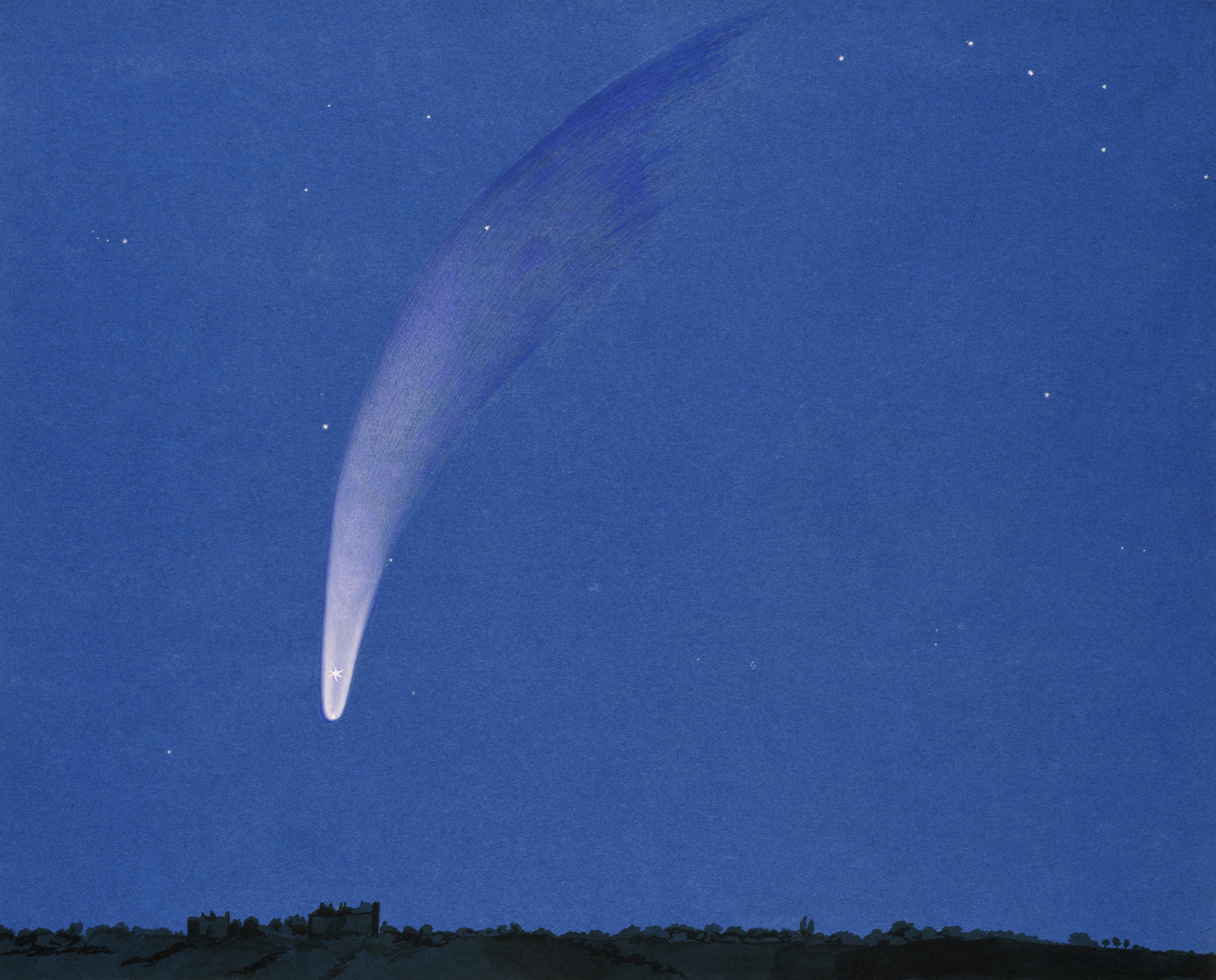
September 29On our way, near the Hosmer moraine, let off some pasture thistle-down. One steadily rose from my hand, freighted with its seed, till it was several hundred feet high, and then passed out of sight eastward. Its down was particularly spreading or open. Is not here a hint to balloonists?  Astronomers can calculate the orbit of that thistle-down called the comet, now in the northwest sky, conveying its nucleus, which may not be so solid as a thistle’s seed, some whither, but what astronomer can calculate the orbit of my thistle-down and tell where it will deposit its precious freight at last?

Donati’s Comet 1858
It may still be travelling when I am sleeping. September 29, 1858 

October 5.  I amuse myself on the hilltop with pulling to pieces and letting fly the now withered and dry pasture thistle tops. They have a much coarser pappus than the milkweeds. I am surprised, amid these perfectly withered and bleached thistles, to see one just freshly in flower.  October 5, 1856

Surprised amid these
withered thistles to see one
freshly in flower.

October 8.  The seeds of the pasture thistle are not so buoyed up by their down as the milkweed. October 8, 1851
October 11. A pasture thistle with many fresh flowers and bees on it. October 11, 1856 
October 12It is interesting to see how some of the few flowers which still linger are frequented by bees and other insects. Their resources begin to fail and they are improving their last chance. 
I have noticed them of late, especially on white goldenrod and pasture thistles, etc. October 12, 1856
October 18. A large pasture thistle bud close to the ground amid its leaves, as in spring. October 18, 1856
October 29.  Soapwort gentian and pasture thistle still.  October 29, 1855
October 23A pasture thistle on Conantum just budded, but flat with the ground. October 23, 1852

November 3.  The thistle radical leaves and fragrant everlasting not to be forgotten.  November 3, 1853
November 18. The fruitless enterprise of some persons who rush helter-skelter, carrying out their crazy scheme,—merely “putting it through,” as they phrase it, — reminds me of those thistle-downs which, not being detained nor steadied by any seed at the base, are blown away at the first impulse and go rolling over all obstacles. They may indeed go fastest and farthest, but where they rest at last not even a thistle springs. I meet these useless barren thistle-downs driving over the fields. They remind me of busy merchants and brokers on ’change doing business on credit, gambling with fancy stocks, that have failed over and over again, assisted to get a-going again to no purpose,—-a great ado about no thing, — all in my eye, — with nothing to deposit, not of the slightest use to the great thistle tribe, not even tempting a jackass. When you right or extricate one of these fellows and set him before the wind again, it is worth the while to look and see if he has any seed of success under him. Such a one you may know afar — he floats more slowly and steadily— and of his enterprise expect results. November18, 1858

December 23. At Lee’s Cliff I notice these radical(?) leaves quite fresh: saxifrage, sorrel, polypody, mullein, columbine, veronica, thyme-leaved sandwort, spleenwort, strawberry, buttercup, radical johnswort, mouse-ear, radical pinweeds, cinquefoils, checkerberry, Wintergreen, thistles, catnip, Turritis strictae specially fresh and bright. December 23, 1855 
January 25, I saw to-day, where a creeping juniper had been burnt, radical leaves of johnswort, thistle, clover, dandelion, etc., as well as sorrel and veronica. January 25, 1853
January 30.   There is also the early crowfoot in some places, strawberry, mullein, and thistle leaves, and hawkweeds, etc., etc. January 30, 1854
February 12. On those parts of the hill which are bare, I see the radical leaves of the butter-cup, mouse-ear, and the thistle.  February 12, 1854
February 18. The snow is nearly all gone, . . . I step excited over the moist mossy ground, dotted with the green stars of thistles, crowfoot, etc., the outsides of which are withered. February 18, 1857 
February 27.  Among the radical leaves most common, and therefore early-noticed, are the veronica and the thistle, - green in the midst of brown and decayed; and at the bottom of little hollows in pastures, now perhaps nearly covered with ice and water.  February 27, 1860 

We live as it were
like a bee asleep in a
thistle blossom.
August 6, 1852


A Book of the Seasons,  by Henry Thoreau
 "A book, each page written in its own season,
out-of-doors, in its own locality."
 ~edited, assembled and rewritten by zphx ©  2009-2025

Saturday, September 29, 2018

What astronomer can calculate the orbit of my thistle-down?


September 29

Fine weather. P. M. — To White Pond. 

September 29, 2018

One or two myrtle-birds in their fall dress, with brown head and shoulders, two whitish bars on wings, and bright-yellow rump. 

Sit on Clamshell, looking up the smooth stream. Two blue herons, or “herns,” as Goodwin calls them, fly sluggishly up the stream. Interesting even is a stake, with its reflection, left standing in the still river by some fisherman. 

Again we have smooth waters, yellow foliage, and faint warbling birds, etc., as in spring. The year thus repeats itself. 

Catch some of those little fuzzy gnats dancing in the air there over the shelly bank, and these are black, with black plumes, unlike those last seen over the Cassandra Pond. 

Brushed a spectrum, ghost-horse, off my face in a birch wood, by the J. P. Brown cold Heart-Leaf Pond. Head somewhat like a striped snake. 

That pond is drier than I ever saw it, perhaps [No, have seen it so before.]—all but a couple of square rods in the middle, —and now covered with cyperus, etc. The mud is cracked into large polygonal figures of four to six sides and six to twelve inches across, with cracks a half to three quarters of an inch wide.

See what must be a solitary tattler feeding by the water’s edge, and it has tracked the mud all about. It cannot be the Tringa pectoralis, for it has no conspicuous white chin, nor black dashes on the throat, nor brown on the back and wings, and I think I see the round white spots on its wings. It has not the white on wing of the peetweet, yet utters the peetweet note!— short and faint, not protracted, and not the “sharp whistle” that Wilson speaks of. 

The lespedeza leaves are all withered and ready to fall in the frosty hollows near Nut Meadow, and [in] the swamps the ground is already strewn with the first maple leaves, concealing the springiness of the soil, and many plants are prostrate there, November-like.

High up in Nut Meadow, the very brook — push aside the half-withered grass which (the farmer disdaining to cut it) conceals it — is as cool as a spring, being near its sources. 

Take perhaps our last bath in White Pond for the year. Half a dozen F. hyemalis about. 

Looking toward the sun, some fields reflect a light sheen from low webs of gossamer which thickly cover the stubble and grass. 

On our way, near the Hosmer moraine, let off some pasture thistle-down. One steadily rose from my hand, freighted with its seed, till it was several hundred feet high, and then passed out of sight eastward. Its down was particularly spreading or open. Is not here a hint to balloonists? 

Astronomers can calculate the orbit of that thistle-down called the comet, now in the northwest sky, conveying its nucleus, which may not be so solid as a thistle’s seed, some whither, but what astronomer can calculate the orbit of my thistle-down and tell where it will deposit its precious freight at last? It may still be travelling when I am sleeping. 

Donati’s Comet 1858

Some Lobelia inflata leaves peculiar hoary-white.

September 29, 2018

H. D. Thoreau,  Journal, September 29, 1858

One or two myrtle-birds in their fall dress, with brown head and shoulders, two whitish bars on wings, and bright-yellow rump. See September 23, 1855 (“A little wren-like (or female goldfinch) bird on a.willow at Hubbard’s Causeway, eating a miller: with bright-yellow rump when wings open, and white on tail. Could it have been a yellow-rump warbler?”); October 14, 1855 ("Black bill and feet, yellow rump, brown above, yellowish-brown on head, cream-colored chin, two white bars on wings, tail black, edged with white, — the yellow-rump warbler or myrtle-bird without doubt.”)

Half a dozen F. hyemalis about. See  September 29, 1854 ("I hear a very pleasant and now unusual strain on the sunny side of an oak wood from many — I think F. hyemalis, though I do not get a clear view of them. Even their slight jingling strain is remarkable at this still season.") See also September 24, 1854 (" Do I see an F. hyemalis in the Deep Cut? It is a month earlier than last yea"); October 5, 1857 ("It is evident that some phenomena which belong only to spring and autumn here . . . the myrtle-bird and F. hyemalis which breed there, but only transiently visit us in spring and fall.") 

The year thus repeats itself. See May 5, 1860 ("It takes us many years to find out that Nature repeats herself annually”)

Brushed a spectrum, ghost-horse, off my face in a birch wood. See ;  August 29, 1858 (“The ghost-horse (Spectrum) is seen nowadays, — several of them.”)

Take perhaps our last bath in White Pond for the year. See September 27, 1856 ("Bathed at Hubbard's Bath, but found the water very cold. Bathing about over”) See also A Book of the Seasons, by Henry Thoreau, The Luxury of Bathing

The comet, now in the northwest sky. See September 23 , 1858 (Saw the comet very bright in the northwest. "); October 5, 1858 ("The comet makes a great show these nights.")

Thistle-down See September 1, 1852 ("These white faery vessels are annually wafted over the cope of their sky. Bethink thyself, O man, when the first thistle-down is in the air. Buoyantly it floated high in air over hills and fields all day, and now, weighed down with evening dews, perchance, it sinks gently to the surface of the lake. Nothing can stay the thistle-down, but with September winds it unfailingly sets sail. The irresistible revolution of time. It but comes down upon the sea in its ship, and is still perchance wafted to the shore with its delicate sails. The thistle-down is in the air. Tell me, is thy fruit also there? Dost thou approach maturity? ") See also A Book of the Seasons,  by Henry Thoreau, the Thistles

What astronomer
can calculate the orbit 
of my thistle-down?


A Book of the Seasons,  by Henry Thoreau
 "A book, each page written in its own season,
out-of-doors, in its own locality."
 ~edited, assembled and rewritten by zphx ©  2009-2025

tinyurl.com/HDT580929

Sunday, August 19, 2018

You may say it is the first day of autumn.

August 19. 

P. M. — Sail to Baker Farm shore. 

It is cool with a considerable northwesterly wind, so that we can sail to Fair Haven. The dog-day weather is suddenly gone and here is a cool, clear, and elastic air. You may say it is the first day of autumn. 

You notice the louder and clearer ring of crickets, and the large, handsome red spikes of the Polygonum amphibium are now generally conspicuous along the shore. The P. hydropiperoides fairly begins to show. The front-rank polygonum is now in prime. 

We scare up a stake-driver several times. The blue heron has within a week reappeared in our meadows, and the stake-driver begins to be seen oftener, and as early as the 5th I noticed young summer ducks about; the same of hawks, owls, etc. 

This occurs as soon as the young birds can take care of themselves, and some appear to be very early on the return southward, with the very earliest prospect of fall. Such birds are not only more abundant but, methinks, more at leisure now, having reared their family, and perhaps they are less shy. 

Yes, bitterns are more frequently seen now to lift themselves from amid the pontederia or flags, and take their sluggish flight to a new resting-place, —bitterns which either have got through the labors of breeding or are now first able to shift for themselves.

And likewise blue herons, which have bred or been bred not far from us (plainly), are now at leisure, or are impelled to revisit our slow stream. I have not seen the last since spring. 

When I see the first heron, like a dusky blue wave undulating over our meadows again, I think, since I saw them going northward the other day, how many of these forms have been added to the landscape, complete from bill to toe, while, perhaps, I have idled! 

I see two herons. A small bird is pursuing the heron as it does a hawk. Perhaps it is a blackbird and the herons gobble up their young! 

I see thistle-down, grayish-white, floating low quite across Fair Haven Pond. There is wont to be just water [sic] enough above the surface to drive it along. 

The heads of the wool-grass are now brown and, in many meadows, lodged. 

The button-bush is about done. Can hardly see a blossom. 

The mikania not yet quite in prime. 

Pontederia has already begun to wane; i. e., the fields of them are not so dense, many seed-vessels having turned down; and some leaves are already withered and black, but the remaining spikes are as fair as ever. 

It chances that I see no yellow lilies. They must be scarce now. 

The water is high for the season. Water cool to bather. 

We have our first green corn to-day, but it is late.

The saw-grass (Paspalum?) of mown fields, not long. 

I noticed the localities of black willows as far up as the mouth of the river in Fair Haven Pond, but not so carefully as elsewhere, and from the last observations I infer that the willow grows especially and almost exclusively in places where the drift is most likely to lodge, as on capes and points and concave sides of the river, though I noticed a few exceptions to my rule. 

It is so cool, some apprehend a frost to-night.

H. D. Thoreau, Journal, August 19, 1858

The dog-day weather is suddenly gone and here is a cool, clear, and elastic air. You may say it is the first day of autumn. See August 19, 1853 ("The first bright day of the fall . . .. The dog-day mists are gone; the washed earth shines; the cooler air braces man. No summer day is so beautiful as the fairest spring and fall days.”)

I see thistle-down, grayish-white, floating low quite across Fair Haven Pond. September 1, 1852 (“-- a delicate hint of approaching autumn, when the first thistle-down descends on some smooth lake's surface, full of reflections, in the woods, sign to the fishes of the ripening year.”)

Blue herons, which have bred or been bred not far from us (plainly), are now at leisure, or are impelled to revisit our slow stream. See August 12, 1853 ("See the blue herons opposite Fair Haven Hill, as if they had bred here.”); August 14,1859 (" If you would know the depth of the water on these few shoalest places of Musketaquid, ask the blue heron that wades and fishes there"): August 15, 1852 (“See a blue heron on the meadow.”); August 15, 1860 ("See a blue heron.”); August 16. 1858 ("A blue heron, with its great undulating wings, prominent cutwater, and leisurely flight, goes over southwest, cutting off the bend of the river west of our house."); August 21, 1859 ("The blue herons must find it easy to get their living now. Are they not more common on our river such [drought] years as this?"); August 24, 1854 (“See a blue heron standing on the meadow at Fair Haven Pond. At a distance before you, only the two waving lines appear, and you would not suspect the long neck and legs.”); August 22, 1854 (“See a blue heron — apparently a young bird, of a brownish blue — fly up from one of these pools, and a stake-driver from another, and also see their great tracks on the mud, and the feathers they had shed, — some of the long, narrow white neck-feathers of the heron. The tracks of the heron are about six inches long.”); August 26, 1856 (“A blue heron sails away from a pine at Holden Swamp shore and alights on the meadow above.”) See also A Book of the Seasons, by Henry Thoreau, the Blue Heron


August 19. See A Book of the Seasons,  by Henry Thoreau, August 19

A Book of the Seasons,  by Henry Thoreau
"A book, each page written in its own season,
out-of-doors, in its own locality.”
~edited, assembled and rewritten by zphx © 2009-2021


Tuesday, August 14, 2018

These might be called the pewee-days.

August 14. 

P. M. — To the one-arched bridge. 

Hardhacks are probably a little past prime. 

Stopped by the culvert opposite the centaurea, to look at the sagittaria leaves. Perhaps this plant is in its prime (?). Its leaves vary remarkably in form. I see, in a thick patch six or eight feet in diameter, leaves nearly a foot long and others, as long or longer,  with all the various intermediate ones. The very narrow ones, perhaps, around the edge of the patch, being also of a darker green, are not distinguished at first, but mistaken for grass.

Suggesting to C. an Indian name for one of our localities, he thought it had too many syllables for a place so near the middle of the town, — as if the more distant and less frequented place might have a longer name, less understood and less alive in its syllables. 

The Canada thistle down is now begun to fly, and I see the goldfinch upon it. Carduelis. Often when I watch one go off, he flies at first one way, rising and falling, as if skimming close over unseen billows, but directly makes a great circuit as if he had changed his mind, and disappears in the opposite direction, or is seen to be joined there by his mate.

We walked a little way down the bank this side the Assabet bridge. The broad-leaved panic grass, with its hairy sheaths or collars, attracts the eye now there by its perfectly fresh broad leaf. 

We see from time to time many bubbles rising from the sandy bottom, where it is two or more feet deep, which I suspect to come from clams there letting off air. I think I see the clams, and it is often noticed there.

I see a pickerel nearly a foot long in the deep pool under the wooden bridge this side the stone one, where it has been landlocked how long?

There is brought me this afternoon Thalictrum Cornuti, of which the club-shaped filaments (and sepals?) and seed-vessels are a bright purple and quite showy. 

To speak from recollection, the birds which I have chanced to hear of late are (running over the whole list): — 


  • The squealing notes of young hawks. 
  • Occasionally a red-Wing's tchuck. 
  • The link of bobolinks. 
  • The chickadee and phebe note of the chickadees, five or six together occasionally. 
  • The fine note of the cherry-bird, pretty often. 
  • The twitter of the kingbird, pretty often. 
  • The wood pewee, with its young, peculiarly common and prominent. 
  • Only the peep of the robin. 
  • The pine warbler, occasionally. 
  • The bay-wing, pretty often. 
  • The seringo, pretty often. 
  • The song sparrow, often. 
  • The field sparrow, often. 
  • The goldfinch, a prevailing note, with variations into a fine song. 
  • The ground-robin, once of late. 
  • The flicker‘s cackle, once of late. 
  • The nighthawk, as usual. 


I have not been out early nor late, nor attended particularly to the birds. The more characteristic notes would appear to be the wood pewee’s and the goldfinch’s, with the squeal of young hawks. These might be called the pewee-days.

H. D. Thoreau, Journal, August 14, 1858

The Canada thistle down is now begun to fly, and I see the goldfinch upon it.  See August 12, 1854 (“I see goldfinches nowadays on the lanceolate thistles, apparently after the seeds.”); August 15, 1854 (“On the top of the Hill I see the goldfinch eating the seeds of the Canada thistle. I rarely approach a bed of them or other thistles nowadays but I hear the cool twitter of the goldfinch about it.“);  August 28, 1856 ("A goldfinch twitters away from every thistle now, and soon returns to it when I am past. I see the ground strewn with the thistle-down they have scattered on every side."); September 4, 1860 (“The goldfinch is very busy pulling the thistle to pieces.”) See also A Book of the Seasons,  by Henry Thoreau the Goldfinch and A Book of the Seasons,  by Henry Thoreau, the Thistles

Sunday, August 28, 2016

Be not in haste

August 28 

First watermelon. 

P. M. — To tortoise eggs, Marlborough road. 

Potentilla Norvegica again. 

I go over linnaea sprout lands. 

The panicled cornel berries are whitening, but already mostly fallen. As usual the leaves of this shrub, though it is so wet, are rolled like corn, showing the paler under sides. At this season it would seem that rain, frost, and drought all produce similar effects. 

Now the black cherries in sprout-lands are in their  prime, and the black choke-berries just after huckleberries and blueberries. They are both very abundant this year. The branches droop with cherries. Those on some trees are very superior to others. 

The bushes are weighed down with choke-berries, which no creature appears to gather. This crop is as abundant as the huckleberries have been. They have a sweet and pleasant taste enough, but leave a mass of dry pulp in the mouth. But it is worth the while to see their profusion, if only to know what nature can do. 

Huckleberries are about given up, low blueberries more or less shrivelled, low blackberries done, high blackberries still to be had. Viburnum nudum berries are beginning; I already see a few shrivelled purple ones amid the light green. Poke berries also begun. 

A goldfinch twitters away from every thistle now, and soon returns to it when I am past. I see the ground strewn with the thistle-down they have scattered on every side. 

At Tarbell's andromeda swamp. A probable Bidens connata or small chrysanthemoides. 

I open the painted tortoise nest of June 10th, and find a young turtle partly out of his shell. He is roundish and the sternum clear uniform pink. The marks on the sides are pink. The upper shell is fifteen sixteenths of an inch plus by thirteen sixteenths. He is already wonderfully strong and precocious. Though those eyes never saw the light before, he watches me very warily, even at a distance. With what vigor he crawls out of the hole I have made, over opposing weeds! He struggles in my fingers with great strength; has none of the tenderness of infancy. His whole snout is convex, and curved like a beak. Having attained the surface, he pauses and warily watches me. In the meanwhile another has put his head out of his shell, but I bury the latter up and leave them.

Meanwhile a striped squirrel sits on the wall across the road under a pine, eying me, with his cheek-pouches stuffed with nuts and puffed out ludicrously, as if he had the mumps, while the wall is strewn with the dry brown husks of hazelnuts he has stripped. A bird, perhaps a thrasher, in the pine close above him is hopping restlessly and scolding at him. 

June, July, and August, the tortoise eggs are hatching a few inches beneath the surface in sandy fields. You tell of active labors, of works of art, and wars the past summer; meanwhile the tortoise eggs underlie this turmoil. What events have transpired on the lit and airy surface three inches above them! Sumner knocked down; Kansas living an age of suspense. Think what is a summer to them! How many worthy men have died and had their funeral sermons preached since I saw the mother turtle bury her eggs here! They contained an undeveloped liquid then, they are now turtles. 

June, July, and August, — the livelong summer, — what are they with their heats and fevers but sufficient to hatch a tortoise in. Be not in haste; mind your private affairs. Consider the turtle. A whole summer — June, July, and August — is not too good nor too much to hatch a turtle in. 

Perchance you have worried yourself, despaired of the world, meditated the end of life, and all things seemed rushing to destruction; but nature has steadily and serenely advanced with a turtle's pace. 

The young turtle spends its infancy within its shell. It gets experience and learns the ways of the world through that wall. While it rests warily on the edge of its hole, rash schemes are undertaken by men and fail. Has not the tortoise also learned the true value of time? You go to India and back, and the turtle eggs in your field are still unhatched. French empires rise or fall, but the turtle is developed only so fast. 

What's a summer? Time for a turtle's eggs to hatch. So is the turtle developed, fitted to endure, for he outlives twenty French dynasties. One turtle knows several Napoleons. 

They have seen no berries, had no cares, yet has not the great world existed for them as much as for you?

Euphorbia hypericifolia, how long? It has pretty little white and also rose-colored petals, or, as they are now called, involucre. Stands six inches high, regularly curving, with large leaves prettily arranged at an angle with both a horizontal and perpendicular line. 

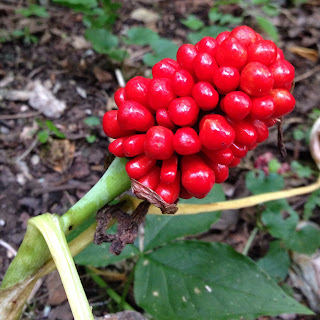
See the great oval masses of scarlet berries of the arum now in the meadows. Trillium fruit, long time.
August 28, 2014

The river being thus high, for ten days or more I have seen little parcels of shells left by the muskrats. So they eat them thus early. 

Peppermint, how long? May be earlier than I have thought, for the mowers clip it. 

The bright china-colored blue berries of the Cornus sericea begin to show themselves along the river, amid their red-brown leaves, — the kinnikinnic of the Indians. 

H. D. Thoreau, Journal, August 28, 1856

The panicled cornel berries are whitening. See August 15, 1854 ("Panicled cornel berries on College Road. “); August 22, 1852 ("The panicled cornel berries now white. “)

I open the painted tortoise nest of June 10th. See June 10, 1856 ("A painted tortoise laying her eggs ten feet from the wheel-track on the Marlborough road.”). See also August 26, 1854 ("Open one of my snapping turtle's eggs.”)

Be not in haste. September 17, 1839 ("Nature never makes haste; her systems revolve at an even pace."); July 19, 1851 ("This rapid revolution of nature, even of nature in me, why should it hurry me?"); August 19, 1851 ("The seasons do not cease a moment to revolve, and therefore Nature rests no longer at her culminating point than at any other."); September 24, 1859 ("Great works of art have endless leisure for a background, as the universe has space. Time stands still while they are created. The artist cannot be in [a] hurry. The earth moves round the sun with inconceivable rapidity, and yet the surface of the lake is not ruffled by it.")

Has not the great world existed for them as much as for you?
See September 9, 1854 ("Thus the earth is the mother of all creatures.”); August 26, 1854 ("I am convinced that there must be an irresistible necessity for mud turtles.”)

The bright china-colored blue berries of the Cornus sericea [red-osier dogwood]] begin to show themselves along the river. .See  August 28, 1852 ("Now the red osier berries are very handsome along the river, overhanging the water, for the most part pale blue mixed with whitish, -- part of the pendant jewelry of the season.”);   See also August 31, 1856 (“The Cornus sericea, with its berries just turning, is generally a dull purple now."); September 1, 1854 (The Cornus sericea berries are now in prime, of different shades of blue, lighter or darker, and bluish white. . . .a great ornament to our causeways and riverside.”)

What is a summer? 
Time for turtle eggs to hatch
June, July, August.

Nature steadily 
and serenely advances 
with a turtle's pace.

A Book of the Seasons, by Henry Thoreau
"A book, each page written in its own season,
out-of-doors, in its own locality.”
~edited, assembled and rewritten by zphx © 2009-2026

https://tinyurl.com/hdt-560828


Popular Posts Last 30 Days.

The week ahead in Henry’s journal

The week ahead in Henry’s journal
A journal, a book that shall contain a record of all your joy.
"A stone fruit. Each one yields me a thought." ~ H. D. Thoreau, March 28, 1859


I sit on this rock
wrestling with the melody
that possesses me.