The year is but a succession of days,
and I see that I could assign some office to each day
which, summed up, would be the history of the year.
Henry Thoreau, August 24, 1852
Bare ashy branches
of red maples sparkling in
this sun and clear air.
The sugar maples
aglow in their glory now
yellow red and green.
A village is not
complete unless it has trees
to mark the season.
October 18, 1858

October 18, 2018
The fringed gentian closes every night and opens every morning in my pitcher. October 18, 1857
We find ourselves in a world that is already planted, but is also still being planted as at first. We say of some plants that they grow in wet places and of others that they grow in desert places. The truth is that their seeds are scattered almost everywhere, but here only do they succeed . . . The development theory implies a greater vital force in nature . . . and equivalent to a sort of constant new creation. October 18, 1860
Chickadees and jays are heard from the shore as in winter. October 18, 1852
There are a great many crows scattered about on the meadow . . . very conspicuous, black against the green. October 18, 1855
Maples and some other shrubs, and more are very thin-leaved so that the swamp, with so many fallen leaves and migrating sparrows, etc., flitting through it, has a very late look. October 18, 1859
See larks, with their white tail-feathers, fluttering low over the meadows these days. October 18, 1858
I scare up a dozen larks at once. October 18, 1855
A large brown marsh hawk comes beating the bush along the river, and ere long a slate-colored one (male), with black tips, is seen circling against a distant wood-side. October 18, 1855
I see many robins on barberry bushes, probably after berries. October 18, 1857
A few muskrat houses are going up abrupt and precipitous on one side sloped on the other . October 18, 1852
The muskrat-houses are more sharpened now. October 18, 1853
As leaves fall along the river and in the woods, the squirrels and musquash make haste to shelter and conceal themselves by constructing nests and cabins. October 18, 1858
I still see a yellow butterfly occasionally zigzagging by the roadside. October 18, 1856
The sugar maples are now in their glory, all aglow with yellow, red, and green. October 18, 1856
The large sugar maples on the Common are now at the height of their beauty . . . A delicate but warmer than golden yellow is the prevailing color, with scarlet cheeks. They are great regular oval masses of yellow and scarlet. October 18, 1858
Surely trees should be set in our streets with a view to their October splendor. October 18, 1858
All the sunny warmth of the season seems to be absorbed in their leaves. October 18, 1858
A village is not complete unless it has these trees to mark the season in it. They are as important as a town clock. October 18, 1858
The red maples have been bare a good while. In the sun and this clear air, their bare ashy branches even sparkle like silver. October 18, 1853
The maple swamps, bare of leaves, here and there about the meadow, look like smoke blown along the edge of the woods. October 18, 1855
The red maples are now fairly bare, though you may occasionally see one full of leaves. So gradually the leaves fall, after all — though individuals will be completely stripped in one short windy rain-storm, — that you scarcely miss them out of the landscape; but the earth grows more bare and the fields more hoary and the heavy shadows that began in June take their departure , November being at hand October 18, 1857
I am struck by the magical change which has taken place in the red maple swamps, . . . — all their splendor gone, wafted away, as it were, by a puff of wind, and they are the mere ghosts of trees, unnoticed by any, or, if noticed at all, like the smoke that is seen where a blaze is extinguished — desolate gray twigs. October 18, 1858
The fall of the leaf . . . began fairly with the fall of the red maple leaves, October 13th. October 18, 1857
Since the red maples generally fell, the chestnuts have been yellowing, and the oaks reddening and yellowing. October 18, 1858
It is a rich sight, that of a large chestnut tree with a dome-shaped top, where the yellowing leaves have become thin, — for most now strew the ground evenly as a carpet throughout the chestnut woods. October 18, 1856
The red oaks I see to-day are full of leaves, — a brownish yellow (with more or less green, but no red or scarlet) October 18, 1857
Looking across to the sprout-land beneath the Cliffs, I see that the pale brown of withered oak leaves begins to be conspicuous, amid the red, in sprout-lands. October 18, 1857
Some white oaks are salmon-red, some lighter and drier. The black oaks are a greenish yellow. October 18, 1853
Poplars (grandidentata) clear, rich yellow. October 18, 1853
Larches have begun to change in water. October 18, 1858
By the brook, witch-hazel, as an underwood, is in the height of its change, but elsewhere exposed large bushes are bare. October 18, 1858
Many alders and birches just bare. October 18, 1857
The bass and the black ash are completely bare; how long? October 18, 1857
Red cedar is fallen and falling. October 18, 1857
So many leaves have now fallen in the woods that a squirrel cannot run after a nut without being heard. October 18, 1857
The woods are losing their bright colors. October 18, 1853
The autumnal tints though less brilliant and striking are perhaps quite as agreeable now that the frosts have somewhat dulled and softened them. October 18, 1852
Now that the forest is universally imbrowned they make a more harmonious impression. October 18, 1852
The autumnal tints though less brilliant and striking are perhaps quite as agreeable now that the frosts have somewhat dulled and softened them. October 18, 1852
Now that the forest is universally imbrowned they make a more harmonious impression. October 18, 1852
In Lee's Wood, white pine leaves are now fairly fallen . . . These leaves, like other, broader ones, pass through various hues (or shades) from green to brown, — first yellow, giving the tree that parti-colored look, then pale brown when they fall, then reddish brown after lying on the ground, and then darker and darker brown when decaying. October 18, 1857
As I come through Hubbard’s Woods I see the wintergreen, conspicuous now above the freshly fallen white pine needles. Their shining green is suddenly revealed above the pale-brown ground. I hail its cool unwithering green, one of the humbler allies by whose aid we are to face the winter. October 18, 1858
As I come through Hubbard’s Woods I see the wintergreen, conspicuous now above the freshly fallen white pine needles. Their shining green is suddenly revealed above the pale-brown ground. I hail its cool unwithering green, one of the humbler allies by whose aid we are to face the winter. October 18, 1858
The wintergreen now
shining above the freshly
shining above the freshly
fallen pine needles.
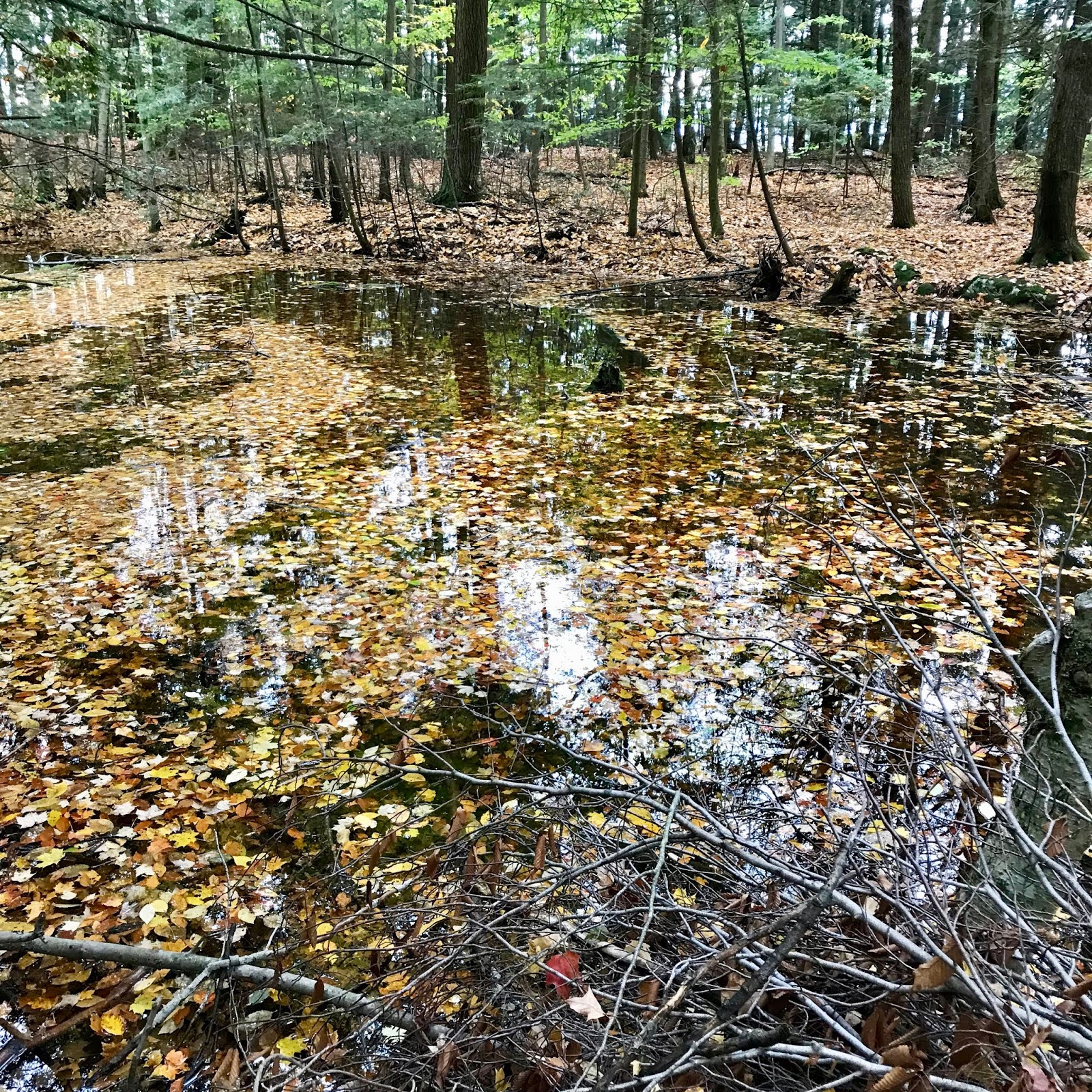
I find my boat all covered — the bottom and seats — with the yellow leaves of the golden willow under which it is moored, and if I empty it, it is full again to-morrow. October 18, 1853
The long, curved, yellowish buds of the Salix discolor begin to show, the leaves falling; even the down has peeped out from under some. October 18, 1859
A large pasture thistle bud close to the ground amid its leaves, as in spring. October 18, 1856
Snakes lie out now on sunny banks, amid the dry leaves, now as in spring. They are chiefly striped ones. October 18, 1857
Noticed a little snake brown above with a paler-brown dorsal stripe.
October 18, 1858
Noticed a little snake brown above with a paler-brown dorsal stripe.
October 18, 1858
What a strong medicinal but rich scent now after the rain, from decaying weeds, perhaps ferns, by the road side! The rain, falling on the fresh dried herbs and filling the ditches into which they drooped, has converted them into tea. October 18, 1856
Going by Dennis Swamp on railroad, the sour scent of decaying ferns is now very strong there. October 18, 1859
Saw a tree-toad on the ground in a sandy wood-path. October 18, 1859
In the ditch along the west side of Dennis Swamp I see half a dozen yellow-spot turtles moving about. Probably they are preparing to go into winter quarters. October 18, 1859
At the brook beyond Hubbard's Grove, I stand to watch the water-bugs . . . The shadows of these bugs on the bottom, half a dozen times as big as themselves, are very distinct and interesting, with a narrow and well-defined halo about them . . . I also see plainly the shadows of ripples they make, which are scarcely perceptible on the surface. October 18, 1857
Returning late, we see a double shadow of ourselves and boat, one, the true, quite black, the other directly above it and very faint, on the willows and high bank. October 18, 1853
All that interests the reader is the depth and intensity of the life excited.We touch our subject but by a point which has no breadth, but the pyramid of our experience, or our interest in it, rests on us by a broader or narrower base. That is, man is all in all, Nature nothing, but as she draws him out and reflects him. October 18, 1856
Pursue some path, however narrow and crooked, in which you can walk with love and reverence. October 18, 1855
So gradually the leaves fall. . . that you scarcely miss them out of the landscape; but the earth grows more bare, and the fields more hoary, and the heavy shadows that began in June take their departure, November being at hand. October 18, 1857
If you will stay here awhile I will promise you strange sights. You shall walk on water; all these brooks and rivers and ponds shall be your highway. You shall see the whole earth covered a foot or more deep with purest white crystals, in which you slump or over which you glide, and all the trees and stubble glittering in icy armor. October 18, 1859

October 18, 2015
A Book of the Seasons, by Henry Thoreau, the Water-bug (Gyrinus)
A Book of the Seasons, by Henry Thoreau, Yellow Butterflies
A Book of the Seasons, by Henry Thoreau, the Chickadee in Winter
A Book of the Seasons, by Henry Thoreau, The Blue Jay
A Book of the Seasons, by Henry Thoreau, the American Crow
A Book of the Seasons, by Henry Thoreau, the Marsh Hawk (Northern Harrier)
A Book of the Seasons, by Henry Thoreau, Birches in Season
A Book of the Seasons, by Henry Thoreau, The Red Maple
A Book of the Seasons, by Henry Thoreau, The White Pines
A Book of the Seasons, by Henry Thoreau ,the Big-toothed Aspen
A Book of the Seasons, by Henry Thoreau, The Basswood
A Book of Seasons, by Henry Thoreau,the Larch
A Book of the Seasons, by Henry Thoreau: The Fringed Gentian
A Book of the Seasons, by Henry Thoreau, The Witch-Hazel
A Book of the Seasons, by Henry Thoreau, The Common Barberry
A Book of the Seasons, by Henry Thoreau, the Thistles
A Book of the Seasons, by Henry Thoreau, the Striped Snake
A Book of the Seasons, by Henry Thoreau, The Yellow-Spotted Turtle
A Book of the Seasons, by Henry Thoreau, the Musquash
A Book of the Seasons, by Henry Thoreau, October Moods
A Book of the Seasons, by Henry Thoreau, Reflections
A Book of the Seasons, by Henry Thoreau, to effect the quality of the day

October 18, 2020
October 4, 1858 ("Witch-hazel apparently at height of change, yellow below, green above, the yellow leaves by their color concealing the flowers. . . . The leaves are often richly spotted reddish and greenish brown.")
October 5, 1857 ("The jay seems to scream more fitly and with more freedom now that some fallen maple leaves have made way for his voice")October 6, 1856 ("The jay's shrill note is more distinct of late about the edges of the woods, when so many birds have left us.”)
October 6, 1856 ("The common notes of the chickadee, so rarely heard for a long time, and also one phebe strain from it, amid the Leaning Hemlocks, remind me of pleasant winter days, when they are more commonly seen.")
October 6, 1858 ("Now, methinks, the autumnal tints are brightest in our streets and in the woods generally.")
October 9, 1851 ("I see half a dozen snakes in this walk, green and striped (one very young striped one), who appear to be out enjoying the sun. They appear to make the most of the last warm days of the year.") October 16, 1857 ("The red maples are now fairly bare,")
October 16, 1859 ("The musquash is steadily adding to his winter lodge. There is no need of supposing a peculiar instinct telling him how high to build his cabin. He has had a longer experience in this river-valley than we. ")October 17, 1857("The swamp floor is covered with red maple leaves, many yellow with bright-scarlet spots or streaks")

October 19, 1853 ("The leaves have fallen so plentifully that they quite conceal the water along the shore, and rustle pleasantly when the wave which the boat creates strikes them.")
October 19, 1856 (“Both the white and black ash are quite bare, and some of the elms there.”)
October 9, 1851 ("I see half a dozen snakes in this walk, green and striped (one very young striped one), who appear to be out enjoying the sun. They appear to make the most of the last warm days of the year.")
October 9, 1858 ("I watch two marsh hawks which rise from the woods before me as I sit on the Cliff. . .gradually lifting themselves as they come round in their gyrations, higher and higher, and floating toward the southeast. Slender dark motes they are at last, almost lost to sight, but every time they come round eastward I see the light of the westering sun reflected from the under sides of their wings")
October 9, 1853 ("The bass bare.")
October 10, 1851 ("Some maples which a week ago were a mass of yellow foliage are now a fine gray smoke, as it were, and their leaves cover the ground.")
October 11, 1857 ("The maple and other leaves strew the water, and it is almost a leaf harvest")
October 11, 1857 ("The maple and other leaves strew the water, and it is almost a leaf harvest")
October 11, 1859 ("The note of the chickadee, heard now in cooler weather and above many fallen leaves, has a new significance.")
October 11, 1856 ("In the woods I hear the note of the jay, a metallic, clanging sound, some times a mew. Refer any strange note to him")
October 12, 1851 ("Many maples around the edges of the meadows are now quite bare, like smoke.")
October 12, 1855 ("The leaves fallen last night now lie thick on the water next the shore, concealing it, —fleets of dry boats.");
October 12, 1858 ("There are many maple, birch, etc., leaves on the Assabet, in stiller places along the shore, but not yet a leaf harvest");
October 12, 1858 ("Some bass trees are quite bare, others but partly.")
October 13, 1855 ("The bass is bare.")
October 13,1852 ("The autumnal tints have already lost their brightness. It lasts but a day or two.")
October 13, 1852 ("Many maples have lost all their leaves and are shrunk all at once to handsome clean gray wisps on the edge of the meadows. Crowded together at a distance they look like smoke.”)
October 13, 1855 ("A thick carpet of white pine needles lies now lightly, half an inch or more in thick ness, above the dark-reddish ones of last year")
October 13, 1855 ("The maples now stand like smoke along the meadows")
October 13, 1857 (“Maple fires are burnt out generally, and they have fairly begun to fall and look smoky in the swamps. When my eyes were resting on those smoke-like bare trees, it did not at first occur to me why the landscape was not as brilliant as a few days ago”)
October 13, 1857 ("Those most brilliant days, then, so far as the autumnal tints are concerned, are over.")
October 13, 1860 ("Now, as soon as the frost strips the maples, and their leaves strew the swamp floor and conceal the pools, the note of the chickadee sounds cheerfully winteryish.")
October 13, 1860 ("Now, as soon as the frost strips the maples, and their leaves strew the swamp floor and conceal the pools, the note of the chickadee sounds cheerfully winteryish.")
October 14, 1852 ("Jays and chickadees are oftener heard in the fall than in summer.")
October 14, 1852 (" The pines are now two-colored, green and yellow, - the latter just below the ends of the boughs.")
October 14, 1856. ("Pine-needles, just fallen, now make a thick carpet ")
October 14, 1858 ("The white maples are now apparently in their autumnal dress. The leaves are much curled and of a pale hoary or silvery yellow, with often a rosaceous cheek")
October 14, 1859 ("I see a black snake, and also a striped snake, out this warm day.")
October 15, 1851 ("The muskrat-houses appear now for the most part to be finished. Some, it is true, are still rising. They line the river all the way. Some are as big as small hay cocks.")
October 15, 1856 ("Large fleets of maple and other leaves are floating on its surface as I go up the Assabet.")
October 15, 1856 ("Large fleets of maple and other leaves are floating on its surface as I go up the Assabet.")
October 16, 1855 ("How evenly the freshly fallen pine-needles are spread on the ground! quite like a carpet, as evenly strewn as if sifted over the whole surface, giving it a uniform neat fawn-color, tempting one to stretch himself on it. They rest alike on the few green leaves of weeds and the fallen cones and the cobwebs between them, in every direction across one another like joggle-sticks")
October 16, 1857 ("The large poplar (P. grandidentata) is now at the height of its change, – clear yellow, but many leaves have fallen")
October 16, 1857 ("Am surprised to find an abundance of witch-hazel, now at the height of its change, . . .The tallest bushes are bare, though in bloom, but the lowest are full of leaves, many of them green, but chiefly clear and handsome yellow of various shades, from a pale lemon in the shade or within the bush to a darker and warmer yellow with out.")
October 16, 1859 ("I see the new musquash-houses erected, conspicuous on the now nearly leafless shores. To me this is an important and suggestive sight. . .For thirty years I have annually observed, about this time or earlier, the freshly erected winter lodges of the musquash along the riverside, . . . It has an important place in my Kalendar. So surely as the sun appears to be in Libra or Scorpio, I see the conical winter lodges of the musquash rising above the withered pontederia and flags.")October 16, 1859 ("The musquash is steadily adding to his winter lodge. There is no need of supposing a peculiar instinct telling him how high to build his cabin. He has had a longer experience in this river-valley than we. ")
October 16, 1857 ("I see red oaks now turned various colors, – red-brown or yellow-brown or scarlet-brown, – not commonly bright")
October 17, 1858 ("There are many crisped but colored leaves resting on the smooth surface of the Assabet, . . .These leaves are chiefly of the red maple")
October 17, 1858 ("They remind me of ditches in swamps, whose surfaces are often quite concealed by leaves now. The waves made by my boat cause them to rustle, ")
October 17, 1858 ("Some late red maples are unexpectedly as fair and bright as ever, both scarlet and yellow, and still distance all competitors")
October 17, 1858 ("There is no brighter and purer scarlet (often running into crimson) and no softer and clearer yellow than theirs now, though the greater part have quite lost their leaves.")
October 17, 1858 ("I distinguish one large red oak — the most advanced one — from black ones, by its red brown, though some others are yellow-brown and greenish. ")
October 17, 1858 ("The large red oaks are about in their prime. Some are a handsome light scarlet, with yellow and green.")

October 18, 2015
October 19, 1856 (“Both the white and black ash are quite bare, and some of the elms there.”)
October 19, 1856 ("The bass has lost, apparently, more than half its leaves")
October 20, 1857 ("The barberry bushes are now alive with, I should say, thousands of robins feeding on them.")
October 20, 1856 ("Thus, of late, when the season is declining, many birds have departed, and our thoughts are turned towards winter . . .we hear the jay again more frequently, and the chickadees are more numerous and lively and familiar and utter their phebe note")
October 21, 1858 ("The Populus grandidentata is quite yellow and leafy yet.")
October 21, 1858 ("The large sugar maples on the Common are in the midst of their fall to-day. ")November 16, 1852 ("Muskrat-houses completed. Interesting objects looking down a river-reach at this season, and our river should not be represented without one or two of these cones. They are quite conspicuous half a mile distant, and are of too much importance to be omitted in the river landscape")
November 19, 1850 ("Now that the grass is withered and the leaves are withered or fallen, it begins to appear what is evergreen the partridge-berry and checkerberry, and winter-green leaves even, are more conspicuous.”)


October 20, 1856 ("Thus, of late, when the season is declining, many birds have departed, and our thoughts are turned towards winter . . .we hear the jay again more frequently, and the chickadees are more numerous and lively and familiar and utter their phebe note")
October 21, 1858 ("The Populus grandidentata is quite yellow and leafy yet.")
October 21, 1858 ("The large sugar maples on the Common are in the midst of their fall to-day. ")
October 22, 1851("The pines, both white and pitch, have now shed their leaves, and the ground in the pine woods is strewn with the newly fallen needles.")
October 22, 1854 (" Bass trees are bare.")
October 23, 1852 (" A striped snake out.")
October 23, 1852 (" A striped snake out.")
October 23, 1857("The fallen pine-needles, as well as other leaves, now actually paint the surface of the earth brown in the woods, covering the green and other colors, and the few evergreen plants on the forest floor stand out distinct and have a rare preeminence.")
October 23, 1852 ("October has been the month of autumnal tints")
October 23, 1852 ("October has been the month of autumnal tints")
October 23, 1852 ("A striped snake out.")
October 24, 1857 ("The sugar maple leaves are now falling fast.")
October 24, 1857 ("The sugar maple leaves are now falling fast.")
October 24, 1855 ("The rich yellow and scarlet leaves of the sugar maple on the Common now thickly cover the grass in great circles about the trees, and, half having fallen, look like the reflection of the trees in water lighting up the Common, reflecting light even to the surrounding houses.")
October 24, 1858 ("The Populus grandidentata and sugar maple . . .have lost the greater part of their leaves.")
October 25, 1853("The ground is strewn with pine-needles as sunlight")
October 25, 1853("The ground is strewn with pine-needles as sunlight")
October 25, 1858 ("Now that the leaves are fallen (for a few days), the long yellow buds (often red-pointed) which sleep along the twigs of the S. discolor are very conspicuous and quite interesting, already even carrying our thoughts forward to spring.")
October 26, 1854 ("Apple trees are generally bare, as well as bass, ash, elm, maple.")
October 28, 1857 ("I look up and see a male marsh hawk with his clean cut wings, that has just skimmed past above my head, – not at all disturbed, only tilting his body a little, now twenty rods off, with demi-semi-quaver of his wings. He is a very neat flyer")
October 28, 1860 ("See a very large flock of crows")
October 29, 1855 ("As I pass Merrick’s pasture, I see and count about a hundred crows advancing in a great rambling flock from the southeast and crossing the river on high, and cawing.")
October 29, 1857 ("A flock of about eighty crows flies ramblingly over toward the sowing, cawing and loitering and making a great ado, apparently about nothing.")
October 29, 1858 (“With the fall of the white pine, etc., the Pyrola umbellata and the lycopodiums, and even evergreen ferns, suddenly emerge as from obscurity. If these plants are to be evergreen, how much they require this brown and withered carpet to be spread under them for effect. Now, too, the light is let in to show them.”)
November 1, 1853 ("I notice crows flying southwesterly in a very long straggling flock, of which I see probably neither end.")
November 1, 1860 (" A striped snake basks in the sun amid dry leaves.")
November 3, 1857 ("I see on many rocks, etc., the seeds of the barberry, which have been voided by birds, – robins, no doubt, chiefly. How many they must thus scatter over the fields, spreading the barberry far and wide!")
November 1, 1860 (" A striped snake basks in the sun amid dry leaves.")
November 3, 1857 ("I see on many rocks, etc., the seeds of the barberry, which have been voided by birds, – robins, no doubt, chiefly. How many they must thus scatter over the fields, spreading the barberry far and wide!")
November 19, 1850 ("Now that the grass is withered and the leaves are withered or fallen, it begins to appear what is evergreen the partridge-berry and checkerberry, and winter-green leaves even, are more conspicuous.”)

October 18, 2020

October 18, 2026

October 18, 2024
If you make the least correct
observation of nature this year,
you will have occasion to repeat it
with illustrations the next,
and the season and life itself is prolonged.
October 17<<<<<<<<< October 18. >>>>>>>> October 19
A Book of the Seasons, by Henry Thoreau, October 18
A Book of the Seasons, by Henry Thoreau"A book, each page written in its own season,out-of-doors, in its own locality.”
~edited, assembled and rewritten by zphx © 2009-2022
https://tinyurl.com/HDT18Oct