Showing posts with label july 7. Show all posts

Monday, July 7, 2025

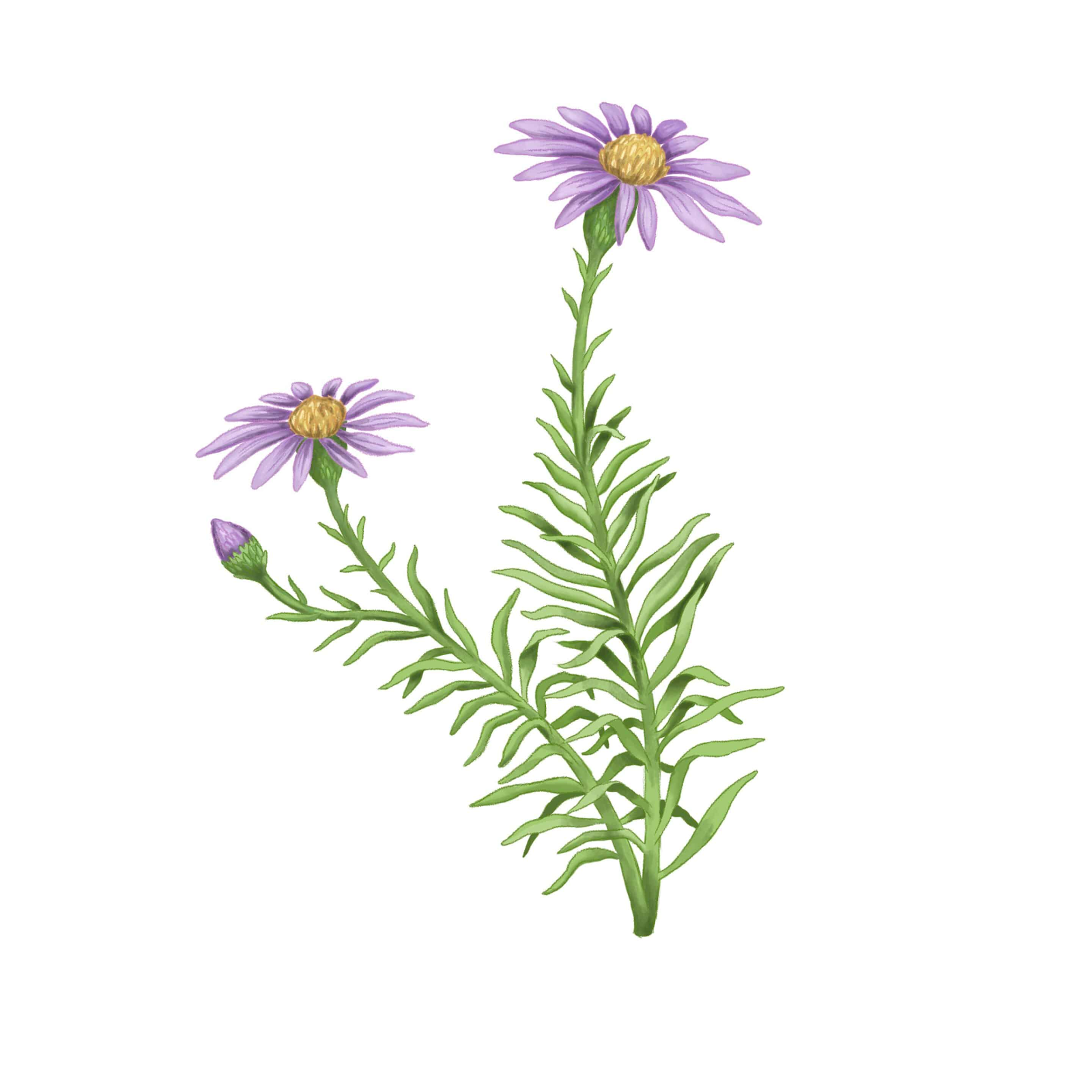
A Book of the Seasons: Savory-leaved aster (Aster Linariifolius/Diplopappus)


South of the lighthouse
the savory-leaved aster
on a steep hillside.
That common rigid
narrow-leaved faint-purplish
aster in dry woods.

July 7.  Just south of the lighthouse near the bank on a steep hillside, the savory-leaved aster (Diplopappus linariifolius) and mouse-ear (Gnaphalium plantaginifolium) form a dense sward, being short and thick; the aster not yet out. July 7, 1855

July 26. Diplopappus linariifolius. Aster dumosus. July 26, 1854

July 28Aster linariifolius.  July 28, 1853

July 29. That common rigid narrow-leaved faint-purplish aster in dry woods by shrub oak path, Aster linariifolius of Bigelow, but it is not savory leaved. I do not find it in Gray. July 29, 1852

August 3. Savory-leaved aster.  August 3, 1858 

August 4. The yellow Bethlehem-star still, and the yellow gerardia, and a bluish "savory-leaved aster."  August 4, 1851 

August 16. Diplopappus linariifolius, apparently several days. August 16, 1856 

August 22The savory-leaved aster (Diplopappus linariifolius) out; how long?  August 22, 1859

August 30. As I went along from the Minott house to the Bidens Brook, I was quite bewildered by the beauty and variety of the asters, now in their prime there – A. lævis (large and handsome with various leaves), patens, linariifolius, etc. Why so many asters and goldenrods now? The sun has shone on the earth, and the goldenrod is his fruit. The stars, too, have shone on it, and the asters are their fruit. August 30, 1853

September 1. D. linariifolius, hardly noticed. September 1, 1856

September 2. Diplopappus linariifolius, quite common . . . D. linariifolius, pale bluish-purple (Some, outdoors, have a lilac or violet tint.) . . . The D. linariifolius is interesting, with its commonly single flower, with very broad rays turned backward, or handsomer still when it has fifteen or twenty heads crowded together. September 2, 1853

September 7. At Brattleboro, Vt . . .The Solidago Canadensis, and the smooth three-ribbed one, and nemoralis, etc., the helianthus (apparently decapetalus), and Aster or Diplopappus linariifolius, Vitis cordifolius (?) (now beginning to be ripe) are quite common along the bank. September 7, 1856

September 10. Diplopappus linariifolius and Aster undulatus apparently now in prime. September 10, 1854

September 18.  – By boat to Conantum, barberrying. Diplopappus linariifolius in prime. September 18, 1856

September 24. D. linariifolius, in prime, abundant.  September 24, 1856

September 29. Diplopappus linariifolius, Aster undulatus, and a few small ones September 29,1853 

September 30. We then took the path to Clematis Brook on the north of Mt. Misery, where we found a few of the Diplopappus linariifolius (savory-leaved aster) and one or two small white (bushy ?) asters, also A. undulatus September 30, 1852

October 8. D. linariifolius, apparently nearly done  October 8, 1856

October 10.  Pulling up some Diplopappus linariifolius, now done, I find many bright-purple shoots, a half to three quarters of an inch long, freshly put forth underground and ready to turn upward and form new plants in the spring. October 10, 1858 

October 12. With man all is uncertainty. He does not confidently look forward to another spring. But examine the root of the  savory-leaved aster, and you will find the new shoots, fair purple shoots, which are to curve upward and bear the next year’s flowers, already grown half an inch or more in earth. Nature is confident. October 12, 1858

October 16.  Many Diplopappus linariifolius are gone to seed, and yellowish globes. Such are the stages in the year's decline. The flowers are at the mercy of the frosts.   October 16, 1859

October 20. Many plants which in the summer show a few red or scarlet leaves at length are all yellow only . . . Diplopappus linariifolius in shade yellow, in sun purple last of October  October 20, 1858

October 22.  I see the small narrow leaves of the Aster dumosus and also the yet finer ones of the Diplopappus linariifolius in wood-paths, turned a clear light-yellow.  October 22, 1858

October 23. One Diplopappus linariifolius in bloom, its leaves all yellow or red. This and A. undulatus the asters seen to-day.  October 23, 1853

October 25. Aster longifolius in low ground (a few). This and the Diplopappus linariifolius, and, above all,  A. undulatus, the only flowers of the kind seen this week. (Afterwards A. puniceus, Tradescanti, and one lævis!)  October 25, 1853

November 7The Diplopappus linariifolius, which was yellow in the shade, in open and sunny places is purple.  November 7, 1858

December 26.  After snow, rain, and hail yesterday and last night, we have this morning quite a glaze, there being at last an inch or two of crusted snow on the ground, the most we have had . . .Weeds in the fields and the wood-paths are the most interesting. Here are asters, savory-leaved, whose flat imbricated calyxes, three quarters of an inch over, are surmounted and inclosed in a perfectly transparent icebutton, like a glass knob, through which you see the reflections of the brown calyx. December 26, 1855 
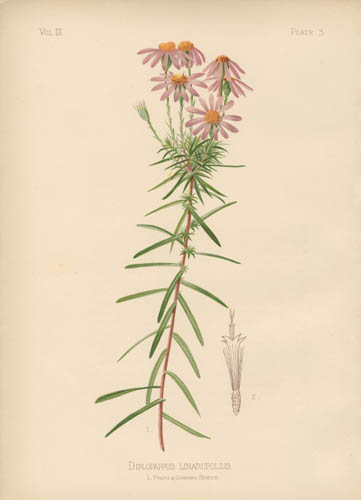
Aster linariifolius and  Diplopappus linariifolius — Savory-leaved aster, Flax-leaved stiff-aster , Stiff-leafed Aster, Sandpaper Aster or Sandpaper Starwort (now classified as  Lonactis linariifolia

See also

 A Book of the Seasons, by Henry Thoreau
"A book, each page written in its own season,
out-of-doors, in its own locality."
~edited, assembled and rewritten by zphx ©  2009-2025

https://tinyurl.com/hdt-savoryaster


Tuesday, July 7, 2020

Now is that annual drought which is always spoken of as something unprecedented


July 7.

Very dry weather.

Every traveller, horse, and cow raises a cloud of dust. It streams off from their feet, white and definite in its outline, like the steam from a locomotive. Those who walk behind a flock of sheep must suffer martyrdom.

Now is that annual drought which is always spoken of as something unprecedented and out of the common course.

Is that a utricularia which fills the water at the north end of Beck Stow's? 


Sarsaparilla berries are ripe.

Paddled up the river this evening.

It is remarkable that, in pushing a boat up a river with a sandy bottom, the sound of the oar on the sand should be communicated so distinctly through the oar to the air. It is perhaps as distinct as if no water intervened.

We have cool nights now after warm days, — cooler than in June. You cannot safely wear your thin coat into evening outdoors.

The Asclepias incarnata, or water asclepias now. 


H. D. Thoreau, Journal, July 7, 1853

Now is that annual drought which is always spoken of as something unprecedented. See  June 18, 1854 ("Every year men talk about the dry weather which has now begun as if it were something new and not to be expected."); July 24, 1854 ("A decided rain-storm to-day and yesterday, such as we have not had certainly since May.")

Sarsaparilla berries are ripe. See July 19, 1856 (“On Linnaea Hills, sarsaparilla berries.”)

The Asclepias incarnata, or water asclepias now.See July 15, 1854 (“There are many butterflies, yellow and red, about the Asclepias incarnata now.”)


This annual drought
is always spoken of as
unprecedented.

Sunday, July 7, 2019

Bathing at Barrett's Bay, I find it to be composed in good part of sawdust

July 7

P. M. — To Great Meadows. 

July 7,  2019
P. Hutchinson says he once found a wood duck's nest in a hollow maple by Heywood's meadow (now by railroad), and tried to get the young as soon as hatched, but they were gone too soon for him. 

On the first, or westerly, part of the Great Meadows, i. e. the firmer parts and the bank, I find, mixed with sedges of different kinds, much red-top (coloring the surface extensively), fowl-meadow (just begun to bloom and of a purplish lead-color, taller than the red-top), the slender purple-spiked panic, Agrostis (perennans? or scabra??). 

In the wet, or main, part, beside various other sedges, — as [Carex] stellulata, lanuginosa, stricta, etc., etc., — wool-grass, now in flower, a sedge (apparently C. ampullacea var. utriculata toward Holbrook's) thicker-culmed than wool-grass, but softer and not round, with fertile spikes often three inches long, and slender. A great part of the meadow is covered with, I think, either this or wood grass (not in flower). I am not certain which prevails, but I think wool-grass, which does not flower. 

Also, mixed with these and lower, dulichium, Eleocharis palustris, etc., etc. 

First notice pontederia out; also tephrosia, how long? 

The note of the bobolink has begun to sound rare? 

Do not young nighthawks run pretty soon after being hatched? I hear of their being gone very soon. 

Bathing at Barrett's Bay, I find it to be composed in good part of sawdust, mixed with sand. There is a narrow channel on each side, deepest on the south. 

The potamogeton is eight feet long there in eighteen inches of water. 

I learn from measuring on Baldwin's second map that the river (i. e. speaking of that part below Framingham) is much the straightest in the lower part of its course, or from Ball's Hill to the Dam. It winds most in the broad meadows. The greatest meander is in the Sudbury meadows. 

From upper end of Sudbury Canal to Sherman's Bridge direct is 558 rods (1 mile 238 rods); by thread of river, 1000 rods (3 miles 40 rods), or nearly twice as far. But, though meandering, it is straighter in its general course than would be believed. These nearly twenty-three miles in length (or 16 + direct) are contained within a breadth of two miles twenty-six rods; i. e., so much it takes to meander in. It can be plotted by the scale of one thousand feet to an inch on a sheet of paper seven feet one and one quarter inches long by eleven inches wide. 

The deep and lake-like are the straightest reaches. The straightest reach within these limits above Ball's Hill is from Fair Haven Pond to Clamshell Hill.

I observed in Maine that the dam at the outlet of Chesuncook Lake, some twenty miles off, had raised the water so as to kill the larches on the Umbazookskus extensively. They were at least four or five miles up the Umbazookskus.

H. D. Thoreau, Journal, July 7, 1859

The slender purple-spiked panic, Agrostis (perennans? or scabra??).See September 5, 1858 ("Agrostis perennans, thin grass, or hair grass, on moist ground or near water. The branches of the panicle are but slightly purplish."); July 3, 1859 (" A large patch of Agrostis scabra a very interesting purple with its fine waving top, mixed with blue-eyed grass.");July 11, 1860 (" I am interested now by patches of Agrostis scabra. Drooping and waving in the wind a rod or two over amid the red-top and herd's-grass of A.Wheeler's meadow, this grass gives a pale purple sheen to those parts, the most purple impression of any grass.")

The note of the bobolink has begun to sound rare? See June 9, 1855 ("I think I have hardly heard a bobolink for a week or ten days.");June 15, 1852 ("The note of the bobolink begins to sound somewhat rare."); June 19, 1853 ("The strain of the bobolink now begins to sound a little rare. It never again fills the air as the first week after its arrival.") Compare June 30, 1852 ("(I heard a bobolink this afternoon.)");July 2, 1855 ("Young bobolinks are now fluttering over the meadow."); July 10, 1859 ("See many young birds now. . . Even hear one link from a bobolink."); July 11, 1856 ('Hear now the link of bobolinks, and see quite a flock of red-wing blackbirds and young. "); July 12, 1857 ("I hear the occasional link note from the earliest bobolinks of the season"); July 15, 1854 ("I hear the link link of the bobolink,. . . . Many birds begin to fly in small flocks like grown-up broods."); July 15, 1856 ("Bobolinks are heard — their link, link — above and amid the tall rue which now whitens the meadows”); July 19, 1855 ("Young bobolinks; one of the first autumnalish notes."); August 6, 1852 (“With the goldenrod comes the goldfinch. About the time his cool twitter is heard, does not the bobolink, thrasher, catbird, oven-bird, veery, etc., cease?”);  August 10, 1853 ("Of late, and for long time, only the link, link of bobolink."); August 10, 1854 ("The tinkling notes of goldfinches and bobolinks which we hear nowadays are of one character and peculiar to the season."); August 16, 1858 ("[Hear]the link of many bobolinks (and see large flocks on the fences and weeds; they are largish-looking birds with yellow throats)"); August 22, 1853 ("Surprised to hear a very faint bobolink in the air; the link, link, once or twice later"); August 25, 1852 (" I hear no birds sing these days, only . . . the mew of a catbird, the link link of a bobolink, or the twitter of a goldfinch, all faint and rare"); September 15, 1858 ("I have not seen not heard a bobolink for some days at least, numerous as they were three weeks ago, and even fifteen days. They depart early.") See also A Book of the Seasons,  by Henry Thoreau, the Bobolink


Do not young nighthawks run pretty soon after being hatched? See June 17, 1853 (" One of the nighthawk's eggs is hatched. The young is unlike any that I have seen, exactly like a pinch of rabbit's fur or down of that color dropped on the ground, not two inches long, with a dimpling or geometrical or somewhat regular arrangement of minute feathers in the middle, destined to become the wings and tail. Yet even it half opened its eye, and peeped if I mistake not. . . It seemed a singular place for a bird to begin its life, — to come out of its egg, — this little pinch of down, — . . ., with nothing but the whole heavens, the broad universe above, to brood it when its mother was away.") See also A Book of Seasons,  by Henry Thoreau,, the Nighthawk

Bathing at Barrett's Bay, I find it to be composed in good part of sawdust, mixed with sand. See April 19, 1854 ("I was surprised to find the river so full of sawdust from the pail-factory and Barrett's mill that I could not easily distinguish if the stone-heaps had been repaired. There was not a square three inches clear. And I saw the sawdust deposited by an eddy in one place on the bottom like a sand-bank a foot or more deep half a mile below the mill.") and note to July 14, 1857 ("Set fire to the carburetted hydrogen from the sawdust shoal with matches, and heard it flash.")

Saturday, July 7, 2018

A night on Mt. Washington.

July 7

Wednesday. Having engaged the services of Wentworth to carry up some of our baggage and to keep our camp, we rode onward to the Glen House, eight miles further, sending back our horse and wagon to his house. 

This road passes through what is called the Pinkham Notch, in Pinkham’s Grant, the land, a large tract, having been given away to Pinkham for making the road a good while since. Wentworth has lived here thirty years and is a native. 

Have occasional views of Mt. Washington or a spur of it, etc. 

Get by roadside, in bloom some time, Geum macrophyllum; also, in a damp place, Platanthera dilatata, a narrow White spike. 

Turned off a little to the right to see Glen Ellis Falls. 

Began the ascent by the mountain road at 11.30 A.M.

For about the first three quarters of a mile of steady (winding) ascent the wood was spruce, yellow birch (some, generally the largest, with a very rough, coarse, scaly bark, but other trees equally large had a beautifully smooth bark, and Wentworth called these “silver birch,” it appeared not to depend on age merely), hemlock, beech, canoe birch (according to Willey, “most abundant in the districts formerly burnt”), rock maple, fir, mountain maple (called by Wentworth bastard maple), northern wild cherry, striped maple, etc. 

At about a mile and three quarters spruce prevails, and rock maple, beech, and hemlock, etc., disappear. At three miles, or near the limit of trees, fir (increasing) and spruce chiefly prevail. And near by was the foot of the ledge and limit of trees, only their dead trunks standing, probably fir and spruce, about the shanty where we spent the night with the colliers.

I went on nearly a mile and a half further, and found many new alpine plants and returned to this shanty. A merry collier and his assistant, who had been making coal for the summit and were preparing to leave the next morning, made us welcome to this shanty and entertained us with their talk. We here boiled some of our beef-tongues, a very strong wind pouring in gusts down the funnel and scattering the fire about through the cracked stove. 

This man, named Page, had imported goats on to the mountain, and milked them to supply us with milk for our coffee. The road here ran north and south to get round the ledge. The wind, blowing down the funnel, set fire to a pile of dirty bed quilts when I was out, and came near burning up the building. 

There were many barrels of spoiled beef in the cellar, and he said that a person coming down the mountain some time ago looked into the cellar and saw five wildcats (loups-cerviers) there. Page had heard two fighting like-cats near by a few nights before. 

The wind blowed very strong and in gusts this night, but he said it was nothing to what it was sometimes, when the building rocked four inches.

H. D. Thoreau, Journal, July 7, 1858

Friday, July 7, 2017

There were no human beings there, only a few imaginary lines on a map.


July 7

July 7, 2017 9:04PM

Some of the inhabitants of the Cape think that the Cape is theirs and all occupied by them, but in my eyes it is no more theirs than it is the blackbirds', and in visiting the Cape there is hardly more need of my regarding or going through the villages than of going through the blackbirds' nests. 

I am inclined to leave them both on one side, or perchance I just glance into them to see how they are built and what they contain. 

I know that they have spoken for the whole Cape, and lines are drawn on their maps accordingly, but I know that these are imaginary, having perambulated many such, and they would have to get me or one of my craft to find them for them. 

For the most part, indeed with very trifling exceptions, there were no human beings there, only a few imaginary lines on a map.

H. D. Thoreau, Journal, July 7, 1857

The inhabitants of the Cape. See June 20, 1857 ("I have now visited the Cape four times in as many different years, once in October, twice in June, and once in July, having spent in all about one month there."); June 16, 1857 ("I have found the compass and chart safer guides than the inhabitants"); July 6, 1855 ("Cape measures two miles in width here on the great chart.")

Thursday, July 7, 2016

A Book of the Seasons: July 7


Knowledge does not come
to us by details but by
lieferungs from the gods.


How wholesome these fogs–
sleep with  your windows open,
let  mist embrace you.

to wake to music
the fog bursting with birdsong
thought and poetry

senses clarified 
rise with elastic vigor
perceive more clearly–

I came near awaking this morning

I am older now,
mornings are further between,
the days are fewer.

Surprised yet prepared
that the flowering season
now has reached its height.


Lilies surprise me.
The flowering season now
has reached its height.

This annual drought 
is always spoken of as
unprecedented. 
July 7, 1853

Amid cranberries
the snake-head arethusa
is now abundant.
July 7, 1856


A Book of the Seasons, by Henry Thoreau
"A book, each page written in its own season,
out-of-doors, in its own locality.”
~edited, assembled and rewritten by zphx © 2009-2016

The purple finch still sings over the street.

July 7 

I see a difference now between the alder leaves near Island and edge of meadow westward, on Hill; the former slightly downy beneath, the latter (apparently Alnus serrulata) green and smooth but yet not pointed at base. 

Do I not see a taller kind of wool grass in that birch meadow east of Hill? 

P. M. — To Gowing’s Swamp. 

The purple finch still sings over the street. 

The sagittaria, large form, is out, roadside, Moore’s Swamp. 

The Vaccinium Oxycoccus is almost entirely out of bloom, and the berries are as big as small huckleberries (while the V. macrocarpon is in full bloom, and no berries appear on it). It must therefore have begun about the 1st of June. 

Saw the Kalmia glauca by the small cranberry, betrayed by its two-edged twig. 


Portsmouth Public Library


The snake-head arethusa is now abundant amid the cranberries there.


H. D. Thoreau, Journal, July 7, 1856


. . .the latter (apparently Alnus serrulata) green and smooth but yet not pointed at base. See April 13, 1856 ("There were alders out at Well Meadow Head, as large bushes as any. Can they be A. serrulata?"): April 15, 1856 ("What I think the Alnus serrulata (?) will shed pollen to-day on the edge of Catbird Meadow.")


The purple finch still sings over the street. See  June 25, 1853 ("I think it must be the purple finch. . .which I see and hear singing so sweetly and variedly in the gardens, — one or two to-day. . . .It has a little of the martin warble and of the canary bird.") See also April 15, 1854 ("The arrival of the purple finches appears to be coincident with the blossoming of the elm, on whose blossom it feeds."; April 15, 1856 ("The purple finch is singing on the elms "); )

The sagittaria, large form, is out, roadside, Moore’s Swamp See July 28, 1852 ("The large shaped sagittaria out, a large crystalline-white three-petalled flower.")

Saw the Kalmia glauca by the small cranberry, betrayed by its two-edged twig. See January 9, 1855 ("Make a splendid discovery this afternoon. Walking through Holden’s white spruce swamp, I see peeping above the snow-crust some slender delicate evergreen shoots . . . the Kalmia glauca var.rosmarinifolia.")

The snake-head arethusa. (Pogonia ophioglossoides.) Snake-mouthed Arethusa, from which genus it was taken; stem nearly a foot high, with a single flower, nodding and pale-purple, and one oval-lanceolate leaf, and a leafy bract near the flower; lip fimbriate; swamps; July. The flower resembles a snake's head, whence its specific name. Reports on the herbaceous plants and on the quadrupeds of Massachusetts 199 (1840).  See July 7, 1852 ("The Arethusa bulbosa, "crystalline purple;" Pogonia ophioglossoides, snake-mouthed arethusa, "pale purple;" and the Calopogon pulchellus, grass pink, "pink purple," make one family in my mind, — next to the purple orchis, or with it, — being flowers par excellence, all flower, all color, with inconspicuous leaves, naked flowers, . . .the pogonia has a strong snaky odor."); See also June 21, 1852  ("The adder's-tongue arethusa smells exactly like a snake."); July 2, 1857 (“Pogonia ophioglossoides apparently in a day or two.”); July 8, 1857 (“Find a Pogonia ophioglossoides with a third leaf and second flower an inch above the first flower.”); August 1, 1856 ("Snake-head arethusa still in the meadow”)


Amid cranberries
the snake-head arethusa
is now abundant.

Now abundant there
the snake-head arethusa
amid cranberries


Tuesday, July 7, 2015

Botanizing Cape Cod: sandwort, saltwort, starwort.

July 7

Smilax glauca in blossom, running over the shrubbery. Honkenya peploides, sea sandwort, just out of bloom on beach. The thick-leaved and dense tufted, upright plant Salsola Kali, saltwort, prickly and glaucous, in bloom. Beach pea (Lathyrus maritimus) going out of bloom.

The piping plover running and standing on the beach, and a few mackerel gulls skimming over the sea and fishing. 

Josh(?) pears (“ juicy,” suggests Small) just begun; few here compared with Provincetown; do not cook them. 

Seaside goldenrod (Solidago sempervirens) not nearly yet. Xanthium echinatum, sea cocklebur or sea-burdock, not yet.

What that smilacina-like plant very common in the shrubbery, a foot high, with now green fruit big as peas at end of spike, with reddish streaks? Uncle Sam calls it snake-corn. It is Smilacina racemosa. Brought home some fruit.

Just south of the lighthouse near the bank on a steep hillside, the savory-leaved aster (Diplopappus linariifolius) and mouse-ear (Gnaphalium plantaginifolium) form a dense sward, being short and thick; the aster not yet out.

Scarlet pimpernel, or poor-man’s weather glass (Anagallis arvensis), in bloom some time, very common on sandy fields and sands, and very pretty, with a peculiar scarlet.

H. D. Thoreau, Journal, July 7, 1855


Just south of the lighthouse near the bank on a steep hillside, the savory-leaved aster (Diplopappus linariifolius) . . . not yet out. See 
July 28, 1853 ("Aster linariifolius."); July 29, 1852 ("That common rigid narrow-leaved faint-purplish aster in dry woods by shrub oak path , Aster linariifolius of Bigelow, but it is not savory leaved. I do not find it in Gray."); August 3, 1858 ("Savory-leaved aster.");  August 4, 1851 ("a bluish 'savory-leaved aster.'"); August 16, 1856 (" Diplopappus linariifolius, apparently several days."); September 10, 1854 ("Diplopappus linariifolius and Aster undulatus apparently now in prime."); August 22, 1859 ("The savory-leaved aster (Diplopappus linariifolius) out; how long?"); September 18, 1856 ("Diplopappus linariifolius in prime.");  September 29,1853 ("Diplopappus linariifolius, Aster undulatus, and a few small ones"); September 30, 1852 ("We then took the path to Clematis Brook on the north of Mt. Misery, where we found a few of the Diplopappus linariifolius ( savory-leaved aster ) and one or two small white (bushy ?) asters, also A. undulatus"); October 10, 1858 ("Pulling up some Diplopappus linariifolius, now done, I find many bright-purple shoots, a half to three quarters of an inch long, freshly put forth underground and ready to turn upward and form new plants in the spring."); October 12, 1858 ("With man all is uncertainty. He does not confidently look forward to another spring. But examine the root of the  savory-leaved aster, and you will find the new shoots, fair purple shoots, which are to curve upward and bear the next year’s flowers, already grown half an inch or more in earth. Nature is confident.");  October 16, 1859 ("Many Diplopappus linariifolius are gone to seed, and yellowish globes."); November 7, 1858 ("The Diplopappus linariifolius, which was yellow in the shade, in open and sunny places is purple."); December 26, 1855 (“Weeds in the fields and the wood-paths are the most interesting. Here are asters, savory-leaved, whose flat imbricated calyxes, three quarters of an inch over, are surmounted and inclosed in a perfectly transparent icebutton, like a glass knob, through which you see the reflections of the brown calyx.”)


Sandpaper Star-Wort, or Diplopappus Linariifolius


Ionactis linariifolia
Flax-leaved stiff-aster  -- Stiff-leafed Aster, Sandpaper Aster or Sandpaper Starwort (previously classified as Aster linariifolius and 
Diplopappus linariifolius) 

South of the lighthouse 
the savory-leaved aster
on a steep hillside.

 A Book of the Seasons, by Henry Thoreau
"A book, each page written in its own season,
out-of-doors, in its own locality."
~edited, assembled and rewritten by zphx ©  2009-2025

https://tinyurl.com/hdt-18550707

Monday, July 7, 2014

A large hawk circling Ministerial Swamp.

July 7.

Woodcock at the spring under Clamshell. 

Disturb two broods of partridges this afternoon, — one a third grown, flying half a dozen rods over the bushes, yet the old, as anxious as ever, rushing to me with the courage of a hen.

Columbines still. 

See a pretty large hawk with narrow and long wings, black-tipped beneath, and white rump, light beneath, circling over the Ministerial Swamp with a loud, shuffling, jay-like and somewhat flicker-like sound.

H. D. Thoreau, Journal, July 7, 1854

Woodcock at the spring under Clamshell.  See  July 10, 1854 ("Woodcock seen within two or three days."); July 12, 1857 ("I drink at every cooler spring in my walk these afternoons.");July 13, 1852 ("Each day now I scare up woodcocks by shady springs and swamps"); See also A Book of the Seasons, by Henry Thoreau, The American Woodcock and July 7, 1860 ("The temperature of good or cool springs in this town at this season varies very little indeed from 49 °")

The old, as anxious as ever, rushing to me with the courage of a hen. See June 27, 1852("I meet the partridge with her brood in the woods, a perfect little hen. She spreads her tail into a fan and beats the ground with her wings fearlessly within a few feet of me, to attract my attention while her young disperse") See also A Book of Seasons,  by Henry Thoreau, the Partridge

Hawk with narrow and long wings, black-tipped beneath, and white rump . . . and somewhat flicker-like sound. See March 27, 1855 (“See my frog hawk . . . It is the hen-barrier, i.e. marsh hawk, male. Slate-colored; beating the bush; black tips to wings and white rump. "); March 29, 1854 (See two marsh hawks, white on rump.”); May 14, 1857 ("See a pair of marsh hawks, the smaller and lighter-colored male, with black tips to wings, and the large brown female, sailing low over J. Hosmer's sprout-land”); May 30, 1858 ("The hawk rises when we approach and circles about over the wood, uttering a note singularly like the common one of the flicker”); June 8, 1858 ("The marsh hawk's eggs are not yet hatched. She rises when I get within a rod and utters that peculiar cackling or scolding note, much like, but distinct from, that of the pigeon woodpecker.”);  August 22, 1853 ("The scream of young marsh hawks sounds like some notes of the jay. ") See also A Book of the Seasons,  by Henry Thoreau, the Marsh Hawk (Northern Harrier)

Ministerial Swamp. See November 14, 1851 ("Surveying the Ministerial Lot in the southwestern part of the town."); November 18,1851 ("Surveying these days the Ministerial Lot . . . Here hawks also circle by day, and chickadees are heard, and rabbits and partridges abound."); December 21, 1851 (“As I stand by the edge of the swamp (Ministerial), a heavy-winged hawk flies home to it at sundown, just over my head, in silence.”);

Hawk with narrow
and long wings, black-tipped beneath --
loud flicker-like sound.

A Book of the Seasons,  by Henry Thoreau
 "A book, each page written in its own season,
out-of-doors, in its own locality."
 ~edited, assembled and rewritten by zphx ©  2009-2024

tinyurl.com/hdt-540707

Saturday, July 7, 2012

A season to awake


July 7.


July 7, 2012

Before I rise I hear the song of birds from out the fog, like the bursting of its bubbles with music, the bead on liquids just uncorked. 

Oh, might I always wake to thought and poetry – regenerated! 

I came near awaking this morning. 

I am older than last year; the mornings are further between; the days are fewer.  

When the yellow lily flowers in the meadows, and the red in dry lands and by wood-paths, then, methinks, the flowering season has reached its height. They surprise me as perhaps no more can. 

Now I am prepared for anything.

H. D. Thoreau, Journal, July 7, 1852


4 a.m. — The first really foggy morning. Yet before I rise I hear the song of birds from out it, like the bursting of its bubbles with music, the bead on liquids just uncorked. Their song gilds thus the frostwork of the morning. As if the fog were a great sweet froth on the surface of land and water, whose fixed air escaped, whose bubbles burst with music. The sound of its evaporation, the fixed air of the morning just brought from the cellars of the night escaping. The morning twittering of birds in perfect harmony with it. 

I came near awaking this morning. I am older than last year; the mornings are further between ; the days are fewer. 

Any excess — to have drunk too much water, even, the day before — is fatal to the morning's clarity, but in health the sound of a cow-bell is celestial music. 

Oh, might I always wake to thought and poetry — regenerated ! Can [it] be called a morning, if our senses are not clarified so that we perceive more clearly, if we do not rise with elastic vigor? 

How wholesome these fogs which some fear ! They are cool, medicated vapor baths, mingled by Nature, which bring to our senses all the medical properties of the meadows. The touchstones of health. Sleep with all your windows open, and let the mist embrace you. 

To the Cliffs. 

The fog condenses into fountains and streams of music, as into the strain of the bobolink which I hear, and runs off so. The music of the birds is the tinkling of the rills that flow from it. 

I cannot see twenty rods. The trees look darker through it, and their outlines more distinct, apparently because of the whiteness of the fog and the less light that comes through the trees. There is everywhere dew on the cobwebs, little gossamer veils or scarfs as big as your hand, dropped from fairy shoulders that danced on the grass the past night. Even where the grass was cut yesterday and is now cocked up, these dewy webs are as thick as anywhere, promising a fair day.

There is no sunrise.

***
The very handsome "pink purple" flowers of the Calopogon (!) pulchellus enrich the grass all around the edge of Hubbard's blueberry swamp, and are now in their prime. 
  • The Arethusa bulbosa, "crystalline purple;" 
  • Pogonia ophioglossoides, snake-mouthed arethusa, "pale purple;" and the 
  • Calopogon pulchellus, grass pink, "pink purple," 
make one family in my mind, — next to the purple orchis, or with it, — being flowers par excellence, all flower, all color, with inconspicuous leaves, naked flowers, and difficult — at least the calopogon — to preserve. 

But they are flowers, excepting the first, at least, without a name. Pogonia! Calopogon ! ! They would blush still deeper if they knew what names man had given them. 

The first and the last interest me most, for the pogonia has a strong snaky odor. 


The mornings are further between; the days are fewer.
See July 20, 1852 ("The stars are few and distant; the fireflies fewer still.")

Methinks the flowering season has reached its height. See July 7, 1851 ("And now that there is an interregnum in the blossoming of flowers, so is there in the singing of the birds.”)

The pogonia has a strong snaky odor.
 See note to July 7, 1856 ("The snake-head arethusa is now abundant ") and June 21, 1852 ("The adder's-tongue arethusa smells exactly like a snake.")


I am older now
mornings are further between –
the days are fewer.


Popular Posts Last 30 Days.

The week ahead in Henry’s journal

The week ahead in Henry’s journal
A journal, a book that shall contain a record of all your joy.
"A stone fruit. Each one yields me a thought." ~ H. D. Thoreau, March 28, 1859


I sit on this rock
wrestling with the melody
that possesses me.