Showing posts with label beard. Show all posts

Saturday, March 9, 2019

It is worthwhile to hear the wind roar in the woods to-day.

March 9

P. M. — To Lee's Cliff with C. 

C. says that he heard and saw a bluebird on the 7th, and R. W. E. the same. This was the day on which they were generally observed. I am doubtful about one having been seen on the 20th of February by a boy, as stated February 23d. 

C. also saw a skater-insect on the 7th, and a single blackbird flying over Cassandra Ponds, which he thought a grackle. 

A true spring day, not a cloud in the sky. The earth shines, its icy armor reflecting the sun, and the rills of melting snow in the ruts shine, too, and water, where exposed in the right light on the river, is a remarkably living blue, just as the osiers appear brighter. 

Yet it is cool and raw and very windy. 

The ice over the channel of the river, when not quite melted, is now generally mackerelled (the water representing the blue portions) with parallel openings, riddling it or leaving a sort of network of ice over it, answering to the ridges of the waves. You can best observe them from bridges. In some cases the snow upon the ice, having lain in successive drifts, might also assist or modify this phenomenon. 

The rain of yesterday has been filling the meadows again, flowing up under the dry ice of the winter freshet, which for the most part rested on the ground, and so this rise is at first the less observed until it shows itself beyond the edge of the ice. At Corner Spring Brook the water reaches up to the crossing and stands over the ice there, the brook being open and some space on each side of it.

When I look, from forty or fifty rods off, at the yellowish water covering the ice about a foot here, it is decidedly purple (though, when close by and looking down on it, it is yellowish merely), while the water of the brook-channel and a rod on each side of it, where there is no ice beneath, is a beautiful very dark blue. 

These colors are very distinct, the line of separation being the edge of the ice on the bottom, and this apparent juxtaposi tion of different kinds of water is a very singular and pleasing sight. You see a light-purple flood, about the color of a red grape, and a broad channel of dark-purple water, as dark as a common blue-purple grape, sharply distinct across its middle. 

I see at Lee's the long, narrow radical leaves of the Turritis striata just beginning to push their shoots, — the most forward-looking plant there. 

We cross Fair Haven Pond on the ice, though it is difficult getting on and off, it being melted about the edges, as well as overflowed there. 

It is worthwhile to hear the wind roar in the woods to-day. It sounds further off than it is.

Came across a stout and handsome woodchopper with a full dark or black beard, but that on his upper lip was a distinct sandy color. It was a very pleasing contrast, suggesting a sympathy with the centre of light and intelligence nearer to which it grew.

H. D. Thoreau, Journal, March 9, 1859

This was the day on which they were generally observed. See March 9, 1852 (“I hear and see bluebirds, come with the warm wind.”); March 9, 1856 (“[T]his is about the date that bluebirds arrive commonly.”)

A true spring day, not a cloud in the sky. The earth shines, its icy armor reflecting the sun, and the rills of melting snow in the ruts shine, too. See March 8, 1853 ("The melting snow, running and sparkling down-hill in the ruts, was quite springlike."):

It is worthwhile to hear the wind roar in the woods to-day. It sounds further off than it is. See March 9, 1852 (“These March winds, which make the woods roar and fill the world with life and bustle, appear to wake up the trees out of their winter sleep and excite the sap to flow.”);   March 9, 1860 ("You incline to walk now along the south side of hills which will shelter you from the blustering northwest and north winds");  See also  March 18, 1858 ("The rather warm but strong wind now roars in the wood — as in the maple swamp — with a novel sound.”);

Listen to the wind
roaring in the woods today,
it sounds further off.


Friday, January 4, 2019

A north snow-storm, very hard to face..


January 4. 


January 4, 2019 

A northeast snow-storm, or rather a north snow-storm, very hard to face.

P. M. to Walden in it. 

It snows very hard, driving along almost horizontally, falling but a foot or two in a rod. Nobody is in the street, or thinks of going out far except on important business. Most roads are trackless. The snow may be now fifteen to eighteen inches deep. As I go along the causeway, I find it is one thing to go south, or from the wind, another to face it. 

I can see through the storm a house or large tree only a quarter of a mile; beyond all is white falling snow. Woods and single trees seen through this air are all dark or black. 

The surface of the snow is in great waves whose ridges run from east to west, about a rod apart, or generally less, — say ten feet, — low and gentle swells. 

The small white pines stand thus, the lower branches loaded and bent down the ground, while the upper are commonly free and erect:

But the pitch pines near Thrush Alley are the most interesting objects, for they hold much more snow. The snow lodges on their plumes, and, bending them down, it accumulates more and more on the angle generally at the base of the several plumes, in little conical heaps shaped somewhat like this:


differing according to the number and position of the plumes. They look as if a child had stuck up its elbow under a white sheet. Some small ones stand stiflly upright like a soldier’s plume. 

Several trees will be so fallen together and intermingled that you do not see them distinctly. At the same time the lowermost small black and dead horizontal limbs near the ground, where there is least wind and jar, — these almost exclusively, — say for six or eight feet up, are covered with upright walls of snow five or six times their own height and zigzagging with them like the Wall of China; or like great white cater pillars they lie along them, these snowy sloths; or rather it is a labyrinth, a sort of cobweb, of broad white belts in the air. 

Only a dim twilight struggles through to this lower region, and the sight of these snowy walls or labyrinths suggests a rare stillness, freedom from wind and jar. If you try to stoop and wind your way there, you get your neck and ears full of snow. 

I can’t draw it. 

That is, for each dead pine branch you have a thin flat branch of snow resting on it, an exaggeration of the former. 

It is a still white labyrinth of snowy purity, and you can look far into its recesses under the green and snowy canopy, — a labyrinth of which, perchance, a rabbit may have the clue. 

I noticed one pitch pine about three feet high so snowed up, and its branches all drooping, it looked like a draped statue or a white-ant hill. 

In the woods the snow is often two feet deep, and you must walk at a very deliberate pace if you would keep it up. 

Still the withered hoary goldenrods (chiefly S. nemoralis) and asters (perhaps oftenest A. dumosus) rise above the snow here and there, — gray weeds, sufficiently dry and everlasting. 

The oak leaves, especially the black oak leaves, are very agreeable and wholesome colors. The deeper the snow, the more universal the whiteness, the more agreeable is this color. 

Your breath causes the snow to turn to ice in your beard; a shaggy mass of icicles it becomes, which makes you look like a man from the extreme north. 

When it grew late, the air being thick and unelastic in this storm, I mistook the distant sound of the locomotive whistle for the hoot of an owl. It was quite like it. 

I see, nevertheless, a few tree sparrows about, looking chubbier than ever, their feathers being puffed up, and flitting and twittering merrily along the fence. 

Turning north, the large rather moist flakes actually put out your eyes, and you must manage to look through the merest crack. 

Even in the midst of the storm I see where great clouds of fine snow roll down the wood-side, the wind shaking the snow from the trees. It looks like the vapor from the locomotive.

H.D. Thoreau, Journal, January 4, 1859

A north snow-storm, very hard to face. It snows very hard, driving along almost horizontally,.  See December 14, 1859 ("Snow-storms might be classified. This is a fine, dry snow, drifting nearly horizontally from the north, so that it is quite blinding to face"); January 19, 1857 ("A fine dry snow, intolerable to face. ")

I mistook the distant sound of the locomotive whistle for the hoot of an owl. See November 21, 1857 ("I hear, I think, a boy whistling upon the bank above me, but immediately perceive that it is the whistle of the locomotive a mile off in that direction."); August 15, 1854 ("The locomotive whistle, far southwest, sounds like a bell.”); March 22, 1856 ("I thought I heard the hum of a bee, but perhaps it was a railroad whistle on the Lowell Railroad") Compare December 9, 1856 ("I hear only the strokes of a lingering woodchopper at a distance, and the melodious hooting of an owl, which is as common and marked a sound as the axe or the locomotive whistle.")

Sunday, July 12, 2015

(Cape Cod) Fog wets your beard and papers


July 12

I measure a horseshoe on the back side twenty-two inches by eleven. 

The low sand-downs between East Harbor head and sea are thinly covered with beach-grass, seaside goldenrod, and beach pea. 

Fog wets your beard till twelve o’clock.

Long slender seaside plantain leaf at East Harbor head. Solanum (with white flowers) nigrum in marsh. Spergularia rubra var. marina

Great many little shells by edge of marsh - Auricula bidentata and Succinea avara

Great variety of beetles, dor-bugs, etc., on beach. I have one green shining one. Also butterflies over bank. 

I was surprised to see great spider-holes in pure sand and gravel, with a firm edge, where man could not make a hole without the sand sliding in, —in tunnel form.

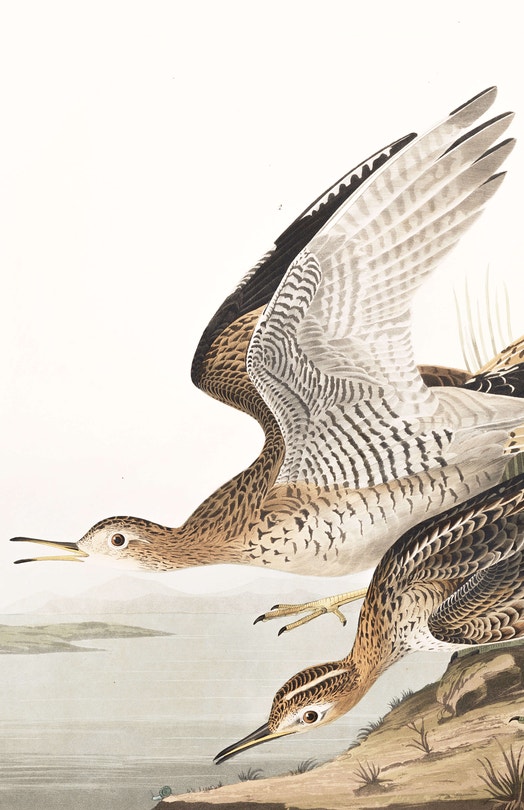
 "In Massachusetts, and to the eastward of that state, 
this species is best known by the name of 'Upland Plover,'” 
  ~ J. J. Audubon 

The upland plover begins with a quivering note somewhat like a tree-toad and ends with a long, clear, somewhat plaintive or melodious hawk-like scream. I never heard this very near to me, and when I asked the inhabitants about it they did not know what I meant.* It hovers on quivering wing, and alights by a steep dive.

My paper so damp in this house I can’t press flowers without mildew, nor dry my towel for a week.

H. D. Thoreau, Journal, July 12, 1855


*Frank Forester, in “Manual for Young Sportsmen,” 1856, page 308, says, 
“This bird has a soft plaintive call or whistle of two notes, which have something of a ventriloquial character and possess this peculiarity, that when uttered close to the ear, they appear to come from a distance, and when the bird is really two or three fields distant, sound as if near at hand.”
Upland ploever  See  Augusst (?), 1850 ("As I was stalking over the surface of this planet in the dark to-night, I started a plover resting on the ground and heard him go off with whistling wings."); June 15, 1860 ("I heard the familiar willet note of the upland plover and  looking up, saw one standing erect — like a large tell tale, or chicken with its head stretched up — on the rail fence. After a while it flew off southwest and l , then wheeled and went a little higher down the river . Of pigeon size, but quick quivering wings. Finally rose higher and flew more or less zigzag, as if uncertain where it would alight, and at last, when almost out of sight  it pitched down into a field near Cyrus Hubbard's. It was the same note I heard so well on Cape Cod in July, '55")

Thoreau's  Upland Plover is the Upland Sandpiper (Bartramia longicauda).His Peetweet  is the Spotted Sandpiper  (Actitis macularia). He also observed the Lesser Golden-Plover (Pluvialis dominica ) and Piping Plover (Charadrius melodus) See Thoreau's Birds

July 12. See A Book of the Seasons,  by Henry Thoreau, July 12

The upland plover
hovers on quivering wing –
 alights by steep dive.

A Book of the Seasons,  by Henry Thoreau
"A book, each page written in its own season,
out-of-doors, in its own locality.”
~edited, assembled and rewritten by zphx © 2009-2021 

Popular Posts Last 30 Days.

The week ahead in Henry’s journal

The week ahead in Henry’s journal
A journal, a book that shall contain a record of all your joy.
"A stone fruit. Each one yields me a thought." ~ H. D. Thoreau, March 28, 1859


I sit on this rock
wrestling with the melody
that possesses me.