Showing posts with label july 21. Show all posts

Wednesday, July 21, 2021

A Book of the Seasons: July 21 (hot afternoons, unsuspected beauty, blue haze, blackberries, evening calm)


The year is but a succession of days,
and I see that I could assign some office to each day
which, summed up, would be the history of the year.
Henry Thoreau, August 24, 1852


The floor of Conant's
leafy woods by the spring now
sprinkled with sunlight.

I eat these berries
as simply and naturally
as thoughts come to mind.

Earliest star seen
before the red is deepest
in the horizon.

Sun warm on my back
I turn round and shade my face --
a beautiful life.

The clear and fresh air
the fairness of the landscape 
this fine afternoon.

With each fresh varnish
we frequent our oldest haunts
with new reverence.

Now after the rain
swallows in numbers skimming
over the river.

July 21, 2014

To go forth before the heat is intolerable, and see what is the difference between forenoon and afternoon. July 21, 1851

It seems there is a little more coolness in the air; there is still some dew, even on this short grass in the shade of the walls and woods; and a feeling of vigor the walker has. July 21, 1851

It threatens to be a hot day, and the haymakers are whetting their scythes in the fields, where they have been out since 4 o'clock. By 2 o'clock it will be warmer and hazier, obscuring the mountains, 
July 21, 1851

There are few sounds but the slight twittering of swallows, and the springy note of the sparrow in the grass or trees, and a lark in the meadow (now at 8 A.M.), and the cricket under all to ally the hour to night. Day is, in fact, about as still as night. July 21, 1851

A rainy day; half an inch of rain falls, spoiling much hay. This is so wet a season that the grass is still growing fast and most things are very fresh. July 21, 1860

Some pigeons here are resting in the thickest of the white pines during the heat of the day, migrating, no doubt.  July 21, 1851. 

A red-eyed vireo nest on a red maple on Island Neck, on meadow-edge, ten feet from ground; one egg half hatched and one cowbird’s egg, nearly fresh, a trifle larger.  July 21, 1855.  

These hot afternoons I go panting through the close sprout-lands and copses, as now from Cliff Brook to Wheeler meadow, and occasionally come to sandy places a few feet in diameter where the partridges have dusted themselves. July 21, 1856. 

This has been a peculiarly fine afternoon. When I looked about casually, was surprised at the fairness of the landscape. July 21, 1856.  

We frequent our oldest haunts with new love and reverence and sail into new ports with each fresh varnish of the air. July 21, 1856

Went, in pursuit of boys who had stolen my boat-seat, to Fair Haven. Plenty of berries there now, — large huckleberries, blueberries, and blackberries. July 21, 1853

Low blackberries thick enough to pick in some places, three or four days. July 21, 1856. 

I eat these berries as simply and naturally as thoughts come to my mind. July 21, 1851

A quarter of a mile is distance enough to make the atmosphere look blue now. It was fit that I should see an indigo-bird here, concerned about its young, a perfect embodiment of the darkest blue that ever fills the valleys at this season. July 21, 1851

The mountains can scarcely be seen for the blue haze, -- only Wachusett and the near ones. July 21, 1851

The pontederia on the Assabet is a very fresh and clear blue to-day, and in its early prime, — very handsome to see. July 21, 1859

The meadow-grass reflecting the light has a bluish cast also. July 21, 1851

The small purple orchis, its spikes half opened. July 21, 1851. 

Now, after the rain, the sun coming forth brightly, the swallows in numbers are skimming low over the river just below the junction. July 21, 1860 

I now return through Conant's leafy woods by the spring, whose floor is sprinkled with sunlight. July 21, 1851

The sun is now warm on my back, and when I turn round I have to shade my face with my hands. July 21, 1853

Never yet did I chance to sit in a house, except my own house in the woods, and hear a wood thrush sing.  July 21, 1851 

I am entering Fair Haven Pond. It is now perfectly still and smooth, like dark glass. Yet the westering sun is very warm. He who passes over a lake at noon, when the waves run, little imagines its serene and placid beauty at evening, as little as he anticipates his own serenity. There is no more beautiful part of the river than the entrance to this pond. July 21, 1853

Ten minutes before sunset I see large clear dewdrops at the tips, or half an inch below the tips, of the pontederia leaves. July 21, 1853

The river is perfectly smooth, reflecting the golden sky and the red, for there is a bright and general golden or amber glow from the upper atmosphere in the west.  July 21, 1852

At evening lakes and rivers become thus placid. Evert dimple made by a fish or insect is betrayed. July 21, 1852

I see the earliest star fifteen or twenty minutes before the red is deepest in the horizon. . . .Do we perceive such a deep Indian red after the first starlight at any other season as now in July? July 21, 1852

*****
July 21,2019
*****
 A Book of the Seasons, by Henry Thoreau:

March 18, 1858 ("When I get two thirds up the hill, I look round and am for the hundredth time surprised by the landscape of the river valley and the horizon with its distant blue scalloped rim. “);

June 18, 1858 (“To Walden to see a bird's nest, a red-eye's, in a small white pine; nest not so high as my head; still laying ”)

July 16, 1851 ("It is a world of orchards and small-fruits now. The season of fruits is arrived.")  

July 17, 1852 ("Swallows are active throughout this rain.")

July 18, 1852  ("The pontederias are now in their prime . . .They are very freshly blue. In the sun, when you are looking west, they are of a violaceous blue.")

July 20, 1852 ("And now, when we had thought the day birds gone to roost, the wood thrush takes up the strain.")

August 19, 1854 (“There is such a haze we see not further than our Annursnack, which is blue as a mountain”)

August 30, 1856 (“[T]here are square rods in Middlesex County as purely primitive and wild as they were a thousand years ago, which have escaped the plow and the axe and the scythe and the cranberry-rake, little oases of wildness in the desert of our civilization, wild as a square rod on the moon, supposing it to be uninhabited. I believe almost in the personality of such planetary matter, feel something akin to reverence for it.")

August 31. 1852 ("The pond, so smooth and full of reflections after a dark and breezy day, is unexpectedly beautiful.")

July 21, 2013

If you make the least correct 
observation of nature this year,
 you will have occasion to repeat it
 with illustrations the next, 
and the season and life itself is prolonged.
July 20 < <<<<<  July 21 >>>>> July 22
A Book of the Seasons, by Henry Thoreau, July 21
A Book of the Seasons, by Henry Thoreau
"A book, each page written in its own season,
out-of-doors, in its own locality."
~edited, assembled and rewritten by zphx © 2009-2023

https://tinyurl.com/HDT21JULY

Sunday, July 21, 2019

From the factory dam to the powder-mills.


July 21. 

P. M. — To Assabet, above factory. 

July 21, 2019


For about one third the way from the factory dam to the powder-mills the river is broad and deep, in short a mill-pond. 

Harrington has what he calls his Elm Hole, where he thinks he finds the old bed of the river some ten rods from the present. The river in many places evidently once washed the base of hills, from which it is now separated by fifty rods of meadow. 

The pontederia on the Assabet is a very fresh and clear blue to-day, and in its early prime, — very handsome to see. 

The nesaea grows commonly along the river near the powder-mills, one very dense bed of it at the mouth of the powder-mill canal. The canal is still cluttered with the wreck of the mills that have been blown up in times past, — timber, boards, etc., etc., — and the steep hill is bestrewn with the fragments of the mills, which fell on it more than half a dozen years ago (many of them), visible half a mile off. 

As you draw near the powder-mills, you see the hill behind bestrewn with the fragments of mills which have been blown up in past years, — the fragments of the millers having been removed, — and the canal is cluttered with the larger ruins. 

The very river makes greater haste past the dry-house, as it were for fear of accidents.

H. D. Thoreau, Journal, July 21, 1859

Harrington has what he calls his Elm Hole.See July 20, 1859 ("Hosmer says that when he digs down in his millet- field, twenty rods or more from the river, in his interval, at three or four feet depth he comes to coarse stones which look like an old bed of the river. ")

The pontederia on the Assabet is a very fresh and clear blue to-day, and in its early prime. See  July 18, 1852 ("The pontederias are now in their prime . . .They are very freshly blue. In the sun, when you are looking west, they are of a violaceous blue."); July 18, 1853 ("The fields of pontederia are in some places four or five rods wide and almost endless")

The steep hill is bestrewn with the fragments of the mills, which fell on it more than half a dozen years ago . See January 7, 1853 ("Timber six inches square and eighteen feet long was thrown over a hill eighty feet high.")

Powder-mills. Nathan Pratt purchased a  mill pond dam on the Assabet River and converted the former sawmill to a powder mill in 1835. The first explosion, in the first year the mills were operating, killed four men in 1836. The last three explosions in 1940 ended gunpowder production, and the dam at the original mill pond site is now being used to generate hydroelectricity for municipal Concord. The body of water created by the dam goes by the name Ripple Pond, and is located in Acton and Maynard.~ Wikipedea

Saturday, July 21, 2018

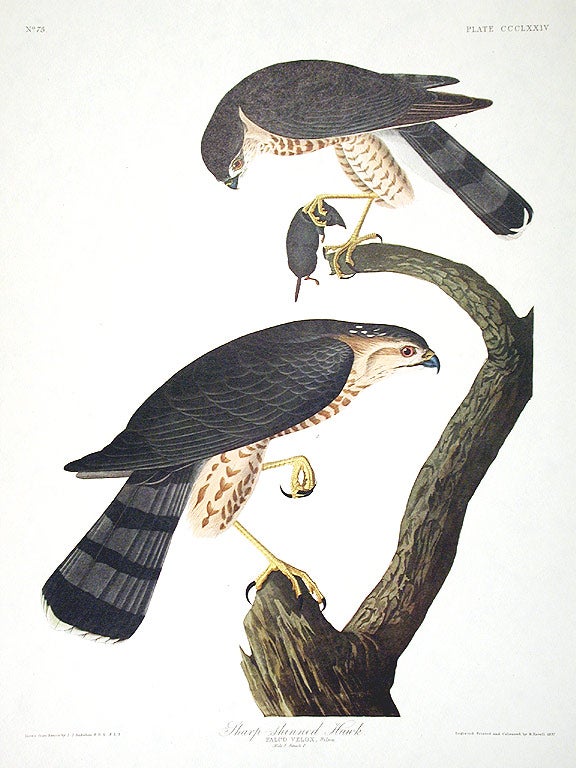
It was the Falco fuscus, the American brown or slate-colored hawk.

July 21. 

Wednesday. Concord. P. M.—To Walden, with E. Bartlett and E. Emerson. 

The former wished to show me what he thought an owl’s nest he had found. Near it, in Abel Brooks’s wood lot, heard a note and saw a small hawk fly over. It was the nest of this bird. Saw several of the young flitting about and occasionally an old bird. 

The nest was in a middling-sized white pine, some twenty feet from the ground, resting on two limbs close to the main stem, on the south side of it. It was quite solid, composed entirely of twigs about as big round as a pipe-stem and less; was some fifteen inches in diameter and one inch deep, or nearly flat, and perhaps five inches thick. It was very much dirtied on the sides by the droppings of the young. 

As we were standing about the tree, we heard again the note of a young one approaching. We dropped upon the ground, and it alighted on the edge of the nest; another alighted near by, and a third a little further off. The young were apparently as big as the old, but still lingered about the nest and returned to it. 

I could hear them coming some distance off. Their note was a kind of peeping squeal, which you might at first suspect to be made by a jay; not very loud, but as if to attract the old and reveal their whereabouts. 

The note of the old bird, which occasionally dashed past, was somewhat like that of the marsh hawk or pigeon woodpecker, a cackling or clattering sound, chiding us. The old bird was anxious about her inexperienced young, and was trying to get them off. At length she dashed close past us, and appeared to fairly strike one of the young, knocking him off his perch, and he soon followed her off. 

I saw the remains of several birds lying about in that neighborhood, and saw and heard again the young and old there abouts for several days thereafter. 

A young man killed one of the young hawks, and I saw it. It was the Falco fuscus, the American brown or slate-colored hawk. 
J. J. Audubon
Sharp-shinned Hawk

Its length was thirteen inches; alar extent, twenty-three. The tail reached two or more inches beyond the closed wings. Nuttall says the upper parts are “a deep slate color” (these were very dark brown); also that the nest is yet unknown. But Wilson describes his F. velox (which is the same as Nuttall’s F. fuscus) as “whole upper parts very dark brown,” but legs, greenish-yellow (these were yellow). The toes had the peculiar pendulous lobes which W. refers to. 

As I saw it in the woods, I was struck by its dark color above, its tawny throat and breast, brown-spotted, its clean, slender, long yellow legs, feathered but little below the knee, its white vent, its wings distinctly and rather finely dark-barred beneath, short, black, much curved bill, and slender black sharp claws. Its tail with a dark bar near edge beneath. 

In hand I found it had the white spots on scapulars of the F. fuscus, and had not the white bars on tail of the F. Pennsylvanicus. It also had the fine sharp shin.

But what then is my hawk killed by Farrar, with so stout a leg? Had that any white bars on tail? 

H. D. Thoreau, Journal, July 21, 1858

In Abel Brooks’s wood lot, heard a note and saw a small hawk fly over. It was the Falco fuscus, the American brown or slate-colored hawk.
See May 4, 1855 (“Sitting in Abel Brooks’s Hollow, see a small hawk go over high in the air, with a long tail and distinct from wings. It advanced by a sort of limping flight yet rapidly, not circling nor tacking, but flapping briskly at intervals and then gliding straight ahead with rapidity, controlling itself with its tail. It seemed to be going a journey. Was it not the sharp-shinned, or Falco fuscus?  I think that what I have called the sparrow hawk falsely, and latterly pigeon hawk, is also the sharp-shinned (vide April 26th and May 8th, 1854, and April 16th, 1855), for the pigeon hawk’s tail is white-barred.”); September 22, 1852 ("Some of those I see are probably the sharp-shinned hawk.");  March 28, 1854 (“See a small slate-colored hawk, with wings transversely mottled beneath, — probably the sharp-shinned hawk.”); April 26, 1854 (“Saw probably a pigeon hawk skim straight and low over field and wood, and another the next day apparently dark slate-color.”); May 8, 1854 (“Saw a small hawk flying low, about size of a robin — tail with black bars”);  April 16, 1855 ( "What I call a pigeon hawk, probably sharp-shinned.”); ; April 25, 1860 ("Looking up, I see what I take to be a sharp-shinned hawk just alighting on the trees . . . The hawk plumes himself, and then flies off, rising gradually and beginning to circle, and soon it joins its mate, and soars with it high in the sky and out of sight. . . It appeared to have a plain reddish-fawn breast. The size more than anything made me think it a sharp-shin."). See also A Book of the Seasons, by Henry Thoreau, the sharp-shinned hawk. and   A Book of the Seasons by Henry Thoreau, The Pigeon Hawk (Merlin)

But what then is my hawk killed by Farrar, with so stout a leg? See October 11, 1856 (“Farrar gave me a wing and foot of a hawk which he shot about three weeks ago . . . . This foot has a sharp shin and stout claws, but the wing is much larger than that of the Falco fuscus (or sharp-shinned hawk), being, . . . the size of the F. Pennsylvanicus. ”)

Friday, July 21, 2017

moose-horns

July 21. 

Tuesday. 1 p. m. At Bangor. 

— Thatcher's moose-horns hanging in his barn spread two feet eight inches. There is one more prong on one side than the other. This is small.

H. D. Thoreau, Journal, July 21, 1857

See July 23, 1857 ("[Mr. Leonard, of Bangor, a sportsman,] said that the horns of a moose would spread four feet, some times six; would weigh thirty or forty pounds")

Thursday, July 21, 2016

With each fresh varnish of the air we frequent our oldest haunts with new love and reverence.

July 21. 

P. M. — To A. Wheeler's grape meadow. 

Mimulus, not long. Hypericum corymbosum, a day or two. Rusty cotton-grass, how long ? The small hypericums are open only in the forenoon. Pursley, also, in our garden opens now not till 8 a. m., and shuts up before 12 m. 

The flat euphorbia is now in prime on the sandy path beyond Potter's Desert, five-finger fungus path.

Plucked a handful of huckleberries from one bush! The Vaccinium vacillans thick enough to go picking, and probably for a day or two in some places. 

Low blackberries thick enough to pick in some places, three or four days. 

Thimble-berries about the 12th, and V. Pennsylvanicum much longer. 

These hot afternoons I go panting through the close sprout-lands and copses, as now from Cliff Brook to Wheeler meadow, and occasionally come to sandy places a few feet in diameter where the partridges have dusted themselves. 

[Gerard, the lion-killer of Algiers, speaks of seeing similar spots when tracking or patiently waiting the lion there, and his truth in this particular is a confirmation of the rest of his story. But his pursuit dwarfs this fact and makes it seem trivial.] 

Shall not my pursuit also contrast with the trivialness of the partridges' dusting? It is interesting to find that the same phenomena, however simple, occur in different parts of the globe. 

I have found an arrowhead or two in such places even. 

Far in warm, sandy woods in hot weather, when not a breath of air is stirring, I come upon these still sandier and warmer spots where the partridges have dusted themselves, now all still and deserted, and am not relieved, yet pleased to find that I have been preceded, by any creature. 

Grapes ready to stew. 

Mr. Russell writes me to-day that he visited the locality of the Magnolia glauca the 18th, on Cape Ann, and saw lingering still a few flowers and flower-buds. It is quite open and rising above the bushes. 

The brook cress might be called river cress, for it is very abundant rising above the surface in all the shallower parts of the river. 

Verbena hastata, apparently several days. 

Sonchus, some time. 

July 21, 2020

This has been a peculiarly fine afternoon. When I look about casually, am surprised at the fairness of the landscape. Though warm, it is clear and fresh, and the air imparts to all surfaces a peculiar fine glaucous color, full of light, without mistiness, like the under side of the Salix lucida (?) leaves at present.  Not only the under sides of the leaves, but the very afternoon landscape, has become glaucous. 

Now, when the fashionable world goes to Saratoga, Nahant, and Newport, we frequent our oldest haunts with new love and reverence and sail into new ports with each fresh varnish of the air.

H. D. Thoreau, Journal, July 21
, 1856

When I look about casually, am surprised at the fairness of the landscape. See note to May 22, 1854 ("How many times I have been surprised thus, on turning about on this very spot, at the fairness of the earth!")

We frequent our oldest haunts with new love and reverence and sail into new ports with each fresh varnish of the air. See October 18, 1855 (“Pursue some path, however narrow and crooked, in which you can walk with love and reverence.”); August 30, 1856 (“[T]here are square rods in Middlesex County as purely primitive and wild as they were a thousand years ago. . .  I believe almost in the personality of such planetary matter, feel something akin to reverence for it, can even worship it as terrene, titanic matter extant in my day. We are so different we admire each other, we healthily attract one another. I love it as a maiden”) 

July 21. See A Book of the Seasons, by Henry Thoreau, July 21

Sandy places where
partridges dusted themselves
this hot afternoon.

Surprised – the fairmess
of the afternooon landscape,
clear fresh full of light.

With each fresh varnish
we frequent our oldest haunts
with new reverence.


A Book of the Seasons, by Henry Thoreau
"A book, each page written in its own season,
out-of-doors, in its own locality."
~edited, assembled and rewritten by zphx ©  2009-2026

https://tinyurl.com/hdt-560721

Tuesday, July 21, 2015

A red-eyed vireo nest.


July 21.

July 21, 2015
9:05 PM

A red-eyed vireo nest on a red maple on Island Neck, on meadow-edge, ten feet from ground; one egg half hatched and one cowbird’s egg, nearly fresh, a trifle larger. The first white (the minute brown dots washing off), sparsely black-dotted at the large end. Have them.

H. D. Thoreau, Journal, July 21, 1855

A red-eyed vireo nest on a red maple. See January 13, 1856 ("What a wonderful genius it is that leads the vireo to select the tough fibres of the inner bark, instead of the more brittle grasses, for its basket, the elastic pine-needles and the twigs, curved as they dried to give it form, and, as I suppose, the silk of cocoons, etc., etc., to bind it together with!”); February 24, 1858 ("What art in the red-eye to make these two adjacent maple twigs serve for the rim of its pensile basket, inweaving them! Surely it finds a place for itself in nature between the two twigs of a maple.");  May 27, 1854 ("I find the pensile nest of a red-eye between a fork of a shrub chestnut near the path. It is made, thus far, of bark and different woolly and silky materials.”); June 12, 1855 ("In the thick swamp behind the hill I look at the vireo’s nest which C. found on the 10th, within reach on a red maple forked twig, eight feet from ground. He took one cowbird’s egg from it, and I now take the other, which he left. There is no vireo’s egg"); June 18, 1858 (“To Walden to see a bird's nest, a red-eye's, in a small white pine; nest not so high as my head; still laying ”)  See also A Book of the Seasons,  by Henry Thoreau, The Red-eyed Vireo

Sunday, July 21, 2013

Sun warm on my back


July 21

2 p. m. — Went, in pursuit of boys who had stolen my boat-seat, to Fair Haven. Plenty of berries there now, — large huckleberries, blueberries, and blackberries.

I am entering Fair Haven Pond. It is now perfectly still and smooth, like dark glass. The westering sun is very warm. 

There is no more beautiful part of the river than the entrance to this pond. He who passes over a lake at noon, when the waves run, little imagines its serene and placid beauty at evening, as little as he anticipates his own serenity. 

The sun is now warm on my back, and when I turn round I shade my face with my hands. Nature is beautiful only as a place where a life is to be lived. It is not beautiful to him who has not resolved on a beautiful life. 

It rapidly grows cool toward sunset. A damp, cool air is felt over the water, and I want a thick coat. 

Ten minutes before sunset I see large clear dewdrops at the tips, or half an inch below the tips, of the pontederia leaves.

H. D. Thoreau, Journal,  July 21, 1853


He who passes over a lake at noon, when the waves run, little imagines its serene and placid beauty at evening, as little as he anticipates his own serenity. See July 21, 1852 (“The river is perfectly smooth, reflecting the golden sky and the red . . . At evening lakes and rivers become thus placid. Every dimple made by a fish or insect is betrayed.”); See also July 3, 1840 ("We will have a dawn, and noon, and serene sunset in ourselves."); August 31. 1852 ("The pond, so smooth and full of reflections after a dark and breezy day, is unexpectedly beautiful."); May 17, 1853 ("Ah, the beauty of this last hour of the day — when a power stills the air and smooths all waters and all minds — that partakes of the light of the day and the stillness of the night!”); August 11, 1853 ("What shall we name this season? — this very late afternoon, or very early evening, this season of the day most favorable for reflection, after the insufferable heats and the bustle of the day are over and before the twilight? The serene hour, the season of reflection! The pensive season")

When I turn round I have to shade my face with my hands.
See July 27, 1852 ("I turn round, and there shines the moon”); September 26, 1857 ("Coming home, the sun is intolerably warm on my left cheek . . . when I cover the reflection with my hand the heat is less intense.")

Ten minutes before sunset I see large clear dewdrops at the tips. . . of the pontederia leaves. See July 18, 1852 ("Just before sundown, the sun still inconveniently warm, we were surprised to observe on the uppermost point of each pontederia leaf a clear drop of dew already formed,"); July 12, 1860 ("Just after the sun is set I observe the dewdrops on the pontederia leaves . . .This is the only broad and thick leaf that rises above the water, and therefore it appears to be the only one that collects the dew thus early.")

July 21. See A Book of the Seasons, by Henry Thoreau, July 21

July 21, 2013

Sun warm on my back
I turn round and shade my face –
a beautiful life.

A Book of the Seasons, by Henry Thoreau
"A book, each page written in its own season,
out-of-doors, in its own locality."
~edited, assembled and rewritten by zphx © 2009-2024

tinyurl.com/hdt-530721

Saturday, July 21, 2012

Midsummer. Evening descends on the waters.


July 21.


The whip-poor-will begins to sing at earliest twilight.  The river is perfectly smooth, reflecting the golden sky and the red, for there is a bright and general golden or amber glow from the upper atmosphere in the west. At evening lakes and rivers become thus placid. Every dimple made by a fish or insect is betrayed. 

Evening descends on the waters. There is not a breath of air. Now is the time to be on the water.
  
I see the earliest star fifteen or twenty minutes before the red is deepest in the horizon. At morning and at evening this precious color suffuses the sky.  Do we perceive such a deep Indian red after the first starlight at any other season as now in July?

H. D. Thoreau,  Journal, July 21, 1852

At evening lakes and rivers become thus placid. Every dimple made by a fish or insect is betrayed. See May 29, 1857 ("Fair Haven Lake now, at 4.30 p. m., is perfectly smooth, reflecting the darker and glowing June clouds as it has not before. Fishes incessantly dimple it here and there . . ..”)

Thursday, July 21, 2011

A morning walk.

July 21.

8 A.M. - I thought to walk this forenoon instead of this after noon, for I have not been in the fields and woods much of late except when surveying. To go forth before the heat is intolerable, and see what is the difference between forenoon and afternoon.

It seems there is a little more coolness in the air; there is still some dew, even on this short grass in the shade of the walls and woods; and a feeling of vigor the walker has.

There are few sounds but the slight twittering of swallows, and the springy note of the sparrow in the grass or trees, and a lark in the meadow (now at 8 A.M.), and the cricket under all to ally the hour to night. Day is, in fact, about as still as night.

It threatens to be a hot day, and the haymakers are whetting their scythes in the fields, where they have been out since 4 o'clock. By 2 o'clock it will be warmer and hazier, obscuring the mountains, and the leaves will curl, and the dust will rise more readily.

Every herb is fresher now, has recovered from yesterday's drought. The cooler air of night still lingers in the fields, as by night the warm air of day.

9 A.M. On Conantum. – Berries are now thick enough to pick. A quarter of a mile is distance enough to make the atmosphere look blue now. It was fit that I should see an indigo-bird here, concerned about its young, a perfect embodiment of the darkest blue that ever fills the valleys at this season. The meadow-grass reflecting the light has a bluish cast also. I eat these berries as simply and naturally as thoughts come to my mind.

10 A. M. - The air grows more and more blue, making pretty effects when one wood is seen from another through a little interval. 


The white lily has opened. 

Some pigeons here are resting in the thickest of the white pines during the heat of the day, migrating, no doubt. 

Flies buzz and rain about my hat. 

The mountains can scarcely be seen for the blue haze, - only Wachusett and the near ones.

The dusty mayweed now blooms by the roadside. The rough hawkweed, too,, resembling in its flower the autumnal dandelion. The Antirrhinum Canadense, Canada snapdragon, in the Corner road; and the ragged orchis on Conantum.

I now return through Conant's leafy woods by the spring, whose floor is sprinkled with sunlight.

H. D. Thoreau, Journal, July 21, 1851


The mountains can scarcely be seen for the blue haze, - only Wachusett and the near ones. See August 19, 1854 (“There is such a haze we see not further than our Annursnack, which is blue as a mountain”)

Wednesday, July 21, 2010

After the rain

July 21.

A rainy day; half an inch of rain falls, spoiling much hay. Thus is so wet a season that the grass is still growing fast and most things are very fresh.

6 P. M. - Up Assabet.

Now, after the rain, the sun coming forth brightly, the swallows in numbers are skimming low over the river just below the junction.

H. D. Thoreau, Journal, July 21, 1860


A rainy day; half an inch of rain falls, spoiling much hay. Thus is so wet a season.
Compare July 14, 1854 (“Awake to day of gentle rain, — very much needed; none to speak of for nearly a month, methinks”)

After the rain, the sun coming forth brightly, the swallows in numbers are skimming low over the river.  See April 29, 1854 (" The barn swallows are very numerous, flying low over the water in the rain.”)

Popular Posts Last 30 Days.

The week ahead in Henry’s journal

The week ahead in Henry’s journal
A journal, a book that shall contain a record of all your joy.
"A stone fruit. Each one yields me a thought." ~ H. D. Thoreau, March 28, 1859


I sit on this rock
wrestling with the melody
that possesses me.