Showing posts with label ferns. Show all posts

Sunday, September 10, 2023

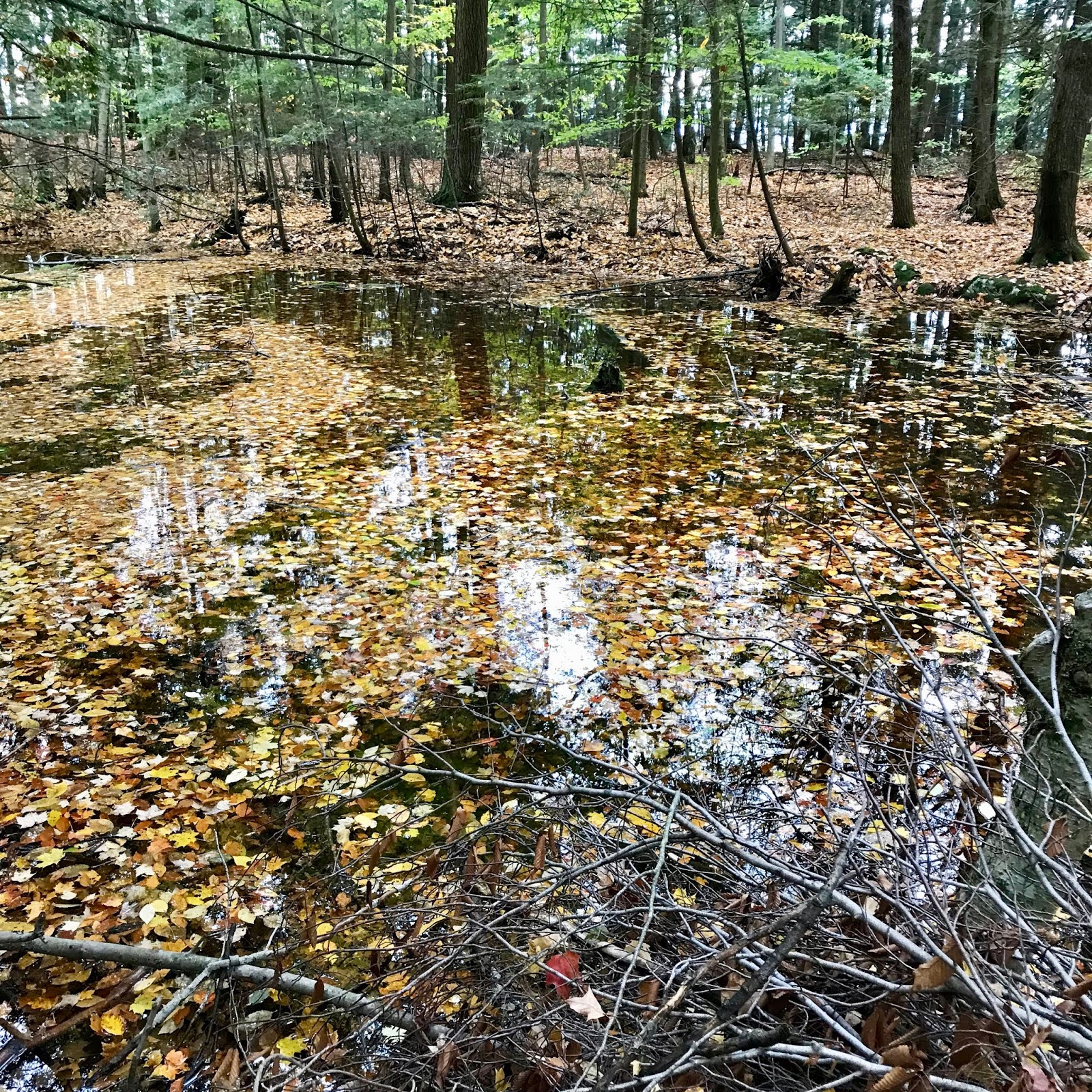
As I go through the woods, I see that the ferns have turned brown and give the woods an autumnal look..


September 10

As I watch the groves on the meadow opposite our house, I see how differently they look at different hours of the day, i. e. in different lights, when the sun shines on them variously. In the morning, perchance, they seem one blended mass of light green. In the afternoon, distinct trees appear, separated by heavy shadows, and in some places I can see quite through the grove.

3 P M. - To the Cliffs and the Grape Cliff beyond.

Hardhack and meadow-sweet are now all dry.

I see the smoke of burning brush in the west horizon this dry and sultry afternoon, and wish to look off from some hill. It is a kind of work the farmer cannot do without discovery. Sometimes I smell these smokes several miles off, and by the odor know it is not a burning building, but withered leaves and the rubbish of the woods and swamp.

As I go through the woods, I see that the ferns have turned brown and give the woods an autumnal look.


The boiling spring is almost completely dry. Nothing flows (I mean without the shed), but there are many hornets and yellow wasps apparently buzzing and circling about in jealousy of one another, either drinking the stagnant water, which is the most accessible this dry parching day, or it may be collecting something from the slime, - I think the former.

As I go up Fair Haven Hill, I see some signs of the approaching fall of the white pine. On some trees the old leaves are already somewhat reddish, though not enough to give the trees a parti-colored look, and they come off easily on being touched, - the old leaves on the lower part of the twigs.

Some farmers are sowing their winter rye? I see the fields smoothly rolled. (I hear the locust still.) I see others plowing steep rocky and bushy fields, apparently for the same purpose.

How beautiful the sproutland (burnt plain) seen from the Cliff! No more cheering and inspiring sight than a young wood springing up thus over a large tract, when you look down on it, the light green of the maples shaded off into the darker oaks, and here and there a maple blushes quite red, enlivening the scene yet more.

Surely this earth is fit to be inhabited, and many enterprises may be undertaken with hope where so many young plants are pushing up.

In the spring I burned over a hundred acres till the earth was sere and black, and by midsummer this space was clad in a fresher and more luxuriant green than the surrounding even.

Shall man then despair? Is he not a sprout-land too, after never so many searings and witherings? If you witness growth and luxuriance, it is all the same as if you grew luxuriantly.

I see three smokes in Stow. One sends up dark volumes of wreathed smoke, as if from the mouth of Erebus. It is remarkable what effects so thin and subtile a substance as smoke produces, even at a distance, -- dark and heavy and powerful as rocks at a distance.

The woodbine is red on the rocks.

The poke is a very rich and striking plant. Some which stand under the Cliffs quite dazzled me with their now purple stems gracefully drooping each way, their rich, somewhat yellowish, purple-veined leaves, their bright purple racemes, -- peduncles, and pedicels, and calyx-like petals from which the birds have picked the berries (these racemes, with their petals now turned to purple, are more brilliant than anything of the kind), -- flower-buds, flowers, ripe berries and dark purple ones, and calyx-like petals which have lost their fruit, all on the same plant.

I love to see any redness in the vegetation of the temperate zone. It is the richest color. I love to press these berries between my fingers and see their rich purple wine staining my hand. It asks a bright sun on it to make it show to best advantage, and it must be seen at this season of the year. It speaks to my blood.

Every part of it is flower, such is its superfluity of color, -- a feast of color. That is the richest flower which most abounds in color. What need to taste the fruit, to drink the wine, to him who can thus taste and drink with his eyes? Its boughs, gracefully drooping, offering repasts to the birds. It is cardinal in its rank, as in its color.

Nature here is full of blood and heat and luxuriance. What a triumph it appears in Nature to have produced and perfected such a plant, -- as if this were enough for a summer.

The downy seeds of the groundsel are taking their flight here. The calyx has dismissed them and quite curled back, having done its part.

Lespedeza sessiliflora, or reticulated lespedeza on the Cliffs now out of bloom.

At the Grape Cliff, the few bright-red leaves of the tupelo contrast with the polished green ones. The tupelos with drooping branches.

The grape-vines overrunning and bending down the maples form little arching bowers over the meadow, five or six feet in diameter, like parasols held over the ladies of the harem, in the East.

Cuscuta Americana, or dodder, in blossom still.

The Desmodium paniculatum of De Candolle and Gray (Hedysarum paniculatum of Linnaeus and Bigelow), tick-trefoil, with still one blossom, by the path-side up from the meadow.  The rhomboidal joints of its loments adhere to my clothes. One of an interesting family that thus disperse themselves.

The oak-ball of dirty drab now.


H. D. Thoreau, Journal, September 10, 1851

How differently they look at different hours of the day. See February 5, 1852 ("The trunks and branches of the trees are of different colors at different times and in different lights and weathers, - in sun, rain, and in the night.”); February 9, 1852 ("Objects do not twice present exactly the same appearance. The air changes from hour to hour of every day. It paints and glasses everything. It is a new glass placed over the picture every hour")

As I go up Fair Haven Hill, I see some signs of the approaching fall of the white pine. See A Book of the Seasons, by Henry Thoreau, The October Pine Fall

As I go through the woods, I see that the ferns have turned brown and give the woods an autumnal look. September 6, 1854 ("The cinnamon ferns along the edge of woods next the meadow are many yellow or cinnamon, or quite brown and withered);   September 12, 1858("Coming to some shady meadow’s edge, you find that the cinnamon fern has suddenly turned this rich yellow. Thus each plant surely acts its part, and lends its effect to the general impression.") See also A Book of the Seasons, by Henry Thoreau, The Cinnamon Fern

The grape-vines overrunning and bending down the maples form little arching bowers over the meadow. See September 8, 1854 (" Sometimes I crawl under low and thick bowers, where they have run over the alders only four or five feet high, and see the grapes hanging from a hollow hemisphere of leaves over my head. At other times I see them dark-purple or black against the silvery undersides of the leaves, high overhead where they have run over birches or maples, and either climb or pull them down to pluck them.") See also A Book of the Seasons, by Henry Thoreau, The Grape

The Desmodium paniculatum . . . tick-trefoil, with still one blossom, by the path-side up from the meadow. See August 7, 1856 ("At Blackberry Steep, apparently an early broad-leafed variety of Desmodium paniculatum, two or three days. This and similar plants are common there and may almost name the place . . . All these plants seem to love a dry open hillside, a steep one. Are rarely upright, but spreading, wand-like."); September 29, 1856 ("I can hardly clamber along the grape cliff now with out getting my clothes covered with desmodium ticks, — there especially the rotundifolium and paniculatum. Though you were running for your life, they would have time to catch and cling to your clothes . . .How surely the desmodium, growing on some rough cliff-side, or the bidens, on the edge of a pool, prophesy the coming of the traveller, brute or human, that will transport their seeds on his coat! ")
'

Sunday, May 30, 2021

The dog lies with his paws hanging over the door-sill this agreeably cool morning.


May 30.

May 30, 2014


The morning wind forever blows; the poem of the world is uninterrupted, but few are the ears that hear it.

Forever that strain of the harp which soothed the Cerberus and called me back to life is sounding.

Olympus is the outside of the earth everywhere.

5 A. M. To Cliffs.

High blackberry out.

As I go by Hayden's in the still cool morning, the farmer's door is open — probably his cattle have been attended to — and the odor of the bacon which is being fried for his breakfast fills the air.


The dog lies with his paws hanging over the door-sill this agreeably cool morning.

The cistus out, probably yesterday, a simple and delicate flower, its stamens all swept to one side. It upholds a delicate saffron-golden (?) basin about nine inches from the ground.

As I look off from Fair Haven I perceive that that downy, silvery hoariness has mostly left the leaves (it now comes off on to the clothes), and they are of a uniform smooth light green, while the pines are a dirty dark brown, almost purple, and are mostly merged and lost in the deciduous trees.

The Erigeron bellidifolius is a tender-looking, pale-purple, aster-like flower a foot high in little squads, nodding in the wind on the bare slopes of hill pastures.

Young bush like black cherries a day or two, on Cliffs and in such favorable places.

The hylodes were about done peeping before those last few warm days, 
— when the toads began in earnest in the river, — but last night being somewhat cooler they were not so loud.

P. M. - To Carlisle Bridge by boat.

A strong but somewhat gusty southerly wind, before which C. and I sailed all the way from home to Carlisle Bridge in not far from an hour; the river unusually high for the season.

Very pleasant to feel the strong, fresh southerly wind from over the water.

There are no clouds in the sky, but a high haziness, as if the moisture drawn up by yesterday's heat was condensed by to-day's comparative coolness.

The water a dull slate-color and waves running high, 
— a dirty yellow where they break, — and long streaks of white foam, six or eight feet apart, stretching north and south between Concord and Bedford, — without end.

The common blue flag just out at Ball's Hill.

The white maples, especially those shaped like large bushes, on the banks are now full of foliage, showing the white under sides of the leaves in the wind, and the swamp white oak, having similar silvery under sides to its leaves, and both growing abundantly and prevailing here along the river, make or impart a peculiar flashing light to the scenery in windy weather, all bright, flashing, and cheerful.

On the meadows are large yellow-green patches of ferns beginning to prevail.

Passed a large boat anchored off in the meadows not far from the boundary of Concord. It was quite a piece of ocean scenery, we saw it so long before reaching it and so long after; and it looked larger than reality, what with the roaring of the wind in our shrouds and the dashing of the waves. The incessant drifting about of a boat so anchored by a long cable, playing with its halter, now showing more, now less, of its side, is a pleasing sight.

Landed at a high lupine bank by Carlisle Bridge. How many such lupine banks there are! — whose blue you detect many rods off.

There I found, methinks, minute Specularia perfoliata, with small crenate clasping leaves alternate at some distance apart, on upright stems about three inches high, but apparently fruiting in the bud.

Also the Silene antirrhina very abundant there.

The Viola palmata, which is later, and therefore, methinks, fresher than most, is now quite prevalent, one of the most common, in fact, in low ground and a very handsome purple, with more red than usual in its violet.

The pines now dotted with white shoots, the pitch pines a little red dish, are an interesting sight now.

Whence came all those dead suckers, a dozen at least, which we saw floating to-day, some on their sides, transversely barred, some on their backs with their white bellies up and dark fins on each side? Why are they suckers only that we see Can it be because the spearers have thrown them away? Or has some bird of prey dropped them? I rarely see other fish floating.

Melvin gave George Brooks some pink azaleas yesterday, said to have grown in the north part of the town.

The white maple keys falling and covering the river.

H. D. Thoreau, Journal, May 30, 1853

The Erigeron bellidifolius is a tender-looking, pale-purple, aster-like flower a foot high in little squads, nodding in the wind on the bare slopes of hill pastures. See May 29, 1856 ("What a flowery place, a vale of Enna, is that meadow! Painted Cup, Erigeron bellidifolius, Thalictrum dioicum, Viola Muhlenbergii, fringed polygala, buck-bean, pedicularis, orobanche, etc., etc. Where you find a rare flower, expect to find more rare ones”); May 8, 1853 ("It is wonderful what a variety of flowers may grow within the range of a walk, and how long some very conspicuous ones may escape the most diligent walker, if you do not chance to visit their localities the right week or fortnight, when their signs are out.")

The common blue flag just out at Ball's Hill. See June 10, 1858 ("Common blue flag, how long?"); June 14, 1853  ("The blue flag (Iris versicolor) grows in this pure water, rising from the stony bottom all around the shores, and is very beautiful, . . . especially its reflections in the water.; June 15, 1859 ("Blue flag abundant."); June 30,1851 ("The blue flag (Iris versicolor) enlivens the meadow.”)

The Viola palmata, which is later, and therefore, methinks, fresher than most, is now quite prevalent. See May 30, 1852 ("Violets everywhere spot the meadows, some more purple, some more lilac. . . . Distinguished the Viola palmata in Hubbard's meadow") See also May 14, 1858 ("Saw the Viola palmata, early form, yesterday; how long?”); May 17, 1853 ("The Viola palmata is out there, in the meadow. ");  May 21, 1855 ("Viola palmata  pretty common, apparently two or three days.") and A Book of the Seasons,  by Henry Thoreau, the Violets

Whence came all those dead suckers? See April 18, 1852 ("The sight of the sucker floating on the meadow at this season affects me singularly"); May 23, 1854 ("How many springs shall I continue to see the common sucker (Catostomus Bostoniensis) floating dead on our river!"); ("When I realize that the mortality of suckers in the spring is as old a phenomenon, perchance, as the race of suckers itself, I contemplate it with serenity and joy even, as one of the signs of spring")

Melvin gave George Brooks some pink azaleas yesterday, See May 31, 1853 (' I am going in search of the Azalea nudiflora. Sophia brought home a single flower without twig or leaf from Mrs. Brooks's last evening. Mrs. Brooks. I find, has a large twig in a vase of water, still pretty fresh, which she says George Melvin gave to her son George. . . . Melvin and I and his dog, - and crossed the river in his boat, and he conducted me to where the Azalea nudiflora grew.")

The white maple keys falling and covering the river. See May 21, 1853 ("The white maple keys are nearly two inches long by a half-inch wide, in pairs, with waved inner edges like green moths ready to bear off their seeds"); May 28, 1858 ("See already one or two (?) white maple keys on the water"); May 29, 1854 ("The white maple keys have begun to fall and float down the stream like the wings of great insects.”); June 9, 1858 ("White maple keys are abundantly floating.")

May 30 See A Book of the Seasons, by Henry Thoreau, May 30

The dog lies with his 
paws hanging over the door–
–sill this cool morning.


 uninterrupted –

morning wind forever blows

poem of the world 


A Book of the Seasons,  by Henry Thoreau
"A book, each page written in its own season,
out-of-doors, in its own locality.”


~edited, assembled and rewritten by zphx © 2009-2026


Monday, November 16, 2020

I admire the fine blue color of the cedar berries.


November 16


I now take notice of the green polypody on the rock. 

P. M. – To Nawshawtuct by boat with Sophia, up Assabet.

The river still higher than yesterday.

I paddled straight from the boat's place to the Island.

I now take notice of the green polypody on the rock and various other ferns, one the marginal (?) shield fern and one the terminal shield fern, and this other, here inserted, on the steep bank above the Hemlocks.

I admire the fine blue color of the cedar berries.

H. D. Thoreau, Journal, November 16, 1853

By boat with Sophia, up Assabet. 
See October 6, 1856 ("Carried Sophia and Aunt up the Assabet"); November 14, 1855 ("Up Assabet with Sophia. A clear, bright, warm afternoon.”)

The river still higher than yesterday.
See November 15, 1853 ("The river has risen yet higher than last night, so that I cut across Hubbard's meadow with ease."); See also November 14, 1855 ("The rain has raised the river an additional foot or more, and it is creeping over the meadows.")

I now take notice of the green polypody on the rock.  See October 23, 1857 ("The ferns which I can see on the bank, apparently all evergreens, are polypody at rock, marginal shield fern, terminal shield fern, and (I think it is) Aspidium spinulosum,. . .The above-named evergreen ferns are so much the more conspicuous on that pale-brown ground. They stand out all at once and are seen to be evergreen; their character appears.”);  November 17, 1858 ("The polypody on the rock is much shrivelled by the late cold") See also  November 2, 1857 (“My thoughts are with the polypody a long time after my body has passed. ”); November 5, 1857 ("At this season polypody is in the air. ") and A Book of the Seasons, by Henry Thoreau,  Polypody, Marginal Shield Fern, Terminal Shield Fern; A Book of the Seasons,  by Henry Thoreau, Polypody

The Rock. Likely Egg Rock / Island Rock, "The most forwrd point on the small area that Thoreau refers to as the Island,"  an outcrop at the confluence of the Assabet and Sudbury rivers where they form the Concord River.~ Ray Angelo,  Thoreau Place Names 74   See November 4, 1855 ("This forenoon the boys found a little black kitten about a third grown on the Island or Rock"); January 16, 1857 ("As I pass the Island (Egg Rock)"); June 9, 1855 (“Rhus Toxicodendron on Island Rock.”); August 9, 1856 ("I am surprised to see the Apocynum cannabinum close to the rock at the Island") 

I admire the fine blue color of the cedar berries.  See November 30, 1853 ("The twigs of young cedars with apparently staminate buds have even a strawberry-like fragrance, and what a heavenly blue have the berries! - a peculiar light blue, whose bloom rubs off, contrasting with the green or purplish-brown leaves."). Note Juniperus virginiana, sometimes known as red cedar, is a species of juniper. The berry-like female  seed cone  is dark purple-blue with a white wax cover giving an overall sky-blue color ~ wikipedia

I now take notice
of the green polypody
and the other ferns.


A Book of the Seasons,  by Henry Thoreau
"A book, each page written in its own season,
out-of-doors, in its own locality."
 ~edited, assembled and rewritten by zphx ©  2009-2025

https://tinyurl.com/hdt-531116

Thursday, June 4, 2020

These evergreen wilderness names.


Saturday.

The date of the introduction of the Rhododendron maximum into Concord is worth preserving, May 16th, ’53. They were small plants, one to four feet high, some with large flower-buds, twenty-five cents apiece; and I noticed next day one or more in every front yard on each side of the street, and the inhabitants out watering them. Said to be the most splendid native flower in Massachusetts; in a swamp in Medfield. I hear to-day that one in town has blossomed.

George Minott says he saw many lightning-bugs a warm evening the forepart of this week, after the rains. Probably it was the 29th.

P. M. – To Hubbard’s Close Swamp.

The vetch just out by Turnpike, — dark violet purple.

Horse-radish fully out (some time).

The great ferns are already two or three feet high in Hubbard’s shady swamp.

The clintonia is abundant there along by the foot of the hill, and in its prime. Look there for its berries. Commonly four leaves there, with an obtuse point, — the lady’s-slipper leaf not so rich, dark green and smooth, having several channels.

June 4, 2020

The bullfrog now begins to be heard at night regularly; has taken the place of the hylodes.

Looked over the oldest town records at the clerk’s office this evening, the old book containing grants of land. Am surprised to find such names as “Walden Pond” and “Fair Haven” as early as 1653, and apparently 1652; also, under the first date at least, “Second Division,” the rivers as North and South Rivers (no Assabet at that date), “Swamp bridge,” apparently on back road, “Goose Pond,” “Mr. Flints Pond,” “Nutt Meadow,” “Willow Swamp,” “Spruce Swamp,” etc., etc. “Dongy,” “Dung Hole,” or what-not, appears to be between Walden and Fair Haven.

Is Rocky Hill Mr. Emerson’s or the Cliffs? Where are South Brook, Frog Ponds, etc., etc., etc.? 

It is pleasing to read these evergreen wilderness names, i. e. of particular swamps and woods, then applied to now perchance cleared fields and meadows said to be redeemed. The Second Division appears to have been a very large tract between the two rivers.

H. D. Thoreau, Journal, June 4, 1853

Hubbard's shady swamp. Thoreau’s first reference to this swamp (Clintonia Swamp, Clintonia Maple Swamp, E. Hubbard’s Clintonia Swamp, E. Hubbard’s Swamp, Hubbard’s Close Swamp) – a large swamp just to the northeast of Hubbard Close. ~ Ray Angelo, Thoreau's Place Names, Clintonia Swamp

The clintonia is abundant there along by the foot of the hill, and in its prime. See June 2, 1853 ("Clintonia borealis, a day or two. This is perhaps the most interesting and neatest of what I may call the liliaceous (?) plants we have. Its beauty at present consists chiefly in its commonly three very handsome, rich, clear dark-green leaves . . . arching over from a centre at the ground, sometimes very symmetrically disposed in a triangular fashion; and from their midst rises the scape [ a ] foot high, with one or more umbels of“green bell - shaped flowers,” yellowish-green, nodding or bent downward"); June 10, 1855 ("Clintonia, apparently four or five days (not out at Hubbard’s Close the 4th).")

The bullfrog now begins to be heard at night regularly; has taken the place of the hylodes.
See May 10, 1858 ("At length, near Ball's Hill, I hear the first regular bullfrog's trump. . . . This sound, heard low and far off over meadows when the warmer hours have come, grandly inaugurates the summer. "); June 13, 1851 ("The different frogs mark the seasons pretty well,- the peeping hyla, the dreaming frog, and the bullfrog."); June 15, 1860 ("The bullfrogs now commonly trump at night, and the mosquitoes are now really troublesome. For some time I have not heard toads by day, and the hylodes appear to have done. . . . A new season begun");See also June 16, 1860 ("It appears to me that these phenomena occur simultaneously, say June 12th . . .")

Monday, May 18, 2020

This season of the tender foliage.


May 18.

May 18, 2020

The rhodora is one of the very latest leafing shrubs, for its leaf-buds are but just expanding, making scarcely any show yet, but quite leafless amid the blossoms. 

The Celtis occidentalis in bloom, maybe a day. Its shoots have grown two inches. It is as forward as the hickory at least; more than the elm. 

A red clover in blossom. 

A geranium budded; will open in a day or two.

Surprised to see a Ranunculus Purshii open. 

A choke-cherry blossomed in a tumbler yesterday, and probably outdoors. 

Finding the Linaria Canadensis yesterday at the Cliffs on a very close search for flowers makes me think that, by looking very carefully in the most favored and warmest localities, you may find most flowers out some weeks even in advance of the rest of their kind. 

We have had no storm this spring thus far, but it mizzles to-night.  Perchance a May storm is brewing.

This day it has mizzled  — as it were a dewy atmosphere, through which for the most part the sun shines. Methinks this is common at this season of the tender foliage, which requires a moist air and protection against the sun. 

A singular effect produced by a mass of ferns at a little distance, some rods square, their light yellow green tops seen above the dark masses of their fruit. At first one is puzzled to account for it. 

White ash fully in bloom.

H. D. Thoreau, Journal, May 18, 1853


The rhodora is quite leafless amid the blossoms. See May 18, 1855 ("Rhodora; probably some yesterday.") May 18, 1856 ("The rhodora there maybe to-morrow. Elsewhere I find it . . . to-day."); May 18, 1857 ("Pratt says he saw the first rhodora . . . out yesterday") See also May 14, 1859 ('Rhodora out, says C."); May 17, 1853 (“The rhodora is peculiar for being, like the peach, a profusion of pink blossoms on a leafless stem. This shrub is, then, a late one to leaf out.”); May 17, 1858 ("Rhodora at Clamshell well out.”)

The Celtis occidentalis in bloom, maybe a day. Its shoots have grown two inches. See May 18, 1855 ("Celtis will probably shed pollen to-morrow; shoots already an inch long.") See also May 27, 1857 ("Celtis occidentalis, perhaps yesterday. How the staminate flowers drop off, even before opening!"); September 28, 1857 (" And they have cut down two or three of the very rare celtis trees, not found anywhere else in town. The Lord deliver us from these vandalic proprietors! The botanist and lover of nature has, perchance, discovered some rare tree which has sprung up by a farmer's wall-side to adorn and bless it, sole representative of its kind in these parts. Strangers send for a seed or a sprig from a distance, but, walking there again, he finds that the farmer has sent a raw Irishman. . . with axe and stub-scythe to exterminate it, and he will know it no more forever. . . .If some are prosecuted for abusing children, others deserve to be prosecuted for maltreating the face of nature committed to their care.")

A red clover in blossom. See June 12, 1854 (“Clover now reddens the fields.”); June 15, 1851 (“the clover gives whole fields a rich appearance, -- the rich red and the sweet-scented white. The fields are blushing with the red species as the western sky at evening.”); June 18, 1860 (“I see very distinctly the redness of a luxuriant field of clover on the top of Fair Haven Hill.”)

Finding the Linaria Canadensis yesterday at the Cliffs on a very close search for flowers makes me think that, by looking very carefully in the most favored and warmest localities, you may find most flowers out some weeks even in advance of the rest of their kind. See May 17, 1853 ("The low black berry, apparently, on Cliffs is out, earlier than else where, and Veronica arvensis, very small, obscure pale-blue flower, and, to my surprise, Linaria Canadensis."); May 22, 1855 ("Linaria Canadensis on Cliffs open.")  See also February 28, 1857 ("It takes several years' faithful search to learn where to look for the earliest flowers."); April 10, 1855 ("As for the early sedge, who would think of looking for a flower of any kind in those dry tufts whose withered blades almost entirely conceal the springing green ones? I patiently examined one tuft after another, higher and higher up the rocky hill, till at last I found one little yellow spike low in the grass which shed its pollen on my finger. As for the saxifrage, when I had given it up for to-day, having, after a long search in the warmest clefts and recesses, found only three or four buds which showed some white, I at length, on a still warmer shelf, found one flower partly expanded, and its common peduncle had shot up an inch. These few earliest flowers in these situations have the same sort of interest with the arctic flora, for they are remote and unobserved and often surrounded with snow.") And see A Book of  the Seasons,, by Henry Thoreau, the Earliest Flower

This season of the tender foliage, See A Book of  the Seasons, by Henry Thoreau, May 18

Perchance a May storm is brewing. See May 17, 1852 ("Now the sun has come out after the May storm, how bright, how full of freshness and tender promise and fragrance is the new world!"); May 17, 1853 ("Does not summer begin after the May storm?”); May 19, 1853 ("A May storm, gentle and rather warm");  May 22, 1857 ("When the May storm is over, then the summer is fairly begun.");May 22, 1858 ("Something like this annually occurs. After this May storm the sun bursts forth . . . and we seem to have taken a long stride into summer.")

Sunday, November 24, 2019

The downy and cottony fruits of November.

November 24. 

The river has risen considerably, at last, owing to the rain of the 22d. Had been very low before. 

See, on the railroad-slope by the pond, and also some days ago, a flock of goldfinches eating the seed of the Roman wormwood. 

At Spanish Brook Path, the witch-hazel (one flower) lingers. 

I observe that ferns grow especially where there is an abrupt or broken bank, as where, in the woods, sand has been anciently dug out of a hillside to make a dam with and the semicircular scar has been covered with a sod and shrubs again. The shelter and steepness are favorable when there is shade and moisture. 

How pretty amid the downy and cottony fruits of November the heads of the white anemone, raised a couple of feet from the ground on slender stalks, two or three together, — small heads of yellowish-white down, compact and regular as a thimble beneath, but, at this time, diffusive and bursting forth above, somewhat like a little torch with its flame, — a very neat object!

H. D. Thoreau, Journal, November 24, 1859

Friday, October 18, 2019

The sour scent of decaying ferns

October 18

Rains till 3 p. m., but is warmer. 

October 18, 2019


P. M. — To Assabet, front of Tarbell's. 

Going by Dennis Swamp on railroad, the sour scent of decaying ferns is now very strong there. 

Rhus venenata is bare, and maples and some other shrubs, and more are very thin-leaved, as alder and birches, so that the swamp, with so many fallen leaves and migrating sparrows, etc., flitting through it, has a very late look. For falling, put the canoe birch with the small white. The beach plum is almost quite bare. The leaves of a chinquapin oak have not fallen. 

The long, curved, yellowish buds of the Salix discolor begin to show, the leaves falling; even the down has peeped out from under some. 

In the ditch along the west side of Dennis Swamp I see half a dozen yellow-spot turtles moving about. Probably they are preparing to go into winter quarters. 

I see one of the smaller thrushes to-day. 

Saw a tree-toad on the ground in a sandy wood-path. It did not offer to hop away, may have been chilled by the rain (?). It is marked on the back with black, some what in the form of the hylodes. 

Why can we not oftener refresh one another with original thoughts ? If the fragrance of the dicksonia fern is so grateful and suggestive to us, how much more refreshing and encouraging — re-creating — would be fresh and fragrant thoughts communicated to us fresh from a man's experience and life! I want none of his pity, nor sympathy, in the common sense, but that he should emit and communicate to me his essential fragrance, that he should not be forever repenting and going to church (when not otherwise sinning), but, as it were, going a-huckleberrying in the fields of thought, and enrich all the world with his visions and his joys. 

Why do you flee so soon, sir, to the theatres, lecture-rooms, and museums of the city? If you will stay here awhile I will promise you strange sights. You shall walk on water; all these brooks and rivers and ponds shall be your highway. You shall see the whole earth covered a foot or more deep with purest white crystals, in which you slump or over which you glide, and all the trees and stubble glittering in icy armor.

H. D. Thoreau, Journal, October 18, 1859


Maples and some other shrubs, and more are very thin-leaved so that the swamp, with so many fallen leaves and migrating sparrows, etc., flitting through it, has a very late look.
See October 18, 1853 ("The red maples have been bare a good while. In the sun and this clear air, their bare ashy branches even sparkle like silver."); October 18, 1855 ("The maple swamps, bare of leaves, here and there about the meadow, look like smoke blown along the edge of the woods."); October 18, 1858 ("I am struck by the magical change which has taken place in the red maple swamps, . . . — all their splendor gone, wafted away, as it were, by a puff of wind, and they are the mere ghosts of trees, unnoticed by any, or, if noticed at all, like the smoke that is seen where a blaze is extinguished, ")

The sour scent of decaying ferns is now very strong. See  October 1, 1858 ("The cinnamon ferns are crisp and sour in open grounds"); October 2, 1857 ("In the more open swamp beyond, these ferns, recently killed by the frost and exposed to the sun, fill the air with a very strong sour scent"); October 2, 1859 ("I perceive in various places, in low ground, this afternoon, the sour scent of cinnamon ferns decaying. It is an agreeable phenomenon, reminding me of the season and of past years.")

The long, curved, yellowish buds of the Salix discolor begin to show. See October 24, 1860 ("I see those narrow pointed yellow buds now laid bare so thickly along the slender twigs of the Salix discolor, which is almost bare of leaves."); October 25, 1858 ("Now that the leaves are fallen (for a few days), the long yellow buds (often red-pointed) which sleep along the twigs of the S. discolor are very conspicuous and quite interesting, already even carrying our thoughts for ward to spring.")

Saturday, October 12, 2019

We have now fairly begun to be surrounded with the brown of withered foliage.

October 12

P. M. — To Hubbard's Close. 

October 12, 2019

The common goldenrods on railroad causeway have begun to look hoary or gray, the down showing itself, — that November feature. 

I see scattered flocks of bay-wings amid the weeds and on the fences. 

There are now apparently very few ferns left (except the evergreen ones), and those are in sheltered places. This morning's frost will nearly finish them. 

Now for lycopodiums (the dendroideum not yet apparently in bloom), the dendroideum and lucidulum, etc., — how vivid a green ! — lifting their heads above the moist fallen leaves. 

We have now fairly begun to be surrounded with the brown of withered foliage, since the young white oaks have withered. This phenomenon begins with the very earliest frost (as this year August 17th), which kills some ferns and other most sensitive plants; and so gradually the plants, or their leaves, are killed and withered that we scarcely notice it till we are surrounded with the scenery of November.

I see quinces commonly left out yet, though apples are gathered. Probably their downy coats defend them.

October 12, 2022
(Avesong)

Going through Clintonia Swamp, I see many of those buff-brown puffballs one to two inches [in] diameter on the ground, partly open and with water in them and partly entire as yet, with a cracked surface. 

The willows on the Turnpike resound with the hum of bees, almost as in spring! I see apparently yellow wasps, hornets, and small bees attracted by something on their twigs.

H. D. Thoreau, Journal, October 12, 1859

The common goldenrods on railroad causeway have begun to look hoary or gray. See October 6, 1858 ("Most S. nemoralis, and most other goldenrods, now look hoary, killed by frost. The corn stands bleached and faded — quite white in the twilight"); October 8, 1856 ("S. nemoralis, done, many hoary, though a very few flowers linger.");  November 10, 1858 ("Aa new season begins, the pure November season of the russet earth and withered leaf and bare twigs and hoary withered goldenrods.")

I see scattered flocks of bay-wings amid the weeds and on the fences.  See April 15, 1859 (“The bay-wing now sings — the first I have been able to hear ”); October 9, 1858 (“Bay-wings flit along road.”); October 11, 1856 ("Bay-wing sparrows numerous"); ;October 12, 1859 ("I see scattered flocks of bay-wings amid the weeds and on the fences.") October 16, 1855 ("I look at a grass-bird on a wall in the dry Great Fields. There is a dirty-white or cream-colored line above the eye and another from the angle of the mouth beneath it and a white ring close about the eye. The breast is streaked with this creamy white and dark brown in streams, as on the cover of a book.") See also A Book of the Seasons, by Henry Thoreau, the Bay-Wing Sparrow

Now for lycopodiums — how vivid a green ! — lifting their heads above the moist fallen leaves.  See October 17, 1857 ("The Lycopodium lucidulum looks suddenly greener amid the withered leaves."); November 17, 1858 (" Lycopodium dendroideum . . .was apparently in its prime yesterdayy . . . So it would seem that these lycopodiums, at least, which have their habitat on the forest floor and but lately attracted my attention there (since the withered leaves fell around them and revealed them by the contrast of their color and they emerged from obscurity), —it would seem that they at the same time attained to their prime, their flowering season. It was coincident with this prominence.") See also A Book of the Seasons,  by Henry Thoreau, The Lycopodiums

Going through Clintonia Swamp, I see many of those buff-brown puffballs. See October 5, 1856 ("In the huckleberry pasture, by the fence of old barn boards, I notice many little pale-brown dome-shaped (puckered to a centre beneath) puff-balls, which emit their dust. When you pinch them, a smoke-like brown dust (snuff-colored) issues from the orifice at their top, just like smoke from a chimney. It is so fine and light that it rises into the air and is wafted away like smoke. They are low Oriental domes or mosques. Sometimes crowded together in nests, like a collection of humble cottages on the moor, in the coal pit or Numidian style; for there is suggested some humble hearth beneath, from which this smoke comes up, as it were the homes of slugs and crickets.")

The willows on the Turnpike resound with the hum of bees, almost as in spring! I see apparently yellow wasps, hornets, and small bees attracted by something on their twigs. See October 12, 1856 ("It is interesting to see how some of the few flowers which still linger are frequented by bees and other insects. . . [I]n the garden, I see half a dozen honey bees, many more flies, some wasps, a grasshopper, and a large handsome butterfly, . . . I did not suspect such a congregation in the desolate garden")

Monday, September 30, 2019

The evergreen ferns by contrast are greener than ever

September 30
Deer Leap September 30, 2019

P. M. — Up Assabet.

Ever since the unusually early and severe frost of the 16th, the evergreen ferns have been growing more and more distinct amid the fading and decaying and withering ones, and the sight of those suggests a cooler season. They are greener than ever, by contrast. 

The terminal shield fern is one of the handsomest. The most decidedly evergreen are the last, polypody, Aspidium marginale, and Aspidium spinulosum of Woodis Swamp and Brister's. 

Asplenium Filix foemina (?) is decaying, maybe a little later than the dicksonia, — the largish fern with long, narrow pinnules deeply cut and toothed, and reniform fruit-dots. 

Of the twenty-three ferns which I seem to know here, seven may be called evergreens. 

As far as I know, the earliest to wither and fall are 
  • the brake (mostly fallen), 
  • the Osmunda cinnamomea (begun to be stripped of leaves), 
  • 0. Claytoniana, 
  • and 0. regalis (the above four generally a long time withered, or say since the 20th); 
  • also (5th), as soon, the exposed onoclea; 
  • then (6th) the dicksonia, 
  • (7th) Aspidium Noveboracense, 
  • (8th) Thelypteris, 
  • (9th) Filix-foemina (the last four now fully half faded or decayed or withered). 
Those not seen are Adiantum pedatum, Woodwardia Virginica, Asplenium thelypteroides, Woodsia Ilvensis, Aspidium cristatum, Lygodium palmatum, Botrychium Virginicum. 

Some acorns (swamp white oak) are browned on the trees, and some bass berries. Most shrub oak acorns browned. 

The wild rice is almost entirely fallen or eaten, apparently by some insect, but I see some green and also black grains left.

H. D. Thoreau, Journal, September 30, 1859

The evergreen ferns have been growing more and more distinct amid the fading and decaying and withering ones. The terminal shield fern is one of the handsomest. See September 25, 1859 ("The terminal shield fern and the Aspidium spinulosum (?) are still fresh and green, the first as much so as the polypody."); October 23, 1857 ("The ferns which I can see on the bank, apparently all evergreens, are polypody at rock, marginal shield fern, terminal shield fern, and (I think it is) Aspidium spinulosum, which I had not identified. . . .The above-named evergreen ferns are so much the more conspicuous on that pale-brown ground. They stand out all at once and are seen to be evergreen; their character appears.”); October 28, 1858 ("I now begin to notice the evergreen ferns, when the others are all withered or fallen."); October 29, 1858 (“Evergreen ferns, suddenly emerge as from obscurity . . . how much they require this brown and withered carpet to be spread under them for effect. Now, too, the light is let in to show them.”); October 31, 1857 (“I see two kinds of ferns still green and much in fruit, apparently the Aspidium spinulosum (?) and cristatum (?) . . . In the summer you might not have noticed them. Now they are conspicuous amid the withered leaves.”); November 5, 1857 ("The terminal shield fern is the handsomest and glossiest green.")

Of the twenty-three ferns which I seem to know here, seven may be called evergreens. See November 17, 1858 ("As for the evergreen ferns, I see now —
  • Common polypody (though shrivelled by cold where exposed).
  • Asplenium trichomanes.
  • A. ebeneum.
  • Aspidium spinulosum (?). large frond, small-fruited, in swamp southeast Brister’s Spring, on 16th.
  • A. cristatum (?), Grackle Swamp on the 15th, with oftener what I take to be the narrower and more open sterile frond.
  • A. marginale (common).
  • A. achrostichoides (terminal shield).
The first one and the last two are particularly handsome, the last especially, it has so thick a frond.") See also A Book of the Seasons, by Henry Thoreau, The Evergreen Ferns, Part One: Maidenhair and Ebony Spleenwort; A Book of the Seasons,  by Henry Thoreau, The Evergreen Ferns, Part Two: Aspidium spinulosum  & Aspidium cristatum;  A Book of the Seasons, by Henry Thoreau, The Evergreen Ferns, Part Three: Polypody, Marginal Shield Fern, Terminal Shield Fern

The wild rice is almost entirely fallen or eaten, but I see some green and also black grains left. See September 15, 1859 ("The grain of the wild rice is all green yet."); September 24, 1852 ("The zizania ripe, shining black, cylindrical kernels, five eighths of an inch long.")

Some acorns (swamp white oak) are browned on the trees, and some bass berries. Most shrub oak acorns browned.  See September 30, 1854 ("Acorns are generally now turned brown and fallen or falling; the ground is strewn with them and in paths they are crushed by feet and wheels. The white oak ones are dark and the most glossy.") See also September 13, 1859 ("I see some shrub oak acorns turned dark on the bushes and showing their meridian lines, but generally acorns of all kinds are green yet. "); September 21, 1859 ("Acorns have been falling very sparingly ever since September 1, but are mostly wormy. They are as interesting now on the shrub oak (green) as ever."); September 26, 1854 ("Many swamp white oak acorns have turned brown on the trees."); September 28, 1858 ("The small shrub oak . . . with its pretty acorns striped dark and light alternately."); September 29, 1854 ("Bass berries dry and brown"); October 1, 1859 ("The shrub oaks on this hill are now at their height, both with respect to their tints and their fruit. The . . . pretty fruit, varying in size, pointedness, and downiness, being now generally turned brown, with light, converging meridional lines . . . Now is the time for shrub oak acorns.")

Evergreen ferns by 
contrast greener than ever
since the severe frost.

Friday, September 27, 2019

From Smith's Hill I looked toward the mountain line.


September 27 

Monday. P. M.— To C. Smith's Hill. 

The flashing clearness of the atmosphere. More light appears to be reflected from the earth, less absorbed. 

September 27, 2015

Green lice are still on the birches. 

At Saw Mill Brook many finely cut and flat ferns are faded whitish and very handsome, as if pressed, — very delicate. 

White oak acorns edible. Everywhere the squirrels are trying the nuts in good season. 

The touch-me-not seed-vessels go off like pistols, — shoot their seeds off like bullets. They explode in my hat. 

The arum berries are now in perfection, cone-shaped spikes an inch and a half long, of scarlet or vermilion- colored, irregular, somewhat pear-shaped berries springing from a purplish core. They are exactly the color of bright sealing-wax, or, I believe, the painted tortoise's shell; on club-shaped peduncles. The changed leaves of this are delicately white, especially beneath. Here and there lies prostrate on the damp leaves or ground this conspicuous red spike. 

Medeola, September 27, 2023
Mt. Prithcard

The medeola berries are common now, and the large red berries of the panicled Solomon's-seal. 

It must have been a turtle dove that eyed me so near, turned its head sideways to me for a fair view, looking with a St. Vitus twitching of its neck, as if to recover its balance on an unstable perch, — that is their way. 

September 27, 2019

From Smith's Hill I looked toward the mountain line.

Who can believe that the mountain peak which he beholds fifty miles off in the horizon, rising far and faintly blue above an intermediate range, while he stands on his trivial native hills or in the dusty high way, can be the same with that which he looked up at once near at hand from a gorge in the midst of primitive woods? 

For a part of two days I travelled across lots once, loitering by the way, through primitive wood and swamps over the highest peak of the Peterboro Hills to Monadnock, by ways from which all landlords and stage-drivers endeavored to dissuade us. It was not a month ago. 

But now that I look across the globe in an instant to the dim Monadnock peak, and these familiar fields and copsewoods appear to occupy the greater part of the interval, I cannot realize that Joe Eavely's house still stands there at the base of the mountain, and all that long tramp through wild woods with invigorating scents before I got to it. 

I cannot realize that on the tops of those cool blue ridges are in abundance berries still, bluer than themselves, as if they borrowed their blueness from their locality. 

From the mountains we do not discern our native hills; but from our native hills we look out easily to the far blue mountains, which seem to preside over them. 

As I look northwestward to that summit from a Concord corn field, how little can I realize all the life that is passing between me and it, — the retired up-country farmhouses, the lonely mills, wooded vales, wild rocky pastures, and new clearings on stark mountain-sides, and rivers murmuring through primitive woods! 

All these, and how much more, I overlook. I see the very peak, — there can be no mistake, — but how much I do not see, that is between me and it! How much I overlook! In this way we see stars. 

What is it but a faint blue cloud, a mist that may vanish? 

But what is it, on the other hand, to one who has travelled to it day after day, has threaded the forest and climbed the hills that are between this and that, has tasted the raspberries or the blueberries that grow on it, and the springs that gush from it, has been wearied with climbing its rocky sides, felt the coolness of its summit, and been lost in the clouds there? 

When I could sit in a cold chamber muffled in a cloak each evening till Thanksgiving time, warmed by my own thoughts, the world was not so much with me.

H. D. Thoreau, Journal, September 27, 1852

The arum berries are now in perfection, cone-shaped spikes an inch and a half long, of scarlet or vermilion- colored, irregular, somewhat pear-shaped berries springing from a purplish core
. See September 28, 1856 (“The arum berries are still fresh and abundant, perhaps in their prime. . . .It is one of the most remarkable and dazzling, if not the handsomest, fruits we have.”)

The medeola berries are common now. See May 25, 1852 ("Medeola or cucumber-root in bud, with its two-storied whorl of leaves. "); July 24, 1853 ("The medeola is still in flower, though with large green berries"); August 26, 1859 ("Some medeola is quite withered. Perhaps they are somewhat frost-bitten. "); August 27, 1851 ("The Medeola Virginica, cucumber-root, the whorl-leaved plant, is now in green fruit"); September 1. 1856 ("A few medeola berries ripe"); September 2, 1853 ("The medeola berries are now dull glossy and almost blue-black; about three, on slender threads one inch long, arising in the midst of the cup formed by the purple bases of the whorl of three upper leaves."); September 3, 1853 ("To fill my basket with the neglected but beautiful fruit of the various species of cornels and viburnums, poke, arum, medeola, thorns, etc. Berries which are as beautiful as flowers, but far less known, the fruit of the flower"); September 11, 1859 ('September is the month when various small, and commonly inedible, berries in cymes and clusters hang over the roadsides and along the walls and fences, or spot the forest floor").; September 18, 1859 ("How little observed are the fruits which we do not use!"); October 6, 1858 ("The medeola leaves are a pale straw-color with a crimson centre; perhaps getting stale now.") See also 
A Book of the Seasons,  by Henry Thoreau, Cucumber Root (medeola)

The  large red berries of the panicled Solomon's-seal. See October 20, 1852 ("The small red Solomon's-seal berries spot the ground here and there amid the dry leaves. ")

From Smith's Hill I looked toward the mountain line. See June 3, 1850 ("The most imposing horizons are those which are seen from tops of hills rising out of a river valley. . . . The landscape is a vast amphitheatre rising to its rim in the horizon."); September 12, 1851 ("It is worth the while to see the mountains in the horizon once a day"); November 11, 1851 ("The horizon has one kind of beauty and attraction to him who has never explored the hills and mountains in it, and another ... to him who has."); August 2, 1852 ("In many moods it is cheering to look across hence to that blue rim of the earth, and be reminded of the invisible towns and communities, for the most part also unremembered, which lie in the further and deeper hollows between me and those hills. . . , and be reminded how many brave and contented lives are lived between me and the horizon. . . . These hills extend our plot of earth; they make our native valley or indentation in the earth so much the larger."); August 5, 1852 (" From Smith's Hill beyond, there is as good a view of the mountains as from any place in our neighbor hood, because you look across the broad valley in which Concord lies first of all. The foreground is on a larger scale and more proportionate. The Peterboro Hills are to us as good as mountains. Hence, too, I see that fair river-reach, in the north."): March 31, 1853 ("It is affecting to see a distant mountain-top,. . . still as blue and ethereal to your eyes as is your memory of it.'); February 6, 1854 ("I see great shadows on the northeast sides of the mountains, forty miles off, the sun being in the southwest.");  August 14, 1854 (“I have come forth to this hill at sunset to see the forms of the mountains in the horizon.— to behold and commune with something grander than man. “); December 8, 1854 ("Why do the mountains never look so fair as from my native fields?"); October 22, 1857 ("But what a perfect crescent of mountains we have in our northwest horizon! Do we ever give thanks for it? "); November 4, 1857 (" But those grand and glorious mountains, how impossible to remember daily that they are there, and to live accordingly! They are meant to be a perpetual reminder to us, pointing out the way."): March 28, 1858 ("turning my glass toward the mountains, I can see the sun reflected from the rocks on Monadnock, and I know that it would be pleasant to be there too to-day as well as here"); May 17, 1858 ("I doubt if in the landscape there can be anything finer than a distant mountain-range. They are a constant elevating influence.")  See also A Book of the Seasons, by Henry Thoreau, On Smith's Hill; A Book of the Seasons, by Henry Thoreau, Mountains in the Horizon

I cannot realize that on the tops of those cool blue ridges are in abundance berries still, bluer than themselves, as if they borrowed their blueness from their locality
. See August 5, 1860 ("When we behold this summit at this season of the year, far away and blue in the horizon, we may think of the blueberries as blending their color with the general blueness of the mountain.")

I see the very peak, — there can be no mistake, — but how much I do not see . . .What is it but a faint blue cloud, a mist that may vanish?  See Basho. "kiri shigure / fuji wo minu hi zo / omoriroki" :

How intriguing! —

Mount Fuji is veiled all day

in the misty rain.

(after Uedo)


See also A Book of the Seasons,  by Henry Thoreau, Basho's Commentary


September 27.  See A Book of the Seasons,  by Henry Thoreau, September 27


That far blue mountain
is but a faint blue cloud – a
mist that may vanish.

 A Book of the Seasons, by Henry Thoreau
"A book, each page written in its own season,
out-of-doors, in its own locality."
 ~edited, assembled and rewritten by zphx ©  2009-2026

tinyurl.com/hdt-520927

Popular Posts Last 30 Days.

The week ahead in Henry’s journal

The week ahead in Henry’s journal
A journal, a book that shall contain a record of all your joy.
"A stone fruit. Each one yields me a thought." ~ H. D. Thoreau, March 28, 1859


I sit on this rock
wrestling with the melody
that possesses me.