Showing posts with label july 14. Show all posts

Wednesday, July 23, 2025

A Book of the Seasons: Rhexia Virginica (meadow-beauty)


For the first time I perceive this spring
that the year is a circle.  
I would make a chart of our life,
know why just this circle of creatures completes the world.
Henry Thoreau, April 18, 1852
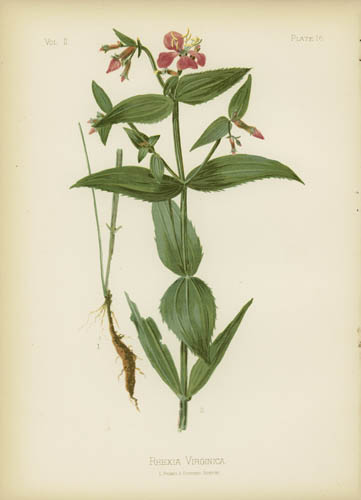

The Rhexia Virginica,

the meadow-beauty,
 high-colored, more beautiful 
than you remembered.

March 28. Here, where in August the bittern booms in the grass, and mowers march en echelon and whet their scythes and crunch the ripe wool-grass, raised now a' few feet, you scud before the wind in your tight bark and listen to the surge (or sough ?) of the great waves sporting around you, while you hold the steering-oar and your mast bends to the gale and you stow all your ballast to windward. The crisped sound of surging waves that rock you, that ceaseless roll and gambol, and ever and anon break into your boat. Deep lie the seeds of the rhexia now, absorbing wet from the flood, but in a few months this mile-wide lake will have gone to the other side of the globe; and the tender rhexia will lift its head on the drifted hummocks in dense patches, bright and scarlet as a flame, — such succession have we here, — where the wild goose and countless wild ducks have floated and dived above them.       So Nature condenses her matter. She is a thousand thick. So many crops the same surface bears. March 28, 1859


July 14. The Rhexia Virginica, the meadow-beauty, high-colored, more beautiful than you remembered. July 14, 1852

July 15. Rhexia near the Rhus copallina, apparently yesterday. July 15, 1854

July 18. The petals of the rhexia have a beautiful clear purple with a violet tinge. July 18, 1852

July 18. Rhexia, a day or two. July 18, 1853

July 20. The Rhexia Virginica is in bloom. July 20, 1851

July 23. The rhexia is seen afar on the islets, — its brilliant red like a rose. It is fitly called meadow-beauty. Is it not the handsomest and most striking and brilliant flower since roses and lilies began?  July 23, 1853

July 23. Rhexia in bloom, how long? July 23, 1859

July 29. Rhexia. Probably would be earlier if not mowed down. July 29, 1856 

August 1. I was surprised to see dense beds of rhexia in full bloom there, apparently on hummocks a rod in diameter left by the ice, or in long ridges mixed with ferns and some Lysimachia lanceolata, arrowhead, etc. They make a splendid show, these brilliant rose-colored patches, especially in the neighborhood of Copan. It is about the richest color to be seen now. Yet few ever see them in this perfection, unless the haymaker who levels them, or the birds that fly over the meadow. Far in the broad wet meadows, on the hummocks and ridges, these bright beds of rhexia turn their faces to the heavens, seen only by the bitterns and other meadow birds that fly over. We, dwelling and walking on the dry upland, do not suspect their existence. How obvious and gay to those creatures that fly over the meadow! Seen only by birds and mowers. These gay standards otherwise unfurled in vain.  August 1, 1856 

August 3.  I see blackened haycocks on the meadows. Think what the farmer gets with his hay, — what his river-meadow hay consists of, — how much of fern and osier and sweet-gale and Polygonum hydropiperoides and rhexia (I trust the cattle love the scent of it as well as I) and lysimachia, etc., etc., and rue, and sium and cicuta.   August 3, 1856

August 5I cannot sufficiently admire the rhexia, one of the highest-colored purple flowers, but difficult to bring home in its perfection, with its fugacious petals. August 5, 1852

August 13.  Rhexia, very common on those bare places on the river meadows from which the soil has been moved by the ice.  August 13, 1852

August 20.  The Rhexia Virginica is a showy flower at present. August 20, 1851

August 20.  The purple gerardia is very beautiful now in green grass, and the rhexia also, both difficult to get home.  August 20, 1852

August 21.  The prevailing conspicuous flowers at present are:
  •  The early goldenrods,
  •  tansy,
  •  the life-everlastings,
  •  flea bane (though not for its flower),
  •  yarrow (rather dry),
  •  hardhack and meadow-sweet (both getting dry, also mayweed),
  •  Eupatorium purpureum,
  •  scabish,
  •  clethra (really a fine, sweet-scented, and this year particularly fair and fresh, flower, some unexpanded buds at top tinged with red),
  •  Rhexia Virginica,
  •  thoroughwort,
  •  Polygala sanguinea,

August 23. The patches of rhexia or meadow-beauty which have escaped the mowers in the low grounds, where rowen is now coming forward apace, look like a little bright purple on one side of Nature's pallet, giving place to some fresh green which Nature has ground. August 23, 1853

August 23. The rhexia in the field west of Clintonia Swamp makes a great show now, though a little past prime. August 23, 1858

August 25. There is a large field of rhexia there now almost completely out of bloom, but its scarlet leaves, reddening the ground at a distance, supply the place of flowers. August 25, 1854

August 26. The Poa hirsuta is left on the upper edge of the meadows ( as at J. Hosmer's ), as too thin and poor a grass , beneath the attention of the farmers. How fortunate that it grows in such places and not in the midst of the rank grasses which are cut. With its beautiful fine purple color, its beautiful purple blush, it reminds me and supplies the place of the rhexia now about done.  ( Leaving off, though I see some pretty handsome Sept. 4th.)  August 26, 1854

August 27. The rhexia greets me in bright patches on meadow banks. August 27, 1856

August 28. The rhexia in Ebby Hubbard's field is considerably past prime, and it is its reddish chalices which show most at a distance now. I should have looked ten days ago. Still it is handsome with its large yellow anthers against clear purple petals. It grows there in large patches with hardhack. August 28, 1859


September 14.  The chalices of the Rhexia Virginica, deer-grass or meadow beauty, are literally little reddish chalices now, though many still have petals, little cream pitchers. September 14, 1851

September 28. Acalypha is killed by frost, and rhexia.  September 28, 1858 

October 2.  The scarlet leaves and stem of the rhexia, some time out of flower, makes almost as bright a patch in the meadow now as the flowers did, with its bristly leaves. Its seed-vessels are perfect little cream-pitchers of graceful form. October 2, 1856 

December 14. We have now the scenery of winter, though the snow is but an inch or two deep. The dried chalices of the Rhexia Virginica stand above the snow, and the cups of the blue-curls and the long sharp red capsules of the small ( ? ) hypericum, etc., etc., johnswort; and a new era commences with the dried herbs. December 14, 1852

A Book of the Seasons, by Henry Thoreau
"A book, each page written in its own season,
out-of-doors, in its own locality.”
~edited, assembled and rewritten by zphx © 2009-2025

Wednesday, July 14, 2021

A Book of the Seasons: July 14 (gentle rain, yellow butterflies, late roses, a new plant, basswood in bloom, moonlight walks)


The year is but a succession of days,
and I see that I could assign some office to each day
which, summed up, would be the history of the year.
Henry Thoreau, August 24, 1852


Fleets of butterflies
filling the air with yellow
in their zigzag flight.

A fine misty rain 
lies on the reddish grass tops 
like morning cobwebs

July 14, 2014

Awake to day of gentle rain, — very much needed; none to speak of for nearly a month, methinks. July 14, 1854

The cooler and stiller day has a valuable effect on my spirits. July 14, 1854
.
A fine, misty rain falls. It lies on the fine reddish tops of some grasses, thick and whitish like morning 
cobwebs. July 14, 1854

The stillness is very soothing. July 14, 1854

This is a summer rain. The earth is being bedewed. July 14, 1854

How deep or perhaps slaty sky-blue are those blueberries that grow in the shade in dense drooping clusters under the fresh green of oak and hickory sprouts. July 14, 1852


Saw something blue, or glaucous, in Beck Stow’s Swamp to-day; approached and discovered the Andromeda Polifolia, in the midst of the swamp at the north end, not long since out of bloom. July 14, 1853

This is another instance of a common experience. When I am shown from abroad, or hear of, or in any [way] become interested in, some plant or other thing, I am pretty sure to find it soon. July 14, 1853

There is an abundance of the buck-bean there also. July 14, 1853

See to-day for the first time this season fleets of yellow butterflies in compact assembly in the road like a mackerel fleet with their small hulls and great sails now suddenly dispersing on our approach and filling the air with yellow in their zigzag flight, as when a fair wind calls schooners out of haven and disperses them over the broad ocean. July 14, 1852

I see a rose, now in its prime, by the river, in the water amid the willows and button-bushes, while others, lower on shore, are nearly out of bloom. July 14, 1853

The red capsules of the Hypericum ellipticum, here and there. This one of the fall-ward phenomena in still rainy days. July 14, 1854. 

A very tall ragged orchis by the Heywood Brook, two feet high, almost like a white fringed one. Lower ones I have seen some time.  July 14, 1853

Bass out about two days at Island. July 14, 1856. 

Senecio long gone to seed and dispersed
. July 14, 1856. 

While drinking at Assabet Spring in woods, noticed a cherry-stone on the bottom. A bird that came to drink must have brought it half a mile. So the tree gets planted! July 14, 1856

Saw apparently my little ruby(?)-crested wren(?) on the weeds there. July 14, 1856 

The creaking of the crickets seems at the very foundation of all sound. At last I cannot tell it from a ringing in my ears. It is a sound from within, not without. July 14, 1851

If I take the same walk by moonlight an hour later or earlier in the evening, it is as good as a different one. I love the night for its novelty; it is less prophaned than the day. July 14, 1851

Health is a sound relation to nature. July 14, 1854

The voice of a bear was like that of a woman in distress. July 14, 1858


July 14, 2019

*****
See A Book of the Seasons,  by Henry Thoreau: 


*****

May 5, 1859 ("Near the oak beyond Jarvis land, a yellow butterfly, — how hot! this meteor dancing through the air.")
May 28, 1854 (“To be serene and successful we must be at one with the universe”)
June 3, 1857 ("The bass at the Island will not bloom this year.")
June 5, 1854 (“I have come to this hill to see the sun go down, to recover sanity and put myself again in relation with Nature.”)
June 11, 1851 ("Hardly two nights are alike.")
July 3, 1853 ("There are no flowers on bass trees commonly this year.")
July 8, 1858 (“In the course of the afternoon we heard, as we thought, a faint shout, and . . . soon Wentworth decided that it must be a bear, for they make a noise like a woman in distress.”)
July 12, 1851 ("Nature is in as rude health as when Homer sang. We may at last by our sympathies be well.")
July 13, 1854 (“In the midst of July heat and drought.”)

July 16, 1851 ("I see the yellow butterflies now gathered in fleets in the road, and on the flowers of the milkweed.")
July 17, 1852 ("Beck Stow's Swamp! . . . deep and impenetrable, where the earth quakes for a rod around you at every step, with its open water where the swallows skim and twitter, its meadow and cotton-grass, its dense patches of dwarf andromeda, now brownish-green, with clumps of blue berry bushes, its spruces and its verdurous border of woods imbowering it on every side.")
July 17, 1856 ("Hear at distance the hum of bees from the bass with its drooping flowers at the Island, a few minutes only before sunset. It sounds like the rumbling of a distant train of cars")
July 18, 1854 ("We have very few bass trees in Concord, but walk near them at this season and they will be betrayed, though several rods off, by the wonderful susurrus of the bees, etc., which their flowers attract.")
July 19, 1851("I see yellow butterflies in pairs, pursuing each other a rod or two into the air, and now, as he had bethought himself of the danger of being devoured by a passing bird, he descends with a zigzag flight to the earth, and the other follows.") 
July 19, 1856 ("It is the Hypericum ellipticum . . . whose red pods are noticed now.")
July 19, 1856 ("Fleets of yellow butterflies on road.")
July 22, 1853 ("Yellow butterflies in the road.")
July 23, 1860 ("The late rose is now in prime along the river, a pale rose-color but very delicate, keeping up the memory of roses.")
July 26, 1854 ("Today I see in various parts of the town the yellow butterflies in fleets in the road, on bare damp sand, twenty or more collected within a diameter of five or six inches in many places.")
July 26, 1856 ("The pod of the ellipticum, when cut, smells like a bee.")
August 19, 1854 ("There is now a remarkable drought.")
August 19, 1852 ("The small fruits of most plants are now generally ripe or ripening, and this is coincident with the flying in flocks of such young birds now grown as feed on them.").
August 23, 1853 ("For all Nature is doing her best each moment to make us well. She exists for no other end. Do not resist her. "Nature" is but another name for health, and the seasons are but different states of health.”)
Walden ("Nature is as well adapted to our weakness as to our strength.”)
September 1, 1860 ("See how artfully the seed of a cherry is placed in order that a bird may be compelled to transport it. . . .The bird is bribed with the pericarp to take the stone with it and do this little service for Nature. Thus a bird's wing is added to the cherry-stone which was wingless, and it does not wait for winds to transport it."); 
September 21, 1860 ("I suspect that ... those [seeds] the wind takes are less generally the food of birds and quadrupeds than the heavier and wingless seeds")
October 26, 1857.(My moods are thus periodical, not two days in my year alike.)
November 18, 1857 ("Sympathy with nature is an evidence of perfect health.”)
December 16, 1853 ("Would you be well, see that you are attuned to each mood of nature")
January 9, 1855 (“Make a splendid discovery this afternoon. Walking through Holden’s white spruce swamp,  I see peeping above the snow-crust some slender delicate evergreen shoots very much like the Andromeda Polifolia, amid sphagnum, lambkill, Andromeda calyculata, blueberry bushes, etc., though there is very little to be seen above the snow. It is, I have little doubt, the Kalmia glauca var. rosmarinifolia.”)
January 23, 1858 ("To insure health, a man’s relation to Nature must come very near to a personal one; . . . I do not see that I can live tolerably without affection for Nature.")

July 14, 2022

If you make the least correct 
observation of nature this year,
 you will have occasion to repeat it
 with illustrations the next, 
and the season and life itself is prolonged.

July 13 < <<<<<  July 14  >>>>> July 15

A Book of Seasons, by Henry Thoreau, July 14

A Book of the Seasons,  by Henry Thoreau
 "A book, each page written in its own season, 
out-of-doors, in its own locality."
 ~edited, assembled and rewritten by zphx ©  2009-2024

https://tinyurl.com/HDT14JULY

Tuesday, July 14, 2020

In Beck Stow’s Swamp to-day; approached and discovered the Andromeda Polifolia

July 14.

Heavy fog. 

I see a rose, now in its prime, by the river, in the water amid the willows and button-bushes, while others, lower on shore, are nearly out of bloom.

Is it not the R. Carolina?

Saw something blue, or glaucous, in Beck Stow’s Swamp to-day; approached and discovered the Andromeda Polifolia, in the midst of the swamp at the north end, not long since out of bloom. 

This is another instance of a common experience. When I am shown from abroad, or hear of, or in any [way] become interested in, some plant or other thing, I am pretty sure to find it soon. 

Within a week R. W. E. showed me a slip of this in a botany, as a great rarity which George Bradford brought from Watertown. I had long been interested in it by Linnæus’s account. I now find it in abundance. 


Andromeda Polifolia


It is a neat and tender-looking plant, with the pearly new shoots now half a dozen inches long and the singular narrow revolute leaves. I suspect the flower does not add much to it.

There is an abundance of the buck-bean there also. 

Holly berries are beginning to be ripe. 

The Polygonum Hydropiper, by to-morrow. 

Spergula arvensis gone to seed and in flower. 

A very tall ragged orchis by the Heywood Brook, two feet high, almost like a white fringed one. Lower ones I have seen some time. 

The clematis there (near the water-plantain) will open in a day or two.  

Mallows gone to seed and in bloom.

Erigeron Canadensis, butter-weed. 

 H. D. Thoreau, Journal, July 14, 1853

In Beck Stow’s Swamp to-day approached and discovered the Andromeda Polifolia. See February 17, 1854 ("In the open part of Gowing's Swamp I find the Andromeda Polifolia. Neither here nor in Beck Stow's does it grow very near the shore. . . . in the middle or deepest part will be an open space not yet quite given up to water, where the Andromeda calyculata and a few A. Polifolia reign almost alone. These are pleasing gardens.”); May 24, 1854 ("Surprised to find the Andromeda Polifolia in bloom and apparently past its prime. . .A timid botanist would never pluck it."); November 15,1857 ("At C. Miles Swamp [Ledum Swamp] [f]ind plenty of Andromeda Polifolia ... where you can walk dry-shod in the spruce wood”); See also February 12, 1858 ("There is, apparently, more of the Andromeda Polifolia in [C.Miles] swamp than anywhere else in Concord."); November 23, 1857 ("This [Gowing's] swamp appears not to have had any natural outlet, though an artificial one has been dug. The same is perhaps the case with the C. Miles Swamp. And is it so with Beck Stow's These three are the only places where I have found the Andromeda Polifolia."). See also  Vascular Flora of Concord, Massachusetts

This is another instance of a common experience. When I become interested in some plant or other thing, I am pretty sure to find it soon. See  May 31, 1853 ("The fact that a rare and beautiful flower which we never saw. . . may be found in our immediate neighborhood, is very suggestive."); August 23, 1854 (“I find a new cranberry on the sphagnum amid the A. calyculata, — V. Oxycoccus . . .It has small, now purplish-dotted fruit, flat on the sphagnum, some turned scarlet partly, on terminal peduncles, with slender, thread-like stems and small leaves strongly revolute on the edges.”); January 9, 1855 (“Make a splendid discovery this afternoon. Walking through Holden’s white spruce swamp, I see peeping above the snow-crust some slender delicate evergreen shoots very much like the Andromeda Polifolia, amid sphagnum, lambkill, Andromeda calyculata, blueberry bushes, etc., though there is very little to be seen above the snow. It is, I have little doubt, the Kalmia glauca var. rosmarinifolia.”); August 30, 1856 ("I have come out this afternoon a-cranberrying, chiefly to gather some of the small cranberry, Vaccinium Oxycoccus . . . “I noticed also a few small peculiar-looking huckleberries hanging on bushes amid the sphagnum, and, tasting, perceived that they were hispid, a new kind to me. Gaylussacia dumosa var. hirtella . . .. Has a small black hairy or hispid berry, shining but insipid and inedible, with a tough, hairy skin left in the mouth.”);  September 2, 1856 ("It commonly chances that I make my most interesting botanical discoveries when I am in a thrilled and expectant mood, perhaps wading in some remote swamp where I have just found something novel and feel more than usually remote from the town. Or some rare plant which for some reason has occupied a strangely prominent place in my thoughts for some time will present itself. My expectation ripens to discovery. I am prepared for strange things."); February 4, 1858 ("It is a remarkable fact that, in the case of the most interesting plants which I have discovered in this vicinity, I have anticipated finding them perhaps a year before the discovery.") November 4, 1858 ("We cannot see any thing until we are possessed with the idea of it, and then we can hardly see anything else. In my botanical rambles I find that first the idea, or image, of a plant occupies my thoughts, though it may at first seem very foreign to this locality, and for some weeks or months I go thinking of it and expecting it unconsciously, and at length I surely see it, and it is henceforth an actual neighbor of mine. This is the history of my finding a score or more of rare plants which I could name.”); August 22, 1860 ("I never find a remarkable Indian relic but I have first divined its existence, and planned the discovery of it. Frequently I have told myself distinctly what it was to be before I found it.") See also  January 27, 1857 ("The most poetic and truest account of objects is generally by those who first observe them, or the discoverers of them, whether a sharper perception and curiosity in them led to the discovery or the greater novelty more inspired their report.")

Beck Stow's Swamp. See July 17, 1852 ("Beck Stow's Swamp! What an incredible spot to think of in town or city! When life looks sandy and barren, is reduced to its lowest terms, we have no appetite, and it has no flavor, then let me visit such a swamp as this, deep and impenetrable, where the earth quakes for a rod around you at every step, with its open water where the swallows skim and twitter, its meadow and cotton-grass, its dense patches of dwarf andromeda, now brownish-green, with clumps of blue berry bushes, its spruces and its verdurous border of woods imbowering it on every side. ") A Book of the Seasons,  by Henry Thoreau,  at Beck Stow's Swamp

There is an abundance of the buck-bean there also See August 30, 1856 ("Consider how remote and novel that [Gowings] swamp. Beneath it is a quaking bed of sphagnum, and in it grow Andromeda Polifolia, Kalmia glauca, menyanthes (or buck -bean), Gaylussacia dumosa, Vaccinium Oxycoccus, — plants which scarcely a citizen of Concord ever sees.”) See also  May 29, 1856 (" Where you find a rare flower, expect to find more rare ones”)

A very tall ragged orchis by the Heywood Brook, two feet high, almost like a white fringed one. See July 21, 1851 ("The ragged orchis on Conantum."); July 13, 1856 ("Orchis lacera, apparently several days, lower part of spike, willow-row, Hubbard side, opposite Wheildon's land.")

Sunday, July 14, 2019

The averge depth of the Concord River

July 14

July 14, 2014

P. M. — Sounded river from Ball's Hill (i. e. off Squaw [?] Harbor) to Atkins's boat-house corner. 

The river, in all the above distance, nowhere washes the base of an isolated (i. e. to except long, lowish hill- banks like Clamshell, etc.) steep hill, without a greater depth off it. The average depth between Sudbury Causeway and Atkins's boat-house bend at wall, or for fifteen miles two hundred and eighty-two rods, is eight and one eighth feet. 

There extends from Tarbell Hill to Skelton Bend what I will call the Straight Reach, a mile and a third long and quite straight. This is the finest water view, making the greatest impression of size, of any that I know on the river. It is very broad, deep, and clear of weeds. Average depth 11+ feet (and at highest water some 19 feet). The bottom is almost everywhere muddy. No weeds in the middle. 

Measuring on the plan by Baldwin, it is three to four hundred feet wide. The depth is also very uniform, varying but little (in the thread) from the average 11 + (except a deep hole and channel at the commencement off Tarbell Hill).

H. D. Thoreau, Journal, July 14, 1859

Saturday, July 14, 2018

The voice of a bear was like that of a woman in distress.

July 14

Wednesday. 

This forenoon we rode on through Whitefield to Bethlehem, clouds for the most part concealing the higher mountains. 

Found the Geum strictum in bloom in Whitefield; also common flax by a house. 

Got another fine view of the mountains — the higher ones much more distant than before— from a hill just south of the public house in Bethlehem, but might have got a better view from a higher hill a little more east, which one said was the highest land between the Green and the White Mountains, of course on that line. 

Saw the Stratford Peaks, thirty or forty miles north, and many mountains east of them. Climbed the long hill from Franconia to the Notch, passed the Profile House, and camped half a mile up the side of Lafayette. 

***

Willey says of Jackson, “The great number of sheep scattered upon the mountains make it the principal place of resort for what bears and wolves are yet left among these hills.” 

Wentworth said that he had trapped and killed a number of them. They killed many of his sheep and calves, and destroyed much of his corn when in the milk, close to his house. A sheep could run faster than a bear, but was not so long winded, especially going up a mountainside. 

The bear, when pursued, would take directly to some distant and impenetrable thicket, as these dark fir thickets on the mountainside. He once found some young bears on a nest made-of small dry sticks collected under a ledge, and raising them five or six inches from the ground. He carried home the young and reared them. 

The voice of a bear was like that of a woman in distress. 

It was in Gilead, the first town (in Maine) northeast from Jackson, that Bean killed his bear, thrusting his arm down her throat.

H. D. Thoreau, Journal, July 14, 1858

The voice of a bear was like that of a woman in distress. See July 8, 1858 (“In the course of the afternoon we heard, as we thought, a faint shout, and . . . soon Wentworth decided that it must be a bear, for they make a noise like a woman in distress. ”)

Bean killed his bear, thrusting his arm down her throatBenjamin G. Willey's Incidents in White Mountain History (1856) ("A Mr. Bean was at work in his field, accompanied by a boy twelve years of age. The bear approached him, and having his gun with him, charged for partridges, he fired, but with little effect. The bear bore down upon him; he walked backwards, loading his gun at the same time, when his foot caught by a twig, which tripped him up, and the bear leaped upon him. He immediately fired again, but with no visible effect. The bear at once went to work,—seizing his left arm, biting through it, and lacerating it severely. While thus amusing himself, he was tearing with his fore paws the clothes, and scratching the flesh on the young man's breast. Having dropped his arm, he opened his huge mouth to make a pounce at his face. Then it was that the young man made the dash that saved his life. As the bear opened his jaws, Bean thrust his lacerated arm down the brute's throat, as far as desperation would enable him. There he had him! The bear could neither retreat nor advance, though the position of the besieged was anything but agreeable. Bean now called upon the lad to come and take from his pocket a jack-knife and open it. The boy marched up to the work boldly. Having got the knife, Bean with his untrammeled hand cut the bear's throat from ear to ear, killing him stone dead, while he lay on his body! It was judged the bear weighed nearly four hundred pounds. One of his paws weighed two pounds eleven ounces.”)

Friday, July 14, 2017

Set fire to the carburetted hydrogen from the sawdust shoal

July 14.

P. M. — Up Assabet with Loomis and Wilde.

Set fire to the carburetted hydrogen from the sawdust shoal with matches, and heard it flash.

It must be an interesting sight by night.

H. D. Thoreau, Journal, July 14, 1857


Set fire to the carburetted hydrogen. See July 9, 1857 ("Am surprised to find how much carburetted hydrogen gas there is in the beds of sawdust by the side of this stream, as at the "Narrows.""); February 28, 1856 ("What a smell as of gun-wash when he raised the gate! . . .It must be the carburetted hydrogen gas from the bottom of the pond under the ice. It powerfully scents the whole mill.")

The sawdust shoal. See  note to July 9, 1857 ("the beds of sawdust by the side of this stream") and April 19, 1854 ("Yesterday, as I was returning down the Assabet, . . . I was surprised to find the river so full of sawdust from the pail-factory and Barrett's mill that I could not easily distinguish if the stone-heaps had been repaired. There was not a square three inches clear. And I saw the sawdust deposited by an eddy in one place on the bottom like a sand-bank a foot or more deep half a mile below the mill.”); October 20, 1856 (“ at Hemlocks, in the eddy there, where the white bits of sawdust keep boiling up and down and whirling round as in a pot.”): July 7, 1859 ("Bathing at Barrett's Bay, I find it to be composed in good part of sawdust, mixed with sand.”); July 16, 1859 ("Afternoons, I sounded the Assabet as far up as the stone bridge.. . . The banks and bars are peculiar. They are commonly composed of a fine sand mixed with sawdust, shavings, etc. in which the black willow loves to grow. I know of no such banks on the main stream.") July 18, 1859 ("One such bank . . . or bar is composed of saw-dust and shavings, almost entirely so to a depth of two feet.")

Thursday, July 14, 2016

So the tree gets planted!

July 14

P. M. — To Muhlenbergii Brook. 

Anthony Wright found a lark's nest with fresh eggs on the 12th in E. Hubbard's meadow by ash tree, — two nests, probably one a second brood. 

Nasturtium hispidum (?), apparently three or four days. 

See and hear martins twittering on the elms by riverside. 

Bass out about two days at Island. 

There is a pyrus twenty feet high with small fruit at Assabet Spring. 

Noli-me-tangere already springs at Muhlenbergii Brook, some days. 

Saw apparently my little ruby(?)-crested wren(?) on the weeds there. 

Senecio long gone to seed and dispersed. 

Canada thistle some time on Huckleberry Pasture-side beyond. 

Ceratophyllum with a dense whorl of twelve little oval red-dotted apparent flower-buds (?) in an axil. 

While drinking at Assabet Spring in woods, noticed a cherry-stone on the bottom. A bird that came to drink must have brought it half a mile. So the tree gets planted!


H. D. Thoreau, Journal, July 14, 1856

A lark's nest with fresh eggs on the 12th. See July 11, 1857 ("And now the lark must look out for the mowers."); July 16, 1851 ("The lark sings in the meadow; the very essence of the afternoon is in his strain. This is a New England sound") July 26, 1856 ("I see young larks fly pretty well before me.")

Bass out about two days at Island. See July 17, 1856 ("Hear at distance the hum of bees from the bass with its drooping flowers at the Island, a few minutes only before sunset. It sounds like the rumbling of a distant train of cars"); July 18, 1854 ("We have very few bass trees in Concord, but walk near them at this season and they will be betrayed, though several rods off, by the wonderful susurrus of the bees, etc., which their flowers attract.") Compare July 3, 1853 ("There are no flowers on bass trees commonly this year."); June 3, 1857 ("The bass at the Island will not bloom this year. ") See also Book of the Seasons by Henry Thoreau, The Basswood

Noli-me-tangere already springs at Muhlenbergii Brook. See August 15, 1851 ("Impatiens, noli-me-tangere, or touch-me-not, with its dangling yellow pitchers or horns of plenty, which I have seen for a month by damp causeway thickets")

Saw apparently my little ruby-crested wren on the weeds there. See A Book of the Seasons, by Henry Thoreau: the ruby-crowned or crested wren.

Senecio long gone to seed and dispersed. See  June 12, 1852 ("The meadows are yellow with golden senecio."); See also A Book of the Seasons  by Henry Thoreau, The Golden Senecio

Canada thistle some time on Huckleberry Pasture-side beyond. See  July 15, 1859 ("To Ledum Swamp. First notice Canada thistle."); July 19, 1851 ("Here is the Canada thistle in bloom, visited by butterflies and bees.") See also A Book of the Seasons by Henry Thoreau, The Thistle and Thistle-down

Ceratophyllum [hornwort] with a dense whorl of twelve little oval red-dotted apparent flower-buds (?) in an axil. See July 27, 1856 ("Ceratophyllum is now apparently in bloom commonly, with its crimson-dotted involucre."); .July 30, 1856 ("The water is suddenly clear,. . . It assists me very much as I go looking for the ceratophyllum, potamogetons, etc. All the secrets of the river bottom are revealed. ")

While drinking at Assabet Spring. See May 2, 1855 ("Open the Assabet spring."); July 12, 1857 ("I drink at every cooler spring in my walk these afternoons."). See also A Book of the Seasonsby Henry Thoreau, At Assabet Spring

A bird that came to drink must have brought it half a mile. See September 1, 1860 ("How artfully the seed of a cherry is placed in order that a bird may be compelled to transport it . . . The bird is bribed with the pericarp to take the stone with it and do this little service for Nature. Thus a bird's wing is added to the cherry-stone which was wingless, and it does not wait for winds to transport it."); also September 21, 1860 ("I suspect that . . . those [seeds] the wind takes are less generally the food of birds and quadrupeds than the heavier and wingless seeds") and  August 19, 1852 ("The small fruits of most plants are now generally ripe or ripening, and this is coincident with the flying in flocks of such young birds now grown as feed on them.").

July 14.  See A Book of the Seasons,  by Henry Thoreau, July 14

A bird come to drink
must have brought this cherry-stone –
the tree gets planted.

A Book of the Seasons,  by Henry Thoreau
"A book, each page written in its own season,
out-of-doors, in its own locality." 
~edited, assembled and rewritten by zphx © 2009-2026

https://tinyurl.com/hdt-560714

Popular Posts Last 30 Days.

The week ahead in Henry’s journal

The week ahead in Henry’s journal
A journal, a book that shall contain a record of all your joy.
"A stone fruit. Each one yields me a thought." ~ H. D. Thoreau, March 28, 1859


I sit on this rock
wrestling with the melody
that possesses me.