Showing posts with label bare twigs. Show all posts

Thursday, November 15, 2018

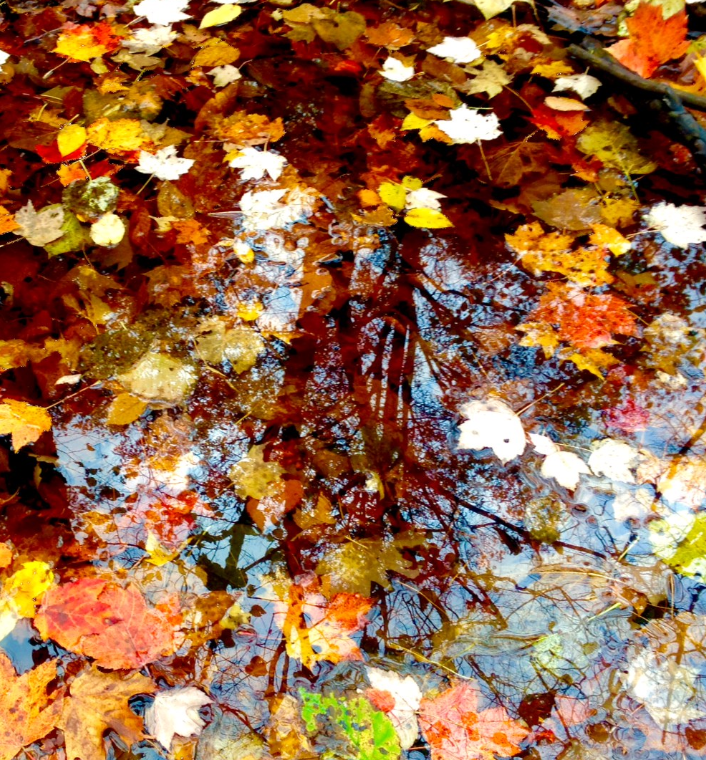
Buds and twigs and the mazes made by twigs in the silvery November light

November 15

P. M. — To Grackle Swamp. A very fine snow falling, just enough to whiten the bare spots a little. 

November 15, 2023

I go to look for evergreen ferns before they are covered up. The end of last month and the first part of this is the time. I do not know that I find more than one kind now in that swamp, and of that the fertile fronds are mostly decayed. All lie flat, ready to be buried in snow. 

Slight as the snow is, you are now reminded occasionally in your walks that you have contemporaries, and perchance predecessors. I see the track of a fox which was returning from his visit to a farmyard last night, and, in the wood-path, of a man and a dog. The dog must have been a large one. I see their shadows before me. 

In another place, where the snow is so slight and lifted up on the withered grass that no track is left, I see by the cakes or balls of snow that have dropped from his shoes that a man has passed. This would be known for a man and a dog’s track in any part of the world. 

Five toes in a bundle, somewhat diamond-shape, forming a sort of rosette, are the print of the dog, whether on the sands of Africa or the snow of New England. The track of his master is somewhat more variable, yet reducible within certain limits. 

The Lycopodium dendroideum var. obscurum appears to be just in bloom in the swamp about the Hemlocks (the regular one (not variety) is apparently earlier), — later than the Lycopodium complanatum, which is done there. 

Gossamer, methinks, belongs to the latter part of October and first part of November; also the frost-weed and evergreen ferns. Buds and twigs (like gossamer), and the mazes made by twigs, and the silvery light on this down and the silver-haired andropogon grass to the first half of November. 

The water andromeda leaves have fallen, and the persistent turned that red brown; how long?

H. D. Thoreau, Journal, November 15, 1858

To Grackle Swamp. See March 19, 1858 ("Met Channing and walked on with him to what we will call Grackle Swamp")

A very fine snow falling, just enough to whiten the bare spots a little. See November 12, 1859 ("The first sprinkling of snow, which for a short time whitens the ground in spots.”); and  note to November 15, 1854 ("The first snow, a mere sugaring which went off the next morning.")

I go to look for evergreen ferns before they are covered up. The end of last month and the first part of this is the time.  See October 31, 1851 (" I see two kinds of ferns still green and much in fruit, apparently the Aspidium spinulosum (?) and cristatum (?).. . .They are quite fresh in those cold and wet places and almost flattened down now . . .Now they are conspicuous amid the withered leaves ");   November 16, 1853 ("I now take notice of the green polypody on the rock and various other ferns, one the marginal (?) shield fern and one the terminal shield fern.") See also A Book of the Seasons, by Henry Thoreau, The Evergreen Ferns, Part One: Maidenhair and Ebony Spleenwort; A Book of the Seasons, by Henry Thoreau, The Evergreen Ferns, Part Two: Aspidium spinulosum & Aspidium cristatumA Book of the Seasons, by Henry Thoreau, The Evergreen Ferns, Part Three: Polypody, Marginal Shield Fern, Terminal Shield Fern

I see the track of a fox which was returning from his visit to a farmyard last night, See December 14, 1855("Then I came upon a fox-track made last night, leading toward a farmhouse"); January 21, 1857 ("It is remarkable how many tracks of foxes you will see quite near the village, where they have been in the night, and yet a regular walker will not glimpse one oftener than once in eight or ten years.")

This would be known for a man and a dog’s track in any part of the world. See November 28, 1858 ("Here is the track of a sportsman and his dog in my secluded path, and probably he preceded me in the summer as well. Yet my hour is not his, and I may never meet him! ")

The Lycopodium denroideum var. obscurum appears to be just in bloom in the swamp about the Hemlocks (the regular one (not variety) is apparently earlier).  See September 24, 1857 ("I find the Lycopodium dendroideum, not quite out, just northwest of this pine grove, in the grass. It is not the
variety obscurum, which grows at Trillium Wood, is more upright-branched and branches round."); Novemberr 7, 1858 ("I see Lycopodium dendroideum which has not yet shed pollen.") See also A Book of the Seasons,  by Henry Thoreau, The Lycopodiums

Gossamer, methinks, belongs to the latter part of October and first part of November. See November 15, 1859 (“A fine gossamer is streaming from every fence and tree and stubble, though a careless observer would not notice it.”);  See also  November 11, 1858 ("Gossamer reflecting the light is another November phenomenon (as well as October)."),  note to November 3, 1857 ("It is a phenomenon peculiar to this season, when the twigs are bare and the air is clear.") and  A Book of the Seasons, by Henry Thoreau, Gossamer Days

Buds and twigs (like gossamer), and the mazes made by twigs, and the silvery light on this down. See November 28, 1856 ("The sunlight reflected from the many ascending twigs of bare young chestnuts and birches, very dense and ascendant with a marked parallelism, they remind me of the lines of gossamer at this season, being almost exactly similar to the eye. It is a true November phenomenon")

The water andromeda leaves have fallen, and the persistent turned that red brown. See November 14, 1858 ("The different colors of the water andromeda in different lights."); November 20, 1857 ("The water andromeda leaves are brown now, except where protected by trees."); November 23, 1857 ("The water andromeda [at Gowing's Swamp] makes a still more uniformly dense thicket, which. . .makes an impression of smoothness and denseness, – its rich brown, wholesome surface, even as grass or moss.")

November 15.  See A Book of the Seasons,  by Henry Thoreau,  November 15

A very fine snow, 
just enough to whiten the 
bare spots a little. 

I go to look for 
the evergreen ferns before 
they are covered up. 


A Book of the Seasons, by Henry Thoreau
"A book, each page written in its own season,
out-of-doors, in its own locality."
~edited, assembled and rewritten by zphx © 2009-2025

https://tinyurl.com/hdt-581115

Tuesday, November 13, 2018

It is wonderful what gradation and harmony there is in nature

November 13. 

8.30 A. M. — To Hill. 

I notice of late the darker green (livid ?) of the arbor vitae and other evergreens, the effect of cold. So they are never so purely bright a green as immediately after their fall. They are not perfectly ever-green. 

I hear go over, not far from the house, goldfinches, as I think, — their mewing note and ricochet flight, -— I think not redpolls, for I hear no rattling notes. Also hear a robin’s note. 

Last night was quite cold, and the ground is white with frost. Thus gradually, but steadily, winter approaches. First there is the bleached grass, then the frost, then snow, the fields growing more and more hoary. There is frost not only on all the withered grass and stubble, but it is particularly thick and white and handsome around the throat of every hole and chink in the earth’s surface, the congealed breath of the earth as it were, so that you would think at first it was the entry to some woodchuck’s, or squirrel’s, or mouse’s, retreat. But it is the great dormant earth gone into winter quarters here, the earth letting off steam after the summer’s work is over. 

As I stand on the hill at 9 A. M., it looks like snow; the sky is overcast; smokes go up thickly from the village, answering to the frost in the chinks; and there is a remarkable stillness, as if it were earlier, the effect of the colder weather merely, as it were stiffening things. Leaves, twigs, birds (except the chickadee, and its feeble note seems to enhance the stillness), and insects are hushed. The few tinkling sounds — the chopping, or the like — are heard far and distinctly. It is like the calm before a hurricane or an earthquake, this stillness which precedes the winter’s setting in. 


Larches now look dark or brownish yellow. Now, on the advent of much colder weather, the last Populus tremuliformis has lost its leaves, the sheltered dogwood is withered, and even the scarlet oak may be considered as extinguished, and the larch looks brown and nearly bare, and the few leaves left here and there on the indigenous shrubs named on the 9th are being rapidly killed by the same cause, and are falling. 

Now for twinkling light reflected from unseen windows in the horizon in the early twilight. 

One hickory at least (on the hill) has not lost its leaves yet, i. e., has a good many left. So they are a month falling. 

I see some feathers of a blue jay scattered along a wood-path, and at length come to the body of the bird. What a neat and delicately ornamented creature, finer than any work of art in a lady’s boudoir, with its soft light purplish-blue crest and its dark-blue or purplish secondaries (the narrow half) finely barred with dusky. It is the more glorious to live in Concord because the jay is so splendidly painted.

A large flock of geese go over just before night. 

After expecting snow all day, —'though we did not know but it would prove rain,—we looked out the window at 9 P. M. and saw the ground for the most part white with the first sugaring, which at first we could hardly tell from a mild moonlight, — only there was no moon. Thus it comes stealthily in the night and changes the whole aspect of the earth. 

Of course frozen ground, ice, and snow have now banished the few remaining skaters (if there were any ?), crickets, and water-bugs. 

It is wonderful what gradation and harmony there is in nature. The light reflected from bare twigs at this season — i. e., since they began to be bare, in the latter part of October — is not only like that from gossamer, but like that which will ere long be reflected from the ice that will incrust them. So the bleached herbage of the fields is like frost, and frost like snow, and one prepares for the other.

H. D. Thoreau, Journal, November 13, 1858

I think not redpolls, for I hear no rattling notes. See November 13, 1852 ("When startled, they went off with a jingling sound somewhat like emptying a bag of coin. Is it the yellow redpoll?"); September 19, 1854 ("Did I see a returned yellow redpoll fly by? "); November 21, 1852 ("The commonest bird I see and hear nowadays is that little red crowned or fronted bird I described the 13th. I hear now more music from them. They have a mewing note which reminds me of a canary-bird. They make very good forerunners of winter. Is it not the {lesser redpoll}?”); December 11, 1855 ("Standing there, though in this bare November landscape, I am reminded of the incredible phenomenon of small birds in winter. ... The age of miracles is each moment thus returned. Now it is wild apples, now river reflections, now a flock of lesser redpolls.")


Now, on the advent of much colder weather, the last Populus tremuliformis has lost its leaves
. See October 25, 1858 ("Aspens (tremuliformis) generally bare"); October 29, 1858 ("Am surprised to see, by the path to Baker Farm, a very tall and slender large Populus tremuliformis still thickly clothed with leaves which are merely yellowish greén."); November 10, 1853 ("There are still a few leaves on the large Populus tremuliformis, but they will be all gone in a day or two. They have turned quite yellow.")

Now for twinkling light reflected from unseen windows in the horizon in the early twilight. See November 17, 1858 ("The setting sun, too, is reflected from windows more brightly than at any other season. “November Lights" would be a theme for me. “)

A large flock of geese go over just before night. See November 8 , 1857 ("About 10 A.M. a long flock of geese are going over from northeast to southwest"); November 13, 1855 ("Seventy or eighty geese, in three harrows successively smaller, flying southwest—pretty well west—over the house. A completely overcast, occasionally drizzling forenoon. "); November 14, 1858 ('The principal flight of geese was November 8th, so that the bulk of them preceded this cold turn five days.") ; November 18, 1854 ("Sixty geese go over the Great Fields, in one waving line, broken from time to time by their crowding on each other and vainly endeavoring to form into a harrow, honking all the while.”); November 30, 1857 (“You first hear a faint honking from one or two in the northeast and think there are but few wandering there, but, looking up, see forty or fifty coming on in a more or less broken harrow, wedging their way southwest. . . . According to my calculation a thousand or fifteen hundred may have gone over Concord to-day. When they fly low and near, they look very black against the sky.”)

It is wonderful what gradation and harmony there is in nature. See Walden ("Nature has woven a natural selvage, and the eye rises by just gradations from the low shrubs of the shore to the highest trees. There are few traces of man's hand to be seen. The water laves the shore as it did a thousand years ago. A lake is the landscape's most beautiful and expressive feature. It is earth's eye; looking into which the beholder measures the depth of his own nature."): January 26, 1858 (" Nature loves gradation")

Monday, November 12, 2018

The fall of the leaf is preceded by a ripe old age.


November 12.

November 12, 2018

I hear from Ricketson to-day that on the 10th the following trees, which I had not seen lately, were leafy and, as I infer, more or less unwithered. His words are, “Horse-chestnut quite full of yellow and green foliage. English walnut ditto. Beech, linden (l), hawthorn (nearly perfect in green foliage, only a little decayed at the top, but in a sheltered place), silver linden, copper beech (2), elm (3), weeping ash, Euonymus Europaeus (4). Also “the guelder-rose”‘ and “Bignonia radicans and acuminata” and “numerous shrubs in full leaf.” Of those not European, “Osage orange (Maclura), Cornus florida (handsome), tulip, three-thomed acacia, Mexican cypress.” 

He sent me specimens of those numbered above which were fresh, especially the fourth, and the third next, the second least so; but then what he sends for the American linden is greener than the European!! I find that E. Hoar observed the English elms with leaves or leafy still November 2d, near Salisbury. 

It is much the coldest day yet, and the ground is a little frozen and resounds under my tread. All people move the brisker for the cold, yet are braced and a little elated by it. They love to say, “Cold day, sir.” Though the days are shorter, you get more work out of a hired man than before, for he must work to keep warm. 

P. M. — To Hill. 

The riverside is skimmed over and presents a wintry aspect, — those great plaits, or folds, as it were, where the crystals have shot, wool-grass frozen in, and the thin white ice where the water has gone down. 

Now for a brisk and energetic walk, with a will and a purpose. Have done with sauntering, in the idle sense. You must rush to the assault of winter. Make haste into the outskirts, climb the ramparts of the town, be on the alert and let nothing escape your observation. The army is all van. 

The cold alone has brought down a good part of the remaining leaves of abeles and white willows. I see the handsome leaves of the last thickly strewn over the ice and reminding of grain even, half upside down. Pitch pine leaves are about all fallen. 

The very common redness of the recent shoots, as white maples, huckleberries, etc., now that the twigs are bare, and on many sides masses of them are run together in a maze, adds to the general russet of nature. The black willow shoots are a very pale brownish yellow. 

We are now reduced to browsing on buds and twigs, and methinks, with this diet and this cold, we shall look to the stall-fed thinkers like those unkempt cattle in meadows now, grazing the withered grass.

Examining closely the base of some frost-weed, I find in each case a little frost firmly attached to the naked woody stem just under the bark, having burst the last  for about an inch along the stem and elevated it. Perhaps this weed dies down slowly, since it blossoms a second time, and there is more sap now in the stem near its base than usual, which escapes in a vapor from the stem, and, being frozen, forms this kind of icicle. 

I think that the change to some higher color in a leaf is an evidence that it has arrived at a late and more perfect and final maturity, answering to the maturity of fruits, and not to that of green leaves, etc., etc., which merely serve a purpose. The word “ripe” is thought by some to be derived from the verb “to reap,” according to which that is ripe which is ready to be reaped. The fall of the leaf is preceded by a ripe old age.

H. D. Thoreau, Journal, November 12, 1858

I think that the change to some higher color in a leaf is an evidence that it has arrived at a late and more perfect and final maturity, answering to the maturity of fruits. See Autumnal Tints ("Most appear to confound changed leaves with withered ones, as if they were to confound ripe apples with rotten ones. I think that the change to some higher color in a leaf is an evidence that it has arrived at a late and perfect maturity, answering to the maturity of fruits.")

Now for a brisk and energetic walk, with a will and a purpose. Have done with sauntering, in the idle sense. You must rush to the assault of winter. See  January 10, 1851 ("And this word "saunter," by the way, is happily derived "from idle people who roved about the country [in the Middle Ages] and asked charity under pretence of going a la Sainte Terre . . . They who never go to the Holy Land in their walks, as they pretend, are indeed mere idlers and vagabonds.")December 25, 1856 ("Take long walks in stormy weather or through deep snows.  Deal with brute nature. Be cold and hungry and weary.");  January 12, 1852 ("I sometimes think that I may go forth and walk hard . . . be much abroad in heat and cold, day and night; live more, expend more atmospheres, be weary often, etc., etc.” ); February 28, 1852 (“To get the value of the storm we must be out a long time and travel far in it, so that it may fairly penetrate our skin . . . and there be no part in us but is wet or weather beaten, - so that we become storm men instead of fair weather men.”); April 19 1852 ("To see wild life you must go forth at a wild season. When it rains and blows, keeping men indoors, then the lover of Nature must forth. Then returns Nature to her wild estate.’); 

Thursday, November 8, 2018

Each phase of nature is there to be found when we look for it, but not demanding our attention.

November 8. 

P. M. — To Boulder Field.

 Goodwin, laying wall at Miss Ripley’s, observed to me going by, “Well, it seems that __ thought that he had lived long enough.” He committed suicide within a week, at his sister’s house in Sudbury. A boy slept in the chamber with him, and, hearing a noise, got and found  __  on the floor with both his jugular veins cut, but his windpipe whole. He said to the boy, “Take the razor and cut deeper,” but the boy ran, and __ died, and Garfield said it was about time, for __, in revenge for being sent to the house of correction, had set fire to a pile of wood of his, that long pile by the road side beyond William Wheeler’s, that I stood under in a rain once.  __ probably burned Witherell’s house too, and perhaps Boynton’s stable. 

The red osier at Mrs. Simmons’s is quite bare; how long? Her hawthorn is still quite leafy and pretty, yellow-brown, dotted. A thorn at Hall’s fence is dark scarlet and pretty. There are many leaves on the buckthorn still.

Common thorn bushes, long since bare, when many grow together in clumps, make another such a smoke, though smaller, as the maples, — the same color. I can often distinguish the bush by this. 

Alders are a very dark gray, sort of iron gray, and, if near enough, you see dark lines (the stems) and specks (the fruit) like cinders, like a very dense, dark, and unconsumed uliginous smoke, in which many cinders rise. 

Those trees and bushes which grow in dense masses and have many fine twigs, being bare, make an agreeable misty impression where there are a myriad retreating points to receive the eye, not a hard, abrupt wall; just as, in the sky, the visual ray is cushioned on clouds, unless it is launched into the illimitable ether. The eye is less worn and wearied, not to say wounded, by looking at these mazes where the seer is not often conscious of seeing anything. 

It is well that the eye is so rarely caught and detained by any object in one whole hemisphere of its range, i. e. the sky. It enjoys everlasting holiday on this side.  Only the formless clouds and the objectless ether are presented to it. For they are nervous who see many faces in the clouds. Corresponding to the clouds in the sky are those mazes now on the earth. 

Nature disposes of her naked stems so softly as not to put our eyes out. She makes them a smoke, or stationary cloud, on this side or that, of whose objective existence we rarely take cognizance. She does not expect us to notice them. She calls our attention to the maple swamp more especially in October. 

There is also the coarse maze produced by an oak wood (when nearly all the leaves are fallen), in which, however, the large boughs reflecting the light have considerable distinctness, and that of the forest in general. 

I thought, from a small specimen, that the brushy yellow birch tops were of the same hue with the alders. [Vide Nov. 11th.] 

Nature has many scenes to exhibit, and constantly draws a curtain over this part or that. She is constantly repainting the landscape and all surfaces, dressing up some scene for our entertainment. Lately we had a leafy wilderness, now bare twigs begin to prevail, and soon she will surprise us with a mantle of snow.[I read that snow fell two or three inches deep in Bangor yesterday morning.] Some green she thinks so good for our eyes, like blue, that she never banishes it entirely, but has created evergreens. 

It is remarkable how little any but a lichenist will observe on the bark of trees. The mass of men have but the vaguest and most indefinite notion of mosses, as a sort of shreds and fringes, and the world in which the lichenist dwells is much further from theirs than one side of this earth from the other. They see bark as if they saw it not. These objects which, though constantly visible, are rarely looked at are a sort of eye-brush. 

Each phase of nature, while not invisible, is yet not too distinct and obtrusive. It is there to be found when we look for it, but not demanding our attention. 

It is like a silent but sympathizing companion in whose company we retain most of the advantages of solitude, with whom we can walk and talk, or be silent, naturally, without the necessity of talking in a strain foreign to the place. I know of but one or two persons with whom I can afford to walk. 

With most the walk degenerates into a mere vigorous use of your legs, ludicrously purposeless, while you are discussing some mighty argument, each one having his say, spoiling each other’s day, worrying one another with conversation, hustling one another with our conversation. I know of no use in the walking part in this case, except that we may seem to be getting on together toward some goal; but of course we keep our original distance all the way. Jumping every wall and ditch with vigor in the vain hope of shaking your companion off. Trying to kill two birds with one stone, though they sit at opposite points of [the] compass, to see nature and do the honors to one who does not. 

Animals generally see things in the vacant way I have described. They rarely see anything but their food, or some real or imaginary foe. I never saw but one cow looking into the sky. 

Lichens as they affect the scenery, as picturesque objects described by Gilpin or others, are one thing; as they concern the lichenist, quite another. These are the various grays and browns which give November its character. 

There are also some red mazes, like the twigs of the white maple and our Cornus sericea, etc. (the red osier, too, further north), and some distinct yellow ones, as willow twigs, which are most interesting in spring. The silvery abeles are steadily , falling nowadays. The chalky white under side of these leaves is remarkable. None of our leaves is so white. 

I think I admire again about this time the still bright red or crimson fruit of the sumach, now when not only its own but most other leaves have fallen and there are few bright tints, it is now so distinct on its twigs. Your attention is not distracted by its brilliant leaves now. 

I go across N. Barrett’s land and over the road beyond his house. The aspect of the Great Meadows is now nearly uniform, the new and exposed grass being nearly as brown and sere as that which was not cut. Thus Nature has been blending and harmonizing the colors here where man had interfered. 

I wandered over bare fields where the cattle, lately turned out, roamed restless and unsatisfied with the feed; I dived into a rustling young oak wood where not a green leaf was to be seen; I climbed to the geological axis of elevation and clambered over curly-pated rocks whose strata are on their edges, amid the rising woods; and again I thought, They are all gone surely, and left me alone. Not even a man Friday remains. What nutriment can I extract from these bare twigs? Starvation stares me in the face. 

Nay, nay!” said a nuthatch, making its way, head downward, about a bare hickory close by.

 “The nearer the bone the sweeter the meat. Only the superfluous has been swept away. Now we behold the naked truth. If at any time the weather is too bleak and cold for you, keep the sunny side of the trunk, for there is a wholesome and inspiring warmth such as the summer never afforded. There are the winter mornings, with the sun on the oak wood tops. While buds sleep, thoughts wake.”
  (“Hear! hear!” screamed the jay from a neighboring copse, where I had heard a tittering for some time.)

“Winter has a concentrated and nutty kernel if you know where to look for it.” 

And then the speaker shifted to another tree, further off, and reiterated his assertions, and his mate at a distance confirmed them; and I heard a suppressed chuckle from a red squirrel that heard the last remark, but had kept silent and invisible all the while. Is that you? “Yes-sir-ee,” said he. 

Then, running down a slanting bough, he called out rather impudently, “Look here! just get a snug-fitting fur coat and a pair of fur gloves like mine, and you may laugh at a northeast storm,” and then he wound up with a slang phrase, in his own lingo, accompanied by a flourish of his tail, just as a newsboy twirls his fingers with his thumb on his nose and inquires, “Does your mother know you are out?” 

The wild pear tree on Ponkawtasset has some yellow leaves still. 

The now more noticeable green radical leaves of the buttercup in the russet pastures remind me of the early spring to come, of which they will offer the first evidence. 

Now, too, I can see (for the same reason) where grows our only patch of broom, a quarter of a. mile off, it such a distinct, somewhat yellowish, green. 

Already the creeping juniper is a ripe glaucous green, with a distinct ruddy tinge to the upper surface, —— the whole bush a ripe tint like a fruit. 

I stand in Ebby Hubbard’s yellow birch swamp, ad miring some gnarled and shaggy picturesque old birches there, which send out large knee-like limbs near the ground, while the brook, raised by the late rain, winds fuller than usual through the rocky swamp. I thought with regret how soon these trees, like the black birches that grew on the hill near by, would be all cut off, and there would be almost nothing of the old Concord left, and we should be reduced to read old deeds in order to be reminded of such things, —deeds, at least, in which some old and revered bound trees are mentioned. These will be the only proof at last that they ever existed. 

Pray, farmers, keep some old woods to match the old deeds. Keep them for history’s sake, as specimens of what the township was. Let us not be reduced to a mere paper evidence, to deeds kept in a chest or secretary, when not so much as the bark of the paper birch will be left for evidence, about its decayed stump. 

The sides of the old Carlisle road where it is low and moist are (and have for a long time been), for many rods together and a rod in width, brown or cinnamon-colored with the withered dicksonia fern, not like the brown of trees (their withered leaves), but a peculiar cinnamon-brown. The bare huckleberry bushes and the sweet ferns are draped with them as a kind of mourning.

Solidago puberula still out, for you see a few bright yellow solidago flowers long after they are generally turned to a dirty-white fuzzy top. 

Pratt says he saw a few florets on a Polygala sanguinea within a week. He shows me samphire, plucked three weeks ago in Brighton, when it was a very brilliant crimson still. 

Looking from Pratt’s window at sunset, I saw that  purple or rosy light reflected from some old chestnut rails on the hilltop before his house. Methinks it is pinkish, even like the old cow-droppings in the pastures. So universally does Nature blush at last. The very herbage which has gone through the stomachs and intestines of the cow acquires at last a faint pinkish tinge. 

The button-bush balls are now blackish (really dark brown) and withered, looking much blacker against the light than a month ago.

H. D. Thoreau, Journal, November 8, 1858

Each phase of nature is there to be found when we look for it, but not demanding our attention. See March 23, 1853 ("Man cannot afford to be a naturalist, to look at Nature directly, but only with the side of his eye"); November 6, 1853 (“It is remarkable how little we attend to what is passing before us constantly, unless our genius directs our attention that way.”);  July 2 1857 (“Many an object is not seen, though it falls within the range of our visual ray, because it does not come within the range of our intellectual ray, i. e., we are not looking for it. So, in the largest sense, we find only the world we look for.); November 4, 1858 ("All this you will see, and much more, if you are prepared to see it, — if you look for it. "); November 3, 1861 ("All this is perfectly distinct to an observant eye, and yet could easily pass unnoticed by most.",)

Lichens as they affect the scenery, as picturesque objects described by Gilpin or others, are one thing; as they concern the lichenist, quite another. See January 26, 1852 ("The beauty of lichens, with their scalloped leaves, the small attractive fields, the crinkled edge! I could study a single piece of bark for hour.”); March 5, 1852 ("Such is the mood of my mind, and I call it studying lichens. The habit of looking at things microscopically, as the lichens on the trees and rocks, really prevents my seeing aught else in a walk"); February 5, 1853 ("It is a lichen day. . . . All the world seems a great lichen and to grow like one to-day”).; January 26, 1858 ("The white lichens, partly encircling aspens and maples, look as if a painter had touched their trunks with his brush as he passed.")

"While buds sleep, thoughts wake,” said the nuthatch, “Winter has a concentrated and nutty kernel if you know where to look for it.” See January 30, 1854 ("The winter was made to concentrate and harden and mature the kernel of man's brain, to give tone and firmness and consistency to his thought. This harvest of thought the great harvest of the year. The human brain is the kernel which the winter itself matures. Now we burn with a purer flame like the stars.")

With most the walk degenerates into a mere vigorous use of your legs, ludicrously purposeless, while you are discussing some mighty argument, each one having his say, spoiling each other’s day. See August 31, 1856 ("Some are so inconsiderate as to ask to walk or sail with me regularly every day. . . Suppose a man asks, not you to go with him, but to go with you! Often, I would rather undertake to shoulder a barrel of pork and carry it a mile than take into my company a man."); November 25, 1857 ("I believe there is no man with whom I can associate who will not, comparatively speaking, spoil my afternoon"); September 16, 1859 ("Ask me for a certain number of dollars if you will, but do not ask me for my afternoons.");


Tuesday, October 28, 2014

The reflected woods begin to look bare

October 28, 2014
October. 28

The woods begin to look bare, reflected in the water, and I look far in between the stems of the trees under the bank. 


Birches, which began to change and fall so early, are still in many places yellow.

H. D. Thoreau, Journal, October 28, 1854


I look far in between the stems of the trees under the bank.
 See March 8, 1853 ("Instead of looking into the sky, I look into the placid reflecting water for the signs and promise of the morrow."); March 9, 1855 ("It occurred to me that the reason was that there was reflected to me from the river the view I should have got if I had stood there on the water in a more favorable position."); October 14, 1857 ("This, too, accounts for my seeing portions of the sky through the trees in reflections often when none appear in the substance."); October 17, 1858 (" Now, by the fall of the leaves, so much more light is let in to the water. The river reflects more light, therefore, in this twilight of the year, as it were an afterglow."). See also A Book of the Seasons, by Henry Thoreau, by Henry Thoreau, Reflections

Birches, which began to change and fall so early. See August 11, 1858 ("The birches have lately lost a great many of their lower leaves, which now cover and yellow the ground."); August 13, 1854 ("I am surprised to behold how many birch leaves have turned yellow, — every other one, — while clear, fresh, leather-colored ones strew the ground with a pretty thick bed under each tree. "); October 22, 1858 ("Th birches have been steadily changing and falling for a long, long time. The lowermost leaves turn golden and fall first; so their autumn change is like a fire which has steadily burned up higher and higher, consuming the fuel below, till now it has nearly reached their tops. ")

Birches . . . are still in many places yellow. See October 22, 1855 ("I see at a distance the scattered birch-tops, like yellow flames amid the pines,"); October 26, 1860 ("This is the season of birch spangles, when you see afar a few clear-yellow leaves left on the tops of the birches.") See also A Book of the Seasons, by Henry Thoreau, Birches in Season

The reflected woods
begin to look bare – I look 
far between the trees.


A Book of the Seasons,  by Henry Thoreau
 "A book, each page written in its own season,
out-of-doors, in its own locality."

 ~edited, assembled and rewritten by zphx ©  2009-2024

https://tinyurl.com/hdt28oct54

Friday, November 23, 2012

This morning the ground is white with snow

November 23

This morning the ground is white with snow, and it still snows. 

There is something genial even in the first snow, and Nature seems to relent a little of her November harshness.The beauty and purity of new-fallen snow, lying just as it fell, on the twigs and leaves all the country over. 


You must go forth early to see the snow on the twigs. 

Now, a few hours later, the twigs and leaves are all bare, and the snow half melted on the ground. Sportsmen have already been out with their dogs, improving this first snow to track their game. 

Having descended the Cliff, I go along to the Andromeda Ponds. 

The air is full of low, heavy mist, almost rain. The pines, in this atmosphere and contrasted with the snow, are suddenly many degrees darker, and the oaks redder. 

The andromeda a warm reddish brown with an edging of yellowish sedge or coarse grass about the swamp, and red rustling shrub oak hills with a white ground rising around.

The mist so low is clouds close to the ground, and the steam of the engine hugs the earth in the Cut, concealing all objects for a great distance.

I am surprised to see Fair Haven entirely skimmed over.

H. D. Thoreau, Journal, November 23, 1852

This morning the ground is white with snow, and it still snows  See note to November 29, 1856 ("Begins to snow this morning and snows slowly and interruptedly with a little fine hail all day")

There is something genial even in the first snow, and Nature seems to relent a little of her November harshness. See November 8, 1853 (“Our first snow . . . The children greet it with a shout when they come out at recess.”); November 24, 1860 ("Though a slight touch, this was the first wintry scene of the season. The rabbits in the swamps enjoy it, as well as you.”) 

The pines, in this atmosphere and contrasted with the snow, are suddenly many degrees darker. See November 29, 1850 (" The pines standing in the ocean of mist, seen from the Cliffs, are trees in every stage of transition from the actual to the imaginary. As you advance, the trees gradually come out of the mist and take form before your eyes"); December 26, 1850 ("Now that the ground is covered with snow, the pine woods seen from the hilltops are not green but a dark brown, greenish-brown perhaps.")

The andromeda a warm reddish brown. See November 13, 1852 ("Andromeda is a dull reddish brown, like oak leaves."); November 24, 1857 ("Looking toward the sun, the andromeda in front of me is a very warm red brown and on either side of me, a pale silvery brown; looking from the sun, a uniform pale brown"); November 17, 1859 ("How fair and memorable this prospect when you stand opposite to the sun, these November afternoons, and look over the red andromeda swamp - a glowing, warm brown red in the Indian-summer sun,"). See also A Book of the Seasons, by Henry Thoreau, The Andromeda Phenomenon

I am surprised to see Fair Haven entirely skimmed over.See November 18, 1858 (“Am surprised to see Fair Haven Pond completely frozen over during the last four days. It will probably open again. Thus, while all the channel elsewhere is open and a mere edging of ice amid the weeds is seen, this great expansion is completely bridged over, thus early.”); November 21, 1852 ("I am surprised this afternoon to find . . . Fair Haven Pond one-third frozen or skimmed over, though commonly there is scarcely any ice to be observed along the shores."); December 5, 1853 (" Fair Haven Pond is skimmed completely over."); December 7, 1856 ("Take my first skate to Fair Haven Pond”)

The new-fallen snow
seen lying just as it fell
on the twigs and leaves.

A Book of the Seasons,  by Henry Thoreau, First Snow
 "A book, each page written in its own season, 
out-of-doors, in its own locality."
 ~edited, assembled and rewritten by zphx ©  2009-2024

https://tinyurl.com/hdt-521123

***
Nov. 23. This morning the ground is white with snow, and it still snows. This is the first time it has been fairly white this season, though once before, many weeks ago, it was slightly whitened for ten or fifteen minutes. It was so warm and still last night at sundown that I remarked to a neighbor that it was moderating to snow. It is, in some degree, also, warmer after the first snow has come and banked up the houses and filled the crevices in the roof. Already the landscape impresses me with a greater sense of fertility. I have not worn gloves yet, though it has been finger-cold. 

There is something genial even in the first snow, and Nature seems to relent a little of her November harshness. Men, too, are disposed to give thanks for the bounties of the year all over the land, and the sound of the mortar is heard in all houses, and the odor of summer savory reaches even to poets' garrets. 

This, then, may be considered the end of the flower season for this year, though this snow will probably soon melt again. Among the flowers which may be put down as lasting thus far, as I remember, in the order of their hardiness: yarrow, tansy (these very fresh and common),  cerastium, autumnal dandelion, dandelion, and perhaps tall buttercup, etc., the last four scarce. The following seen within a fortnight: a late three-ribbed goldenrod of some kind, blue-stemmed goldenrod (these two perhaps within a week), Potentilla argentea, Aster undulatus, Ranunculus repens, Bidens connata, shepherd's-purse, etc., etc. N. B.: I have not looked for witch-hazel nor Stellaria media lately. 

I had a thought in a dream 'last night which surprised me by its strangeness, as if it were based on an experience in a previous state of existence, and could not be entertained by my waking self. Both the thought and the language were equally novel to me, but I at once perceived it to be true and to coincide with my experience in this state. 

3 p. m. — To Cliffs and Walden. You must go forth early to see the snow on the twigs. The twigs and leaves are all bare now, and the snow half melted on the ground; where the trees are thick it has not reached the ground at all, except in the shape of water in the course of the day. But early this morning the woods presented a very different scene. The beauty and purity of new-fallen snow, lying just as it fell, on the twigs and leaves all the country over, afforded endless delight to the walker. It was a delicate and fairylike scene. But a few hours later the woods were comparatively lumpish and dirty. So, too, you must go forth very early to see a hoar frost, which is rare here; these crisped curls adorn only the forehead of the snow, are suddenly many degrees darker, and the oaks redder. But still the tops of the dead grass rise above the snow in the fields, and give the country a yellow or russet look. The wetter meadows are quite russet. 

I am surprised to see Fair Haven entirely skimmed over. 

Having descended the Cliff, I go along to the Andromeda Ponds. Sportsmen have already been out with their dogs, improving this first snow to track their game. The andromeda looks somewhat redder than before, a warm reddish brown, with an edging of yellowish sedge or coarse grass about the swamp, and red rustling shrub oak hills with a white ground rising around. These swamps, resorted to by the muskrat and ducks, most remind me of the Indian. 

The mist so low is clouds close to the ground, and the steam of the engine also hugs the earth in the Cut, concealing all objects for a great distance. 

Though the parents cannot determine whether the child shall be male or female, yet, methinks, it depends on them whether he shall be a worthy addition to the human family.

Sunday, October 28, 2012

The dew reflects moonlight.


Sunset from the Poplar Hill. A warm, moist afternoon. The clouds lift in the west, — indeed the horizon is now clear all around.

October 28, 2019

Suddenly the light of the setting sun yellows and warms all the landscape. The air is filled with a remarkably vaporous haze. The shadows of the trees on the river's edge stretch straight a quarter of a mile into the level russet Great Meadows. 

The boys are gathering walnuts. Their leaves are a yellowish brown. 

8 p.m.— To Cliffs.

After whatever revolutions in my moods and experiences, when I come forth at evening, as if from years of confinement to the house, I see the few stars which make the constellation of the Lesser Bear in the same relative position, - the everlasting geometry of the stars. 

The moon beginning to wane. It is a quite warm but moist night. The dew in the withered grass reflects the moonlight like glow-worms.

That star which accompanies the moon will not be her companion tomorrow.

The forest has lost so many leaves that its floor and paths are much more checkered with light. I hear no sound but the rustling of the withered leaves, and, on the wooded hilltops, the roar of the wind. Each tree resounds all night, though some have but a few leaves left to flutter and hum.

Four months of the green leaf make all our summer, if I reckon from June 1st to October 1st, the growing season, and methinks there are about four months when the ground is white with snow. That would leave two months for spring and two for autumn. October the month of ripe or painted leaves; November the month of withered leaves and bare twigs and limbs.

H. D. Thoreau, Journal, October 28, 1852


Suddenly the light of the setting sun yellows and warms all the landscape.
 See October 28, 1857 ("All at once a low-slanted glade of sunlight from one of heaven’s west windows behind me fell on the bare gray maples, lighting them up with an incredibly intense and pure white light;"); See also October 21 1857 ("I see, this cool and grayish evening, that peculiar yellow light in the east, from the sun at little before its setting. It has just come out beneath a great cold slate-colored cloud that occupies most of the western sky, as smaller ones the eastern, and now its rays, slanting over the hill in whose shadow I float, fall on the eastern trees and hills with a thin, yellow light"); October 22, 1852 ("We have to-night a bright warm sunset after a cool gray afternoon, lighting up the green pines at the northeast end of the pond"); October 22, 1854 ("t was a beautiful evening, and a clear amber sunset lit up all the eastern shores"); October 27, 1858 ("We have a cool, white sunset, Novemberish, and no redness to warm our thoughts."); October 31, 1858 ("Looking off just before sunset, when all other trees visible for miles around are reddish or green, I distinguish my new acquaintance by its yellow color"); and also August 31, 1852 ("The evening of the year is colored like the sunset."); November 14, 1853 ("October is the month of painted leaves, . . .it is the sunset month of the year, when the earth is painted like the sunset sky. . . .This light fades into the clear, white, leafless twilight of November, and what ever more glowing sunset or Indian summer we have then is the afterglow of the year.”)

The sun setting red
in haze at the same time as
the full moon rises.
October 8, 1851

The mountains distinct –
the sunset sky white and cold
now as I come home.

A bright warm sunset
after a gray afternoon
lights up every leaf.
October 22, 1852

October is the
red sunset sky, November
the later twilight. 

That star which accompanies the moon will not be her companion tomorrow. See January 24, 1852 ("And now the crescent of the moon is seen, and her attendant star is farther off than last night.”)

October the month of ripe or painted leaves. See August 31, 1852 ("The evening of the year is colored like the sunset.”); November 14, 1853 (“October . . . is the sunset month of the year, when the earth is painted like the sunset sky.”)

The boys are gathering walnuts.
 See October 24, 1852 ("I see, far over the river, boys gathering walnuts."); October 24, 1857 ("I hear the dull thump of heavy stones against the trees from far through the rustling wood, where boys are ranging for nuts. ")

The dew in the withered grass reflects the moonlight. See Dogen ("The whole moon and the entire sky are reflected in dewdrops on the grass, or even in one drop of water.. . .. Each reflection, however long or short its duration, manifests the vastness of the dewdrop, and realizes the limitlessness of the moonlight in the sky.") and May 13, 1860 ("Each dewdrop takes the form of the planet itself."); June 11, 1851 ("The woodland paths are never seen to such advantage as in a moonlight night . . . Hardly two nights are alike. I now descend round the corner of the grain-field . . .and find myself in a colder, damp and misty atmosphere, with much dew on the grass. There is something creative and primal in the cool mist. . . .I seem to be nearer to the origin of things."); June 16, 1840 ("The river down which we glided for that long afternoon was like a clear drop of dew with the heavens and the landscape reflected in it.")

https://tinyurl.com/HDT521028


Popular Posts Last 30 Days.

The week ahead in Henry’s journal

The week ahead in Henry’s journal
A journal, a book that shall contain a record of all your joy.
"A stone fruit. Each one yields me a thought." ~ H. D. Thoreau, March 28, 1859


I sit on this rock
wrestling with the melody
that possesses me.