Showing posts with label june 2. Show all posts

Monday, June 2, 2025

A Book of the Seasons: The Eastern Kingbird


 For the first time I perceive this spring
that the year is a circle.  
I would make a chart of our life,
know why just this circle of creatures completes the world.
Henry Thoreau, April 18, 1852

Are these not kingbird days,
when, in clearer first June days full of light,
this aerial, twittering bird flutters from willow to willow
and swings on the twigs,
showing his white-edged tail?
June 2, 1854

That aerial and spirited bird
loves best, methinks,
to fly where the sky is reflected beneath him.
  August 5, 1858
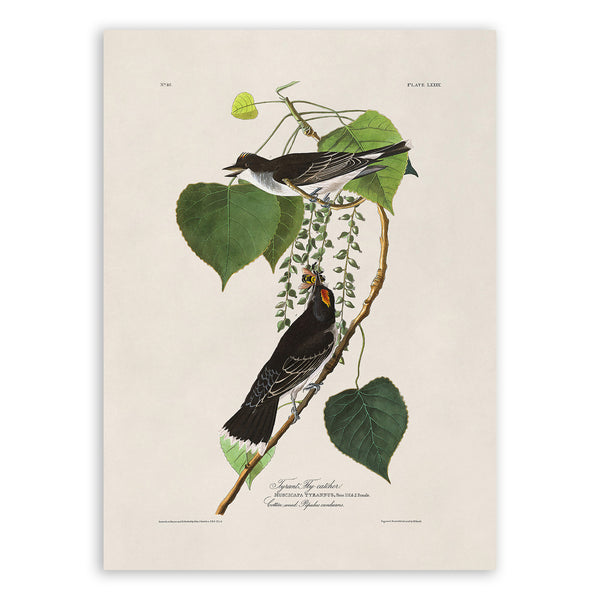

May 9.  Kingbird. May 9, 1857

May 10.   See a kingbird, looking like a large phoebe, on a willow by the river, and hear higher the clear whistle of the oriole. New days, then, have come, ushered in by the warbling vireo, yellowbird, Maryland yellow-throat, and small pewee, and now made perfect by the twittering of the kingbird and the whistle of the oriole amid the elms . . .  if not already the bobolink. May 10, 1853  

May 10.  It is remarkable that I saw this morning for the first time the bobolink, gold robin, and kingbird, - May 10, 1853

May 11.  I see the kingbird. May 11, 1854

May 11.  Now, some time after sunset, the robins scold and sing, the Maryland yellow-throat is heard amid the alders and willows by the waterside, and the peetweet and black birds, and sometimes a kingbird, and the tree-toad. May 11, 1854

May 12. Is not this the first day of summer, when first I sit with the window open and forget fire? and hear the golden robin and kingbird, etc., etc.? not to mention the bobolink, vireo, yellowbird, etc., and the trump of bullfrogs heard last evening. May 12, 1854

May 14.  First kingbird. Its voice and flight relate it to the swallow. May 14, 1852 

May 14.  The still dead-looking willows and button-bushes are alive with red-wings . . .The yellowbird, kingbird, and pewee, beside many swallows, are also seen. But the rich colors and the rich and varied notes of the blackbirds surpass them all. May 14, 1853

May 14.  A kingbird.  May 14, 1858

May 16.  Hear a bobolink and kingbird, and find sparrows' nests on the ground. May 16, 1859

May 17.  Kingbird.  May 17, 1856

May 29. How still the hot noon; people have retired behind blinds. Yet the kingbird — lively bird, with white belly and tail edged with white, and with its lively twittering— stirs and keeps the air brisk. May 29, 1853

June 2. Are these not kingbird days, when, in clearer first June days full of light, this aerial, twittering bird flutters from willow to willow and swings on the twigs, showing his white-edged tail? June 2, 1854

June 2. Bats go over, and a kingbird, very late. June 2, 1860

June 3.  A very warm day, without a breeze. A kingbird's nest in a fork of a black willow. June 3, 1854 

June 5. I see at a distance a kingbird or blackbird pursuing a crow lower down the hill, like a satellite revolving about a black planet.  June 5, 1854

June 5.  The Muscicapa Cooperi sings pe pe pe', sitting on the top of a pine, and shows white rump ( ? ) , etc. , unlike kingbird. June 5, 1856 

June 6.  A kingbird's nest, with two of its large handsome eggs, very loosely set over the fork of a horizontal willow by river, with dried everlasting of last year, as usual, just below Garfield's boat. Another in black willow south of long cove (east side, north of Hubbard's Grove) and another north of said cove.   June 6, 1857 

June 6.  As the light is obscured after sunset, the birds rapidly cease their songs, and the swallows cease to flit over the river. And soon the bats are seen taking the places of the swallows and flying back and forth like them, and commonly a late kingbird will be heard twittering still in the air.  June 6, 1860

June 7.  What does it signify, the kingbird, black bird, swallow, etc., etc., pursuing a crow? June 7, 1858 

June 7.  It is evidence enough against crows and hawks and owls, proving their propensity to rob birds’ nests of eggs and young, that smaller birds pursue them so often. You do not need the testimony of so many farmers' boys when you can see and hear the small birds daily crying “Thief and murder” after these spoilers.  June 7, 1858 

June 8.  A kingbird’s nest on a black cherry, above Barbarea Shore. loosely constructed, with some long white rags dangling; one egg. June 8, 1856 

June 8.   The marsh hawk's eggs are not yet hatched. She rises when I get within a rod and . . . keeps circling over the nest and repeatedly stoops within a rod of my head in an angry manner.  . . . A red-wing and a kingbird are soon in pursuit of the hawk, which proves, I think, that she meddles with their nests or themselves.  She circles over me, scolding, as far as the edge of the wood, or fifteen rods. June 8, 1858

June 8.    A kingbird's nest with three eggs, lined with some hair, in a fork — or against upright part — of a willow, just above near stone bridge. June 8, 1858 

Kingbird's nest with eggs
in a fork of a willow
above near stone bridge.

June 9.   I have come with a spy-glass to look at the hawks.  . . . Now and then pursued by a kingbird or a blackbird, who appear merely to annoy it by dashing down at its back. June 9, 1853

June 9.  A kingbird's nest and one egg.  June 9, 1860

June 11.  See many small blue devil's-needles to-day, but no mates with them, and is it not they that the kingbird stoops to snap up, striking the water each time?  June 11, 1860 

June 13.    The kingbird's eggs are not yet hatched. June 13, 1854

June 13.  Two kingbirds’ nests with eggs in an apple and in a willow by riverside.  June 13, 1855

June 14.  A kingbird’s nest with four eggs on a large horizontal stem or trunk of a black willow, four feet high, over the edge of the river, amid small shoots from the willow; outside of mikania, roots, and knotty sedge, well lined with root fibres and wiry weeds. June 14, 1855 

June 16.  Examined a kingbird’s nest found before (13th) in a black willow over edge of river, four feet from ground. Two eggs. West of oak in Hubbard’s meadow. June 16, 1855 

June 24.  A kingbird’s nest just completed in an apple tree. June 24, 1856 

July 5.  Borrowed Witherell’s boat and paddled over Loring’s Pond. A kingbird’s nest in fork of a button—bush five feet high on shore (not saddled on); three young just hatched and one egg.  July 5, 1856 

July 9. Paddle up river and sound a little above Fair Haven Pond. See young kingbirds which have lately flown perched in a family on the willows, — the airy bird, lively, twittering. July 9, 1859

July 10.  Kingbird lively. July 10, 1854

July 10.  Hearing a noise, I look up and see a pigeon woodpecker pursued by a kingbird, and the former utters loud shrieks with fear. July 10, 1859

July 10. See many young birds now, —  blackbirds, swallows, kingbirds, etc., in the air. July 10, 1859

July 10. The singing birds at present are: —Rural: Song sparrow, seringos, flicker, kingbird, goldfinch, link of bobolink, cherry-bird. July 10, 1854

July 17. The birds are quite lively at this hour of noon, — the robin, red - eye, wood pewee  martins, and kingbirds, etc. July 17, 1854

July 18.  5 A. M.  Whence these fogs and this increase of moisture in the air? The kingbird, song sparrows, and quail are lively. July 18, 1854

July 28. P. M. – Up Assabet. The kingbirds eat currants.  July 28, 1859

August 1.  I see a kingbird hovering within six inches above the potamogetons, front of Cheney's, and repeatedly snapping up some insects, perhaps a devil's-needle. [Often afterward for weeks; stoops from the willows]  August 1, 1859

August 5.  [Black willows] resound still with the sprightly twitter of the kingbird, that aerial and spirited bird hovering over them, swallow-like, which loves best, methinks, to fly where the sky is reflected beneath him. Also now from time to time you hear the chattering of young blackbirds or the link of bobolinks there, or see the great bittem flap slowly away.  The kingbird, by his activity and lively note and his white breast, keeps the air sweet. He sits now on a dead willow twig, akin to the flecks of mackerel sky, or its reflection in the water, or the white clamshell, wrong side out, opened by a musquash, or the fine particles of white quartz that may be found in the muddy river’s sand.  He is here to give a voice to all these.  The willow’s dead twig is aerial perch enough for him.  August 5, 1858

His activity
and lively note and his white
breast keeps the air sweet.

August 6.  If our sluggish river, choked with potamogeton, might seem to have the slow-flying bittern for its peculiar genius, it has also the sprightly and aerial kingbird to twitter over and lift our thoughts to clouds as white as its own breast  August 6, 1858 

August 7.  The sprightly kingbird glances and twitters above the glossy leaves of the swamp white oak. Perchance this tree, with its leaves glossy above and whitish beneath, best expresses the life of the kingbird and is its own tree. August 7, 1858

The sprightly kingbird
twitters above glossy leaves
of the swamp white oak.

August 12.  It is surprising how young birds, especially sparrows of all kinds, abound now, and bobolinks and wood pewees and kingbirds.  August12, 1858

August 14.  To speak from recollection, the birds which I have chanced to hear of late are (running over the whole list):  . . .The twitter of the kingbird, pretty often.  August 14, 1858

August 17.  Some days ago I saw a kingbird twice stoop to the water from an overhanging oak and pick an insect from the surface.  August 17, 1858

August 19.  Flocks of bobolinks go tinkling along about the low willows, and swallows twitter, and a kingbird hovers almost stationary in the air, a foot above the water.  August 19, 1853

August 23.  I see to-day — and may add to yesterday's list — the blue heron launch off from an oak by the river and flap or sail away with lumbering flight; also kingbirds and crows. August 23, 1853

August 29.  Many birds nowadays resort to the wild black cherry tree, as here front of Tarbell's. I see them continually coming and going directly from and to a great distance, — cherry birds, robins, and kingbirds. August 29, 1854 

September 1.  Now see many birds about E. Hubbard's elder hedge, —  bobolinks, kingbirds, pigeon woodpeckers, — and not elsewhere. September 1, 1860

December 22. In a (apparently kingbird's?) nest on this island I saw three cherry-stones, as if it had carried home this fruit to its young. It was, outside, of gnaphalium and saddled on a low limb. Could it have been a cherry-bird? December 22. 1859

See also

 A Book of the Seasons, by Henry Thoreau
"A book, each page written in its own season,
out-of-doors, in its own locality.”
~edited, assembled and rewritten by zphx © 2009-2025

Saturday, June 2, 2018

Monadnock as an arctic isle in the sky.

June 2. 


June 2, 2018
8.30 A. M. — Start for Monadnock. 

Between Shirley Village and Lunenburg, I notice, in a meadow on the right hand, close to the railroad, the Kalmia glauca in bloom, as we are whirled past. The conductor says that he has it growing in his garden. 

Blake joins me at Fitchburg. Between Fitchburg and Troy saw an abundance of wild red cherry, now apparently in prime, in full bloom, especially in burnt lands and on hillsides, a small but cheerful lively white bloom. 

Arrived at Troy Station at 11.5 and shouldered our knapsacks, steering northeast to the mountain, some four miles off, —its top. It is a pleasant hilly road, leading past a few farmhouses, where you already begin to snuff the mountain, or at least up-country air. 

By the roadside I plucked, now apparently in prime, the Ribes Cynosbati, rather downy leaved, and, near by, the same with smooth berries. I noticed, too, 'the Salix lucida, by the roadside there on high land; the S. rostrata, etc., were common. 

Almost without interruption we had the mountain in sight before us, — its sublime gray mass — that antique, brownish-gray, Ararat color. Probably these crests of the earth are for the most part of one color in all lands, that gray color of antiquity, which nature loves; color of unpainted wood, weather-stain, time-stain; not glaring nor gaudy; the color of all roofs, the color of things that endure, and the color that wears well; color of Egyptian ruins, of mummies and all antiquity; baked in the sun, done brown. 

Methought I saw the same color with which Ararat and Caucasus and all earih’s brows are stained, which was mixed in antiquity and receives a new coat every century; not scarlet, like the crest of the bragging cock, but that hard, enduring gray; a terrene sky-color; solidified air with a tinge of earth. [Best view of mountain about two and a half miles this side of summit.] 

The red elder was in full bloom by the road, apparently in prime.

We left the road at a schoolhouse, and, crossing a meadow, began to ascend gently through very rocky pastures. Previously an old man, a mile back, who lived on a hilltop on the road, pointed out the upper corner of his pasture as a short way up. Said he had not been up for seven years and, looking at our packs, asked, “Are you going to carry them up?” “Well,” said he, with a tone half of pity and lIalf regret, adding, “ I shall never go up again.” 

Here, at the base, by the course of a rocky rill, where we paused in the shade, in moist ground, I saw the Tiarella cordifolia, abundant and apparently in prime, with its white spike sometimes a foot and more high; also the leaves of the Geranium Robertianum, emitting their peculiar scent, with the radical reddish tinge, not yet budded. The cress in the water there was quite agreeable to our taste, and methinks would be good to eat fresh with bread. 

The neighboring hills began to sink, and entering the wood we soon passed Fassett's shanty, — he so busily at work inside that he did not see us, – and we took our dinner by the rocky brook-side in the woods just above. 

A dozen people passed us early in the afternoon, while we sat there, men and women on their way down from the summit, this suddenly very pleasant day after a louring one having attracted them. We met a man (apparently an Indian or Canadian half-breed) and a boy, with guns, who had been up after pigeons but only killed five crows. 

Thereabouts first I noticed the Ribes prostratum, abundantly in bloom, apparently in prime, with its pretty erect racemes of small flowers, sometimes purplish with large leaves. 

There, too, the Trillium erythrocarpum, now in prime, was conspicuous, – three white lanceolate waved-edged petals with a purple base. This the handsomest flower of the mountain, coexten sive with the wooded sides. 

Also the Viburnum lantanoides, apparently in prime, with its large and showy white outer florets, reminding me by its marginal flowering of the tree-cranberry, coextensive with last; and Uvularia grandiflora, not long begun to bloom. 

Red elder-berry not open, apparently, there; and Amelanchier Canadensis var. Botryapium not long in bloom. 

Having risen above the dwarfish woods (in which mountain-ash was very common), which reached higher up along this ravine than elsewhere, and nearly all the visitors having descended, we proceeded to find a place for and to prepare our camp at mid-afternoon. We wished it to be near water, out of the way of the wind, which was northwest, and of the path, and also near to spruce trees for a bed. (There is a good place if you would be near the top within a stone's throw of the summit, on the north side, under some spruce trees.) 

We chose a sunken yard in a rocky plateau on the southeast side of the mountain, perhaps half a mile from the summit, by the path, a rod and a half wide by many more in length, with a mossy and bushy floor about five or six feet beneath the general level, where a dozen black spruce trees grew, though the surrounding rock was generally bare. There was a pretty good spring within a dozen rods, and the western wall shelved over a foot or two. 

We slanted two scraggy spruce trees, long since bleached, from the western wall, and, cutting many spruce boughs with our knives, made a thick bed and walls on the two sides to keep out the wind. Then, putting several poles transversely across our two rafters, we covered [them] with a thick roof of spruce twigs, like shingles. The spruce, though harsh for a bed, was close at hand, we cutting away one tree to make room. 

We crawled under the low eaves of this roof, about eighteen inches high, and our extremities projected about a foot. Having left our packs here and made all ready for the night, we went up to the summit to see the sun set. 

Our path lay through a couple of small swamps and then up the rocks. 

Some forty or fifty rods below the very apex southeast, or quite on the top of the mountain, I saw a little bird flit out from beneath a rock close by the path on the left of it, where there were only very few scattered dwarf black spruce about, and, looking, I found a nest with three eggs. 

It was the Fringilla hyemalis, which soon disappeared around a projecting rock. It was near by a conspicuous spruce, six or eight feet high, on the west edge of a sort of hollow, where a vista opened south over the precipice, and the path ascended at once more steeply. The nest was sunk in the ground by the side of a tuft of grass, and was pretty deep, made of much fine dry grass or sedge (?) and lined with a little of a delicate bluish hair-like fibre (?) (q.v.) two or three inches long. 

The eggs were three, of a regular oval form, faint bluish white, sprinkled with fine pale-brown dots, in two of the three condensed into a ring about the larger end. They had apparently just begun to develop. The nest and tuft were covered by a projecting rock. 

Brewer says that only one nest is known to naturalists. 

We saw many of these birds flitting about the summit, perched on the rocks and the dwarf spruce, and disappearing behind the rocks. It is the prevailing bird now up there, i.e. on the summit. 

They are commonly said to go to the fur countries to breed, though Wilson says that some breed in the Alleghanies. The New York Reports make them breed on the mountains of Oswego County and the Catskills.” 

This was a quite interesting discovery. They probably are never seen in the surrounding low grounds at this season. 

The ancestors of this bird had evidently perceived on their flight northward that here was a small piece of arctic region, containing all the conditions they require, — coolness and suitable food, etc., etc., –and so for how long have builded here. For ages they have made their home here with the Arenaria Graenlandica and Potentilla tridentata. They discerned arctic isles sprinkled in our southern sky.

I did not see any of them below the rocky and generally bare portion of the mountain. It finds here the same conditions as in the north of Maine and in the fur countries, – Labrador mosses, etc. 

Now that the season is advanced, migrating birds have gone to the extreme north or gone to the mountain tops. 

By its color it harmonized with the gray and brownish-gray rocks. 

We felt that we were so much nearer to perennial spring and winter. 

I observed rabbit's dung commonly, quite to the top and all over the rocky portion, and where they had browsed the bushes. 

For the last fifteen or twenty rods the ground between the rocks is pretty thickly clothed or carpeted with mountain cranberry and Potentilla tridentata, only the former as yet slightly budded, but much lower than this the mountain cranberry is not common. The former grows also in mere seams on the nearly upright sides of rocks, and occasionally I found some of last year's cranberries on the latter, which were an agreeable acid. These were the prevailing plants of a high order on the very summit. 

There was also on the same ground considerable fine grass, and radical leaves of a sericocarpus-like aster (?), – I saw some withered heads, – springing up commonly, and a little (hardly yet conspicuously budded except in the warmest places) Arenaria Granlandica in dense tufts, succulent. 

There were a few very dwarfish black spruce there, and a very little dry moss, and, on the rocks, many of that small leather-colored lichen, and Umbilicaria pustulata, and the two common (?) kinds of cladonia, white and green, between them.

Scarcely, if at all, lower than the above-named plants, grew the Vaccinium Pennsylvanicum, also Pyrus arbutifolia, very minute and but just budded, and minute mountain-ashes, a few inches high only. From these one may judge what plants, among others, grow far north. 

We heard the hylodes peeping from a rain-water pool a little below the summit toward night. 

As it was quite hazy, we could not see the shadow of the mountain well, and so returned just before the sun set to our camp. We lost the path coming down, for nothing is easier than to lose your way here, where so little trail is left upon the rocks, and the different rocks and ravines are so much alike. Perhaps no other equal area is so bewildering in this respect as a rocky mountain summit, though it has so conspicuous a central point. 

Notwithstanding the newspaper and egg-shell left by visitors, these parts of nature are still peculiarly unhandselled and untracked. The natural terraces of rock are the steps of this temple, and it is the same whether it rises above the desert or a New England village. 

Even the inscribed rocks are as solemn as most ancient gravestones, and nature reclaims them with bog and lichens. They reminded me of the grave and pass of Ben Waddi (?). These sculptors seemed to me to court such alliance with the grave as they who put their names over tombstones along the highway. One, who was probably a blacksmith, had sculptured the emblems of his craft, an anvil and hammer, beneath his name. Apparently a part of the regular outfit of mountain-climbers is a hammer and cold-chisel, and perhaps they allow themselves a supply of garlic also. Certainly you could not hire a stone-cutter to do so much engraving for less than several thousand dollars. But no Old Mortality will ever be caught renewing these epitaphs. It reminds what kinds of steeps do climb the false pretenders to fame, whose chief exploit is the carriage of the tools with which to inscribe their names. For speaking epitaphs they are, and the mere name is a sufficient revelation of the character. They are all of one trade, -- stone cutters, defacers of mountain-tops. “Charles & Lizzie!” Charles carried the sledge-hammer, and Lizzie the cold chisel. Some have carried up a paint-pot, and painted their names on the rocks. 

We returned to our camp and got our tea in our sunken yard. While one went for water to the spring, the other kindled a fire. 

The whole rocky part of the mountain, except the extreme summit, is strewn with the relics of spruce trees, a dozen or fifteen feet long, and long since dead and bleached, so that there is plenty of dry fuel at hand. We sat out on the brink of the rocky plateau near our camp, taking our tea in the twilight, and found it quite dry and warm there, though you would not have thought of sitting out at evening in the surrounding valleys. 

It was evidently warmer and drier there than below. I have often perceived the warm air high on the sides of hills late into the night, while the valleys were filled with a cold damp night air, as with water, and here the air was warmer and drier the greater part of the night. We perceived no dew there this or the next night. 

This was our parlor and supper-room; in another direction was our wash-room. 

The chewink sang before night, and this, as I have before observed, is a very common bird on mountain-tops. It seems to love a cool atmosphere, and sometimes lingers quite late with us. And the wood thrush, indefinitely far or near, a little more distant and unseen, as great poets are. 

Early in the evening the nighthawks were heard to spark and boom over these bare gray rocks, and such was our serenade at first as we lay on our spruce bed. We were left alone with the nighthawks. 

These with drawn bare rocks must be a very suitable place for them to lay their eggs, and their dry and unmusical, yet supramundane and spirit-like, voices and sounds gave fit expression to this rocky mountain solitude. It struck the very key-note of the stern, gray, barren solitude. It was a thrumming of the mountain’s rocky chords; strains from the music of Chaos, such as were heard when the earth was rent and these rocks heaved up. Thus they went sparking and booming, while we were courting the first access of sleep, and I could imagine their dainty limping flight, circling over the kindred rock, with a spot of white quartz in their wings. 

No sound could be more in harmony with that scenery. 

Though common below, it seemed peculiarly proper here. But ere long the nighthawks were stilled, and we heard only the sound of our companion's breathing or of a bug in our spruce roof. I thought I heard once faintly the barking of a dog far down under the mountain, and my companion thought he heard a bullfrog. 

A little after 1 A. M., I woke and found that the moon had risen, and heard some little bird near by sing a short strain of welcome to it, somewhat song-sparrow-like. But every sound is a little strange there, as if you were in Labrador. Before dawn the nighthawks commenced their sounds again, and these sounds were as good as a clock to us, telling how the night got on.

H.. D. Thoreau, Journal, June 2, 1858


Thoreau visited Monadnock on four occasions: a solo overnight on the summit in 1844, a quick day-hike in  September 1852, and more extended stays in 1858 and 1860:  August 4 1860, August 5, 1860. August 6, 1860, August 7, 1860, August 8, 1860,  and  August 9, 1860


The ground between the rocks is pretty thickly clothed or carpeted with mountain cranberry and Potentilla tridentata. Compare September 7, 1852 (“In one little hollow between the rocks grow blueberries, choke-berries, bunch-berries, red cherries, wild currants (Ribes prostratum, with the berry the odor of skunk-cabbage, but a not quite disagreeable wild flavor), a few raspberries still, holly berries, mountain cranberries (Vaccinium Vitis-Idaea), all close together. The little soil on the summit between the rocks was covered with the Potentilla tridentata, now out of bloom, the prevailing plant at the extreme summit. Mountain-ash berries also.”)

Arctic isles sprinkled in our southern sky.  Monadnock rises 2,000 feet above its surrounding terrain and stands, at 3,165 feet, nearly 1,000 feet higher than any mountain peak within 30 miles .~ wikipedia. The internet credits the ecological term “sky island” as first introduced in 1943 by writer Natt N. Dodge’s in the Arizona Highways magazine.

Now that the season is advanced, migrating birds have gone to the extreme north or gone to the mountain tops. Dark-eyed juncos   have long been observed migrating through the eastern part of Massachusetts toward the mountains of Vermont, Maine, and New Hampshire and on into Canada, with a strong contingent stopping to nest in the higher elevations of western Massachusetts. Mass Audubon

June 2. See A Book of the Seasons, by Henry Thoreau, June 2

A Book of the Seasons,  by Henry Thoreau
"A book, each page written in its own season,
out-of-doors, in its own locality.”

~edited, assembled and rewritten by zphx © 2009-2021

Friday, June 2, 2017

The grass is flaming up through the shallow water on the meadows.

June 2. 

Sterile buttonwood, not yet generally, but some apparently several days at least. 

It was a portion of the natural surface of the earth itself which jutted out and became my roof the other day. How fit that Nature should thus shelter her own children! The first drops were dimpling the pond even as the fishes had done. 

June 2, 2017
The grass is flaming up through the shallow water on the meadows. 

It is very warm till 3 p. m., and then a washing breeze arises, and before night probably distant thunder-showers have cooled the air, for after dark we see the flashes called heat lightning in the north, and hear the distant thunder. 

Geraniums bring thunder. 

That bobolink's song affected me as if one were endeavoring to keep down globes of melody within a vase full of liquid, but some bubbled up irrepressible, — kept thrusting them down with a stick, but they slipped and came up one side. 

A young sparrow already flies. 

Drove this afternoon to Painted-Cup Meadow. 

A tanager yesterday.

H. D. Thoreau, Journal , June 2, 1857

It was a portion of the natural surface of the earth itself which jutted out and became my roof the other day. See May 29, 1857 (“The drops fall thicker, and I seek a shelter under the Cliffs. ”); May 30, 1857 (“When first I had sheltered myself under the rock, I began at once to look out on the pond with new eyes,”)

Heat lightning in the north, and hear the distant thunder. See June 16, 1852 (“Heat lightning in the horizon. A sultry night. A flute from some villager.”)

That bobolink's song affected me. See June 1, 1857 (“I hear the note of a bobolink concealed in the top of an apple tree behind me. . . . Methinks they are the most liquidly sweet and melodious sounds I ever heard.”); May 16, 1854 ("The earth is all fragrant as one flower. And bobolinks tinkle in the air. Nature now is perfectly genial to man.”) and note to May 12, 1856 (“We hear the first bobolink. . . How much life the note of the bobolink imparts to the meadow! ”) See also A Book of the Seasons,  by Henry Thoreau, the Bobolink


June 2. See A Book of the Seasons, by Henry Thoreau, June 2

A Book of the Seasons,  by Henry Thoreau
"A book, each page written in its own season,
out-of-doors, in its own locality.”

~edited, assembled and rewritten by zphx © 2009-2021

Thursday, June 2, 2016

A Book of the Seasons: June 2 (azalea in prime, morning mist, first shades, sun sparkles, the leaves being few and small yet, as regularly open as a sieve)


The year is but a succession of days,
and I see that I could assign some office to each day
which, summed up, would be the history of the year.
Henry Thoreau, August 24, 1852


The dark dim outlines
of the trees coming to meet
me out of the mist.

I reach the hilltop
at quarter to five sunrise
o'er a sea of fog.

These virgin shades of
the year when everything is
tender fresh and green —

how full of promise!
I would fain be present at
the birth of shadow.


The junco makes its home
in these arctic isles sprinkled
in our southern sky.
June 2, 1858 

The waves as I look
toward the sun sparkle with so
bright and white a light.
June 2, 1860

June 2, 2018

I would fain be present at the birth of shadow. It takes place with the first expansion of the leaves. June 2, 1854 

These virgin shades of the year, when everything is tender, fresh and green, — how full of promise! June 2, 1854

First come first served. . . . You must taste the first glass of the day's nectar, if you would get all the spirit of it. June 2, 1853

3.30 A.M.- When I awake I hear the low universal chirping or twittering of the chip-birds, like the bursting bead on the surface of the uncorked day. June 2, 1853

The birds are wide awake, as if knowing that this fog presages a fair day. June 2, 1853

4 A.M. - To Nawshawtuct. I go to the river in a fog through which I cannot see more than a dozen rods . . .. As I row down the stream, the dark, dim outlines of the trees on the banks appear, coming to meet me out of the mist. June 2, 1853

Now I have reached the hill top above the fog at a quarter to five, about sunrise, and all around me is a sea of fog, level and white, reaching nearly to the top of this hill, only the tops of a few high hills appearing as distant islands in the main. It resembles nothing so much as the ocean June 2, 1853

Now, at 5.15, . . the sun reflected from the river makes a bright glow in the fog, and now, at 5.30, I see the green surface of the meadows and the water through the trees, sparkling with bright reflections. June 2, 1853

I look now from the yard to the waving and slightly glaucous-tinged June meadows, edged by the cool shade of shrubs and trees. June 2, 1854

Are these not kingbird days, when, in clearer first June days full of light, this aerial, twittering bird flutters from willow to willow and swings on the twigs, showing his white-edged tail? June 2, 1854

The Azalea nudiflora now in its prime. What splendid masses of pink! with a few glaucous green leaves sprinkled here and there —just enough for contrast. June 2, 1855 – To Azalea nudiflora, which is in prime. June 2, 1856

Clintonia borealis, a day or two.


clintonia borealis June 1, 2017
(avesong)


This is perhaps the most interesting and neatest of what I may call the liliaceous (?) plants we have.  June 2, 1853

Ranunculus recurvatus the same; how long? June 2, 1856


Buttercups now spot the churchyard. June 2, 1852


Milkweed, butter-and-eggs, etc., etc. are getting up. June 2, 1852

Low blackberry in bloom. June 2, 1852

Red maple seed is partly blown off. Some of it is conspicuously whitish or light-colored on the trees. June 2, 1859

White maple keys conspicuous. June 2, 1856

Strawberries reddening on some hills June 2, 1859

See Camilla on rye, undulating light and shade.. June 2, 1856

Hemlock leafed two or three days, the earliest young plants. June 2, 1855

The black spruce beyond the hill has apparently just begun to leaf, but not yet to blossom June 2, 1855

Pinus rigida pollen a day or two or three on the plain. June 2, 1855

Equisetum limosum pollen — a few — apparently two or three days. June 2, 1855

Sweet flag pollen about two days. June 2, 1855

Female sassafras in bloom. June 2, 1852

Silene, or wild pink, how long? June 2, 1855

Golden alexanders - looks like a parsnip - near or beyond the East Quarter schoolhouse. June 2, 1852

Myrica cerifera, possibly yesterday. Very few buds shed pollen yet; more, probably, to-day. Leaves nearly an inch long, and shoot and all no more. June 2, 1856

Geraniums bring thunder. June 2, 1857

English hawthorn will open apparently in two days. June 2, 1856

The late crataegus on the hill is in full bloom while the other is almost entirely out of bloom. June 2, 1855

Sterile buttonwood, not yet generally, but some apparently several days at least. June 2, 1857

The grass is flaming up through the shallow water on the meadows. June 2, 1857

I see in the meadow-grass a fine cob web or spider’s nest three or four inches [in] diameter and, within it, on two twigs, two collections of little yellowish spiders containing a thousand or more, about half - as big as a pin-head, like minute fruit-buds or kernels clustered on the twig. June 2, 1855

Examine a small striped snake, some sixteen inches long. June 2, 1859

June 2, 2018

From that cocoon of the Attacus cecropia . . . , came out this forenoon a splendid moth. . . .


It was surprising to see the creature unfold and expand before our eyes. . . .and at dusk, when apparently it was waving its wings preparatory to its evening flight, I gave it ether and so saved it in a perfect state. June 2, 1855

I hear that Farmer shot on the 28th ult. two marsh hawks, male and female, and got their four eggs, in which the young were moving. June 2, 1859

The dried brown petals of apple blossoms spot the sod in pastures. June 2, 1852

Mr. Hoar tells me that Deacon Farrar’s son tells him that a white robin has her nest on an apple tree near their house. Her mate is of the usual color. June 2, 1855

Nest of Wilson's thrush with bluish-green eggs. June 2, 1852

A young sparrow already flies. June 2, 1857

A tanager yesterday. June 2, 1857

Saw most hummingbirds when cherries were in bloom, — on them. June 2, 1856

Found within three rods of Flint's Pond a rose-breasted grosbeak's nest. . . .The egg is thickly spotted with reddish brown on a pale-blue ground, like a hermit thrush's, but rounder; very delicate.  June 2, 1859

The male uttered a very peculiar sharp clicking or squeaking note of alarm while I was near the nest. June 2, 1859

Now that the season is advanced, migrating birds have gone to the extreme north or gone to the mountain tops. June 2, 1858

The ancestors of this bird [ the dark-eyed junco] had evidently perceived on their flight northward that here was a small piece of arctic region, containing all the conditions they require, — coolness and suitable food, etc., etc., –and so for how long have builded here. For ages they have made their home here with the Arenaria Graenlandica and Potentilla tridentata. They discerned arctic isles sprinkled in our southern sky. June 2, 1858

I hear a very faint and slight sound once, and suspect a screech owl, which I after see on an oak. I soon hear its mournful scream, probably to its mate, not loud now, but, though within twenty or thirty rods, sounding a mile off. June 2, 1860

That bobolink's song affected me as if one were endeavoring to keep down globes of melody within a vase full of liquid, but some bubbled up irrepressible, — kept thrusting them down with a stick, but they slipped and came up one side.

The past has been Anniversary Week in Boston, and there have been several rainy or cloudy days. . . . This Anniversary Week is said to be commonly rainy. June 2, 1860

The air has now begun to be filled with a bluish haze. June 2, 1854

The evergreens are very dark and heavy. June 2, 1860

The elms now hold a good deal of shade and look rich and heavy with foliage. You see darkness in them. June 2, 1852

Hazy days now. June 2, 1852

The wind shakes the house night and day. June 2, 1855

It is very warm till 3 p. m., and then a washing breeze arises, and before night probably distant thunder-showers have cooled the air, for after dark we see the flashes called heat lightning in the north, and hear the distant thunder. June 2, 1857

The impurities have all come down out of the air. June 2, 1860

There is a lively and washing northwest wind after the rain. The waves are breaking on this shore with a swash. The air is cleansed and clear, and the waves, as I look toward the sun, sparkle with so bright and white a light, - so peculiarly fresh and bright. June 2, 1860

When we returned to our boat at 7 p. m., I noticed first, to my surprise, that the river was all alive with leaping fish. . .. Looking up I found that the whole atmosphere over the river was full of shad-flies. It was a great flight of ephemera. June 2, 1854

Water-bugs dimple the surface now quite across the river, in the moonlight, for it is a full moon. June 2, 1860

Bats go over, and a kingbird, very late. June 2, 1860

A cool evening. A cold, white twilight sky after the air has been cleared by rain, and now the trees are seen very distinctly against it, - not yet heavy masses of verdure, but a light openwork, the leaves being few and small yet, as regularly open as a sieve. June 2, 1860

***

I would fain be present at the birth of shadow. See May 17, 1852 ("The birch leaves are so small that you see the landscape through the tree, and they are like silvery and green spangles in the sun, fluttering about the tree.”); May 21, 1860 ("Noticed the shadows of apple trees yesterday”); May 24, 1860 (“I notice the first shadows of hickories, - not dense and dark shade, but open-latticed, a network of sun and shadow on the north sides of the trees.”); June 4, 1860 (" . . . a grateful but thin shade, like a coarsefb sieve, so open that we see the fluttering of each leaf in its shadow.”); June 11, 1856 (“I observe and appreciate the shade, as it were the shadow of each particular leaf on the ground..”).

The air is cleansed and clear, and the waves sparkle with so bright and white a light.
Compare June 9, 1852 ("For a week past we have had washing days. . . . The weather is very clear, and the sky bright. The river shines like silver.”); June 23, 1852 ("It is an agreeably cool and clear and breezy day, when all things appear as if washed bright and shine, . . . The air is cleared and cooled by yesterday's thunder-storms. The river too has a fine, cool, silvery sparkle or sheen on it.”)

That bobolink's song affected me.
See June 1, 1857 (“I hear the note of a bobolink concealed in the top of an apple tree behind me. . . . Methinks they are the most liquidly sweet and melodious sounds I ever heard.”); May 16, 1854 ("The earth is all fragrant as one flower. And bobolinks tinkle in the air. Nature now is perfectly genial to man.”) and note to May 12, 1856 (“We hear the first bobolink. . . How much life the note of the bobolink imparts to the meadow! ”)

A rose-breasted grosbeak's nest. . . .The male uttered a very peculiar sharp clicking or squeaking note of alarm while I was near the nest.
See May 25, 1854 ("Hear and see . . . the rose-breasted grosbeak, a handsome bird with a loud and very rich song, in character between that of a robin and a red-eye. . . . Rose breast, white beneath, black head and above, white on shoulder and wings.")

Ranunculus recurvatus [in prime]
. . . See May 26, 1855 ("Ranunculus recurvatus at Corner Spring up several days at least; pollen.")

Buttercups now spot the churchyard.
See May 27, 1853 ("The buttercups in the church-yard and on some hillsides are now looking more glossy and bright than ever after the rain."); May 28, 1851 ("The buttercups spot the churchyard."); May 30, 1857 ("Buttercups thickly spot the churchyard."); 

Low blackberry in bloom.
See note to June 1, 1860 (“Many low blackberry flowers at Lee's Cliff.”)

A spider's nest...containing a thousand or more.
See June 8, 1860 ("I see a small mist of cobweb, globular, on a dead twig eight inches above the ground in the wood-path...., and when I disturb it I see it swarming with a mass of a thousand minute spiders.")

Ether. See May 12, 1851("If you have an inclination to travel, take the ether; you go beyond the furthest star.")

The Azalea nudiflora 
See ;May 31, 1853 ("I am going in search of the Azalea nudiflora."); May 17, 1854 (Azalea nudiflora in woods begins to leaf now"); May 29, 1855 ("Azalea nudiflora in garden"); May 25, 1856 ("Azalea nudiflora in garden.")

White maple keys conspicuous.
See  May 29, 1854 ("The white maple keys have begun to fall and float down the stream like the wings of great insects.”)J;une 6, 1855 ("The white maple keys are about half fallen. It is remarkable that this happens at the time the emperor moth (cecropia) comes out.");

The birds are wide awake, as if knowing that this fog presages a fair day. See July 22, 1851 (“These are our fairest days, which are born in a fog.”); July 25, 1852 (“his is one of those ambosial, white, ever-memorable fogs presaging fair weather”)

Clintonia borealis.
. See August 27, 1856 ("the peculiar large dark blue indigo clintonia berries of irregular form and dark-spotted, in umbels of four or five on very brittle stems ")

Heat lightning in the north, and hear the distant thunder. See June 16, 1852 (“Heat lightning in the horizon. A sultry night. A flute from some villager.”)

When we returned to our boat at 7 p. m . . .It was a great flight of ephemera.
See June 8, 1856 (“my boat being by chance at the same place where it was in ’54, I noticed a great flight of ephemera”); June 9, 1854 ("7 p. m. — Up Assabet. . . .[T]here is an incessant sound made by the fishes leaping for their evening meal, dimpling the river like large drops as far as I can see . ..”); June 9, 1856 ("Again, about seven, the ephemera came out, in numbers as many as last night, ...; and the fishes leap as before. . . . “); June 15,1850(“I observe to-night, June 15th, the air over the river by the Leaning Hemlocks filled with myriads of newly fledged insects drifting and falling as it were like snow-flakes from the maples, only not so white. Now they drift up the stream, now down, while the river below is dimpled with the fishes rising to swallow the innumerable insects which have fallen [into] it and are struggling with it.”)

Water-bugs dimple the surface now quite across the river, in the moonlight, for it is a full moon. See June 30,1852 (“I see the bright curves made by the water-bugs in the moonlight . . .now at 9 o'clock. ”); August 8, 1851 (“As I recross the string-pieces of the bridge, I see the water-bugs swimming briskly in the moonlight . . .”)

June 2, 2017

If you make the least correct 
observation of nature this year,
 you will have occasion to repeat it
 with illustrations the next, 
and the season and life itself is prolonged.


June 1 < <<<<<. June 2    >>>>> June 3 


A Book of the Seasons, by Henry Thoreau, June 2
A Book of the Seasons,  by Henry Thoreau
"A book, each page written in its own season,
out-of-doors, in its own locality.”
~edited, assembled and rewritten by zphx © 2009-2022

Popular Posts Last 30 Days.

The week ahead in Henry’s journal

The week ahead in Henry’s journal
A journal, a book that shall contain a record of all your joy.
"A stone fruit. Each one yields me a thought." ~ H. D. Thoreau, March 28, 1859


I sit on this rock
wrestling with the melody
that possesses me.