Showing posts with label seringo. Show all posts

Monday, May 2, 2022

They peep at intervals.


May 2.

6 A. M. — Is not the chipping sparrow the commonest heard in the village streets in the mornings now, sitting on an elm or apple tree?

Was it the black and white warbler that I saw this morning? It did not stop to creep round the trunks; was very shy.

Or was it the myrtle-bird? 

Might it have been the log-cock woodpecker that I saw yesterday morning?

Reptiles must not be omitted, especially frogs; their croaking is the most earthy sound now, a rustling of the scurf of the earth, not to be overlooked in the awakening of the year. It is such an earth-sound.

The flowers of Cheney's elm are not only much earlier and larger than others, but the peduncles are in separate bundles proceeding from a common short peduncle. There appears to be such a difference, the tree is made of a different form and appearance.\ I can easily break off a twig from its branches, which hang very low. Vide the rough -- barked elm in the swamp, --if it is not the corky elm.

The balm-of-Gilead begins to show its male (?) catkins.

The commonplaces of one age or nation make the poetry of another.

I think that my seringo-bird has not the marks of the Savannah sparrow. Looks like a chip-bird; or did I see a spot on its breast?

That white maple, methinks, has a smoother bark tħan the red ones.

P. M. - To Conantum.

The handsome blood-red lacquered marks on the edge and under the edge of the painted tortoise's shell, like the marks on a waiter, concentric, few colors like it in nature. This tortoise, too, like the guttata, painted on these parts of its shell and on legs and tail in this style, but throat bright yellow stripes, sternum dull yellowish or buff.
It hisses like the spotted.

Tortoises everywhere coupling.

Is the male the large and flatter, with depressed sternum? It so seems? There is some regularity in the guttata's spots, — generally a straight row on back. Some of the spots are orange sometimes on the head.

Brought home two little frogs which I have described in the Report (q. v.) but cannot make out. Are they young?

The andromeda is ready to bloom.

The yellow lily is budded.

The little frogs peep more or less during the day, but chiefly at evening twilight, rarely in the morning. They peep at intervals. One begins, then all join in over the whole pond, and they suddenly stop all together.

If you would obtain insight, avoid anatomy.

I am pretty sure that is the myrtle-bird I see and hear on the Corner road, picking the blossoms of the maple, with the yellow crown and black throat or cheeks. It sings pe-te-te-te-ter twe ', emphasizing the last and repeating the second, third, and fourth fast.

The little frogs I kept three days in the house peeped at evening twilight, though they had been silent all day; never failed; swelled up their little bagpipes, transparent, and as big as a small cherry or a large pea.

Saw a bird on the willows, very shy, which may be the indigo-bird, but I am not sure.

The Equisetum arvense is now in bloom (the male flowers) all over the railroad embankment, coloring it yellowish (?).


H. D. Thoreau, Journal, May 2, 1852

Thursday, September 2, 2021

August has been a month of berries and melons, small fruits.


September  2. 

P. M. – To Walden.

The seringo, too, has long been silent like other birds.

The red prinos berries ripe in sunny places.

Rose hips begin to be handsome.

Small flocks of pigeons are seen these days. Distinguished from doves by their sharper wings and bodies.

August has been a month of berries and melons, small fruits.

First in the descent from summer's culminating-point.

There is a stillness in nature for want of singing birds, commenced a month or more ago; only the crickets’ louder creak to supply their place.

I have not heard a bullfrog this long time.

The small cornel, or bunch-berry, is in bloom now (!!) near the pond.

What great tuft-like masses the cow-wheat makes now in sprout-lands! 

As I look over the pond now from the eastern shore, I am obliged to employ both my hands to defend my eyes against the reflected as well as the true sun, for they appear equally bright; and between my hands I look over the smooth and glassy surface of the lake.

The skaters make the finest imaginable sparkle.

Otherwise it is literally as smooth as glass, except where a fish leaps into the air or a swallow dips beneath its surface.

Sometimes a fish describes an arc of three or four feet in the air, and there is a bright flash where it emerges and another where it strikes the water.

A slight haze at this season makes the shore-line so much the more indistinct.

Looking across the pond from the Peak toward Fair Haven, which I seem to see, all the earth beyond appears insulated and floated, even by this small sheet of water, the heavens being seen reflected, as it were beneath it, so that it looks thin.

The scenery of this small pond is humble though very beautiful, and does not approach to grandeur, nor can it much concern one who has not long frequented it, or lived by its shore.

H. D. Thoreau, Journal,  September 2, 1852 


August has been a month of berries and melons
. See August 10, 1853 ("August, royal and rich. Green corn now, and melons have begun. That month, surely, is distinguished when melons ripen.");August 12, 1854 ("It takes all the heat of the year to produce these yellow flowers. It is the 3 o'clock p. m. of the year when they begin to prevail, — when the earth has absorbed most heat, when melons ripen and early apples and peaches. It is already the yellowing year.")


First in the descent from summer's culminating-point.
 See June 6, 1857 ("Each season is but an infinitesimal point. It no sooner comes than it is gone. It has no duration."); July 5, 1852 ("We have become accustomed to the summer. It has acquired a certain eternity.") July 15, 1854 ("We seem to be passing a dividing line between spring and autumn, and begin to descend the long slope toward winter"); July 19, 1851 ("Yesterday it was spring, and to-morrow it will be autumn."); July 24, 1852 ("When the first crop of grass is off, and the aftermath springs, the year has passed its culmination."); July 26, 1853 ("This the afternoon of the year. How apt we are to be reminded of lateness, even before the year is half spent!");; July 28, 1854 ("Methinks the season culminated about the middle of this month, — . . . and, having as it were attained the ridge of the summer, commenced to descend the long slope toward winter, the afternoon and down-hill of the year"); August 5, 1854 ("It is one long acclivity from winter to midsummer and another long declivity from midsummer to winter."); August 6, 1852 ("Methinks there are few new flowers of late. An abundance of small fruits takes their place. Summer gets to be an old story. Birds leave off singing, as flowers blossoming."); August 6, 1852 ("Has not the year grown old ? . . . It is the signs of the fall that affect us most. It is hard to live in the summer content with it."); August 7, 1854 ("There is a light on the earth and leaves, as if they were burnished. It is the glistening autumnal side of summer."); August 7, 1854 (" Do you not feel the fruit of your spring and summer beginning to ripen?") August 18, 1853 ("What means this sense of lateness that so comes over one now, — as if the rest of the year were down-hill.") August 19, 1851("Nature rests no longer at her culminating point than at any other. If you are not out at the right instant, the summer may go by and you not see it.”); August 23, 1858 ("There is no plateau on which Nature rests at midsummer, but she instantly commences the descent to winter."); August 28, 1858 ("When. . . I see these bright leaves strewing the moist ground . . .I am reminded that I have crossed the summit ridge of the year and have begun to descend the other slope."


A Book of the Seasons
,  by Henry Thoreau,

A Book of the Seasons
,  by Henry Thoreau
 "A book, each page written in its own season,
out-of-doors, in its own locality."
 ~edited, assembled and rewritten by zphx ©  2009-2025

Wednesday, May 5, 2021

The seringo note


May 5.

Hear the seringo note.
Fringilla savanna

"Although this little Finch cannot be said to have a song,
 it is yet continually pouring out its notes.
 You see it perched on a fence rail, 
the top of a stone, or a tall grass or bush,
 mimicking as it were 
the sounds of the common cricket."
 ~ J.J. Audubon


H. D. Thoreau, 
Journal, May 5, 1861

Seringo note. See May 1, 1852 ("I hear the note of the shy Savannah sparrow (F. Savanna), that plump bird with a dark-streaked breast that runs and hides in the grass, whose note sounds so like a cricket's in the grass . . . The word seringo reminds me of its note , as if it were produced by some kind of fine metallic spring."); April 22, 1856 ("The seringo also sits on a post, with a very distinct yellow line over the eye,and the rhythm of its strain is ker chick | ker che | ker-char—r-r-r-r | chick, the last two bars being the part chiefly heard."); April 27, 1859 ("Hear and see the seringo in fields next the shore. No noticeable yellow shoulder, pure whitish beneath, dashed throat and a dark-brown line of dashes along the sides of the body."); June 26, 1856 ("[S]aw, apparently, the F. Savanna near their nests (my seringo note), restlessly flitting about me from rock to rock within a rod."); and notes to note to August 11, 1858 (" I heard there abouts the seringo note."); and December 7, 1858 ("Dr. Bryant calls my seringo (i. e. the faint-noted bird) Savannah sparrow.”) See also Guide to Thoreau’s Birds ("Thoreau frequently called the Savannah Sparrow Passerculus sandwichensis the seringo or seringo-bird, but he also applied the name to other small birds.")

Saturday, April 27, 2019

The North Shore

April 27. 

Walk along Swampscott Beach from Red Rock northeast. 

The beach is strewn with beautifully colored purple and whitish algae just left by the tide. 

Hear and see the seringo in fields next the shore. No noticeable yellow shoulder, pure whitish beneath, dashed throat and a dark-brown line of dashes along the sides of the body. 

Struck inland and passed over the west end of High Rock, through the cemetery, and over Pine Hill, where I heard a strange warbler, methought, a dark-colored, perhaps reddish-headed bird. 

Thence through East Saugus and Saugus to Cliftondale, I think in the southern part of Saugus. 

The little brown snake with the light line along the back just killed in the road. 

Saw at the Aquarium in Bromfield Street apparently brook minnows with the longitudinal dark lines bordered with light. A little pout incessantly nibbles at the dorsal fin of the common perch, also at apparently the mucus on its back. 

See the sea-raven. 

Toads ring and, no doubt, in Concord also.

H. D. Thoreau, Journal, April 27, 1859

Hear and see the seringo in fields next the shore. See note to December 7, 1858 ("Dr. Bryant calls my seringo (i. e. the faint-noted bird) Savannah sparrow.”)


The little brown snake with the light line along the back just killed in the road
. See April 22, 1857 (“Near Tall's Island, rescue a little pale or yellowish brown snake that was coiled round a willow half a dozen rods from the shore and was apparently chilled by the cold. Was it not Storer's "little brown snake?”); October 29, 1857 (“I see evidently what Storer calls the little brown snake (Coluber ordinatus). . . . Above it is pale-brown, with a still lighter brown stripe running down the middle of the back”); April 29, 1858 ("Noticed a man killing, on the sidewalk by Minott's, a little brown snake with blackish marks along each side of back and a pink belly. Was it not the Coluber amaenus?”); October 18, 1858 (“Noticed a little snake, eight or nine inches long, in the rut in the road in the Lincoln woods. It was brown above with a paler-brown dorsal stripe, which was bounded on each side by a row of dark-brown or blackish dots one eighth inch apart, the opposite rows alternating; beneath, light cream-color or yellowish white. Evidently Storer’s Coluber ordinatus. It ran along in the deep sandy rut and would probably be run over there.”)


Tuesday, April 23, 2019

A large hickory apparently just blown down, the one I saw the screech owl go into two or three years ago.

April 23. 

Rain, rain. 

Hear seringo, by chance the first, and while it rains. 

The tree sparrows abundant and singing in the yard, but I have not noticed a hyemalis of late. 

The field sparrow sings in our yard in the rain. 

The sidewalk is all strewn with fishworms this forenoon, up and down the street, and many will evidently die in the cold rain. Apparently the rain tempted them to remain on the surface, and then the cold and wet benumbs and drowns them. Some of them are slowly crawling across the paths. What an abundant supply of food for the birds lately arrived!

From Gilbert White, and the notes by others to his last edition, I should infer that these were worms which, having been tempted out in unusual numbers by the rain, lost their way back to their holes. They say that they never take their tails out of their holes. 

In about five quarts of scarlet oak acorns gathered the other day there [were] only some three gills that had life in them, or say one in seven. I do not know how many the squirrels had got, but as it was quite near a house, a tree by itself, I think not a great many. The rest were apparently destroyed by worms; so that I should say the worms destroyed before spring three fourths of them. As the grub is already in the acorn, it may be just as well (except for the squirrels) to sow them now as in the fall, whatever you can get. 

Clears up at 3 p. m., and a very strong south wind blows. 

I go on the water. I frequently observe that the waves do not always run high in proportion to the strength of the wind. The wind seems sometimes to flat them down, perhaps when it blows very hard in gusts, which interrupt a long roll. 

What is that small willow on the north side of S. Brown's stump, which apparently began to open two days ago? 

A large hickory by the wall on the north side (or northeast side) of the hill apparently just blown down, the one I saw the screech owl go into two or three years ago. I think it may have fallen in this very high wind which arose within an hour; at any rate it has fallen since the grass began to spring, for the owl-hole contains a squirrel's nest made of half-green grass some what withered, which could only have been found quite recently, and also the limbs have been driven so deep into the ground that I cannot pull them out, which shows that the ground was thawed when it fell; also the squirrel's nest, which is perfectly sheltered, now the tree is fallen, was quite wet through with rain, that of the morning, as I think. 

This nest, which I suppose was that of a red squirrel, was at the bottom of a large hole some eighteen inches deep and twenty-five feet from the ground, where a large limb had been broken off formerly. An opening on the side had been stopped with twigs as big as a pipe-stem and larger, some of them the hickory twigs quite green and freshly gnawed off with their buds, forming a rude basketwork which kept up and in the grass and rotten wood, four or five handfuls of which, mixed with the rotten wood of the inside, composed the nest. This was the half old and withered and half green grass gathered a few days since about the base of the tree.

H. D. Thoreau, Journal, April 23, 1859


Hear seringo, by chance the first, and while it rains
See April 22, 1856 ("The seringo also sits on a post, with a very distinct yellow line over the eye, and the rhythm of its strain is ker chick | ker che | ker-char—r-r-r-r | chick,")  See also A Book of the Seasons, by Henry Thoreau, The Savannah Sparrow (Fringilla savanna)

But I have not noticed a hyemalis of late. Compare April 23, 1854 ("A rain is sure to bring the tree sparrow and hyemalis to the gardens"). See April 17, 1854 ("There are but few F. hyemalis about now; they appear to have gone north mostly on the advent of warmer weather."); April 17, 1855 (" I  do not remember an F. hyemalis for two days"); and  notes to March 14, 1858 and October 5, 1857 ( F. hyemalis . . . only transiently visit us in spring and fall.") See also A Book of the Seasons, by Henry Thoreau, The Dark-eyed Junco


The field sparrow sings in our yard in the rain
. See April 23, 1854 (" A rain is sure to bring the tree sparrow and hyemalis to the gardens."). See also April 27, 1852 ("Heard the field or rush sparrow this morning (Fringilla juncorum), George Minott's "huckleberry-bird." It sits on a birch and sings at short intervals,. . .; sounding like phe, phe, phe, pher-pher-tw-tw-tw-t-t-t-t, — the first three slow and loud, the next two syllables quicker, and the last part quicker and quicker, becoming a clear, sonorous trill or rattle, like a spoon in a saucer"). and A Book of the Seasons, by Henry Thoreau, the Field Sparrow; A Book of the Seasons by Henry Thoreau, Birds in the Rain
.

The sidewalk is all strewn with fishworms this forenoon. See May 4, 1857 (" I see in the footpath across the Common, where water flows or has flown, a great many worms, apparently drowned.")

A large hickory by the wall on the north side (or northeast side) of the hill , the one I saw the screech owl go into two or three years ago. See May 25, 1855 ("Scared a screech owl out of an apple tree on hill; flew swiftly off . . . then flew into a hole high in a hickory near by")

The nest of a red squirrel forming a rude basketwork. See April 1, 1858 ("I see a squirrel's nest twenty-three or twenty-four feet high in a large maple, and, climbing to it, —for it was so peculiar, having a basketwork of twigs about it.")  See also Henry Thoreau, A Book of the Seasons, The Red Squirrel.

Friday, December 7, 2018

Eggs at Natural History Rooms.

December 7

Boston Society of Natural History 
(c. 1847-1863),
Mason Street, Boston
\
To Boston. At Natural History Rooms. 


December 7, 2018

The egg of Turdus solitarius is light-bluish with pale brown spots. This is apparently mine which I call hermit thrush, though mine is redder and distincter brown spots. 

The egg of Turdus brunneus (called hermit thrush) is a clear blue. 

The rail’s egg (of Concord, which I have seen) is not the Virginia rail’s, which is smaller and nearly pure white, nor the clapper rail’s, which is larger. Is it the sora rail’s (of which there is no egg in this collection)? 

My egg found in R. W. E’s garden is not the white throated sparrow’s egg. 

Dr. Bryant calls my seringo (i. e. the faint-noted bird) Savannah sparrow. 

He says Cooper’s hawk is just like the sharp-shinned, only a little larger commonly. He could not tell them apart. 

Neither he nor Brewer can identify eggs always. Could match some gulls’ eggs out of another basket full of a different species as well as out of the same basket.

H.D. Thoreau, Journal, December 7, 1858

The egg of Turdus solitarius is apparently mine which I call hermit thrush, though mine is redder and distincter brown spots. See June 12, 1857 (“The egg of the Turdus solitarius is lettered "Swamp Robin."”); June 21, 1858 ("Talked with Mr. Bryant at the Natural History Rooms... The egg of the Turdus solitarius in the collection is longer, but marked very much like the tanager’s, only paler-brown");  June 22, 1858 ("[Edward Bartlett]Says the bird was a thrush of some kind. The egg is one inch by five eighths, rather slender, faint-blue, and quite generally spotted with distinct rather reddish brown, inclining to small streaky blotches, though especially at the larger end; not pale-brown like that described [June 21]. Can it be the Turdus solitarias? I have the egg.");

The egg of Turdus brunneus (called hermit thrush) is a clear blue.
 See June 21, 1858 ("Talked with Mr. Bryant at the Natural History Rooms . . .They have also the egg of the T. brunneus, the other hermit thrush, not common here."); September 29, 1855 ("At Natural History Library saw Dr. Cabot, who says that he has heard either the hermit, or else the olivaceous, thrush sing,—very like a wood thrush, but softer. Is sure that the hermit thrush sometimes breeds hereabouts.”).; June 12, 1857 ("At Natural History Rooms.. . . The wood thrush's is a slender egg, a little longer than a catbird's and uniform greenish-blue. . . . The egg of the hermit thrush [which variety?] is about as big as that of Wilson's thrush, but darker green.”) Also see note to April 24, 1856 ("Behold my hermit thrush, with one companion, flitting silently through the birches.")

The rail’s egg (of Concord, which I have seen) is not the Virginia rail’s, which is smaller and nearly pure white, nor the clapper rail’s, which is larger. Is it the sora rail’s? See September 7, 1858 ("Storrow Higginson brings from Deerfield this evening some eggs to show me, — among others apparently that of the Virginian rail. It agrees in color, size, etc., according to Wilson, and is like (except, perhaps, in form) to one which E. Bartlett brought me a week or ten days ago, which dropped from a load of hay carried to Stow’s barn! So perhaps it breeds here. Also a smaller egg of same form, but dull white with very pale dusky spots, which may be that of the Carolina rail."); September 18, 1858 (" Rallus Carolinus . . .in Virginia is called the sora"); September 21, 1858 (" the eggs of the Rallus Virginianus,labelled by Brewer, but much smaller than those I have seen, and nearly white, with dull-brown spots! Can mine be the egg of the R. crepitons [Clapper rail], though larger than mine?")

My egg found in R. W. E’s garden is not the white throated sparrow’s egg. See June 12 1857 ("At Natural History Rooms. — The egg found on ground in R. W. E.'s garden some weeks since cannot be the bobolink's, for that is about as big as a bay-wing's but more slender, dusky-white, with numerous brown and black blotches")

Dr. Bryant calls my seringo (i. e. the faint-noted bird) Savannah sparrow. See June 26, 1856 ("[S]aw, apparently, the F. Savanna near their nests (my seringo note), restlessly flitting about me from rock to rock within a rod."); April 22, 1856 ("The seringo also sits on a post, with a very distinct yellow line over the eye,_and the rhythm of its strain is ker chick | ker che | ker-char—r-r-r-r | chick, the last two bars being the part chiefly heard."); and note to August 11, 1858 (" I heard there abouts the seringo note."); See also Guide to Thoreau’s Birds "(Thoreau frequently called the Savannah Sparrow Passerculus sandwichensis the seringo or seringo-bird, but he also applied the name to other small birds.”); April 27, 1859 (“Hear and see the seringo in fields next the shore. No noticeable yellow shoulder, pure whitish beneath, dashed throat and a dark-brown line of dashes along the sides of the body.”)

He says Cooper’s hawk is just like the sharp-shinned, only a little larger . See May 17, 1860 ("J. Farmer sends me to - day what is plainly Cooper's hawk. ") 

Tuesday, April 18, 2017

The beaked hazel below the little pine at Blackberry Steep.

April 18.

P. M. — To Conantum. 

Hear the huckleberry-bird, also the seringo. 

The beaked hazel, if that is one just below the little pine at Blackberry Steep, is considerably later than the common, for I cannot get a whole twig fully out, though the common is too far gone to gather there. The catkins, too, are shorter.

H. D. Thoreau, Journal, April 18, 1857

Hear the huckleberry-bird. See  
April 18, 1855 ("The rush sparrows tinkle now at 3 P. M. far over the bushes, and hylodes are peeping in a distant pool."); .April 18, 1859 ("Hear a field sparrow."); April 15, 1856 ("I hear the note of the Fringilla juncorum (huckleberry-bird) from the plains beyond. "); April 27, 1852 ("Heard the field or rush sparrow this morning (Fringilla juncorum), George Minott's "huckleberry-bird.""); June 10, 1856 ("I hear the huckleberry-bird now add to its usual strain a-tea tea tea tea tea."); See also A Book of the Seasons, by Henry Thoreau, the Field Sparrow (Fringilla juncorum)

. . .also the seringo. See April 22, 1856 ("The seringo also sits on a post, with a very distinct yellow line over the eye,and the rhythm of its strain is ker chick | ker che | ker-char—r-r-r-r | chick, the last two bars being the part chiefly heard."). See also note to June 26, 1856 (" saw, apparently, the F. Savanna near their nests (my seringo note), restlessly flitting about me from rock to rock within a rod. Distinctly yellow-browed and spotted breast, not like plate of passerina.")

The beaked hazel . . . is considerably later than the common . . .See April 9, 1854 (" The beaked hazel stigmas out; put it just after the common."') See also note to March 31, 1853 ("The catkins of the hazel are now trembling in the wind and much lengthened, showing yellowish and beginning to shed pollen."); and April 7, 1854 ("The hazel stigmas are well out and the catkins loose, but no pollen shed yet. "); April 13, 1855 ("The common hazel just out. It is perhaps the prettiest flower of the shrubs that have opened. . . . They know when to trust themselves to the weather."); April 11, 1856 ("The hazel sheds pollen to-day; some elsewhere possibly yesterday.")

Sunday, June 26, 2016

I ought to have had my hat full of plants.

June 26

According to Audubon’s and Wilson’s plates, the Fringilla passerina has for the most part clear yellowish-white breast (vide May 28th), but the Savannah sparrow no conspicuous yellow on shoulder, a yellow brow, and white crown line. 

Rode to Sconticut Neck or Point in Fairhaven, five or six miles, and saw, apparently, the F. Savanna near their nests (my seringo note), restlessly flitting about me from rock to rock within a rod. Distinctly yellow-browed and spotted breast, not like plate of passerina. 

Audubon says that the eggs of the Savannah sparrow “are of a pale bluish color, softly mottled with purplish brown,” and those of the yellow-winged sparrow are “of a dingy white, sprinkled with brown spots.” The former is apparently my seringo’s egg of May 28th.

When R. decided to take another road home from the latter place, because it was less hilly, I said I had not observed a hill in all our ride. 

I found on the rocky and rather desolate extremity of this point the common Oxalis stricta on the seashore, abundant, going to seed; apparently carrots (?) naturalized; atriplex not yet out; beach pea, still out and going to seed. An abundance of the small iris in the field near by. 

It was thick weather, after a drizzling forenoon, and we could just see across Buzzard’s Bay from the point to Falmouth.

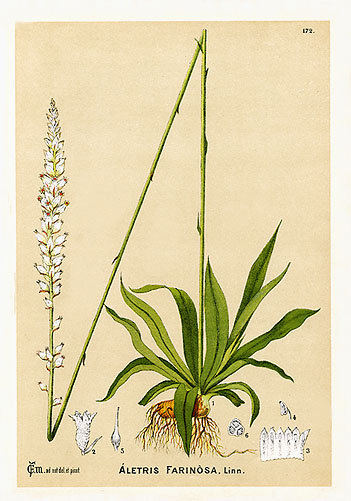
I had been expecting to find the aletris about New Bedford,
and when taking our luncheon on this neck what should I see rising above the luncheon-box, between me and R., but what I knew must be the Aletris farinosa; not yet out, but one near by would open apparently in two or three days.

Heard of, and sought out, the hut of Martha Simons, the only pure-blooded Indian left about New Bedford. She lives alone on the narrowest point of the Neck, near the shore, in sight of New Bedford. Her hut stands some twenty-five rods from the road on a small tract of Indian land, now wholly hers . . .

We knocked and walked in, and she asked us to sit down. She had half an acre of the real tawny Indian face, broad with high cheek-bones, black eyes, and straight hair, originally black but now a little gray, parted in the middle. Her hands were several shades darker han her face. She had a peculiarly vacant expression, perhaps characteristic of the Indian, and answered our questions listlessly, without being interested or implicated, mostly in monosyllables, as if hardly present there. To judge from her physiognomy, she might have been King Philip’s own daughter.


She was born on that spot. Her grandfather also lived on the same spot, though not in the same house. He was the last of her race who could speak Indian.

The question she answered with most interest was, “What do you call that plant?” and I reached her the aletris from my hat. She took it, looked at it a moment, and said, “That’s husk-root. It ’s good to put into bitters for a weak stomach.” 

The last year’s light-colored and withered leaves surround the present green star like a husk. This must be the origin of the name. Its root is described as intensely bitter. 

I ought to have had my hat full of plants.

H. D. Thoreau, Journal, June 26, 1856

Savannah sparrow no conspicuous yellow on shoulder, a yellow brow, and white crown line. . . Audubon says that the eggs “are of a pale bluish color, softly mottled with purplish brown,”  See ; April 22, 1856 ("The seringo also sits on a post, with a very distinct yellow line over the eye,_and the rhythm of its strain is ker chick | ker che | ker-char—r-r-r-r | chick, the last two bars being the part chiefly heard."); 
May 28, 1856 ("A seringo or yellow-browed (?) sparrow’s nest . . . Egg, bluish-white ground, thickly blotched with brown.”); July 16, 1854 ("Is it the yellow-winged or Savannah sparrow with yellow alternating with dark streaks on throat, as well as yellow over eye, reddish flesh-colored legs, and two light bars on wings?";) October 22, 1855 ("I sit on a bank at the brook crossing, beyond the grove, to watch a flock of seringos, perhaps Savannah sparrows, which, with some F. hyemalis and other sparrows, are actively flitting about amid the alders and dogwood. ") See also Guide to Thoreau’s Birds "(Thoreau frequently called the Savannah Sparrow Passerculus sandwichensis the seringo or seringo-bird, but he also applied the name to other small birds.)” and  A Book of the Seasons, by Henry Thoreau, The Savannah Sparrow (Fringilla savanna)

I had been expecting to find the aletris about New Bedford. . . See June 25 1856 ( “[i]n answer to my question what were the rare or peculiar plants thereabouts, [Green] named the Aletris farinosa, or star-grass”); See also November 4, 1858 ("We cannot see any thing until we are possessed with the idea of it, . . . In my botanical rambles I find that first the idea, or image, of a plant occupies my thoughts, . . . expecting it unconsciously, and at length I surely see it . . . This is the history of my finding a score or more of rare plants which I could name.”)

Aletris / husk root . . .withered leaves surround the present green star like a husk. See April 5, 1857 ("See in many places the withered leaves of the aletris in rather low ground, about the still standing withered stems. It was well called husk-root by the squaw.")

I ought to have had my hat full of plants. See June 23, 1852 ("I am inclined to think that my hat, whose lining is gathered in midway so as to make a shelf, is about as good a botany-box as I could have and far more convenient. . ."); September 7, 1852 ("We reach . . . Concord . . . four hours from the time we were picking blueberries on the mountain, with the plants of the mountain fresh in my hat.”); December 4, 1856 ("About half a dozen years ago I found myself again attending to plants with more method, looking out the name of each one and remembering it. I began to bring them home in my hat, a straw one with a scaffold lining to it, which I called my botany- box. I never used any other, and when some whom I visited were evidently surprised at its dilapidated look, as I deposited it on their front entry table, I assured them it was not so much my hat as my botany-box.”)
Heard of and sought out 
the hut of Martha Simons,
the last of her race
She named the plant in 
my hat,  I ought to have had 
my hat full of plants.

Saturday, May 28, 2016

In Painted-Cup Meadow.

May 28 

Rainy. To Painted-Cup Meadow. 

Potentilla argentea, maybe several days. 


Trifolium pratense.

A seringo or yellow-browed (?) sparrow’s nest about ten or twelve rods southwest of house-leek rock, between two rocks which are several rods apart northwest and southeast; four eggs. The nest of coarse grass stubble, lined with fine grass, and is two thirds at least covered by a jutting sod. Egg, bluish-white ground, thickly blotched with brown, yet most like a small ground bird’s egg, rather broad at one end, pretty fresh.

A cricket creaks. 

Hypoxis erecta, maybe a day or two. 

Thalictrum dioicum [early meadow-rue]abundantly out, apparently in prime, male and female, some effete, perhaps a week, near wall in Painted-Cup Meadow, fifteen to eighteen inches high. I think it was a mass of young Thalictrum Cornuti leaves which had that rank, dog-like scent.

Painted-cup pollen a good while ago. 

Saw, under an apple tree, nearly half a pint of some white grub with a light reddish head, like a small potato-worm, one inch long, and part of a snake-skin, making the greater part of the faeces of some animal, — chiefly the grubs, — a formless soft mass. Skunk?

H. D. Thoreau, Journal, May 28, 1856

May 28, 2026

Painted-Cup Meadow. See May 29, 1856 ("What a flowery place, a vale of Enna, is that  meadow! Painted Cup, Erigeron bellidifolius, Thalictrum dioicum, Viola Muhlenbergii, fringed polygala, buck-bean, pedicularis, orobanche, etc., etc. Where you find a rare flower, expect to find more rare ones”) June 3, 1853 (“A large meadow full of [painted-cup], and yet very few in the town have ever seen it.”);

Trifolium pratense. See May 28, 1854 ("Red clover at Clamshell, a day or two.”) 

A seringo or yellow-browed (?) sparrow’s nest . . . Egg, bluish-white ground, thickly blotched with brown. See April 22, 1856 ("The seringo . . . with a very distinct yellow line over the eye,_and the rhythm of its strain is ker chick | ker che | ker-char—r-r-r-r | chick, the last two bars being the part chiefly heard."); June 26, 1856 ("Saw, apparently, the F. Savanna near their nests (my seringo note), restlessly flitting about me from rock to rock within a rod. Distinctly yellow-browed and spotted breast . . . Audubon says that the eggs of the Savannah sparrow “are of a pale bluish color, softly mottled with purplish brown,”. . . apparently my seringo’s egg of  May 28th.”); See also Guide to Thoreau’s Birds ("Thoreau frequently called the Savannah Sparrow . . .  the seringo or seringo-bird, but he also applied the name to other small birds.")

 A cricket creaks. See  May 22, 1854 ("First observe the creak of crickets . . . Their strain is unvaried as Truth. Only in their saner moments do men hear the crickets.");  May 24, 1857 ("Hear the first cricket as I go through a warm hollow, bringing round the summer with his everlasting strain"); May 26, 1852 ("To-night I hear many crickets. They have commenced their song. They bring in the summer"); May 27, 1859 (" A peculiarity of these days is the first hearing of the crickets' creak, suggesting philosophy and thought. No greater event transpires now."); May 30, 1855 ("Is it not summer now when the creak of the crickets begins to be general?") See also A Book of the Seasons, by Henry Thoreau, The Cricket in Spring

Hypoxis erecta, maybe a day or two. See  June 15, 1851 ("The Hypoxis erecta, yellow Bethlehem-star, where there is a thick, wiry grass in open path; should be called yellow-eyed grass, methinks."); A Book of the Seasons, by Henry Thoreau, Yellow Bethlehem-star

Thalictrum dioicum abundantly out, apparently in prime, male and female, some effete. See May 15, 1858 ("Thalictrum dioicum abundant, apparently in prime; how long? It is a very interesting, graceful, and delicate plant, especially the sterile, with its pretty, commonly purple, petal-like sepals, and its conspicuous long yellow anthers in little bare clusters (?), trembling over the meadow.")

I think it was a mass of young Thalictrum Cornuti leaves which had that rank, dog-like scent. See May 29, 1856 ("To return to Painted-Cup Meadow, I do not perceive the rank odor of Thalictrum Cornuti expanding leaves to-day. How more than fugacious it is! Evidently this odor is emitted only at particular times.")

Painted-cup pollen a good while ago. See May 8, 1853 ("Surprised by the brilliant pale scarlet flowers of the painted-cup (Castilleja coccinea) just coming into bloom . . .the most high-colored and brilliant flower yet, not excepting the columbine . . . It is all the more interesting for being a painted leaf and not petal . . . It is a flaming leaf. The very leaf has flowered; not the ripe tints of autumn, but the rose in the cheek of infancy; a more positive flowering."); May 29, 1856 ("Found a painted-cup with more yellow than usual in it, and at length Edith found one perfectly yellow.”) June 3, 1853 ("The painted-cup is in its prime. It reddens the meadow, – Painted-Cup Meadow. It is a splendid show of brilliant scarlet. . . might be called flame-flower, or scarlet-tip. Here is a large meadow full of it, and yet very few in the town have ever seen it") [Scarlet painted-cup (Castilleja coccinea) is an annual herb that is hemiparasitic . . . formerly found in several New England states, but is now apparently restricted to Connecticut, where only a small handful of populations remain. GoBotany]

The faeces of some animal. . . Skunk? See  January 24, 1860 ("The droppings of a skunk left on a rock, perhaps at the beginning of winter, were full of grasshoppers' legs.");  March 28, 1855 (" I see where a skunk (apparently) has been probing the sod. . . I dig up there a frozen and dead white grub, the large potato grub; this I think he was after.");   April 15, 1856 ("Near the water are many recent skunk probings, as if a drove of pigs had passed along last night, death to many beetles and grubs."); May 4, 1855 ("See where a skunk has probed last night, and large black dung with apparently large ants’ heads and earth or sand and stubble or insects’ wings in it; probably had been probing a large ants’ hill") See also A Book of the Seasons,  by Henry Thoreau, The Skunk

May 28. See A Book of the Seasons, by Henry Thoreau, May 28

A Book of the Seasons,  by Henry Thoreau
"A book, each page written in its own season,
out-of-doors, in its own locality."
 ~edited, assembled and rewritten by zphx ©  2009-2026

Friday, April 22, 2016

Sailing with an umbrella: It is highly important to invent a dress which will enable us to be abroad with impunity in the severest storms.

April 22

It has rained two days and nights, and now the sun breaks out, but the wind is still easterly, and the storm probably is not over. In a few minutes the air is full of mizzling rain again. 

8 A. M. —Go to my boat opposite Bittern Cliff. 

Monroe’s larches by river will apparently shed pollen soon. The staminate flowers look forward, but the pistil late scarcely show any red. 

There is snow still (of the winter) in the hollows where sand has been dug on the hillside east of Clamshell. 

Going through Hubbard’s root-fence field, see a pigeon woodpecker on a fence post. He shows his lighter back between his wings cassock-like and like the smaller woodpeckers. Joins his mate on a tree and utters the wooing note o-week o-week, etc. 

The seringo also sits on a post, with a very distinct yellow line over the eye,_and the rhythm of its strain is ker chick | ker che |  ker-char—r-r-r-r | chick, the last two bars being the part chiefly heard. 

The huckleberry buds are much swollen. 

I see the tracks of some animal which has passed over Potter’s sand, perhaps a skunk. They are quite distinct, the ground being smoothed and softened by rain. The tracks of all animals are much more distinct at such a time. 

By the path, and in the sandy field beyond, are many of those star-fingered puffballs. I think they must be those which are so white, like pigeons’ eggs, in the fall, the thick, leathery rind bursting into eight to eleven segments, like those of a boy’s batting ball, and curving back. They are very pretty and remarkable now, sprinkled over the sand, smooth and plump on account of the rain. (I find some beyond at Mountain Sumach Knoll, smaller with a very thin rind and more turned back, a different species plainly.) The inside of the rind, which is uppermost, approaches a chocolate-color; the puffball is a rough dirty or brownish white; the dust which does not fly now at any rate is chocolate-colored. Seeing these thus open, I should know there had been wet weather. 

The mountain sumach berries have no redness now, though the smooth sumach berries have. Its twigs are slender and so have a small pith. Its heart-wood is not yellow, like the smooth and the dogwood, but green. Its bark is more gray than that of the smooth, which last, when wet, is slightly reddish. Its bark sap or juice is not yellow like that of the smooth, and is slower to harden. 

Some hellebore leaves are opened in the Cliff Brook Swamp. 

My boat is half full of water. 

There are myriads of snow-fleas in the water amid the bushes, apparently washed out of the bark by the rain and rise of river. I push up-stream to Lee’s Cliff, behind Goodwin, who is after musquash. 

Many suckers and one perch have washed up on the Conantum shore, the wind being southeasterly. I do not detect any wound. Their eyes are white, -- it would be worth while to see how long before this happens, —and they appear to have been dead some time; their fins are worn, and they are are slimy. I cut open a sucker, and it looked rather yellow within. I also see sometimes their bladders washed up. They float on their backs. When cut open they sink, but the double bladder is uppermost and protruded as far as possible. Saw some pieces of a sucker recently dropped by some bird or beast, eight or ten rods from the shore. 

Much root and leaf-bud washed up. 

A gull. 

Very perfect and handsome clamshells, recently opened by the musquash, i. e. during the storm, lie on the meadow and the hillside just above water-mark. They are especially handsome because wet by the rain. 

I buy a male muskrat of Goodwin, just killed. He sometimes baits his mink-traps with muskrat; always with some animal food. The musquash does not eat this, though he sometimes treads on the trap and is caught. 

It rains hard and steadily again, and I sail before it.

Now I see many more ducks than in all that fair weather, — sheldrakes, etc. 

A marsh hawk, in the midst of the rain, is skimming along the shore of the meadow, close to the ground, and, though not more than thirty rods, I repeatedly lose sight of it, it is so nearly the color of the hillside beyond. It is looking for frogs. 

The small slate-colored hawk which I have called pigeon hawk darts away from a bushy island in the meadow. 

The muskrat, which I bought for twelve cents, weighs three pounds, six ounces. Goodwin thought that some would weigh a half to three quarters of a pound more than this; I think a pound more. Thought this was a young one of last year, — judged by the tail, —and that they hardly came to their growth in one year. Extreme length, twenty—three inches; length of bare tail, nine inches; breadth of tail, seven eighths of an inch; breadth of body, etc., as it lies, six and a half. An oval body, dark-brown above (black in some lights, the coarse wind hairs aft), reddish-brown beneath. Thus far the color of the hair. The fur within slate-color. Tail black; feet a delicate glossy dark slate (?), with white nails. The hind feet half webbed, and their sides and toes fringed thickly with stiff hair, apparently to catch water; ears (the head is wet and bruised), partly concealed in the fur, short and round; long black mustachial bristles; fore legs, quite short, more like hands; hind ones, about three inches without the line of the body’s fur and hair. Tail, on the skin, is a little curved downwards. 

The star fungi, as they dried in my chamber in the course of two or three hours, drew in the fingers. The different segments curled back tightly upon the central puff, the points being strongly curled downward into the middle dimple-wise. It requires wet weather, then, to expand and display them to advantage. They are hygrometers. 

Their coat seems to be composed of two thicknesses of different material and quality, and I should guess that the inside chocolate-colored had a great affinity for moisture and, being saturated with it, swelled, and so necessarily burst off and turned back, and perchance the outside dirty-white or pale-brown one expands with dryness. 

A single male sheldrake rose from amid the alders against Holden Swamp Woods, as I was sailing down in angles across my course, only four or five rods from me and a foot or two above the water, finally circling round into my rear. 

Soon after I turned about in Fair Haven Pond, it began to rain hard. The wind was but little south of east and therefore not very favorable for my voyage. I raised my sail and, cowering under my umbrella in the stern, wearing the umbrella like a cap and holding the handle between my knees, I steered and paddled, almost perfectly sheltered from the heavy rain. Yet my legs and arms were a little exposed sometimes, in my endeavors to keep well to windward so as to double certain capes ahead. For the wind occasionally drove me on to the western shore. 

From time to time, from under my umbrella, I could see the ducks spinning away before me, like great bees. For when they are flying low directly from you, you see hardly anything but their vanishing dark bodies, while the rapidly moving wings or paddles, seen edgewise, are almost invisible. 

At length, when the river turned more easterly, I was obliged to take down my sail and paddle slowly in the face of the rain, for the most part not seeing my course, with the umbrella slanted before me. But, though my progress was slow and laborious, and at length I began to get a little wet, I enjoyed the adventure because it combined to some extent the advantages of being at home in my chamber and abroad in the storm at the same time. 

It is highly important to invent a dress which will enable us to be abroad with impunity in the severest storms. We cannot be said to have fully invented clothing yet. In the meanwhile the rain-water collects in the boat, and you must sit with your feet curled up on a paddle, and you expose yourself in taking down your mast and raising it again at the bridges. 

These rain-storms -- this is the third day of one -- characterize the season, and belong rather to winter than to summer. Flowers delay their blossoming, birds tarry in their migrations, etc., etc. It is surprising how so many tender organizations of flowers and insects survive them uninjured. 

The muskrat must do its swimming chiefly with its hind feet. They are similar in form and position to those of the sheldrake. Its broad oval and flattish body, too, must help keep it up. 

Those star puffballs which had closed up in my chamber, put into water, opened again in a few hours. 

What is that little bodkin-shaped bulb which I found washed up on the edge of the meadow, white with a few  small greenish rounded leafets? 

On the 19th, when setting out one of those over cup oaks in Sleepy Hollow, digging at the decayed stump of an apple tree, we disturbed, dug up, a toad, which probably had buried itself there last fall and had not yet come out.

H. D. Thoreau, Journal, April 22, 1856

Monroe’s larches by river will apparently shed pollen soon. The staminate flowers look forward, but the pistil late scarcely show any red. See April 26, 1856 (“ Monroe’s larch will [shed pollen], apparently, by day after to-morrow.”); April 27, 1856 (" I find none of Monroe’s larch buds shedding pollen, but the anthers look crimson and yellow, and the female flowers are now fully expanded and very pretty, but small. I think it will first scatter pollen to-morrow.”); April 29, 1855 ( A few of the cones within reach on F. Monroe’s larches shed pollen; say, then, yesterday. The crimson female flowers are now handsome but small. “);April 29, 1856 ("Monroe’s larch staminate buds have now erected and separated their anthers, and they look somewhat withered, as if they had shed a part of their pollen. If so, they began yesterday.”)

You expose yourself in taking down your mast and raising it again at the bridges.  See April 17, 1856 ("I make haste to take down my sail at the bridges, but at the stone arches forgot my umbrella, which was un avoidably crushed in part. ")

A marsh hawk . . . looking for frogs . See April 8, 1856  ("marsh hawks circling low shows that frogs must be out.”); April 5, 1854 ("These days, when a soft west or southwest wind blows and it is truly warm, and an outside coat is oppressive, — these bring out the butterflies and the frogs, and the marsh hawks which prey on the last.”); 
 April 19, 1858 ("He skims along exactly over the edge of the water, on the meadowy side, not more than three or four feet from the ground and winding with the shore, looking for frogs, for in such a tortuous line do the frogs sit.") See also A Book of the Seasons, by Henry Thoreau,  the Marsh Hawk

It is highly important to invent a dress which will enable us to be abroad with impunity in the severest storms. See February 15, 1857 (“Never under take to ascend a mountain or thread a wilderness where there is any danger of being lost, without taking thick clothing, partly india-rubber, if not a tent or material for one; the best map to be had and a compass. . .”); February 28, 1852 (“To get the value of the storm we must be out a long time and travel far in it, so that it may fairly penetrate our skin, . . . and there be no part in us but is wet or weather beaten, - so that we become storm men instead of fair weather men.”); November 6, 1851 ("I had on my  bad-weather clothes” at Quebec like Olaf Trygvesson, the Northman, when he went to Thing in England.")

I buy a male muskrat of Goodwin . . .The hind feet half webbed, and their sides and toes fringed thickly with stiff hair. See  April 7, 1856 ("We see Goodwin skinning the muskrats he killed this forenoon . . .Their hind legs are half-webbed, the fore legs not at all.") See also A Book of the Seasons,  by Henry Thoreau, the Musquash

It has rained two days and nights . . . the wind is still easterly, and the storm probably is not over . . . These rain-storms . . . characterize 'the season. See April 22, 1852 ("It still rains . . . This makes five stormy days. Sunday, Monday, Tuesday, Wednesday, Thursday"); April 4, 1853 ("Rain, rain . . . A warm, dripping rain, heard on one's umbrella as on a snug roof . . .We never feel so comfortable as when we are abroad in a storm."); April 1, 1854 ("This rainy and truly April day  . . . April has begun like itself. It is warm and showery”);.April 1, 1855 ("The month comes in true to its reputation . . . a strong, steady, and rather warm rain. ");April 20, 1856 ("Rain, rain, rain, — a northeast storm. "); April 17, 1857 (" It rains about every other day now for a fortnight past.”);  April 20, 1858 ("Rain-storm begins, with hail.");April 22, 1859 ("This afternoon there is an east wind, and a rain-storm accordingly beginning, the eighth of the kind with this wind.");  April 26, 1859 ("This is the last of the rains (spring rains !) which invariably followed an east wind."); April 16, 1860 ("April rain, dripping and soaking into the earth and heard on the roof.)

April 22. See A Book of the Seasons,  by Henry Thoreau, April 22

Days-long rain-storms now
characterize the season –
this, the third storm day.

A Book of the Seasons,  by Henry Thoreau
"A book, each page written in its own season,
out-of-doors, in its own locality.”
~edited, assembled and rewritten by zphx © 2009-2026

https://tinyurl.com/hdt-560422


* * * 


Tonight, April 22, we leave the dogs behind around 6 o'clock and climb straight up behind the house to the logging road that connects to the red trail over the ridge down the red trail towards the wetland turn right at the big tree and there is that pile of scat still there. 

She says she wishes she had something to take it home and I reach in my back pocket ( I'm wearing shorts) and serendipity have a blue latex glove and  a plastic bag from an old Subway sandwich. (She collects the scat I put it in the cargo pocket of my shorts and hand it to her when we got home a little before 9:30.)

We detour into the wetland she gets very excited there is lots of Sphagum moss and a pit of mud where some animal has been digging. 

I discover part of the shell and skeleton of a snapping turtle. 

Surprisingly we are able to walk on the tufts of grass and mossy fallen logs without getting wet although there is a great deal of water all around.


Discover part of 
the shell and skeleton of 
a snapping turtle.

zphx April 22, 2016

Popular Posts Last 30 Days.

The week ahead in Henry’s journal

The week ahead in Henry’s journal
A journal, a book that shall contain a record of all your joy.
"A stone fruit. Each one yields me a thought." ~ H. D. Thoreau, March 28, 1859


I sit on this rock
wrestling with the melody
that possesses me.