Showing posts with label bay-wing. Show all posts

Friday, April 23, 2021

Think I hear bay-wings.


April 23.

April 23, 2021

Think I hear bay-wings.

Toads ring.

H. D Thoreau, Journal, April 23, 1861


Think I hear bay-wings. See  note to April 15, 1859 ("The bay-wing now sings — the first I have been able to hear . . .When the laborer rests on his spade to-day, the sun having just come out, he is not left wholly to the mercy of his thoughts, nature is not a mere void to him, but he can hardly fail to hear the pleasing and encouraging notes of some newly arrived bird. The strain of the grass finch is very likely to fall on his ear and convince him, whether he is conscious of it or not, that the world is beautiful and life a fair enterprise to engage in ") See also A Book of the Seasons, by Henry Thoreau, the Bay-Wing Sparrow

Toads ring. See  April 23, 1858 ("The toads ring now by day, but not very loud nor generally"); See also A Book of the Seasons, by Henry Thoreau: The Ring of Toads

Saturday, October 3, 2020

Bay-wings about. Sparrows in flocks.


October 3

See Vanessa Antiopa.

The hard frost of September 28th, 29th, and 30th, and especially of October 1st, has suddenly killed, crisped, and caused to fall a great many leaves of ash, hickory, etc., etc. These ( and the locusts generally ) look shrivelled and hoary, and of course they will not ripen or be bright. They are killed and withered green, — all the more tender leaves. Has killed all the burdock flowers and no doubt many others.

Sam Barrett says that last May he waded across the Assabet River on the old dam in front of his house with out going over his india - rubber boots, which are sixteen and a half inches high. I do not believe you could have done better than this a hundred years ago, or before the canal dam was built.

Bay-wings about.

I have seen and heard sparrows in flocks, more as if flitting by, within a week, or since the frosts began.

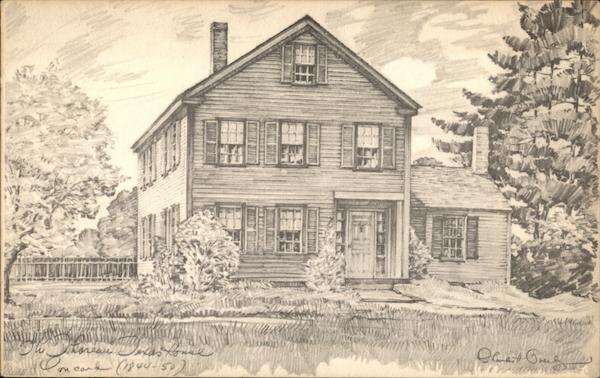
Gathered to-day my apples at the Texas house. I set out the trees, fourteen of them fourteen years ago and five of them several years later, and I now get between ten and eleven barrels of apples from them.

“Texas” House
(Thoreau Family Residence, 1844-1850)

H. D. Thoreau, Journal, October 3, 1860

See Vanessa Antiopa. See . April 17, 1860 (“It is unexpectedly very warm on lee side of hilltop just laid bare and covered with dry leaves and twigs. See my first Vanessa Antiopa”); October 1, 1860.(“C. saw the first Vanessa Antiopa since spring.”) See also A Book of the Seasons,  by Henry Thoreau, the Buff-edged Butterfly

The hard frost of September 28th, 29th, and 30th, and especially of October 1st. See October 1, 1860 ("Remarkable frost and ice this morning . . . I do not remember such cold at this season.").”); Compare October 3, 1856 (“The frost keeps off remarkably .” )

Sam Barrett says that last May he waded across the Assabet River on the old dam. See August 17, 1858 (“Being overtaken by a shower, we took refuge in the basement of Sam Barrett’s sawmill, where we spent an hour, and at length came home with a rainbow over arching the road before us”)

Bay-wings about. See April 15, 1859 (“The bay-wing now sings — the first I have been able to hear — . . . about the Texas house ”); October 9, 1858 (“Bay-wings flit along road.”); October 11, 1856 (“Bay-wing sparrows numerous.”); October 12, 1859 (“ I see scattered flocks of bay-wings amid the weeds and on the fences.”); October 16, 1855 ("I look at a grass-bird on a wall in the dry Great Fields. There is a dirty-white or cream-colored line above the eye and another from the angle of the mouth beneath it and a white ring close about the eye. The breast is streaked with this creamy white and dark brown in streams, as on the cover of a book.") See also A Book of the Seasons, by Henry Thoreau, the Bay-Wing Sparrow

I have seen and heard sparrows in flocks within a week. See September 17, 1858 (“Methinks, too, that there are more sparrows in flocks now about in garden”);  September 23, 1851 ("I scare up large flocks of sparrows in the garden.");September 26, 1858 (“Now is the time, too, when flocks of sparrows begin to scour over the weedy fields,”); September 27, 1858 ("What are those little birds in flocks in the garden and on the peach trees these mornings, about size of chip-birds, without distinct chestnut crowns?”); October 2, 1858 ("The garden is alive with migrating sparrows these mornings."); October 5, 1858 (“I still see large flocks, apparently of chip birds, on the weeds and ground in the yard.”); October 10, 1853 ("There are . . . large flocks of small sparrows,  which make a business of washing and pruning themselves in the puddles in the road, as if cleaning up after a long flight and the wind of yesterday.”)

October 3. See A Book of the Seasons, by Henry Thoreau,  October 3
See sparrows in flocks 
and have heard more flitting by 
since the frosts began.

A Book of the Seasons, by Henry Thoreau
"A book, each page written in its own season,
out-of-doors, in its own locality."
~edited, assembled and rewritten by zphx © 2009-2025
 

Saturday, October 12, 2019

We have now fairly begun to be surrounded with the brown of withered foliage.

October 12

P. M. — To Hubbard's Close. 

October 12, 2019

The common goldenrods on railroad causeway have begun to look hoary or gray, the down showing itself, — that November feature. 

I see scattered flocks of bay-wings amid the weeds and on the fences. 

There are now apparently very few ferns left (except the evergreen ones), and those are in sheltered places. This morning's frost will nearly finish them. 

Now for lycopodiums (the dendroideum not yet apparently in bloom), the dendroideum and lucidulum, etc., — how vivid a green ! — lifting their heads above the moist fallen leaves. 

We have now fairly begun to be surrounded with the brown of withered foliage, since the young white oaks have withered. This phenomenon begins with the very earliest frost (as this year August 17th), which kills some ferns and other most sensitive plants; and so gradually the plants, or their leaves, are killed and withered that we scarcely notice it till we are surrounded with the scenery of November.

I see quinces commonly left out yet, though apples are gathered. Probably their downy coats defend them.

October 12, 2022
(Avesong)

Going through Clintonia Swamp, I see many of those buff-brown puffballs one to two inches [in] diameter on the ground, partly open and with water in them and partly entire as yet, with a cracked surface. 

The willows on the Turnpike resound with the hum of bees, almost as in spring! I see apparently yellow wasps, hornets, and small bees attracted by something on their twigs.

H. D. Thoreau, Journal, October 12, 1859

The common goldenrods on railroad causeway have begun to look hoary or gray. See October 6, 1858 ("Most S. nemoralis, and most other goldenrods, now look hoary, killed by frost. The corn stands bleached and faded — quite white in the twilight"); October 8, 1856 ("S. nemoralis, done, many hoary, though a very few flowers linger.");  November 10, 1858 ("Aa new season begins, the pure November season of the russet earth and withered leaf and bare twigs and hoary withered goldenrods.")

I see scattered flocks of bay-wings amid the weeds and on the fences.  See April 15, 1859 (“The bay-wing now sings — the first I have been able to hear ”); October 9, 1858 (“Bay-wings flit along road.”); October 11, 1856 ("Bay-wing sparrows numerous"); ;October 12, 1859 ("I see scattered flocks of bay-wings amid the weeds and on the fences.") October 16, 1855 ("I look at a grass-bird on a wall in the dry Great Fields. There is a dirty-white or cream-colored line above the eye and another from the angle of the mouth beneath it and a white ring close about the eye. The breast is streaked with this creamy white and dark brown in streams, as on the cover of a book.") See also A Book of the Seasons, by Henry Thoreau, the Bay-Wing Sparrow

Now for lycopodiums — how vivid a green ! — lifting their heads above the moist fallen leaves.  See October 17, 1857 ("The Lycopodium lucidulum looks suddenly greener amid the withered leaves."); November 17, 1858 (" Lycopodium dendroideum . . .was apparently in its prime yesterdayy . . . So it would seem that these lycopodiums, at least, which have their habitat on the forest floor and but lately attracted my attention there (since the withered leaves fell around them and revealed them by the contrast of their color and they emerged from obscurity), —it would seem that they at the same time attained to their prime, their flowering season. It was coincident with this prominence.") See also A Book of the Seasons,  by Henry Thoreau, The Lycopodiums

Going through Clintonia Swamp, I see many of those buff-brown puffballs. See October 5, 1856 ("In the huckleberry pasture, by the fence of old barn boards, I notice many little pale-brown dome-shaped (puckered to a centre beneath) puff-balls, which emit their dust. When you pinch them, a smoke-like brown dust (snuff-colored) issues from the orifice at their top, just like smoke from a chimney. It is so fine and light that it rises into the air and is wafted away like smoke. They are low Oriental domes or mosques. Sometimes crowded together in nests, like a collection of humble cottages on the moor, in the coal pit or Numidian style; for there is suggested some humble hearth beneath, from which this smoke comes up, as it were the homes of slugs and crickets.")

The willows on the Turnpike resound with the hum of bees, almost as in spring! I see apparently yellow wasps, hornets, and small bees attracted by something on their twigs. See October 12, 1856 ("It is interesting to see how some of the few flowers which still linger are frequented by bees and other insects. . . [I]n the garden, I see half a dozen honey bees, many more flies, some wasps, a grasshopper, and a large handsome butterfly, . . . I did not suspect such a congregation in the desolate garden")

Monday, April 15, 2019

The bay-wing now sings.


April 15. 

Ground white with snow this morning, but it melts in a few hours, and, the sun coming out, I observe, after it is gone, much bluish vapor curling up from plowed ground, looking like a smoke there, but not from ground not recently plowed or from grass ground. 

Is it that the plowed ground is warmer, or merely that it has absorbed more moisture? Perhaps the sun penetrates it and so warms it more, since it lies up lighter. It is a very noticeable phenomenon, at any rate, that only the ground just plowed thus smokes. 

P. M. — To Cliffs and Well Meadow. 

There is quite a shimmer in the air, the day being pretty warm, but methinks it is a little greater over plowed ground than over sod, but I see it in woods as high as the tree-tops. M. [?] Pratt refers it chiefly to heat, as about a stove, and thinks I should [see] the most over the driest sand, and it occurs to me that if it is chiefly owing to evaporation I ought to see considerable over water, but I believe that I do not. 

Carpenter refers it (in part, at least) to the exhalation of plants, but they are not now exhaling, — not leafed or leafing as yet. I am uncertain, therefore, whether to regard [sic] the earliest shimmer in the spring, on pleasant days, to heated air in motion or to vapor raised by heat into the air. (Vide back to April 10th.) 

I see and hear white-bellied swallows as they are zigzagging through the air with their loud and lively notes. I am pretty sure it was these and not the martin I heard on the 13th. 

The bay-wing now sings — the first I have been able to hear — both about the Texas house and the fields this side of Hayden's, both of them similar dry and open pastures. I heard it just before noon, when the sun began to come out, and at 3 p. m., singing loud and clear and incessantly. It sings with a pleasing deliberation, contrasting with the spring vivacity of the song sparrow, whose song many would confound it with. It comes to revive with its song the dry up lands and pastures and grass-fields about the skirts of villages. 

Only think how finely our life is furnished in all its details, — sweet wild birds provided to fill its interstices with song! It is provided that while we are employed in our corporeal, or intellectual, or other, exercises we shall be lulled and amused or cheered by the singing of birds. 

When the laborer rests on his spade to-day, the sun having just come out, he is not left wholly to the mercy of his thoughts, nature is not a mere void to him, but he can hardly fail to hear the pleasing and encouraging notes of some newly arrived bird. The strain of the grass finch is very likely to fall on his ear and convince him, whether he is conscious of it or not, that the world is beautiful and life a fair enterprise to engage in. It will make him calm and contented. 

If you yield for a moment to the impressions of sense, you hear some bird giving expression to its happiness in a pleasant strain. We are provided with singing birds and with ears to hear them. What an institution that! 

Nor are we obliged to catch and cage them, nor to be bird-fanciers in the common sense. Whether a man's work be hard or easy, whether he be happy or unhappy, a bird is appointed to sing to a man while he is at his work. 

Consider how much is annually spent on the farmer's life: the beauty of his abode, which has inspired poets since the world was made; the hundreds of delicate and beautiful flowers scattered profusely under his feet and all around him, as he walks or drives his team afield, — he cannot put his spade into uncultivated, nor into much cultivated, ground without disturbing some of them; a hundred or two of equally beautiful birds to sing to him morning and evening, and some at noonday, a good part of the year; a perfect sky arched over him, a perfect carpet spread under him, etc., etc. ! 

And can the farmer speak or think carelessly of these gifts ? Will he find it in his heart to curse the flowers and shoot the birds? 

Hear a goldfinch, after a loud mewing on an apple tree, sing in a rich and varied way, as if imitating some other bird. 

Observe in the small shallow rills in the sandy road beyond the Smallpox Burying-Ground, made by the snow of the morning, now melted, very interesting ripples over a pebbly or uneven bottom on this side or that. 

The beauty of these little ripples was occasioned by their shadows amid the bright water. They were so arranged with remarkable order as to resemble the bright scales of a portion of a snake's skin with geometrical regularity, seven or eight parallel rows in a triangular form, successively diminishing in size. 

The ripple is occasioned merely by the impetuosity of the water meeting some slight obstacle. Thus you see in the very ripples on a rill a close resemblance in arrangement to the bright scales of a fish, and it [would] greatly help to conceal a fish if it could lie under them. The water was generally less than an inch deep on a sandy bottom. 

The warm pine woods are all alive this afternoon with the jingle of the pine warbler, the for the most part invisible minstrel. That wood, for example, at the Punk Oak, where we sit to hear it. It is surprising how quickly the earth, which was covered half an inch deep this morning, and since so wet, has become comparatively dry, so that we sit on the ground or on the dry leaves in woods at 3 p. m. and smell the pines and see and hear the flies, etc., buzz about, though the sun did not come out till 12 m. 

This morning, the aspect of winter; at mid-forenoon, the ground reeking with moisture; at 3 p. m., sit on dry leaves and hear the flies buzz and smell the pines! 

That wood is now very handsome seen from the westerly side, the sun falling far through it, though some trunks are wholly in shade. This warbler impresses me as if it were calling the trees to life. I think of springing twigs. Its jingle rings through the wood at short intervals, as if, like an electric shock, it imparted a fresh spring life to them. You hear the same bird, now here now there, as it incessantly flits about, commonly invisible and uttering its simple jingle on very different keys, and from time to time a companion is heard farther or nearer. 

This is a peculiarly summer-like sound. Go to a warm pine wood-side on a pleasant day at this season after storm, and hear it ring with the jingle of the pine warbler.

 As I sit on the stump of a large white pine which was sawed off, listening to these warblers, in a warm sun, I see a fair-weather cloud going over rather low, and hear the flies buzz about me, and it reminds me of those long-drawn summer days when you lie out-of-doors and are more related to the clouds travelling over. The summer clouds, the thunder-cloud especially, are nearer to us than the clouds of winter.

When we go huckleberrying, the clouds are our fellow-travellers, to greet or avoid. I might say the clouds have come. I perceive that I am in the same apartment with them. 

Going up a mountain is like travelling half a day through a tan-yard, till you get into a fog, and then, when the fog blows away, you discover yourself and a buzzing fly on the sunny mountain-top. 

The wood thrush! At Well Meadow Head. Not being prepared to hear it, I thought it a boy whistling at first. 

Also a catbird mews? [Could this have been a goldfinch?]

The epigaea opened, apparently, the 13th.

H. D. Thoreau, Journal, April 15, 1859

I see and hear white-bellied swallows as they are zigzagging through the air with their loud and lively notes. See April 15, 1855 ("Many martins (with white—bellied swallows) are skimming and twittering above the water, perhaps catching the small fuzzy gnats"); April 15, 1856 ("The white-bellied swallows are circling about and twittering above the apple trees and walnuts on the hillside.")

The bay-wing now sings. See April 13, 1856 ("I hear a bay-wing on the railroad fence sing, the rhythm somewhat like, char char (orhere here), che che, chip chip chip (fast), chitter chitter chitter chit (very fast and jingling), tchea tchea (jinglingly). It has another strain, considerably different, but a second also sings the above. Two on different posts are steadily singing the same.") ,May 12, 1857(" I hear from across the fields the note of the bay-wing, Come here here there there quick quick quick or I'm gone . . . and it instantly translates me from the sphere of my work and repairs all the world that we jointly inhabit. It reminds me of so many country afternoons and evenings when this bird's strain was heard far over the fields, as I pursued it from field to field. . .  As the bay-wing sang many a thousand years ago, so sang he to-night. In the beginning God heard his song and pronounced it good, and hence it has endured.. . . . [S]uddenly, in some fortunate moment, the voice of eternal wisdom reaches me even, in the strain of the sparrow, and liberates me, whets and clarifies my senses, makes me a competent witness."). See also A Book of the Seasons, by Henry Thoreau, the Bay-Wing Sparrow

The beauty of these little ripples was occasioned by their shadows amid the bright water. See March 26, 1860 ("The yellow sands of a lonely brook seen through the rippling water, with the shadows of the ripples like films passing over it.")

The wood thrush!  Probably the hermit thrush. See April 15, 1858 ("Saw flitting silently through the wood, near the yew, two or three thrushes, . . . a light ring about eyes, and whitish side of throat (?); rather fox-colored or cinnamon tail, with ashy reflections from edges of primaries; flesh-colored legs.").  See also  note to April 24, 1856 ("See a brown bird flit, and behold my hermit thrush, with one companion, flitting silently through the birches. I saw the fox-color on his tail-coverts, as well as the brown streaks on the breast.") See also A Book of the Seasons, by Henry Thoreau, Signs of Spring: The Arrival of the Hermit Thrush


The warm pine woods are all alive this afternoon with the jingle of the pine warbler, the for the most part invisible minstrel. See April 15, 1855 ( "In the meanwhile, as we steal through the woods, we hear the pleasing note of the pine warbler, bringing back warmer weather"); April 15, 1860 ("At Conantum pitch pines hear the first pine warbler") See also A Book of the Seasons, by Henry Thoreau, the Pine Warbler

April 15. See A Book of the Seasons,  by Henry Thoreau, April 15

Birdsong falling on
our ear convinces us that the
world is beautiful –

Calm and contentment
if you yield for a moment 
to sense impressions.

A Book of the Seasons, by Henry Thoreau,  The bay-wing now sings.
A Book of the Seasons, by Henry Thoreau
"A book, each page written in its own season,
out-of-doors, in its own locality.”
~edited, assembled and rewritten by zphx © 2009-2026

Monday, April 8, 2019

The gray bodkin-pointed willow

April 8. 

Friday. 

I believe that I rarely hear the nuthatch's note from the elms toward evening, for when I heard it yesterday evening I was surprised. 

P. M. — To epigaea and Well Meadow. 

I see on the west side of the railroad causeway a peculiar early willow, now just beginning to bloom with the common Salix discolor there, perhaps (as I remember) some thirty rods beyond the wall, against A. Wheeler's land.

The catkins (sterile) are peculiarly long and tapering, and grayish or mouse-color, beginning to open low on one side, while the points have comparatively little down on them. I find no description of it. Perhaps rather more than one inch long. The most decidedly opening first on one side near the base of any. Call it the gray bodkin-pointed. 

As I stood by the foot of a middling-sized white pine the other day, on Fair Haven Hill, one of the very windy days, I felt the ground rise and fall under my feet, being lifted by the roots of the pine, which was waving in the wind; so loosely are they planted. 

We have had two more windy days, this and yesterday, though less so than the previous ones. 

We have had, most of the time, during this windy weather for a month past, when the wind was northwest, those peculiar brushy clouds which look as if a little snow or rain was falling in the northwest, but they prove to be wind chiefly. It has not rained, I think, with the wind in that quarter. 

These windy days the sparrows resort to the pines and peach trees on the east side of our house for shelter, and there they sing all together, — tree sparrows, fox-colored sparrows, and song sparrows. The F. hyemalis with them do not sing so much of late. The first two are most commonly heard together, the fine canary like twitter of the tree sparrow appearing to ripen or swell from time to time into the clear, rich whistle of the fox-colored sparrow, so that most refer both notes to one bird. 

What a pitiful business is the fur trade, which has been pursued now for so many ages, for so many years by famous companies which enjoy a profitable mono poly and control a large portion of the earth's surface, unweariedly pursuing and ferreting out small animals by the aid of all the loafing class tempted by rum and money, that you may rob some little fellow-creature of its coat to adorn or thicken your own, that you may get a fashionable covering in which to hide your head, or a suitable robe in which to dispense justice to your fellow-men! Regarded from the philosopher's point of view, it is precisely on a level with rag and bone picking in the streets of the cities. The Indian led a more respectable life before he was tempted to debase himself so much by the white man. Think how many musquash and weasel skins the Hudson's Bay Company pile up annually in their warehouses, leaving the bare red carcasses on the banks of the streams throughout all British America, — and this it is, chiefly, which makes it British America. It is the place where Great Britain goes a-mousing. 

We have heard much of the wonderful intelligence of the beaver, but that regard for the beaver is all a pretense, and we would give more for a beaver hat than to preserve the intelligence of the whole race of beavers. When we see men and boys spend their time shooting and trapping musquash and mink, we cannot but have a poorer opinion of them, unless we thought meanly of them before. Yet the world is imposed on by the fame of the Hudson's Bay and Northwest Fur Companies, who are only so many partners more or less in the same sort of business, with thousands of just such loafing men and boys in their service to abet them. On the one side is the Hudson's Bay Company, on the other the company of scavengers who clear the sewers of Paris of their vermin. 

There is a good excuse for smoking out or poisoning rats which infest the house, but when they are as far off as Hudson's Bay, I think that we had better let them alone. To such an extent do time and distance, and our imaginations, consecrate at last not only the most ordinary, but even vilest pursuits. The efforts of legislation from time to time to stem the torrent are significant as showing that there is some sense and conscience left, but they are insignificant in their effects. We will fine Abner if he shoots a singing bird, but encourage the army of Abners that compose the Hudson's Bay Company. One of the most remarkable sources of profit opened to the Yankee within a year is the traffic in skunk- skins. I learn from the newspapers — as from other sources (vide Journal of Commerce in Tribune for April 5, 1859) — that "the traffic in skunk-skins has suddenly become a most important branch of the fur trade, and the skins of an animal which three years ago were deemed of no value whatever, are now in the greatest demand.”

"The principal markets are Russia and Turkey, though some are sent to Germany, where they are sold at a large profit." Furs to Russia ! " The black skins are valued the most, and during the past winter the market price has been as high as one dollar per skin, while mottled skins brought only seventy cents." "Upward of 50,000 of these skins have been shipped from this city [New York] alone within the past two months." Many of them "are designed for the Leipsic sales, Leipsic being next to Novgorod, in Russia, the most important fur entrepot in Europe. 

The first intimation received in this market of the value of this new description of fur came from the Hudson's Bay Company, which, having shipped a few to Lon don at a venture, found the returns so profitable that they immediately prosecuted the business on an extensive scale." "The heaviest collections are made in the Middle and Eastern States, in some parts of which the mania for capturing these animals seems to have equalled the Western Pike's Peak gold excitement, men, women, and children turning out en masse for that purpose." And beside, "our fur dealers also receive a considerable sum for the fat of these animals!!"

Almost all smile, or otherwise express their contempt, when they hear of this or the rat-catching of Paris, but what is the difference between catching and skinning the skunk and the mink? It is only in the name. 

When you pass the palace of one of the managers of the Hudson's Bay Company, you are reminded that so much he got for his rat-skins. In such a snarl and contamination do we live that it is almost impossible to keep one's skirts clean. Our sugar and cotton are stolen from the slave, and if we jump out of the fire, it is wont to be into the frying-pan at least. It will not do to be thoughtless with regard to any of our valuables or property. When you get to Europe you will meet the most tender-hearted and delicately bred lady, perhaps the President of the Antislavery Society, or of that for the encouragement of humanity to animals, marching or presiding with the scales from a tortoise's back — obtained by laying live coals on it to make them curl up — stuck in her hair, rat-skin fitting as close to her fingers as erst to the rat, and, for her cloak, trimmings perchance adorned with the spoils of a hundred skunks, — rendered inodorous, we trust. Poor misguided woman! Could she not wear other armor in the war of humanity? When a new country like North America is discovered, a few feeble efforts are made to Christianize the na tives before they are all exterminated, but they are not found to pay, in any sense. But the energetic traders of the discovering country organize themselves, or rather inevitably crystallize, into a vast rat-catching society, tempt the natives to become mere vermin-hunters and rum-drinkers, reserving half a continent for the field of their labors. Savage meets savage, and the white man's only distinction is that he is the chief. She says to the turtle basking on the shore of a dis tant isle, " I want your scales to adorn my head " (though fire be used to raise them); she whispers to the rats in the wall, " I want your skins to cover my delicate fingers;" and, meeting an army of a hundred skunks in her morning walk, she says, "worthless vermin, strip off your cloaks this instant, and let me have them to adorn my robe with;" and she comes home with her hands muffled in the pelt of a gray wolf that ventured abroad to find food for its young that day. When the question of the protection of birds comes up, the legislatures regard only a low use and never a high use; the best-disposed legislators employ one, perchance, only to examine their crops and see how many grubs or cherries they contain, and never to study their dispositions, or the beauty of their plumage, or listen and report on the sweetness of their song. The legislature will preserve a bird professedly not because it is a beautiful creature, but because it is a good scavenger or the like. This, at least, is the defense set up. It is as if the question were whether some celebrated singer of the human race — some Jenny Lind or an other — did more harm or good, should be destroyed, or not, and therefore a committee should be appointed, not to listen to her singing at all, but to examine the contents of her stomach and see if she devoured any thing which was injurious to the farmers and gardeners, or which they cannot spare.1 

Cold as it is, and has been for several weeks, in all exposed places, I find it unexpectedly warm in perfectly sheltered places where the sun shines. And so it always is in April. The cold wind from the northwest seems distinct and separable from the air here warmed by the sun, and when I sit in some warm and sheltered hollow in the woods, I feel the cold currents drop into it from time to time, just as they are seen to ripple a small lake in such a situation from time to time. 

The epigaea is not quite out. The earliest peculiarly woodland herbaceous flowers are epigaea, anemone, thalictrum, and — by the first of May — Viola pedata. These grow quite in the woods amid dry leaves, nor do they depend so much on water as the very earliest flowers. 

I am, perhaps, more surprised by the growth of the Viola pedata leaves, by the side of paths amid the shrub oaks and half covered with oak leaves, than by any other growth, the situation is so dry and the surrounding bushes so apparently lifeless.

I noticed the other day a leaf on a young oak very rapidly revolving like a windmill, in the wind, not around its midrib for an axis, but about its broken stem, and I saw that this was the way those curiously broken and twisted and splintered petioles were made. It went round so fast as almost to appear like a circular figure.

 I find that the cress (Cardamine hirmta) which was so forward at Well Meadow a fortnight ago has been almost entirely browsed off by some creature, so that, if I had not detected it, I might have been surprised that it made no more show. 

The skunk-cabbage leaf-buds, which have just begun to unroll, also have been extensively eaten off as they were yet rolled up like cigars. These early greens of the swamp are thus kept down. Is it by the rabbit? 

I could see the tracks of some animal, apparently as large, very indistinct in the mud and water. Also an early kind of sedge there was cropped. 

The only animals at all likely to have done this are rabbits, musquash, woodchuck (though I doubt if the last has been about here long enough), and geese. Of these, I think it most likely to have been the first, and probably it was the same that gnawed the spathes and ate up the spadix of the cabbage some weeks ago. Woodchucks might nibble some plants now in warmer and drier places. These earliest greens must be very acceptable to these animals. Do partridges ever eat these things ? 

The Alnus serrulata is evidently in its prime considerably later than the incana, for those of the former which I notice to-day have scarcely begun, while the latter chance to be done. The fertile flowers are an interesting bright crimson in the sun. 

C. says that he found a musquash's skull (which he showed me) at the fox-burrow in Laurel Glen, from which it would appear that they kill the musquash. 

See the first bay-wing hopping and flitting along the railroad bank, but hear no note as yet. 

I saw Heavy Haynes fishing for trout down the Mill Brook this morning, cold and blustering as it was. He caught two. He is splitting pine-knots at the alms house door for spearing. Has already been spearing in Walden, and got some pickerel, all in the two little meadows there, and saw some pouts and perch. So the pickerel have come into those meadows, probably since January, for the bars were dry before. Perhaps they lie in shallow water, not for warmth, — for it is coldest there by night now, — but for food, the early insects and frogs which may soonest be found there!

H. D. Thoreau, Journal, April 8, 1859

These windy days the sparrows resort to the pines and peach trees on the east side of our house for shelter, and there they sing all together, — tree sparrows, fox-colored sparrows, and song sparrows. See April 8, 1855 ("Also song sparrows and tree sparrows and F. hyemalis are heard in the yard. The fox-colored sparrow is also there”); and note to April 6, 1859 ("Tree sparrows, F. hyemalis, and fox-colored sparrows in company").  See also A Book of the Seasons, by Henry Thoreau, The Tree Sparrow;  A Book of the Seasons, by Henry Thoreau, the Fox-colored Sparrow;  A Book of the Seasons, by Henry Thoreau, the Dark-eyed Junco;   A Book of the Seasons, by  Henry Thoreau, the Song Sparrow (Fringilla melodia)

The first two are most commonly heard together so that most refer both notes to one bird.  See March 23, 1858 ("See a large flock of fox-colored sparrows flits by along an alder-row, uttering a faint chip like that of the tree sparrow.")  April 3, 1859 ("Their [fox-tailed sparrow's] note to-day is the chip much like a tree sparrow's")


Cold as it is, and has been for several weeks, in all exposed places, I find it unexpectedly warm in perfectly sheltered places where the sun shines. And so it always is in April. The cold wind from the northwest seems distinct and separable from the air here warmed by the sun. See April 13, 1855 ("A fair day, but a cool wind still, from the snow covered country in the northwest. It is, however, pleasant to sit in the sun in sheltered places."); April 26, 1857 ("How well adapted we are to our climate! In the winter we sit by fires in the house; in spring and fall, in sunny and sheltered nooks; in the summer, in shady and cool groves, or over water where the breeze circulates."); See also note to November 18, 1857 (“Now, as in the spring, we rejoice in sheltered and sunny places. ”)


The Alnus serrulata is evidently in its prime considerably later than the incana See April 8, 1855 ("I find also at length a single catkin of the Alnus incana, . . . Though I have looked widely, I have not found the alder out before."): See also A Book of the Seasons, by Henry Thoreau, The Alders

Tuesday, October 9, 2018

It is quite Novemberish.

October 9. 

Cold and northwest wind still. 

The maple swamps begin to look smoky, they are already so bare. Their fires, so faded, are pale-scarlet or pinkish. 

Some Cornus sericea looks quite greenish yet. 

Huckleberry leaves falling fast. 

I go to the Cliffs. 

The air is clear, with a cold northwest wind, and the trees beginning to be bare. 

The mountains are darker and distincter, and Walden, seen from this hill, darker blue. It is quite Novemberish. 

People are making haste to gather the remaining apples this cool evening.

Bay-wings flit along road. 

Crows fly over and caw at you now. 

Methinks hawks are more commonly seen now, — the slender marsh hawk for one. I see four or five in different places. 

I watch two marsh hawks which rise from the woods before me as I sit on the Cliff, at first plunging at each other, gradually lifting themselves as they come round in their gyrations, higher and higher, and floating toward the southeast. Slender dark motes they are at last, almost lost to sight, but every time they come round eastward I see the light of the westering sun reflected from the undersides of their wings. 

Those little bits of phosphorescent wood which I picked up on the 4th have glowed each evening since, but required wetting to get the most light out of them. This evening only one, about two inches long, shows any light. This was wet last evening, but is now apparently quite dry. If I should wet it again, it would, no doubt, glow again considerably.

H. D. Thoreau, Journal, October 9, 1858


Bay-wings flit along road.  See April 15, 1859 (“The bay-wing now sings — the first I have been able to hear ”); October 9, 1858 (“Bay-wings flit along road.”); October 11, 1856 ("Bay-wing sparrows numerous"); ;October 12, 1859 ("I see scattered flocks of bay-wings amid the weeds and on the fences.") October 16, 1855 ("I look at a grass-bird on a wall in the dry Great Fields. There is a dirty-white or cream-colored line above the eye and another from the angle of the mouth beneath it and a white ring close about the eye. The breast is streaked with this creamy white and dark brown in streams, as on the cover of a book.") See also A Book of the Seasons, by Henry Thoreau, the Bay-Wing Sparrow

Crows fly over and caw at you now. See September 18, 1852 ("The crows congregate and pursue me through the half-covered woodland path, cawing loud and angrily above me, and when they cease, I hear the winnowing sound of their wings."); November 18, 1857 ("Crows will often come flying much out of their way to caw at me.")

Methinks hawks are more commonly seen now. See   September 16, 1852 (What makes this such a day for hawks?"); September 27, 1857 (“As I sit there I see the shadow of a hawk flying above and behind me. I think I see more hawks nowadays.”); October 9, 1860 ("See one crow chasing two marsh hawks over E. Hosmer's meadow. Occasionally a hawk dives at the crow, but the crow perseveres in pestering them.. . .The crow is at length joined by an other.")

The mountains are darker and distincter. See May 17, 1858 ("I doubt if in the landscape there can be anything finer than a distant mountain-range. They are a constant elevating influence."); May 24, 1854 ("As I return down the hill, my eyes are cast toward the very dark mountains in the northwest horizon."); August 14, 1854(“I have come forth to this hill at sunset to see the forms of the mountains in the horizon.— to behold and commune with something grander than man. “); September 12, 1858 ("The mountains are of a darker blue. "); October 13, 1852 (" The air is singularly fine-grained; the mountains are more distinct from the rest of the earth and slightly purple."); October 17, 1857 ("The mountains are more distinct in the horizon "); October 20, 1852 (“I see the mountains in sunshine, all the more attractive from the cold I feel here, with a tinge of purple on them”); October 22, 1857 (" Look from the high hill, just before sundown, over the pond. The mountains are a mere cold slate-color. But what a perfect crescent of mountains we have in our northwest horizon! Do we ever give thanks for it?"); November 4, 1857 ("The mountains north . . . stand out grand and distinct, a decided purple.").; November 11, 1851 ("The horizon has one kind of beauty and attraction to him who has never explored the hills and mountains in it, and another ... to him who has.")

Walden, seen from this hill, darker blue. Compare August 27, 1852 ("Viewed from a hilltop, it is blue in the depths and green in the shallows, but from a boat it is seen to be a uniform dark green."); September 1, 1852 ("Viewed from the hilltop, [Walden] reflects the color of the sky. Beyond the deep reflecting surface, near the shore, it is a vivid green.").  See also Walden ("Walden is blue at one time and green at another ...")

Sunday, August 12, 2018

I can hardly be sure whether I hear it still, or remember it, it so rings in my ears.

August 12

When I came down-stairs this morning, it raining hard and steadily, I found an Irishman sitting with his coat on his arm in the kitchen, waiting to see me. He wanted to inquire what I thought the weather would be to-day! I sometimes ask my aunt, and she consults the almanac. So we shirk the responsibility.

P. M. — To the Miles blueberry swamp and White Pond. 

It clears up before noon and is now very warm and clear. When I look at the sparrows on the fences, yellow-browed and bay-wings, they all have their bills open and are panting with heat. Apparently the end of the very wet weather we have had about a fortnight. 

At Clamshell I see more of, I think, the same clear breasted, yellow-browed sparrows which I saw there the other day and thought the Fringilla passerina, and now I hear, from some thereabouts, the seringo note. 

As I stand on the bank there, I find suddenly that I hear, low and steady, under all other sounds, the creak of the mole cricket by the riverside. It has a peculiarly late sound, suggestive of the progress of the year. It is the voice which comes up steadily at this season from that narrow sandy strip between the meadow and the water’s edge. You might think it issued from that small frog, the only living thing you see, which sits so motionless on the sand. But the singer is wholly out of sight in his gallery under the surface. 

Creak creak, creak creak, creak creak, creak creak. 

It is a sound associated with the declining year and recalls the moods of that season. It is so unobtrusive yet universal a sound, so underlying the other sounds which fill the air, —the song of birds, rustling of leaves, dry hopping sound of grasshoppers, etc., —that now, in my chamber, I can hardly be sure whether I hear it still, or remember it, it so rings in my ears. 

It is surprising how young birds, especially sparrows of all kinds, abound now, and bobolinks and wood pewees and kingbirds. All weeds and fences and bare trees are alive with them. The sparrows and bobolinks are seen surging over or falling behind the weeds and fences, even as grasshoppers now skip from the grass and leaves in your path. 

That very handsome high-colored fine purple grass grows particularly on dry and rather unproductive soil just above the edge of the meadows, on the base of the hills, where the hayer does not deign to swing his scythe. He carefully gets the meadow-hay and the richer grass that borders it, but leaves this fine purple mist for the walker’s harvest. 

Higher up the hill, perchance, grow blackberries and johnswort and neglected and withered and wiry June-grass. Twenty or thirty rods off it appears as a high-colored purple border above the meadow, like a berry’s stain laid on close and thick, but if you pluck one plant you will be surprised to find how thin it is and how little color it has. What puny causes combine to produce such decided effects! 

There is ripeness in its color as in the poke stem. It grows in waste places, perhaps on the edge of blackberry-fields, a thin, fine, spreading grass, left by the mower. It oftenest grows in scattered rounded tufts a foot in diameter, especially on gentle slopes.

I see a hen-harrier (female) pursued by a red-wing, etc., circling low and far off over the meadow. She is a peculiar and distinct reddish brown on the body beneath. 

All farmers are complaining of the catching weather. I see some of their hay, which is spread, afloat in the meadow. 

This year the fields have not yet worn a parched and withered look. 

I perceive that some high blueberries have a peculiar and decided bitter taste, which makes them almost in edible. Some of the blueberries growing sparingly on recent sprouts are very large. I eat the blueberry, but I am also interested in the rich-looking glossy black choke-berries which nobody eats, but which bend down the bushes on every side,—sweetish berries with a dry, and so choking, taste. Some of the bushes are more than a dozen feet high. 

The note of the wood pewee is a prominent and common one now. You see old and young together.

As I sit on the high bank overlooking White Pond, I am surprised at the number of birds about me, — wood pewees, singing so sweetly on a pine; chickadees, uttering their phebe notes, apparently with their young too; the pine warbler, singing; robins, restless and peeping; and a Maryland yellow-throat, hopping within a bush closely. 

Some boys bathing shake the whole pond. I see the undulations a third across it though they are out of sight, and, if it were smooth, might perhaps see them quite across. 

Hear what I have called the alder locust (?) as I return over the causeway, and probably before this. 

It is pleasant enough, for a change, to walk in the woods without a path in a wet and mizzling afternoon, as we did the 10th, winding amid the wet bushes, which wet our legs through, and seeing ever and anon a wood frog skip over the dead and wet leaves, and the various colored fungi, — rejoicing in fungi. (I saw some large ones, green, that afternoon.) We are glad to come to more open spaces where we can walk dry on a carpet of pine leaves. 

Saw a Viola pedata blooming again.

H. D. Thoreau, Journal, August 12, 1858

Low and steady, under all other sounds, the creak of the mole cricket by the riverside. See August 23, 1857 ("The mole cricket nowadays.”); August 22, 1856 ("The creak of the mole cricket is heard along the shore."); August 6, 1855 ("The mole cricket creaks along the shore.”)

I see-a hen-harrier (female) pursued by a red-wing, etc., circling low and far off over the meadow. She is a peculiar and distinct reddish brown on the body beneath. See June 8, 1858 ("A red-wing and a kingbird are soon in pursuit of the hawk, which proves, I think, that she meddles with their nests or themselves.”); August 19, 1853 (" A great reddish-brown marsh hawk circling over the meadow there.”)

The note of the wood pewee is a prominent and common one now. You see old and young together. See August 18, 1858 ("I sit under the oaks at the east end of Hubbard’s Grove, and hear two wood pewees singing close by. . . . One appeared to answer the other, and sometimes they both sung together, — even as if the old were teaching her young. ") and  note to August 18, 1860 ("The note of the wood pewee sounds prominent of late.")

Viola pedata blooming again. See note to September 4, 1856 (“Viola pedata again.”)

Saturday, August 11, 2018

I smell the fragrant everlasting concealed in the higher grass and weeds, some distance off.

August 11

P. M. — To Beck Stow’s. 

I see of late a good many young sparrows (and old) of different species flitting about. That blackberry-field of Gowing’s in the Great Fields, this side of his swamp, is a famous place for them. I see a dozen or more, old and young, perched on the wall. As I walk along, they fly up from the grass and alight on the wall, where they sit on the alert with outstretched necks. 

Nearest and unalarmed sit the huckleberry-birds; next, quite on the alert, the bay-wings, with which and further off the yellow-browed sparrows, of whom one at least has a clear yellowish breast; add to which that I heard there abouts the seringo note. If made by this particular bird, I should infer it was Fringilla passerina. I still hear there at intervals the bay-wing, huckleberry-bird, and seringo. 

Now is our rainy season. It has rained half the days for ten days past. Instead of dog-day clouds and mists, we have a rainy season. You must walk armed with an umbrella. It is wettest in the woods, where the air has had no chance to dry the bushes at all. 

The Myriophyllum ambiguum, apparently variety natans, is now apparently in its prime. Some buds have gone to seed; others are not yet open. It is floating all over the surface of the pool, by the road, at the swamp, — long utricularia-like masses without the bladders. The emersed part, of linear or pectinate leaves, rises only about half an inch; the rest, eighteen inches more or less in length, consists of an abundance of capillary pinnate leaves, covered with slime or conserve (?) as a web. Evidently the same plant, next the shore and creeping over the mud, only two or three inches long, is without the capillary leaves, having roots instead, and apparently is the variety limosum (?), I suspect erroneously so called. 

Heard a fine, sprightly, richly warbled strain from a bird perched on the top of a bean-pole. It was at the same time novel yet familiar to me. I soon recognized it for the strain of the purple finch, which I have not heard lately. But though it appeared as large, it seemed a different-colored bird. With my glass, four rods off, I saw it to be a goldfinch. It kept repeating this warble of the purple finch for several minutes. A very surprising note to be heard now, when birds generally are so silent. Have not heard the purple finch of late. 

I conclude that the goldfinch is a very fine and powerful singer, and the most successful and remarkable mocking-bird that we have. In the spring I heard it imitate the thrasher exactly, before that bird had arrived, and now it imitates the purple finch as perfectly, after the latter bird has ceased to sing! It is a surprising vocalist. It did not cease singing till I disturbed it by my nearer approach, and then it went off with its usual mew, succeeded by its watery twitter in its ricochet flight. Have they not been more common all summer than formerly?

I go along plum path behind Adolphus Clark’s. This is a peculiar locality for plants. The Desmodium Canadense is now apparently in its prime there and very common, with its rather rich spikes of purple flowers, — the most (?) conspicuous of the desmodiums. It might be called Desmodium Path. 

Also the small rough sunflower (now abundant) and the common apocynum (also in bloom as well as going and gone to seed) are very common. 

I smell the fragrant everlasting concealed in the higher grass and weeds there, some distance off. It reminds me of the lateness of the season. 

Saw the elodea (not long) and a dangle-berry ripe (not long) at Beck Stow’s. 

See a small variety of helianthus growing with the divaricatus, on the north side of Peter’s path, two rods east of bars southeast of his house. It is an imperfect flower, but apparently answers best to the H. tracheliifolius. There is evidently a great variety in respect to form, petiole, venation, roughness, thickness, and color of the leaves of helianthuses. 

Saw yesterday the Utricularia vulgaris, apparently in its prime, yellowing those little pools in Lincoln at the town bound by Walden. Their stems and leaves seem to half fill them. Some pools, like that at bath-place by pond in R. W. E.’s wood, will have for all vegetation only the floating immersed stems and leaves, light brown, of this plant, without a flower, perhaps on account of shade. 

The great bullfrogs, of various colors from dark brown to greenish yellow, lie out on the surface of these slimy pools or in the shallow water by the shore, motionless and philosophic. Toss a chip to one, and he will instantly leap and seize and drop it as quick. Motionless and indifferent as they appear, they are ready to leap upon their prey at any instant.

H. D. Thoreau, Journal, August 11, 1858

Nearest sit the huckleberry-birds; next the bay-wings, with which and further off the yellow-browed sparrows, of whom one at least has a clear yellowish breast I infer was Fringilla passerina. See August 8, 1858 (“I see at Clamshell Hill a yellow-browed sparrow sitting quite near on a haycock, pluming itself.”); and note to July 26, 1858 (“ A broad egg, white with large reddish and purplish brown spots chiefly about large end. . .  Could not see the bird; only saw bay-wings and huckleberry-birds. I suspect it may be the Fringilla passerina? He says the bird had a clear yellowish-white breast!”); June 28, 1858 (“According to Audubon’s and Wilson’s plates, the Fringilla passerina has for the most part clear yellowish-white breast.... Audubon says that the eggs . . .of the yellow-winged sparrow are “of a dingy white, sprinkled with brown spots.”); May 28, 1856 (“A seringo or yellow-browed (?) sparrow’s nest . . .Egg, bluish-white ground, thickly blotched with brown, yet most like a small ground bird’s egg, rather broad at one end, pretty fresh.”)

The seringo note. See April 22, 1856 ("The seringo also sits on a post, with a very distinct yellow line over the eye,and the rhythm of its strain is ker chick | ker che | ker-char—r-r-r-r | chick, the last two bars being the part chiefly heard."). See June 26, 1856 (" According to Audubon’s and Wilson’s plates, ... the Savannah sparrow no conspicuous yellow on shoulder, a yellow brow, and white crown line. Rode to Sconticut Neck or Point in Fairhaven, five or six miles, and saw, apparently, the F. Savanna near their nests (my seringo note), restlessly flitting about me from rock to rock within a rod. Distinctly yellow-browed and spotted breast, not like plate of passerina. Audubon says that the eggs of the Savannah sparrow “are of a pale bluish color, softly mottled with purplish brown,””); May 28, 1856 ("A seringo or yellow-browed (?) sparrow’s nest . . . Egg, bluish-white ground, thickly blotched with brown . . ..”); October 22, 1855 ("I sit on a bank at the brook crossing, beyond the grove, to watch a flock of seringos, perhaps Savannah sparrows, which, with some F. hyemalis and other sparrows, are actively flitting about amid the alders and dogwood. "); July 16, 1854 ("Is it the yellow-winged or Savannah sparrow with yellow alternating with dark streaks on throat, as well as yellow over eye, reddish flesh-colored legs, and two light bars on wings?“). See also Guide to Thoreau’s Birds "(Thoreau frequently called the Savannah Sparrow Passerculus sandwichensis the seringo or seringo-bird, but he also applied the name to other small birds.)”


Heard a fine, sprightly, richly warbled strain from a bird perched on the top of a bean-pole.I conclude that the goldfinch is a very fine and powerful singer, and the most successful and remarkable mocking-bird that we have. See April 19, 1858 ("This was the most varied and sprightly performer of any bird I have heard this year, and it is strange that I never heard the strain before. It may be this note which is taken for the thrasher’s before the latter comes.") See also June 25, 1853 ("I think it must be the purple finch . . . which I see and hear singing so sweetly and variedly in the gardens . .. on a bean-pole or fence-picket. It has a little of the martin warble and of the canary bird.") and A Book of the Seasons, by Henry Thoreau, the Goldfinch

I smell the fragrant everlasting concealed in the higher grass and weeds. See August 10, 1856 ("Fragrant everlasting, maybe some days.”);  August 13, 1856 (“Is there not now a prevalence of aromatic herbs in prime?. . . Does not the season require this tonic?“); August 29, 1856 ("Fragrant everlasting in prime and very abundant, whitening Carter's pasture.”); September 19, 1852 ("The small-flowering Bidens cernua (?) and the fall dandelion and the fragrant everlasting abound. "); September 26, 1852 ("The small cottony leaves of the fragrant everlasting in the fields for some time, protected, as it were, by a little web of cotton against frost and snow, — a little dense web of cotton spun over it, — entangled in it, — as if to restrain it from rising higher."); February 25, 1857 (“The fragrant everlasting has retained its fragrance all winter.”) See also A Book of the Seasons, by Henry Thoreau, Aromatic Herbs

The small rough sunflower (now abundant) and see a small variety of helianthus growing with the divaricatus, on the north side of Peter’s path. See August 1, 1852 ("The small rough sunflower (Helianthus divaricatus) tells of August heats”); August 11, 1856 ("A new sunflower at Wheeler's Bank, . . ., which I will call the tall rough sunflower; opened say August 1st”); August 12, 1856 (“Am surprised to see still a third species or variety of helianthus (which may have opened near August 1st)”); August 29, 1856 (The Helianthus decapetalus, apparently a variety, with eight petals, about three feet high, leaves petioled, but not wing-petioled, and broader-leaved than that of August 12th“)

It reminds me of the lateness of the season. See July 26, 1853 ("This the afternoon of the year. How apt we are to be reminded of lateness, even before the year is half spent!”); July 30 1852 (After midsummer we have a belated feeling . . .") ; August 18, 1853 ("What means this sense of lateness that so comes over one now”)

August 11.  See A Book of the Seasons, by Henry Thoreau, August 11


A Book of the Seasons,  by Henry Thoreau
"A book, each page written in its own season,
out-of-doors, in its own locality.”
~edited, assembled and rewritten by zphx © 2009-2021

Popular Posts Last 30 Days.

The week ahead in Henry’s journal

The week ahead in Henry’s journal
A journal, a book that shall contain a record of all your joy.
"A stone fruit. Each one yields me a thought." ~ H. D. Thoreau, March 28, 1859


I sit on this rock
wrestling with the melody
that possesses me.