Showing posts with label roots. Show all posts

Monday, November 30, 2020

There was more light in the water than in the sky.


November 30


8 A. M. To river, to examine roots,

I rake up almost everywhere from the bottom of the river that very fresh and bright green ranunculus, the handsomely divided leaf.

I ascertain this morning that that white root with eyes and slaty-tinged fibres and sharp leaves rolled up, found gnawed off and floating about muskrat-houses, is the root of the great yellow lily. The leaf-stalk is yellow, while that of the white lily is a downy or mildewy blue black. The yellow lily root is, then, a principal item, it would seem, in their vegetable diet. 

I find that those large triangular or rhomboidal or shell-shaped eyes or shoulders on this root are the bases of leaf-stalks which have rotted off, but toward the upper end of the root are still seen decaying.  They are a sort of abutment on which the leaf-stalk rested, and the fine black dots on them are the bases of the fine threads or fibres of the leaf-stalk, which, in the still living leaf-stalk, are distinguished by their purple color.

These eyes, like the leaves, of course, are arranged spirally around the roots in parallel rows, in quincunx order, so that four make a diamond figure,

The slate-tinged fibres spring from the bare white intervals between the bases of the leaves, Closely packed between, and protected by the under leaf stalk, I find already the tender club-shaped yellow flower-bud a quarter of an inch in diameter, with a stem two inches long and wider than the bud. 

I am surprised to find these roots, even within to the bases of the leaves about the buds, infested with white grubs nearly half an inch long and minute, threadlike red dish and speckled worms.

Also on the fibres are transparent elliptical chrysalids, the color of a snail-shell, containing insects apparently just ready to fly,

The white lily roots are more enveloped in down and fibre, a dark-blue or blackish down.

I raked up one dark-brown root somewhat like a white lily, except that it was smooth and the leaf-stalks were very slender and the leaf-buds minute. Perhaps it was the kalmiana lily.

I raked up one live clam in deep water, and could feel them like stones on the bottom.

All these leaves are lightly rolled up in the form of arrowheads, as thus best prepared to pierce whatever obstacles the mud or water may present.

There is a vast amount of decaying vegetable matter at the bottom of the river, and what I draw up on my rake emits a very offensive odor. 


1 P. M. – Down river by boat and inland to the green house beyond Blood's.

A mild and summery afternoon with much russet light on the landscape.

I think it was a flock of low-warbling tree sparrows which I saw amid the weeds beyond the monument, though they looked larger,

I am attracted nowadays by the various withered grasses and sedges, of different shades of straw-color and of various more or less graceful forms.

That which I call fescue grass is quite interesting, gracefully bending to the zephyr, and many others are very perfect and pure.

Wool-grass is one of the largest and most conspicuous. I observe it rising thinly above the water in which it is reflected, two or three feet, and all its narrow rustling leaves stream southeasterly from the stems, though it is now quite calm, proving the prevalence of northwesterly winds.

An abundance of withered sedges and other coarse grasses, which in the summer you scarcely noticed, now cover the low grounds, -- the granary of the winter birds.

A very different end they serve from the flowers which decay so early.

Their rigid culms enable them to withstand the blasts of winter. Though divested of color, fairly bleached, they are not in the least decayed but seasoned and living like the heart-wood.

Now, first since spring, I take notice of the cladonia lichens, which the cool fall rains appear to have started.

The Callitriche verna is perfectly fresh and green, though frozen in, in the pools.

We are going across the Hunt and Mason pastures.

The twigs of young cedars with apparently staminate buds have even a strawberry-like fragrance, and what a heavenly blue have the berries! - a peculiar light blue, whose bloom rubs off, contrasting with the green or purplish-brown leaves.

I do not know so fine a pine grove as that of Mason's. The young second-growth white pines are peculiarly soft, thick, and bushy there. They branch directly at the ground and almost horizontally, for the most part four or five large stems springing from the ground together, as if they had been broken down by cattle originally. But the result is a very dark and dense, almost impenetrable, but peculiarly soft and beautiful grove, which any gentleman might covet on his estate.

We returned by the bridle-road across the pastures.

When I returned to town the other night by the Walden road through the meadows from Brister's Hill to the poorhouse, I fell to musing upon the origin of the meanders in the road; for when I looked straight before or behind me, my eye met the fences at a short distance, and it appeared that the road, instead of being built in a straight line across the meadows, as one might have expected, pursued a succession of curves like a cow-path.  In fact, it was just such a meandering path as an eye of taste requires, and the landscape-gardener consciously aims to make, and the wonder is that a body of laborers left to themselves, without instruments or geometry, and perchance intending to make a straight road, — in short, that circumstances ordinarily, — will so commonly make just such a meandering road as the eye requires.

A man advances in his walk somewhat as a river does, meanderingly, and such, too, is the progress of the race.

The law that plants the rushes in waving lines along the edge of a pond, and that curves the pond shore itself, incessantly beats against the straight fences and highways of men and makes them conform to the line of beauty which is most agreeable to the eye at last.
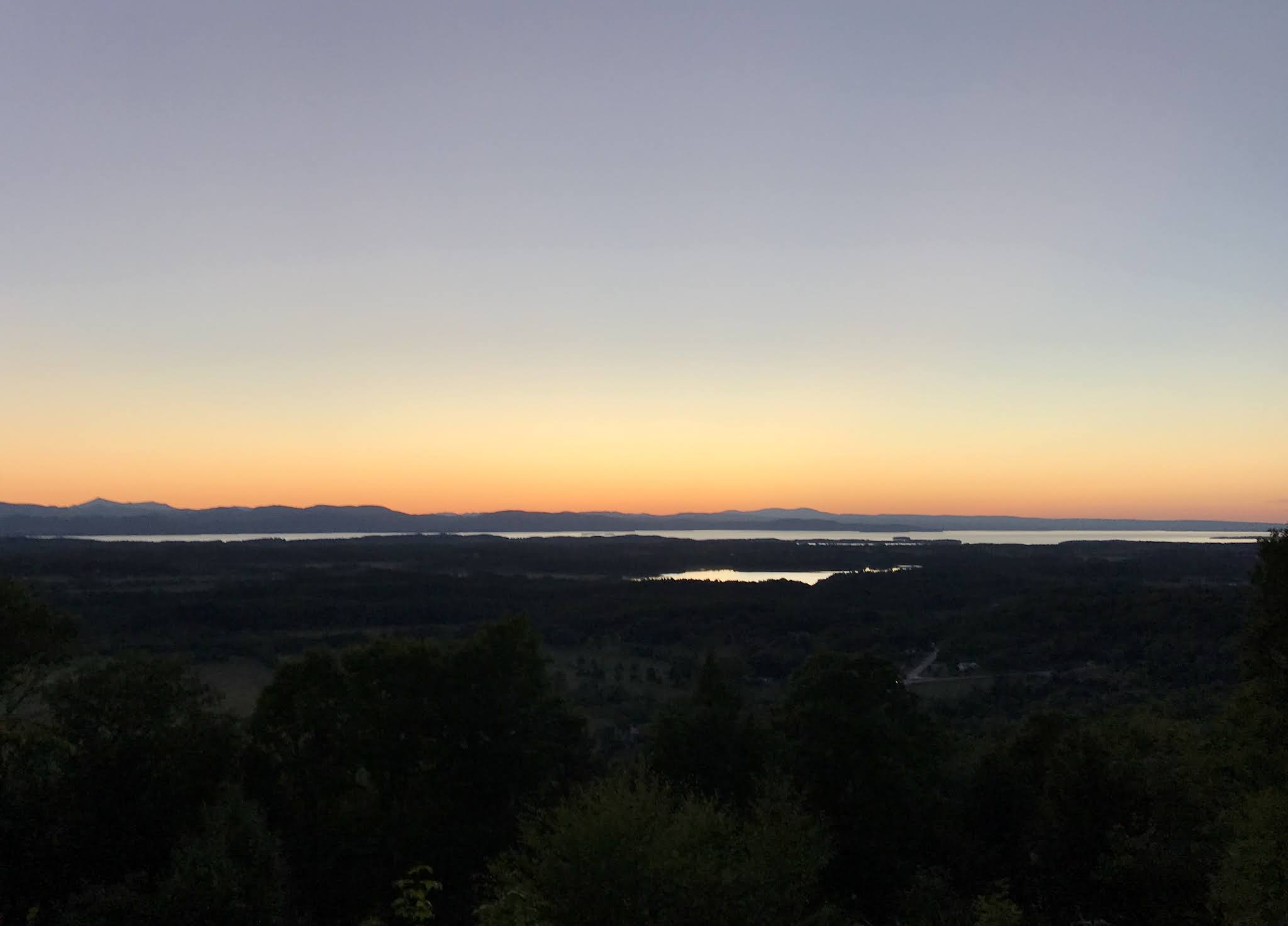

There was more light in
 the water than in the sky
as we paddled home.

But to return to the walk of the day.

Though there were some clouds in the west, there was a bright silver twilight before we reached our boat.

C. remarked it descending into the hollows immediately after sunset,

A red house could hardly be distinguished at a distance, but a white one appeared to reflect light on the landscape. 

At first we saw no redness in the sky, but only some peculiar dark wisp-like clouds in the west, but on rising a hill I saw a few red stains like veins of red quartz on a ground of feldspar.

The river was perfectly smooth except the upwelling of its tide, and as we paddled home westward, the dusky yellowing sky was all reflected in it, together with the dun-colored clouds and the trees, and there was more light in the water than in the sky.

The reflections of the trees and bushes on the banks were wonderfully dark and distinct, for though frequently we could not see the real bush in the twilight against the dark bank, in the water it appeared against the sky.  We were thus often enabled to steer clear of the overhanging bushes. 

It was an evening for the muskrats to be abroad, and we saw one, which dove as he was swimming rapidly, turning over like a wheel.

H. D. Thoreau, Journal, November 30, 1853


A flock of low-warbling tree sparrows.
See December 3, 1853 ("Saw two tree sparrows on Monroe's larch by the waterside. Larger than chip-birds, with more bay above and a distinct white bar on wings, not to mention bright-chestnut crown and obscure spot on breast; all beneath pale-ash. . . . uttering from time to time a faint, tinkling chip")

.I do not know so fine a pine grove as that of Mason's. See November 30, 1851 ("My eye wanders across the valley to the pine woods which fringe the opposite side, and in their aspect my eye finds something which addresses itself to my nature.. . .I experienced a transient gladness, at any rate, at something which I saw. I am sure that my eye rested with pleasure on the white pines, now reflecting a silvery light, the infinite stories of their boughs, tier above tier, a sort of basaltic structure, a crumbling precipice of pine horizontally stratified. Each pine is like a great green feather stuck in the ground. A myriad white pine boughs extend themselves horizontally, one above and behind another, each bearing its burden of silvery sunlight, ")

Though frequently we could not see the real bush in the twilight against the dark bank, in the water it appeared against the sky. See November 2, 1857 ("In the reflection the tree is black against the clear whitish sky, though as I see it against the opposite woods it is a warm greenish yellow. But the river sees it against the bright sky, and hence the reflection is like ink. The water tells me how it looks to it seen from below.");
 November 23, 1853 ("What lifts and lightens and makes heaven of the earth is the fact that you see the reflections of the humblest weeds against the sky, but you cannot put your head low enough to see the substance so. The reflection enchants us, just as an echo does.") See also A Book of the Seasons,  by Henry Thoreau, Reflections

It was an evening for the muskrats to be abroad, and we saw one, which dove as he was swimming rapidly, turning over like a wheel. See December 2, 1852 ("There goes a muskrat. He leaves so long a ripple behind that in this light you cannot tell where his body ends, and think him longer than he is.") See also A Book of the Seasons by Henry Thoreau, the Musquash

November 30. See A Book of the Seasons, by Henry Thoreau, November 30

There was more light in
 the water than in the sky
as we paddled home.


A Book of the Seasons
,  by Henry Thoreau
 "A book, each page written in its own season, 
out-of-doors, in its own locality."
 ~edited, assembled and rewritten by zphx ©  2009-2024

https://tinyurl.com/hdt-531130


Sunday, November 8, 2020

The snow begins to whiten the plowed ground.


November 8

Mayweed and shepherd’s-purse.

10 A. M. — Our first snow, the wind southerly, the air chilly and moist; a very fine snow, looking like a mist toward the woods or horizon, which at 2 o’clock has not whitened the ground. The children greet it with a shout when they come out at recess.


P. M. – To riverside as far down as near Peter’s, to look at the water-line before the snow covers it.

By Merrick’s pasture it is mainly a fine, still more or less green, thread-like weed or grass of the river bottom (?), sedges, utricularias (that coarse one especially, whose name I am not sure of, with tassels (?), yellow water ranunculus, potamogeton’s translucent leaves, a few flags and pontederia stems.

By Peter’s there was much of that coarse triangular cellular stem mentioned yesterday as sparganium (?). I would not have thought it so common.

There is not so much meadow grass or hay as I expected, for that has been raked and carried off.

The pads, too, have wasted away and the pontederias’ leaves, and the stems of the last for the most part still adhere to the bottom.

Three larks rise from the sere grass on Minott’s Hill before me, the white of their outer tail-feathers very conspicuous, reminding me of arctic snowbirds by their size and form also.

The snow begins to whiten the plowed ground now, but it has not overcome the russet of the grass ground.

November 8, 2023

Birds generally wear the russet dress of nature at this season. They have their fall no less than the plants; the bright tints depart from their foliage or feathers, and they flit past like withered leaves in rustling flocks.

The sparrow is a withered leaf.

The Stellaria media still blooms in Cheney’s garden, and the shepherd’s-purse looks even fresher. This must be near the end of the flower season.

Perchance I heard the last cricket of the season yesterday. They chirp here and there at longer and longer intervals, till the snow quenches their song.

And the last striped squirrel, too, perchance, yesterday. They, then, do not go into winter quarters till the ground is covered with snow.

The partridges go off with a whir, and then sail a long way level and low through the woods with that impetus they have got, displaying their neat forms perfectly.

The yellow larch leaves still hold on, — later than those of any of our pines.

I noticed the other day a great tangled and netted mass of an old white pine root lying upon the surface, nearly a rod across and two feet or more high, too large even to be turned up for a fence. 

It suggested that the roots of trees would be an interesting study. There are the small thickly interwoven roots of the swamp white oaks on the Assabet.

At evening the snow turned to rain, and the sugaring soon disappeared. 

H.D. Thoreau, Journal, November 8, 1853 

Our first snow. The children greet it with a shout. See November 24, 1860 ("Though a slight touch, this was the first wintry scene of the season. The rabbits in the swamps enjoy it, as well as you.”) See also note to November 29, 1856 ("This the first snow I have seen")

The snow begins to whiten the plowed ground now, but it has not overcome the russet of the grass ground.  See December 3, 1856 ("The sight of the sedgy meadows that are not yet snowed up while the cultivated fields and pastures are a uniform white.") See also November 24, 1858 ("Plowed ground is quite white.); November 24, 1860 (“The plowed fields were for a short time whitened”);  October 19, 1854 (“The country above Littleton (plowed ground) more or less sugared with snow,”); December 16, 1857 ("Plowed grounds show white first.”)

Perchance I heard the last cricket of the season. See A Book of the Seasons, by Henry Thoreau, The Cricket in November

And the last striped squirrel, too, perchance, yesterday.
See A Book of the Seasons, by Henry Thoreau, the Striped Squirrel

Three larks rise from the sere grass on Minott’s Hill before me, the white of their outer tail-feathers very conspicuous. See October 13, 1855 ("Larks in flocks in the meadows, showing the white in their tails as they fly, sing sweetly as in spring."); October 18, 1858 ("See larks, with their white tail-feathers, fluttering low over the meadows these days"); November 1, 1853  ("I see and hear a flock of larks in Wheeler's meadow on left of the Corner road, singing exactly as in spring and twittering also, but rather faintly or suppressedly.");  See also June 30, 1851 ("The lark sings a note which belongs to a New England summer evening."); August 4, 1852 ("I must make a list of those birds which, like the lark and the robin, if they do not stay all the year, are heard to sing longest of those that migrate."); October 6, 1851 ("I hear a lark singing this morn (October 7th ), and yesterday saw them in the meadows. Both larks and blackbirds are heard again now occasionally, seemingly after a short absence, as if come to bid farewell")

Birds generally wear the russet dress of nature at this season. . . and they flit past like withered leaves in rustling flocks. The sparrow is a withered leaf. See January 24, 1860 ("These birds, though they have bright brown and buff backs, hop about amid the little inequalities of the pasture almost unnoticed, such is their color and so humble are they.")

Birds in russet dress now flit past like withered leaves in rustling flocks.


A Book of the Seasons, by Henry Thoreau
"A book, each page written in its own season,
out-of-doors, in its own locality."
~edited, assembled and rewritten by zphx © 2009-2024

https://tinyurl.com/hdt-531108

Monday, September 3, 2018

The squirrel lives in a hazel grove.

September 3

P. M. — Up Assabet a-hazelnutting. 

I see a small striped snake, some fifteen or eighteen inches long, swallowing a toad, all but the head and one foreleg taken in. It is a singular sight, that of the little head of the snake directly above the great, solemn, granitic head of the toad, whose eyes are open, though I have reason to think that he is not alive, for when I return some hours after I find that the snake has disgorged the toad and departed. 

The toad had been swallowed with the hind legs stretched out and close together, and its body is compressed and elongated to twice its length, while the head, which had not been taken in, is of the original size and full of blood. The toad is quite dead, apparently killed by being so far crushed; and its eyes are still open. The body of the snake was enlarged regularly from near the middle to its jaws. It appeared to have given up this attempt at the eleventh hour. Probably the toad is very much more elongated when perfectly swallowed by a small snake. It would seem, then, that snakes undertake to swallow toads which are too big for them. 

I see where the bank by the Pokelogan is whitewashed, i. e. the grass, for a yard or two square, by the thin drop pings of some bird which has roosted on a dead limb above. It was probably a blue heron, for I find some slate-blue feathers dropped, apparently curving breast feathers, broadly shafted with white. 

I hear a faint warble from time to time from some young or old birds, from my window these days. Is it the purple finch again, — young birds practicing?

Zizania still. 

The hazelnut bushes up this way are chiefly confined to the drier river-bank. At least they do not extend into the lower, somewhat meadowy land further inland. They appear to be mostly stripped. The most I get are left hanging over the water at the swimming-ford. 

How important the hazelnut to the ground squirrel! They grow along the walls where the squirrels have their homes. They are the oaks that grow before their doors. They have not far to go to their harvesting.  These bushes are generally stripped, but isolated ones in the middle of fields, away from the squirrel-walks, are still full of burs. 

The wall is highway and rampart to these little beasts. They are almost inaccessible in their holes beneath it, and on either side of it spring up, also defended by the wall, the hazel bushes on whose fruit the squirrels in a great measure depend. Notwithstanding the abundance of hazelnuts here, very little account is made of them, and I think it is because pains is not taken to collect them before the squirrels have done so. Many of the burs are perfectly green yet, though others are brightly red-edged. 

The squirrel lives in a hazel grove. There is not a hazel bush but some squirrel has his eye on its fruit, and he will be pretty sure to anticipate you. As we say, “The tools to those who can use them,” so we may say, “The nuts to those who can get them.” 

That floating grass by the riverside whose lower leaves, so flat and linear, float on the surface of the water, though they are not now, at least, lake-colored, is apparently the Glyceria fluitans, floating fescue grass, still blooming and for a good while. I got it yesterday at Merrick’s shore. 

At the sand-bar by the swimming-ford, I collect two small juncuses, not knowing but I have pressed them before. One appears to be Juncus scirpoides (?), small as it is; the other, Juncus articulates (? ?). 

At Prichard’s shore I see where they have plowed up and cast into the river a pile of elm roots, which interfered with their laying down the adjacent field. One which I picked up I at first thought was a small lead pipe, partly coiled up and muddy in the water, it being apparently of uniform size. It was just nineteen feet and eight inches long; the biggest end was twenty-one fortieths of an inch in diameter, and the smallest nineteen fortieths. This difference was scarcely obvious to the eye. No doubt it might have been taken up very much longer. It looked as if, when green and flexible, it might answer the purpose of a rope, — of a cable, for instance, when you wish to anchor in deep water. The wood is very porous. 

The narrow brown sheaths from the base of white pine leaves now strew the ground and are washed up on the edge of puddles after the rain.

H. D. Thoreau, Journal, September 3, 1858

See a small striped snake, some fifteen or eighteen inches long, swallowing a toad, all but the head and one foreleg taken in. See May 19, 1856 (“Saw a small striped snake in the act of swallowing a Rana palustris, within three feet of the water. The snake, being frightened, released his hold, and the frog hopped off to the water. ”)

The narrow brown sheaths from the base of white pine leaves now strew the ground. September 5, 1857 ("I now see those brown shaving like stipules of the white pine leaves, which
are falling, i.e. the stipules, and caught in cobwebs.”) See also A Book of the Seasons, by Henry Thoreau, The October Pine Fall

Monday, May 15, 2017

Willow roots

May 15. 

Black currant at R. W. E.'s. 

Abel Hosmer thought that the Salix alba roots might reach half a dozen rods into his field as big as your finger. Thought that they made the grass grow as much as the locust; only they made it rough plowing by throwing the plow out.

H. D. Thoreau, Journal, May 15, 1857

Black currant at R. W. E.’s. See May 18, 1856 (“R. W. E.’s black currant (which the wild Ribes floridum is said to be much like), maybe a day.”)

Salix alba roots might reach half a dozen rods into his field. See  January 16, 1857 and  February 10, 1857 ("the willows . . . so filled the ground with their roots . . .that you could not plow within five rods of them . .”)

Tuesday, May 2, 2017

Building a fence between us and Mrs. Richardson.


May 2.

Saturday. Building a fence between us and Mrs. Richardson. 

In digging the holes I find the roots of small apple trees, seven or eight feet distant and four or more inches in diameter, two feet underground, and as big as my little finger. This is two or three feet beyond any branches. They reach at least twice as far as the branches. The branches get trimmed, the roots do not.

H. D. Thoreau, Journal, May 2, 1857

Sunday, November 17, 2013

Life in the roots

November 17.

I notice that many plants about this season of the year or earlier, after they have died down at top, put forth fresh and conspicuous radical leaves against another spring. 

So some human beings in the November of their days exhibit some fresh radical greenness, which, though the frosts may soon nip it, indicates and confirms their essential vitality. When their summer leaves have faded and fallen, they put forth fresh radical leaves which sustain the life in their root still, against a new spring.

The dry fields have for a long time been spotted with the small radical leaves of the fragrant life-everlasting, not to mention the large primrose, johnswort, etc., etc. And almost every plant, although it may show no greenness above ground, if you dig about it, will be found to have fresh shoots already pointing upward and ready to burst forth in the spring.

H. D. Thoreau, Journal, November 17, 1853

Many plants about this season of the year . . . put forth fresh and conspicuous radical leaves against another spring. See November 3, 1853 ("Now is the time to observe the radical leaves of many plants, which put forth with springlike vigor and are so unlike the others with which we are familiar that it is sometimes difficult to identify them."); December 23, 1855 ("At Lee’s Cliff I notice these radical(?) leaves quite fresh: saxifrage, sorrel, polypody, mullein, columbine, veronica, thyme-leaved sandwort, spleenwort, strawberry, buttercup, radical johnswort, mouse-ear, radical pinweeds, cinquefoils, checkerberry, Wintergreen, thistles, catnip, Turritis strictae specially fresh and bright.")


The life in their root still . . . See May 12, 1851 (" You exist in your roots, like a tree in the winter.")

Popular Posts Last 30 Days.

The week ahead in Henry’s journal

The week ahead in Henry’s journal
A journal, a book that shall contain a record of all your joy.
"A stone fruit. Each one yields me a thought." ~ H. D. Thoreau, March 28, 1859


I sit on this rock
wrestling with the melody
that possesses me.