May 11.
Wednesday.
Golden robin yesterday.
Fir-balsam well out in the rain; so say 9th.
P. M. — To Flint's Pond.
Arum triphyllum out. Almost every one has a little fly or two concealed within. One of the handsomest- formed plants when in flower.
Sorrel out in rain, apparently a day or two, — say 9th.
A blue heron flies away from the shore of the pond.
Scirpus planifolius in bloom on Smith's wooded hill, side of Saw Mill Brook.
A partridge-nest, with eleven fresh eggs, at foot of a chestnut, one upon another. It is quite a deep cavity amid the leaves, with some feathers of the bird in it.
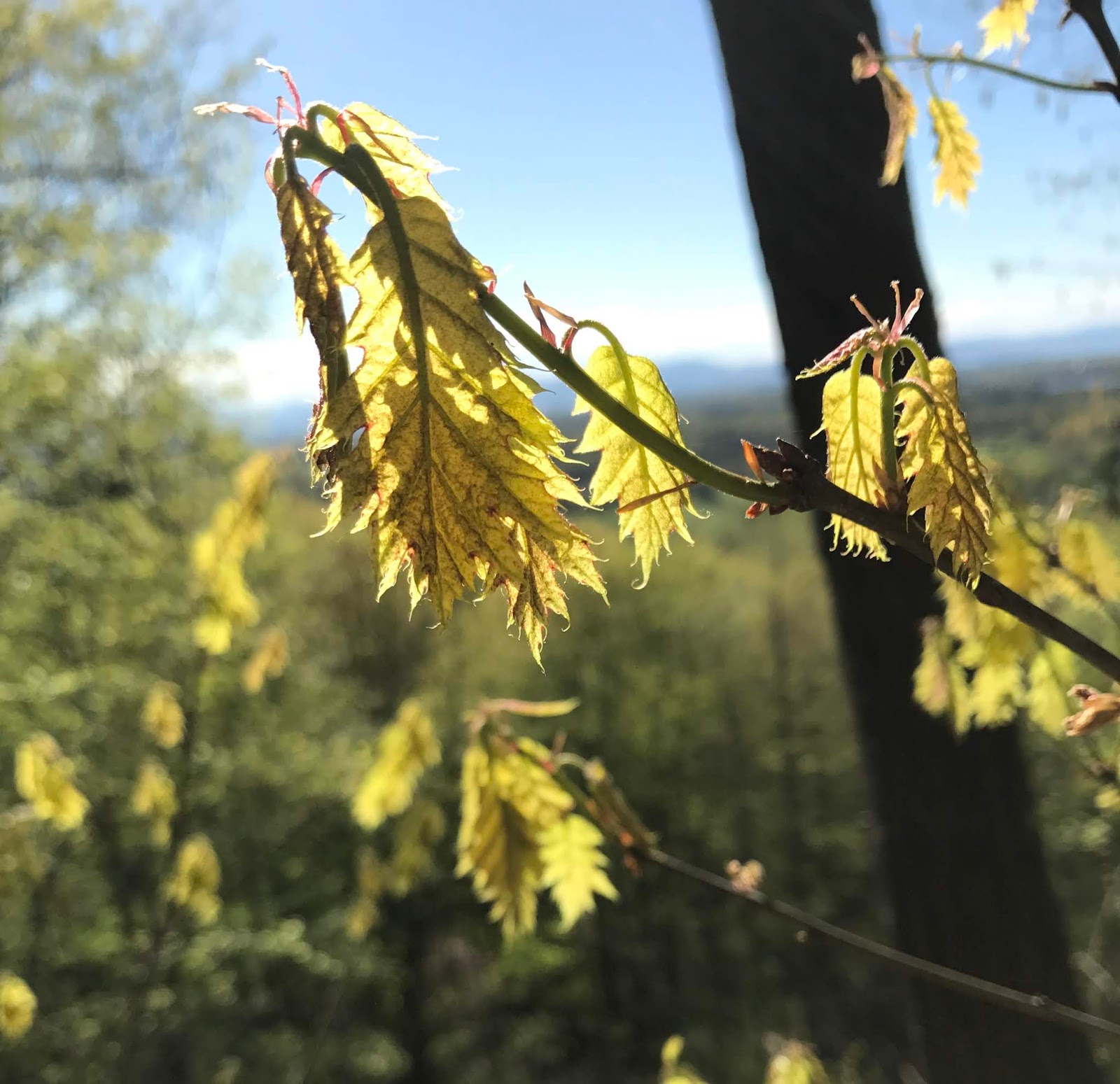
Young, or fresh-expanding, oak leaves are very handsome now, showing their colors. It is a leafy mist throughout the forest.
 |
| May 12, 2017 |
Uvularia perfoliata out in rain; say, then, the 9th. Just after plucking it I perceived what I call the meadow fragrance, though in the woods; but I afterward found that this flower was peculiarly fragrant, and its fragrance like that, so it was probably this which I had perceived. S. was reminded of the lily-of-the-valley by it.
The witch-hazel has one of the broadest leaves now.
In the path in Stow's wood-lot, I find apparently Thaspium aureum (Zizia aurea), which will open the first fair day. Shows quite yellow now.
Found in the path in the woods by the Mill Brook ditch, Flint's Pond, dead, the Coluber punctatus, 13 1/4 inches long, but no row of spots in middle of abdomen. The head above blackish with a blackish ring behind the yellow. Tail 3 inches long; breadth of body 5/16 ; plates 162; scales 55. Above, uniform glossy slate-color, with a yellowish-white band across the occiput; the head above blackish, and a blackish band close behind the yellowish one. Beneath, yellow or buff (whitish under head), with a row of small slanting black spots, one on each side of each abdominal plate except the first 3/4 inch behind the head. In the midst of the path in the woods. I admired the iridescence from its glossy belly. It differs from Storer's C. punctatus, for it is not brown above, nor "reddish yellow" beneath, and has no row of spots in middle of the abdomen.
In that first thunder-shower, the evening of the 9th, the grass evidently erected itself and grew darker, as it were instantaneously. Was it the effect of electricity in the air? It looked very differently from what it had ten minutes before.
H. D. Thoreau, Journal, May 11, 1859
Golden robin yesterday. See
. May 10, 1853 (“Hear higher the clear whistle of the oriole. New days, then, have come, ushered in by the warbling vireo, yellowbird, Maryland yellow-throat, and small pewee, and now made perfect by the twittering of the kingbird and the whistle of the oriole amid the elms, which are but just beginning to leaf out, thinking of his nest there, -. . .The warbling vireo promised warmer days, but the oriole ushers in summer heats.”); May 10, 1858 ("The oriole is seen darting like a bright flash with clear whistle from one tree-top to another over the street.”)
Arum triphyllum out. See May 1, 1857 ("Plucked the
Arum triphyllum, three inches high, with its acrid corm.”);
May 19, 1851 ("Find the
Arum triphyllum . . in Conant's Swamp.")
Young, or fresh-expanding, oak leaves are very handsome now, showing their colors. It is a leafy mist throughout the forest. See
May 15, 1854 ("The aspect of oak and other woods at a distance is somewhat like that of a very thick and reddish or yellowish mist about the evergreens. . . . Oak leaves are as big as a mouse's ear.”);
May 15, 1860 ("Looking from the Cliffs through the haze, the deciduous trees are a mist of leaflets.”); May 18, 1851 ("The oak leaves of all colors are just expanding, and are more beautiful than most flowers"); May 23, 1860 ("The quarter-grown red oak leaves between you and the sun, how yellow-green! "); May 26, 1857 ("Very interesting now are the red tents of expanding- oak leaves, as you go through sprout-lands, — the crimson velvet of the black oak and the more pinkish white oak. The salmon and pinkish-red canopies or umbrellas of the white oak")
Uvularia perfoliata out in rain; say, then, the 9th. See
September 22, 1852 ("Sophia has in her herbarium and has found in Concord these which I have not seen this summer
...Uvularia perfoliata”); May 30, 1857 ("By the path near the northeast shore of Flint's Pond, just before reaching the wall by the brook, I . . .am surprised to find ... the
Uvularia perfoliata, which I have not found hereabouts before. . . . It is considerably past its prime”);
May 3, 1858 ("Ride to Flint's Pond to look for
Uvularia perfoliata. ... It apparently will not bloom within ten days”);
May 16, 1858 (“The
Uvularia perfoliata, which did not show itself at all on the 3d, is now conspicuous, and one is open but will not shed pollen before to-morrow. It has shot up about ten inches in one case and bloomed within thirteen days!!”)
Just after plucking it I perceived what I call the meadow fragrance, but I afterward found that this flower was peculiarly fragrant. See
May 6, 1855 ("that unaccountable fugacious fragrance, as of all flowers,”); May 15, 1856 ("Perceive some of that delicious meadow fragrance coming over the railroad causeway”);
May 27, 1855 ("The meadow fragrance to-day”);
May 27, 1856 ("perceived the meadow fragrance”); May 27, 1857 ("I perceived that rare meadow fragrance on the 25th.”);
June 3, 1860 ("I perceive the meadow fragrance.”)
The Coluber punctatus [ringneck snake], uniform glossy slate-color above, with a yellowish-white band across the occiput; the head above blackish, and a blackish band close behind the yellowish one. Beneath, yellow or buff (whitish under head), with a row of small slanting black spots. Nnot brown above, nor "reddish yellow" beneath,. Compare and see note to May 1, 1859 (“a little snake . . . uniformly brown (or reddish-brown) above except a yellowish ring on the occiput, the head also lighter than the body; beneath vermilion, with apparently a row of light dots along each side.”)