Showing posts with label slate-colors. Show all posts

Sunday, November 22, 2020

A book which should be a memorial of October.


November 22

Geese went over yesterday, and to-day also.

The drizzling rain of yesterday has not checked the fall of the river. It was raised by the rain of Sunday, the 13th, and began to fall the 20th.

P. M. — Up river by boat.

I think it must be the white lily root I find gnawed by the rats, though the leaves are pellucid. It has large roots with eyes and many smaller rootlets attached, white tinged with a bluish slate-color. The radical leaves appear to have started again.

Turnip freshly in bloom in cultivated fields; knawel still; yarrow is particularly fresh and innocent; but I find no blossom on the Arenaria serpyllifolia.

If there is any one with whom we have a quarrel, it is most likely that that one makes some just demand on us which we disappoint.

I see still, here and there, a few deep-sunk yellow and decayed pads, the bleared, dulled, drowned eyes of summer.

I was just thinking it would be fine to get a specimen leaf from each changing tree and shrub and plant in autumn, in September and October, when it had got its brightest characteristic color, the intermediate ripeness in its transition from the green to the russet or brown state, outline and copy its color exactly with paint in a book, a book which should be a memorial of October, be entitled October Hues or Autumnal Tints.

I remember especially the beautiful yellow of the Populus grandidentata and the tint of the scarlet maple.

What a memento such a book would be, beginning with the earliest reddening of the leaves, woodbine and ivy, etc., etc., and the lake of radical leaves, down to the latest oaks! I might get the impression of their veins and outlines in the summer with lampblack, and after color them.

As I was returning down the river toward night, I mistook the creaking of a plow-wheel for a flock of blackbirds passing overhead, but it is too late for them.

The farmers plow considerably this month. No doubt it destroys many grubs in the earth.


H. D. Thoreau, Journal, November 22, 1853

Geese went over yesterday, and to-day. See November 20, 1853 ("Methinks the geese are wont to go south just before a storm, and, in the spring, to go north just after one, say at the end of a long April storm.”) See also A Book of Seasons, by Henry Thoreau, Geese in Autumn

Yarrow is particularly fresh and innocent. See November 18, 1855 ("Tansy still shows its yellow disks, but yarrow is particularly fresh and perfect, cold and chaste, with its pretty little dry-looking rounded white petals and green leaves.") See also A Book of the Seasons,  by Henry Thoreau, Yarrow and Tansy in Autumn

I remember especially the beautiful yellow of the Populus grandidentata. See October 25, 1858 ("The leaves of the Populus grandidentata, though half fallen and turned a pure and handsome yellow, are still wagging as fast as ever. These do not lose their color and wither on the tree . . .but they are fresh and unwilted, full of sap and fair as ever when they are first strewn on the ground. I do not think of any tree whose leaves are so fresh and fair when they fall.")  See also A Book of the Seasons, by Henry Thoreau, the Big-toothed Aspen (Populus grandidentata)

Tuesday, December 24, 2019

A conversation with Therien, the woodchopper.

December 24

The rain of yesterday concluded with a whitening of snow last evening, the third thus far. To day is cold and quite windy. 

P. M. — To the field in Lincoln which I surveyed for Weston the 17th. 

Walden almost entirely open again. 

Skated across Flint's Pond; for the most part smooth but with rough spots where the rain had not melted the snow. 

From the hill beyond I get an arctic view northwest. The mountains are of a cold slate-color. It is as if they bounded the continent toward Behring's Straits. 

In Weston's field, in springy land on the edge of a swamp, I counted thirty-three or four of those large silvery-brown cocoons within a rod or two, and probably there are many more about a foot from the ground, commonly on the main stem — though sometimes on a branch close to the stem — of the alder, sweet-fern, brake, etc., etc. 

The largest are four inches long by two and a half, bag-shaped and wrinkled and partly concealed by dry leaves, — alder, ferns, etc., — attached as if sprinkled over them. This evidence of cunning in so humble a creature is affecting, for I am not ready to refer it to an intelligence which the creature does not share, as much as we do the prerogatives of reason. This radiation of the brain. The bare silvery cocoons would otherwise be too obvious. 

The worm has evidently said to itself: "Man or some other creature may come by and see my casket. I will disguise it, will hang a screen before it." 

Brake and sweet-fern and alder leaves are not only loosely sprinkled over it and dangling from it, but often, as it were, pasted close upon and almost incorporated into it. 

Saw Therien yesterday afternoon chopping for Jacob Baker in the rain. I heard his axe half a mile off, and also saw the smoke of his fire, which I mistook for a part of the mist which was drifting about. 

I asked him where he boarded. At Shannon's.

He asked the price of board and said I was a grass boarder, i. e. not a regular one. 

Asked him what time he started in the morning. The sun was up when he got out of the house that morning. He heard Flint's Pond whooping like cannon the moment he opened the door, but sometimes he could see stars after he got to his chopping-ground. 

He was working with his coat off in the rain. 

He said he often saw gray squirrels running about and jumping from tree to tree. There was a large nest of leaves close by. 

That morning he saw a large bird of some kind. 

He took a French paper to keep himself in practice, — not for news; he said he didn't want news. He had got twenty- three or twenty-four of them, had got them bound and paid a dollar for it, and would like to have me see it. He hadn't read it half; there was a great deal of reading in it, by gorry.

He wanted me to tell him the meaning of some of the hard words. 

How much had he cut? He wasn't a-going to kill himself. He had got money enough. 

He cut enough to earn his board. A man could not do much more in the winter. 

He used the dry twigs on the trees to start his fire with, and some shavings which he brought in his pocket. He frequently found some fire still in the morning. 

He laid his axe by a log and placed another log the other side of it. I said he might have to dig it out of a snow drift, but he thought it would not snow. 

Described a large hawk killed at Smith's (which had eaten some hens); its legs "as yellow as a sovereign;" apparently a goshawk. 

He has also his beetle and wedges and whetstone. 

In the town hall this evening, my spruce tree, one of the small ones in the swamp, hardly a quarter the size of the largest, looked double its size, and its top had been cut off for want of room. It was lit with candles, but the starlit sky is far more splendid to-night than any saloon.

H. D. Thoreau, Journal,  December 24, 1853

A whitening of snow last evening, the third thus far. See  December 24,1850 ("the fine, dry snow blown over the surface of the frozen fields looks like steam curling up, as from a wet roof when the sun comes out after a rain."); December 24,1851 ("Now and long since the birds' nests have been full of snow."); December 24, 1854 ("Some three inches of snow fell last night and this morning,"); December 24, 1856 ("More snow in the night and to-day, making nine or ten inches")
Walden almost entirely open again. Skated across Flint's Pond. See December 4, 1853 ("Flint's Pond only skimmed a little at the shore, like the river."). Compare  December 27, 1852 (" Not a particle of ice in Walden to-day. Paddled across it. I took my new boat out. A black and white duck on it, Flint's and Fair Haven being frozen up.."); December 11, 1854 ("I find Flint’s frozen to-day,and how long?");  December 9, 1856 ("Yesterday I met Goodwin bringing a fine lot of pickerel from Flint's, which was frozen at least four inches thick. This is, no doubt, owing solely to the greater depth of Walden."); December 24, 1856 ("Am surprised to find Walden still open in the middle. . "); December 24, 1858 ("Those two places in middle of Walden not frozen over yet, ..."); December 24, 1859 (“There is, in all, an acre or two in Walden not yet frozen, though half of it has been frozen more than a week. ”);

From the hill beyond I get an arctic view northwest. The mountains are of a cold slate-color. See September 12, 1851 ("To the Three Friends' Hill beyond Flint's Pond. . . I go to Flint's Pond for the sake of the mountain view from the hill beyond, looking over Concord. I have thought it the best, especially in the winter, which I can get in this neighborhood. It is worth the while to see the mountains in the horizon once a day. "); October 22, 1857 ("Look from the high hill, just before sundown, over the pond. The mountains are a mere cold slate-color. But what a perfect crescent of mountains we have in our northwest horizon!")

In Weston's field I counted thirty-three or four of those large silvery-brown cocoons. See December 17, 1853 ("While surveying for Daniel Weston in Lincoln to-day, see a great many — maybe a hundred — silvery-brown cocoons");  February 19, 1854 (" the light ash-colored cocoons of the A. Promethea, with the withered and faded leaves wrapped around them "); January 6, 1855 ("Saw one of those silver-gray cocoons which are so securely attached by the silk being wound round the leaf-stalk and the twig.")

This evidence of cunning in so humble a creature is affecting, for I am not ready to refer it to an intelligence which the creature does not share.See February 19, 1854 ("Each and all such disguises and other resources remind us that not some poor worm's instinct merely, as we call it, but the mind of the universe rather, which we share, has been intended upon each particular object. All the wit in the world was brought to bear on each case to secure its end.”)

Saw Therien yesterday afternoon chopping for Jacob Baker in the rain. See July 14, 1845 ("Alek Therien, he called himself; a Canadian now, a woodchopper, a post-maker; makes fifty posts—holes them, i. e.—in a day; and who made his last supper on a woodchuck which his dog caught. And he too has heard of Homer, and if it were not for books, would not know what to do rainy days."); February 5, 1855 ("Found Therien cutting down the two largest chestnuts in the wood-lot behind where my house was."); December 29, 1853 ("I asked Therien yesterday if he was satisfied with himself.")

He wasn't a-going to kill himself. He had got money enough. He cut enough to earn his board. See Walden ("He wasn’t a-going to hurt himself. He didn’t care if he only earned his board.")

He took a French paper to keep himself in practice.
See Walden ("I know a woodchopper, of middle age, who takes a French paper, not for news as he says, for he is above that, but to “keep himself in practice,” he being a Canadian by birth; and when I ask him what he considers the best thing he can do in this world, he says, beside this, to keep up and add to his English.")

He has also his beetle.  See March 15, 1857 ("An indispensable piece of woodcraft."); December 29, 1853 ("The woodchopper to-day is the same man that Homer refers to, and his work the same. He, no doubt, had his beetle and wedge and whetstone then, carried his dinner in a pail or basket, and his liquor in a bottle, and caught his woodchucks, and cut and corded, the same.")

My spruce tree. See December 22, 1853 ("Got a white spruce for a Christmas-tree for the town out of the spruce swamp,")


A man could not do 
much more in the winter than
to earn his board.

Sunday, September 15, 2019

Dense flocks of pigeons.


September 15.


Yesterday was very cold, with northwest wind, and this morning the first frost in the garden, killing some of our vines. 

W. Ricketson says that, when looking for insects this morning under the loose bark of an apple tree on Nawshawtuct, he found a bat hanging there which measured eleven feet [sic], alar extent.

P. M. — To Annursnack. 

Dense flocks of pigeons hurry-skurry over the hill. Pass near Brooks's pigeon-stands. There was a flock perched on his poles, and they sat so still and in such regular order there, being also the color of the wood, that I thought they were wooden figures at first.

They were perched not only in horizontal straight lines one above the other, which the cross-bars required, but at equal distances apart on these perches, which must be their own habit; and it struck me that they made just such a figure seen against the sky as pigeonholes cut in a doves' house do, i. e. a  more or less triangular figure, and possibly the seeing them thus perched might have originally suggested this arrangement of the holes. 

Pigeons dart by on every side, — a dry slate color, like weather-stained wood (the weather-stained birds), fit color for this aerial traveller, a more subdued and earthy blue than the sky, as its field (or path) is between the sky and the earth, — not black or brown, as is the earth, but a terrene or slaty blue, suggesting their aerial resorts and habits. 

The Emersons tell me that their Irishman, James, held his thumb for the calf to suck, after dipping it in a pitcher of milk, but, the milk not coming fast enough, [the calf] butted (or bunted) the pitcher to make the milk come down, and broke it. 

The grain of the wild rice is all green yet. 

I find that Temple raises his own tobacco. The great leaves were spread over the bottom and sides of a hayrigging in his barn, by the open door, to dry. He smokes them. He says that the season is rather short for it here, but I saw some still growing and in bloom abundantly. What kind is it? "Cuby, they call it." He smokes it and thinks it better than any he can buy.

H. D. Thoreau, Journal, September 15, 1859

This morning the first frost in the garden, killing some of our vines. See September 7, 1857 ("Our first slight frost in some places this morning. Northwest wind to-day and cool weather "); September 14, 1852 ("This morning the first frost"); September 21, 1854 ("The first frost in our yard last night, the grass white and stiff in the morning. The muskmelon vines are now blackened in the sun.")

Pass near Brooks's pigeon-stands. There was a flock perched on his poles, and they sat so still and in such regular order there, being also the color of the wood, that I thought they were wooden figures at first. See September 12, 1851 (" Saw a pigeon-place on George Heywood's cleared lot, — the six dead trees set up for the pigeons to alight on, and the brush house close by to conceal the man. I was rather startled to find such a thing going now in Concord. The pigeons on the trees looked like fabulous birds with their long tails and their pointed breasts. I could hardly believe they were alive and not some wooden birds used for decoys, they sat so still; . . .Several men still take pigeons in Concord every year; by a method, methinks, extremely old and which I seem to have seen pictured in some old book of fables or symbols, and yet few in Concord know exactly how it is done. And yet it is all done for money and because the birds fetch a good price."); September 16, 1856 ("See a flock of pigeons dash by. From a stout breast they taper straightly and slenderly to the tail. They have been catching them a while."); September 13, 1858 ("A small dense flock of wild pigeons dashes by over the side of the hill, from west to east, — perhaps from Wetherbee’s to Brooks’s, for I see the latter’s pigeon place. They make a dark slate-gray impression")

Saturday, July 21, 2018

It was the Falco fuscus, the American brown or slate-colored hawk.

July 21. 

Wednesday. Concord. P. M.—To Walden, with E. Bartlett and E. Emerson. 

The former wished to show me what he thought an owl’s nest he had found. Near it, in Abel Brooks’s wood lot, heard a note and saw a small hawk fly over. It was the nest of this bird. Saw several of the young flitting about and occasionally an old bird. 

The nest was in a middling-sized white pine, some twenty feet from the ground, resting on two limbs close to the main stem, on the south side of it. It was quite solid, composed entirely of twigs about as big round as a pipe-stem and less; was some fifteen inches in diameter and one inch deep, or nearly flat, and perhaps five inches thick. It was very much dirtied on the sides by the droppings of the young. 

As we were standing about the tree, we heard again the note of a young one approaching. We dropped upon the ground, and it alighted on the edge of the nest; another alighted near by, and a third a little further off. The young were apparently as big as the old, but still lingered about the nest and returned to it. 

I could hear them coming some distance off. Their note was a kind of peeping squeal, which you might at first suspect to be made by a jay; not very loud, but as if to attract the old and reveal their whereabouts. 

The note of the old bird, which occasionally dashed past, was somewhat like that of the marsh hawk or pigeon woodpecker, a cackling or clattering sound, chiding us. The old bird was anxious about her inexperienced young, and was trying to get them off. At length she dashed close past us, and appeared to fairly strike one of the young, knocking him off his perch, and he soon followed her off. 

I saw the remains of several birds lying about in that neighborhood, and saw and heard again the young and old there abouts for several days thereafter. 

A young man killed one of the young hawks, and I saw it. It was the Falco fuscus, the American brown or slate-colored hawk. 
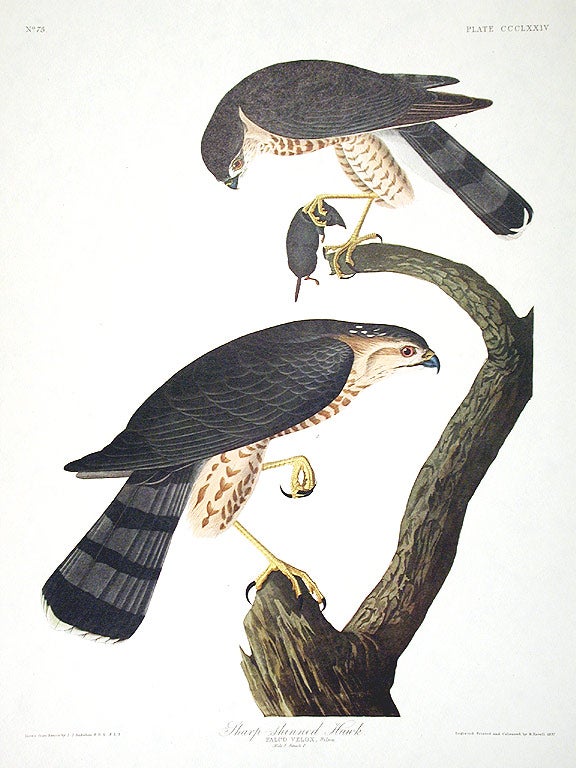
J. J. Audubon
Sharp-shinned Hawk

Its length was thirteen inches; alar extent, twenty-three. The tail reached two or more inches beyond the closed wings. Nuttall says the upper parts are “a deep slate color” (these were very dark brown); also that the nest is yet unknown. But Wilson describes his F. velox (which is the same as Nuttall’s F. fuscus) as “whole upper parts very dark brown,” but legs, greenish-yellow (these were yellow). The toes had the peculiar pendulous lobes which W. refers to. 

As I saw it in the woods, I was struck by its dark color above, its tawny throat and breast, brown-spotted, its clean, slender, long yellow legs, feathered but little below the knee, its white vent, its wings distinctly and rather finely dark-barred beneath, short, black, much curved bill, and slender black sharp claws. Its tail with a dark bar near edge beneath. 

In hand I found it had the white spots on scapulars of the F. fuscus, and had not the white bars on tail of the F. Pennsylvanicus. It also had the fine sharp shin.

But what then is my hawk killed by Farrar, with so stout a leg? Had that any white bars on tail? 

H. D. Thoreau, Journal, July 21, 1858

In Abel Brooks’s wood lot, heard a note and saw a small hawk fly over. It was the Falco fuscus, the American brown or slate-colored hawk.
See May 4, 1855 (“Sitting in Abel Brooks’s Hollow, see a small hawk go over high in the air, with a long tail and distinct from wings. It advanced by a sort of limping flight yet rapidly, not circling nor tacking, but flapping briskly at intervals and then gliding straight ahead with rapidity, controlling itself with its tail. It seemed to be going a journey. Was it not the sharp-shinned, or Falco fuscus?  I think that what I have called the sparrow hawk falsely, and latterly pigeon hawk, is also the sharp-shinned (vide April 26th and May 8th, 1854, and April 16th, 1855), for the pigeon hawk’s tail is white-barred.”); September 22, 1852 ("Some of those I see are probably the sharp-shinned hawk.");  March 28, 1854 (“See a small slate-colored hawk, with wings transversely mottled beneath, — probably the sharp-shinned hawk.”); April 26, 1854 (“Saw probably a pigeon hawk skim straight and low over field and wood, and another the next day apparently dark slate-color.”); May 8, 1854 (“Saw a small hawk flying low, about size of a robin — tail with black bars”);  April 16, 1855 ( "What I call a pigeon hawk, probably sharp-shinned.”); ; April 25, 1860 ("Looking up, I see what I take to be a sharp-shinned hawk just alighting on the trees . . . The hawk plumes himself, and then flies off, rising gradually and beginning to circle, and soon it joins its mate, and soars with it high in the sky and out of sight. . . It appeared to have a plain reddish-fawn breast. The size more than anything made me think it a sharp-shin."). See also A Book of the Seasons, by Henry Thoreau, the sharp-shinned hawk. and   A Book of the Seasons by Henry Thoreau, The Pigeon Hawk (Merlin)

But what then is my hawk killed by Farrar, with so stout a leg? See October 11, 1856 (“Farrar gave me a wing and foot of a hawk which he shot about three weeks ago . . . . This foot has a sharp shin and stout claws, but the wing is much larger than that of the Falco fuscus (or sharp-shinned hawk), being, . . . the size of the F. Pennsylvanicus. ”)

Saturday, April 23, 2016

The white birch sap flows yet from a stump cut last fall.


April 23

P. M. — Up Assabet to white cedars. 

The river risen again, on account of the rain of the last three days, to nearly as high as on the 11th. I can just get over Hosmer’s meadow. 

The red maple did not shed pollen on the 19th and could not on the 20th, 21st, or 22d, on account of rain; so this must be the first day, — the 23d, —though I see none quite so forward by the river. 

The wind is now westerly and pretty strong. 

No sap to be seen in the bass. The white birch sap flows yet from a stump cut last fall, and a few small bees, flies, etc., are attracted by it.


Along the shore by Dove Rock I hear a faint tseep like a fox colored sparrow, and, looking sharp, detect upon a maple a white-throated sparrow. It soon flies to the ground amid the birches two or three rods distant, a plump-looking bird and, with its bright white and yellow marks on the head distinctly separated from the slate-color, methinks the most brilliant of the sparrows. Those bright colors, however, are not commonly observed.  

The white cedar swamp consists of hummocks, now surrounded by water, where you go jumping from one to another. The fans are now dotted with the minute reddish staminate flowers, ready to open. The skunk cabbage leaf has expanded in one open place there; so it is at least as early as the hellebore of yesterday. 

Returning, when near the Dove Rock saw a musquash crossing in front. He dived without noise in the middle of the river, and I saw by a bubble or two where he was crossing my course, a few feet before my boat. He came up quietly amid the alders on my right, and lay still there with his head and back partly out. His back looked reddish-brown with a black grain inmixed. 

I think that that white root washed up since the ice broke up, with a stout stem flat on one side and narrow green or yellowish leaf-bud rolled up from each side, with a figure in, in the middle, is the yellow lily, and probably I have seen no pontederia. 

The white lily root is thickly clothed with a slate-blue fur or felt, close-fitting, reflecting prismatic colors under the microscope, but generally the slate-color of the fur of most animals, and perhaps it is designed to serve a similar use, viz. for warmth and dryness. The end of the root is abruptly rounded and sends forth leaves, and along the sides of the root are attached oval bulb-like offshoots, one or two inches long, with very narrow necks, ready, apparently, to be separated soon from the parent stock. 

Hear the yellow redpoll sing on the maples below Dove Rock, —a peculiar though not very interesting strain, or jingle. 

A very handsome little beetle, deep, about a quarter of an inch long, with pale-golden wing-cases, artificially and handsomely marked with burnished dark-green marks and spots, one side answering to the other; front and beneath burnished dark-green; legs brown or cinnamon-color. It was on the side of my boat. 

Brought it home in a clam’s shells tied up, —a good insect-box.

H. D. Thoreau, Journal, April 23, 1856

The river risen again. I can just get over Hosmer’s meadow. See April 23, 1855 ("River higher than before since winter. Whole of Lee Meadow covered."); See also  April 22, 1856 ("These rain-storms -- this is the third day of one -- characterize the season, and belong rather to winter than to summer.");  April 22, 1857 ("The river higher than before and rising. C. and I sail rapidly . . .  cutting off great bends by crossing the meadows.")

The red maple did not shed pollen on the 19th and could not on the 20th, 21st, or 22d, on account of rain; so this must be the first day, — the 23d. See April 18, 1856  ("Red maple stamens in some places project considerably, and it will probably blossom to-morrow if it is pleasant."); April 24, 1854 ("The first red maple blossoms — so very red over the water — are very interesting."): April 24, 1857 ("I see the now red crescents of the red maples in their prime . . . above the gray stems.") See also A Book of the Seasons,  by Henry Thoreau, The Red Maple

I hear a faint tseep land, looking sharp, detect upon a maple a white-throated sparrow with its bright white and yellow marks on the head distinctly separated from the slate-color . . . See April 25, 1855 ("Hear a faint cheep and at length detect the white throated sparrow, the handsome and well-marked bird . . .  with a yellow spot on each side of the front, . . . I first saw the white-throated sparrow at this date last year. “); see also A Book of the Seasons: the White-throated Sparrow 

Up Assabet to white cedars. Cedar Swamp . .  .minute reddish staminate flowers, ready to open.  See April 23, 1855 ("White cedar to-morrow."); April 24, 1854 ("The white cedar female blossoms are open . . . New plant (Racemed andromeda) flower-budded at Cedar Swamp amid the high blueberry, panicled andromeda, clethra, etc.— upright dense racemes of reddish flower-buds on reddish terminal shoots.”); April 24, 1855 ("The sprigs of red cedar, now full of the buff-colored staminate flowers, like fruit, are very rich . . . [Its pollen] is a clear buff color, while that of the white cedar is very different, being a faint salmon.”); April 26, 1856 ("The white cedar gathered the 23d does not shed pollen in house till to-day, and I doubt if it will in swamp before to-morrow.");  April 26, 1857 ("The white cedar is apparently just out. The higher up the tree, the earlier") See also 
 A Book of the Seasons, by Henry Thoreau, The Cedar Swamps

Returning, when near the Dove Rock saw a musquash . . .  His back looked reddish-brown with a black grain inmixed. See April 8, 1856 ("The muskrats are now very fat. They are reddish-brown beneath and dark—brown above."); April 22, 1856 ("An oval body, dark-brown above (black in some lights, the coarse wind hairs aft), reddish-brown beneath."); November 17, 1858 ("One sitting in the sun, as if for warmth, on the opposite shore to me looks quite reddish brown.") See also A Book of the Seasons,  by Henry Thoreau, the Musquash

Hear the yellow redpoll sing on the maples below Dove Rock, —a peculiar though not very interesting strain, or jingle. See April 15, 1856 ("From amid the willows and alders along the wall there, I hear a bird sing, a-chitter chitter chitter chitter chitter chitter, che che che che, with increasing intensity and rapidity, and the yellow redpoll hops in sight."); April 27, 1854 (""The yellow redpolls still numerous; sing chill lill lill lill lill lill. ); April 30, 1855 ("Many new birds should have arrived about the 21st. There were plenty of myrtle-birds and yellow redpolls  . . . Hear a short, rasping note, somewhat tweezer-bird like, I think from a yellow redpoll."); See also A Book of the Seasons,  by Henry Thoreau, The Yellow Redpoll ( Palm) Warbler

Friday, April 22, 2016

Sailing with an umbrella: It is highly important to invent a dress which will enable us to be abroad with impunity in the severest storms.

April 22

It has rained two days and nights, and now the sun breaks out, but the wind is still easterly, and the storm probably is not over. In a few minutes the air is full of mizzling rain again. 

8 A. M. —Go to my boat opposite Bittern Cliff. 

Monroe’s larches by river will apparently shed pollen soon. The staminate flowers look forward, but the pistil late scarcely show any red. 

There is snow still (of the winter) in the hollows where sand has been dug on the hillside east of Clamshell. 

Going through Hubbard’s root-fence field, see a pigeon woodpecker on a fence post. He shows his lighter back between his wings cassock-like and like the smaller woodpeckers. Joins his mate on a tree and utters the wooing note o-week o-week, etc. 

The seringo also sits on a post, with a very distinct yellow line over the eye,_and the rhythm of its strain is ker chick | ker che |  ker-char—r-r-r-r | chick, the last two bars being the part chiefly heard. 

The huckleberry buds are much swollen. 

I see the tracks of some animal which has passed over Potter’s sand, perhaps a skunk. They are quite distinct, the ground being smoothed and softened by rain. The tracks of all animals are much more distinct at such a time. 

By the path, and in the sandy field beyond, are many of those star-fingered puffballs. I think they must be those which are so white, like pigeons’ eggs, in the fall, the thick, leathery rind bursting into eight to eleven segments, like those of a boy’s batting ball, and curving back. They are very pretty and remarkable now, sprinkled over the sand, smooth and plump on account of the rain. (I find some beyond at Mountain Sumach Knoll, smaller with a very thin rind and more turned back, a different species plainly.) The inside of the rind, which is uppermost, approaches a chocolate-color; the puffball is a rough dirty or brownish white; the dust which does not fly now at any rate is chocolate-colored. Seeing these thus open, I should know there had been wet weather. 

The mountain sumach berries have no redness now, though the smooth sumach berries have. Its twigs are slender and so have a small pith. Its heart-wood is not yellow, like the smooth and the dogwood, but green. Its bark is more gray than that of the smooth, which last, when wet, is slightly reddish. Its bark sap or juice is not yellow like that of the smooth, and is slower to harden. 

Some hellebore leaves are opened in the Cliff Brook Swamp. 

My boat is half full of water. 

There are myriads of snow-fleas in the water amid the bushes, apparently washed out of the bark by the rain and rise of river. I push up-stream to Lee’s Cliff, behind Goodwin, who is after musquash. 

Many suckers and one perch have washed up on the Conantum shore, the wind being southeasterly. I do not detect any wound. Their eyes are white, -- it would be worth while to see how long before this happens, —and they appear to have been dead some time; their fins are worn, and they are are slimy. I cut open a sucker, and it looked rather yellow within. I also see sometimes their bladders washed up. They float on their backs. When cut open they sink, but the double bladder is uppermost and protruded as far as possible. Saw some pieces of a sucker recently dropped by some bird or beast, eight or ten rods from the shore. 

Much root and leaf-bud washed up. 

A gull. 

Very perfect and handsome clamshells, recently opened by the musquash, i. e. during the storm, lie on the meadow and the hillside just above water-mark. They are especially handsome because wet by the rain. 

I buy a male muskrat of Goodwin, just killed. He sometimes baits his mink-traps with muskrat; always with some animal food. The musquash does not eat this, though he sometimes treads on the trap and is caught. 

It rains hard and steadily again, and I sail before it.

Now I see many more ducks than in all that fair weather, — sheldrakes, etc. 

A marsh hawk, in the midst of the rain, is skimming along the shore of the meadow, close to the ground, and, though not more than thirty rods, I repeatedly lose sight of it, it is so nearly the color of the hillside beyond. It is looking for frogs. 

The small slate-colored hawk which I have called pigeon hawk darts away from a bushy island in the meadow. 

The muskrat, which I bought for twelve cents, weighs three pounds, six ounces. Goodwin thought that some would weigh a half to three quarters of a pound more than this; I think a pound more. Thought this was a young one of last year, — judged by the tail, —and that they hardly came to their growth in one year. Extreme length, twenty—three inches; length of bare tail, nine inches; breadth of tail, seven eighths of an inch; breadth of body, etc., as it lies, six and a half. An oval body, dark-brown above (black in some lights, the coarse wind hairs aft), reddish-brown beneath. Thus far the color of the hair. The fur within slate-color. Tail black; feet a delicate glossy dark slate (?), with white nails. The hind feet half webbed, and their sides and toes fringed thickly with stiff hair, apparently to catch water; ears (the head is wet and bruised), partly concealed in the fur, short and round; long black mustachial bristles; fore legs, quite short, more like hands; hind ones, about three inches without the line of the body’s fur and hair. Tail, on the skin, is a little curved downwards. 

The star fungi, as they dried in my chamber in the course of two or three hours, drew in the fingers. The different segments curled back tightly upon the central puff, the points being strongly curled downward into the middle dimple-wise. It requires wet weather, then, to expand and display them to advantage. They are hygrometers. 

Their coat seems to be composed of two thicknesses of different material and quality, and I should guess that the inside chocolate-colored had a great affinity for moisture and, being saturated with it, swelled, and so necessarily burst off and turned back, and perchance the outside dirty-white or pale-brown one expands with dryness. 

A single male sheldrake rose from amid the alders against Holden Swamp Woods, as I was sailing down in angles across my course, only four or five rods from me and a foot or two above the water, finally circling round into my rear. 

Soon after I turned about in Fair Haven Pond, it began to rain hard. The wind was but little south of east and therefore not very favorable for my voyage. I raised my sail and, cowering under my umbrella in the stern, wearing the umbrella like a cap and holding the handle between my knees, I steered and paddled, almost perfectly sheltered from the heavy rain. Yet my legs and arms were a little exposed sometimes, in my endeavors to keep well to windward so as to double certain capes ahead. For the wind occasionally drove me on to the western shore. 

From time to time, from under my umbrella, I could see the ducks spinning away before me, like great bees. For when they are flying low directly from you, you see hardly anything but their vanishing dark bodies, while the rapidly moving wings or paddles, seen edgewise, are almost invisible. 

At length, when the river turned more easterly, I was obliged to take down my sail and paddle slowly in the face of the rain, for the most part not seeing my course, with the umbrella slanted before me. But, though my progress was slow and laborious, and at length I began to get a little wet, I enjoyed the adventure because it combined to some extent the advantages of being at home in my chamber and abroad in the storm at the same time. 

It is highly important to invent a dress which will enable us to be abroad with impunity in the severest storms. We cannot be said to have fully invented clothing yet. In the meanwhile the rain-water collects in the boat, and you must sit with your feet curled up on a paddle, and you expose yourself in taking down your mast and raising it again at the bridges. 

These rain-storms -- this is the third day of one -- characterize the season, and belong rather to winter than to summer. Flowers delay their blossoming, birds tarry in their migrations, etc., etc. It is surprising how so many tender organizations of flowers and insects survive them uninjured. 

The muskrat must do its swimming chiefly with its hind feet. They are similar in form and position to those of the sheldrake. Its broad oval and flattish body, too, must help keep it up. 

Those star puffballs which had closed up in my chamber, put into water, opened again in a few hours. 

What is that little bodkin-shaped bulb which I found washed up on the edge of the meadow, white with a few  small greenish rounded leafets? 

On the 19th, when setting out one of those over cup oaks in Sleepy Hollow, digging at the decayed stump of an apple tree, we disturbed, dug up, a toad, which probably had buried itself there last fall and had not yet come out.

H. D. Thoreau, Journal, April 22, 1856

Monroe’s larches by river will apparently shed pollen soon. The staminate flowers look forward, but the pistil late scarcely show any red. See April 26, 1856 (“ Monroe’s larch will [shed pollen], apparently, by day after to-morrow.”); April 27, 1856 (" I find none of Monroe’s larch buds shedding pollen, but the anthers look crimson and yellow, and the female flowers are now fully expanded and very pretty, but small. I think it will first scatter pollen to-morrow.”); April 29, 1855 ( A few of the cones within reach on F. Monroe’s larches shed pollen; say, then, yesterday. The crimson female flowers are now handsome but small. “);April 29, 1856 ("Monroe’s larch staminate buds have now erected and separated their anthers, and they look somewhat withered, as if they had shed a part of their pollen. If so, they began yesterday.”)

You expose yourself in taking down your mast and raising it again at the bridges.  See April 17, 1856 ("I make haste to take down my sail at the bridges, but at the stone arches forgot my umbrella, which was un avoidably crushed in part. ")

A marsh hawk . . . looking for frogs . See April 8, 1856  ("marsh hawks circling low shows that frogs must be out.”); April 5, 1854 ("These days, when a soft west or southwest wind blows and it is truly warm, and an outside coat is oppressive, — these bring out the butterflies and the frogs, and the marsh hawks which prey on the last.”); 
 April 19, 1858 ("He skims along exactly over the edge of the water, on the meadowy side, not more than three or four feet from the ground and winding with the shore, looking for frogs, for in such a tortuous line do the frogs sit.") See also A Book of the Seasons, by Henry Thoreau,  the Marsh Hawk

It is highly important to invent a dress which will enable us to be abroad with impunity in the severest storms. See February 15, 1857 (“Never under take to ascend a mountain or thread a wilderness where there is any danger of being lost, without taking thick clothing, partly india-rubber, if not a tent or material for one; the best map to be had and a compass. . .”); February 28, 1852 (“To get the value of the storm we must be out a long time and travel far in it, so that it may fairly penetrate our skin, . . . and there be no part in us but is wet or weather beaten, - so that we become storm men instead of fair weather men.”); November 6, 1851 ("I had on my  bad-weather clothes” at Quebec like Olaf Trygvesson, the Northman, when he went to Thing in England.")

I buy a male muskrat of Goodwin . . .The hind feet half webbed, and their sides and toes fringed thickly with stiff hair. See  April 7, 1856 ("We see Goodwin skinning the muskrats he killed this forenoon . . .Their hind legs are half-webbed, the fore legs not at all.") See also A Book of the Seasons,  by Henry Thoreau, the Musquash

It has rained two days and nights . . . the wind is still easterly, and the storm probably is not over . . . These rain-storms . . . characterize 'the season. See April 22, 1852 ("It still rains . . . This makes five stormy days. Sunday, Monday, Tuesday, Wednesday, Thursday"); April 4, 1853 ("Rain, rain . . . A warm, dripping rain, heard on one's umbrella as on a snug roof . . .We never feel so comfortable as when we are abroad in a storm."); April 1, 1854 ("This rainy and truly April day  . . . April has begun like itself. It is warm and showery”);.April 1, 1855 ("The month comes in true to its reputation . . . a strong, steady, and rather warm rain. ");April 20, 1856 ("Rain, rain, rain, — a northeast storm. "); April 17, 1857 (" It rains about every other day now for a fortnight past.”);  April 20, 1858 ("Rain-storm begins, with hail.");April 22, 1859 ("This afternoon there is an east wind, and a rain-storm accordingly beginning, the eighth of the kind with this wind.");  April 26, 1859 ("This is the last of the rains (spring rains !) which invariably followed an east wind."); April 16, 1860 ("April rain, dripping and soaking into the earth and heard on the roof.)

April 22. See A Book of the Seasons,  by Henry Thoreau, April 22

Days-long rain-storms now
characterize the season –
this, the third storm day.

A Book of the Seasons,  by Henry Thoreau
"A book, each page written in its own season,
out-of-doors, in its own locality.”
~edited, assembled and rewritten by zphx © 2009-2026

https://tinyurl.com/hdt-560422


* * * 


Tonight, April 22, we leave the dogs behind around 6 o'clock and climb straight up behind the house to the logging road that connects to the red trail over the ridge down the red trail towards the wetland turn right at the big tree and there is that pile of scat still there. 

She says she wishes she had something to take it home and I reach in my back pocket ( I'm wearing shorts) and serendipity have a blue latex glove and  a plastic bag from an old Subway sandwich. (She collects the scat I put it in the cargo pocket of my shorts and hand it to her when we got home a little before 9:30.)

We detour into the wetland she gets very excited there is lots of Sphagum moss and a pit of mud where some animal has been digging. 

I discover part of the shell and skeleton of a snapping turtle. 

Surprisingly we are able to walk on the tufts of grass and mossy fallen logs without getting wet although there is a great deal of water all around.


Discover part of 
the shell and skeleton of 
a snapping turtle.

zphx April 22, 2016

Wednesday, December 23, 2015

These are the colors of the earth now


December 23

A very bright and pleasant day with remarkably soft wind from a little north of west. The frost has come out so in the rain of yesterday that I avoid the muddy plowed fields and keep on the grass ground, which shines with moisture. I think I do not remember such and so much pleasant, springlike weather as this and some other days of this month. 

I admire those old root fences which have almost entirely disappeared from tidy fields, -- White pine roots got out when the neighboring meadow was a swamp, -- the monuments of many a revolution. These roots have not penetrated into the ground, but spread over the surface, and, having been cut off four or five feet from the stump, were hauled off and set up on their edges for a fence. The roots are not merely interwoven, but grown together into solid frames, full of loopholes like Gothic windows of various sizes and all shapes, triangular and oval and harp-like, and the slenderer parts are dry and resonant like harp-strings. They are rough and unapproachable, with a hundred snags and horns which bewilder and balk the calculation of the walker who would surmount them. The part of the trees above ground presents no such fantastic forms. Here is one seven paces, or more than a rod, long, six feet high in the middle, and yet only one foot thick, and two men could turn it up, and in this case the roots were six or nine inches thick at the extremities. 

The roots of pines growing in swamps grow thus in the form of solid frames or rackets, and those of different trees are interwoven with all so that they stand on a very broad foot and stand or fall together to some extent before the blasts, as herds meet the assault of beasts of prey with serried front. You have thus only to dig into the swamp a little way to find your fence, -- post, rails, and slats already solidly grown together and of material more durable than any timber. 

How pleasing a thought that a field should be fenced with the roots of the trees got out in clearing the land a century before! I regard them as mementoes of the primitive forest. The tops of the same trees made into fencing-stuff would have decayed generations ago. These roots are singularly unobnoxious to the effects of moisture. 

The swamp is thus covered with a complete web of roots. Wild trees, such as are fitted to grow in the uncultivated swamps.
 

I sit on the hillside near the wall corner, in the further Conantum field, as I might in an Indian summer day in November or October. 

These are the colors of the earth now: 

  • all land that has been some time cleared, except it is subject to the plow, is russet;
  •  the color of withered herbage and the ground finely commixed, a lighter straw-color where are rank grasses next water;
  •  sprout-lands, the pale leather-color of dry oak leaves; 
  • pine woods, green; 
  • deciduous woods (bare twigs and stems and withered leaves commingled), a brownish or reddish gray; 
  • maple swamps, smoke-color; 
  • land just cleared, dark brown and earthy; 
  • plowed land, dark brown or blackish;
  • ice and water, slate-color or blue; 
  • andromeda swamps, dull red and dark gray;
  • rocks, gray. 


At Lee’s Cliff I notice these radical(?) leaves quite fresh: saxifrage, sorrel, polypody, mullein, columbine, veronica, thyme-leaved sandwort, spleenwort, strawberry, buttercup, radical johnswort, mouse-ear, radical pinweeds, cinquefoils, checkerberry, Wintergreen, thistles, catnip, Turritis stricta especially fresh and bright. 

H. D. Thoreau, Journal, December 23, 1855


These are the colors of the earth now.
See December 23, 1851 ("A pure and trackless white napkin covers the ground,"); December 23, 1859 ("Patches of bare ice . . . already reflect a green light which advertises me of the lateness of the hour"); December 23, 1859 ("How red [the sun's]light at this hour! its rays light up the fine woollen fibres of my glove. They were a dazzling rose-color")  See also November 25, 1853 ("The landscape, seen from the side of the hill looking westward to the horizon . . . There is first the clean light-reflecting russet earth, the dark-blue water, the dark or dingy green evergreens, the dull reddish-brown of young oaks and shrub oaks, the gray of maples and other leafless trees, and the white of birch stems."); December 20, 1851 ("Red, white, green, and, in the distance, dark brown are the colors of the winter landscape."); December 21, 1855 ("A few simple colors now prevail.”);  December 21, 1854 ("The last rays of the sun falling on the Baker Farm reflect a clear pink color. "); January 14, 1860 ("A warm reddish color revealed by the snow."); January 31, 1859 ("When I look westward now to the flat snow-crusted shore, it reflects a strong violet color."); February 12, 1860 ("Just before sunset, I see the ice beginning to be green, and a rose-color to be reflected from the low snow-patches.")  Compare February 13, 1860 ("The principal charm of a winter walk over ice is perhaps the peculiar and pure colors exhibited. There is the red of the sunset sky, and of the snow at evening, and in rainbow flocks during the day, and in sun-dogs. The blue of the sky, and of the ice and water reflected, and of shadows on snow. The yellow of the sun and the morning and evening sky, and of the sedge (or straw-color, bright when lit on edge of ice at evening), and all three in hoar frost crystals. . . .the purple of the snow in drifts or on hills, of the mountains, and clouds at evening. The green of evergreen woods, of the sky, and of the ice and water toward evening. The orange of the sky at evening. The white of snow and clouds, and the black of clouds, of water agitated, and water saturating thin snow on ice. ") See also Winter Colors (The solstice) (posted December 21, 2020)

Popular Posts Last 30 Days.

The week ahead in Henry’s journal

The week ahead in Henry’s journal
A journal, a book that shall contain a record of all your joy.
"A stone fruit. Each one yields me a thought." ~ H. D. Thoreau, March 28, 1859


I sit on this rock
wrestling with the melody
that possesses me.