Showing posts with label dispersion. Show all posts

Friday, September 24, 2021

One milkweed with faith in its seeds.


September 24

Returning over the causeway from Flint's Pond the other evening (22d ), just at sunset, I observed that while the west was of a bright golden color under a bank of clouds, — the sun just setting, — and not a tinge of red was yet visible there, there was a distinct purple tinge in the nearer atmosphere, so that Annursnack Hill, seen through it, had an exceedingly rich empurpled look.

It is rare that we perceive this purple tint in the air, telling of the juice of the wild grape and poke-berries. The empurpled hills! Methinks I have only noticed this in cooler weather.

Last night was exceedingly dark. I could not see the sidewalk in the street, but only felt it with my feet. I was obliged to whistle to warn travellers of my nearness, and then I would suddenly find myself abreast of them without having seen anything or heard their footsteps.

It was cloudy and rainy weather combined with the absence of the moon. So dark a night that, if a farmer who had come in a-shopping had spent but an hour after sunset in some shop, he might find himself a prisoner in the village for the night.

Thick darkness.

8 A. M. — To Lee's Bridge via Conantum.

It is a cool and windy morning, and I have donned a thick coat for a walk.

The wind is from the north, so that the telegraph harp does not sound where I cross.

This windy autumnal weather is very exciting and bracing, clear and cold, after the rain of yesterday, it having cleared off in the night.

I see a small hawk, a pigeon (?) hawk, over the Depot Field, which can hardly fly against the wind.

At Hubbard's Grove the wind roars loudly in the woods.

Grapes are ripe and already shrivelled by frost; barberries also.

It is cattle show day at Lowell.

Yesterday's wind and rain has strewn the ground with leaves, especially under the apple trees. Rain coming after frost seems to loosen the hold of the leaves, making them rot off.

Saw a woodchuck disappearing in his hole.

The river washes up-stream before the wind, with white streaks of foam on its dark surface, diagonally to its course, showing the direction of the wind. Its surface, reflecting the sun, is dazzlingly bright.

The outlines of the hills are remarkably distinct and firm, and their surfaces bare and hard, not clothed with a thick air.

I notice one red tree, a red maple, against the green woodside in Conant's meadow. It is a far brighter red than the blossoms of any tree in summer and more conspicuous.

The huckleberry bushes on Conantum are all turned red.


September 24, 2021

What can be handsomer for a picture than our river scenery now? Take this view from the first Conantum Cliff:
  • First this smoothly shorn meadow on the west side of the stream, with all the swaths distinct, sprinkled with apple trees casting heavy shadows black as ink, such as can be seen only in this clear air, this strong light, one cow wandering restlessly about in it and lowing; 
  • then the blue river, scarcely darker than and not to be distinguished from the sky, its waves driven southward, or up-stream, by the wind, making it appear to flow that way, bordered by willows and button-bushes; 
  • then the narrow meadow beyond, with varied lights and shades from its waving grass, which for some reason has not been cut this year, though so dry, now at length each grass-blade bending south before the wintry blast, as if bending for aid in that direction; 
  • then the hill rising sixty feet to a terrace-like plain covered with shrub oaks, maples, etc., now variously tinted, clad all in a livery of gay colors, every bush a feather in its cap; and
  •  further in the rear the wood crowned Cliff some two hundred feet high, where gray rocks here and there project from amidst the bushes, with its orchard on the slope; 
  • and to the right of the Cliff the distant Lincoln hills in the horizon.
The landscape so handsomely colored, the air so clear and wholesome; and the surface of the earth is so pleasingly varied, that it seems rarely fitted for the abode of man.


In Cohush Swamp the sumach leaves have turned a very deep red, but have not lost their fragrance. I notice wild apples growing luxuriantly in the midst of the swamp, rising red over the colored, painted leaves of the sumach, and reminding me that they were ripened and colored by the same influences, some green, some yellow, some red, like the leaves.

Fell in with a man whose breath smelled of spirit which he had drunk. How could I but feel that it was his own spirit that I smelt? 

Behind Miles's, Darius Miles's, that was, I asked an Irishman how many potatoes he could dig in a day, wishing to know how well they yielded. “Well, I don't keep any account,” he answered; “I scratch away, and let the day's work praise itself.” Aye, there's the difference between the Irish man and the Yankee; the Yankee keeps an account. The simple honesty of the Irish pleases me.

A sparrow hawk, hardly so big as a nighthawk, flew over high above my head, –
 a pretty little graceful fellow, too small and delicate to be rapacious.

Found a grove of young sugar maples (Acer saccharinum ) behind what was Miles's. How silently and yet startlingly the existence of these sugar maples was revealed to me, which I had not thought grew in my immediate neighborhood, — when first I perceived the entire edges of its leaves and their obtuse sinuses.

Such near hills as Nobscot and Nashoba have lost all their azure in this clear air and plainly belong to earth. Give me clearness nevertheless, though my heavens be moved further off to pay for it.

I perceive from the hill behind Lee's that much of the river meadows is not cut, though they have been very dry. The sun-sparkle on the river is dazzlingly bright in this atmosphere, as it has not been, perchance, for many a month.

It is so cold I am glad to sit behind the wall.

Still the great bidens blooms by the causeway side beyond the bridge.


At Clematis Brook I perceive that the pods or follicles of the Asclepias Syriaca now point upward. Did they before all point down? Have they turned up? They are already bursting.

I release some seeds with the long, fine silk attached. The fine threads fly apart at once, open with a spring, and then ray themselves out into a hemispherical form, each thread freeing itself from its neighbor and all reflecting prismatic or rainbow tints. The seeds, besides, are furnished with wings, which plainly keep them steady and prevent their whirling round. I let one go, and it rises slowly and uncertainly at first, now driven this way, then that, by currents which I cannot perceive, and I fear it will make shipwreck against the neighboring wood; but no, as it approaches it, it surely rises above it, and then, feeling the strong north wind, it is borne off rapidly in the opposite direction, ever rising higher and higher and tossing and heaved about with every fluctuation of the air, till, at a hundred feet above the earth and fifty rods off, steering south, I lose sight of it.

How many myriads go sailing away at this season, high over hill and meadow and river, on various tacks until the wind lulls, to plant their race in new localities, who can tell how many miles distant! And for this end these silken streamers have been perfecting all summer, snugly packed in this light chest,
— a perfect adaptation to this end, a prophecy not only of the fall but of future springs.

Who could believe in prophecies of Daniel or of Miller that the world would end this summer, while one milkweed with faith matured its seeds?


On Mt. Misery some very rich yellow leaves — clear yellow — of the Populus grandidentata, which still love to wag, and tremble in my hands. Also canoe birches there.

The river and pond from the side of the sun look comparatively dark.

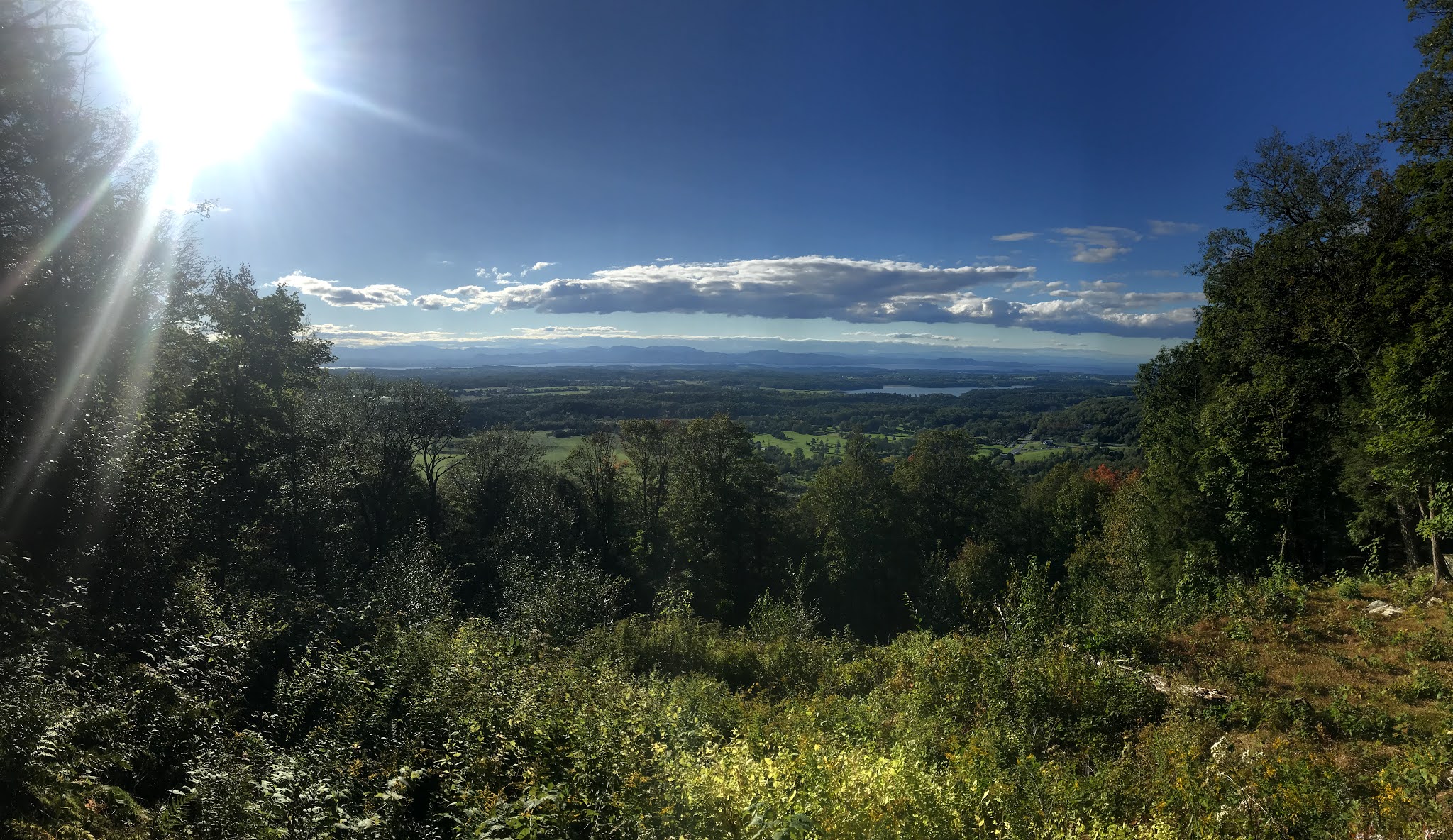
As I look over the country westward and northwestward, the prospect looks already bleak and wintry. The surface of the earth between the forests is no longer green, but russet and hoary. You see distinctly eight or ten miles the russet earth and even houses, and then its outline is distinctly traced against the further blue mountains, thirty or thirty-five miles distant. You see distinctly perhaps to the height of land between the Nashua and Concord, and then the convexity of the earth conceals the further hills, though high, and your vision leaps a broad valley at once to the mountains.

Get home at noon.

At sundown the wind has all gone down.

H. D. Thoreau, Journal, September 24, 1851


 I observed that while the west was of a bright golden color under a bank of clouds, — the sun just setting, — and not a tinge of red was yet visible there, there was a distinct purple tinge in the nearer atmosphere, so that Annursnack Hill, seen through it, had an exceedingly rich empurpled look. See October 19, 1858 ("The sun just ready to set, I notice that its light on my note-book is quite rosy or purple")

Last night was exceedingly dark. I could not see the sidewalk in the street, but only felt it with my feet. I was obliged to whistle to warn travellers of my nearness. See September 12, 1860 ("A dark and stormy night . . . Where the fence is not painted white I can see nothing, and go whistling for fear I run against some one. . . .You walk with your hands out to feel the fences and trees"); September 18, 1857 ("It was exceedingly dark. I met two persons within a mile, and they were obliged to call out from a rod distant lest we should run against each other. ")

I notice one red tree, a red maple, against the green woodside in Conant's meadow. See September 24, 1855 ("the maples are but just beginning to blush") See also September 25, 1857 ("The whole tree, thus ripening in advance of its fellows, attains a singular preéminence"); September 25, 1857 ("The red maple has fairly begun to blush in some places by the river. I see one, by the canal behind Barrett’s mill, all aglow against the sun."); September 25, 1857 ("A single tree becomes the crowning beauty of some meadowy vale and attracts the attention of the traveller from afar."); September 26, 1854 ("Some single red maples are very splendid now, the whole tree bright-scarlet against the cold green pines; now, when very few trees are changed, a most remarkable object in the landscape; seen a mile off."); September 27, 1855 ("Some single red maples now fairly make a show along the meadow. I see a blaze of red reflected from the troubled water."

At Clematis Brook I perceive that the pods or follicles of the Asclepias Syriaca now point upward. Did they before all point down? Have they turned up? See August 24, 1851 ("The pods of the Asclepias pulchra stand up pointedly like slender vases on a salver, an open salver truly! Those of the Asclepias Syriaca hang down.")

The fine threads fly apart at once, open with a spring, and then ray themselves out into a hemispherical form, each thread freeing itself from its neighbor. . . .a prophecy not only of the fall but of future springs. See September 10, 1860 ("If you sit at an open attic window almost anywhere, about the 20th of September, you will see many a milkweed down go sailing by on a level with you, though commonly it has lost its freight, — notwithstanding that you may not know of any of these plants growing in your neighborhood."); October 23, 1852 ("The milkweed (Syriaca) now rapidly discounting. The lanceolate pods having opened, the seeds spring out on the least jar, or when dried by the sun, and form a little fluctuating white silky mass or tuft, each held by the extremities of the fine threads, until a stronger puff of wind sets them free. It is a pleasant sight to see it dispersing its seeds")

The further blue mountains, thirty or thirty-five miles distant. See June 3, 1850 ("The landscape is a vast amphitheatre rising to its rim in the horizon."); September 12, 1851 ("It is worth the while to see the mountains in the horizon once a day"); August 2, 1852 ("In many moods it is cheering to look across hence to that blue rim of the earth,"); March 31, 1853 ("It is affecting to see a distant mountain-top,. . . still as blue and ethereal to your eyes as is your memory of it.'); September 27, 1853 ("From our native hills we look out easily to the far blue mountains, which seem to preside over them.");October 22, 1857 ("But what a perfect crescent of mountains we have in our northwest horizon! Do we ever give thanks for it? "); November 22, 1860 ("Simply to see to a distant horizon through a clear air, - the fine outline of a distant hill or a blue mountaintop through some new vista, - this is wealth enough for one afternoon.")

Wednesday, May 20, 2020

Abundant fine and light seed, buoyed up and wafted far through the atmosphere.


May 20

A strong, cold west wind. 60° at 2 P. M. 

To Walden. 

The Carex vulgaris is more glaucous than the stricta.

Mouse-ear down at last. 

Scirpus planifolius — how long? — apparently in prime in woods about the bottom of the long south bay of Walden, say two rods southwest. 

Judging from Hind's Report of his survey of the region between the Assiniboine and Saskatchewan Rivers, the prevailing trees — and they are small — are aspens and willows, which, if let alone, i. e., if the prairies were not burned by the Indians, might at last make a soil for nobler forests. 

No wonder that these small trees are so widely dispersed; their abundant fine and light seed, being buoyed up and wafted far through the atmosphere, speedily clothe the burnt tracts of British America. Heavy-seeded trees are slow to spread themselves, but both air and water combine to transport the seeds of these trees.

H. D. Thoreau, Journal, May 20, 1860

The Carex vulgaris is more glaucous than the stricta. See May 10, 1860 ("A sedge darker than the stricta and not in tufts, quite short. Is it the C. vulgaris? Its leading spikes are effete. ")

Scirpus planifolius  apparently in prime. See May 11, 1859 ("Scirpus planifolius in bloom on Smith's wooded hill, side of Saw Mill Brook.")

Mouse-ear down at last. See May 26, 1855 ("Already the mouse-ear down begins to blow in the fields and whiten the grass.")

No wonder that these small trees are so widely dispersed, See  December 30, 1855 ("For a few days I have noticed the snow sprinkled with alder and birch scales. . . .The high wind is scattering them over the snow there."); February 14, 1856 ("I was struck to-day by the size and continuousness of the natural willow hedge on the east side of the rail road causeway, at the foot of the embankment, next to the fence. Some twelve years ago, when that causeway was built through the meadows, there were no willows there or near there, but now, just at the foot of the sand-bank, where it meets the meadow, and on the line of the fence, quite a dense willow hedge has planted itself. [T]he seeds have been blown hither from a distance, and lodged against the foot of the bank, just as the snow-drift accumulates there. "); March 2, 1856 ("How unwearied Nature is, spreading her seeds.");  May 26, 1857 ("Some of the earliest willows about warm edges of woods are gone to seed and downy"); July 9, 1857 ("I think I see how this [willow]tree is propagated by its seeds. Its countless minute brown seeds, just perceptible to the naked eye in the midst of their cotton, are wafted with the cotton to the water, — most abundantly about a fortnight ago, — and there they drift . . ."); October 16, 1860 (Looking from a hilltop, I observe that pines, white birches, red maples, alders, etc., often grow in more or less regular rounded or oval or conical patches, while oaks, chestnuts, hickories, etc., simply form woods of greater or less extent, whether by themselves or mixed, and do not naturally spring up in an oval form. This is a consequence of the different manner in which trees which have winged seeds and those which have not are planted")

Tuesday, December 17, 2019

What a change there will be in a few years, this little forest of goldenrod giving place to a forest of pines!

December 17.

P. M. — To Walden.

The snow being some three or four inches deep, I see rising above it, generally, at my old bean-field, only my little white pines set last spring in the midst of an immense field of Solidago nemoralis, with a little sweet-fern (i.e. a large patch of it on the north side).

What a change there will be in a few years, this little forest of goldenrod giving place to a forest of pines!

By the side of the Pout's Nest, I see on the pure white snow what looks like dust for half a dozen inches under a twig. Looking closely, I find that the twig is hardhack and the dust its slender, light-brown, chaffy looking seed, which falls still in copious showers, dusting the snow, when I jar it; and here are the tracks of a sparrow which has jarred the twig and picked the minute seeds a long time, making quite a hole in the snow. The seeds are so fine that it must have got more snow than seed at each peck. But they probably look large to its microscopic eyes.

I see, when I jar it, that a meadow-sweet close by has quite similar, but larger, seeds.

This the reason, then, that these plants rise so high above the snow and retain their seed, dispersing it on the least jar over each successive layer of snow beneath them; or it is carried to a distance by the wind.

What abundance and what variety in the diet of these small granivorous birds, while I find only a few nuts still!

These stiff weeds which no snow can break down hold their provender. What the cereals are to men, these are to the sparrows. The only threshing they require is that the birds fly against their spikes or stalks.

A little further I see the seed-box (?) (Ludwigia) full of still smaller, yellowish seeds.

And on the ridge north is the track of a partridge amid the shrubs. It has hopped up to the low clusters of smooth sumach berries, sprinkled the snow with them, and eaten all but a few. Also, here only, or where it has evidently jarred them down — whether intentionally or not, I am not sure — are the large oval seeds of the stiff-stalked lespedeza, which I suspect it ate, with the sumach berries. There is much solid food in them. When the snow is deep the birds could easily pick the latter out of the heads as they stand on the snow.

I observe, then, eaten by birds to-day, the seed of hardhack and meadow-sweet, sumach, and probably lespedeza, and even seed-box.

Under the hill, on the southeast side of R. W. E.'s lot, where the hemlock stands, I see many tracks of squirrels. The dark, thick green of the hemlock (amid the pines) seems to attract them as a covert. The snow under the hemlock is strewn with the scales of its cones, which they (and perhaps birds?) have stripped off, and some of its little winged seeds. It is pleasant to see the tracks of these squirrels (I am not sure whether they are red or gray or both, for I see none) leading straight from the base of one tree to that of another, thus leaving untrodden triangles, squares, and polygons of every form, bounded by much trodden highways.

One, two, three, and the track is lost on the upright bole of a pine, — as if they had played at base-running from goal to goal, while pine cones were thrown at them on the way. The tracks of two or three suggest a multitude. You come thus on the tracks of these frisky and volatile (semivolitant) creatures in the midst of perfect stillness and solitude, as you might stand in a hall half an hour after the dancers had departed.

I see no nests in the trees, but numerous holes through the snow into the earth, whence they have emerged. They have loitered but little on the snow, spending their time chiefly on the trees, their castles, when abroad.

The snow is strewn not only with hemlock scales, but, under other trees, with the large white pine scales for rods together where there is no track, the wind having scattered them as they fell, and also the shells of hickory-nuts. It reminds me of the platform before a grocery where nuts are sold.

You see many places where they have probed the snow for these white pine cones, evidently those which they cut off green and which accordingly have not opened so as to drop the seeds. This was perhaps the design in cut ting them off so early, — thus to preserve them under the snow (not dispersed). Do they find them by the scent?

At any rate they will dig down through the snow and come right upon a pine cone or a hickory-nut or an acorn, which you and I cannot do.

Two or three acres of Walden, off the bar, not yet frozen.

Saw in [it] a good-sized black duck, which did not dive while I looked. I suspect it must have been a Fuligula, though I saw no white.

H. D. Thoreau, Journal, December 17, 1859

What abundance and what variety in the diet of these small granivorous birds. These stiff weeds which no snow can break down hold their provender.  See January 16, 1860 ("Though you may have never noticed this shrub, the tree sparrow comes from the north in the winter straight to it, and confidently shakes its panicle, and then feasts on the fine shower of seed that falls from it. The bird understands how to get its dinner perfectly.")

Two or three acres of Walden, off the bar, not yet frozen. Saw in it a good-sized black duck. See December 27, 1852 ("Not a particle of ice in Walden to-day. . . . A black and white duck on it, Flint's and Fair Haven being frozen up.")

Thursday, June 28, 2018

Fertile bayberry bushes fifteen rods east of yellow birch and six south of apple tree


June 28. 

P. M. — To broom. 

The erect potentilla is a distinct variety, with differently formed leaves as well as different time of flowering, and not the same plant at a different season. Have I treated it as such? 

The Genista tinctoria has been open apparently a week. It has a pretty and lively effect, reminding me for some reason of the poverty-grass. 

Mountain laurel on east side of the rocky Boulder Field wood is apparently in prime. 

I see in many places little barberry bushes just come up densely in the cow-dung, like young apple trees, the berries having been eaten by the cows. Here they find manure and an open space for the first year at least, when they are not choked by grass or weeds. In this way, evidently, many of these clumps of barberries are commenced. 

I notice that the ostrya, when growing in woods, has a remarkable spread for the size of its trunk, more than any tree, methinks. 

Cymbidium, how long? 

Epilobium coloratum, how long? 

We find in the Botrychium Swamp fine wiry asparagus plants, six inches high, with the seeds at bottom, apparently planted by birds, but no plants two years old. 

There are fertile bayberry bushes fifteen rods east of yellow birch and six south of apple tree.

H. D. Thoreau, Journal, June 28, 1858

The erect potentilla is not the same plant at a different season. See  June 28, 1860 ("I meet to-day with a wood tortoise which is eating the leaves of the early potentilla") See also June 4, 1857 ("The early potentilla is now erect in the June grass."); June 4, 1855 (“There are now many potentillas ascendant.”); June 8, 1858 ("The early potentilla is now in some places erect."); and note to June 23, 1851 ("The common cinquefoil (Potentilla simplex) greets me with its simple and unobtrusive yellow flower in the grass.")

I see in many places little barberry bushes just come up densely in the cow-dung, like young apple trees, the berries having been eaten by the cows. See May 29, 1858 ("I mistook dense groves of little barberries in the droppings of cows in the Boulder Field for apple trees at first. So the cows eat barberries, and help disperse or disseminate them exactly as they do the apple! That helps account for the spread of the barberry, then."); August 6, 1858 ("I then looked for the little groves of barberries which some two months ago I saw in the cow-dung thereabouts, but to my surprise I found some only in one spot after a long search") See also November 3, 1857 ("I see on many rocks, etc., the seeds of the barberry, which have been voided by birds, – robins, no doubt, chiefly. How many they must thus scatter over the fields, spreading the barberry far and wide!"); February 4, 1856. ("It it now occurs to me that these and barberries, etc., may be planted by the crows, and probably other birds."). Also September 21, 1860 ("I suspect that such seeds as these will turn out to be more sought after by birds and quadrupeds, and so transported by them, than those lighter ones furnished with a pappus and transported by the wind; and that those the wind takes are less generally the food of birds and quadrupeds than the heavier and wingless seeds.")

Cymbidium, how long? See July 11, 1857 ("The cymbidium is really a splendid flower, with its spike two or three inches long, of commonly three or five large, irregular, concave, star-shaped purple flowers, amid the cool green meadow-grass. It has an agreeable fragrance withal")

Epilobium coloratum [eastern willow-herb], how long?  See July 5, 1856 ("Epilobium coloratum, a day or more."); July 28, 1852 ("Epilobium coloratum, roadside just this side of Dennis's. ")

Fertile bayberry bushes. See May 30, 1855 ("The myrica, bayberry, plucked on the 23d, now first sheds pollen in house, the leaf being but little more expanded on the flowering shoot."); June 2, 1856 ("Myrica cerifera, possibly yesterday. Very few buds shed pollen yet; more, probably, to-day."); June 12, 1857 ("Bayberry well out")

Tuesday, May 29, 2018

So the cows eat barberries, and help disperse or disseminate them exactly as they do the apple!

May 29


May 29, 2018


P. M. – To Bateman's Pond via Pratt's. 

Buttonwood, one tree, not for two or three days. 

Rubus triflorus, well out, at Calla Swamp, how long?

Calla apparently in two or three, or three or four days, the very earliest. 

Arethusa bulbosa, well out. 

Cornus Canadensis blooms apparently with C. florida; not quite yet. 

I mistook dense groves of little barberries in the droppings of cows in the Boulder Field for apple trees at first. So the cows eat barberries, and help disperse or disseminate them exactly as they do the apple! That helps account for the spread of the barberry, then. 

See the genista, winter-killed at top, some seven or eight rods north of the southernmost large boulder in the Boulder Field. 

Cannot find any large corydalis plants where it has been very plenty. 

A few of the Cornus florida buds by the pond have escaped after all. 

Farmer describes an animal which he saw lately near Bateman's Pond, which he thought would weigh fifty or sixty pounds, color of a she fox at this season, low but very long, and ran somewhat like a woodchuck. I think it must have been an otter, though they are described as dark glossy-brown.

H. D. Thoreau, Journal, May 29, 1858

Calla apparently in two or three, or three or four days, the very earliest. See June 7, 1857 (“Pratt has got the Calla palustris, in prime. . .from the bog near Bateman's Pond”) and note to July 2, 1857 ("Calla palustris . . . at the south end of Gowing's Swamp. Having found this in one place, I now find it in another.")

Arethusa bulbosa, well out. See note to May 29, 1856 ("Two Arethusa bulbosa at Hubbard’s Close apparently a day or two.")

See the genista, winter-killed at top, some seven or eight rods north of the southernmost large boulder in the Boulder Field. See May 21, 1858 ("Pratt shows me what I take to be Genista tinctoria (not budded) from the Boulder Field");  June 28, 1858  ("The Genista tinctoria has been open apparently a week. It has a pretty and lively effect, reminding me for some reason of the poverty-grass."). See also April 21, 1852 ("In the pasture beyond the brook, where grow the barberries, huckleberries, — creeping juniper, etc., are half a dozen huge boulders, which look grandly now in the storm, covered with greenish-gray lichens, alternating with the slatish-colored rock. Slumbering, silent, . . .I look down on some of them as on the backs of oxen. A certain personality, or at least brute life, they seem to have."); November 3, 1857 ("It is singular that several of those rocks should be thus split into twins. Even very low ones, just appearing above the surface, are divided and parallel, having a path between them. It would be something to own that pasture with the great rocks in it")

The Cornus florida by the pond. See May 18, 1857 (“There is a large tree [Cornus florida] on the further side the ravine near Bateman's Pond and another by some beeches on the rocky hillside a quarter of a mile northeast.”)

Monday, May 21, 2018

The propagation of birches by seed blown in winter.

May 21
May 21, 2018

P. M. – To Boulder Field. 

Horse-chestnut in bloom. 

Aetoea  spicata var. rubra will bloom, apparently, in four or five days. It is now fifteen inches high. 

Lilac in bloom. 

Pratt shows me what I take to be Genista tinctoria (not budded) from the Boulder Field. It has leafed; when? 

Also a ranunculus from his land, – which has been out how long?— which is very near to R. repens, but has small flowers, petals less than the calyx, and leaves, methinks, more divided, but I did not see it open. It may be a variety of repens. 

His daughter has found in bloom: huckleberry on the 19th; Viola pubescens, 16th; Geranium maculatum, 18th. 

I notice that the old indigo-bird path behind Pratt's is for some distance distinctly defined by young birches, three or four feet high, which are now clothed with tender leaves before the young oaks, etc., on each side. They are especially thick in the ruts, while there are but few here and there in the sprout-land generally. I suspect that the seed was blown and lodged there in the winter. 

E. Hoar saw Silene Pennsylvanica out in Lincoln to day, in a warm cleft of a rock; also Cerasus pumila between here and Newton.

H. D. Thoreau, Journal, May 21, 1858

Birches thick in the ruts, the seed was blown and lodged there in the winter. See March 2, 1856 ("Walking up the river by Prichard's, was surprised to see, on the snow over the river, a great many seeds and scales of birches, . . . A great proportion of the seed that was carried to a distance lodged in the hollow over the river, and when the river breaks up will be carried far away, to distant shores and meadows. "); May 12, 1858 (“I notice that birches near meadows,. . . grow in more or less parallel lines a foot or two apart, parallel with the shore, apparently the seed having been dropped there either by a freshet or else lodged in the parallel waving hollows of the snow.”)

Sunday, November 19, 2017

Under the Cliffs

November 19

P. M. – To Cliffs. 

In Stow's sprout-land west of railroad cut, I see where a mouse which has a hole under a stump has eaten out clean the insides of the little Prinos verticillatus berries. These may be the doubtful seeds of the 14th. What pretty fruit for the mice, these bright prinos berries! They run up the twigs in the night and gather this shining fruit, take out the small seeds, and eat their kernels at the entrance to their burrows. The ground is strewn with them there. 

Turning up a stone on Fair Haven Hill, I find many small dead crickets about the edges, which have endeavored to get under it and apparently have been killed by the frost; quite under it and alive, two or three small purplish-brown caterpillars; and many little ants, quite active, with their white grubs, in spacious galleries, somewhat semicylindrical, whose top often was the bottom of the stone. You would think they had been made by a worm. 

Going along close under the Cliffs, I see a dozen or more low blackberry vines dangling down a perpendicular rock at least eight feet high, and blown back and forth, with leaves every six inches, and one or two have reached the ground and taken firm root there. 

There are also many of the common cinquefoil with its leaves five inches asunder, dangling down five or six feet over the same rock.

I see many acorn and other nut shells which in past years have been tucked into clefts in the rocks.

H. D. Thoreau, Journal, November 19, 1857

These may be the doubtful seeds of the 14th. See November 14, 1857 (“I have but little doubt that these seeds were placed there by a Mus leucopus, our most common wood mouse. ”) See also
A Book of the Seasons
, by Henry Thoreau, The Wild Mouse

I find many small dead crickets. See November 22, 1851 ("He turned over a stone, and I saw under it many crickets and ants still lively,"); see also A Book of the Seasons, by Henry Thoreau, The Cricket in November (Listening for the Last Cricket)

Many little ants, quite active, with their white grubs, in spacious galleries. ee November 15, 1857 (“My walk is the more lonely when I perceive that there are no ants now upon their hillocks in field or wood. These are deserted mounds. They have commenced their winter's sleep.”); November 22, 1851 (", He turned over a stone, and I saw under it many crickets and ants still lively, which had gone into winter quarters there apparently. There were many little galleries leading under the stone, indenting the hardened earth like veins")

The common cinquefoil dangling down over the rock. See May 1, 1854 (“At Lee's Cliff find the early cinquefoil”) See also A Book of the Seasons, by Henry Thoreau, Cinquefoil in Autumn

Tuesday, November 14, 2017

The first freezing day-- the crunching sound of frost-crystals in the heaving mud under my feet


November 14

P. M. – Ride to limestone quarries on old Carlisle road with E. Hoar. 

This morning it was considerably colder than for a long time, and by noon very much colder than heretofore, with a pretty strong northerly wind. The principal flight of geese was November 8th, so that the bulk of them preceded this cold turn five days. 

You need greatcoat and buffalo and gloves now, if you ride. I find my hands stiffened and involuntarily finding their way to my pockets. No wonder that the weather is a standing subject of conversation, since we are so sensitive. 

If we had not gone through several winters, we might well be alarmed at the approach of cold weather. With this keener blast from the north, my hands suddenly fail to fulfill their office, as it were begin to die. We must put on armor against the new foe. I am almost world-ridden suddenly. I can hardly tie and untie my shoe-strings. 

What a story to tell an inhabitant of the tropics, – perchance that you went to walk, after many months of warmth, when suddenly the air became so cold and hostile to your nature, that it benumbed you so that you lost the use of some of your limbs, could not untie your shoe-strings or unbutton your clothes! 

This cold weather makes us step more briskly.

I hear that the Indians say we are to have a hard winter, because of the abundance of acorns, also because of the unusual thickening of corn-husks in the summer! 

The stone at those quarries strikes northeasterly and southwesterly, or apparently with the rocks of Curly-pate, a third of a mile off. The strata appear to be nearly vertical. In the most southwesterly quarry, I noticed in the side of an upright sliver of rock, where the limestone had formerly been blasted off, the bottom of the nearly perpendicular hole which had been drilled for that purpose, two or three inches deep and about two and a half feet from the ground.

 In this I found two fresh chestnuts, a dozen or more amphicarpaea seeds, as many apparently either prinos (?) or rose (?) seeds (single seeds and fresh), and several fresh barberry seeds mixed with a little earth and rubbish. 

What placed them there? Squirrel, mouse, jay, or crow? At first I thought that a quadruped could hardly have reached this hole, but probably it could easily, and it was a very cunning place for such a deposit.  I brought them all home in order to ascertain what the seeds were and how they came there. 

Examining the chestnuts carefully in the evening and wondering if so small a bird as a chickadee could transport one, I observed near the larger end of one some very fine scratches, which it seemed to me might have been made by the teeth of a very small animal when carrying it, but certainly not by the bill of a bird, since they had pricked sharply into the shell, rucking it up one way. I then looked to see where the teeth of the other jaw had scratched it, but could discover no marks and was therefore still somewhat in doubt. 

Coming up-stairs an hour afterward, I examined those scratches with a microscope, and saw plainly that they had been made by some fine and sharp cutting instrument like a fine chisel, a little concave, and had plowed under the surface of the shell a little, toward the big end of the nut, raising it up; and, looking farther, I now discovered, on the larger end of the nut, at least two corresponding marks made by the lower incisors, plowing toward the first and about a quarter of an inch distant. These were a little less obvious to the unarmed eye, but no less plain through the glass. 

I now had no doubt that they were made by the incisors of a mouse, and, comparing them with the incisors of a deer mouse (Mus leucopus) whose skull I have, I found that one or two of the marks were just the width of its two incisors combined (a twentieth of an inch), and the others, though finer, might have been made by them. On one side, at least, it had taken fresh hold once or twice. I have but little doubt that these seeds were placed there by a Mus leucopus, our most common wood mouse. 

The other nut, which had no marks on it, I suppose was carried by the star end, which was gone from both. There was no chestnut tree within twenty rods. These seeds thus placed in this recess will account for chestnut trees, barberry bushes, etc., etc., growing in chinks and clefts where we do not see how the seeds could have fallen. There was earth enough even in this little hole to keep some very small plant alive. 

I hear that Gardiner Heywood caught a trout in Walden Pond the other day and that it weighed five pounds. [And a little over. Speared it about a week ago, and saw another not quite so large. Henry and John Bigelow put a couple into the pond some ten years ago. Were these the ones?]

It seems that the Abel Davis who caught the pickerel in Temple Brook, which would make such a meal for his “Lavinia” and himself, was addicted to talking to himself, thinking aloud. He was once talked of for captain of the company, and about that time, they say, was overheard saying to himself, “Captain Abel Davis! What a fine-looking man!”  

Can those straight ridges running north by west and south by east over the most level part of Curly-pate have anything to do with diluvial furrows? 

Returning along the edge of Calla Swamp, under the fern-clad hill, I feel the crunching sound  of frost-crystals in the heaving mud under my feet, and see and feel the sphagnum already stiffened into a crust, and what probably in the forenoon was water trickling from a fern-clad rock is now half a dozen icicles, six or eight inches long. 

Such is the first freezing day. Such phenomena are first observed under the north side of a hill in a cold swamp like this. Such are the first advances of winter. Ice-crystals shoot in the mud, the sphagnum becomes a stiffened mass, and dropping water in these cold places, a rigid icicle. 

E. Hoar tells me that his partner, having a new adobe house, or perhaps roof to it, built in Santa Barbara, on the California coast, corrected the bad levelling of his carpenters by taking such a position as to make the ridge-pole coincide with the horizon line where the Pacific appeared to meet the sky. 

The thermometer is 27° at 6 P. M. The mud in the street is stiffened under my feet this evening. 

Where there is a wall near a pitch pine wood, I see the scales of the cones which the squirrels have carried to the wall and stripped, strewn all along the wall on the ground.

H. D. Thoreau, Journal, November 14, 1857

I have but little doubt that these seeds were placed there by a Mus leucopus, our most common wood mouse. See November 19, 1857 (" What pretty fruit for the mice, these bright prinos berries! They run up the twigs in the night and gather this shining fruit, take out the small seeds, and eat their kernels at the entrance to their burrows. The ground is strewn with them there.") See also A Book of the Seasons, by Henry Thoreau, The Wild Mouse

The crunching sound of frost-crystals under my feet, such is the first freezing day.
See November 14, 1858 ("It is all at once perfect winter. I walk on frozen ground two thirds covered with a sugaring of dry snow.")

This cold weather makes us step more briskly. See November 12, 1858 ("All people move the brisker for the cold, yet are braced and a little elated by it. They love to say, “Cold day, sir.” Though the days are shorter, you get more work out of a hired man than before, for he must work to keep warm. ")

Friday, November 3, 2017

Looking westward now.

November 3. 


November 3, 2017

P. M. – To the Easterbrooks moraine via Ponkawtasset-top.

Islands, pale-brown grassy isles, are appearing again in the meadow as the water goes down. 

From this hilltop, looking down-stream over the Great Meadows away from the sun, the water is rather dark, it being windy, but about the shores of the grassy isles is a lighter-colored smooth space. 

Pitch pine needles are almost all fallen.

There is a wild pear tree on the east side of Ponkawtasset, which I find to be four and a half feet in circumference at four feet from the ground.

Looking westward now, at 4 P.M., I see against the sunlight, where the twigs of a maple and black birch intermingle, a little gossamer or fine cobwebs, but much more the twigs, especially of the birch, waving slightly, reflect the light like cobwebs. It is a phenomenon peculiar to this season, when the twigs are bare and the air is clear. I cannot easily tell what is cobweb and what twig, but the latter often curve upward more than the other. 

I see on many rocks, etc., the seeds of the barberry, which have been voided by birds, – robins, no doubt, chiefly. How many they must thus scatter over the fields, spreading the barberry far and wide! That has been their business for a month. 

Follow up the Boulder Field northward, and it terminates in that moraine. As I return down the Boulder Field, I see the now winter-colored — i.e. reddish (of oak leaves) — horizon of hills, with its few white houses, four or five miles distant southward, between two of the boulders, which are a dozen rods from me, a dozen feet high, and nearly as much apart, — as a landscape between the frame of a picture. But what a picture frame! These two great slumbering masses of rock, reposing like a pair of mastodons on the surface of the pasture, completely shutting out a mile of the horizon on each side, while between their adjacent sides, which are nearly perpendicular, I see to the now purified, dry, reddish, leafy horizon, with a faint tinge of blue from the distance. 

To see a remote landscape between two near rocks! I want no other gilding to my picture-frame. There they lie, as perchance they tumbled and split from off an iceberg. What better frame could you have? The globe itself, here named pasture, for ground and foreground, two great boulders for the sides of the frame, and the sky itself for the top! And for artists and subject, God and Nature! Such pictures cost nothing but eyes, and it will not bankrupt one to own them. They were not stolen by any conqueror as spoils of war, and none can doubt but they are really the works of an old master. What more, pray, will you see between any two slips of gilded wood in that pasture you call Europe and browse in sometimes? 

It is singular that several of those rocks should be thus split into twins. Even very low ones, just appearing above the surface, are divided and parallel, having a path between them. 

It would be something to own that pasture with the great rocks in it! And yet I suppose they are considered an incumbrance only by the owner. 

I came along the path that comes out just this side the lime-kiln. 

Coming by Ebby Hubbard’s thick maple and pine wood, I see the rays of the sun, now not much above the horizon, penetrating quite through it to my side in very narrow and slender glades of light, peculiarly bright. It seems, then, that no wood is so dense but that the rays of the setting sun may penetrate twenty rods into it. 

The other day (November 1st), I stood on the sunny side of such a wood at the same season, or a little earlier. Then I saw the lit sides of the tree stems all aglow with their lichens, and observed their black shadows behind. Now I see chiefly the dark stems massed together, and it is the warm sunlight that is reduced to a pencil of light; i. e., then light was the rule and shadow the exception, now shadow the rule and light the exception. 

I notice some old cow-droppings in a pasture, which are decidedly pink. Even these trivial objects awaken agreeable associations in my mind, connected not only with my own actual rambles but with what I have read of the prairies and pampas and Eastern land of grass, the great pastures of the world.

H. D. Thoreau, Journal, November 3, 1857

To the Easterbrooks moraine via Ponkawtasset-top. See June 10, 1853 ("What shall this great wild tract over which we strolled be called?. . . It contains what I call the Boulder Field, the Yellow Birch Swamp, the Black Birch Hill, the Laurel Pasture, the Hog-Pasture, the White Pine Grove, the Easterbrooks Place, the Old Lime-Kiln, the Lime Quarries, Spruce Swamp, the Ermine Weasel Woods; also the Oak Meadows, the Cedar Swamp, the Kibbe Place, and the old place northwest of Brooks Clark‘s. Ponkawtasset bounds it on the south. There are a few frog-ponds and an old mill-pond within it, and Bateman‘s Pond on its edge. What shall the whole be called? . . .Shall we call it the Easterbrooks Country?")

Looking westward now. See September 18, 1858 ("As we paddle westward, toward College Meadow, I perceive that a new season has come."); October 20, 1854 ("This is the time to look westward.");  November 10, 1858 ("I look out westward across Fair Haven Pond. The warmer colors are now rare . . .  All the light of November may be called an afterglow. ");  November 30, 1853 (" And as we paddled home westward . . . there was more light in the water than in the sky"); December 9, 1856 ("I look over the pond westward. The sun is near setting,. . . The pond is perfectly smooth and full of light.") January 9, 1859 ("As I stand on the pond looking westward toward the twilight sky, a soft, satiny light is reflected from the ice in flakes here and there, like the light from the under side of a bird’s wing.") ;  January 31, 1859 ("When I look westward now to the flat snow-crusted shore, it reflects a strong violet color. ");  February 21, 1854 ("The ice in the fields . . . amid the snow, looking westward now while the sun is about setting, in cold weather, is green."); February 29, 1852 ("From Pine Hill, looking westward, I see the snowcrust shine in the sun as far as the eye can reach.");   April 30, 1852 ("Far over the woods westward, a shining vane, glimmering in the sun."); May 10, 1853 ("From the hill, I look westward over the landscape. The deciduous woods are in their hoary youth, every expanding bud swaddled with downy webs.") See also  October 20, 1858 ("There is one advantage in walking eastward these afternoons, at least, that in returning you may have the western sky before you");  Walking (1861) ("Every sunset which I witness inspires me with the desire to go to a West as distant and as fair as that into which the sun goes down He appears to migrate westward daily and tempt us to follow him . . . The West of which I speak is but another name for the Wild and what I have been preparing to say is that in Wildness is the preservation of the World .") and A Book of the Seasons, by Henry Thoreau, November Sunsets

It is a phenomenon peculiar to this season, when the twigs are bare and the air is clear. See  November 1, 1860  ("Gossamer on the withered grass is shimmering in the fields, and flocks of it are sailing in the air."); November 7, 1855 ("gossamer on the grass. . . revealed by the dewy mist which has collected on it.”); November 11, 1858 ("Gossamer reflecting the light is another November phenomenon (as well as October)."); November 13,1855 (" I see the streaming lines of gossamer from trees and fences.”); November 15, 1858 ("Gossamer, methinks, belongs to the latter part of October and first part of November"); November 19, 1853 (“This, too, is a gossamer day, though it is not particularly calm. . . .”);  November 28, 1856 ("sunlight reflected from the many ascending twigs of bare young chestnuts and birches... remind me of the lines of gossamer at this season, being almost exactly similar to the eye. It is a true November phenomenon.").  Also November 3, 1853 ("There are very few phenomena which can be described indifferently as occurring at different seasons of the year .")  See also A Book of the Seasons, by Henry Thoreau, Gossamer Days

To see a remote landscape between two near rocks! See November 1, 1852 ("To see, between two near pine boughs, whose lichens are distinct, a distant forest and lake, the one frame, the other picture. ")

Pitch pine needles are almost all fallen. See November 3, 1858 ("The pitch pine fallen and falling leaves now and for some time have not been bright or yellow, but brown.") See also October 22, 1851 ("The pines, both white and pitch, have now shed their leaves, and the ground in the pine woods is strewn with the newly fallen needles."); November 1, 1851 ("The pitch pines show new buds at the end of their plumes.");  November 4, 1857 ("I frequently see a spreading pitch pine on whose lower and horizontal limbs the falling needles have lodged, forming thick and unsightly masses, where anon the snow will collect and make a close canopy.") And A Book of the Seasons,  by Henry Thoreau, the Pitch Pine. 

Spreading the barberry far and wide! That has been their business for a month. See  May 29, 1858 ("I mistook dense groves of little barberries in the droppings of cows in the Boulder Field for apple trees at first. So the cows eat barberries, and help disperse or disseminate them exactly as they do the apple! That helps account for the spread of the barberry, then."); June 28, 1858 ("I see in many places little barberry bushes just come up densely in the cow-dung, like young apple trees, the berries having been eaten by the cows. Here they find manure and an open space for the first year at least, when they are not choked by grass or weeds. In this way, evidently, many of these clumps of barberries are commenced"); October 20, 1857 ("The barberry bushes are now alive with, I should say, thousands of robins feeding on them."); October 18, 1857 ("I see many robins on barberry bushes, probably after berries.")  February 4, 1856. ("I have often wondered how red cedars could have sprung up in some pastures which I knew to be miles distant from the nearest fruit-bearing cedar, but it now occurs to me that these and barberries, etc., may be planted by the crows, and probably other birds."). Also September 21, 1860 ("I suspect that such seeds as these will turn out to be more sought after by birds and quadrupeds, and so transported by them, than those lighter ones furnished with a pappus and transported by the wind; and that those the wind takes are less generally the food of birds and quadrupeds than the heavier and wingless seeds."); September 23, 1860 ("It is evident, then, that the fox eats huckleberries and so contributes very much to the dispersion of this shrub, for there were a number of entire berries in its dung in both the last two I chanced to notice. To spread these seeds, Nature employs not only a great many birds but this restless ranger the fox.") See also A Book of the Seasons,  by Henry Thoreau, The Common Barberry

Coming by Ebby Hubbard’s thick maple and pine wood, I see the rays of the sun, now not much above the horizon, penetrating quite through it to my side in very narrow and slender glades of light, peculiarly bright. See November 1, 1857 (" I see that the sun, when low, will shine into a thick wood,. . .lighting it all up, making the gray, lichen-clad stems of the trees all warm and bright with light, and a distinct black shadow behind each. As if every grove, however dense, had its turn.") Compare April 29, 1852 ("Coming home over the Corner road, the sun, now getting low, is reflected very bright and silvery from the water on the meadows, seen through the pines of Hubbard's Grove.")

A remote landscape
seen between two near rocks – what 
better picture-frame!

Looking westward now
I see gossamer waving
against the sunlight.


A Book of the Seasons, by Henry Thoreau
"A book, each page written in its own season,
out-of-doors, in its own locality."
~edited, assembled and rewritten by zphx © 2009-2024

https://tinyurl.com/hdt-571103

Wednesday, January 4, 2017

Even in the middle of winter, aye, in middle of the Great Snow, Nature does not forget these her vegetable economies.


January 4

To my surprise a high wind arose in the night and the cold so dried the snow that this morning it is a good deal drifted. 

It did not freeze together, or crust, as you might have expected. You would not suppose it had been moist when it fell. 

About eight inches have fallen, yet there is very little on the river. It blows off, unless where water has oozed out at the sides or elsewhere, and the rough, flowing, scaly mass is frozen into a kind of batter, like mortar, or bread that has spewed out in the oven. 

Deep and drifted as the snow is, I find, when I return from my walk, some dry burs of the burdock adhering to the lining of my coat. Even in the middle of winter, aye, in middle of the Great Snow, Nature does not forget these her vegetable economies. 

It does look sometimes as if the world were on its last legs. How many there are whose principal employment it is nowadays to eat their meals and go to the post-office! 

After spending four or five days surveying and drawing a plan incessantly, I especially feel the necessity of putting myself in communication with nature again, to recover my tone, to withdraw out of the wearying and unprofitable world of affairs. The things I have been doing have but a fleeting and accidental importance, however much men are immersed in them, and yield very little valuable fruit. I would fain have been wading through the woods and fields and conversing with the sane snow. Having waded in the very shallowest stream of time, I would now bathe my temples in eternity. I wish again to participate in the serenity of nature, to share the happiness of the river and the woods. 

I thus from time to time break off my connection with eternal truths and go with the shallow stream of human affairs, grinding at the mill of the Philistines; but when my task is done, with never-failing confidence I devote myself to the infinite again. It would be sweet to deal with men more, I can imagine, but where dwell they? Not in the fields which I traverse.

H. D. Thoreau, Journal, January 4, 1857

. . .the rough, flowing, scaly mass is frozen into a kind of batter, like mortar, or bread that has spewed out in the oven. See December 20, 1854 (The river is "uneven like frozen suds, in rounded pan cakes, as when bread spews out in baking.) ; December 26, 1858 ("I notice that water has oozed out over the edge of this ice or next the meadow’s edge . . . This thin water is turned to a slush of crystals as thick as mortar nearly, and will soon be solid ice. ")

Having waded in the very shallowest stream of time, I would now bathe my temples in eternity. See Where I lived and what I lived for (“I . . .detect how shallow it is. Its thin current slides away, but eternity remains.”); March 23, 1856 ("The eternity which I detect in Nature I predicate of myself also")

Popular Posts Last 30 Days.

The week ahead in Henry’s journal

The week ahead in Henry’s journal
A journal, a book that shall contain a record of all your joy.
"A stone fruit. Each one yields me a thought." ~ H. D. Thoreau, March 28, 1859


I sit on this rock
wrestling with the melody
that possesses me.