Showing posts with label shiners. Show all posts

Sunday, March 19, 2023

A Book of the Seasons, Signs of the Spring: ripples made by fishes


No mortal is alert enough 
to be present at the first dawn of the spring. 
Henry Thoreau, March 17, 1857

No wonder we feel the spring influences. 
There is a motion in the very ground under our feet. 
Each rill is peopled with new life rushing up it. 

Sandy-bottomed brook
flowing cold from ice and snow —
fins poised over sand!

March 19, 2015


February 1
 Nut Meadow Brook open for some distance in the meadow. I am affected by the sight of some green polygonum leaves there. Some kind of minnow darts off. February 1, 1856 

February 23.   I have seen signs of the spring.  February 23, 1857

February 25Am surprised to see some little minnows only an inch long in an open place in Well Meadow Brook. February 25, 1856

March 7. I see many tadpoles of medium or full size in deep warm ditches in Hubbard’s meadow. They may probably be seen as soon as the ditches are open, thus earlier than frogs. At his bridge over the brook it must have been a trout I saw glance,—rather dark, as big as my finger. March 7, 1855

March 8.  I walk these days along the brooks, looking for tortoises and trout, etc.  March 8, 1855

March 9. I detect the trout minnows not an inch long by their quick motions or quirks, soon concealing themselves. March 9, 1854

March 11Snow and ice together make a curtain twenty-eight inches thick now drawn over the pond. Such is the prospect of the fishes!   March 11, 1856

March 15.  The trout darts away in the puny brook there so swiftly in a zigzag course that commonly I only see the ripple that he makes, in proportion, in this brook only a foot wide, like that made by a steamer in a canal. Or if I catch a glimpse of him before he buries himself in the mud, it is only a dark film without distinct outline. By his zigzag course he bewilders the eye, and avoids capture perhaps. March 15, 1857

March 16Saw a flock of sheldrakes a hundred rods off, on the Great Meadows, mostly males with a few females, all intent on fishing . . . It is remarkable that they find their finny prey on the middle of the meadow now, and even on the very inmost side, as I afterward saw, though the water is quite low. Of course, as soon as they are seen on the meadows there are fishes there to be caught. I never see them fish thus in the channel. Perhaps the fishes lie up there for warmth already. March 16, 1860 

March 18.  Nut Meadow Brook is open for a dozen rods from its mouth, and for a rod into the river . . . I see the ripples made by some fishes, which were in the small opening at its mouth, making haste to hide themselves in the ice-covered river. This square rod and one or two others like it in the town are the only places where I could see this phenomenon now. Thus early they appear, ready to be the prey of the fish hawk. Within the brook I see quite a school of little minnows, an inch long, amid or over the bare dead stems of polygonums, and one or two little water-bugs (apple seeds). The last also in the broad ditch on the Corner road, in Wheeler’s meadow.  Notwithstanding the backwardness of the season, all the town still under deep snow and ice, here they are, in the first open and smooth water, governed by the altitude of the sun. March 18, 1856

March 19.  See in Mill Brook behind Shannon's three or four shiners (the first), poised over the sand with a distinct longitudinal light-colored line midway along their sides and a darker line below it. This is a noteworthy and characteristic lineament, or cipher, or hieroglyphic, or type, of spring.  You look into some clear, sandy-bottomed brook, where it spreads into a deeper bay, yet flowing cold from ice and snow not far off, and see, indistinctly poised over the sand on invisible fins, the outlines of a shiner, scarcely to be distinguished from the sands behind it as if it were transparent, as if the material of which it was builded had all been picked up from them. March 19, 1854

March 19.  No sooner is some opening made in the river, a square rod in area, where some brook or rill empties in, than the fishes apparently begin to seek it for light and warmth, and thus early, perchance, may become the prey of the fish hawk. They are seen to ripple the water, darting out as you approach. March 19, 1856

March 19.  I observed yesterday a dead shiner by the riverside, and to-day the first sucker.  March 19, 1857

March 19.  I see in the ditch by the Turnpike bridge a painted tortoise, and, I think, a small shiner or two, also several suckers which swiftly dart out of sight, rippling the water. We rejoice to see the waters inhabited again, for a fish has become almost incredible.  March 19, 1860

March 20The wind blows eastward over the opaque ice in vain till it slides on to the living water surface where it raises a myriad brilliant sparkles on the bare face of the pond, an expression of glee, of youth, of spring, as if it spoke the joy of the fishes within it and of the sands on its shore. March 20, 1853

March 20[The dead sucker phenomenon] is confined to the very earliest spring or winter. March 20, 1857 

March 20. In the sluiceway of Pole Brook, by the road just beyond, I found . . . a dozen (or more) willow sticks, as big one's finger or larger, being set small end down in a circle, in a thin round board which made the bottom, and then smaller osiers interwoven at right angles with them, close and firm. Another funnel-shaped basket was secured within this, extending about half-way down it. . . with an opening hardly two inches wide at the bottom, where only a dozen sharped sticks approached each other. There was a square door in the board bottom, by which the fishes could be taken out. This was set in that sluice way, with the mouth or broad end down-stream, all sunk beneath the surface, the fishes being now evidently running up the brooks from the river and ponds, the ice being mostly gone out of the meadows and brooks. We raised this and found eight or ten small pickerel in it, the biggest a foot long.  March 20, 1858

March 20The fishes are going up the brooks as they open. They are dispersing themselves through the fields and woods, imparting new life into them. They are taking their places under the shelving banks and in the dark swamps. The water running down meets the fishes running up. They hear the latest news. Spring-aroused fishes are running up our veins too. Little fishes are seeking the sources of the brooks, seeking to disseminate their principles. Talk about a revival of religion! and business men's prayer-meetings! with which all the country goes mad now! What if it were as true and wholesome a revival as the little fishes feel which come out of the sluggish waters and run up the brooks toward their sources? All Nature revives at this season. With her it is really a new life, but with these churchgoers it is only a revival of religion or hypocrisy. They go down stream to still muddier waters. It cheers me more to behold the swarms of gnats which have revived in the spring sun. The fish lurks by the mouth of its native brook, watching its opportunity to dart up the stream by the cakes of ic . . . No wonder we feel the spring influences. There is a motion in the very ground under our feet. Each rill is peopled with new life rushing up it.. March 20, 1858

March 22. The phenomena of an average March . . . As for fishes, etc., trout glance in the brooks , brook minnows are seen; see furrows on sandy bottoms, and small shell snails copulate; dead suckers, etc. , are seen floating on meadows; pickerel and perch are running up brooks, and suckers (24th) and pickerel begin to dart in shallows.  March 22, 1860

March 27. I saw on the 22d a sucker which apparently had been dead a week or two at least. Therefore they must begin to die late in the winter. March 27,1858

March 28.  I can remember now some thirty years — after a fashion — of life in Concord, and every spring there are many dead suckers floating belly upward on the meadows. This phenomenon of dead suckers is as constant as the phenomenon of living ones; nay, as a phenomenon it is far more apparent . . . When I realize that the mortality of suckers in the spring is as old a phenomenon, perchance, as the race of suckers itself, I contemplate it with serenity and joy even, as one of the signs of spring. Thus they have fallen on fate. And so, many a fisherman is not seen on the shore who the last spring did not fail here.   March 28, 1857 

March 29.  The trout glances like a film from side to side and under the bank. March 29, 1853

March 30.   It is a little warmer than of late, though still the shallows are skimmed over. The pickerel begin to dart from the shallowest parts not frozen.  March 30, 1855

*****
So I came in and
shut the door and passed my first
spring night in the woods.
Walden, Spring

See also

A Book of the Seasons, by Henry Thoreau, Pickerel
A Book of the Seasons, by Henry Thoreau, the Osprey (Fish Hawk)
A Book of the Seasons, by Henry Thoreau, The Sheldrake (Goosander, Merganser)

and Signs of the Spring:

A Book of the Seasons,  by Henry Thoreau, Signs of the Spring:
A Book of the Seasons,  by Henry Thoreau
 "A book, each page written in its own season, 
out-of-doors, in its own locality."
 ~edited, assembled and rewritten by zphx ©  2009-2024

https://tinyurl.com/HDTfishes

Thursday, March 19, 2020

The pitch pine has an ingrained sunniness especially valuable for imparting warmth to the landscape at this season.


March 19. 

Early willows in their silvery state. 

2 P. M.—Thermometer 51; wind easterly, blowing slightly. To Everett's Spring.

Going along the Turnpike, I look over to the pitch pines on Moore's hillside, – ground bare as it has been since February 23, except a slight whitening or two, — and it strikes me that this pine, take the year round, is the most cheerful tree and most living to look at and have about your house, it is so sunny and full of light, in harmony with the yellow sand there and the spring sun. 

The deciduous trees are apparently dead, and the white pine is much darker, but the pitch pine has an ingrained sunniness and is especially valuable for imparting warmth to the landscape at this season.and is especially valuable for imparting warmth to the landscape at this season. Yet men will take pains to cut down these trees and set imported larches in their places! The pitch pine shines in the spring somewhat as the osiers do. 

I see in the ditch by the Turnpike bridge a painted tortoise, and, I think, a small shiner or two, also several suckers which swiftly dart out of sight, rippling the water. We rejoice to see the waters inhabited again, for a fish has become almost incredible.

Myriads of water-bugs of various sizes are now gyrating, and they reflect the sun like silver. Why do they cast a double orbicular shadow on the bottom? 

I see some monstrous yellow lily roots in the ditch there just beyond the bridge on the right hand, - great branching roots, three or four of them from one base, two feet long (or more) and as big as my arm, all covered with muddy sediment. I know of no herbaceous plant which suggests so much vigor. They taper at the extremity, down (or up) to the green leaf-bud, and, regularly marked as they are with the bases of the leaf-stalks, they look like pineapples there. 

Holding by an alder, I get my hand covered with those whitish lice, which I suppose will cover themselves with down. 

The Rana halecina sits on the bank there. 


The Alnus incana is out, near Everett' s Spring, but not the Alnus serrulata, i. e. the smaller one, which grows south of scouring-rush.
The plants which have grown the most there — and they are very conspicuous now — are the forget-me-not , the Ranunculus repens (much more than any bulbosus), and a common sedge which already begins to yellow the top of some tussocks.  

The lower part of the hill at Minott's is decidedly green now. 

The road and paths are perfectly dry and settled in the village, except a very little frost still coming out on the south side the street.

H. D. Thoreau, Journal, March 19, 1860

The pitch pine shines in the spring . See March 26, 1846 ( The green pitch  suddenly looked brighter and more erect, as if now entirely washed and cleansed by the rain. I knew it would not rain any more. A serene summer-evening sky seemed darkly reflected in the pond, though the clear sky was nowhere visible overhead. It was no longer the end of a season, but the beginning.).  Compare March 19, 1858 ("This is the brightening and awakening of the pines, a phenomenon perchance connected with the flow of sap in them.")

I see in the ditch by the Turnpike bridge a painted tortoise. See March 28, 1857 ("He who painted the tortoise thus, what were his designs? ") See also A Book of the Seasons, by Henry Thoreau, the Painted Turtle

I see, I think, a small shiner or two, also several suckers which swiftly dart out of sight, rippling the water.  See March 19, 1854 ("You look into some clear, sandy-bottomed brook, where it spreads into a deeper bay, yet flowing cold from ice and snow not far off, and see, indistinctly poised over the sand on invisible fins, the outlines of a shiner, scarcely to be distinguished from the sands behind it as if it were transparent.”);  March 19, 1856 ("No sooner is some opening made in the river, a square rod in area, where some brook or rill empties in, than the fishes apparently begin to seek it for light and warmth, . . .They are seen to ripple the water, darting out as you approach.") Compare March 19, 1857 ("I observed yesterday a dead shiner by the riverside, and to-day the first sucker.")

We rejoice to see the waters inhabited again,. See March 20, 1853 ("A myriad brilliant sparkles on the bare face of the pond, an expression of glee, of youth, of spring, as if it spoke the joy of the fishes within it.")

Myriads of water-bugs of various sizes are now gyrating, and they reflect the sun like silver. Why do they cast a double orbicular shadow on the bottom? See March 10, 1855 ("To-day they are here and yesterday they were not");  March 19, 1856 ("In the smooth open water there, small water-bugs were gyrating singly, not enough to play the game"); October 18, 1857 ("The shadows of these bugs on the bottom, half a dozen times as big as themselves, are very distinct and interesting, with a narrow and well-defined halo about them. But why are they composed, as it were, of two circles run together, the foremost largest? Is it owing to the manner in which the light falls on their backs, in two spots? You think that the insect must be amused with this pretty shadow. I also see plainly the shadows of ripples they make, which are scarcely perceptible on the surface.")

The Alnus incana is out, near Everett' s Spring,  See   March 22, 1853 ("The very earliest alder is in bloom and sheds its pollen. I detect a few catkins at a distance by their distinct yellowish color. This the first native flower.") See also A Book of the Seasons, by Henry Thoreau : the Alders

The road and paths are perfectly dry and settled in the village, except a very little frost still coming out on the south side the street.  See March 15, 1860 ("Though it is pretty dry and settled travelling on open roads, it is very muddy still in some roads through woods").

Saturday, February 23, 2019

Look for hard ice in the shade.

February 23. 
Fire & Ice February 23, 2019

P. M. — Walk to Quinsigamond Pond, where was good skating yesterday, but this very pleasant and warm day it is suddenly quite too soft. 

I was just saying to Blake that I should look for hard ice in the shade, or north side, of some wooded hill close to the shore, though skating was out of the question elsewhere, when, looking up, I saw a gentleman and lady very gracefully gyrating and, as it were, courtesying to each other in a small bay under such a hill on the opposite shore of the pond. 

Intervening bushes and shore concealed the ice, so that their swift and graceful motions, their bodies inclined at various angles as they gyrated forward and backward about a small space, looking as if they would hit each other, reminded me of the circling of two winged insects in the air, or hawks receding and approaching. 

I first hear and then see eight or ten bluebirds going over. Perhaps they have not reached Concord yet. One boy tells me that he saw a bluebird in Concord on Sunday, the 20th. 

I see, just caught in the pond, a brook pickerel which, though it has no transverse bars, but a much finer and slighter reticulation than the common, is very distinct from it in the length and form of the snout. This is much shorter and broader as you look down on it.

In Bell Pond (once Bladder Pond) on the same road, near to Worcester, they were catching little shiners, only, at most, two inches long, for perch bait. (The perch and pickerel they commonly catch at Quinsigamond are small.) They cut a round hole about three feet in diameter and let down a simple net, with only a stone to sink it in the bottom, then cast Indian meal or bits of cracker into the water, and the minnows swim forward after the bait, and the fisherman, without seeing them, pulls up the net at a venture.

H. D.Thoreau, Journal, February 23, 1859

One boy tells me that he saw a bluebird in Concord on Sunday, the 20th. See note to February 18, 1857 (“I am excited by this wonderful air and go listening for the note of the bluebird”) See also A Book of the Seasons, by Henry Thoreau, the Bluebird in Early Spring.

A brook pickerel which, though it has no transverse bars, is very distinct from it in the length and form of the snout.  See April 21, 1858 ("Melvin says that those short-nosed brook pickerel are caught in the river also, but rarely weigh more than two pounds.”) and note to January 20, 1859 (“Among four or five pickerel in a “well” on the river, I see one with distinct transverse bars as I look down on its back, — not quite across the back, but plain as they spring from the side of the back, — while all the others are uniformly dark above.”)  See also A Book of the Seasons, by Henry Thoreau, Pickerel

Tuesday, December 25, 2018

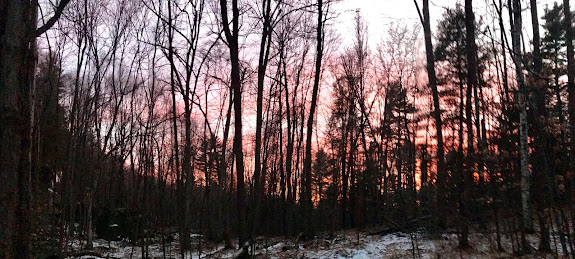
Now after sunset the light of the western sky – the outlines of pines.


December 25

December 25, 2018

P. M. —Up river on ice to Fair Haven Pond and across to Walden. 

The ground is still for the most part bare. Such a December is at least as hard a month to get through as November. You come near eating your heart now.

There is a good deal of brown or straw-color in the landscape now, especially in the meadows, where the ranker grasses, many of them uncut, still stand. They are bleached a shade or two lighter. Looking from the sun, there is a good deal of warm sunlight in them. 

I see where one farmer has been getting this withered sedge on the ice within a day or two for litter, in a meadow which had not been cut. Of course he could not cut very close. 

The ice on the river is about half covered with light snow, it being drifted thus, as usual, by the wind. (On Walden, however, which is more sheltered, the ice is uniformly covered and white.) I go running and sliding from one such snow-patch to another. It is easiest walking on the snow, which gives a hold to my feet, but I walk feebly on the ice. It is so rough that it is but poor sliding withal. 

I see, in the thin snow along by the button-bushes and willows just this side of the Hubbard bridge, a new track to me, looking even somewhat as if made by a row of large rain-drops, but it is the track of some small animal. The separate tracks are at most five eighths of an inch in diameter, nearly round, and one and three quarters to two inches apart, varying perhaps half an inch from a straight line. Sometimes they are three or four inches apart. The size is but little larger than that of a mouse, but it is never like a mouse. Goodwin, to whom I described it, did not know what it could be. 

The sun getting low now, say at 3.30, I see the ice green, southeast. 

Goodwin says that he once had a partridge strike a twig or limb in the woods as she flew, so that she fell and he secured her. 

Going across to Walden, I see that the fuzzy purple wool-grass is now bleached to a dark straw-color with out any purple. 

I notice that a fox has taken pretty much my own course along the Andromeda Ponds. 

The sedge which grows in tufts eighteen or twenty inches high there is generally recurving. 

I see that the shiners which Goodwin is using for bait to-day have no longitudinal dark bar or line on their sides, such as those minnows of the 11th and 18th had. Yet I thought that by the position of their fins, etc., the latter could not be the banded minnow. 

Walden at length skimmed over last night, i. e. the two holes that remained open. One was very near the middle and deepest part, the other between that and the railroad. 

Now that the sun is setting, all its light seems to glance over the snow-clad pond and strike the rocky shore under the pitch pines at the northeast end. Though the bare rocky shore there is only a foot or a foot and a half high as I look, it reflects so much light that the rocks are singularly distinct, as if the pond showed its teeth. 

I stayed later to hear the pond crack, but it did not much. 

December 25, 2019
How full of soft, pure light the western sky now, after sunset! I love to see the outlines of the pines against it. Unless you watch it, you do not know when the sun goes down. It is like a candle extinguished without smoke. A moment ago you saw that glittering orb amid the dry oak leaves in the horizon, and now you can detect no trace of it. In a pensive mood I enjoy the complexion of the winter sky at this hour.

Those small sphagnous mountains in the Andromeda Ponds are grotesque things. Being frozen, they bear me up like moss-clad rocks and make it easy getting through the water-brush. 

But for all voice in that serene hour I hear an owl hoot. How glad I am to hear him rather than the most eloquent man of the age! 

I saw a few days ago the ground under a swamp white oak in the river meadow quite strewn with brown dry galls about as big as a pea and quite round, like a small fruit which had fallen from it.

H. D. Thoreau, Journal, December 25, 1858

As hard a month to get through as November. You come near eating your heart now.
See November 27, 1853 ("Now a man will eat his heart, if ever, now while the earth is bare, barren and cheerless, and we have the coldness of winter without the variety of ice and snow"); November 25, 1857 (“November Eatheart, — is that the name of it? “)

Looking from the sun, there is a good deal of warm sunlight in them. See January 4, 1858 (“It is surprising how much sunny light a little straw that survives the winter will reflect . . .
That bright and warm reflection of sunlight from the insignificant edging of stubble”)

I notice that a fox has taken pretty much my own course along the Andromeda Ponds. See December 13, 1859 ("I see that the fox too has already taken the same walk before me, just along the edge of the button-bushes, where not even he can go in the summer.”)

The shiners which Goodwin is using for bait to-day have no longitudinal dark bar or line on their sides. See March 29, 1854 ("poised over the sand on invisible fins, the outlines of a shiner. . . distinct longitudinal light-colored line midway along their sides and a darker line below it”); July 16, 1856 ("I see many young shiners (?) (they have the longitudinal bar)"): July 17, 1856 (“They have . . . a broad, distinct black band along sides (which methinks marks the shiner)"); December 11, 1858 (“a minnow — apparently a young shiner, but it has a dark longitudinal line along side ”); December 18, 1858 (“They are little shiners with the dark longitudinal stripe”)

The sun getting low now, say at 3.30, I see the ice green, southeast. See January 7, 1856 (“Returning just before sunset, the few little patches of ice look green as I go from the sun . . .It is probably a constant phenomenon in cold weather when the ground is covered with snow and the sun is low, morning or evening, and you are looking from it.”); February 12, 1860 ("Returning just before sunset, I see the ice beginning to be green.”)

Walden at length skimmed over last night, i. e. the two holes that remained open. See note to December 20, 1858 (“Walden is frozen over, except two small spots, less than half an acre in all, in middle.”); 
December 22, 1858 (“The pond is no more frozen than on the 20th.”); December 24, 1858 ("Those two places in middle of Walden not frozen over yet, though it was quite cold last night! "); December 28, 1858 (“The ice is about six inches thick.”) See also December 25, 1859 ("The last our coldest night, as yet. No doubt Walden froze over last night entirely.") and A Book of the Seasons, by Henry Thoreau, Annual ice-in at Walden

Now that the sun is setting, all its light seems to glance over the snow-clad pond and strike the rocky shore under the pitch pines at the northeast end.
See December 25, 1858 ("That rocky shore under the pitch pines which so reflects the light, is only three feet wide by one foot high")

Unless you watch it, you do not know when the sun goes down.  See December 25, 1851 (“I go forth to see the sun set. Who knows how it will set, even half an hour beforehand ?”); See also July 20, 1852 (“We see the first star in the southwest, and know not how much earlier we might have seen it had we looked.”)

How full of soft, pure light the western sky now, after sunset! I love to see the outlines of the pines against it.
Full of soft pure light
western sky after sunset –
the outlines of pines.


See December 3, 1856   ("The pine forest's edge seen against the winter horizon"); December 12, 1859 ("The night comes on early these days, and I soon see the pine tree tops distinctly outlined against the dun (or amber) but cold western sky."); December 20, 1851 (In the west the sun goes down apace behind glowing pines, and golden clouds like mountains skirt the horizon."); January 5, 1853 ("A fine rosy sky in the west after sunset; and later an amber-colored horizon, in which a single tree-top showed finely."); January 9, 1859 ("It is worth the while to stand here at this hour and look into the soft western sky, over the pines whose outlines are so rich and distinct against the clear sky."); January 19, 1859 ("It occurs to me that I know of no more agreeable object to bound our view . . . than the pyramidal tops of a white pine forest in the horizon.");  See also October 20, 1858 ("There is one advantage in walking eastward these afternoons, at least, that in returning you may have the western sky before you.");   December 8, 1854 (“There is a glorious clear sunset sky, soft and delicate and warm”); December 9, 1859 (“I observe at mid-afternoon that peculiarly softened western sky . . . giving it a slight greenish tinge.”); December 11, 1854 ("I see the sun setting far through the woods, and there is that peculiar clear vitreous greenish sky in the west, as it were a molten gem.The day is short; it seems to be composed of two twilights merely"); December 18, 1853 (“The western hills, these bordering it, seen through the clear, cold air, have a hard, distinct edge against the sunset sky.”); January 17, 1852 (“In proportion as I have celestial thoughts, is the necessity for me to be out and behold the western sky sunset these winter days")

Clear yellow light of
the western sky reflected
from the smooth water.

Night comes on early.  
Pine tree tops outlined against
the cold western sky,

To look over pines
so rich and distinct into
the soft western sky.
January 9, 1859

The unclouded mind,
serene, pure, ineffable
like the western sky.

See also A Book of the Seasons,  by Henry Thoreau, the Western Sky

I hear an owl hoot. How glad I am to hear him. See November 18, 1851 ("I rejoice that there are owls. . . . This sound faintly suggests the infinite roominess of nature”); January 7, 1854 (“It is a sound which the wood or horizon makes”) See also A Book of Seasons, by Henry Thoreau, The Voice of the Barred Owl

December 25.  See A Book of the Seasons,  by Henry Thoreau, December 25


Now after sunset
the light of the western sky –
the outlines of pines.

I hear an owl hoot.
How glad I am to hear him
in this serene hour.


A Book of the Seasons
,  by Henry Thoreau, 
"A book, each page written in its own season,
out-of-doors, in its own locality.”
~edited, assembled and rewritten by zphx © 2009-2024

https://tinyurl.com/hdt-581225

Tuesday, December 18, 2018

The pond is frozen about the edges.


December 18. 

December 18, 2018

P. M. — To Walden. 

The pond is merely frozen a little about the edges. I see various little fishes lurking under this thin, transparent ice, close up to the edge or shore, especially where the shore is flat and water shoal. 

They are little shiners with the dark longitudinal stripe, about an inch and a half long, perch, and one pickerel about a foot long. They are all a peculiar rich-brown color seen thus through the ice. They love to get up as close to the shore as possible, and when you walk along you scare them out. 

I cast a stone on the ice over a perch six inches long, thinking only to stun it, but killed it so. 

The ice is about one inch thick. I notice that it is firmly frozen to the shore, so that there is no rise and fall as when it was water, or at least nothing equal to that, but the ice has been cracked with a great many parallel cracks six inches to a foot from the shore. Yet apparently no water has oozed out there. 

Minott tells how he used to love to walk through swamps where great white pines grew and hear the wind sough in their tops. He recalls this now as he crouches over his stove, but he adds that it was dangerous, for even a small dead limb broken off by the wind and falling from such a height would kill a man at once.

H. D. Thoreau, Journal, December 18, 1858

This thin, transparent ice, close up to the edge or shore. See December 19, 1856 ("The ice is now from two and a half to three inches thick, a transparent green ice, through which I see the bottom.")

I cast a stone on the ice over a perch six inches long, thinking only to stun it. See December 2, 1857 ("I observed two painted tortoises moving about under the thin transparent ice. When I broke it with my fist over each in succession, it was stunned by the blow.")

Minott tells how he used to love to walk through swamps where great white pines grew and hear the wind sough in their tops He recalls this now as he crouches over his stove. See October 4, 1851 ("He loves to walk in a swamp in windy weather and hear the wind groan through the pines."); February 29, 1856 ("I willingly listen to the stories he has told me half a dozen times already.“); February 20, 1857 ("Minott always sits in the corner behind the door, close to the stove, with commonly the cat by his side. See also April 3, 1854 ("This is methinks the first hazy day, and the sough of the wind in the pines sounds warmer, whispering of summer.")

Tuesday, December 11, 2018

Walden is about one-third skimmed over.

December 11. 

P. M. — To Walden. 

An overcast afternoon and rather warm. The snow on the ground in pastures brings out the warm red in leafy oak woodlands by contrast. These are what Thomson calls “the tawny copse.” So that they suggest both shelter and warmth. All browns, indeed, are warmer now than a week ago. These oak woodlands half a mile off, commonly with pines intermingled, look like warm coverts for birds and other wild animals. How much warmer our woodlands look and are for these withered leaves that still hang on! Without them the woods would be dreary, bleak, and wintry indeed.  Here is a manifest provision for the necessities of man and the brutes. These leaves remain to keep us warm, and to keep the earth warm about their roots. 

While the oak leaves look redder and warmer, the pines look much darker since the snow has fallen (the hemlocks darker still). A mile or two distant they are dark brown, or almost black, as, still further, is all woodland, and in the most distant horizon have a blue tinge like mountains, from the atmosphere. The boughs of old and bare oak woods are gray and in harmony with the white ground, looking as if snowed on. 

Already, in hollows in the woods and on the sheltered sides of hills, the fallen leaves are collected in small heaps on the snow-crust, simulating bare ground and helping to conceal the rabbit and partridge, etc. They are not equally diffused, but collected together here and there as if for the sake of society. 

I find at the Pout’s Nest, now quite frozen over, air-holes and all, twenty-two pollywogs frozen in and dead within a space of two and a half feet square, also a minnow — apparently a young shiner, but it has a dark longitudinal line along side (about an inch and a half long)—with the bream.

The terminal shoots of the small scarlet oaks are still distinctly red, though withered. 

A “swirl,” applied to leaves suddenly caught up by a sort of whirlwind, is a good word enough, methinks. 

Walden is about one-third skimmed over. It is frozen  nearly half the way out from the northerly shore, excepting a very broad open space on the northwest shore and a considerable space at the pines at the northeast end; but the ice, thin as it is, extends quite across from the northwest side to the southwest cape (west side of the railroad bay) by an isthmus only two or three rods wide in its narrowest part. 

It is evident that whether a pond shall freeze this side or that first depends much on the wind. If it is small and lies like Walden between hills, I should expect that in perfectly calm weather it would freeze soonest along the south shore, but in this case there was probably wind from the north or northwest, and the more sheltered and smooth north side froze first.

The warmth reflected from the pines at the northeast corner may account for the open water there, but I can not account for the open space of the northwest end. [It must be because it is there open to the rake of the north Wind. the shore being flat and gently sloping backward a long way, while the protection of Heywood‘s Peak may account for the ice isthmus being met by the break-wind of the west railroad cape.]

It is remarkable that the south edge of the ice projects southward in a cape corresponding to the deep triangular bay in the south side, though it is in the middle of the pond, and there is even a rude correspondence else where along the edge of the ice to the opposite shore.  This might seem to indicate that the ice to some extent formed first over deepest water. 

When the ice was melting and the trees dripping, on the morning of the 6th, I noticed that the snow was discolored, — stained yellow by this drip, — as if the trees were urinating. 

The large scarlet oak in the cemetery has leaves on the lower limbs near the trunk just like the large white oaks now. So has the largest black oak which I see. Others of both, and all, kinds are bare. 

Some, being offended, think sharp and satirical things, which yet they are not prepared consciously to utter. But in some unguarded moment these things escape from them, when they are as it were unconscious. They betray their thoughts, as it were by talking in their sleep, for the truth will out, under whatever veil of civility.

H.D. Thoreau, Journal, December 11, 1858


Already, in hollows in the woods and on the sheltered sides of hills, the fallen leaves are collected in small heaps on the snow-crust. See December 9, 1856 ("Coming through the Walden woods, I see already great heaps of oak leaves collected in certain places on the snow-crust by the roadside, where an eddy deposited them."); January 28, 1857 ("Notice many heaps of leaves on snow on the hillside southwest of the pond, as usual.");  February 4, 1856 ("The oak leaves which have blown over the snow are collected in dense heaps on the still side of the bays at Walden, where I suspect they make warm beds for the rabbits to squat on.").. Also  January 7, 1857 ("Though the rest of the broad path is else perfectly unspotted white, each track of the fox has proved a trap which has caught from three or four to eight or ten leaves each."); January 8, 1852 ("almost every track which I made yesterday in the snow - perhaps ten inches deep - has got a dead leaf in it, though none is to be seen on the snow around.")

Walden is about one-third skimmed over. See December 9, 1856 ("There is scarcely a particle of ice in Walden yet, and that close to the edge, apparently, on the west and northwest sides. . . .This is, no doubt, owing solely to the greater depth of Walden."); December 19,1856 ("Walden froze completely over last night.This is very sudden, for on the evening of the 15th there was not a particle of ice in it. In just three days, then, it has been completely frozen over, and the ice is now from two and a half to three inches thick, a transparent green ice, through which I see the bottom where it is seven or eight feet deep."); December 20, 1858 (“Walden is frozen over, except two small spots, less than half an acre in all, in middle.”) December 21, 1855 (“Walden is skimmed over, all but an acre, in my cove.”); December 21, 1854 (“Walden is frozen over, apparently about two inches thick.”)


It is evident that whether a pond shall freeze this side or that first depends much on the wind. See December 29, 1855 ("Am surprised to find eight or ten acres of Walden still open, notwithstanding the cold of the 26th, 27th, and 28th and of to-day. It must be owing to the wind partly."); December 30, 1853 ("The pond [Walden] not yet frozen entirely over; about six acres open, the wind blew so hard last night.");


Wednesday, October 3, 2018

The maples about Walden are quite handsome now.

October 3

One brings me this morning a Carolina rail alive, this year’s bird evidently from its marks. He saved it from a cat in the road near'the Battle-Ground. On being taken up, it peeked a little at first, but was soon quiet. It staggers about as if weak on my window sill and pecks at the glass, or stands with its eyes shut, half asleep, and its back feathers hunched up. Possibly it is wounded. I suspect it may have been hatched here. Its feet are large and spreading, qualifying it to run on mud or pads. Its crown is black, but chin white, and its back feathers are distinctly edged with white in streaks. 

I compare my hazelnuts gathered some time ago. The beaked are pointed nuts, while the common are blunt; and the former are a much paler brown, also have a yellower and much sweeter meat. 

A fringed gentian, plucked day before yesterday, at length, this forenoon, untwists and turns its petals partially, in my chamber.

Have noticed a very brilliant scarlet blackberry patch within a week. 

The red maples which changed first, along the river, are now faded and partly fallen. They look more pink. But others are lit, and so there is more color than before. Some particular maple among a hundred will be of a peculiarly bright and pure scarlet, and, by its difference of tint and intenser color, attract our eyes even at a distance in the midst of the crowd. Looking all around Fair Haven Pond yesterday, where the maples were glowing amid the evergreens, my eyes invariably rested on a particular small maple of the purest and intensest scarlet. 

P. M. — Paddle about Walden. 

As I go through the Cut, I discover a new locality for the crotalaria, being attracted by the pretty blue-black pods, now ripe and dangling in profusion from these low plants, on the bare sandy and gravelly slope of the Cut. The vines or plants are but half a dozen times longer (or higher) than the pods. It was the contrast of these black pods with the yellowish sand which betrayed them.

How many men have a fatal excess of manner! There was one came to our house the other evening, and behaved very simply and well till the moment he was passing out the door. He then suddenly put on the airs of a well-bred man, and consciously described some are of beauty or other with his head or hand. It was but a slight flourish, but it has put me on the alert. 

It is interesting to consider how that crotalaria spreads itself, sure to find out the suitable soil. One year I find it on the Great Fields and think it rare; the next I find it in a new and unexpected place. It flits about like a flock of sparrows, from field to field. 

The maples about Walden are quite handsome now. Standing on the railroad, I look across the pond to Pine Hill, where the outside trees and the shrubs scattered generally through the wood glow through the green, yellow, and scarlet, like fires just kindled at the base of the trees, — a general conflagration just fairly under way, soon to envelop every tree. The hillside forest is all aglow along its edge and in all its cracks and fissures, and soon the flames will leap upward to the tops of the tallest trees. About the pond I see maples of all their tints, and black birches (on the southwest side) clear pale yellow; and on the peak young chestnut clumps and walnuts are considerably yellowed. 

I hear, out toward the middle, or a dozen rods from me, the plashing made apparently by the shiners, — for they look and shine like them, — leaping in schools on the surface. Many lift themselves quite out for a foot or two, but most rise only part way out, — twenty black points at once. There are several schools indulging in this sport from time to time as they swim slowly along. This I ascertain by paddling out to them. Perhaps they leap and dance in the water just as gnats dance in the air at present. I have seen it before in the fall. Is it peculiar to this season? 

Hear a hylodes peeping on shore. 

A general reddening now of young and scrub oaks. Some chinquapin bright-red. 

White pines fairly begin to change. 

The large leaves of some black oak sprouts are dark-purple, almost blackish, above, but greenish beneath. 

See locust leaves all crisped by frost in Laurel Glen Hollow, but only part way up the bank, as on the shore of a lake.

H. D. Thoreau, Journal, October 3, 1858

A Carolina rail alive. Its crown is black, but chin white, and its back feathers are distinctly edged with white in streaks. Compare September 18, 1858 ("In R. Virginianus. . . the crown and whole upper parts are black, streaked with brown; the throat, breast, and belly, orange-brown; sides and vent, black tipped with white; legs and feet, dark red-brown; none of which is true of the R. Carolinus.")

The beaked are pointed nuts, while the common are blunt. See September 9, 1858 ("I find an abundance of beaked hazelnuts at Blackberry Steep, one to three burs together, but, gathering them, I get my fingers full of fine shining bristles, while the common hazel burs are either smooth or covered with a softer glandular down; i. e., its horns are brazen tipped.")

A fringed gentian, plucked day before yesterday, at length, this forenoon, untwists and turns its petals partially, in my chamber.See October 1, 1858 ("The fringed gentians are now in prime. . . .They who see them closed, or in the afternoon only, do not suspect their beauty.")

Have noticed a very brilliant scarlet blackberry patch within a week. See September 23, 1854 ("Low blackberry vines generally red. "); September 25, 1854 ("I am detained by the very bright red blackberry leaves strewn along the sod")

Some particular maple among a hundred will be of a peculiarly bright and pure scarlet, and, by its difference of tint and intenser color, attract our eyes even at a distance in the midst of the crowd. See September 25, 1857 (“A single tree becomes the crowning beauty of some meadowy vale and attracts the attention of the traveller from afar.”); September 26, 1854 ("Some single red maples are very splendid now, the whole tree bright-scarlet against the cold green pines; now, when very few trees are changed, a most remarkable object in the landscape; seen a mile off. "); September 27, 1855 ("Some single red maples now fairly make a show along the meadow. I see a blaze of red reflected from the troubled water.");  September 27, 1857 (“At last, its labors for the year being consummated and every leaf ripened to its full, it flashes out conspicuous to the eye of the most casual observer, with all the virtue and beauty of a maple, – Acer rubrum.”); October 8, 1852 (“Nothing can exceed the brilliancy of some of the maples which stand by the shore and extend their red banners over the water.”);)

I discover a new locality for the crotalaria, being attracted by the pretty blue-black pods, now ripe and dangling in profusion from these low plants, on the bare sandy and gravelly slope of the Cut. See October 3, 1856 ("I detect the crotalaria behind the Wyman site, by hearing the now rattling seeds in its pods as I go through the grass, like the trinkets about an Indian's leggins, or a rattlesnake.")

Hear a hylodes peeping on shore. See October 3, 1852 ("I hear a hylodes (?) from time to time.")

 White pines fairly begin to change. See October 3, 1852 ("The pine fall, i.e. change, is commenced, and the trees are mottled green and yellowish."); October 3, 1856 ("The white pines are now getting to be pretty generally parti-colored, the lower yellowing needles ready to fall.") See also November 9, 1850 (" I expect to find that it is only for a few weeks in the fall after the new leaves have done growing that there are any yellow and falling, — that there is a season when we may say the old pine leaves are now yellow, and again, they are fallen."); See also A Book of the Seasons, by Henry Thoreau, The October Pine Fall


Popular Posts Last 30 Days.

The week ahead in Henry’s journal

The week ahead in Henry’s journal
A journal, a book that shall contain a record of all your joy.
"A stone fruit. Each one yields me a thought." ~ H. D. Thoreau, March 28, 1859


I sit on this rock
wrestling with the melody
that possesses me.