Showing posts with label rue anemone. Show all posts

Tuesday, June 9, 2020

I have come with a spy-glass to look at the hawks


4. 30 A. M.— To Nawshawtuct by boat.

A prevalent fog, though not quite so thick as the last described.

It is a little more local, for it is so thin southwest of this hill that I can see the earth through it, but as thick as before northeast. Yet here and there deep valleys are excavated in it, as painters imagine the Red Sea for the passage of Pharaoh's host, wherein trees and houses appear as it were at the bottom of the sea.

What is peculiar about it is that it is the tops of the trees which you see first and most distinctly, before you see their trunks or where they stand on earth.

Far in the northeast there is, as before, apparently a tremendous surf breaking on a distant shoal. It is either a real shoal, i. e. a hill over which the fog breaks, or the effect of the sun's rays on it. 


I was amused by the account which Mary, the Irish girl who left us the other day, gave of her experience at-- the milkman's, in the north part of the town. She said that twenty-two lodged in the house the first night, including two pig men, that Mr. —-kept ten men, had six children and a deaf wife, and one of the men had his wife with him, who helped sew, beside taking care of her own child. Also all the cooking and washing for his father and mother, who live in another house and whom he is bound to carry through, is done in his house, and she, Mary, was the only girl they hired; and the workmen were called up at four by an alarm clock which was set a quarter of an hour ahead of the clock down stairs, — and that more than as much ahead of the town clock, — and she was on her feet from that hour till nine at night. Each man had two pairs of overalls in the wash, and the cans to be scalded were countless. Having got through washing the breakfast dishes by a quarter before twelve, Sunday noon, by — ' s time, she left, no more to return. He had told her that the work was easy, that girls had lived with him to recover their health, and then went away to be married. He is regarded as one of the most enterprising and thrifty farmers in the county, and takes the premiums of the Agricultural Society. He probably exacts too much of his hands.
June 9, 2023

The steam of the engine streaming far behind is regularly divided, as if it were the vertebræ of a serpent, probably by the strokes of the piston.

The reddish seeds or glumes of grasses cover my boots now in the dewy or foggy morning.

The diervilla out apparently yesterday.

The first white lily bud.

White clover is abundant and very sweet on the common, filling the air, but not yet elsewhere as last year.


8 A. M. – To Orchis Swamp; Well Meadow.

Hear a goldfinch; this the second or third only that I have heard.

Whiteweed now whitens the fields.

There are many star flowers. I remember the anemone, especially the rue anemone, which is not yet all gone, lasting longer than the true one above all the trientalis, and of late the yellow Bethlehem-star, and perhaps others.

I have come with a spy-glass to look at the hawks. They have detected me and are already screaming over my head more than half a mile from the nest.

I find no difficulty in looking at the young hawk (there appears to be one only, standing on the edge of the nest), resting the glass in the crotch of a young oak. I can see every wink and the color of its iris.

It watches me more steadily than I it, now looking straight down at me with both eyes and outstretched neck, now turning its head and looking with one eye.

How its eye and its whole head express anger! Its anger is more in its eye than in its beak.

It is quite hoary over the eye and on the chin.

The mother meanwhile is incessantly circling about and above its charge and me, farther or nearer, sometimes withdrawing a quarter of a mile, but occasionally coming to alight for a moment almost within gunshot, on the top of a tall white pine; but I hardly bring my glass fairly to bear on her, and get sight of her angry eye through the pine-needles, before she circles away again.

Thus for an hour that I lay there, screaming every minute or oftener with open bill. Now and then pursued by a kingbird or a blackbird, who appear merely to annoy it by dashing down at its back.

Meanwhile the male is soaring, apparently quite undisturbed, at a great height above, evidently not hunting, but amusing or recreating himself in the thinner and cooler air, as if pleased with his own circles, like a geometer, and enjoying the sublime scene.

I doubt if he has his eye fixed on any prey, or the earth. He probably descends to hunt.


Got two or three handfuls of strawberries on Fair Haven. They are already drying up.

The huckleberry bedbug-smelling bug is on them.It is natural that the first fruit which the earth bears should emit and be as it were an embodiment of that vernal fragrance with which the air has teemed.

Strawberries are its manna, found ere long where that fragrance has filled the air. Little natural beds or patches on the sides of dry hills, where the fruit sometimes reddens the ground. But it soon dries up, unless there is a great deal of rain.

Well, are not the juices of early fruit distilled from the air? 


Prunella out.

The meadows are now yellow with the golden senecio, a more orange yellow, mingled with the light glossy yellow of the buttercup.

The green fruit of the sweet-fern now.

The Juniperus repens appears, though now dry and effete, to have blossomed recently.

The tall white Erigeron annuus ( ? ), for this is the only one described as white tinged with purple, just out.

The bullfrogs are in full blast to-night.

I do not hear a toad from my window; only the crickets beside. The toads I have but rarely heard of late. So there is an evening for the toads and another for the bullfrogs.


H. D. Thoreau, Journal, June 9, 1853

June 9, 2013

The steam of the engine streaming far behind is regularly divided, as if it were the vertebræ of a serpent.  
See December 25, 1851 ("If there is not something mystical in your explanation, something unexplainable to the understanding, some elements of mystery, it is quite insufficient.  . . Just as inadequate to a pure mechanic would be a poet's account of a steam-engine.") See also A Book of the Seasons, by Henry Thoreau, The Steam of the Engine

I have come with a spy-glass to look at the hawks. See June 8, 1853 ("At length I detect the nest about eighty feet from the ground, in a very large white pine by the edge of the swamp. It is about three feet in diameter, of dry sticks, and a young hawk, apparently as big as its mother, stands on the edge of the nest looking down at me")

So there is an evening for the toads and another for the bullfrogs.  See June 13, 1851 ("The different frogs mark the seasons pretty well,- the peeping hyla, the dreaming frog, and the bullfrog."); See also  June 1, 1853 ("The birds have now all come and no longer fly in flocks. The hylodes are no longer heard. The bullfrogs begin to trump.”); June 11, 1853 ("Another fog this morning. The mosquitoes first troubled me a little last night. On the river at dusk I hear the toads still, with the bullfrogs.");  June 15, 1860 ("A new season begun. The bullfrogs now commonly trump at night, and the mosquitoes are now really troublesome. For some time I have not heard toads by day, and the hylodes appear to have done.")

The meadows are now yellow with the golden senecio, a more orange yellow, mingled with the light glossy yellow of the buttercup. See May 23, 1853 ("I am surprised by the dark orange-yellow of the senecio. At first we had the lighter, paler spring yellows of willows, dandelion, cinquefoil, then the darker and deeper yellow of the buttercup; and then this broad distinction between the buttercup and the senecio, as the seasons revolve toward July."); June 6, 1858 ("Golden senecio is not uncommon now") See also A Book of the Seasons,  by Henry Thoreau, The Golden Senecio

Sunday, May 1, 2016

Crescents of bright brick red above and amid a maze of ash-colored branches.

May 1


6 P. M. —To Hill. 

I judge that the larch blossomed when the anthers began to be loose and dry and yellow on their edges. Say then the 28th. 

The water on the meadows is rapidly going down. I am now confined to the river for the most part. The water begins to feel as warm or warmer than the air when cool. 

The scrolls of the ferns clothed in wool at Sassafras Shore, five or six inches high. 


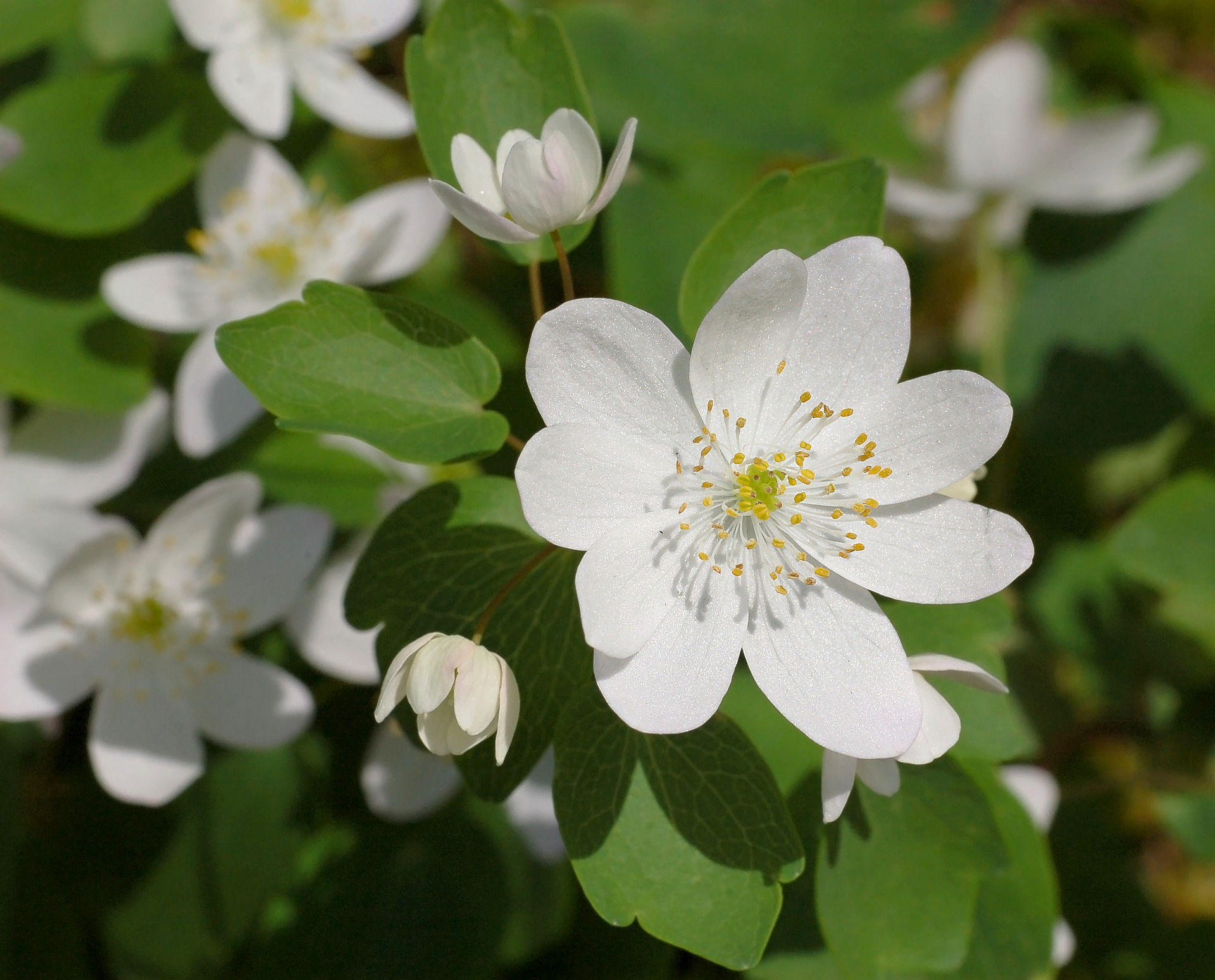
Rue Anemone Thalictrum thalictroides Flower 2479px.jpg
(Originally described as Anemone thalictroides by Linnaeus in 1753 )
Wikipedia

Thalictrum anemonoides well out, probably a day or two, same shore, by the apple trees. 

Viola ovata on southwest side of hill, high up near pines. 

How pleasing that early purple grass in smooth water! Half a dozen long, straight purple blades of different lengths but about equal width, close together and exactly parallel, resting flat on the surface of the water. There is something agreeable in their parallelism and flatness. 

From the hilltop I look over Wheeler’s maple swamp. The maple-tops are now, I should say, a bright brick red. It is the red maple’s reign now, as the peach and the apple will have theirs. Looking over the swamps a quarter of a mile distant, you see dimly defined crescents of bright brick red above and amid a maze of ash-colored branches.

H. D. Thoreau, Journal, May 1, 1856

I judge that the larch blossomed when the anthers began to be loose and dry and yellow on their edges. Say then the 28th. . . . See April 23, 1855 ("The anthers of the larch are conspicuous, but I see no pollen.”) April 24, 1854 ("The larch will apparently blossom in one or two days at least, both its low and broad purple-coned male flowers and its purple-tipped female cones.”); April 25, 1856 ("Larch not yet sheds pollen.”);  April 27, 1856  ("I find none of Monroe’s larch buds shedding pollen, but the anthers look crimson and yellow, and the female flowers are now fully expanded and very pretty, but small. I think it will first scatter pollen to-morrow.”)  April 29, 1855 (“A few of the cones within reach on F. Monroe’s larches shed pollen; say, then, yesterday The crimson female flowers are now handsome but small); April 29, 1856 ("Monroe’s larch staminate buds have now erected and separated their anthers, and they look somewhat withered, as if they had shed a part of their pollen. If so, they began yesterday. ”); April 30, 1857 (“The larch plucked yesterday sheds pollen to-day in house, probably to-day abroad.”)  See also A Book of the Seasons,  by Henry Thoreau the Larch in Spring

It is the red maple’s reign now. . .  See April 24, 1857 ("I see the now red crescents of the red maples in their prime . . . above the gray stems."); April 28, 1855 ("The red maples, now in bloom, are quite handsome at a distance over the flooded meadow beyond Peter’s. The abundant wholesome gray of the trunks and stems beneath surmounted by the red or scarlet crescents.”)  April 26, 1855 ("The blossoms of the red maple (some a yellowish green) are now most generally conspicuous and handsome scarlet crescents over the swamps. “);May 1, 1855 ("The maples of Potter’s Swamp, seen now nearly half a mile off against the russet or reddish hillside, are a very dull scarlet, like Spanish brown . . .”); May 7, 1854 (A spreading red maple in bloom, seen against a favorable background, as water looking down from a hillside, presenting not a dense mass of color but an open, graceful and ethereal top of light crimson or scarlet . . .”).

Thalictrum anemonoides [rue-anemone] well out, probably a day or two, same shore, by the apple trees. See May 1, 1855 ("Thalictrum anemonoides at Conant Cliff. Did not look for pollen.”). See also April 8, 1859 ("The earliest peculiarly woodland herbaceous flowers are epigaea, anemone, thalictrum, and — by the first of May — Viola pedata.”); April 27, 1860 (“Thalictrum anemonoides are abundant, maybe two or three days, at Blackberry Steep”); May 5, 1854 (“Thalictrum anemonoides by Brister's Spring on hillside.”); May 5, 1860 (“Anemone and Thalictrum anemonoides are apparently in prime about the 10th of May.”);  May 11, 1854 (“The Thalictrum anemonoides is a perfect and regular white star..”)

How pleasing that early purple grass in smooth water! See April 29, 1855 ("That lake grass — or perhaps I should call it purple grass — is now apparently in perfection on the water.” . . . )

Monday, May 5, 2014

The peculiarly beautiful clean and tender green of the grass there! –The grassy season's beginning


May 5

May 3d and 4th, it rained again, especially hard the night of the 4th, and the river is now very high, far higher than in any other freshet this year; will reach its height probably tomorrow.

Hear what I should call the twitter and mew of a goldfinch  and see the bird go over with ricochet flight. 

The oak leaves apparently hang on till the buds fairly expand.  

Thalictrum anemonoides by Brister's Spring on hillside.

False Hellebore. April 28, 2019
Some skunk-cabbage leaves are now eight or nine inches wide near there. These and the hellebore make far the greatest show of any herbs yet.

The peculiarly beautiful clean and tender green of the grass there!  

May 5, 2022

Green herbs of all kinds, — tansy, buttercups, etc., etc., etc., now make more or less show. Put this with the grassy season's beginning.  

Have not observed a tree sparrow for four or five days.

The Emerson children found blue and white violets May 1st at Hubbard's Close, probably Viola ovata and blanda; but I have not been able to find any yet.

H. D. Thoreau, Journal, May 5, 1854

The river is now very high, far higher than in any other freshet this year; will reach its height probably tomorrow.
See May 7, 1854 ("Our principal rain this spring was April 28th, 29th, and 30th, and again, May 3d and 4th . . . The causeways being flooded, I have to think before I set out on my walk how I shall get back across the river.")

Have not observed a tree sparrow for four or five days. See April 23, 1854 ("A rain is sure to bring the tree sparrow and hyemalis to the gardens."); May 4, 1855 ("See no gulls, nor F. hyemalis nor tree sparrows now.") See also A Book of the Seasons, by Henry Thoreau, the Tree Sparrow

Thalictrum anemonoides [Rue Anemone] by Brister's Spring on hillside. See note to May 1, 1856 ("Thalictrum anemonoides well out, probably a day or two . . .by the apple trees. ")

Skunk-cabbage leaves . . .a nd the hellebore make far the greatest show of any herbs yet.
See note to April 26, 1860 ("The hellebore now makes a great garden of green under the alders and maples there, five or six rods long and a foot or more high.It grows thus before these trees have begun to leaf, while their numerous stems serve only to break the wind but not to keep out the sun. It is the greatest growth, the most massive, of any plant's; now ahead of the cabbage. Before the earliest tree has begun to leaf it makes conspicuous green patches a foot high."). See allso A Book of the Seasons, by Henry Thoreau, the Skunk Cabbage

Green herbs of all kinds . . . now make more or less show. See May 6, 1860 ("As the leaves are putting forth on the trees, so now a great many herbaceous plants are springing up in the woods and fields.")

The grassy season's beginning. See April 9, 1854 ("As yet the landscape generally wears its November russet."); April 14, 1854 ("There is a general tinge of green now discernible through the russet on the bared meadows and the hills, the green blades just peeping forth amid the withered ones"); April 23, 1854 ("How thickly the green blades are starting up amid the russet! The tinge of green is gradually increasing in the face of the russet earth."); April 28, 1854 ("Perhaps the greenness of the landscape may be said to begin fairly now . . . during the last half of April the earth acquires a distinct tinge of green, which finally prevails over the russet."); May 26, 1854 (" The season of grass, now everywhere green and luxuriant.") See also A Book of the Seasons, by Henry Thoreau, the Brown Season


The Emerson children found blue and white violets May 1st at Hubbard's Close, probably Viola ovata and blanda; but I have not been able to find any yet.
 See April 23, 1858 ("Saw a Viola blanda in a girl's hand."); April 19, 1858 (Viola ovata . . . Edith Emerson found them there yesterday"); May 7, 1852 ("That little early violet close to the ground in dry fields and hillsides, which only children's eyes detect"); February 5, 1852 ("I suspect that the child plucks its first flower with an insight into its beauty and significance which the subsequent botanist never retains.")

May 5. See A Book of the Seasons, by Henry Thoreau, May 5

The peculiarly
beautiful clean and tender
green of the grass there!

A Book of the Seasons,  by Henry Thoreau, 
"A book, each page written in its own season,
out-of-doors, in its own locality.”
~edited, assembled and rewritten by zphx © 2009-2024
https://tinyurl.com/hdt-540505

Song of the wood thrush
between evening rain showers
and white trillium.
Zphx20240505.


Popular Posts Last 30 Days.

The week ahead in Henry’s journal

The week ahead in Henry’s journal
A journal, a book that shall contain a record of all your joy.
"A stone fruit. Each one yields me a thought." ~ H. D. Thoreau, March 28, 1859


I sit on this rock
wrestling with the melody
that possesses me.