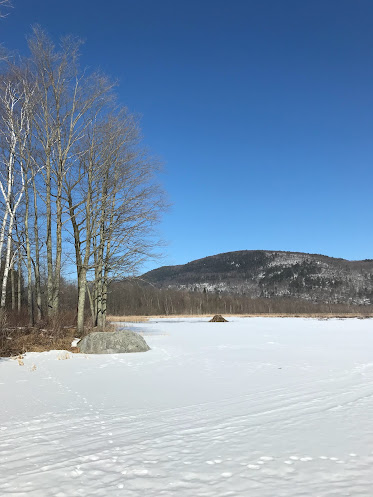
Why should just these sights and sounds
accompany our life?
accompany our life?
I would fain explore
the mysterious relation
the mysterious relation
between myself and these things.
I would at least know
what these things unavoidably are, know
why just this circle of creatures completes the world.
what these things unavoidably are, know
why just this circle of creatures completes the world.
Henry Thoreau,
April 18, 1852
I see a pitch pine
seed, blown thirty rods from J.
Hosmer’s little grove.
February 1, 1856
That singular sharp
crackling sound produced by a
bursting pitch pine cone.
November 14, 1855
December 5. Rather hard walking in the snow. There is a slight mist in the air and accordingly some glaze on the twigs and leaves, and thus suddenly we have passed from Indian summer to winter. . . . . I remark, half a mile off, a tall and slender pitch pine against the dull-gray mist, peculiarly monumental. December 5, 1859
December 12. The pitch pines have not done falling, considerable having fallen on the snow. December 12, 1858
December 14. I heard the sound of a downy woodpecker tapping a pitch pine in a little grove, and saw him inclining to dodge behind the stem. He flitted from pine to pine before me. Frequently, when I pause to listen, I hear this sound in the orchards or streets. This was in one of these dense groves of young pitch pines. December 14, 1855
December 17. The pitch pine woods on the right of the Corner road.. . . The pitch pines hold the snow well. It lies now in balls on their plumes and in streaks on their branches, their low branches rising at a small angle and meeting each other. A certain dim religious light comes through this roof of pine leaves and snow. It is a sombre twilight, yet in some places the sun streams in, producing the strongest contrasts of light and shade. December 17, 1851
December 18. The pitch pines on the south of the road at the Colburn farm are very inspiriting to behold. Their green is as much enlivened and freshened as that of the lichens. It suggests a sort of sunlight on them, though not even a patch of clear sky is seen to-day. December 18, 1859
December 26. I passed by the pitch pine that was struck by lightning. I was impressed with awe on looking up and seeing that broad, distinct spiral mark, more distinct even than when made eight years ago, as one might groove a walking-stick, — mark of an invisible and in tangible power, a thunderbolt, mark where a terrific and resistless bolt came down from heaven, out of the harmless sky, eight years ago. It seemed a sacred spot. December 26, 1853
January 3. That large round track forming nearly a straight line Goodwin thinks a fox. January 3, 1854
January 4. In Hosmer's pitch pine wood just north of the bridge, I find myself on the track of a fox. January 4, 1860
January 7. The pitch pine tops were much broken by the damp snow last month. January 7, 1855
January 8. All of the pitch pine cones that I see, but one, are open. January 8, 1856
January 13. Picked up a pitch pine cone which had evidently been cut off by a squirrel. The successive grooves made by his teeth while probably he bent it down were quite distinct. The woody stem was a quarter of an inch thick, and I counted eight strokes of his chisel. January 13, 1855
January 18. Standing under Lee's Cliff, several chickadees, uttering their faint notes, come flitting near to me as usual. They are busily prying under the bark of the pitch pines, occasionally knocking off a piece, while they cling with their claws on any side of the limb. Of course they are in search of animal food, but I see one suddenly dart down to a seedless pine seed wing on the snow, and then up again. C. says that he saw them busy about these wings on the snow the other day, so I have no doubt that they eat this seed. January 18, 1860
January 19. The snow lay in great continuous masses on the pitch pines and the white, not only like napkins, but great white table-spreads and counterpanes, when you looked off at the wood from a little distance. Looking thus up at the Cliff, I could not tell where it lay an unbroken mass on the smooth rock, and where on the trees, it was so massed on the last also. . . . On some pitch pines it lay in fruit-like balls as big as one’s head, like cocoanuts.. . . Under one pitch pine, which shut down to the ground on every side, you could not see the sky at all, but sat in a gloomy light as in a tent. January 19, 1855
January 22. At Walden, near my old residence, I find that since I was here on the 11th, apparently within a day or two, some gray or red squirrel or squirrels have been feeding on the pitch pine cones extensively. The snow under one young pine is covered quite thick with the scales they have dropped while feeding overhead. I count the cores of thirty-four cones on the snow there, and that is not all. Under another pine there are more than twenty, and a well-worn track from this to a fence post three rods distant, under which are the cores of eight cones and a corresponding amount of scales. The track is like a very small rabbit. They have gnawed off the cones which were perfectly closed. I see where one has taken one of a pair and left the other partly off. He had first sheared off the needles that were in the way, and then gnawed off the sides or cheeks of the twig to come at the stem of the cone, which as usual was cut by successive cuts as with a knife, while bending it.
One or two small, perhaps dead, certainly unripe ones were taken off and left unopened. I find that many of those young pines are now full of unopened cones, which apparently will be two years old next summer, and these the squirrel now eats. There are also some of them open, perhaps on the most thrifty twigs. January 22, 1856
January 23. I see where the squirrels have torn the pine cones in pieces to come at their seeds. And in some cases the mice have nibbled the buds of the pitch pines, where the plumes have been bent down by the snow. January 23, 1852
January 25. A closed pitch pine cone gathered January 22d opened last night in my chamber. . . .If you would be convinced how differently armed the squirrel is naturally for dealing with pitch pine cones, just try to get one off with your teeth. He who extracts the seeds from a single closed cone with the aid of a knife will be constrained to confess that the squirrel earns his dinner. It is a rugged customer, and will make your fingers bleed. But the squirrel has the key to this conical and spiny chest of many apartments. He sits on a post, vibrating his tail, and twirls it as a plaything. January 25, 1856
January 30. The snow collects upon the plumes of the pitch pine in the form of a pineapple. January 30, 1841
January 31. The value of the pitch pine in winter is that it holds the snow so finely. I see it now afar on the hillsides decking itself with it, its whited towers forming coverts where the rabbit and the gray squirrel lurk. It makes the most cheerful winter scenery beheld from the window, you know so well the nature of the coverts and the sombre light it makes. January 31, 1852
January 31. Saw a pitch pine on a rock about four feet high, but two limbs flat on the ground. This spread much and had more than a hundred cones of different ages on it. Such are always the most fertile. January 31, 1860
February 1. I see a pitch pine seed, blown thirty rods from J. Hosmer’s little grove. February 1, 1856

February 1. I see a pitch pine seed, blown thirty rods from J. Hosmer’s little grove. February 1, 1856
February 2. I stole up within five or six feet of a pitch pine behind which a downy woodpecker was pecking. From time to time he hopped round to the side and observed me without fear. They are very confident birds, not easily scared, but incline to keep the other side of the bough to you, perhaps. February 2, 1854
February 4. The pitch pines are a brighter yellowish-green than usual. The sun loves to nestle in the boughs of the pine and pass rays through them. February 4, 1852
February 4. The pitch pines are a brighter yellowish-green than usual. The sun loves to nestle in the boughs of the pine and pass rays through them. February 4, 1852
February 6 Already the white pine plumes were drooping, but the pitch pines stood stifliy erect. I was again struck by the deep open cup at the extremity of the latter, formed by the needles standing out very regularly around the red-brown buds at the bottom. February 6, 1857
February 13. I see where the squirrels have been eating the pitch pine cones since the last snow. February 13, 1855
February 13. The crust is quite green with the needles of pitch pines, sometimes whole plumes which have recently fallen. Are these chiefly last year’s needles brought down by the glaze, or those of the previous year which had not fallen before? February 13, 1856
February 14. I find that a great many pine-needles, both white and pitch, of ’54 still hold on, bristling around the twigs, especially if the tree has not grown much the last year. So those that strew the snow now are of both kinds. February 14, 1856
February 18. I see pitch pine cones two years old still closed on felled trees, two to six together recurved, in the last case closely crowded and surrounding the twig in a ring, forming very rich-looking clusters eight to ten inches from the extremity, and, within two or three inches of the extremity, maybe one or two small ones of the last year. Low down on twigs around the trunks of old trees, and sometimes on the trunk itself, you see old gray cones which have only opened or blossomed at the apex, covered with lichens; which have lost their spines. February 18, 1855
February 16. It is a moist and starry snow, lodging on trees, — leaf, bough, and trunk. The pines are well laden with it. How handsome, though wintry, the side of a high pine wood, well grayed with the snow that has lodged on it, and the smaller pitch pines converted into marble or alabaster with their lowered plumes like rams' heads! The character of the wood-paths. February 16, 1860
February 18. I see pitch pine cones two years old still closed on felled trees, two to six together recurved, in the last case closely crowded and surrounding the twig in a ring, forming very rich-looking clusters eight to ten inches from the extremity, and, within two or three inches of the extremity, maybe one or two small ones of the last year. Low down on twigs around the trunks of old trees, and sometimes on the trunk itself, you see old gray cones which have only opened or blossomed at the apex, covered with lichens; which have lost their spines. February 18, 1855
February 22. Pitch pine cones must be taken from the tree at the right season, else they will not open or “blossom” in a chamber. I have one which was gnawed off by squirrels, apparently of full size, but which does not open. February 22, 1855
February 27. A week or two ago I brought home a handsome pitch pine cone which had freshly fallen and was closed perfectly tight. It was put into a table drawer. To-day I am agreeably surprised to find that it has there dried and opened with perfect regularity, filling the drawer, and from a solid, narrow, and sharp cone, has become a broad, rounded, open one, -- has, in fact, expanded with the regularity of a flower's petals into a conical flower of rigid scales, and has shed a remarkable quantity of delicate-winged seeds. Each scale, which is very elaborately and perfectly constructed, is armed with a short spine, pointing downward, as if to protect its seed from squirrels and birds. That hard closed cone, which defied all violent attempts to open it has thus yielded to the gentle persuasion of warmth and dryness. The expanding of the pine cones, that, too, is a season. February 27, 1853
February 28. I see twenty-four cones brought together under one pitch pine in a field, evidently gnawed off by a squirrel, but not opened. February 28, 1858
February 27. I had noticed for some time, far in the middle of the Great Meadows, something dazzlingly white, which I took, of course, to be a small cake of ice on its end, but now that I have climbed the pitch pine hill and can overlook the whole meadow, I see it to be the white breast of a male sheldrake accompanied perhaps by his mate (a darker one). February 27, 1860
February 28. I see twenty-four cones brought together under one pitch pine in a field, evidently gnawed off by a squirrel, but not opened. February 28, 1858
February 28. I take up a handsomely spread (or blossomed) pitch pine cone, but I find that a squirrel has begun to strip it first, having gnawed off a few of the scales at the base. The squirrel always begins to gnaw a cone thus at the base, as if it were a stringent law among the squirrel people, — as if the old squirrels taught the young ones a few simple rules like this. February 28, 1860
March 1. I see a pitch pine seed with its wing, far out on Walden. March 1, 1856
March 3. A few rods from the broad pitch pine beyond, I find a cone which was probably dropped by a squirrel in the fall, for I see the marks of its teeth where it was cut off; and it has probably been buried by the snow till now, for it has apparently just opened, and I shake its seeds out. Not only is this cone, resting upright on the ground, fully blossomed, a very beautiful object, but the winged seeds which half fill my hand, small triangular black seeds with thin and delicate flesh colored wings, remind me of fishes.
I see, in another place under a pitch pine, many cores of cones which the squirrels have completely stripped of their scales, These you find left on and about stumps where they have sat, and under the pines. Most fallen pitch pine cones show the marks of squirrels’ teeth, showing they were cut off. March 3, 1855
March 5. The red ground under a large pitch pine is strewn with scales of the ashy-brown bark over a diameter of ten or twelve feet, where some woodpecker has searched and hammered about the stem. March 5, 1857
March 6. The hemlock cones have shed their seeds, but there are some closed yet on the ground. Part of the pitch pine cones are yet closed. This is the form of one: —
 March 6, 1853
March 6. See the snow discolored yellowish under a (probably) gray squirrel’s nest high in a pitch pine, and acorn shells about on it. March 6, 1856
March 8. A partridge goes off from amid the pitch pines. March 8, 1857.
March 8. I see, under the pitch pines on the southwest slope of the hill, the reddish bud-scales scattered on the snow which fell on the 4th, and also settled an inch into it, and, examining, I find that in a great many cases the buds have been eaten by some creature and the scales scattered about, or, being opened, have closed over a cavity. Many scales rest amid the needles. There is no track on the snow, which is soft, but the scales must have been dropped within a day or two. I see near one pine, however, the fresh track of a partridge and where one has squatted all night. Tracks might possibly have been obliterated by the rapid melting of the snow the last day or two. Yet I am inclined to think that these were eaten by the red squirrel; or was it the crossbill? for this is said to visit us in the winter. Have I ever seen a squirrel eat the pine buds? March 8, 1859
March 6. The hemlock cones have shed their seeds, but there are some closed yet on the ground. Part of the pitch pine cones are yet closed. This is the form of one: —

March 6. See the snow discolored yellowish under a (probably) gray squirrel’s nest high in a pitch pine, and acorn shells about on it. March 6, 1856
March 8. A partridge goes off from amid the pitch pines. March 8, 1857.
March 8. I see, under the pitch pines on the southwest slope of the hill, the reddish bud-scales scattered on the snow which fell on the 4th, and also settled an inch into it, and, examining, I find that in a great many cases the buds have been eaten by some creature and the scales scattered about, or, being opened, have closed over a cavity. Many scales rest amid the needles. There is no track on the snow, which is soft, but the scales must have been dropped within a day or two. I see near one pine, however, the fresh track of a partridge and where one has squatted all night. Tracks might possibly have been obliterated by the rapid melting of the snow the last day or two. Yet I am inclined to think that these were eaten by the red squirrel; or was it the crossbill? for this is said to visit us in the winter. Have I ever seen a squirrel eat the pine buds? March 8, 1859
March 11. C. observes where mice (?) have gnawed the pitch pines the past winter. Is not this a phenomenon of a winter of deep snow only? as that when I lived at Walden, a hard winter for them. I do not commonly observe it on a large scale. March 11, 1861
A Book of the Seasons: The Pitch Pine in Winter
A Book of Seasons, by Henry Thoreau
"A book, each page written in its own season,
out-of-doors, in its own locality."
out-of-doors, in its own locality."
~edited, assembled and rewritten by zphx © 2009-2020