Showing posts with label cornus. Show all posts

Tuesday, July 2, 2024

This is my year of observation.


July 2. 

July 2, 2014


Bigelow tells me that saddlers sometimes use the excrescence, the whitish fungus, on the birch to stick their awls in. Men find a use for everything at last. I saw one nailed up in his shop with an awl in it. 

Last night, as I lay awake, I dreamed of the muddy and weedy river on which I had been paddling, and I seemed to derive some vigor from my day's experience like the lilies which have their roots at the bottom. 

I have plucked a white lily bud just ready to expand, and, after keeping it in water for two days,  have turned back its sepals with my hand and touched the lapped points of the petals, when they sprang open and rapidly expanded in my hand into a perfect blossom, with the petals as perfectly disposed at equal intervals as on their native lakes, and in this case, of course, untouched by an insect. 

I cut its stem short and placed it in a broad dish of water, where it sailed about under the breath of the beholder with a slight undulatory motion. The breeze of his half-suppressed admiration it was that filled its sail. 

It was a rare-tinted one. A kind of popular aura that may be trusted, methinks. Men will travel to the Nile to see the lotus flower  who have never seen in their glory the lotuses of their native streams. 

The Mollugo verticillata, carpet-weed, is just beginning in the garden, and the Polygonum convolvulus, black bindweed. 

The spikes of the pale lobelia, some  blue, some white, passing insensibly from one to the other, and especially hard to distinguish in the twilight, are quite handsome now in moist ground, rising above the grass. 

The prunella has various tints in various lights, now blue, now lilac. As the twilight deepens into night, its color changes. It always suggests freshness and coolness, from the places where it grows. 

I see the downy heads of the senecio gone to seed, thistle-like but small. 

The gnaphaliums and this are among the earliest to present this appearance. 

On my way to the Hubbard Bathing-Place, at sun-down. 

The blue-eyed grass shuts up before night, and me-thinks it does not open very early the next morning. 

The Cornus stolonifera, red osier, osier rouge, well out, and probably has been a day or two. I have got the order of the cornels, I think, pretty well. 

I see plenty of the Peltandra Virginica coming forward in Hubbard's meadow, and its lobes are more blunt than the sagittaria. 

Pogonias are very common in the meadows now. 

The seed-vessels of the Iris Virginica are formed. 

At the bathing-place there is [a] hummock which was floated on to the meadow some springs ago, now densely covered with the handsome red-stemmed wild rose, a full but irregular clump, from the ground, showing no bare stems below, but a dense mass of shining leaves and small red stems above in their midst, and on every side now, in the twilight, more than usually beautiful they appear. Countless roses, partly closed, of a very deep rich color, as if the rays of the departed sun still shone through them; a more spiritual rose this hour, beautifully blushing; and then the unspeakable beauty and promise of those fair swollen buds that spot the mass, which will blossom to-morrow, and the more distant promise of the handsomely formed green ones, which yet show no red, for few things are handsomer than a rosebud in any stage; these mingled with a few pure white elder blossoms and some rosaceous or pinkish meadow-sweet heads. I am confident that there can be nothing so beautiful in any cultivated garden, with all their varieties, as this wild clump. 

I afterwards found a similar though not so large and dense a clump of sweetbriars. Methinks their flowers are not so fragrant, and perhaps never of so deep a red. Perhaps they are more sure to open in a pitcher than the last. 

It is starlight. Near woods the veery is a steady singer at this hour. 

I notice that the lowest leaves of my potamogeton are pellucid and wavy, which  combined with their purplish tinge on the surface, makes me doubt if it be not the pulcher. 

Do the hardhack leaves stand up and hug the stem at night, that they show their under sides so? 

Nature is reported not by him who goes forth consciously as an observer, but in the fullness of life. To such a one she rushes to make her report. To the full heart she is all but a figure of speech. This is my year of observation and I fancy that my friends are also more devoted to outward observation than ever before, as if it were an epidemic. 

I cross the brook by Hubbard's little bridge. 

Now nothing but the cool invigorating scent which is perceived at night in these low meadowy places where the alder and ferns grow can restore my spirits. (I made it an object to find a new Parmelia caperata in fruit in each walk.) 

At this season, methinks, we do not regard the larger features of the landscape, as in the spring, but are absorbed in details. 

Then, when the meadows were flooded, I looked far over them to the distant woods and the outlines of hills, which were more distinct. I should not have so much to say of extensive water or landscapes at this season. 

You are a little bewildered by the variety of objects. There must be a certain meagreness of details and nakedness for wide views. (The obtuse galium shows its minute white flowers in the meadows.) 

If I remember, the early part of June was cool, as also the latter, though we had some hot weather, perhaps, toward the middle. 

The clover heads are drying up except in meadows. 

9 o'clock. The full moon rising (or full last night) is revealed first by some slight clouds above the eastern horizon looking white, the first indication that she is about to rise, the traces of day not yet gone in the west . In the west, similar clouds, seen against a lighter sky, look dark and heavy. Now a lower cloud in the east reflects a more yellowish light. The moon, far over the round globe travelling this way, sends her light forward to yonder cloud, from which the news of her coming is reflected to us. 

The moon's aurora! it is without redness or fulgidness, like the dawn of philosophy, and its noon, too. At her dawning no cocks crow. How few creatures to hail her rising! Only some belated travellers that may be abroad this night. 

What graduated information of her coming! More and more yellow glows the low cloud, with concentrating light, and now the moon's edge suddenly appears above a low bank of cloud not seen before, and she seems to come forward apace without introduction, after all; and the steadiness with which she rises with undisturbed serenity, like a queen who has learned to walk before her court, is glorious, and she soon reaches the open sea of the heavens. She seems to advance (so, perchance, flows the blood in the veins of the beholder) by graceful sallying essays, trailing her garment up the sky.

H. D. Thoreau, Journal, July 2, 1852

Nature is reported not by him who goes forth consciously as an observer, but in the fullness of life.
See September 13, 1852 ("I must walk more with free senses. I must let my senses wander as my thoughts, my eyes see without looking. Carlyle said that how to observe was to look, but I say that it is rather to see, and the more you look the less you will observe. Be not preoccupied with looking. Go not to the object; let it come to you."); May 10, 1853 ("He is the richest who has most use for nature as raw material of tropes and symbols with which to describe his life. . . .I pray for such inward experience as will make nature significant."); May 6, 1854 ("There is no such thing as pure objective observation. Your observation, to be interesting, i. e. to be significant, must be subjective."


I have plucked a white lily bud just ready to expand, and, after keeping it in water for two days, have turned back its sepals with my hand and touched the lapped points of the petals, when they sprang open and rapidly expanded in my hand into a perfect blossom. See July 4, 1852 ("I bring home a dozen perfect lily buds. . .which have never yet opened; I prepare a large pan of water; I cut their stems quite short; I turn back their calyx-leaves with my fingers, so that they may float upright; I touch the points of their petals, and breathe or blow on them, and toss them in. They spring open rapidly, or gradually expand in the course of an hour.")


It is starlight. Near woods the veery is a steady singer at this hour.
See June 28,1852 ("When I get nearer the wood, the veery is heard."). See also A Book of the Seasons,  by Henry Thoreau, The Veery

Saturday, September 11, 2021

The white-red-purple-berried bush in Hubbard's Meadow.


September 11, 2021

2 P. M. - To Hubbard's Meadow Grove.

The skunk-cabbage's checkered fruit (spadix), one three inches long; all parts of the flower but the anthers left and enlarged.

Bidens cernua, or nodding burr marigold, like a small sunflower (with rays) in Heywood Brook, i. e. beggar- tick.

Bidens connata (?), without rays, in Hubbard's Meadow.

Blue-eyed grass still.

Drooping neottia very common.

I see some yellow butterflies and others occasionally and singly only.

The smilax berries are mostly turned dark.

I started a great bittern from the weeds at the swimming-place.

It is very hot and dry weather.

We have had no rain for a week, and yet the pitcher-plants have water in them. Are they ever quite dry? Are they not replenished by the dews always, and, being shaded by the grass, saved from evaporation? What wells for the birds!

The white-red-purple-berried bush in Hubbard's Meadow, whose berries were fairest a fortnight ago, appears to be the Viburnum nudum, or withe-rod.

Our cornel (the common) with berries blue one side, whitish the other, appears to be either the Cornus sericea or C. stolonifera of Gray, i. e. the silky, or the red-osier cornel (osier rouge), though its leaves are neither silky nor downy nor rough.

This and the last four or five nights have been perhaps the most sultry in the year thus far.

H. D. Thoreau, Journal, September 11, 1851

Bidens cernua and Bidens connata. See September 11, 1852 ("How much fresher some flowers look in rainy weather!. . .their beauty is enhanced, as if by the contrast of the louring atmosphere with their bright colors.Such are the purple gerardia and the Bidens cernua."); September 12, 1851 ("the Bidens cernua, nodding burr-marigold, with five petals"); September 12, 1859 ("The four kinds of bidens (frondosa, connata, cernua, and chrysanthemoides) abound now, . . . the third and fourth are conspicuous and interesting, expressing by their brilliant yellow the ripeness of the low grounds"); September 13, 1852("The great bidens in the sun in brooks affects me as the rose of the fall. They are low suns in the brook."); September 14, 1854 ("The great bidens, the flower and ornament of the riversides at present, and now in its glory,. . . Full of the sun. It needs a name."); September 15, 1856 ("What I must call Bidens cernua, like a small chrysanthemoides, is bristly hairy, somewhat connate and apparently regularly toothed"); September 19, 1851 ("Large-flowered bidens,or beggar-ticks,or bur-marigold, now abundant by riverside.") See also A Book of the Seasons, by Henry Thoreau, The Bidens Beckii and A Book of the Seasons, by Henry Thoreau, the Great Bidens

Blue-eyed grass still. See August 25, 1851 and August 30, 1854 ("Blue-eyed grass still"). See also June 17. 1853 ("The dense fields of blue-eyed grass now blue the meadows, as if, in this fair season of the year, the clouds that envelop the earth were dispersing, and blue patches began to appear, answering to the blue sky. The eyes pass from these blue patches into the surrounding green as from the patches of clear sky into the clouds. "); September 23, 1859 ("So live that only the most beautiful wild-flowers will spring up where you have dwelt,") and note to May 29, 1853 ("That exceedingly neat and interesting little flower blue-eyed grass now claims our attention.') See also A Book of the Seasons,  by Henry Thoreau, blue-eyed grass

We have had no rain for a week, and yet the pitcher-plants have water in them. See August 18, 1854 ("We can walk across the Great Meadows now in any direction. They are quite dry. Even the pitcher-plant leaves are empty."); August 21, 1854 ("In Hubbard's meadow, between the two woods, I can not find a pitcher-plant with any water in it."); August 22, 1854 ("I find at length a pitcher-plant with a spoonful of water in it. It must be last night's dew."); November 16, 1852 ("At Holden's Spruce Swamp. The water is frozen in the pitcher-plant leaf."); February 11, 1858 ("The water in the pitcher-plant leaves is frozen, but I see none burst. They are very tightly filled and smooth, apparently stretched.")


The white-red-purple-berried bush in Hubbard's Meadow, whose berries were fairest a fortnight ago, appears to be the Viburnum nudum, or withe-rod.
See August 24, 1851 ("Is that the naked viburnum, so common, with its white, red, then purple berries, in Hubbard's meadow?"); August 24, 1852 ("The Viburnum nudum shows now rich, variegated clusters amid its handsome, firm leaves, bright rosy-cheeked ones mingled with dark-purple.  All do not appear to turn purple."); August 29, 1858 ("[J. Farmer] calls the Viburnum nudum 'withe-wood' and  makes a withe by treading on one end and twisting by the other till he cracks it and makes it flexible so that it will bend without breaking.") See also  August 28, 1852 ("The viburnums, dentatum and nudum, are in their prime. The sweet viburnum not yet purple, and the maple-leaved still yellowish."); August 28, 1856 ("The panicled cornel berries are whitening, but already mostly fallen."); August 28, 1852 ("The berries of the alternate leaved cornel have dropped off mostly."); August 31, 1856 ("The Viburnum nudum berries are now in prime, a handsome rose-purple."); September 3, 1856 ("Gather four or five quarts of Viburnum nudum berries, now in their prime, attracted more by the beauty of the cymes than the flavor of the fruit. The berries, which are of various sizes and forms, — elliptical, oblong, or globular, — are in different stages of maturity on the same cyme, and so of different colors, — green or white, rose-colored, and dark purple or black, — i. e. three or four very distinct and marked colors, side by side. If gathered when rose-colored, they soon turn dark purple and are soft and edible, though before bitter. They add a new and variegated wildness to the swampy sprout-lands. Remarkable for passing through so many stages of color before they arrive at maturity. A singular and pleasing contrast, also, do the different kinds of viburnum and cornel berries present when compared with each other.") 

Our cornel (the common) with berries blue one side, whitish the other, appears to be either the Cornus sericea or C. stolonifera of Gray, i. e. the silky, or the red-osier cornel. See June 13, 1852 ("I think I know four kinds of cornel beside the dogwood and bunchberry: . . . (Cornus alternifolia? or sericea?); . . . (C. circinata?); . . . (C. paniculata); and the red osier by the river (C. stolonifera), which I have not seen this year."); August 28, 1852 ("Now the red osier berries are very handsome along the river, overhanging the water, for the most part pale blue mixed with whitish, -- part of the pendant jewelry of the season. . . . The white-berried and red osier are in their prime. The other three kinds I have not seen.); August 28, 1856 ("The bright china-colored blue berries of the Cornus sericea begin to show themselves along the river."); August 31, 1856 (“The Cornus sericea, with its berries just turning,"); September 1, 1854 ("The Cornus sericea berries are now in prime, of different shades of blue, lighter or darker, and bluish white. . . .a great ornament to our causeways and riverside.”); September 3, 1856 (“The white berries of the panicled cornel, soon and apparently prematurely dropping from its pretty fingers, are very bitter. So also are those of the C. sericea. ”); September 4, 1857 ("Cornus sericea berries begin to ripen") September 4, 1859 ("The Cornus sericea and C. paniculata are rather peculiar for turning to a dull purple on the advent of cooler weather and frosts,"); September 7, 1856 ("Apparently Cornus stolonifera (?) by brook . . . with the sericea. ")   See also August 27, 1856 ("There are many wild-looking berries about now."); September 3, 1853 ("Now is the season for those comparatively rare but beautiful wild berries which are not food for man.. . .Berries which are as beautiful as flowers, but far less known, the fruit of the flower."); September 11, 1859 ("September is the month when various small, and commonly inedible, berries in cymes and clusters hang over the roadsides and along the walls and fences, or spot the forest floor. ")

Wednesday, September 11, 2019

September is the month when various small, and commonly inedible, berries in cymes and clusters hang over the roadsides and along the walls and fences, or spot the forest floor

September 11. 

P.M. — To Conantum-end. 

The prinos berries are now seen, red (or scarlet), clustered along the stems, amid the as yet green leaves. A cool red.

By the pool in Hubbard's Grove, I see tall tupelos, all dotted with the now ripe (apparently in prime) small oval purple berries, two or three together on the end of slender peduncles, amid the reddening leaves. This fruit is very acid and has a large stone, but I see several robins on the trees, which appear to have been attracted by it. Neither tree nor fruit is generally known, and many liken the former when small to a pear. The trees are quite full of fruit. 

The wax-like fruit of Cornus paniculata still holds on abundantly. 

This being a cloudy and somewhat rainy day, the autumnal dandelion is open in the afternoon.

The Rhus Toxicodendron berries are now ripe and greenish-yellow, and some already shrivelled, over bare rocks. 

September is the month when various small, and commonly inedible, berries in cymes and clusters hang over the roadsides and along the walls and fences, or spot the forest floor. 

The clusters of the Viburnum Lentago berries, now in their prime, are exceedingly and peculiarly handsome, and edible withal. These are drooping, like the Cornus sericea cymes. Each berry in the cyme is now a fine, clear red on the exposed side and a distinct and clear green on the opposite side. Many are already purple, and they turn in your hat, but they are handsomest when thus red and green. 

The large clusters of the Smilacina racemosa berries, four or five inches long, of whitish berries a little smaller than a pea, finely marked and dotted with vermilion or bright red, are very conspicuous. I do not chance to see any ripe. 

No fruit is handsomer than the acorn. I see but few fallen yet, and they are all wormy. Very pretty, especially, are the white oak acorns, three raying from one centre. 

I see dill and saffron still, commonly out at R. W. E.'s.

H. D. Thoreau, Journal, September 11, 1859


September is the month when various small, and commonly inedible, berries in cymes and clusters hang over the roadsides and along the walls and fences, or spot the forest floor.
See September 3, 1853 ("Now is the season for those comparatively rare but beautiful wild berries which are not food for man.. . .Berries which are as beautiful as flowers, but far less known, the fruit of the flower.") See also August 27, 1856 ("There are many wild-looking berries about now.");  September 1, 1854 ("The Cornus sericea berries are now in prime, of different shades of blue, lighter or darker, and bluish white."); September 1, 1856 ("Cohush berries appear now to be in their prime, and arum berries, and red choke-berries, which last further up in this swamp, with their peculiar glossy red and squarish form, are really very handsome. A few medeola berries ripe."); September 2, 1853 ("The dense oval bunches of arum berries now startle the walker in swamps. They are a brilliant vermilion on a rich ground . . . The medeola berries are now dull glossy and almost blue-black; about three, on slender threads one inch long, arising in the midst of the cup formed by the purple bases of the whorl of three upper leaves."); ); September 3, 1856 (A singular and pleasing contrast, also, do the different kinds of viburnum and cornel berries present when compared with each other. "); September 4, 1859 (See a very large mass of spikenard berries fairly ripening, eighteen inches long").

The clusters of the Viburnum Lentago berries, now in their prime, are exceedingly and peculiarly handsome, and edible withal.
 See August 21, 1853 ("The Viburnum Lentago berries are but just beginning to redden on one cheek.”); August 23, 1853 (".How handsome now the cymes of Viburnum Lentago berries, flattish with red cheeks!”); August 25, 1852 ("The fruit of the Viburnum Lentago is now very handsome, with its sessile cymes of large elliptical berries, green on one side and red with a purple bloom on the other or exposed side, not yet purple, blushing on one cheek.”);    August 27, 1854 (Some Viburnum Lentago berries, turned blue before fairly reddening."); . August 27, 1856 ("The Viburnum Lentago begin to show their handsome red cheeks, rather elliptic-shaped and mucronated, one cheek clear red with a purplish bloom, the other pale green, now. Among the handsomest of berries, one half inch long by three eighths by two eighths, being somewhat flattish"); August 30, 1853 ("Viburnum Lentago berries are now common and handsome");September 1, 1854 ("The Viburnum Lentago are just fairly begun to have purple cheeks."); September 13, 1856 ("The Viburnum Lentago, which I left not half turned red when I went up-country a week ago, are now quite black-purple and shrivelled like raisins on my table, and sweet to taste, though chiefly seed."); Also see A Book of the Seasons,by Henry Thoreau, The Viburnum lentago (Nannyberry)


September  – the month 
when various berries  hang
in cymes and clusters.

Wednesday, September 4, 2019

The earth itself appears to me as a ripe purple fruit.

September 4

P. M. — To Well Meadow and Walden.

The purple culms and spikes of the crab-grass or finger-grass, spreading and often almost prostrate under our feet in sandy paths and causeways, are where the purple cuticle of the earth again shows itself, and we seem to be treading in our vintage whether we will or not. Earth has donned the purple. 

When, walking over some dry field (some time since), I looked down and saw the yellowish tuft of the Fimbristylis capillaris, with its spreading inverted cone of capillary culms, like the upper half of an hour-glass, but still more, when, pacing over the sandy railroad causeway, I look down and find myself treading on the purple culms of the crab-grass, I am reminded of the maturity of the year. 

We have now experienced the full effects of heat such as we have in this latitude. The earth itself appears to me as a ripe purple fruit, — though somewhat dusty here, — and I may have rubbed the bloom off with my feet. But if Bacchus can ever stand our climate, this must be his season. 

Topping the corn, which has been going on some days, now reveals the yellow and yellowing pumpkins. This is a genuine New England scene. The earth blazes not only with sun-flowers but with sun-fruits. 

The four-leaved loosestrife, which is pretty generally withering and withered, seems to have dried up, — to suffer peculiarly from the annual drought, — perhaps both on account of its tenuity and the sandiness or dryness of its locality. 

The Lycopodium complanatum sheds pollen [sic]. 

Where are the robins and red-wing blackbirds of late? I see no flocks of them; not one of the latter, and only a few solitary robins about wild cherry trees, etc.

 A few yew berries, but they appear (?) to be drying up. The most wax-like and artificial and surprising of our wild berries, — as surprising as to find currants on hemlocks. 

In the Well Meadow Swamp, many apparent Aster miser, yet never inclining to red there (in the leaf) and sometimes with larger flowers (five eighths of an inch [in] diameter) and slenderer cauline leaves than common, out apparently almost as long as miser elsewhere. 

The swamp thistle (Cirsium muticum) is apparently in its prime. One or two on each has faded, but many more are to come. Some are six feet high and have radical leaves nearly two feet long. Even these in the shade have humblebees on them. 

You see small flocks of ducks, probably wood ducks, in the smaller woodland ponds now and for a week, as I at Andromeda Ponds, and can get nearer to them than in the spring. 

The Cornus sericea and C. paniculata are rather peculiar for turning to a dull purple on the advent of cooler weather and frosts, in the latter part of August and first part of September. The latter, which grows at the bottom of our frostiest hollows, turns a particularly clear dark purple, an effect plainly attributable to frost. 

I see it this afternoon in the dry, deep hollow just west of the middle Andromeda Pond. 

I think I see two kinds of three-ribbed goldenrod (beside Canadensis), both being commonly smooth-stemmed below and downy above, but one has very fine or small rays as compared with the other. They appear to be both equally common now. The fine-rayed at Sedge Path. 

See a very large mass of spikenard berries fairly ripening, eighteen inches long. 

Three kinds of thistles are commonly out now, — the pasture, lanceolate, and swamp, — and on them all you are pretty sure to see one or two humblebees. They be come more prominent and interesting in the scarcity of purple flowers. (On many you see also the splendid goldfinch, yellow and black (?) like the humble-bee.) The thistles beloved of humblebees and goldfinches. 

Three or four plants are peculiar now for bearing plentifully their fruit in drooping cymes, viz. the elder berry and the silky cornel and the Viburnum Lentago and Solanum Dulcamara

The other cornels do not generally come to droop before they lose their fruit. Nor do the viburnums droop much. The fruit of the Cornus sericea is particularly interesting to me, and not too profuse, — small cymes of various tints half concealed amid the leaves.


H. D. Thoreau, Journal, September 4, 1859

The purple culms and spikes of the crab-grass or finger-grass. See September 4, 1858 ("P[anicum]. sanguinale, crab grass, finger grass, or purple panic grass")

The earth blazes not only with sun-flowers but with sun-fruits. See October 6, 1857 ("The very pumpkins yellowing in the fields become a feature in the landscape, and thus they have shone, maybe, for a thousand years here.")

Where are the robins and red-wing blackbirds of late? I see no flocks of them; not one of the latter. See September 20, 1859 ("Where are the red-wings now? I have not seen nor heard one for a long time")

The swamp thistle (Cirsium muticum) is apparently in its prime. See July 29, 1857 (" [the Maine Woods--} Cirsium muticum, or swamp thistle, abundantly in bloom."); September 13, 1854 ("I find the large thistle (Cirsium muticum) out of bloom,")

 The Cornus sericea and C. paniculata are rather peculiar for turning to a dull purple on the advent of cooler weather and frosts, in the latter part of August and first part of September. The fruit of the Cornus sericea is particularly interesting to me, and not too profuse, — small cymes of various tints half concealed amid the leaves. See September 4, 1857 ("Cornus sericea berries begin to ripen").; September 1, 1854 ("The Cornus sericea berries are now in prime, of different shades of blue, lighter or darker, and bluish white."); August 31, 1856 (“The Cornus sericea, with its berries just turning, is generally a dull purple now "); August 28, 1856 ("The bright china-colored blue berries of the Cornus sericea begin to show themselves along the river.”)

Three kinds of thistles are commonly out now, — the pasture, lanceolate, and swamp, — . . . The thistles beloved of humblebees and goldfinches. See September 4, 1860  ("The goldfinch is very busy pulling the thistle to pieces") and  A Book of the Seasons, by Henry Thoreau, the Thistles.See also A Book of the Seasons, by Henry Thoreau the Goldfinch

Monday, August 26, 2019

I see sun-sparkles on the river, such as I have not seen for a long time

August 26

The dust is laid, the streets washed, the leaves — the first ripe crop — fallen, owing to yesterday's copious rain. It is clearer weather, and the creak of the crickets is more distinct, just as the air is clearer. 

The trees look greener and fresher, not only because their leaves are washed and erected, but because they have for the most part shed their yellow and sere leaves. 

The front-rank polygonum is now perhaps in its prime. Where it forms an island in the river it is surmounted in the middle or highest part by the P. hydropiperoides. 

P. M. — To Fair Haven Hill. 

Elder-berries have fairly begun to be ripe, as also the Cornus sericea berries, and the dull-reddish leaves of the last begin to be conspicuous. 

The creak of the mole cricket has a very afternoon sound.

 Potato vines are generally browning and rank. Roman wormwood prevails over them; also erechthites, in new and boggy ground, and butterweed. These lusty natives prevail in spite of the weeding hoe, and take possession of the field at last. Potato vines have taken a veil of wormwood. 

The barn-yard grass and various panics (sanguinale, capillare, and bottle-grass) now come forward with a rush and take possession of the cultivated fields, partly abandoned for the present by the farmer and gardener. 

How singular that the Polygonum aviculare should grow so commonly and densely about back doors where the earth is trodden, bordering on paths ! Hence properly called door-grass. I am not aware that it prevails in any other places. 

The pontederia leaves are already slightly imbrowned, though the flowers are still abundant. 

The river is a little cooled by yesterday's rain, and considerable heart-leaf (the leaves mainly) is washed up. 

I begin to think of a thicker coat and appreciate the warmth of the sun. I see sun-sparkles on the river, such as I have not seen for a long time. At any rate, they surprise me. There may be cool veins in the air now, any day. 

Now for dangle-berries. 

Also Viburnum nudum fruit has begun. 

I saw a cherry-bird peck from the middle of its upright (vertical) web on a bush one of those large (I think yellow-marked) spiders within a rod of me. It dropped to the ground, and then the bird picked it up. It left a hole or rent in the middle of the web. The spider cunningly spreads his net for feebler insects, and then takes up his post in the centre, but perchance a passing bird picks him from his conspicuous station. 

I perceived for the first time, this afternoon, in one place, a slight mouldy scent. There are very few fungi in a dry summer like this.

The Uvularia sessilifolia is for the most part turned yellow, with large green fruit, or even withered and brown. 

Some medeola is quite withered. Perhaps they are somewhat frost-bitten. 

I see a goldfinch eating the seeds of the coarse barn yard grass, perched on it. It then goes off with a cool twitter. 

Notice arrowhead leaves very curiously eaten by some insect. They are dotted all over in lines with small roundish white scales, — which your nail will remove, and then a scar is seen beneath, — as if some juice had exuded from each puncture and then hardened. 

The first fall rain is a memorable occasion, when the river is raised and cooled, and the first crop of sere and yellow leaves falls. The air is cleared; the dog- days are over; sun-sparkles are seen on water; crickets sound more distinct; saw-grass reveals its spikes in the shorn fields; sparrows and bobolinks fly in flocks more and more. Farmers feel encouraged about their late potatoes and corn. Mill-wheels that have rested for want of water begin to revolve again. Meadow-haying is over. 

The first significant event (for a long time) was the frost of the 17th. That was the beginning of winter, the first summons to summer. Some of her forces succumbed to it. The second event was the rain of yesterday. 

My neighbor told me yesterday that about four inches of rain had fallen, for he sent his man for a pail that was left in the garden during the rain, and there was about four inches depth of water in it. I inquired if the pail had upright sides. "No," he said, "it was flaring ! ! " However, according to another, there was full four inches in a tub. 

Leersia or cut-grass in prime at Potter's holes. 

That first frost on the 17th was the first stroke of winter aiming at the scalp of summer. Like a stealthy and insidious aboriginal enemy, it made its assault just before daylight in some deep and far-away hollow and then silently withdrew. Few have seen the drooping plants, but the news of this stroke circulates rapidly through the village. Men communicate it with a tone of warning. The foe is gone by sunrise, but some fearful neighbors who have visited their potato and cranberry patches report this stroke. The implacable and irresistible foe to all this tender greenness is not far off, nor can we be sure, any month in the year, that some scout from his low camp may not strike down the tenderest of the children of summer. 

The earliest and latest frosts are not distinguishable. This foe will go on steadily increasing in strength and boldness, till his white camps will be pitched over all the fields, and we shall be compelled to take refuge in our strongholds, with some of summer's withered spoils stored up in barns, maintaining ourselves and our herds on the seeds and roots and withered grass which we have embarned. Men in anticipation of this time have been busily collecting and curing the green blades all the country over, while they have still some nutriment in them. Cattle and horses have been dragging homeward their winter's food.

A new plant, apparently Lycopodium inundatum, Hubbard's meadow-side, Drosera Flat, not out.

H. D. Thoreau, Journal, August 26, 1859


Elder-berries have fairly begun to be 
ripe. See note to August 23, 1856 (Elder-berries, now looking purple, are weighing down the bushes along fences by their abundance. ")
  
Cornus sericea berries See August 28, 1856 ("The bright china-colored blue berries of the Cornus sericea begin to show themselves along the river. .”)

The creak of the mole cricket has a very afternoon sound. See August 23, 1857 ("The mole cricket nowadays"); August 22, 1856 ("The creak of the mole cricket is heard along the shore."); September 11, 1855 ("Loudly the mole cricket creaks by mid-afternoon.")

Viburnum nudum fruit has begun. See August 25, 1854 ("The Viburnum nudum berries, in various stages, — green, deep-pink, and also deep-blue, not purple or ripe, — are very abundant at Shadbush Meadow. They appear to be now in their prime and are quite sweet, but have a large seed. Interesting for the various colors on the same bush and in the same cluster.")

One of those large (I think yellow-marked) spiders. See September 12, 1858 ("They are the yellow-backed spider, commonly large and stout but of various sizes. I count sixty-four such webs there, and in each case the spider occupies the centre, head downward.")

A new plant, apparently Lycopodium inundatum. See August 28, 1860 ("The Lycopodium inundatum common by Harrington's mud-hole, Ministerial Swamp.") 
[Northern bog-clubmoss is by far the most common species of bog-clubmoss in New England.  The tops of the erect shoots are distinctively widened. Its diminutive size, thin horizontal shoots, and entire trophophylls (sterile leaves) quickly distinguish most populations; it frequently occurs in the absence of other species or hybrids. ~ GoBotany]
See also A Book of the Seasons, by Henry Thoreau, The Lycopodiums

Tuesday, June 4, 2019

Alternate leaf dogwood.

June 4. 

P. M. — To Flint's Pond. 

Cornus alternifolia well out, apparently three or four days. 

Yellow-eyed grass, how long? 


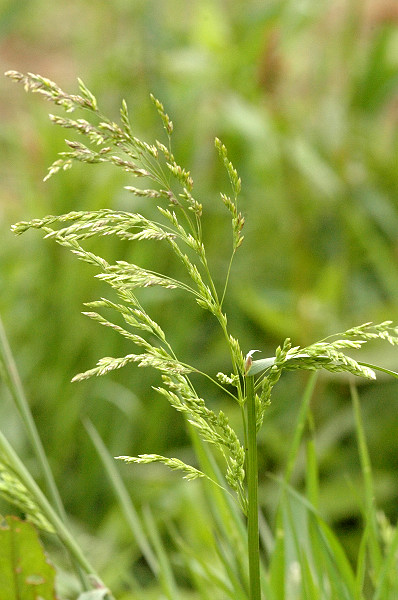
Canada Bluegrass

Poa compressa not quite out.

H. D. Thoreau, Journal, June 4, 1859

Cornus alternifolia well out. See June 10, 1856 ("Cornus alternifolia a day or two, up railroad; maybe longer elsewhere.")

Poa compressa .  The Canada bluegrass or flattened meadow-grass, is a perennial flattened meadow grass, similar to common meadow-grass,  native to Europe  found nearly worldwide as an introduced species. ~ Wikipedia . Specimen in Thoreau herbarium collected on June 14, 1859 at the railroad  causeway. Two other specimens collected at Britton’s Shanty and Great Road on June 2 and 4, 1859, which are in neighboring Lincoln, Massachusetts . The only Journal reference with a specific Concord locale is on June 23, 1860, the railroad at Walden Pond, likely the same locale as his June 14, 1859 collection. ~ Vascular Flora of Concord, Massachusetts. See June 23, 1860 ("Poa compressa may fairly begin on the railroad at Walden").

Friday, November 16, 2018

A cold and blustering afternoon. They want me to agree not to breathe castles.

November 16.


November 16, 2018
P. M. -— To Hubbard’s Close. 

A cold and blustering afternoon; sky for the most part overcast. 

The Cornus Canadensis is called by Loudon “a deciduous herbaceous plant,” the pyrolas “ever-green herbaceous plants.” The bunchberry leaves are now little if any withered, but generally drooping, the four hanging together as is the habit of the sericea and florida, the lambkill, etc. The plant dies down to its perennial spring. You can see its pink bud already strongly formed. But this year’s plant is very slow to die, and I suspect many of the leaves remain green all winter under the snow. They are now generally purplish-tinged. Let me observe in what respect the pyrolas are more evergreen. The new bud is formed between the present two leaves, the old leaves, lower on the stem or vine, being mostly decayed. 

There are many large limbs strewn about the woods, which were broken off by that strong southeast wind in peach time. These are now thickly leaved, the dead wood not being able to cast off the withered leaves; but the leaves having died thus prematurely are of a different color from that their companions changed to, — a peculiar yellow-brown (i. e. chestnuts and oaks) with more or less green in it.

I see a gray squirrel, eight or ten rods off in Hubbard’s large wood, scamper over the leaves and run up an oak. From the oak it crosses ascending into a tall white pine top, and there lies concealed, and I can see no more of him. 

The earth half covered with this slight snow, merely grayed with [it], is the more like the bare gray limbs of oak woods now, and such woods and the earth make the more uniform impression. 

Methinks the wintergreen, pipsissewa, is our handsomest evergreen, so liquid glossy green and dispersed almost all over the woods. The mountain laurel, the lycopodium dendroideum, complanatum, and lucidulum, and the terminal shield fern are also very interesting.

Preaching? Lecturing? Who are ye that ask for these things? What do ye want to hear, ye puling infants? A trumpet-sound that would train you up to mankind, or a nurse’s lullaby? The preachers and lecturers deal with men of straw, as they are men of straw themselves. Why, a free-spoken man, of sound lungs, cannot draw a long breath without causing your rotten institutions to come toppling down by the vacuum he makes. Your church is a baby-house made of blocks, and so of the state. It would be a relief to breathe one’s self occasionally among men. If there, were any magnanimity in us, any grandeur of soul, anything but sects and parties undertaking to patronize God and keep the mind within bounds, how often we might encourage and provoke one another by a free expression! I will not consent to walk with my mouth muzzled, not till I am rabid, until there is danger, that I shall bite the unoffending and that my bite will produce hydrophobia. 

Freedom of speech! It hath not entered into your hearts to conceive what those words mean. It is not leave given me by your sect to say this or that; it is when leave is given to your sect to withdraw. The church, the state, the school, the magazine, think they are liberal and free! It is the freedom of a prison-yard. I ask only that one fourth part of my honest thoughts be spoken aloud. 'What is it you tolerate, you church to-day? Not truth, but a lifelong hypocrisy. Let us have institutions framed not out of our rottenness, but out of our soundness. This factitious piety is like stale gingerbread. I would like to suggest what a pack of fools and cowards we mankind are. They want me to agree not to breathe castles. If I should draw a long breath in the neighborhood of these institutions, their weak and flabby sides would fall out, for my own inspiration would exhaust the air about them. The church! it is eminently the timid institution, and the heads and pillars of it are constitutionally and by principle the greatest cowards in the community. The voice that goes up from the monthly concerts is not so brave and so cheering as that which rises from the frogponds of the land. The best “preachers,” so called, are an effeminate class; their bravest thoughts wear petticoats. If they have any manhood they are sure to forsake the ministry, though they were to turn their attention to baseball. Look at your editors of popular magazines. I have dealt with two or three the most liberal of them. They are afraid to print a whole sentence, a round sentence, a free-spoken sentence. They want to get thirty thousand subscribers, and they will do anything to get them. They consult the D.D.’s and all the letters of the alphabet before printing a 'sentence.‘ I have been into many of these cowardly New England towns where they profess Christianity, — invited to speak, perchance, —where they were trembling in their shoes at the thought of the things you might say, as if they knew their weak side, — that they were weak on all sides. The devil they have covenanted with is a timid devil. If they would let their sores alone they might heal, and they could to the wars again like men; but in stead of that they get together in meeting-house cellars, rip off the bandages and poultice them with sermons.

One of our New England towns is scaled up hermetically like a molasses-hogshead,— such is its sweet Christianity, — only a little of the sweet trickling out at the cracks enough to daub you. The few more liberal-minded or indifferent inhabitants are the flies that buzz about it. It is Christianity bunged up. I see awful eyes looking out through a bull’s-eye at the bung-hole. It is doubtful if they can fellowship with me. 

The further you go up country, I think the worse it is, the more benighted they are. On the one side you will find a barroom which holds the “Scoffers,” so called, on the other a vestry where is a monthly concert of prayer. There is just as little to cheer you in one of these companies as the other. It may be often the truth and righteousness of the barroom that saves the town. There is nothing to redeem the bigotry and moral cowardice of New-Englanders in my eyes. You may find a cape which runs six miles into the sea that has not a man of moral courage upon it. What is called faith is an immense prejudice. Like the Hindoos and Russians and Sandwich-Islanders (that were), they are the creatures of an institution. They do not think; they adhere like oysters to what their fathers and grandfathers adhered to. How often is it that the shoemaker, by thinking over his last, can think as valuable a thought as he makes a valuable shoe? 

I have been into the town, being invited to speak to the inhabitants, not valuing, not having read even, the Assembly’s Catechism, and I try to stimulate them by reporting the best of my experience. I see the craven priest looking round for a hole to escape at, alarmed  because it was he that invited me thither, and an awful silence pervades the audience. They think they will never get me there again. But the seed has not all fallen in stony and shallow ground. 

The following are our shrubby evergreen plants (not including Coniferas): — 

  • Mitchella repens 
  • Linnaea 
  • Andromeda Polifolia 
  • Cassandra calyculata 
  • Mayflower 
  • Checkerberry 
  • Mountain laurel 
  • Lambkill 
  • Kalmia glauca 
  • Labrador tea 
  • Common cranberry 
  • European cranberry 


To which I will add the herbaceous:— 

  • Chimaphila umbellata 
  •                  maculata 


N. B. — Rubus hispidus leaves last through the winter, turning reddish.

It is no compliment to be invited to lecture before the rich Institutes and Lyceums. The settled lecturers are as tame as the settled ministers. The audiences do not want to hear any prophets; they do not wish to be stimulated and instructed, but entertained. They, their wives and daughters, go to the Lyceum to suck a sugarplum. The little of medicine they get is disguised with sugar. It is never the reformer they hear there, but a faint and timid echo of him only. They seek a pass time merely. Their greatest guns and sons of thunder are only wooden guns and great-grandsons of thunder, who give them smooth words well pronounced from manuscripts well punctuated, — they who have stolen the little fire they have from prophets whom the audience would quake to hear. They ask for orators that will entertain them and leave them where they found them. The most successful lecturing on Washington, or what-not, is an awful scratching of backs to the tune, it may be, of fifty thousand dollars. Sluggards that want to have a lullaby sung to them! Such manikins as I have described are they, alas, who have made the greatest stir (and what a shallow stir) in the church and Lyceum, and in Congress. They want a medicine that will not interfere with their daily meals. 

There is the Lowell Institute with its restrictions, requiring a certain faith in the lecturers. How can any free thinking man accept its terms? It is as if you were to resolve that you would not eat oysters that were not of a particular faith, — that, for instance, did not believe the Thirty-Nine Articles,— for the faith that is in an oyster is just as valuable as the faith referred to in Mr. Lowell’s will. These popular lecturers, our preachers, and magazines are for women and children in the bad sense. 

The curators have on their lists the names of the men who came before the Philomathean Institute in the next large town and did no harm; left things in statu quo, so that all slept the better for it; only confirmed the audience in their previous badness; spoke a good word for youngsters to be good boys. A man may have a good deal to say who has not any desk to thump on, who does not thunder in bad air. 

They want all of a man but his truth and independence and manhood. 

One who spoke to their condition would of course make them wince, and they would retaliate, i. e. kick him out, or stop their ears. 

The cold weather which began on the 12th, with the snow of the 13th and since, suddenly killed the few remaining living leaves, without any exceptions to speak of. Most foreign plants at once dropped their leaves, though pretty thick before, but there are many still on the privet. The sweet-fern in some places has still many green, more than any indigenous shrub or tree, though far the greater part of them (the sweet-ferns) are bare or withered. Probably the larch about fallen.

H. D. Thoreau, Journal, November 16, 1858

Walden, \\"If you have built castles in the air, your work need not be lost; that is where they should be. Now put the foundations under them.” )

A cold and blustering afternoon; sky for the most part overcast. See November 13, 1851 (“A cold and dark afternoon, the sun being behind clouds in the west. The landscape is barren of objects, the trees being leafless, and so little light in the sky for variety.”)

Church, state and school – all
mankind want me to agree 
not to breathe castles.  

Wednesday, November 7, 2018

Now we are left to the hemlocks and pines with their silvery light, to the bare trees and withered grass.

November 7

P. M. — To Bateman’s Pond. 

November 7,, 2018

It cleared up this forenoon. I leave my boat opposite the Hemlocks. I see the cold sunlight from some glade between the clouds falling on distant oak woods, now nearly bare, and as I glance up the hill between them. seeing the bare but bright hillside beyond, I think, Now we are left to the hemlocks and pines with their silvery light, to the bare trees and withered grass. 

The very rocks and stones in the rocky roads (that beyond Farmer’s) look white in the clear November light, especially after the rain. We are left to the chickadee’s familiar notes, and the jay for trumpeter. What struck me was a certain emptiness beyond, between the hemlocks and the hill, in the cool, washed air, as if I appreciated even here the absence of insects from it. It suggested agreeably to me a mere space in which to walk briskly. The fields are bleak, and they are, as it were, vacated. 

The very earth is like a house shut up for the winter, and I go knocking about it in vain. But just then I heard a chickadee on a hemlock, and was inexpressibly cheered to find that an old acquaintance was yet stirring about the premises, and was, I was assured, to be there all winter. All that is evergreen in me revived at once.

The very moss, the little pine-tree moss, in Hosmer’s meadow is revealed by its greenness amid the withered grass and stubble.

Hard frosts have turned the cranberry vines to a dark purple. 

I hear one faint cricket’s chirp this afternoon. 

Going up the lane beyond Farmer’s, I was surprised to see fly up from the white, stony road, two snow buntings, which alighted again close by, one on a large rock, the other on the stony ground. They had pale-brown or tawny touches on the white breast, on each side of the head, and on the top of the head, in the last place with some darker color. Had light-yellowish bills. They sat quite motionless within two rods, and allowed me to approach within a rod, as if conscious that the white rocks,  etc., concealed them. It seemed as if they were attracted to surfaces of the same color with themselves, — white and black (or quite dark) and tawny. One squatted flat, if not both. Their soft rippling notes as they went off reminded me [of] the northeast snow-storms to which ere long they are to be an accompaniment.

I find in a swamp witch-hazel buds still opening, for here they are sheltered, but I can find no fringed gentian, blue, near Bateman’s Pond. But Aster undulatus and several golden rods, at least, may be found yet. I see Lycopodium dendroideum which has not yet shed pollen. 

In and about Fox Castle Swamp, lambkill is reddened about as much as ever. Round-leaved cornel is bare.

The nuthatch is another bird of the fall which I hear these days and for a long time, — apparently ever since the young birds grew up. 

The Cornus florida by the pond is quite bare; how long? (That at Island still thickly leaved.) So that I can only say that the sheltered C. florida change much later than the scarlet oak generally, and perhaps the former is to be considered later on the whole.

Methinks those scarlet oaks, those burning bushes, begin to be rare in the landscape. They are about Bateman’s Pond, at any rate.

My apple harvest! It is to glean after the husbandman and the cows, or to gather the crop of those wild trees far away on the edges of swamps which have es caped their notice. Now, when it is generally all fallen, if indeed any is left, though you would not suppose there were any on the first survey, nevertheless with experienced eyes I explore amid the clumps of alder (now bare) and in the crevices of the rocks full of leaves, and prying under the fallen and decaying ferns which, with apple and alder leaves, thickly strew the ground. From amid the leaves anywhere within the circumference of the tree, I draw forth the fruit, all wet and glossy, nibbled by rabbits and hollowed out by crickets, but still with the bloom on it and at least as ripe and well kept, if not better than those in barrels, while those which lay exposed are quite brown and rotten. Showing only a blooming cheek here and there between the wet leaves, or fallen into hollows long since and covered up with the leaves of the tree,— a proper kind of packing. I fill my pockets on each side, and as I retrace my steps, I eat one first from this side, and then from that, in order to preserve my balance. And here and there is one lodged as it fell between the bases of the suckers which spring thickly from a horizontal limb. In the midst of an alder clump, covered by leaves, there it lies, safe from cows which might smell it out and unobserved by the husbandman; reserved for me.

It is too late, generally, to look for the handsome ones now. The exposed are decayed or decaying.

Looking southwest toward the pond just before sunset, I saw against the light what I took to be a shad-bush in full bloom, but without a leafet. I was prepared for this sight after this very warm autumn, because this tree frequently puts forth new leaves in October. Or it might be a young wild apple. Hastening to it, I found it was only the feathery seeds of the virgin’s-bower, whose vine, so close to the branches, was not noticeable. They looked just like dense umbels of white flowers, and in this light, three or four rods off, were fully as white as white apple blossoms. 

It is singular how one thing thus puts on the semblance of another. I thought at first I had made a discovery more interesting than the blossoming of apple trees in the fall. This, I thought, which I never saw nor heard of before, must be the result of that wonderfully warm weather about the 19th and 20th of October. It carried me round to spring again, when the shad-bush, almost leafless, is seen waving its white blossoms amid the yet bare trees. The feathery masses at intervals along the twigs, just like umbels of apple bloom, so caught and reflected the western light.

The small beeches are still covered with withered leaves, but the larger are three-quarters bare. 

The Diplopappus linariifolius, which was yellow in the shade, in open and sunny places is purple.

I see the small botrychium leaf in Hosmer’s meadow still firm, but a reddish brown or leather-color. 

Rounding the Island just after sunset, I see not only the houses nearest the river but our own reflected in the river by the Island. From what various points of view and in what unsuspected lights and relations we sooner or later see the most familiar objects! I see houses reflected in the river which stand a mile from it, and whose inhabitants do not consider themselves near the shore.

I pass a musquash-house, apparently begun last night. The first mouthfuls of weeds were placed between some small button-bush stems which stood amid the pads and pontederia, for a support and to prevent their being washed away. Opposite, I see some half concealed amid the bleached phalaris grass (a tall coarse grass), or, in some places, the blue-joint.

H. D. Thoreau, Journal, November 7, 1858


Now we are left to the hemlocks and pines with their silvery light, to the bare trees and withered grass. We are left to the chickadee’s familiar notes. See November 7, 1853 (" The notes of one or two small birds, this cold morning, in the now comparatively leafless woods, sound like a nail dropped on an anvil.")

Their soft rippling notes as they went off reminded me [of] the northeast snow-storms to which ere long they are to be an ac
companiment. See January 2, 1856 ("They have come with this deeper snow and colder weather "); December 24, 1851 ("I see them so commonly when it is beginning to snow that I am inclined to regard them as a sign of a snow-storm.”) and note to November 29, 1859 ("Saw quite a flock of snow buntings not yet very white. They rose from the midst of a stubble-field unexpectedly. The moment they settled after wheeling around, they were perfectly concealed, though quite near, and I could only hear their rippling note from the earth from time to time.") . Also A Book of Seasons, by Henry Thoreau, the Snow Bunting

My apple harvest! See November 4, 1855 ("The winter is approaching. The birds are almost all gone. The note of the dee de de sounds now more distinct, prophetic of winter, as I go amid the wild apples on Nawshawtuct.");  November 11, 1850 ("Now is the time for wild apples")

Popular Posts Last 30 Days.

The week ahead in Henry’s journal

The week ahead in Henry’s journal
A journal, a book that shall contain a record of all your joy.
"A stone fruit. Each one yields me a thought." ~ H. D. Thoreau, March 28, 1859


I sit on this rock
wrestling with the melody
that possesses me.