September 14.
To opposite Pelham’s Pond by boat. Quite cool, with some wind from east and southeast. Took a watermelon for drink.
Now, instead of haying, they are raking cranberries all along the river. The raker moves slowly along with a basket before him, into which he rakes (hauling) the berries, and his wagon stands one side. It is now the middle of the cranberry season.
The river has risen about a foot within a week, and now the weeds in midstream have generally disappeared, washed away or drowned. Now our oars leave a broad wake of large bubbles, which are slow to burst.
This cooler morning methinks the jays are heard more.
To opposite Pelham’s Pond by boat. . . We went up thirteen or fourteen miles at least, and, . .rowed about twenty-five miles to-day. See note to October 15, 1851 ("Up the river in a boat to Pelham's Pond . . . Rowed about twenty-four miles, going and coming. In a straight line it would be fifteen and one half." See also July 31, 1859 ("This sixteen miles up, added to eleven down, makes about twenty-seven that I have boated on this river, to which may be added five or six miles of the Assabet.")
Now that the pontederias have mostly fallen, the polygonums are the most common and conspicuous flowers of the river. I see a stream of small white insects in the air over the side of the river.
At a distance, entering the pond, we mistake some fine sparkles, probably of insects, for ducks in the water, they were so large, which when we are nearer, looking down at a greater angle with the surface, wholly disappear.
At a distance, entering the pond, we mistake some fine sparkles, probably of insects, for ducks in the water, they were so large, which when we are nearer, looking down at a greater angle with the surface, wholly disappear.
Crossing Fair Haven, the reflections are very fine, prolonged by the ripples made by an east wind just risen.
The Bidens Beckii is drowned or dried up, and has given place to the great bidens, the flower and ornament of the riversides at present, and now in its glory, especially at I. Rice’s shore, where there are dense beds. It is a splendid yellow — Channing says a lemon yellow — and looks larger than it is (two inches in diameter, more or less).
Full of the sun. It needs a name.
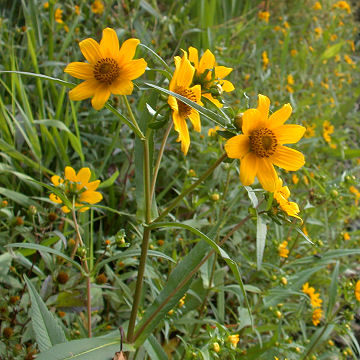 |
Bidens cernua
Large-flowered bidens,
or beggar-ticks,
or bur-marigold,
now abundant by riverside.
|
The Bidens Beckii is drowned or dried up, and has given place to the great bidens, the flower and ornament of the riversides at present, and now in its glory, especially at I. Rice’s shore, where there are dense beds. It is a splendid yellow — Channing says a lemon yellow — and looks larger than it is (two inches in diameter, more or less).
Full of the sun. It needs a name.
We see half a dozen herons in this voyage. Their wings are so long in proportion to their bodies that there seems to be more than one undulation to a wing as they are disappearing in the distance, and so you can distinguish them. You see another begin before the first has ended. It is remarkable how common these birds are about our sluggish and marshy river.
We went up thirteen or fourteen miles at least, and, as we stopped at Fair Haven Hill returning, rowed about twenty-five miles to-day.
H. D. Thoreau, Journal, September 14, 1854
A flock of thirteen tell tales, great yellow-legs, start up with their shrill whistle from the midst of the great Sudbury meadow, and away they sail in a flock,—a sailing (or skimming) flock, that is something rare methinks, — showing their white tails, to alight in a more distant place.
We went up thirteen or fourteen miles at least, and, as we stopped at Fair Haven Hill returning, rowed about twenty-five miles to-day.
H. D. Thoreau, Journal, September 14, 1854
To opposite Pelham’s Pond by boat. . . We went up thirteen or fourteen miles at least, and, . .rowed about twenty-five miles to-day. See note to October 15, 1851 ("Up the river in a boat to Pelham's Pond . . . Rowed about twenty-four miles, going and coming. In a straight line it would be fifteen and one half." See also July 31, 1859 ("This sixteen miles up, added to eleven down, makes about twenty-seven that I have boated on this river, to which may be added five or six miles of the Assabet.")
It is now the middle of the cranberry season. See September 26, 1857 ("I see far off the various-colored gowns of cranberry pickers against the green of the meadow.")
Now our oars leave a broad wake of large bubbles See June 3, 1854 (“On the pond we make bubbles with our paddles on the smooth surface, in which little hemispherical cases we see ourselves and boat, small, black and distinct, with a fainter reflection on the opposite side of the bubble (head to head). These last sometimes a minute before they burst.”); June 7, 1857 (“Now I notice many bubbles left on the water in my wake, as if it were more sluggish or had more viscidity than earlier. Far behind me they rest without bursting.”)
This cooler morning methinks the jays are heard more. See September 21, 1854 ("I hear many jays since the frosts began."); September 21, 1859 ("Jays are more frequently heard of late, maybe because other birds are more silent") See also A Book of the Seasons, by Henry Thoreau, The Blue Jay
We mistake some fine sparkles, probably of insects, for ducks in the water. See September 20,1852 ("How sweet the phenomena of the lake! Everything that moves on its surface produces a sparkle.. . .The motion of an oar or an insect produces a flash of light;"); October 11, 1852 (" In this clear air and with this glassy surface the motion of every water-bug, ceaselessly progressing over the pond, was perceptible."); October 28, 1858 ("I can hardly distinguish the sparkle occasioned by an insect from the white breast of a duck")
The reflections are very fine, prolonged by the ripples. See October 7, 1857 ("There being a slight ripple on the surface, these reflections . . .were extended downward . . .forming sharp pyramids of the several colors, gradually reduced to mere dusky points. The effect of this prolongation of the reflection was a very pleasing softening and blending of the colors . . .The color seems to be reflected and re-reflected from ripple to ripple, losing brightness each time by the softest possible gradation, and tapering toward the beholder, since he occupies a mere point of view. This is one of the prettiest effects of the autumnal change. . . .The ripples convey the reflection toward us."); November 1, 1858 ("The reflection of Flint’s white house in the river, prolonged by a slight ripple so as to reach the reflected cloud, was a very distinct and luminous light blue."); November 4, 1857 ("Its [Walden's] surface is slightly rippled, and dusky prolonged reflections of trees extend wholly across its length,")
Great bidens, the flower and ornament of the riversides at present ... ii needs a name. See.September 12, 1859 ("The four kinds of bidens (frondosa, connata, cernua, and chrysanthemoides) abound now, but much of the Beckii was drowned by the rise of the river. Omitting this, the first two are inconspicuous flowers, cheap and ineffectual, commonly without petals, like the erechthites, but the third and fourth are conspicuous and interesting, expressing by their brilliant yellow the ripeness of the low grounds"); September 13, 1852 ("The great bidens in the sun in brooks affects me as the rose of the fall, the most flavid product of the water and the sun. They are low suns in the brook. The golden glow of autumn concentrated, more golden than the sun. How surely this yellow comes out along the brookss in autumn."); September 19, 1851 ("Large-flowered bidens,or beggar-ticks, or bur-marigold,now abundant by riverside")
Their wings are so long in proportion to their bodies that there seems to be more than one undulation to a wing as they are disappearing in the distance. See April 15, 1855 ("When the heron takes to flight, what a change in size and appearance! It is presto change! There go two great undulating wings pinned together, but the body and neck must have been left behind somewhere"); September 5, 1854 ("Now at sundown, a blue heron flaps away from his perch on an oak over the river before me, just above the rock."); November 1, 1855 ("I see the blue heron arise from the shore and disappear with heavily-flapping wings around a bend in front; the greatest of the bitterns, with heavily-undulating wings, low over the water, seen against the woods, just disappearing round a bend in front; with a great slate-colored expanse of wing, suited to the shadows of the stream, a tempered blue as of the sky and dark water commingled.") See also A Book of the Seasons, by Henry Thoreau, the Blue Heron
A flock of thirteen tell tales, great yellow-legs, start up with their shrill whistle. See May 31, 1854 ( It acts the part of a telltale." "watchful, but not timid, ... while it stands on the lookout ... wades in the water to the middle of its yellow legs; goes off with a loud and sharp phe phe phe phe.";) August 5, 1855 (" Hear a yellow-legs flying over,—phe' phe phe, phe' phe phe.” ); September 26, 1859 ("Hearing a sharp phe-phe and again phe-phe-phe, I look round and see two (probably larger) yellow-legs. . . their whole forms reflected in the water. They allow me to paddle past them, though on the alert."); October 20, 1859 ("Scare up a yellow-legs, apparently the larger, on the shore of Walden. It goes off with a sharp phe phe, phe phe.")
September 14. See A Book of the Seasons, by Henry Thoreau, September 14
September 14. See A Book of the Seasons, by Henry Thoreau, September 14
Along the river
they are raking cranberries
instead of haying.
Bidens in the sun –
the flower and ornament
of the riverside.
With their shrill whistle
yellow-legs sail in a flock
showing their white tails.
A Book of the Seasons, by Henry Thoreau, A voyage up the Sudbury
A Book of the Seasons, by Henry Thoreau
"A book, each page written in its own season,
out-of-doors, in its own locality.”
~edited, assembled and rewritten by zphx © 2009-2024
https://tinyurl.com/hdt-540914


