Friday, August 1, 2025

A Book of the Seasons: August days


A year is made up of 
a certain series and number 
of sensations and thoughts 
which have their language in nature.

Henry Thoreau, June 6, 1857


 August, royal and rich.
Green corn now, 
and melons have begun.
That month, surely, is distinguished
when melons ripen.
 August 10, 1853
 
 In August live on berries.
Be blown on by all the winds. 
August 23, 1853


*****

Singing birds are scarce.
No catbird or thrush heard but
the pewee sings yet.
 August 1, 1852

Perfect dog-days now 
thick blue musty veil of mist
drawn before the sun.


To-day Fields sends me a copy of "Walden" to be published the 12th

I go up the hill surrounded by its shadow soothed by the stillness on this rock on the hilltop warm with the heat of the departed sun the depths of silence like a fathomless ocean my life is afloat. On this rock in the droppings of some bird are the seeds of some berries.


Midsummer standstill.
That fine z-ing of locusts
is an August sound.
 August 2, 1859
East window at noon.
Crickets and the sound of  a
distant piano.
August 3, 1852


Small lake in the woods
full of light and reflections
as the wood thrush sings.

August rain and mist
contract our horizon
to the near and small.
August 4, 1854
In low swampy woods
where cinnamon fern prevails.
it’s already fall.
August 4, 1854
Low, thick, flat white fog
on meadows after sunset
ushers in the night.
August 4, 1854
Such a profusion.
Each patch, each bush, seems fuller –
blacker than the last.
August 4, 1856
Lightning in the south,
clouds alternate with moonlight
all rest of the night.
August 4, 1860
Sobered by moonlight,
sensing my own existence,
who i am and where.
August 5, 1851 
The blue horizon,
the blueness of the mountain,
blueberry blueness.
August 5, 1860
Mowers and rakers
bending to their manly work
with graceful motion.
August 5, 1854
Summer becomes an 
old story. With the goldfinch
comes the goldenrod. 
August 6, 1852
Fall coolness and clouds,
crickets steadily chirping
in mid-afternoon.
August 6, 1854
And all of Vermont
is but a succession of
parallel mountains.
 August 6, 1860
The fruit of my spring
and summer ripen, its seed
hardens within me.
Along the river
a day of sunny water–
I see the fishes.
On the horizon
local cloud of the mountain,
isle in sunset sky.
August 9, 1860
Notes like nuts of sound,
like the sparkle on water,
friction on crisped air.
August 10, 1854
The pensive season.
At early evening the poet
collects his thoughts.
August 11, 1853
The Bidens Beckii
yellows the side of the river
below Hubbard Path.
August 12, 1854
Cool, fall-like weather.
With a pang I remember
spring and summer past.
August 13, 1854
To float on a stream
is like embarking on a
train of thought itself.
August 14, 1854
Silver strip of sky
the river is full of light
in the dark landscape.
An indistinct path
leading through a dense birch wood 
quite out of our course.
August 15, 1854
Far in the southwest
the locomotive whistle
sounds like a bell.
August 15, 1854
One is upside down,
the shadow of our shadows
at steam-mill sand-bank.
August 16, 1854
How can that depth be 
fathomed where a man may see 
himself reflected? 
This sense of lateness.
Now is the season of fruits
but where is our fruit?
August 18, 1853
This haze, we see no
further than our Annursnack,
blue as a mountain.
 August 19, 1854
I cannot account
for this peculiar smoothness
of the dimpled stream.
August 20, 1853
When the red-eye ceases
the woodland quire is dissolved.
The concert is over.
August 20, 1854
Bees on goldenrods
improve their time before the
sun of the year sets.
August 21, 1852
I hear muttering
of thunder as the first drops
dimple the river.
August 22, 1853
Now begins the year's
dark green early afternoon
when shadows increase.

 The blackness of the 
foliage between me and
the light reminds me 

it begins in spring
the dewy dawn of the year
silver downiness

the saffron-robed morn
a yellowish or light green–
then pure glossy green

undersides reflect
the light – the forenoon 
and now early afternoon

the dark green shadows
begin to increase and next 
it will turn yellow 

or red the sunset 
finally black when the night 
of the year sets in . . .
 
Now begins the year's
 dark green early afternoon
when shadows increase.
 

Crimson undersides
of the great white lily pads,
turned up by the wind.
August 24, 1854
A cheering fall rain
brings a different mood or
season of the mind.
August 25, 1852
The sun, round and red,
is soon completely concealed
by the haze alone.
August 25, 1854
All bushes resound.
I wade up to my ears in the
alder locust song.
August 26, 1860
Cooler nights of late,
the heat of the sun by day
local, palpable.
August 27, 1860
The sky overcast.
A sudden vivid green blaze
of reflected light.
August 28, 1860
Rain-storm in the night.
The first leaves begin to fall,
blown off by the wind.
August 29, 1852
When the flower’s fall
is symbol of my own change 
the flower appears.
August 30, 1851
Now after the rain,
bright, fresh green on fields and trees–
sense of summer past.
August 31, 1852


 “The year is but a succession of days,
and I see that I could assign some office to each day
which, summed up, would be the history of the year.”
Henry Thoreau, August 24, 1852

<<<<<<<< Last Month                                        Next Month >>>>>

A Book of the Seasons,  by Henry Thoreau. August Days

A Book of the Seasons,  by Henry Thoreau.
"A book, each page written in its own season,
out-of-doors, in its own locality."
 ~edited, assembled and rewritten by zphx ©  2009-2025

Sunday, July 27, 2025

A Book of the Seasons: The Cricket in July

I came here to live . . .
 Always there was the sound of 
the morning cricket. 
Henry Thoreau, July 5, 1845 


*****

July 5.  Saturday. Walden. - Yesterday I came here to live . . . Always there was the sound of the morning cricket. July 5, 1845 

July 7. It is a mark of serenity and health of mind when a person hears the sound of the cricket. Be ever so little distracted, your thoughts so little confused, your engagements so few, your attention so free, your existence so mundane, that in all places and in all hours you can hear the sound of crickets in those seasons when they are to be heard.  July 7, 1851

July 9. The crickets appear to have received a reinforcement during the sultry night. July 9, 1852

July 14. The creaking of the crickets seems at the very foundation of all sound. At last I cannot tell it from a ringing in my ears. It is a sound from within, not without. You cannot dispose of it by listening to it. In proportion as I am stilled I hear it. It reminds me that I am a denizen of the earth. July 14, 1851

July 15. The robin sings still, but the goldfinch twitters over oftener, and I hear the link link of the bobolink, and the crickets creak more as in the fall. All these sounds dispose our minds to serenity. July 15, 1854

July 16. The earliest corn begins to tassel out. The lark sings in the meadow; the very essence of the afternoon is in his strain. This is a New England sound, but the cricket is heard under all sounds. July 16, 1851

July 16. Many men walk by day; few walk by night. It is a very different season. Instead of the sun, there are the moon and stars; instead of the wood thrush, there is the whip-poor-will;. . . Instead of singing birds, the croaking of frogs and the intenser dream of crickets  .July 16, 1860

July 19. Beyond the bridge there is a goldenrod partially blossomed. First came the St. John's-wort and now the goldenrod to admonish us. I hear, too, a cricket amid these stones under the blackberry vines, singing as in the fall. Yesterday it was spring, and to-morrow it will be autumn. Where is the summer then?  July 19, 1851

July 19. I hear now that very fine pittering sound of a locust or cricket in the grass. July 19, 1860

July 20. The light of the moon is a cold, almost frosty light, white on the ground. There are a few fireflies about. Green, their light looks sometimes, and crickets are heard. You are pretty sure also to hear some human music, vocal or instrumental, far or near. July 20, 1853

July 21. There are few sounds but the slight twittering of swallows, and the springy note of the sparrow in the grass or trees, and a lark in the meadow (now at 8 A.M.), and the cricket under all to ally the hour to night. Day is, in fact, about as still as night. July 21, 1851

July 24. The corn now forms solid phalanxes, though the ears have not set, and, the sun going down, the shadows, even of corn-fields, fall long over the meadows, and a sweetness comes up from the shaven grass, and the crickets creak more loud in the new-springing grass. July 24, 1852

July 24.  I hear incessantly a cricket or locust, inspired by the damp, cool shade, telling of autumn. July 24, 1853

July 26. Dog-days, - sultry, sticky weather, - now when the corn is topped out. Clouds without rain. Rains when it will. Old spring and summer signs fail . . . I mark again, about this time when the first asters open, the sound of crickets or locusts that makes you fruitfully meditative, helps condense your thoughts, like the mel dews in the afternoon. This the afternoon of the year. How apt we are to be reminded of lateness, even before the year is half spent! July 26, 1853 

July 27. New creaking or shrilling from crickets (?) for a long time past, more fine and piercing than the other. July 27, 1852

July 28. Last evening it was much cooler, and I heard a decided fall sound of crickets. July 28, 1854

July 29. The sight of the small rough sunflower about a dry ditch bank and hedge advances me at once further toward autumn. At the same time I hear a dry, ripe, autumnal chirp of a cricket. It is the next step to the first goldenrod. July 29, 1853

July 31. Returning home last evening, I heard that exceedingly fine z-ing or creaking of crickets (?), low in the grass in the meadows. You might think it was a confused ringing in your head, it is so fine. Heard it again toward evening. Autumnalish. July 31, 1859

See also:
The Cricket in November (Listening for the last cricket)


 A Book of the Seasons, by Henry Thoreau
"A book, each page written in its own season,
out-of-doors, in its own locality."
~edited, assembled and rewritten by zphx ©  2009-2025

https://tinyurl.com/hdt-julycricket


Wednesday, July 23, 2025

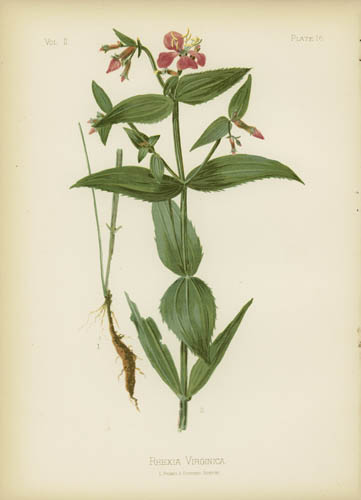
A Book of the Seasons: Rhexia Virginica (meadow-beauty)


For the first time I perceive this spring
that the year is a circle.  
I would make a chart of our life,
know why just this circle of creatures completes the world.
Henry Thoreau, April 18, 1852


The Rhexia Virginica,

the meadow-beauty,
 high-colored, more beautiful 
than you remembered.

March 28. Here, where in August the bittern booms in the grass, and mowers march en echelon and whet their scythes and crunch the ripe wool-grass, raised now a' few feet, you scud before the wind in your tight bark and listen to the surge (or sough ?) of the great waves sporting around you, while you hold the steering-oar and your mast bends to the gale and you stow all your ballast to windward. The crisped sound of surging waves that rock you, that ceaseless roll and gambol, and ever and anon break into your boat. Deep lie the seeds of the rhexia now, absorbing wet from the flood, but in a few months this mile-wide lake will have gone to the other side of the globe; and the tender rhexia will lift its head on the drifted hummocks in dense patches, bright and scarlet as a flame, — such succession have we here, — where the wild goose and countless wild ducks have floated and dived above them.       So Nature condenses her matter. She is a thousand thick. So many crops the same surface bears. March 28, 1859


July 14. The Rhexia Virginica, the meadow-beauty, high-colored, more beautiful than you remembered. July 14, 1852

July 15. Rhexia near the Rhus copallina, apparently yesterday. July 15, 1854

July 18. The petals of the rhexia have a beautiful clear purple with a violet tinge. July 18, 1852

July 18. Rhexia, a day or two. July 18, 1853

July 20. The Rhexia Virginica is in bloom. July 20, 1851

July 23. The rhexia is seen afar on the islets, — its brilliant red like a rose. It is fitly called meadow-beauty. Is it not the handsomest and most striking and brilliant flower since roses and lilies began?  July 23, 1853

July 23. Rhexia in bloom, how long? July 23, 1859

July 29. Rhexia. Probably would be earlier if not mowed down. July 29, 1856 

August 1. I was surprised to see dense beds of rhexia in full bloom there, apparently on hummocks a rod in diameter left by the ice, or in long ridges mixed with ferns and some Lysimachia lanceolata, arrowhead, etc. They make a splendid show, these brilliant rose-colored patches, especially in the neighborhood of Copan. It is about the richest color to be seen now. Yet few ever see them in this perfection, unless the haymaker who levels them, or the birds that fly over the meadow. Far in the broad wet meadows, on the hummocks and ridges, these bright beds of rhexia turn their faces to the heavens, seen only by the bitterns and other meadow birds that fly over. We, dwelling and walking on the dry upland, do not suspect their existence. How obvious and gay to those creatures that fly over the meadow! Seen only by birds and mowers. These gay standards otherwise unfurled in vain.  August 1, 1856 

August 3.  I see blackened haycocks on the meadows. Think what the farmer gets with his hay, — what his river-meadow hay consists of, — how much of fern and osier and sweet-gale and Polygonum hydropiperoides and rhexia (I trust the cattle love the scent of it as well as I) and lysimachia, etc., etc., and rue, and sium and cicuta.   August 3, 1856

August 5I cannot sufficiently admire the rhexia, one of the highest-colored purple flowers, but difficult to bring home in its perfection, with its fugacious petals. August 5, 1852

August 13.  Rhexia, very common on those bare places on the river meadows from which the soil has been moved by the ice.  August 13, 1852

August 20.  The Rhexia Virginica is a showy flower at present. August 20, 1851

August 20.  The purple gerardia is very beautiful now in green grass, and the rhexia also, both difficult to get home.  August 20, 1852

August 21.  The prevailing conspicuous flowers at present are:
  •  The early goldenrods,
  •  tansy,
  •  the life-everlastings,
  •  flea bane (though not for its flower),
  •  yarrow (rather dry),
  •  hardhack and meadow-sweet (both getting dry, also mayweed),
  •  Eupatorium purpureum,
  •  scabish,
  •  clethra (really a fine, sweet-scented, and this year particularly fair and fresh, flower, some unexpanded buds at top tinged with red),
  •  Rhexia Virginica,
  •  thoroughwort,
  •  Polygala sanguinea,

August 23. The patches of rhexia or meadow-beauty which have escaped the mowers in the low grounds, where rowen is now coming forward apace, look like a little bright purple on one side of Nature's pallet, giving place to some fresh green which Nature has ground. August 23, 1853

August 23. The rhexia in the field west of Clintonia Swamp makes a great show now, though a little past prime. August 23, 1858

August 25. There is a large field of rhexia there now almost completely out of bloom, but its scarlet leaves, reddening the ground at a distance, supply the place of flowers. August 25, 1854

August 26. The Poa hirsuta is left on the upper edge of the meadows ( as at J. Hosmer's ), as too thin and poor a grass , beneath the attention of the farmers. How fortunate that it grows in such places and not in the midst of the rank grasses which are cut. With its beautiful fine purple color, its beautiful purple blush, it reminds me and supplies the place of the rhexia now about done.  ( Leaving off, though I see some pretty handsome Sept. 4th.)  August 26, 1854

August 27. The rhexia greets me in bright patches on meadow banks. August 27, 1856

August 28. The rhexia in Ebby Hubbard's field is considerably past prime, and it is its reddish chalices which show most at a distance now. I should have looked ten days ago. Still it is handsome with its large yellow anthers against clear purple petals. It grows there in large patches with hardhack. August 28, 1859


September 14.  The chalices of the Rhexia Virginica, deer-grass or meadow beauty, are literally little reddish chalices now, though many still have petals, little cream pitchers. September 14, 1851

September 28. Acalypha is killed by frost, and rhexia.  September 28, 1858 

October 2.  The scarlet leaves and stem of the rhexia, some time out of flower, makes almost as bright a patch in the meadow now as the flowers did, with its bristly leaves. Its seed-vessels are perfect little cream-pitchers of graceful form. October 2, 1856 

December 14. We have now the scenery of winter, though the snow is but an inch or two deep. The dried chalices of the Rhexia Virginica stand above the snow, and the cups of the blue-curls and the long sharp red capsules of the small ( ? ) hypericum, etc., etc., johnswort; and a new era commences with the dried herbs. December 14, 1852

A Book of the Seasons, by Henry Thoreau
"A book, each page written in its own season,
out-of-doors, in its own locality.”
~edited, assembled and rewritten by zphx © 2009-2025

Popular Posts Last 30 Days.

The week ahead in Henry’s journal

The week ahead in Henry’s journal
A journal, a book that shall contain a record of all your joy.
"A stone fruit. Each one yields me a thought." ~ H. D. Thoreau, March 28, 1859


I sit on this rock
wrestling with the melody
that possesses me.