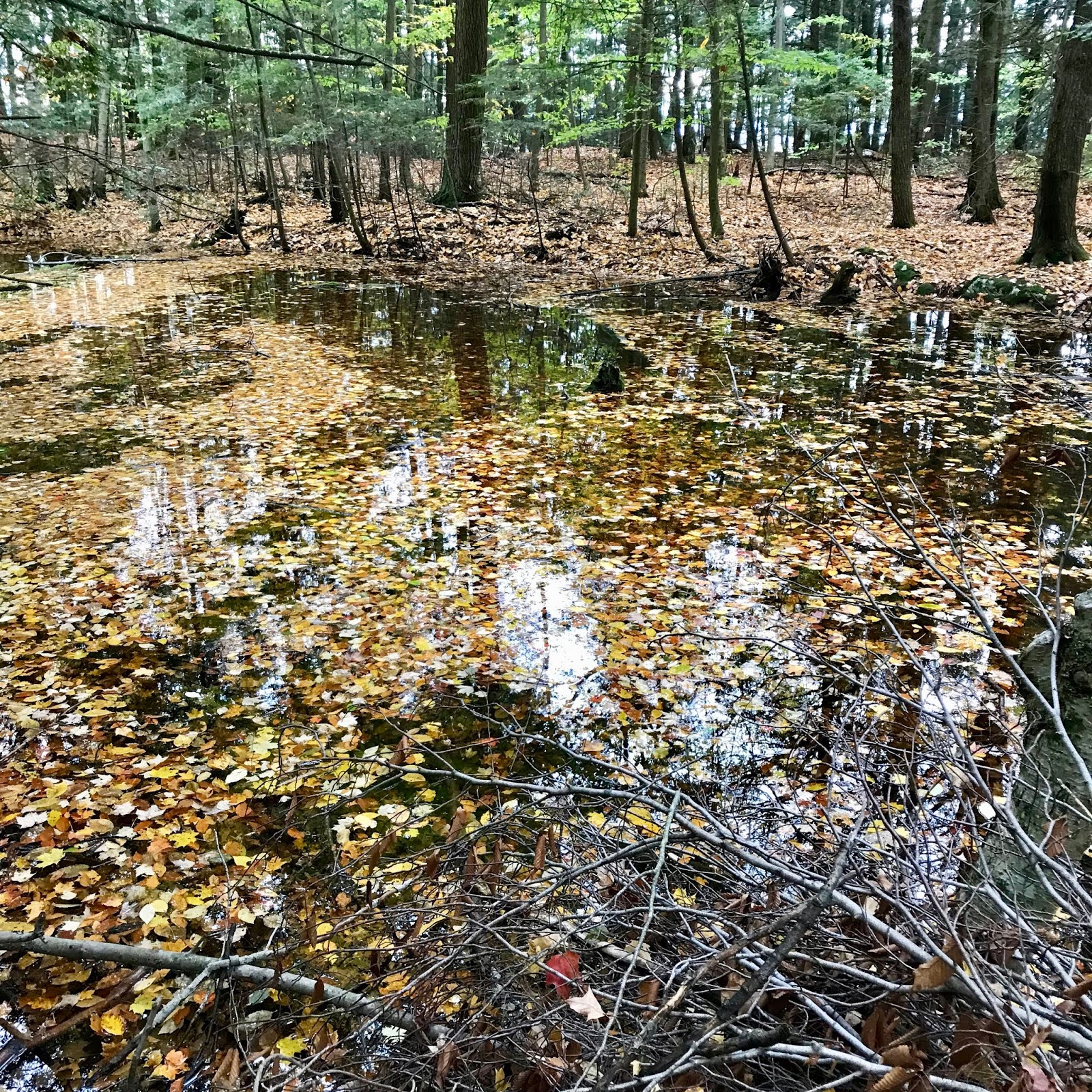
Saturday, October 19, 2019

Lycopodium dendroideum is just shedding pollen.


October 19.

October 19,2 019

C. says that he saw a loon at Walden the 15th. 


P. M.— To Lee's Cliff. 

The tupelo berries have all fallen; how long? 

Alternate cornel about bare. 

Hardhack half bare. 

Many witch-hazel nuts are not yet open. The bushes just bare. 

The slippery elm is nearly bare, like the common near it. 

Cedar berries, how long? 14th at least; probably by the time they lost their leaves. There is one sizable tree west by north of Lee's Cliff, near the wall. 

Lycopodium dendroideum (not variety) is just shedding pollen near this cedar. 

I see asparagus in the woods there near the cedar, four or five feet high! 

Find the seedling archangelica grown about two feet high and still quite green and growing, though the full-grown plants are long since dead, root and stalk. This suggests that no doubt much of the radical spring greenness is of this character, — seedlings of biennials, and perhaps more of them a persistent or late growth from a perennial root, as crowfoot, whiteweed, five-finger, etc. 

The scent of the archangelica root is not agreeable to me. The scent of my fingers after having handled it reminds me strongly of the musquash and woodchuck, though the root itself does not; so its odor must be allied to theirs. 

I find at Lee's Cliff, on the shelves and sides of the rocks, a new fern, apparently Cystopteris fragilis, more than half decayed or withered, though some fresher and shorter fronds at the base of the others are still quite green. It curls up so in my hat that I have difficulty in examining it. It is abundant thereabouts. 

Paddling up the river the other day, those (probably canoe) birches on Mt. Misery on the edge of the hill a mile in front looked like little dark clouds, for I could not distinguish their white trunks against the sky. 

Though the dark-blue, or ripe, creeping juniper berries are chiefly on the lower part of the branches, I see fresh green ones on old wood as big as a pipe-stem and often directly opposite to purple ones (!). They are strangely mixed up. I am not sure but some of this year's berries are already ripe. 

See a black and rusty hedgehog (?) caterpillar in the path.

H. D. Thoreau, Journal, October 19, 1859

The tupelo berries have all fallen. See September 30, 1854 ("I find a fine tupelo near Sam Barrett’s now all turned scarlet. I find that it has borne much fruit — small oval bluish berries, . . .."); October 6, 1858 (“The tupelo at Wharf Rock is completely scarlet, with blue berries amid its leaves”)

Lycopodium dendroideum (not variety) is just shedding pollen near this cedar.  See September 24, 1857 ("I find the Lycopodium dendroideum, not quite out, just northwest of this pine grove, in the grass. It is not the variety obscurum, which grows at Trillium Wood, is more upright-branched and branches round."); October 12, 1859 ("Now for lycopodiums (the dendroideum not yet apparently in bloom), the dendroideum and lucidulum, etc., — how vivid a green ! — lifting their heads above the moist fallen leaves.") October 17, 1857 ("The Lycopodium lucidulum looks suddenly greener amid the withered leaves."); November 11, 1859 ("The flat variety of Lycopodium dendroideum shed pollen on the 25th of October."); November 17, 1858 ("It would seem that these lycopodiums, at least, which have their habitat on the forest floor and but lately attracted my attention there (since the withered leaves fell around them and revealed them by the contrast of their color and they emerged from obscurity), —it would seem that they at the same time attained to their prime, their flowering season. "); November 7, 1858 ("I see Lycopodium dendroideum which has not yet shed pollen."); November 11, 1859 ("The flat variety of Lycopodium dendroideum shed pollen on the 25th of October."); November 15, 1858 ("The Lycopodium dendroideum var. obscurum appears to be just in bloom in the swamp about the Hemlocks (the regular one (not variety) is apparently earlier)."); November 17, 1858 ("Lycopodium dendroideum . . .was apparently in its prime yesterday); December 7, 1853 ("In the latter part of November and now, before the snow, I am attracted by the numerous small evergreens on the forest floor, now most conspicuous, especially the very beautiful Lycopodium dendroideum, somewhat cylindrical") See also A Book of the Seasons,  by Henry Thoreau, The Lycopodiums

Lycopodium dendroideum,  (now 

C. says that he saw a loon at Walden the 15th. See October 8, 1852 ("As I was paddling along the north shore, after having looked in vain over the pond for a loon, suddenly a loon, sailing toward the middle, a few rods in front, set up his wild laugh")

Many witch-hazel nuts are not yet open. The bushes just bare. See October 19, 1856 ("Witch-hazel is in prime, or probably a little past, though some buds are not yet open. Their leaves are all gone.")

Find the seedling archangelica grown about two feet high and still quite green and growing, though the full-grown plants are long since dead. See September 4, 1856 ("Measured an archangelica stem (now of course dry) in Corner Spring Swamp, eight feet eight inches high, and seven and a quarter inches in circumference at ground. It is a somewhat zigzag stem with few joints and a broad umbelliferous top, so that it makes a great show. One of those plants that have their fall early")

Friday, October 18, 2019

The sour scent of decaying ferns

October 18

Rains till 3 p. m., but is warmer. 

October 18, 2019


P. M. — To Assabet, front of Tarbell's. 

Going by Dennis Swamp on railroad, the sour scent of decaying ferns is now very strong there. 

Rhus venenata is bare, and maples and some other shrubs, and more are very thin-leaved, as alder and birches, so that the swamp, with so many fallen leaves and migrating sparrows, etc., flitting through it, has a very late look. For falling, put the canoe birch with the small white. The beach plum is almost quite bare. The leaves of a chinquapin oak have not fallen. 

The long, curved, yellowish buds of the Salix discolor begin to show, the leaves falling; even the down has peeped out from under some. 

In the ditch along the west side of Dennis Swamp I see half a dozen yellow-spot turtles moving about. Probably they are preparing to go into winter quarters. 

I see one of the smaller thrushes to-day. 

Saw a tree-toad on the ground in a sandy wood-path. It did not offer to hop away, may have been chilled by the rain (?). It is marked on the back with black, some what in the form of the hylodes. 

Why can we not oftener refresh one another with original thoughts ? If the fragrance of the dicksonia fern is so grateful and suggestive to us, how much more refreshing and encouraging — re-creating — would be fresh and fragrant thoughts communicated to us fresh from a man's experience and life! I want none of his pity, nor sympathy, in the common sense, but that he should emit and communicate to me his essential fragrance, that he should not be forever repenting and going to church (when not otherwise sinning), but, as it were, going a-huckleberrying in the fields of thought, and enrich all the world with his visions and his joys. 

Why do you flee so soon, sir, to the theatres, lecture-rooms, and museums of the city? If you will stay here awhile I will promise you strange sights. You shall walk on water; all these brooks and rivers and ponds shall be your highway. You shall see the whole earth covered a foot or more deep with purest white crystals, in which you slump or over which you glide, and all the trees and stubble glittering in icy armor.

H. D. Thoreau, Journal, October 18, 1859


Maples and some other shrubs, and more are very thin-leaved so that the swamp, with so many fallen leaves and migrating sparrows, etc., flitting through it, has a very late look.
See October 18, 1853 ("The red maples have been bare a good while. In the sun and this clear air, their bare ashy branches even sparkle like silver."); October 18, 1855 ("The maple swamps, bare of leaves, here and there about the meadow, look like smoke blown along the edge of the woods."); October 18, 1858 ("I am struck by the magical change which has taken place in the red maple swamps, . . . — all their splendor gone, wafted away, as it were, by a puff of wind, and they are the mere ghosts of trees, unnoticed by any, or, if noticed at all, like the smoke that is seen where a blaze is extinguished, ")

The sour scent of decaying ferns is now very strong. See  October 1, 1858 ("The cinnamon ferns are crisp and sour in open grounds"); October 2, 1857 ("In the more open swamp beyond, these ferns, recently killed by the frost and exposed to the sun, fill the air with a very strong sour scent"); October 2, 1859 ("I perceive in various places, in low ground, this afternoon, the sour scent of cinnamon ferns decaying. It is an agreeable phenomenon, reminding me of the season and of past years.")

The long, curved, yellowish buds of the Salix discolor begin to show. See October 24, 1860 ("I see those narrow pointed yellow buds now laid bare so thickly along the slender twigs of the Salix discolor, which is almost bare of leaves."); October 25, 1858 ("Now that the leaves are fallen (for a few days), the long yellow buds (often red-pointed) which sleep along the twigs of the S. discolor are very conspicuous and quite interesting, already even carrying our thoughts for ward to spring.")

Thursday, October 17, 2019

Be prepared for the hardest of times

October 17. 


A smart frost this morning. Ground stiffened. Hear of ice in a tub. 

P. M. — To Gowing's Swamp.

The water standing over the road at Moore's Swamp, I see the sand spotted black with many thousands of little snails with a shell, and two feelers out, slowly dragging themselves over the bottom. They reminded me by their color, number, and form of the young tad poles. 

I look for Vaccinium Oxycoccus in the swamp. The uneven surface of the sphagnum in which the slender vine grows comes up to my idea of a mountainous country better than many actual mountains that I have seen. Labrador mountains these are at least. The higher patches of sphagnum are changed to a dark purple, which shows a crude green where you crack it by your weight. The lower parts are yet yellowish-green merely. 

These interesting little cranberries are quite scarce, the vine bearing (this year, at least) only amid the higher and drier sphagnous mountains amid the lowest bushes about the edge of the open swamp. There the dark-red berries (quite ripe) now rest, on the shelves and in the recesses of the red sphagnum. 

There is only enough of these berries for sauce to a botanist's Thanksgiving dinner. 

What I put into my pocket, whether berry or apple, generally has to keep company with an arrowhead or two. I hear the latter chinking against a key as I walk. These are the perennial crop of Concord fields. If they were sure it would pay, we should see farmers raking the fields for them. 

The rain drives me from my berrying and we take shelter under a tree. It is worth the while to sit under the lee of an apple tree trunk in the rain, if only to study the bark and its inhabitants. 

I do not disturb the father-long-legs which to avoid the storm has merely got round to the lee side, or under the shelter of an excrescence. Thus easily insects find their roof ready for them. 

Man's very size compels him to build a house. Caves and recesses big enough are too rare. Why should we not stay at home? This is the land and we are the inhabitants so many travellers come to see. Why should we suffer ourselves to drift outside and lose all our advantages? 

They were bold navigators once who merely sighted these shores. We were born and bred further in the land than Captain John Smith got. 

I hear that ten geese went over New Bedford some days ago. 

When La Mountain and Haddock dropped down in the Canada wilderness the other day, they came near starving, or dying of cold and wet and fatigue, not knowing where to look for food nor how to shelter themselves. Thus far we have wandered from a simple and independent life. I think that a wise and independent, self-reliant man will have a complete list of the edibles to be found in a primitive country or wilderness, a bill of fare, in his waistcoat pocket at least, to say nothing of matches and warm clothing, so that he can commence a systematic search for them without loss of time. 

They might have had several frogs apiece if they had known how to find them. Talk about tariffs and protection of home industry, so as to be prepared for wars and hard times! ! 

Here we are, deriving our breadstuff s from the West, our butter stuffs from Vermont, and our tea and coffee and sugar stuffs, and much more with which we stuff ourselves, from the other side of the globe. Why, a truly prudent man will carry such a list as the above, in his mind at least, even though he walk through Broadway or Quincy Market. He will know what are the permanent resources of the land and be prepared for the hardest of times. He will go behind cities and their police; he will see through them. Is not the wilderness of mould and dry-rot forever invading and threatening them? They are but a camp abundantly supplied to day, but gnawing their old shoes to-morrow.

Why, a philosopher who soars higher than usual in his thoughts from time to time drops down into what is just such a wilderness to him as that was to La Mountain and Haddock, where he finds hardly one little frog gone into winter quarters to sustain him and runs screaming toward the climes of the sun. 

I see all the farmers' old coats spread over the few squashes and pumpkins still left out in a pile. 

The arbor-vitae sheds seeds; how long?

H. D. Thoreau, Journal, October 17, 1859

Talk about tariffs
and home industry prepared 
for wars and hard times! 

To sit in the rain
under an apple tree trunk
studying the bark.

Wednesday, October 16, 2019

A cold, clear, Novemberish day.; The different hues of Vermont gray.

October 16

Sunday. P. M. — Paddle to Puffer's and thence walk to Ledum Swamp and Conant's Wood. 

A cold, clear, Novemberish day. The wind goes down and we do not sail. The button-bushes are just bare, and the black willows partly so, and the mikania all fairly gray now. I see the button-bush balls reflected on each side, and each wool-grass head and recurved withered sedge or rush is also doubled by the reflection. The Scirpus lacustris is generally brown, the Juncus militaris greener. It is rather too cool to sit still in the boat unless in a sunny and sheltered place. 

I have not been on the river for some time, and it is the more novel to me this cool day. 

When I get to Willow Bay I see the new musquash-houses erected, conspicuous on the now nearly leafless shores. To me this is an important and suggestive sight, as, perchance, in some countries new haystacks in the yards; as to the Esquimaux the erection of winter houses. 

I remember this phenomenon annually for thirty years. A more constant phenomenon here than the new haystacks in the yard, for they were erected here probably before man dwelt here and may still be erected here when man has departed. For thirty years I have annually observed, about this time or earlier, the freshly erected winter lodges of the musquash along the riverside, reminding us that, if we have no gypsies, we have a more indigenous race of furry, quadrupedal men maintaining their ground in our midst still. 

This may not be an annual phenomenon to you. It may not be in the Greenwich almanac or ephemeris, but it has an important place in my Kalendar. So surely as the sun appears to be in Libra or Scorpio, I see the conical winter lodges of the musquash rising above the withered pontederia and flags. 

There will be some reference to it, by way of parable or otherwise, in my New Testament. 

Surely, it is a defect in our Bible that it is not truly ours, but a Hebrew Bible. The most pertinent illustrations for us are to be drawn, not from Egypt or Babylonia, but from New England. 

Talk about learning our letters and being literate! Why, the roots of letters are things. Natural objects and phenomena are the original symbols or types which express our thoughts and feelings, and yet American scholars, having little or no root in the soil, commonly strive with all their might to confine themselves to the imported symbols alone. 

All the true growth and experience, the living speech, they would fain reject as "Americanisms." It is the old error, which the church, the state, the school ever commit, choosing darkness rather than light, holding fast to the old and to tradition. A more intimate knowledge, a deeper experience, will surely originate a word. 

When I really know that our river pursues a serpentine course to the Merrimack, shall I continue to describe it by referring to some other river no older than itself which is like it, and call it a meander? It is no more meandering than the Meander is musketaquidding. As well sing of the nightingale here as the Meander. 

What if there were a tariff on words, on language, for the encouragement of home manufactures? Have we not the genius to coin our own? Let the schoolmaster distinguish the true from the counterfeit. 

They go on publishing the "chronological cycles" and "movable festivals of the Church" and the like from mere habit, but how insignificant are these compared with the annual phenomena of your life, which fall within your experience! The signs of the zodiac are not nearly of that significance to me that the sight of a dead sucker in the spring is. That is the occasion for an immovable festival in my church. Another kind of Lent then begins in my thoughts than you wot of. I am satisfied then to live on fish alone for a season.

Men attach a false importance to celestial phenomena as compared with terrestrial, as if it were more respect able and elevating to watch your neighbors than to mind your own affairs. The nodes of the stars are not the knots we have to untie. 

The phenomena of our year are one thing, those of the almanac another. For October, for instance, instead of making the sun enter the sign of the scorpion, I would much sooner make him enter a musquash-house. 

Astronomy is a fashionable study, patronized by princes, but not fungi. "Royal Astronomer." The snapping turtle, too, must find a place among the constellations, though it may have to supplant some doubtful characters already there. If there is no place for him overhead, he can serve us bravely underneath, supporting the earth. 

This clear, cold, Novemberish light is inspiriting. Some twigs which are bare and weeds begin to glitter with hoary light. The very edge or outline of a tawny or russet hill has this hoary light on it. 


Your thoughts sparkle like 
the water surface 
and the downy twigs. 

From the shore you look back at the silver-plated river. 

Every rain exposes new arrowheads. We stop at Clamshell and dabble for a moment in the relics of a departed race. 

Where we landed in front of Puffer's, found a jug which the haymakers had left in the bushes. Hid our boat there in a clump of willows, and though the ends stuck out, being a pale green and whitish, they were not visible or distinguishable at a little distance. 

Passed through the sandy potato-field at Witherell's cellar-hole. Potatoes not dug; looking late and neglected now; the very vines almost vanished on some sandier hills. 

When we emerged from the pleasant footpath through the birches into Witherell Glade, looking along it the westering sun, the glittering white tufts of the Andropogon scoparius, lit up by the sun, were affectingly fair and cheering to behold. It was already a cheerful Novemberish scene. 

A narrow glade stretching east and west between a dense birch wood, now half bare, and a ruddy oak wood on the upper side, a ground covered with tawny stubble and fine withered grass and cistuses. Looking westward along it, your eye on these lit tufts of andropogon, their glowing half raised a foot or more above the ground, a lighter and more brilliant white ness than the downiest cloud presents (though seen on one side they are grayish).

Even the lespedezas stand like frost-covered wands, and now hoary goldenrods and some bright-red blackberry vines amid the tawny grass are in harmony with the rest; and if you sharpen and rightly intend your eye you see the gleaming lines of gossamer (stretching from stubble to stubble over the whole surface) which you are breaking. How cheerful these cold but bright white waving tufts! 

They reflect all the sun's light without a particle of his heat, or yellow rays. A thousand such tufts now catch up the sun and send to us its light but not heat. His heat is being steadily withdrawn from us. Light without heat is getting to be the prevailing phenomenon of the day now. 

We economize all the warmth we get now. The frost of the 11th, which stiffened the ground, made new havoc with vegetation, as I perceive. Many plants have ceased to bloom, no doubt. 

Many Diplopappus linariifolius are gone to seed, and yellowish globes. 

Such are the stages in the year's decline. 

The flowers are at the mercy of the frosts. Places where erechthites grows, more or less bare, in sprout- lands, look quite black and white (black withered leaves and white down) and wintry.

At Ledum Swamp, feeling to find the Vaccinium Oxycoccus berries, I am struck with the coldness of the wet sphagnum, as if I put my hands into a moss in Labrador, — a sort of winter lingering the summer through there. 

To my surprise, now at 3.30 p. m., some of the sphagnum in the shade is still stiff with frost, and when I break it I see the glistening spiculae. This is the most startling evidence of winter as yet. 

For only on the morning of the 11th was there any stiffening of the ground elsewhere. Also in the high sedgy sprout-land south of this swamp, I see hoary or frost-like patches of sedge amid the rest, where all is dry; as if in such places (the lowest) the frost had completely bleached the grass so that it now looks like frost. I think that that is the case. 

It is remarkable how, when a wood has been cut (perhaps where the soil was light) and frosts for a long while prevent a new wood from springing up there, that fine sedge (Carex Pennsylvanica?) will densely cover the ground amid the stumps and dead sprouts. It is the most hardy and native of grasses there. This is the grass of the sprout-lands and woods. It wants only the sun and a reasonably dry soil. 

Then there are the grasses and sedges of the meadows, but the cultivated fields and the pastures are commonly clothed with introduced grasses. The nesaea is all withered, also the woodwardia. The ledum and Andromeda Polijolia leaves have fallen. The Kalmia glauca is still falling. The spruce, also, has fallen. 

The ledum smells like a bee, — that peculiar scent they have. C, too, perceives it. 

See a hairy woodpecker on a burnt pitch pine. He distinctly rests on his tail constantly. With what vigor he taps and bores the bark, making it fly far and wide, and then darts off with a sharp whistle! 

I remark how still it is to-day, really Sabbath-like. This day, at least, we do not hear the rattle of cars nor the whistle. I cannot realize that the country was often as still as this twenty years ago. 

Returning, the river is perfectly still and smooth. The broad, shallow water on each side, bathing the withered grass, looks as if it were ready to put on its veil of ice at any moment. It seems positively to invite the access of frost. I seem to hear already the creaking, shivering sound of ice there, broken by the undulations my boat makes. So near are we to winter. 

Then, nearer home, I hear two or three song sparrows on the button-bushes sing as in spring, — that memorable tinkle, — as if it would be last as it was first. 

The few blackish leaves of pontederia rising above the water now resemble ducks at a distance, and so help to conceal them now that they are returning. The weeds are dressed in their frost jackets, naked down to their close-fitting downy or flannel shirts. Like athletes they challenge the winter, these bare twigs. 

This cold refines and condenses us. Our spirits are strong, like that pint of cider in the middle of a frozen barrel. The cool, placid, silver-plated waters at even coolly await the frost. 

The musquash is steadily adding to his winter lodge. There is no need of supposing a peculiar instinct telling him how high to build his cabin. He has had a longer experience in this river-valley than we. 

Evergreens, I should say, fall early, both the coniferous and the broad-leaved. 

That election-cake fungus which is still growing (as for some months) appears to be a Boletus. 

I love to get out of cultivated fields where I walk on an imported sod, on English grass, and walk in the fine sedge of woodland hollows, on an American sward. In the former case my thoughts are heavy and lumpish, as if I fed on turnips. In the other I nibble ground nuts. 

Your hands begin to be cool, rowing, now. 

At many a place in sprout-lands, where the sedge is peculiarly flat and white or hoary, I put down my hand to feel if there is frost on it. It must be the trace of frost. Since the frost of the 11th, the grass and stubble has received another coat of tawny. 

That andropogon bright feathery top may be put with the clematis seed and tail. Only this cold, clear sky can light them up thus. 

The farmer begins to calculate how much longer he can safely leave his potatoes out. 

Each ball of the button-bush reflected in the silvery water by the riverside appears to me as distinct and important as a star in the heavens viewed through "optic glass." This, too, deserves its Kepler and Galileo. 

As nature generally, on the advent of frost, puts on a russet and tawny dress, so is not man clad more in harmony with nature in the fall in a tawny suit or the different hues of Vermont gray? I would fain see him glitter like a sweet-fern twig between me and the sun. 

A few green yellow lily pads lie on the surface waiting to be frozen in. 

All the Lycopodium complanatum I see to-day has shed its pollen.

H. D. Thoreau, Journal, October 16, 1859

I see the new musquash-houses erected, conspicuous on the now nearly leafless shores To me this is an important and suggestive sight, as, perchance, in some countries new haystacks in the yards. . . .So surely as the sun appears to be in Libra or Scorpio, I see the conical winter lodges of the musquash rising above the withered pontederia and flags.
See September 20, 1855 ("Open a new and pretty sizable muskrat-house with no hollow yet made in it. "); September 26, 1857 ("The pickerel-weed is brown, and I see musquash-houses"); October 15, 1851 ("The muskrat-houses appear now for the most part to be finished. Some, it is true, are still rising. They line the river all the way. Some are as big as small hay cocks");  October 18, 1852 ("A few muskrat houses are going up abrupt and precipitous on one side sloped on the other I distinguish the dark moist layer of weeds deposited last night on what had dried in the sun."):  November 2, 1851 ("The muskrat-houses are mostly covered by the rise of the river! — not a very unexpected one either"); November 4, 1855 ("Many new muskrat-houses have been erected this wet weather."); November 5, 1853 ("muskrat-cabins were lately covered by the flood, but now that it has gone down in a great measure, . . . I notice that they have not been washed away or much injured. . ..Moreover, for the most part they are protected, as well as concealed, by the button-bushes, willows, or weeds about them.What exactly are they for?"); November 7, 1855 ("Opened a muskrat-house nearly two feet high, but there was no hollow to it. Apparently they do not form that part yet."); November 11, 1855 ("The bricks of which the muskrat builds his house are little masses or wads of the dead weedy rubbish on the muddy bottom, which it probably takes up with its mouth. It consists of various kinds of weeds, now agglutinated together by the slime and dried confervae threads, utricularia, hornwort, etc., — a streaming, tuft-like wad. The building of these cabins appears to be coincident with the commencement of their clam diet, for now their vegetable food, excepting roots, is cut off.”); November 16, 1852 ("Muskrat-houses completed. Interesting objects looking down a river-reach at this season, and our river should not be represented without one or two of these cones. They are quite conspicuous half a mile distant, and are of too much importance to be omitted in the river landscape."); December 3, 1853 ("I see that muskrats have not only erected cabins, but, since the river rose, have in some places dug galleries a rod into the bank,")

This clear, cold, Novemberish light. Your thoughts sparkle like the water surface. See October 25, 1858 ("Call these November Lights. Hers is a cool, silvery light.”)

When we emerged from the pleasant footpath through the birches into Witherell Glade, looking along it the westering sun, the glittering white tufts of the Andropogon scoparius, lit up by the sun, were affectingly fair and cheering to behold. See November 8, 1859 (“The tufts of purplish withered andropogon in Witherell Glade are still as fair as ever, soft and trembling and bending from the wind; of a very light mouse-color seen from the side of the sun, and as delicate as the most fragile ornaments of a lady's bonnet; but looking toward the sun they are a brilliant white, each polished hair (of the pappus?) reflecting the November sun without its heats, not in the least yellowish or brown like the goldenrods and asters.”); November 10, 1858 (“This a November phenomenon, — the silvery light reflected from a myriad of downy surfaces. A true November seat is amid the pretty white-plumed Andropogon scoparius, the withered culms of the purple wood grass which covers so many dry knolls.. . .Looking toward the sun, as I sit in the midst of it rising as high as my head, its countless silvery plumes are a very cheerful sight. At a distance they look like frost on the plant.”);  November 15, 1858 ("[T]he silver-haired andropogon grass [belongs] to the first half of November.”); November 15, 1859 (“I turn down Witherell Glade, only that I may bring its tufts of andropogon between me and the sun for a moment. They are pretty as ever.”).

Two or three song sparrows on the button-bushes sing as in spring, See October 26, 1855 (“The song sparrow still sings on a button-bush.”)

The farmer begins to calculate how much longer he can safely leave his potatoes out. See October 16, 1856 ("The ground was so stiff on the 15th, in the morning, that some could not dig potatoes.")

The few blackish leaves of pontederia rising above the water now resemble ducks at a distance, and so help to conceal them now that they are returning. See September 18, 1858 ("I see one pontederia spike rising blue above the surface. Elsewhere the dark withered pontederia leaves show themselves, and at a distance look like ducks, and so help conceal them. For the ducks are now back again in numbers,")


In this clear cold light
your thoughts sparkle like
 the silver-plated river.

https://tinyurl.com/HDY591016

Tuesday, October 15, 2019

Each town should have a park, or rather a primitive forest, a common possession forever, for instruction and recreation

October 15. 

P. M. — To Botrychium Swamp. 

A cold northwest wind. 

I see some black oak acorns on the trees still and in some places at least half the shrub oak acorns. The last are handsomer now that they have turned so much darker. 

I go along the east edge of Poplar Hill. This very cold and windy day, now that so many leaves have fallen, I begin to notice the silveriness of willows blown up in the wind, — a November sight. 

The hickories at Poplar Hill (and elsewhere, as far as I perceive) are all past prime now and most half-withered or bare, very different from last year. In warmer autumns, if I remember rightly, they last several weeks later than this in some localities, one succeeding an other with its splendid glow, an evidence of the genial-ness of the season. In cool and moist places, in a genial year, some are preserved green after others have changed, and by their later change and glow they prolong the season of autumnal tints very agreeably. 

This is a cold fall. 

The larches in A. Heywood's swamp, though a yellower green than the white pines, are not yet sharply distinguished from them by their form, as they will be. 

The oaks generally are very fair now at a distance. 

Standing on this hilltop this cold and blustering day, when dark and slate-colored clouds are flitting over the sky, the beauty of the scenery is enhanced by the contrast in the short intervals of sunshine. The whole surface of the country, both young woodlands and full- grown forests, whether they clothe sides of hills or their lit tops are seen over a ridge, — the birch phalanxes and huckleberry flocks [?], etc., — even to the horizon, is like a rug of many brilliant colors, with the towns in the more open and tawny spaces. 

The beauty or effect of the scene is enhanced, if, standing here, you see far in the horizon the red regiments of oaks alternately lit up by the sun and dimmed by the passing shadow of a cloud. As the shadows of these cold clouds flit across the landscape, the red banners of distant forests are lit up or disappear like the colors of a thousand regiments. 

Pratt says that he planted a ground-nut in his garden in good soil, but they grew no bigger than a bean. He did not know but it would take more than one year, even if he planted the tuber. 

The yellow birches are generally bare. 

Juniperus repens leaves have fallen, perhaps with red cedar.

The ash trees I see to-day are quite bare, apparently several or some days. 

October 12, 2019

The little leaves of the mitchella, with a whitish midrib and veins, lying generally flat on the mossy ground, perhaps about the base of a tree, with their bright-scarlet twin berries sprinkled over them, may properly be said to checker the ground. Now, particularly, they are noticed amid the fallen leaves. 

The bayberry leaves have fallen, and all the berries are gone. I suppose the birds have eaten them. 

Mountain laurel leaves are fallen. 

The yellow birches are bare, revealing the fruit (the short, thick brown catkins) now ripe and ready to scale off. How full the trees are! About as thick as the leaves were. 

The fever-bush is for the most part bare, and I see no berries. 

Rhus radicans too is bare. 

The maidenhair is for the most part withered. It is not evergreen, then. 

The mountain sumach which I see is bare, and some smooth ditto. 

That appears to be Aspidium cristatum which I find evergreen in swamps, but no fertile fronds now. It is broader and denser than the plate of the English one. It cannot be a described variety of spinulosum, for it is only once pinnate. 

I think I see myrtle-birds on white birches, and that they are the birds I saw on them a week or two ago, — apparently, or probably, after the birch lice. 

See a Fringilla hyemalis. 

The chickadees sing as if at home. They are not travelling singers hired by any Barnum. Theirs is an honest, homely, heartfelt melody. Shall not the voice of man express as much content as the note of a bird?  

Botrychium Lunaria has shed pollen, how long? 

The little larches in midst of Gowing's Swamp already changed, before others elsewhere. 

Each town should have a park, or rather a primitive forest, of five hundred or a thousand acres, where a stick should never be cut for fuel, a common possession forever, for instruction and recreation. We hear of cow-commons and ministerial lots, but we want men-commons and lay lots, inalienable forever. Let us keep the New World new, preserve all the advantages of living in the country.
There is meadow and pasture and wood-lot for the town's poor. Why not a forest and huckleberry-field for the town's rich? All Walden Wood might have been preserved for our park forever, with Walden in its midst, and the Easterbrooks Country, an unoccupied area of some four square miles, might have been our huckleberry-field. 

If any owners of these tracts are about to leave the world without natural heirs who need or deserve to be specially remembered, they will do wisely to abandon their possession to all, and not will them to some individual who perhaps has enough already. As some give to Harvard College or another institution, why might not another give a forest or huckleberry-field to Concord? A town is an institution which deserves to be remembered. 

We boast of our system of education, but why stop at schoolmasters and schoolhouses? We are all schoolmasters, and our school-house is the universe. To attend chiefly to the desk or schoolhouse while we neglect the scenery in which it is placed is absurd. If we do not look out we shall find our fine schoolhouse standing in a cow-yard at last. 

The Kalmia glauca, now falling, is quite a brilliant scarlet. In this case you have the fresh liquid-green leaves of this year above the brilliant scarlet ones of last year. Most other evergreens exhibit only a contrast of green with yellow or yellowish. 

The balm-of-Gileads by Mrs. Ripley's bare. Those beyond Barrett's Bridge green and full of leaves. 

The spruce leaves have fallen, — how long? — and its seeds are falling. Larch seeds falling. 

Celtis berries ripe, how long? 

Solanum Dulcamara berries linger over water but mostly are shrivelled. 

Canoe birch is now at least half fallen or more, apparently with the small white; looks in color like an aspen.

H. D. Thoreau, Journal, October 15, 1859

The hickories at Poplar Hill (and elsewhere, as far as I perceive) are all past prime now and most half-withered or bare, very different from last year. See October 15, 1858 ("Small hickories are the clearest and most delicate yellow in the shade of the woods.") See also October 8, 1856 ("The hickory leaves are among the handsomest now, varying from green through yellow, more or less broadly green-striped on the principal veins, to pure yellow, at first almost lemon-yellow, at last browner and crisped. This mingling of yellow and green on the same leaf, the green next the veins where the life is most persistent, is very pleasing."); October 22, 1857 ("The hickory leaves, now after they have fallen, are often if not oftenest a dark rich yellow, very conspicuous upon the brown leaves of the forest floor, seeming to have more life in them than those leaves which are brown."); October 4, 1858 ("The hickories on the northwest side of this hill are in the prime of their color, of a rich orange; some intimately mixed with green, handsomer than those that are wholly changed.")

The oaks generally are very fair now at a distance. See October 15, 1858 ("The colors of the oaks are far more distinct now than they were before.")

The chickadees sing as if at home. Theirs is an honest, homely, heartfelt melody. See note to October 15, 1856 ("The chickadees are hopping near on the hemlock above. They resume their winter ways before the winter comes.")

The balm-of-Gileads by Mrs. Ripley's bare. Those beyond Barrett's Bridge green and full of leaves. See October 15,1858 ("The balm-of-Gileads are half bare. ")

October 15.  See A Book of the Seasons,  by Henry Thoreau October 15

In the horizon 
the red regiments of oaks  
lit up by the sun.

Each town should have a park – a primitive forest, never cut for fuel.
A Book of the Seasons, by Henry Thoreau
"A book, each page written in its own season,
out-of-doors, in its own locality.”
~edited, assembled and rewritten by zphx © 2009-2025

https://tinyurl.com/hdt591015
I

Monday, October 14, 2019

We sit on the rock on Pine Hill overlooking Walden.


October 14. 

9 a. m. — To and around Flint's Pond with Blake. 

A fine Indian-summer day. 

The 6th and 10th were quite cool, and any particularly warm days since may be called Indian summer (?), I think. 

We sit on the rock on Pine Hill overlooking Walden.
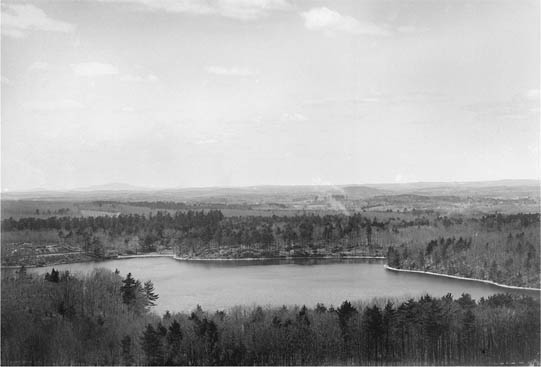

Overlooking Walden Pond from Pine Hill
April 28, 1906
There is a thick haze almost entirely concealing the mountains. There is wind enough to raise waves on the pond and make it bluer. What strikes me in the scenery here now is the contrast of the unusually blue water with the brilliant-tinted woods around it. 

The tints generally may be about at their height. The earth appears like a great inverted shield painted yellow and red, or with imbricated scales of that color, and a blue navel in the middle where the pond lies, and a distant circumference of whitish haze. 

The nearer woods, where chestnuts grow, are a mass of warm, glowing [yellow] (though the larger chestnuts have lost the greater part of their leaves and generally you wade through rustling chestnut leaves in the woods), but on other sides the red and yellow are intermixed. The red, probably of scarlet oaks on the south of Fair Haven Hill, is very fair. The beech tree at Baker's fence is past prime and many leaves fallen. 

The shrub oak acorns are now all fallen, — only one or two left on, — and their cups, which are still left on, are apparently somewhat incurved at the edge as they have dried, so that probably they would not hold the acorn now. 

The ground is strewn also with red oak acorns now, and, as far as I can discover, acorns of all kinds have fallen. 

At Baker's wall two of the walnut trees are bare but full of green nuts (in their green cases), which make a very pretty sight as they wave in the wind. So distinct you could count every one against the sky, for there is not a leaf on these trees, but other walnuts near by are yet full of leaves. You have the green nut contrasted with the clean gray trunks and limbs. These are pig nut-shaped. 

The chestnuts generally have not yet fallen, though many have. I find under one tree a great many burs, apparently not cast down by squirrels — for I see no marks of their teeth — and not yet so opened that any of the nuts fall out. They do not all wait till frosts open the burs before they fall, then. 

I see a black snake, and also a striped snake, out this warm day.

***
Some Rhus radicans was leafless on the 13th, and some tupelos bare maybe a week or more, and button-bushes nearly bare. 

My little white pines by Walden are now conspicuous in their rows, the grass, etc., having withered to tawny and the blackberry turned to scarlet. They have been almost inobvious through the summer. 

The dark evergreen leaves of the checkerberry also attract us now amid the shrub oaks, as on the southwest of Pine Hill.

I hear a man laughed at because he went to Europe twice in search of an imaginary wife who, he thought, was there, though he had never seen nor heard of her. But the majority have gone further while they stayed in America, have actually allied themselves to one whom they thought their wife and found out their mistake too late to mend it. It would be cruel to laugh at these. 

Wise, the balloonist, says that he lost a balloon "in a juniper bog in the State of Maine," which he mistook for a "prairie." Does he mean a larch swamp? 

Balloonists speak of hearing dogs bark at night and wagons rumbling over bridges.

Arbor-vitae falling (seeds), how long?

H. D. Thoreau, Journal, October 14, 1859

A fine Indian-summer day. See October 14, 1853 ("Fine, clear Indian-summer weather.")

We sit on the rock on Pine Hill overlooking Walden. See October 1, 1859 ("Looking down from Pine Hill, I see a fish hawk over Walden."); October 22, 1852 ("Looking over the forest on Pine Hill, I can hardly tell which trees are lit up by the sunshine and which are the yellow chestnut-tops."); October 20, 1852 (“Picking chestnuts on Pine Hill. . . . I see the mountains in sunshine, all the more attractive from the cold I feel here, with a tinge of purple on them”); October 25, 1858 ("Returning in an old wood-path from top of Pine Hill to Goose Pond, I see many goldenrods turned purple"); November 4, 1857 ("I climb Pine Hill just as the sun is setting, this cool evening. Sitting with my back to a thick oak sprout whose leaves still glow with life, Walden lies an oblong square endwise to, beneath me. Its surface is slightly rippled, and dusky prolonged reflections of trees extend wholly across its length, or half a mile, — I sit high."); November 5, 1857 ("I shiver about awhile on Pine Hill, waiting for the sun to set."); November 30, 1852 ("From Pine Hill, Wachusett is seen over Walden. The country seems to slope up from the west end of Walden to the mountain"); February 29, 1852 ("The ice on Walden is of a dull white as I look directly down on it, but not half a dozen rods distant on every side it is a light-blue color.From Pine Hill, looking westward, I see the snowcrust shine in the sun as far as the eye can reach. . ."); April 27, 1859 ("Through the cemetery, and over Pine Hill, where I heard a strange warbler, methought, a dark-colored, perhaps reddish-headed bird"); May 15, 1856 (“Checker-berries very abundant on south side of Pine Hill, by pitch pine wood. Now is probably best time to gather them.”); June 12, 1853 ("Going up Pine Hill, disturbed a partridge and her brood. She ran indeshabille directly to me, within four feet, while her young, not larger than a chicken just hatched, dispersed. "); July 29, 1858 ("To Pine Hill, looking for the Vaccinium Pennsylvanicum berries. I find plenty of bushes, but these bear very sparingly. They appear to bear but one or two years before they are overgrown."); August 27, 1854 ("I am surprised to see the top of Pine Hill wearing its October aspect, — yellow with changed maples and here and there faintly blushing with changed red maples. . . .. As I go up Pine Hill, gather the shrivelled Vaccinium vacillans berries, many as hard as if dried on a pan. They are very sweet and good."); September 12, 1851 ("Found a violet, apparently Viola cucullata, or hood-leaved violet, in bloom in Baker's Meadow beyond Pine Hill.")

The earth appears like a great inverted shield painted yellow and red. . .and a blue navel in the middle where the pond lies, and a distant circumference of whitish haze. See October 13, 1852 (" The water or lake from however distant a point seen is always the centre of the landscape. The pond is now most beautifully framed with the autumn-tinted woods and hills.");  November 4, 1857 ("I climb Pine Hill just as the sun is setting. . . Walden lies an oblong square endwise to, beneath me. Its surface is slightly rippled, and dusky prolonged reflections of trees extend wholly across its length");See also June 3, 1850 ("The landscape is a vast amphitheatre rising to its rim in the horizon."): June 25, 1852 ("The earth appears like a vast saucer sloping upward to its sharp mountain rim.")

The ground is strewn also with red oak acorns now, and, as far as I can discover, acorns of all kinds have fallen. See September 12, 1854 ("White oak acorns have many of them fallen. . . .. Some black scrub oak acorns have fallen, and a few black oak acorns also have fallen. The red oak began to fall first."); September 30, 1854 ("Acorns are generally now turned brown and fallen or falling; the ground is strewn with them and in paths they are crushed by feet and wheels."); October 1, 1859 ("The shrub oaks on this hill are now at their height, both with respect to their tints and their fruit. . . .Now is the time for shrub oak acorns if not for others."); October 11, 1860 ("There is a remarkably abundant crop of white oak acorns this fall, also a fair crop of red oak acorns; but not of scarlet and black, very few of them. The acorns are now in the very midst of their fall."); October 12, 1858 ("Acorns, red and white (especially the first), appear to be fallen or falling. They are so fair and plump and glossy that I love to handle them, and am loath to throw away what I have in my hand."); October 13, 1859 ("I see no acorns on the trees. They appear to have all fallen before this."); October 13, 1860 ("This is a white oak year, . . . I should think that there might be a bushel or two of acorns on and under some single trees.")

Some tupelos bare maybe a week or more. Compare October 14, 1857 ("Near by is a tupelo which is all a distinct yellow with a little green. ")

Sunday, October 13, 2019

In my latter years, let me have some shad-bush thoughts.

October 13. 

P. M. — Up Assabet. 

Many of the small hypericums, mutilum and Canadense, have survived the frosts as yet, after all.

Hypericum mutilum, dwart St. John’s-wort,
August 2, 2019

The hemlock seed is now in the midst of its fall, some of it, with the leaves, floating on the river. The cones, being thus expanded, are more conspicuous on the trees. 

Many feverwort berries are fresh yet, though the leaves are quite withered. They are remarkable for their peculiar color. 

The thorn fruit on the hill is considerably past prime, though abundant and reddening the bushes still. 

The common alder up the Assabet is nerved like the hornbeam. 

I see no acorns on the trees. They appear to have all fallen before this. 

The swamp amelanchier is leafing again, as usual. What a pleasing phenomenon, perhaps an Indian- summer growth, an anticipation of the spring, like the notes of birds and frogs, etc., an evidence of warmth and genialness. Its buds are annually awakened by the October sun as if it were spring. The shad-bush is leafing again by the sunny swamp-side. It is like a youthful or poetic thought in old age. Several times I have been cheered by this sight when surveying in former years. The chickadee seems to lisp a sweeter note at the sight of it. I would not fear the winter more than the shad-bush which puts forth fresh and tender leaves on its approach. In the fall I will take this for my coat-of-arms. It seems to detain the sun that expands it. These twigs are so full of life that they can hardly contain themselves. They ignore winter. They anticipate spring. What faith! Away in some warm and sheltered recess in the swamp you find where these leaves have expanded. It is a foretaste of spring. In my latter years, let me have some shad-bush thoughts. 

I perceive the peculiar scent of the witch-hazel in bloom for several rods around, which at first I refer to the decaying leaves. 

I see where dodder was killed, with the button-bush, perhaps a week. 

British naturalists very generally apologize to the reader for having devoted their attention to natural history to the neglect of some important duty. 

Among plants which spring in cellars (vide September 22d) might be mentioned funguses. I remember seeing in an old work a plate of a fungus which grew in a wine-cellar and got its name from that circumstance. It is related in Chambers's Journal that Sir Joseph Banks, having caused a cask of wine to be placed in a cellar in order to improve it, "at the end of three years he directed his butler to ascertain the state of the wine, when, on attempting to open the cellar door, he could not affect it, in consequence of some powerful obstacle; the door was consequently cut down, when the cellar was found to be completely filled with a fungous production, so firm that it was necessary to use an axe for its removal. This appeared to have grown from, or to have been nourished by, the decomposing particles of the wine, the cask being empty, and carried up to the ceiling, where it was supported by the fungus." Perhaps it was well that the fungus instead of Sir Joseph Banks drank up the wine. The life of a wine-bibber is like that of a fungus.

H. D. Thoreau, Journal, October 13, 1859

Many of the small hypericums, mutilum and Canadense, have survived the frosts as yet, after all. See July 15, 1856 ("Both small hypericums, Canadense and mutilum, apparently some days at least by Stow's ditch."); July 26, 1856 ("Arranged the hypericums in bottles this morning and watched their opening"); August 12, 1856 ("11 a. m. — To Hill. The Hypericum mutilum is well out at this hour."); August 15, 1859 ("Hypericum Canadense, Canadian St. John's-wort, distinguished by its red capsules."); August 17, 1856 ("Hypericum Canadense well out at 2 p. m.");  August 19, 1856 ("I see Hypericum Canadense and mutilum abundantly open at 3 p. m"); August 27, 1856 ("Hypericum Canadense and mutilum now pretty generally open at 4 P.M., thus late in the season"); September 15, 1856 ("The hypericums generally appear to be now about done. I see none."); October 2, 1856 ("Now and then I see a Hypericum Canadense flower still. The leaves, . . . turned crimson."); October 19, 1856 ("The hypericums — the whole plant — have now generally been killed by the frost")  See also A Book of the Seasons,  by Henry Thoreau, St. Johns-wort (Hypericum)

The hemlock seed is now in the midst of its fall, some of it, with the leaves, floating on the river. The cones, being thus expanded, are more conspicuous on the trees. Compare  October 28, 1858 (The hemlock is in the midst of its fall, and the leaves strew the ground like grain. They are inconspicuous on the tree.")/  See also  October 8, 1857 (“Hemlock leaves are copiously falling. They cover the hillside like some wild grain. ”); October 15, 1856 ("A great part of the hemlock seeds fallen."); October 16, 1857 (“Hemlock leaves are falling now faster than ever, and the trees are more parti-colored. The falling leaves look pale-yellow on the trees, but become reddish on the ground.”); October 31, 1853 ("The hemlock seeds are apparently ready to drop from their cones.”); November 1. 1853 ("As I paddle under the Leaning Hemlocks, the breeze rustles the boughs, and showers of their fresh winged seeds come wafted down to the water and are carried round and onward in the great eddy there.");   November 11, 1855 (“At the Hemlocks I see a narrow reddish line of hemlock leaves . .. mathematically level. This chronicles the hemlock fall, which I had not noticed, we have so few trees, and also the river’s rise”)

The swamp amelanchier is leafing again, as usual. See October 22, 1855 ("The swamp pyrus (Amelanchier) is leafing again. One opening leafet is an inch long, while the reddish yellow leaves still hold on at the end of the twig above. Its green swollen buds are generally conspicuous, curving round the stems. It is a new spring there. "); November 1, 1853 (I notice the shad-bush conspicuously leafing out. Those long, narrow, pointed buds, prepared for next spring, have anticipated their time. I noticed some thing similar when surveying the Hunt wood-lot last winter.); November 4, 1854 (“The shad-bush buds have expanded into small leaflets already.”).

Many feverwort berries are fresh yet, though the leaves are quite withered. They are remarkable for their peculiar color. See August 23, 1853 ("The feverwort berries are yellowing and yellowed."); Septmeber 6, 1859 ("The feverwort berries are apparently nearly in their prime, of a clear "corn yellow " and as large as a small cranberry, in whorls at the axils of the leaves of the half- prostrate plants.")

I perceive the peculiar scent of the witch-hazel in bloom for several rods around, which at first I refer to the decaying leaves. See October 9, 1851 (I"ts blossoms smell like the spring, like the willow catkins; by their color as well as fragrance they belong to the saffron dawn of the year. . . Its spray, so jointed and angular, is not to be mistaken for any other."); October 11, 1858 ("It is a cool seat under the witch-hazel in full bloom, which has lost its leaves! The leaves are greenish and brownish yellow")

October 13. See A Book of the Seasons, by Henry Thoreau, October 13

In my latter years
let me have some shad-bush thoughts –
the shad-bush leafing!

A Book of the Seasons, by Henry Thoreau, In my latter years

A Book of the Seasons, by Henry Thoreau
"A book, each page written in its own season,
out-of-doors, in its own locality.”
~edited, assembled and rewritten by zphx © 2009-2024

Popular Posts Last 30 Days.

The week ahead in Henry’s journal

The week ahead in Henry’s journal
A journal, a book that shall contain a record of all your joy.
"A stone fruit. Each one yields me a thought." ~ H. D. Thoreau, March 28, 1859


I sit on this rock
wrestling with the melody
that possesses me.