Saturday, September 25, 2021

The untouched white pine timber which comes down the Penobscot.


September 25. 

Sunday.

Dined with Lowell.

Said the largest pine Goddard's men cut last winter scaled in the woods forty-five hundred feet board measure, and was worth ninety dollars at the Bangor boom, Oldtown.

They cut a road three miles and a half for this alone. They do not make much of a path, however.

From L. I learned that the untouched white pine timber which comes down the Penobscot waters is to be found at the head of the East Branch and the head waters of the Allegash, about Eagle Lake and Chamberlain, etc., and Webster Stream.

But Goddard had bought the stumpage in eight townships in New Brunswick. They are also buying up townships across the Canada line.

H. D. Thoreau, Journal, September 25, 1853


The untouched white pine timber which comes down the Penobscot waters is to be found at the head of the East Branch and the head waters of the Allegash
, See The Maine Woods, July 29, 1857 ("I passed one white pine log, which had lodged, in the forest near the edge of the stream, which was quite five feet in diameter at the butt") See also November 18, 1852 ("Measured a stick of round timber, probably white pine, on the cars this afternoon, -- ninety-five feet long, nine and ten-twelfths in circumference at butt, and six and two-twelfths in circumference at small end, quite straight. From Vermont."); July 8, 1857 ("Counted the rings of a white pine stump, sawed off last winter at Laurel Glen. It was three and a half feet diameter and has one hundred and twenty-six rings")

Friday, September 24, 2021

One milkweed with faith in its seeds.


September 24

Returning over the causeway from Flint's Pond the other evening (22d ), just at sunset, I observed that while the west was of a bright golden color under a bank of clouds, — the sun just setting, — and not a tinge of red was yet visible there, there was a distinct purple tinge in the nearer atmosphere, so that Annursnack Hill, seen through it, had an exceedingly rich empurpled look.

It is rare that we perceive this purple tint in the air, telling of the juice of the wild grape and poke-berries. The empurpled hills! Methinks I have only noticed this in cooler weather.

Last night was exceedingly dark. I could not see the sidewalk in the street, but only felt it with my feet. I was obliged to whistle to warn travellers of my nearness, and then I would suddenly find myself abreast of them without having seen anything or heard their footsteps.

It was cloudy and rainy weather combined with the absence of the moon. So dark a night that, if a farmer who had come in a-shopping had spent but an hour after sunset in some shop, he might find himself a prisoner in the village for the night.

Thick darkness.

8 A. M. — To Lee's Bridge via Conantum.

It is a cool and windy morning, and I have donned a thick coat for a walk.

The wind is from the north, so that the telegraph harp does not sound where I cross.

This windy autumnal weather is very exciting and bracing, clear and cold, after the rain of yesterday, it having cleared off in the night.

I see a small hawk, a pigeon (?) hawk, over the Depot Field, which can hardly fly against the wind.

At Hubbard's Grove the wind roars loudly in the woods.

Grapes are ripe and already shrivelled by frost; barberries also.

It is cattle show day at Lowell.

Yesterday's wind and rain has strewn the ground with leaves, especially under the apple trees. Rain coming after frost seems to loosen the hold of the leaves, making them rot off.

Saw a woodchuck disappearing in his hole.

The river washes up-stream before the wind, with white streaks of foam on its dark surface, diagonally to its course, showing the direction of the wind. Its surface, reflecting the sun, is dazzlingly bright.

The outlines of the hills are remarkably distinct and firm, and their surfaces bare and hard, not clothed with a thick air.

I notice one red tree, a red maple, against the green woodside in Conant's meadow. It is a far brighter red than the blossoms of any tree in summer and more conspicuous.

The huckleberry bushes on Conantum are all turned red.


September 24, 2021

What can be handsomer for a picture than our river scenery now? Take this view from the first Conantum Cliff:
  • First this smoothly shorn meadow on the west side of the stream, with all the swaths distinct, sprinkled with apple trees casting heavy shadows black as ink, such as can be seen only in this clear air, this strong light, one cow wandering restlessly about in it and lowing; 
  • then the blue river, scarcely darker than and not to be distinguished from the sky, its waves driven southward, or up-stream, by the wind, making it appear to flow that way, bordered by willows and button-bushes; 
  • then the narrow meadow beyond, with varied lights and shades from its waving grass, which for some reason has not been cut this year, though so dry, now at length each grass-blade bending south before the wintry blast, as if bending for aid in that direction; 
  • then the hill rising sixty feet to a terrace-like plain covered with shrub oaks, maples, etc., now variously tinted, clad all in a livery of gay colors, every bush a feather in its cap; and
  •  further in the rear the wood crowned Cliff some two hundred feet high, where gray rocks here and there project from amidst the bushes, with its orchard on the slope; 
  • and to the right of the Cliff the distant Lincoln hills in the horizon.
The landscape so handsomely colored, the air so clear and wholesome; and the surface of the earth is so pleasingly varied, that it seems rarely fitted for the abode of man.


In Cohush Swamp the sumach leaves have turned a very deep red, but have not lost their fragrance. I notice wild apples growing luxuriantly in the midst of the swamp, rising red over the colored, painted leaves of the sumach, and reminding me that they were ripened and colored by the same influences, some green, some yellow, some red, like the leaves.

Fell in with a man whose breath smelled of spirit which he had drunk. How could I but feel that it was his own spirit that I smelt? 

Behind Miles's, Darius Miles's, that was, I asked an Irishman how many potatoes he could dig in a day, wishing to know how well they yielded. “Well, I don't keep any account,” he answered; “I scratch away, and let the day's work praise itself.” Aye, there's the difference between the Irish man and the Yankee; the Yankee keeps an account. The simple honesty of the Irish pleases me.

A sparrow hawk, hardly so big as a nighthawk, flew over high above my head, –
 a pretty little graceful fellow, too small and delicate to be rapacious.

Found a grove of young sugar maples (Acer saccharinum ) behind what was Miles's. How silently and yet startlingly the existence of these sugar maples was revealed to me, which I had not thought grew in my immediate neighborhood, — when first I perceived the entire edges of its leaves and their obtuse sinuses.

Such near hills as Nobscot and Nashoba have lost all their azure in this clear air and plainly belong to earth. Give me clearness nevertheless, though my heavens be moved further off to pay for it.

I perceive from the hill behind Lee's that much of the river meadows is not cut, though they have been very dry. The sun-sparkle on the river is dazzlingly bright in this atmosphere, as it has not been, perchance, for many a month.

It is so cold I am glad to sit behind the wall.

Still the great bidens blooms by the causeway side beyond the bridge.


At Clematis Brook I perceive that the pods or follicles of the Asclepias Syriaca now point upward. Did they before all point down? Have they turned up? They are already bursting.

I release some seeds with the long, fine silk attached. The fine threads fly apart at once, open with a spring, and then ray themselves out into a hemispherical form, each thread freeing itself from its neighbor and all reflecting prismatic or rainbow tints. The seeds, besides, are furnished with wings, which plainly keep them steady and prevent their whirling round. I let one go, and it rises slowly and uncertainly at first, now driven this way, then that, by currents which I cannot perceive, and I fear it will make shipwreck against the neighboring wood; but no, as it approaches it, it surely rises above it, and then, feeling the strong north wind, it is borne off rapidly in the opposite direction, ever rising higher and higher and tossing and heaved about with every fluctuation of the air, till, at a hundred feet above the earth and fifty rods off, steering south, I lose sight of it.

How many myriads go sailing away at this season, high over hill and meadow and river, on various tacks until the wind lulls, to plant their race in new localities, who can tell how many miles distant! And for this end these silken streamers have been perfecting all summer, snugly packed in this light chest,
— a perfect adaptation to this end, a prophecy not only of the fall but of future springs.

Who could believe in prophecies of Daniel or of Miller that the world would end this summer, while one milkweed with faith matured its seeds?


On Mt. Misery some very rich yellow leaves — clear yellow — of the Populus grandidentata, which still love to wag, and tremble in my hands. Also canoe birches there.

The river and pond from the side of the sun look comparatively dark.

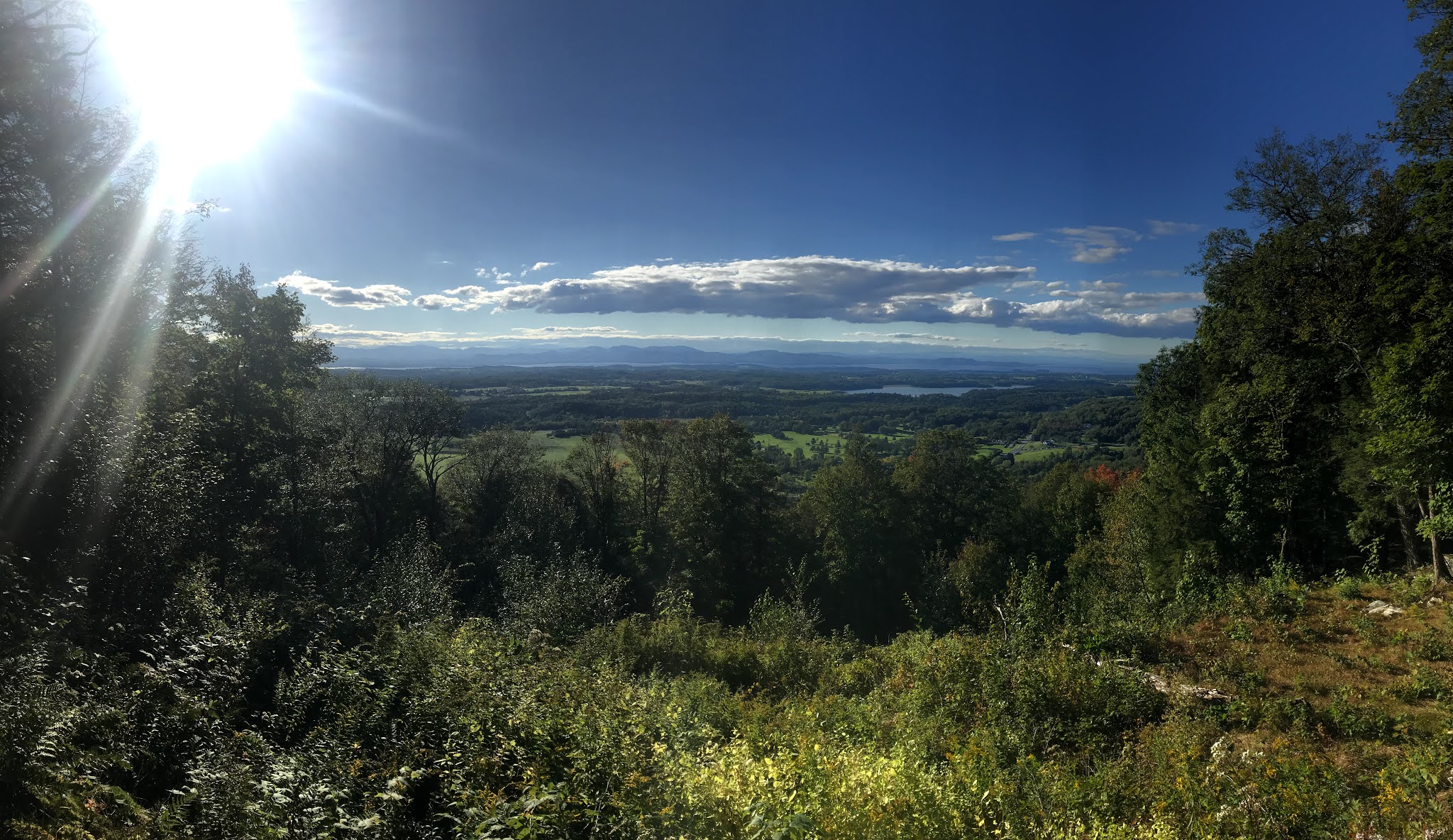
As I look over the country westward and northwestward, the prospect looks already bleak and wintry. The surface of the earth between the forests is no longer green, but russet and hoary. You see distinctly eight or ten miles the russet earth and even houses, and then its outline is distinctly traced against the further blue mountains, thirty or thirty-five miles distant. You see distinctly perhaps to the height of land between the Nashua and Concord, and then the convexity of the earth conceals the further hills, though high, and your vision leaps a broad valley at once to the mountains.

Get home at noon.

At sundown the wind has all gone down.

H. D. Thoreau, Journal, September 24, 1851


 I observed that while the west was of a bright golden color under a bank of clouds, — the sun just setting, — and not a tinge of red was yet visible there, there was a distinct purple tinge in the nearer atmosphere, so that Annursnack Hill, seen through it, had an exceedingly rich empurpled look. See October 19, 1858 ("The sun just ready to set, I notice that its light on my note-book is quite rosy or purple")

Last night was exceedingly dark. I could not see the sidewalk in the street, but only felt it with my feet. I was obliged to whistle to warn travellers of my nearness. See September 12, 1860 ("A dark and stormy night . . . Where the fence is not painted white I can see nothing, and go whistling for fear I run against some one. . . .You walk with your hands out to feel the fences and trees"); September 18, 1857 ("It was exceedingly dark. I met two persons within a mile, and they were obliged to call out from a rod distant lest we should run against each other. ")

I notice one red tree, a red maple, against the green woodside in Conant's meadow. See September 24, 1855 ("the maples are but just beginning to blush") See also September 25, 1857 ("The whole tree, thus ripening in advance of its fellows, attains a singular preéminence"); September 25, 1857 ("The red maple has fairly begun to blush in some places by the river. I see one, by the canal behind Barrett’s mill, all aglow against the sun."); September 25, 1857 ("A single tree becomes the crowning beauty of some meadowy vale and attracts the attention of the traveller from afar."); September 26, 1854 ("Some single red maples are very splendid now, the whole tree bright-scarlet against the cold green pines; now, when very few trees are changed, a most remarkable object in the landscape; seen a mile off."); September 27, 1855 ("Some single red maples now fairly make a show along the meadow. I see a blaze of red reflected from the troubled water."

At Clematis Brook I perceive that the pods or follicles of the Asclepias Syriaca now point upward. Did they before all point down? Have they turned up? See August 24, 1851 ("The pods of the Asclepias pulchra stand up pointedly like slender vases on a salver, an open salver truly! Those of the Asclepias Syriaca hang down.")

The fine threads fly apart at once, open with a spring, and then ray themselves out into a hemispherical form, each thread freeing itself from its neighbor. . . .a prophecy not only of the fall but of future springs. See September 10, 1860 ("If you sit at an open attic window almost anywhere, about the 20th of September, you will see many a milkweed down go sailing by on a level with you, though commonly it has lost its freight, — notwithstanding that you may not know of any of these plants growing in your neighborhood."); October 23, 1852 ("The milkweed (Syriaca) now rapidly discounting. The lanceolate pods having opened, the seeds spring out on the least jar, or when dried by the sun, and form a little fluctuating white silky mass or tuft, each held by the extremities of the fine threads, until a stronger puff of wind sets them free. It is a pleasant sight to see it dispersing its seeds")

The further blue mountains, thirty or thirty-five miles distant. See June 3, 1850 ("The landscape is a vast amphitheatre rising to its rim in the horizon."); September 12, 1851 ("It is worth the while to see the mountains in the horizon once a day"); August 2, 1852 ("In many moods it is cheering to look across hence to that blue rim of the earth,"); March 31, 1853 ("It is affecting to see a distant mountain-top,. . . still as blue and ethereal to your eyes as is your memory of it.'); September 27, 1853 ("From our native hills we look out easily to the far blue mountains, which seem to preside over them.");October 22, 1857 ("But what a perfect crescent of mountains we have in our northwest horizon! Do we ever give thanks for it? "); November 22, 1860 ("Simply to see to a distant horizon through a clear air, - the fine outline of a distant hill or a blue mountaintop through some new vista, - this is wealth enough for one afternoon.")

Thursday, September 23, 2021

I scare up large flocks of sparrows in the garden.


September 23

Notwithstanding the fog, the fences this morning are covered with so thick a frost that you can write your name anywhere with your nail.

The partridge and the rabbit, — they still are sure to thrive like true natives of the soil, whatever revolutions occur. If the forest is cut off, many bushes spring up which afford them concealment, and they become more numerous than ever.

The sumach are among the reddest leaves at present.

The telegraph harp sounds strongly to-day, in the midst of the rain. I put my ear to the trees and I hear it working terribly within, and anon it swells into a clear tone, which seems to concentrate in the core of the tree, for all the sound seems to proceed from the wood. It is if you had entered some world - famous cathedral, resounding to some vast organ.

The fibres of all things have their tension, and are strained like the strings of a lyre. I feel the very ground tremble under my feet as I stand near the post. This wire vibrates with great power, as if it would strain and rend the wood.

What an awful and fateful music it must be to the worms in the wood! No better vermifuge were needed. No danger that worms will attack this wood; such vibrating music would thrill them to death.

I scare up large flocks of sparrows in the garden.

H. D. Thoreau, Journal, September 23, 1851


The partridge and the rabbit, — they still are sure to thrive like true natives of the soil, whatever revolutions occur.
See  February 14, 1856 ("In all the little valleys in the woods and sprout-lands, and on the southeast sides of hills, the oak leaves which have blown over the crust are gathered in dry and warm-looking beds. . . No doubt they are of service to conceal and warm the rabbit and partridge and other beasts and birds."); March 17, 1860 ("The rabbit and partridge can eat wood; therefore they abound and can stay here all the year."); November 18, 1851 (".Here hawks also circle by day, and chickadees are heard, and rabbits and partridges abound. . . .You must be conversant with things for a long time to know much about them,. . . as the partridge and the rabbit are acquainted with the thickets and at length have acquired the color of the places they frequent."); Walden (" All day the sun has shone on the surface of some savage swamp, where the single spruce stands hung with usnea lichens, and small hawks circulate above, and the chickadee lisps amid the evergreens, and the partridge and rabbit skulk beneath”); December 1, 1856 ("Well named shrub oak. Low, robust, hardy, indigenous. Well known to the striped squirrel and the partridge and rabbit"); December 11, 1854 ("A gray rabbit scuds away over the crust in the swamp on the edge of the Great Meadows beyond Peter’s. A partridge goes off, and, coming up, I see where she struck the snow first with her wing,"); December 11, 1858 ("Already, in hollows in the woods and on the sheltered sides of hills, the fallen leaves are collected in small heaps on the snow-crust, simulating bare ground and helping to conceal the rabbit and partridge, etc"); December 31, 1855 ("I see many partridge-tracks in the light snow, where they have sunk deep amid the shrub oaks; also gray rabbit and deer mice tracks");
.
I scare up large flocks of sparrows in the garden. See August 25, 1859 ("I see, after the rain, when the leaves are rustling and glistening in the cooler breeze and clear air, quite a flock of (apparently) Fringilla socialis in the garden"); September 1, 1854 (" A still, cloudy, misty day, through which has fallen a very little rain this forenoon already. Now I notice a few faint-chipping sparrows, busily picking the seeds of weeds in the garden."); September 17, 1858 ("Methinks, too, that there are more sparrows in flocks now about in garden, etc");September 25, 1859 (" The very crab-grass in our garden is for the most part a light straw-color and withered. . . and hundreds of sparrows (chip-birds ?) find their food amid it. "); October 2, 1858 ("The garden is alive with migrating sparrows these mornings")

Wednesday, September 22, 2021

It is a beautifully clear and bracing air, with just enough coolness, full of the memory of frosty mornings.


September 22. 

To the Three Friends' Hill over Bear Hill. 


Yesterday and to-day the stronger winds of autumn have begun to blow, and the telegraph harp has sounded loudly.

I heard it especially in the Deep Cut this afternoon, the tone varying with the tension of different parts of the wire. The sound proceeds from near the posts, where the vibration is apparently more rapid.

I put my ear to one of the posts, and it seemed to me as if every pore of the wood was filled with music, labored with the strain, as if every fibre was affected and being seasoned or timed, rearranged according to a new and more harmonious law. Every swell and change or inflection of tone pervaded and seemed to proceed from the wood, the divine tree or wood, as if its very substance was transmuted.

What a recipe for preserving wood, perchance, — to keep it from rotting, — to fill its pores with music ! How this wild tree from the forest, stripped of its bark and set up here, rejoices to transmit this music! When no music proceeds from the wire, on applying my ear I hear the hum within the entrails of the wood, — the oracular tree acquiring, accumulating, the prophetic fury.

The resounding wood! how much the ancients would have made of it! To have a harp on so great a scale, girdling the very earth, and played on by the winds of every latitude and longitude, and that harp were, as it were, the manifest blessing of heaven on a work of man'! Shall we not add a tenth Muse to the immortal Nine?

And that the invention thus divinely honored and distinguished — on which the Muse has condescended to smile is this magic medium of communication for mankind!

To read that the ancients stretched a wire round the earth, attaching it to the trees of the forest, by which they sent messages by one named Electricity, father of Lightning and Magnetism, swifter far than Mercury, the stern commands of war and news of peace, and that the winds caused this wire to vibrate so that it emitted a harp-like and æolian music in all the lands through which it passed, as if to express the satisfaction of the gods in this invention. Yet this is fact, and we have yet attributed the invention to no god.

I am astonished to see how brown and sere the groundsel or "fire-weed” on hillside by Heywood's Meadow, which has been touched by frost, already is, — as if it had died long months ago, or a fire had run through it. It is a very tender plant. 

Standing on Bear Hill in Lincoln.


                                                September 22, 2017

The black birches ( I think they are ), now yellow, on the south side of Flint's Pond, on the hillside, look like flames. The chestnut trees are brownish-yellow as well as green. 

It is a beautifully clear and bracing air, with just enough coolness, full of the memory of frosty mornings, through which all things are distinctly seen and the fields look as smooth as velvet.

The fragrance of grapes is on the breeze and the red drooping barberries sparkle amid the leaves.

From the hill on the south side of the pond, the forests have a singularly rounded and bowery look, clothing the hills quite down to the water's edge and leaving no shore; the ponds are like drops of dew amid and partly covering the leaves. So the great globe is luxuriously crowded without margin.

The Utricularia cornuta, or horned utricularia, on the sandy pond-shore, not affected by the frost.

H. D. Thoreau, Journal, September 22, 1851


Three Friends Hill. See September 12, 1851 ("To the Three Friends' Hill beyond Flint's Pond. . . I go to Flint's Pond for the sake of the mountain view from the hill beyond, looking over Concord.")

How brown and sere the groundsel or "fire-weed” on hillside by Heywood's Meadow, which has been touched by frost, See August 23, 1856 ("On R. W. E.'s hillside by railroad, burnt over by the engine in the spring, the erechthites has shot up abundantly, very tall and straight, some six or seven feet high."); August 26, 1856 ("Also erechthites as abundant and rank in many places there as if it had been burnt over! So it does not necessarily imply fire."); August 27, 1851 ("Hawkweed groundsel (Senecio hieracifolius) (fireweed)"); August 30, 1859 ("The erechthites down has begun to fly."); September 9, 1852 ("The groundsel down is in the air."); September 20, 1851 ("On Monday of the present week water was frozen in a pail under the pump. . . .All tender herbs are flat in gardens and meadow"); September 20, 1852 ("The groundsel and hieracium down is in the air"); September 21, 1856 ("Was not the fireweed seed sown by the wind last fall, blown into the woods, where there was a lull which caused it to settle? Perhaps it is fitted to escape or resist fire. The wind which the fire creates may, perchance, lift it again out of harm's way."); October 2, 1857 ("The erechthites down (fire-weed) is conspicuous in sprout-lands of late, since its leaves were killed."); October 16, 1859 ("The flowers are at the mercy of the frosts. Places where erechthites grows, more or less bare, in sprout- lands, look quite black and white (black withered leaves and white down) and wintry")

It is a beautifully clear and bracing air, with just enough coolness, full of the memory of frosty mornings.. See
 
These bracing fine days
when frosts come to ripen the
year, the days, like fruit.

See also September 20, 1851 ("This week we have had most glorious autumnal weather, - cool and cloudless, bright days, . . . preceded by frosty mornings." ); October 10, 1857 ("The most brilliant days in the year, ushered in, perhaps, by a frosty morning, as this.") November 11, 1853 ("Bracing cold, and exhilarating sunlight on russet and frosty fields “) December 10, 1853 ("These are among the finest days in the year, on account of the wholesome bracing coolness and clearness.”) See also A Book of the Seasons, by Henry Thoreau, The world can never be more beautiful than now.

The fragrance of grapes is on the breeze. See September 20, 1851 ("This week we have had most glorious autumnal weather, - - cool and cloudless, bright days, filled with the fragrance of ripe grapes, preceded by frosty mornings.")

Tuesday, September 21, 2021

The Light of the Moon.


Sunday.

It is remarkably dry weather.

The neighbors' wells are failing.

The watering-places for cattle in pastures, though they have been freshly scooped out, are dry.

People have to go far for water to drink, and then drink it warm.

The river is so low that rocks which are rarely seen show their black heads in mid-channel.

I saw one which a year or two ago upset a boat and drowned a girl.

You see the nests of the bream on the dry shore.

I perceive that many of the leaves of shrub oaks and other bushes have been killed by the severe frosts of last week, before they have got ripe and acquired the tints of autumn, and they now look as [if] a fire had run through them, dry and crispy and brown.

So far from the frost painting them, it has withered them.

I notice new cabins of the muskrats in solitary swamps.

The chestnut trees have suffered severely from the drought; already their leaves look withered.


Moonlight is peculiarly favorable to reflection.

It is a cold and dewy light in which the vapors of the day are condensed, and though the air is obscured by darkness, it is more clear.

Lunacy must be a cold excitement, not such insanity as a torrid sun on the brain would produce.

In Rees's Cyclopedia it is said, “The light of the moon, condensed by the best mirrors, produces no sensible heat upon the thermometer.”


I see some cows on the new Wheeler's Meadow, which a man is trying to drive to certain green parts of the meadow next to the river to feed, the hill being dried up, but they seem disinclined and not to like the coarse grass there, though it is green. And now one cow is steering for the edge of the hill, where is some greenness. 

I suppose that herds are attracted by a distant greenness, though it may be a mile or more off.  I doubt if a man can drive his cows to that part of their pasture where is the best feed for them, so soon as they will find it for themselves. 

The man tries in vain to drive them to the best part of the meadow. As soon as he is gone, they seek their own parts.


The light of the moon, sufficient though it is for the pensive walker, and not disproportionate to the inner light we have, is very inferior in quantity and intensity to that of the sun.

The Cyclopedia says that Dr. Hooke has calculated that “it would require 104,368 full moons to give a light and heat equal to that of the sun at noon, and Dr. Smith says, “The light of the full moon is but equal to a 90,900th part of the common light of the day, when the sun is hidden by a cloud."

But the moon is not to be judged alone by the quantity of light she sends us, but also by her influence on the earth. No thinker can afford to overlook the influence of the moon any more than the astronomer can. “The moon gravitates towards the earth, and the earth reciprocally towards the moon.” This statement of the astronomer would be bald and meaningless, if it were not in fact a symbolical expression of the value of all lunar influence on man.

Even the astronomer admits that “the notion of the moon's influence on terrestrial things was confirmed by her manifest effect upon the ocean,” but is not the poet who walks by night conscious of a tide in his thought which is to be referred to lunar influence, in which the ocean within him overflows its shores and bathes the dry land? '

Has he not his spring-tides and his neap-tides, the former sometimes combining with the winds of heaven to produce those memorable high tides of the calendar which leave their marks for ages, when all Broad Street is submerged, and incalculable damage is done to the ordinary shipping of the mind?

Burritt in his “Geography of the Heavens" says, “The quantity of light which we derive from the Moon when full, is at least three hundred thousand times less than that of the Sun." This is M. Bouguer's inference as stated by Laplace. Professor Leslie makes it one hundred and fifty thousand times less, older astronomers less still.

Rees says: “It is remarkable, that the moon during the week in which she is full in harvest, rises sooner after sun-setting than she does in any other full moon week in the year. By doing so she affords an immediate supply of light after sunset, which is very beneficial to the farmers for reaping and gathering in the fruits of the earth; and therefore they distinguish this full moon from all the others in the year, by calling it the harvest moon.” 
Howitt places the Harvest Moon in August.


The retirement in which Green has lived for nearly eighty years in Carlisle is a retirement very different from and much greater than that in which the pioneer dwells at the West; for the latter dwells within sound of the surf of those billows of migration which are breaking on the shores around him, or near him, of the West, but those billows have long since swept over the spot which Green inhabits, and left him in the calm sea.

There is somewhat exceedingly pathetic to think of in such a life as he must have lived, with no more to redeem it, — such a life as an average Carlisle man may be supposed to live drawn out to eighty years.

And he has died, perchance, and there is nothing but the mark of his cider-mill left.

Here was the cider-mill, and there the orchard, and there the hog-pasture; and so men lived, and ate, and drank, and passed away, — like vermin.

Their long life was mere duration.

As respectable is the life of the woodchucks, which perpetuate their race in the orchard still.

That is the life of these select men 
(!) spun out.

They will be forgotten in a few years, even by such as themselves, like vermin.

They will be known only like Kibbe, who is said to have been a large man who weighed two hundred and fifty, who had five or six heavy daughters who rode to Concord meeting house on horseback, taking turns,-they were so heavy that only one could ride at once.

What, then, would redeem such a life? We only know that they ate, and drank, and built barns, and died and were buried, and still, perchance, their tombstones cumber the ground.

But if I could know that there was ever entertained over their cellar-hole some divine thought, which came as a messenger of the gods, that he who resided here acted once in his life from a noble impulse, rising superior to his grovelling and penurious life, if only a single verse of poetry or of poetic prose had ever been written or spoken or conceived here beyond a doubt, I should not think it in vain that man had lived here.

It would to some extent be true then that God had lived here.

That all his life he lived only as a farmer as the most valuable stock only on a farm — and in no moments as a man!

H. D. Thoreau, Journal, September 21, 1851

I notice new cabins of the muskrats in solitary swamps. See October 16, 1859 ("I see the new musquash-houses erected, conspicuous on the now nearly leafless shores. . . .an important and suggestive sight, . . . For thirty years I have annually observed, about this time or earlier, the freshly erected winter lodges of the musquash along the riverside, . . .So surely as the sun appears to be in Libra or Scorpio, I see the conical winter lodges of the musquash rising above the withered pontederia and flags.") See also A Book of the Seasons, by Henry Thoreau, the Musquash

And now one cow is steering for the edge of the hill, where is some greenness. See September 27, 1851 ("The pastures are so dry that the cows have been turned on to the meadow, but they gradually desert it, all feeding one way."); October 5, 1856 ("I think I would rather watch the motions of these cows in their pasture for a day, which I now see all headed one way and slowly advancing, — watch them and project their course carefully on a chart, and report all their behavior faithfully.") See also September 6, 1859 ("Hear the sounds nowadays — the lowing, tramp, and calls of the drivers — of cows coming down from up-country."); September 20, 1852 ("Droves of cattle have for some time been coming down from up-country")

Moonlight is peculiarly favorable to reflection. See August 5, 1851 ("With the coolness and the mild silvery light . . . Reflection is more possible. I am sobered by the moonlight. I bethink myself.")

Is not the poet who walks by night conscious of a tide in his thought which is to be referred to lunar influence, in which the ocean within him overflows. See September 3, 1852 ("I will endeavor to separate the tide in my thoughts, or what is due to the influence of the moon, from the current distractions and fluctuations. The winds which the sun has aroused go down at evening, and the lunar influence may then perchance be detected. ")


A Book of the Seasons
, by Henry Thoreau, 
The Light of the Moon.
A Book of the Seasons, by Henry Thoreau
"A book, each page written in its own season,
out-of-doors, in its own locality.”
~edited, assembled and rewritten by zphx © 2009-2024

Monday, September 20, 2021

A Book of the Seasons: September 20 ( How distinctly each thing in nature is marked)


The year is but a succession of days,
and I see that I could assign some office to each day
which, summed up, would be the history of the year.
Henry Thoreau, August 24, 1852 


 September 20


Blackbird all alone
singing very earnestly

on an apple tree.

September 20, 2015


As I go through the fields, endeavoring to recover my tone and sanity and to perceive things truly and simply again, after having been perambulating the bounds of the town all the week, and dealing with the most commonplace and worldly-minded men, and emphatically trivial things, I feel as if I had committed suicide in a sense . . . The poet must keep himself unstained and aloof. Let him perambulate the bounds of Imagination's provinces, the realms of faery, and not the insignificant boundaries of towns. The excursions of the imagination are so boundless, the limits of towns are so petty.  September 20, 1851

Droves of cattle have for some time been coming down from up-country. September 20, 1852

Cattle-Show. September 20, 1860

Miss Pratt shows me a small luminous bug found on the earth floor of their shed (I think a month ago). Had two bright points in its tail, as bright or brighter than the glow-worm. September 20, 1858

There has been no drought the past summer. September 20, 1857

It rained very hard while we were aboard the steamer. September 20, 1853

Windy rain-storm last night. September 20, 1854

Rain in afternoon. Rain again in the night, hard. September 20, 1856

Sunday. Another mizzling day. September 20, 1857

This is our first fall rain, and makes a dividing line between the summer and fall. September 20, 1857

Rainy in forenoon. September 20, 1860

The outlines of trees are more conspicuous and interesting such a day as this, being seen distinctly against the near misty background, – distinct and dark. September 20, 1857

This week we have had most glorious autumnal weather, - - cool and cloudless, bright days, filled with the fragrance of ripe grapes, preceded by frosty mornings. September 20, 1851

On Monday of the present week water was frozen in a pail under the pump. September 20, 1851

First decisive frost, killing melons and beans, browning button-bushes and grape leaves. September 20, 1855

All tender herbs are flat in gardens and meadows. The cranberries, too, are touched. September 20, 1851

The smooth sumachs are turning conspicuously and generally red, apparently from frost. 
September 20, 1852

In some hollows in sprout-lands, the grass and ferns are crisp and brown from frost. September 20, 1852

The ivy here is reddened. September 20, 1851

The dogwood, or poison sumach, by Hubbard's meadow is also turned reddish. September 20, 1851

The cleared plateau beneath the Cliff, now covered with sprouts, shows red, green, and yellow tints, like a rich rug. September 20, 1851

White pines on Fair Haven Hill begin to look parti-colored with the falling leaves, but not at a distance. September 20, 1851

And here and there is a whole maple tree red, about water. September 20, 1852

A great many small red maples in Beck Stow's Swamp are turned quite crimson, when all the trees around are still perfectly green. It looks like a gala day there. September 20, 1857  

I fear that the autumnal tints will not be brilliant this season, the frosts have commenced so early. September 20, 1851

To-day it is warmer and hazier, and there is, no doubt, some smoke in the air, from the burning of the turf and moss in low lands, where the smoke, seen at sunset, looks like a rising fog. September 20, 1851

Last week was the warmest perhaps in the year. September 20, 1851

I hear the locust sing as in August. September 20, 1851

Here are late buttercups and dwarf tree-primroses still. September 20, 1851

Methinks there are not many goldenrods this year. September 20, 1851

Butter-and-eggs on Fair Haven. September 20, 1851

I suppose it is the Aster undulatus, or variable aster, with a large head of middle-sized blue flowers. September 20, 1852

The Viola sagittata has blossomed a
gain. September 20, 1852. 

The Galium circcezans (?) still, and narrow-leaved johnswort. September 20, 1852

The groundsel and hieracium down is in the air. September 20, 1852

The river is remarkably low. There is a rod wide of bare shore beneath the Cliff Hill. September 20, 1851

The river probably reaches its highest since June to-day. September 20, 1858

The button-bushes by the river are generally overrun with the mikania. September 20, 1859

It is a sort of tropical vegetation at the bottom of the river. The palm-like potamogeton,—or ostrich plumes. September 20, 1855

I suspect that the button-bushes and black willows have been as ripe as ever they get to be. September 20, 1859

Vegetation is unusually fresh. Methinks the grass in some shorn meadows is even greener than in the spring. September 20, 1857

You are soon wet through by the underwood if you enter the woods, — ferns, aralia, huckleberries, etc. September 20, 1857

The early decaying and variegated spotted leaves of the Aralia nudicaulis, which spread out flat and of uniform height some eighteen (?) inches above the forest floor, are very noticeable and interesting in our woods in early autumn, now and for some time. For more than a month it has been changing. September 20, 1857

The branches of the alternate cornel are spreading and flat, somewhat cyme-like, as its fruit. September 20, 1857

Beach plums are now perfectly ripe and unexpectedly good, as good as an average cultivated plum. I get a handful, dark purple with a bloom, as big as a good-sized grape and but little more oblong, about three quarters of an inch broad and a very little longer. September 20, 1857

I got a handkerchief full of elder-berries, though I am rather late about it, for the birds appear to have greatly thinned the cymes. September 20, 1857

A pitch pine and birch wood is rapidly springing up between the Beck Stow Wood and the soft white pine grove. September 20, 1857

Try to trace by the sound a mole cricket, -- thinking it a frog, — advancing from two sides and looking where our courses intersected, but in vain. September 20, 1855

Open a new and pretty sizable muskrat-house with no hollow yet made in it. Many tortoise-scales upon it. September 20, 1855

The Maryland yellow-throat is here. September 20, 1858

Hear warbling vireos still, in the elms. September 20, 1858

The golden plover, they say, has been more than usually plenty here this year. September 20, 1852

I see ducks or teal flying silent, swift, and straight, the wild creatures. September 20, 1851

Melvin says that there are many teal about the river now. September 20, 1856

See larks in flocks on meadow. September 20, 1855

See to-day quite a flock of what I think must be rusty grackles about the willows and button-bushes. September 20, 1854

See blackbirds (grackle or red-wing or crow blackbird)? September 20, 1855

I get quite near to a blackbird on an apple tree, singing with the grackle note very earnestly and not minding me. He is all alone. September 20, 1859

Has a (rustyish) brown head and shoulders and the rest black. I think it is a grackle. Is this a grackle come from its northern breeding-place? September 20, 1859

Where are the red-wings now? I have not seen nor heard one for a long time. September 20, 1859

I scare up the great bittern in meadow by the Heywood Brook near the ivy. He rises buoyantly as he flies against the wind, and sweeps south over the willow with outstretched neck, surveying. September 20, 1851

The great bittern, as it flies off from near the railroad bridge, filthily drops its dirt and utters a low hoarse kwa kwa; then runs and hides in the grass, and I land and search within ten feet of it before it rises. September 20, 1855  

     On Heywood's Peak by Walden. —
    
    How soothing to sit on a stump
    on this height overlooking the pond

    and study the dimpling circles
    which are incessantly inscribed

    and again erased 
    on the smooth and otherwise
 
    invisible surface 
    amid the reflected skies! 


The reflected sky is of a deeper blue. September 20, 1852

How beautiful that over this vast expanse there can be no disturbance, but it is thus at once gently smoothed away and assuaged, as . . . the trembling circles seek the shore and all is smooth again ! September 20, 1852

Not a fish can leap or an insect fall on it but it is reported in lines of beauty, in circling dimples, as it were the constant welling up of its fountain, the gentle pulsing of its life, the heaving of its breast. September 20, 1852

The thrills of joy and those of pain are indistinguishable. September 20, 1852

How sweet the phenomena of the lake! 
Everything that moves on its surface 
produces a sparkle.

The motion of an oar or an insect 
produces a flash of light
and if an oar falls – 
how sweet the echo!
 
The peaceful pond! 
How distinctly each thing 
in nature is marked! 

Walden from Heywood's Peak, 
October 21, 1920 (Gleason)

February 6, 1852 (A mistiness makes the woods look denser, darker and more primitive.)
March 29, 1855 ("As I stand on Heywood’s Peak, looking over Walden, more than half its surface already sparkling blue water,")
June 15, 1856 ("A Miss Martha Le Barron describes to me a phosphorescence on the beach at night in Narragansett Bay. They wrote their names with some minute creatures on the sand."}
June 25, 1852 ("Nature loves variety in all things, and so she adds glow-worms to fireflies. . .")
July 9, 1859 ("The button-bush and black willow generally grow together, especially on the brink of the stagnant parts of the river.")
July 29, 1859 ("See large flocks of red-wings now, the young grown.")
August 1, 1853 ("Is it the Galium circæzans which I have seen so long on Heywood Peak and elsewhere, with four broad leaves, low and branched?")
August 4, 1854 ("Rain and mist contract our horizon and we notice near and small objects")
August 12, 1853 ("You now see and hear no red-wings along the river as in spring.")
August 16, 1859 ("A large flock of red-wings goes tchucking over")
August 15, 1854 ("The button-bush is now nearly altogether out of bloom, so that it is too late to see the river's brink in its perfection. It must be seen between the blooming of the mikania and the going out of bloom of the button bush, before you feel this sense of lateness in the year.")
August 15, 1858 (“The black willows are already being imbrowned.")
August 19, 1853 ("It is a glorious and ever-memorable day. . . . The first bright day of the fall" )
August 22, 1858 ("As for the beauty of the river’s brim: now that the mikania begins to prevail the button-bush has done . . . and the willows are already some what crisped and imbrowned , , , So perhaps I should say that the brim of the river was in its prime about the 1st of August this year")
August 22, 1856 ("The faint warbling I hear nowadays is from apparently the young Maryland yellow- throats, as it were practicing against another spring, — half-finished strains. ")
;August 22, 1852 ("The elder bushes are weighed down with fruit partially turned, and are still in bloom at the extremities of their twigs."); 
August 24, 1854 ("The white pines are parti-colored there [Lee's Cliff]")August 24, 1853 ("I see cattle coming down from up-country. Why? ")
August 24, 1857 ("The Galium circæzans leaves taste very much like licorice")
August 25, 1858 ("The note of a warbling vireo sounds very rare")
August 27, 1854 ("From Heywood's Peak I am surprised to see the top of Pine Hill wearing its October aspect, — yellow with changed maples and here and there faintly blushing with changed red maples. This is the effect of the drought.")
August 27, 1859 ("The first notice I have that grapes are ripening is by the rich scent at evening from my own native vine against the house")
August 28, 1852 ("The berries of the alternate leaved cornel have dropped off mostly. ")
August 29, 1855 ("Saw two green-winged teal, somewhat pigeon-like, on a flat low rock in the Assabet.")
August 29, 1853 ("Walking down the street in the evening, I detect my neighbor’s ripening grapes by the scent twenty rods off.")
August 29, 1859 ("The very earliest ripe grapes begin to be scented in the cool nights.")
August 29, 1858 ("The mikania is apparently in prime or a little past.")
August 29, 1854 ("The cymes of elder-berries, black with fruit, are now conspicuous."); 
August 29, 1859 ("Elder-berry clusters swell and become heavy and therefore droop, bending the bushes down, just in proportion as they ripen. Hence you see the green cymes perfectly erect, the half-ripe drooping, and the perfectly ripe hanging straight down on the same bush."); 
August 30, 1853 ("Grapes are already ripe; I smell them first.")
August 31, 1852 ("That part of the sky just above the horizon seen reflected, apparently, some rods off from the boat is as light a blue as the actual, but it goes on deepening as your eye draws nearer to the boat, until, when you look directly down at the reflection of the zenith, it is lost in the blackness of the water.”)
August 31, 1855 ("Passed in boat within fifteen feet of a great bittern, standing perfectly still in the water by the riverside, with the point of its bill directly up, as if it knew that from the color of its throat, etc., it was much less likely to be detected in that position, near weeds.")
August 31, 1853 ("Great black cymes of elder berries now bend down the bushes.")
September 1, 1859 ("The elder-berry cyme, held erect, is of very regular form, four principal divisions drooping toward each quarter around an upright central one.")
September 1, 1851 ("Aster undulatus begins to be common.")
September 3, 1860 ("Here is a beautiful, and perhaps first decidedly autumnal, day, -- a, cloudless sky, a clear air, with, maybe, veins of coolness”)
September 4, 1859 ("Where are the robins and red-wing blackbirds of late? I see no flocks of them; not one of the latter")
September 4, 1853 ("Hear a warbling vireo, — something rare")
September 4, 1853 ("The fragrance of a grape-vine branch, with ripe grapes on it, which I have brought home, fills the whole house.")
September 5, 1854 ("Hear locusts after sundown.")
September 6, 1860 ("The willows and button-bushes have very rapidly yellowed since I noticed them August 22d.")
September 6, 1858 ("Hear a warbling vireo, sounding very rare and rather imperfect.)
September 6, 1859 ("Hear the sounds nowadays — the lowing, tramp, and calls of the drivers — of cows coming down from up-country.")
September 7, 1858 ( It is an early September afternoon, melting warm and sunny. . .and ever and anon the hot z-ing of the locust is heard.");
September 8, 1854 ("The grapes would no doubt be riper a week hence, but I am compelled to go now before the vines are stripped. I partly smell them out.");
September 8, 1858 (“Gather half my grapes, which for some time have perfumed the house.”).
September 9, 1856 ("A large alternate cornel, four or five inches in diameter, a dark-gray stem. ")
September 9, 1858 ("Now it is about time to gather elder-berries.")
September 11, 1852 ("I started a great bittern from the weeds at the swimming-place")
September 12, 1858 ("Some small red maples by water begun to redden.")
September 12, 1851 ("How autumnal is the scent of ripe grapes now by the roadside!")
September 12, 1851 (" On Monday, the 15th instant, I am going to perambulate the bounds of the town.")
September 13, 1858 ("Hear many warbling vireos these mornings") 
September 13, 1856 ("Gather quite a parcel of grapes, quite ripe.. . . the best are more admirable for fragrance than for flavor. Depositing them in the bows of the boat, they fill all the air with their fragrance, as we row along against the wind, as if we were rowing through an endless vineyard in its maturity.")
September 15, 1851("The potato vines and the beans which were still green are now blackened and flattened by the frost.")
September 15, 1851 ("Ice in the pail under the pump, and quite a frost.")
September 15, 1851 ("Commenced perambulating the town bounds.")
September 16, 1852 (" I hear a warbling vireo in the village, which I have not heard for long.")
September 16, 1857 (“Watson gave me three glow-worms which he found by the roadside in Lincoln last night. They exhibit a greenish light, only under the caudal extremity, and intermittingly, or at will. As often as I touch one in a dark morning, it stretches and shows its light for a moment, only under the last segment.”)
September 17, 1851 ("Perambulated the Lincoln line.")
September 17, 1852 ("Is it the alder locust that rings so loud in low land now?")
September 18, 1851 ("Perambulated Bedford line.")
September 18, 1858 ("Many red maples are now partly turned dark crimson along the meadow-edge.")
September 18, 1860 ("The shrilling of the alder locust fills the air")
September 18, 1860 ("This is a beautiful day, warm but not too warm, a harvest day . . . the first unquestionable and conspicuous autumnal day,")
September 19, 1851 ("Perambulated Carlisle line.")
September 19, 1852 ("And in the distance is a maple or two by the water, beginning to blush")
September 19, 1856 ("Observed an Aster undulatus behind oak at foot of hill on Assabet ")

The dimpling circles
inscribed and erased amid
the reflected skies.

September 21, 1851 ("Here was the cider-mill, and there the orchard, and there the hog-pasture; and so men lived, and ate, and drank, and passed away, — like vermin.")
September 21, 1856 ("Aster undulatus in prime, in the dry woods just beyond Hayden's, large slanting, pyramidal panicles of some lilac-tinged, others quite white, flowers")
September 21, 1854 ("The red maples, especially at a distance, begin to light their fires, some turning yellow")
September 21, 1854 ("The first frost in our yard last night,")
September 22, 1852 ("Has been a great flight of blue-winged teal this season. ")
September 24, 1854 (The button-bushes, which before had attained only a dull mixed yellow, are suddenly bitten, wither, and turn brown, all but the protected parts. . . . The button-bushes thus withered suddenly paint with a rich brown the river’s brim.")
September 24, 1855 ("the maples are but just beginning to blush")
September 25, 1855 ("Scare up the usual great bittern above the railroad bridge, whose hoarse qua qua, as it flies heavily off, a pickerel-fisher on the bank imitates.")
September 25, 1857 ("The whole tree, thus ripening in advance of its fellows, attains a singular preéminence")
September 25, 1857 ("The red maple has fairly begun to blush in some places by the river. I see one, by the canal behind Barrett’s mill, all aglow against the sun.")\
September 25, 1857 ("A single tree becomes the crowning beauty of some meadowy vale and attracts the attention of the traveller from afar.")
September 25, 1860 ("Hard, gusty rain (with thunder and lightning) in afternoon.")
September 26, 1854 ("Some single red maples are very splendid now, the whole tree bright-scarlet against the cold green pines; now, when very few trees are changed, a most remarkable object in the landscape; seen a mile off.")
September 26, 1852 ("Larks, like robins, fly in flocks.")
September 27, 1855 ("Some single red maples now fairly make a show along the meadow. I see a blaze of red reflected from the troubled water.");
September 27, 1857 ("At last, its labors for the year being consummated and every leaf ripened to its full, it flashes out conspicuous to the eye of the most casual observer, with all the virtue and beauty of a maple, – Acer rubrum."; )
September 28, 1852 ("I have now seen all but the blanda, palmata, and pubescens blooming again .. . This is the commencement, then, of the second spring")
September 28, 1854 ("R. W. E.’s pines are parti-colored, preparing to fall, some of them.")
September 29, 1857 ("Pines have begun to be parti-colored with yellow leaves")
September 29, 1851 ("The intense brilliancy of the red-ripe maples scattered here and there in the midst of the green oaks and hickories on its hilly shore is quite charming. They are unexpectedly and incredibly brilliant, especially on the western shore and close to the water's edge, where, alternating with yellow birches and poplars and green oaks, they remind me of a line of soldiers, redcoats and riflemen in green mixed together.") 
September 30, 1854 ("I am surprised to see that some red maples, which were so brilliant a day or two ago, have already shed their leaves, and they cover the land and the water quite thickly.")
September 30, 1858 ("A large flock of grackles amid the willows by the riverside, or chiefly concealed low in the button bushes . . .These are the first I have seen, and now for some time, I think, the red wings have been gone. These are the first arrivers from the north where they breed.")
October 1, 1857 ("The pines now half turned yellow, the needles of this year are so much the greener by contrast.")
October 1, 1858 ("See larks in small flocks.")
October 2, 1859 ("The A. undulatus looks fairer than ever, now that flowers are more scarce.")
October 3, 1852 ("The Aster undulates is common and fresh. ")
October 3, 1852 ("The pine fall, i.e. change, is commenced, and the trees are mottled green and yellowish");
October 3, 1856 ("The white pines are now getting to be pretty generally parti-colored, the lower yellowing needles ready to fall. ")
October 3, 1858 ("Some particular maple among a hundred will be of a peculiarly bright and pure scarlet, and, by its difference of tint and intenser color, attract our eyes even at a distance in the midst of the crowd");
October 4, 1857 ("The button-bushes are generally greenish-yellow now; only the highest and most exposed points brown and crisp in some places. The black willow, rising above them, is crisped yellowish-brown, so that the general aspect of the river's brim now is a modest or sober ripe yellowish-brown")
October 4, 1853 ("Bumblebees are on the Aster undulatus")
October 6, 1858 ("the Aster undulatus is now very fair and interesting. Generally a tall and slender plant with a very long panicle of middle-sized lilac or paler purple flowers, bent over to one side the path. ")
October 8, 1852 (“Nothing can exceed the brilliancy of some of the maples which stand by the shore and extend their red banners over the water.”)
October 8, 1858 ("The button-bushes and black willows are rapidly losing leaves, and the shore begins to look Novemberish")
October 9, 1853 ("I smell grapes, . . . their scent is very penetrating and memorable.")
October 9, 1853 ("Touch-me-not, self-heal, Bidens cernua, ladies'-tresses, cerastium, dwarf tree-primrose, butter and-eggs (abundant), prenanthes, sium, silvery cinque-foil, mayweed.")
October 10, 1858 ("November has already come to the river with the fall of the black willow and the button-bush, . . . letting in the autumn light to the water")
October 10, 1857 ("The most brilliant days in the year, ushered in, perhaps, by a frosty morning, as this.")
October 11, 1857 ("This is the seventh day of glorious weather. Perhaps, these might be called Harvest Days")
October 13, 1855 ("Larks in flocks in the meadows, showing the white in their tails as they fly, sing sweetly as in spring.")
October 14, 1857 ("I see a large flock of grackles, probably young birds, quite near me on William Wheeler's apple trees, pruning themselves and trying to sing.")
October 14, 1858 ("The blue of the sky, and indeed all tints, are deepened in the reflection.")
October 16, 1858 (" I have not seen red-wings [for] a long while.");
October 16, 1858 See a large flock of grackles . . . [T]hese birds, which went so much further north to breed, are still arriving from those distant regions, fetching the year about.")
October 18, 1858 ("See larks, with their white tail-feathers, fluttering low over the meadows these days")
October 19, 1856 ("The A. undulatus is, perhaps, the only [aster]of which you can find a respectable specimen. I see one so fresh that there is a bumblebee on it.")
October 20, 1852 ("Canada snapdragon, tansy, white goldenrod, blue-stemmed goldenrod. Aster undulatus, autumnal dandelion, tall buttercup, yarrow, mayweed")
October 23, 1853 ("The Aster undulatus is still quite abundant and fresh on this high, sunny bank")
October 25, 1858 ("The Aster undulatus is now a dark purple (its leaves), with brighter purple or crimson under sides.")
October 28, 1857 ("On a black willow, a single grackle with the bright iris")
October 28, 1858 ("Cattle coming down from up country.")
October 29, 1859 (''Also a flock of blackbirds fly eastward over my head from the top of an oak, either red-wings or grackles")
November 2, 1853 ("I am somewhat surprised to find that the Aster undulatus at Walden is killed by the frost; only one low and obscure one has any flowers left.")
November 3, 1852 ("Only one or two butter-and-eggs left.")
November 3, 1853 ("I saw a very fresh A. undulatus this afternoon.")
November 3, 1858 ("Aster undulatus is still freshly in bloom")
November 6, 1853 ("The alternate cornel, small, very dark reddish buds, on forking, smooth, slender twigs at long intervals")
November 7, 1855 ("I find it good to be out this still, dark, mizzling afternoon . . .The world and my life are simplified. ")
November 7, 1855 ("The view is contracted by the misty rain . . . I am compelled to look at near objects.")
November 7, 1855("Opened a muskrat-house nearly two feet high, but there was no hollow to it. Apparently they do not form that part yet."); 
November 7, 1858 ("Aster undulatus and several goldenrods, at least, may be found yet.")
November 9, 1858 ("As I stood upon Heywood’s Peak, I observed in the very middle of the pond, which was smooth and reflected the sky there, what at first I took to be a sheet of very thin, dark ice . . . But, suspecting what it was, I looked through my glass and could plainly see the dimples made by a school of little fishes continually coming to the surface there together.")
November 14, 1855 ("Two red-wing blackbirds alight on a black willow.")
November 29, 1850 ("The trees and shrubs look larger than usual when seen through the mist...As you advance, the trees gradually come out of the mist and take form before your eyes.")
December 9, 1853 ("The third (at least) glorious day, clear and not too cold . . .with peculiarly long and clear cloudless silvery twilights morn and eve")
December 16, 1855 ("The mist makes the near trees dark and noticeable, like pictures, and makes the houses more interesting, revealing but one at a time.")

September 20, 2019

If you make the least correct 
observation of nature this year,
 you will have occasion to repeat it
 with illustrations the next, 
and the season and life itself is prolonged.


A Book of the Seasons,  by Henry Thoreau, September 20
A Book of the Seasons,  by Henry Thoreau
"A book, each page written in its own season,
out-of-doors, in its own locality.”
~edited, assembled and rewritten by zphx © 2009-2022


https://tinyurl.com/HDT20September 


Popular Posts Last 30 Days.

The week ahead in Henry’s journal

The week ahead in Henry’s journal
A journal, a book that shall contain a record of all your joy.
"A stone fruit. Each one yields me a thought." ~ H. D. Thoreau, March 28, 1859


I sit on this rock
wrestling with the melody
that possesses me.